


Disruptors for GOOD | Social Entrepreneurs and Social Enterprises
Subscribed: 102Played: 4,342
Subscribe

© 2025 Causeartist
Description
Disruptors for GOOD is a podcast that showcases global social entrepreneurship and social enterprises committed to ethical fashion, impact investing, climate mitigation, sustainable travel, and businesses generating positive global impact. Through in-depth interviews, Grant Trahant, the founder of Causeartist, engages with innovative and impactful startups and brands worldwide.
330 Episodes
Reverse
The technology for harvesting critical minerals from the ocean floor has barely changed since the 1960s. Big tracked vehicles.Vacuum dredges. Sediment plumes. The same architecture, decade after decade.Oliver Gunasekara looked at that and saw an opportunity.He's the CEO of Impossible Metals, a deep tech startup building a fleet of autonomous underwater robots designed to collect polymetallic nodules from the seafloor with a fraction of the environmental disruption of conventional methods.On this episode of Disruptors for Good, Oliver walks through the technology, the regulatory landscape, the environmental tradeoffs, and why he thinks the first commercial deep sea mining operations are closer than most people realize.
----------------------------------------Disruptors for GOOD is powered by Causeartist, a nonprofit media company dedicated to bridging the gap between capital and culture by spotlighting founders, investors, and organizations reimagining how business can serve people and the planet.Through storytelling, events, and open-access education, Causeartist helps create a shared language of impact, inspiring more founders to build with purpose and more funders to invest with intention.By amplifying ideas and innovations across industries, Causeartist transforms awareness into action and cultivates a community where paying it forward is part of the foundation for growth.
Grove Collaborative is one of the most ambitious experiments in mission-driven consumer commerce of the past decade. Founded in 2012, it started as a subscription delivery service for eco-friendly cleaning products and grew into a publicly traded company with a $1.5 billion peak valuation.Along the way, it became the world's first plastic-neutral retailer, earned B Corp certification, and pioneered transparency tools no other retailer in the category had attempted.Then it nearly fell apart.From 2022 onward, Grove faced declining revenue, a delisting threat, an executive overhaul, and the painful acknowledgment that its flagship environmental commitment, 100% plastic free by 2025 — would not be met.The company has spent the past two years rebuilding: operationally, financially, and strategically.This case study covers the full arc.The founding thesis, the growth decisions that worked, the ones that didn't, the financial turbulence after going public, and how Grove is attempting to rebuild as a leaner, more durable business without walking away from its core mission.Full Case Study
----------------------------------------Disruptors for GOOD is powered by Causeartist, a nonprofit media company dedicated to bridging the gap between capital and culture by spotlighting founders, investors, and organizations reimagining how business can serve people and the planet.Through storytelling, events, and open-access education, Causeartist helps create a shared language of impact, inspiring more founders to build with purpose and more funders to invest with intention.By amplifying ideas and innovations across industries, Causeartist transforms awareness into action and cultivates a community where paying it forward is part of the foundation for growth.
B Corp certification is a third-party credential issued by B Lab, a nonprofit, that verifies a company meets defined standards of social and environmental performance, accountability, and transparency.It is not a legal structure.It is not a tax designation.It is a certification, similar in nature to LEED for buildings or Fair Trade for supply chains.To earn it, a company completes the B Impact Assessment (BIA), a scored evaluation across five areas: governance, workers, community, environment, and customers.A minimum score of 80 out of 200 is required to qualify.The median score for companies that complete the BIA without certification intent sits around 50.Certification also requires signing the B Lab Declaration of Interdependence, submitting to a verification review, and in most U.S. states, amending your governing documents to protect the consideration of stakeholders beyond shareholders.As of early 2025, there are roughly 9,000 certified B Corps across 90+ countries.
----------------------------------------Disruptors for GOOD is powered by Causeartist, a nonprofit media company dedicated to bridging the gap between capital and culture by spotlighting founders, investors, and organizations reimagining how business can serve people and the planet.Through storytelling, events, and open-access education, Causeartist helps create a shared language of impact, inspiring more founders to build with purpose and more funders to invest with intention.By amplifying ideas and innovations across industries, Causeartist transforms awareness into action and cultivates a community where paying it forward is part of the foundation for growth.
Tony's Chocolonely transformed from a Dutch journalist's investigative project into a $200+ million chocolate company by making supply chain transparency its core competitive advantage.Founded in 2005 after journalist Teun van de Keuken exposed slavery in West African cocoa production, the company built a vertically integrated model that pays farmers 40% above Fairtrade premiums while maintaining competitive retail pricing.The business operates on three strategic pillars:direct relationships with 8,942 cocoa farmers across Ghana and Ivory Coastaggressive transparency including publishing full supply chain data and acknowledging when slavery is discovered in their chainand a consumer brand built on storytelling rather than traditional food marketing.Tony's reached profitability in 2013 and has grown revenue at approximately 25-30% annually since 2016. The company holds 18% market share in Netherlands chocolate and expanded to the United States in 2015, where it now generates roughly 20% of total revenue.Unlike most mission-driven food brands that exit to CPG conglomerates, Tony's remains independent with a governance structure designed to prevent acquisition by companies that do not meet their sourcing standards.
----------------------------------------Disruptors for GOOD is powered by Causeartist, a nonprofit media company dedicated to bridging the gap between capital and culture by spotlighting founders, investors, and organizations reimagining how business can serve people and the planet.Through storytelling, events, and open-access education, Causeartist helps create a shared language of impact, inspiring more founders to build with purpose and more funders to invest with intention.By amplifying ideas and innovations across industries, Causeartist transforms awareness into action and cultivates a community where paying it forward is part of the foundation for growth.
In episode 238 of the Disruptors for GOOD podcast, Brittany Christenson, the CEO of AidKit, shares her journey from studying applied math to leading a tech company focused on social impact. AidKit aims to deliver aid with dignity, providing access to emergency relief and public benefits through innovative technology.Brittany discusses the challenges and opportunities in the nonprofit and government sectors, emphasizing the importance of customization in technology solutions. She also highlights the role of AI in enhancing their services while maintaining data privacy. Looking ahead, AidKit aims to expand its reach and impact, striving to serve millions and improve the efficiency of aid distribution.
----------------------------------------Disruptors for GOOD is powered by Causeartist, a nonprofit media company dedicated to bridging the gap between capital and culture by spotlighting founders, investors, and organizations reimagining how business can serve people and the planet.Through storytelling, events, and open-access education, Causeartist helps create a shared language of impact, inspiring more founders to build with purpose and more funders to invest with intention.By amplifying ideas and innovations across industries, Causeartist transforms awareness into action and cultivates a community where paying it forward is part of the foundation for growth.
Aspiration was a California-based neobank founded in 2013 that positioned itself as the sustainable alternative to traditional banking. The company built its value proposition around fossil fuel-free deposits, automatic tree planting for every transaction, and a "pay what is fair" pricing model that allowed customers to set their own fees.At its peak in 2021, Aspiration claimed more than 5 million customer accounts, had raised over $870 million in funding from venture and celebrity investors including Leonardo DiCaprio, Robert Downey Jr., and Orlando Bloom, and announced a $2.3 billion SPAC merger.The company earned B Corp certification and was named "Best for the World" five times between 2017 and 2022.However, the company's trajectory took a dramatic turn when federal investigations revealed extensive fraud by co-founder Joseph Sanberg.In March 2025, Aspiration Partners filed for Chapter 11 bankruptcy after Sanberg was arrested on wire fraud charges. He later pleaded guilty to defrauding investors of $248 million.The consumer banking brand was spun off in 2024 and continues operating under new ownership as GreenFi, while the Aspiration story serves as a cautionary tale about governance failures in mission-driven companies.Full Case Study
----------------------------------------Disruptors for GOOD is powered by Causeartist, a nonprofit media company dedicated to bridging the gap between capital and culture by spotlighting founders, investors, and organizations reimagining how business can serve people and the planet.Through storytelling, events, and open-access education, Causeartist helps create a shared language of impact, inspiring more founders to build with purpose and more funders to invest with intention.By amplifying ideas and innovations across industries, Causeartist transforms awareness into action and cultivates a community where paying it forward is part of the foundation for growth.
The modern retail landscape is currently defined by a structural tension between consumer demands for convenience, the escalating necessity for sustainable practices, and the persistent inflationary pressures affecting household food security.Thrive Market has emerged as a seminal case study in resolving these tensions through a membership-based, digital-first model that integrates social impact directly into its financial architecture.Founded in 2014, the organization was conceptualized not just as a commercial enterprise but as a movement to democratize access to healthy living, specifically targeting the geographic and monetary barriers that have historically rendered organic and non-GMO products the exclusive domain of affluent, urban demographics.By operating as a hybrid of a wholesale club and a specialty health store, frequently articulated as "Costco meets Whole Foods", Thrive Market has successfully bypassed traditional retail markups, offering a hyper-curated catalog of over 6,500 products at prices 25% to 50% below traditional retail.Full case study
----------------------------------------Disruptors for GOOD is powered by Causeartist, a nonprofit media company dedicated to bridging the gap between capital and culture by spotlighting founders, investors, and organizations reimagining how business can serve people and the planet.Through storytelling, events, and open-access education, Causeartist helps create a shared language of impact, inspiring more founders to build with purpose and more funders to invest with intention.By amplifying ideas and innovations across industries, Causeartist transforms awareness into action and cultivates a community where paying it forward is part of the foundation for growth.
Eileen Fisher is an American fashion brand founded in 1984 by designer Eileen Fisher, known for its minimalist women’s apparel and pioneering commitment to ethical and sustainable practices.Over four decades, the company has grown from a small startup (launched with just $350) into a medium-sized global enterprise with hundreds of millions in annual sales.The brand is particularly recognized for its use of organic and natural fibers, timeless designs, and innovative programs that promote circular fashion and social responsibility.Uniquely, Eileen Fisher (the person) still owns about 60% of the privately held company, while roughly 770 employees own the remaining 40% through an employee stock ownership plan.This shared ownership structure reinforces the company’s people-centered ethos. In 2015, Eileen Fisher became a certified B Corporation, voluntarily meeting high standards of social and environmental performance; as of 2025 it has been recertified four times, reflecting continuous improvement in its sustainability score.This case study examines how Eileen Fisher has integrated sustainable and ethical practices into its business model, its expansion beyond the U.S., and the latest developments up to 2025 that position the brand as a leader in responsible fashion.Full case study
----------------------------------------Disruptors for GOOD is powered by Causeartist, a nonprofit media company dedicated to bridging the gap between capital and culture by spotlighting founders, investors, and organizations reimagining how business can serve people and the planet.Through storytelling, events, and open-access education, Causeartist helps create a shared language of impact, inspiring more founders to build with purpose and more funders to invest with intention.By amplifying ideas and innovations across industries, Causeartist transforms awareness into action and cultivates a community where paying it forward is part of the foundation for growth.
This Sundance, you’ll have the chance to experience a first look at the film’s sizzle — and to sit with other creators, funders, civic leaders, and artists wrestling with these questions at Power House, a warm and intentional gathering hosted by Powerlines.org just steps from Main Street.Over hot food and drinks, these conversations go beyond festival noise into how stories truly intersect with democratic life, citizen power, depolarization, and collaborative problem-solving.The Fight For Power isn’t just a film to watch, it’s a lens on what’s at stake for communities, for accountability, and for civic engagement in 2026 and beyond.To watch the sizzle and be part of this Sundance experience, RSVP at www.thefightforpowerfilm.comFull post here.
----------------------------------------Disruptors for GOOD is powered by Causeartist, a nonprofit media company dedicated to bridging the gap between capital and culture by spotlighting founders, investors, and organizations reimagining how business can serve people and the planet.Through storytelling, events, and open-access education, Causeartist helps create a shared language of impact, inspiring more founders to build with purpose and more funders to invest with intention.By amplifying ideas and innovations across industries, Causeartist transforms awareness into action and cultivates a community where paying it forward is part of the foundation for growth.
In a fashion industry built on shortcuts, KENT has taken the harder road on purpose.Founded by Stacy Grace, KENT is a super natural basics brand focused on one simple but radical idea, underwear and essentials should be made entirely without plastic.No spandex. No polyester. No hidden synthetics.Just organic, plant based materials that are healthier for people and capable of returning to the earth at the end of their life.While many brands claim sustainability, KENT operates with a stricter definition.Every product is designed from fabric to thread to elastic using 100 percent natural materials, with the explicit goal of creating basics that can be composted instead of sitting in landfills for centuries.
----------------------------------------Disruptors for GOOD is powered by Causeartist, a nonprofit media company dedicated to bridging the gap between capital and culture by spotlighting founders, investors, and organizations reimagining how business can serve people and the planet.Through storytelling, events, and open-access education, Causeartist helps create a shared language of impact, inspiring more founders to build with purpose and more funders to invest with intention.By amplifying ideas and innovations across industries, Causeartist transforms awareness into action and cultivates a community where paying it forward is part of the foundation for growth.
Healthcare has not changed its patient attire in over a century. That is not an exaggeration. While medicine, technology, and clinical standards have advanced at a remarkable pace, the patient gown has remained largely untouched, often becoming a quiet barrier to care rather than a support for it.Shawn Gibbs knows this firsthand.After 15 years in clinical practice, he repeatedly heard the same story from patients. People delayed or avoided care because they felt exposed, embarrassed, or powerless the moment they were handed a standard medical gown.Over time, that pattern became impossible to ignore. What started as individual patient conversations turned into a clear systemic failure.GIV Gowns was born from a simple but uncomfortable truth. Dignity matters in healthcare. Confidence matters. What a patient wears can influence whether they show up, how open they are during an exam, and how effectively a provider can do their job.GIV is building what Shawn calls a new gold standard for patient attire, designed with real human experience in mind, not institutional convenience.Read full interview
----------------------------------------Disruptors for GOOD is powered by Causeartist, a nonprofit media company dedicated to bridging the gap between capital and culture by spotlighting founders, investors, and organizations reimagining how business can serve people and the planet.Through storytelling, events, and open-access education, Causeartist helps create a shared language of impact, inspiring more founders to build with purpose and more funders to invest with intention.By amplifying ideas and innovations across industries, Causeartist transforms awareness into action and cultivates a community where paying it forward is part of the foundation for growth.

For nearly 25 years, One Percent for the Planet has quietly reshaped how businesses think about responsibility, strategy, and long term stewardship. What began as a simple commitment has grown into a global network spanning more than 100 countries and hundreds of millions of dollars in certified environmental giving.In this episode of Disruptors for GOOD, I sit down with Kate Williams, the organization’s CEO, to unpack how the model really works, why progress matters more than perfection, and what it takes to keep climate action grounded, practical, and nonpartisan.This conversation goes beyond surface level sustainability talk. It digs into how businesses of all sizes can meaningfully participate, how philanthropy becomes strategy when done right, and why steady commitments often outlast trends, politics, and fatigue.
----------------------------------------Disruptors for GOOD is powered by Causeartist, a nonprofit media company dedicated to bridging the gap between capital and culture by spotlighting founders, investors, and organizations reimagining how business can serve people and the planet.Through storytelling, events, and open-access education, Causeartist helps create a shared language of impact, inspiring more founders to build with purpose and more funders to invest with intention.By amplifying ideas and innovations across industries, Causeartist transforms awareness into action and cultivates a community where paying it forward is part of the foundation for growth.
Transportation has always shaped how societies function. Who can move, how easily they can get from one place to another, and at what cost often determines access to work, healthcare, education, and community. In the digital age, rideshare platforms have quietly become part of that infrastructure.In a recent conversation, I sat down with Jerry Golden, Chief Policy Officer at Lyft, to unpack how transportation policy, technology, and social responsibility intersect. The discussion covered Golden’s unconventional career path, the realities of policymaking in a fast moving sector, Lyft’s expanding role in disaster response and accessibility, and how autonomous vehicles may reshape the future.
----------------------------------------Disruptors for GOOD is powered by Causeartist, a nonprofit media company dedicated to bridging the gap between capital and culture by spotlighting founders, investors, and organizations reimagining how business can serve people and the planet.Through storytelling, events, and open-access education, Causeartist helps create a shared language of impact, inspiring more founders to build with purpose and more funders to invest with intention.By amplifying ideas and innovations across industries, Causeartist transforms awareness into action and cultivates a community where paying it forward is part of the foundation for growth.
For over a decade, Causeartist has published the annual Social Entrepreneurs to Watch list. If you know a founder building a real solution, put them on our radar.What is Causeartist Next?Causeartist Next is our annual list of social entrepreneurs building companies that put impact next to profit, not behind it. We cover founders creating practical solutions across climate, food, health, education, financial inclusion, ethical supply chains, and more.Check out the lists from past years:2014 / 2015 / 2016 / 2017 / 2018 / 2019 / 2020 / 2021 / 2022 / 2023 / 2024 / 2025Frequently asked questionsIs nomination required to be included?No. We also source founders through interviews, research, and referrals. Nominations help us find people we might miss.Do you charge to be featured?No. If someone asks you for money to get on the list, it is not us.Can I nominate myself?Yes. Self nominations are welcome and encouraged. 😀When does the 2026 list publish?Deadline for nominations is January 20th. We publish in early February and share the list for all of 2026 via our website, newsletter, and social accounts.Nominate here
----------------------------------------Disruptors for GOOD is powered by Causeartist, a nonprofit media company dedicated to bridging the gap between capital and culture by spotlighting founders, investors, and organizations reimagining how business can serve people and the planet.Through storytelling, events, and open-access education, Causeartist helps create a shared language of impact, inspiring more founders to build with purpose and more funders to invest with intention.By amplifying ideas and innovations across industries, Causeartist transforms awareness into action and cultivates a community where paying it forward is part of the foundation for growth.
The statistics on marine pollution are staggering: an estimated 11 million metric tons of plastic enter our oceans every single year, equivalent to dumping a garbage truck full of plastic into the sea every minute.This crisis impacts everything from coral reefs and endangered species to the seafood on our plates.For decades, the fight to save our oceans was led primarily by large, established non-profits. Today, however, a new, dynamic force has emerged: the ocean conservation startup.These ventures are attracting significant investment and deploying cutting-edge technology to tackle pollution at its source, in rivers, and in the open ocean. They represent the leading edge of sustainable ocean tech.Full post here.
----------------------------------------Disruptors for GOOD is powered by Causeartist, a nonprofit media company dedicated to bridging the gap between capital and culture by spotlighting founders, investors, and organizations reimagining how business can serve people and the planet.Through storytelling, events, and open-access education, Causeartist helps create a shared language of impact, inspiring more founders to build with purpose and more funders to invest with intention.By amplifying ideas and innovations across industries, Causeartist transforms awareness into action and cultivates a community where paying it forward is part of the foundation for growth.
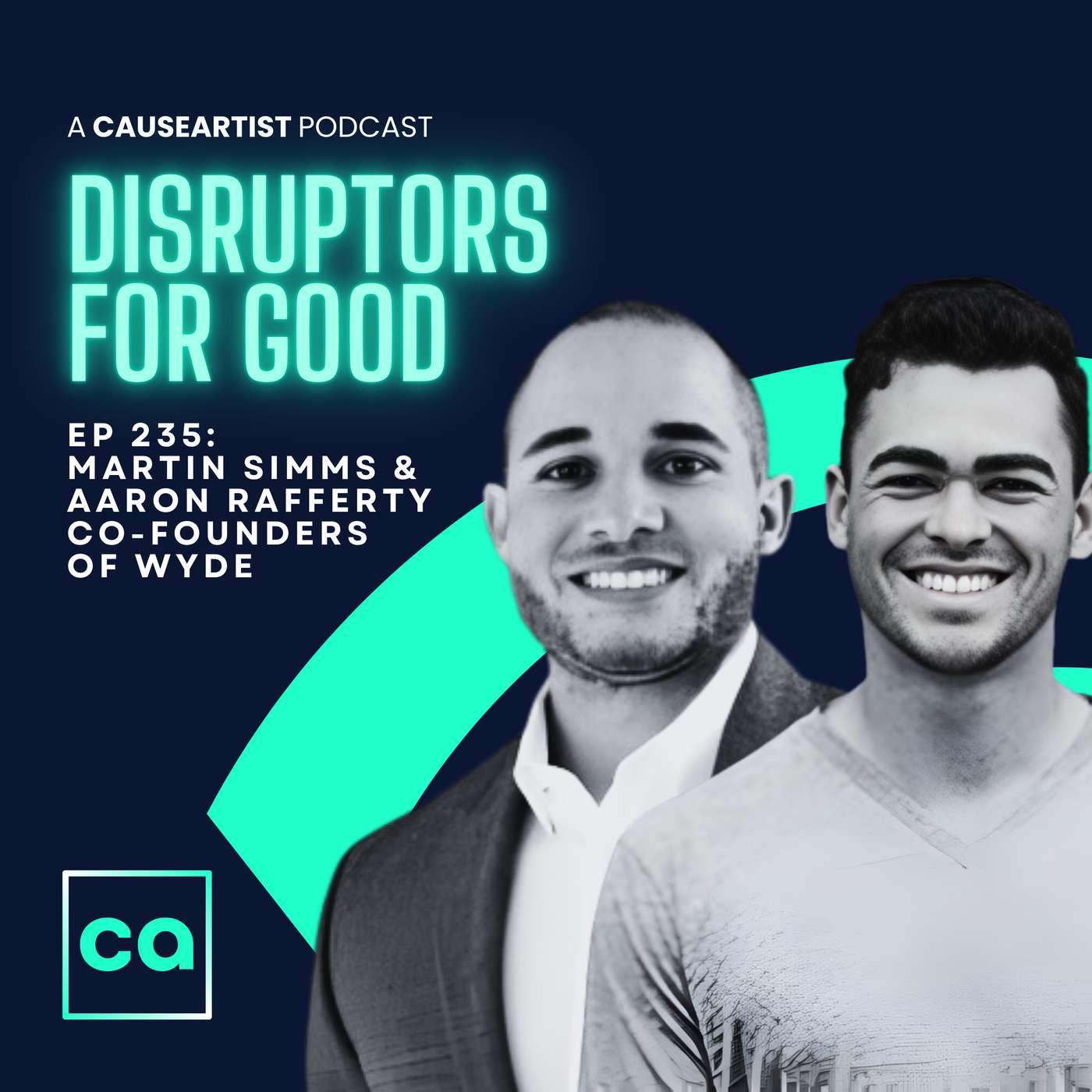
For decades, nonprofits have relied on the same narrow funding playbook. Donations spike at year end. Grant cycles are slow and unpredictable. Teams spend enormous time fundraising instead of delivering impact.Meanwhile, trillions of dollars move through global markets every day with no connection to social outcomes.In Episode 235 of the Disruptors for GOOD podcast, we sat down with Martin Simms and Aaron Rafferty, co founders of WYDE Impact Exchange, to explore a bold alternative.What if markets themselves could fund missions automatically.What if trading activity generated real nonprofit revenue And what if transparency and accountability were built directly into the system.WYDE is not another crypto exchange chasing speculation.
----------------------------------------Disruptors for GOOD is powered by Causeartist, a nonprofit media company dedicated to bridging the gap between capital and culture by spotlighting founders, investors, and organizations reimagining how business can serve people and the planet.Through storytelling, events, and open-access education, Causeartist helps create a shared language of impact, inspiring more founders to build with purpose and more funders to invest with intention.By amplifying ideas and innovations across industries, Causeartist transforms awareness into action and cultivates a community where paying it forward is part of the foundation for growth.
The push to decarbonize the world’s energy systems now overlaps with a long standing problem: what to do with the massive amount of agricultural waste produced every year.Billions of tons of crop residues and animal waste are generated across the globe. Much of it is left to rot or is burned, which adds to air pollution and releases methane.The result is a two sided problem.We face avoidable environmental damage on one side, and a large source of unused energy on the other.A growing group of startups is working to change this. They are building practical technologies that convert agricultural waste into clean energy that farmers and rural communities can actually use.These companies are cutting waste, lowering emissions, and supporting local economies. They are also helping build a circular bioeconomy that treats waste as a resource rather than a burden.Read full post
----------------------------------------Disruptors for GOOD is powered by Causeartist, a nonprofit media company dedicated to bridging the gap between capital and culture by spotlighting founders, investors, and organizations reimagining how business can serve people and the planet.Through storytelling, events, and open-access education, Causeartist helps create a shared language of impact, inspiring more founders to build with purpose and more funders to invest with intention.By amplifying ideas and innovations across industries, Causeartist transforms awareness into action and cultivates a community where paying it forward is part of the foundation for growth.
The global move toward cleaner energy is gaining speed, yet two issues continue to shape its future. We need a dependable and sustainable supply of battery materials, and we need storage systems that can carry the grid through long periods of weak wind or sunlight.The surge in electric vehicles and utility scale renewables has put real pressure on both fronts. It has exposed how fragile a linear, mining dependent supply chain can be and how little short duration storage can do when the grid faces extended stress.These gaps must be solved if the energy transition is going to hold up over the long run.A new generation of startups is rising to meet this challenge, fundamentally disrupting both the Circular Economy for battery materials and the Long-Duration Energy Storage (LDES) market.These innovators are not just fixing problems; they are building the technological and logistical backbone of a truly resilient, decarbonized grid.Read full list
----------------------------------------Disruptors for GOOD is powered by Causeartist, a nonprofit media company dedicated to bridging the gap between capital and culture by spotlighting founders, investors, and organizations reimagining how business can serve people and the planet.Through storytelling, events, and open-access education, Causeartist helps create a shared language of impact, inspiring more founders to build with purpose and more funders to invest with intention.By amplifying ideas and innovations across industries, Causeartist transforms awareness into action and cultivates a community where paying it forward is part of the foundation for growth.
Ben & Jerry’s is often celebrated as the blueprint for socially conscious capitalism, a company that set out to prove business could serve both profit and purpose.Founded in 1978 in Burlington, Vermont by Ben Cohen and Jerry Greenfield, the brand grew from a local scoop shop into a global symbol of activism wrapped in indulgence.Its mission, famously defined as a three-part balance between product quality, economic sustainability, and social justice, positioned the company decades ahead of mainstream corporate responsibility trends.But behind the lighthearted flavor names and progressive branding lies a far more complicated story. Over the past four decades, Ben & Jerry’s has struggled to reconcile its idealism with industrial reality, and its activism with corporate ownership.The 2000 acquisition by Unilever(SEC Filing) marked a turning point, one that gave the brand global reach but also sparked ongoing tension over how far a subsidiary can push social and political boundaries inside a multinational conglomerate.The company’s evolution highlights both the potential and the pitfalls of value-driven business. Its impact programs, from Fairtrade sourcing and regenerative agriculture to refugee employment and racial equity initiatives, have made real contributions to ethical commerce.Yet, the same mission has exposed Ben & Jerry’s to accusations of hypocrisy and partisanship. The gap between its public commitments and operational constraints has grown increasingly visible as global scrutiny around corporate activism intensifies.Today, Ben & Jerry’s stands as both a pioneer and a cautionary tale.Its enduring popularity and strong brand equity demonstrate the power of purpose-driven storytelling, while its public controversies and internal governance conflicts reveal the structural limits of idealism in a profit-driven system.The lessons drawn from its trajectory extend well beyond ice cream, they speak to the broader tension facing any brand that dares to mix business with belief.Full case study
----------------------------------------Disruptors for GOOD is powered by Causeartist, a nonprofit media company dedicated to bridging the gap between capital and culture by spotlighting founders, investors, and organizations reimagining how business can serve people and the planet.Through storytelling, events, and open-access education, Causeartist helps create a shared language of impact, inspiring more founders to build with purpose and more funders to invest with intention.By amplifying ideas and innovations across industries, Causeartist transforms awareness into action and cultivates a community where paying it forward is part of the foundation for growth.
Climate action often feels heavy. The headlines focus on crisis, the solutions demand sacrifice, and the average person ends up believing their choices are too small to matter.Robert Luo has been working to break that cycle.As the CEO of Tanbii, he is building a platform that turns climate restoration into a daily habit through play.His team has found a way to turn virtual energy into real world reforestation.The idea is simple.When people enjoy something, they stick with it.When they see the results of their actions, they stay committed.Tanbii uses those truths to make sustainability feel accessible, social, and rewarding.Players plant virtual trees, complete missions, and build worlds within the game.Behind the scenes, every eligible planting triggers a real tree planted on the ground through verified NGO partners.What began as a frustration with the traditional sustainability message has grown into a global early access community with thousands of players and thousands of trees already planted.In this interview, Robert breaks down the origin story of Tanbii, how the platform works, and what it takes to create a climate action experience that people actually enjoy.Full interview
----------------------------------------Disruptors for GOOD is powered by Causeartist, a nonprofit media company dedicated to bridging the gap between capital and culture by spotlighting founders, investors, and organizations reimagining how business can serve people and the planet.Through storytelling, events, and open-access education, Causeartist helps create a shared language of impact, inspiring more founders to build with purpose and more funders to invest with intention.By amplifying ideas and innovations across industries, Causeartist transforms awareness into action and cultivates a community where paying it forward is part of the foundation for growth.


Download from Google Play

Download from App Store
 United States
Good work George! And thanks for the show, Disruptors for social good..🙌🏼