


 Claim Ownership
Itihaas 2.0
Subscribed: 971Played: 21,740
Subscribe

© Copyright 2021 Sneha Gore Mehendale
Description
Itihaas 2.0 is a podcast that looks at Indian history with a twist. It brings history out of boring textbooks and looks at things around us, tracing their evolution. From brands to elections and from media to public policy, this podcast explores why today's India is the way it is.
57 Episodes
Reverse

On the occasion of world radio day, this episode traces the evolution of the earliest broadcasting medium- Radio. It features Dr. Ujjwala Barve in conversation with Sneha Gore Mehendale where they do a succinct recap of the All India Radio (AIR). Dr. Barve talks about her own association with the AIR, its former glory, the challenges AIR faced on its way and its current, modern Avatar.
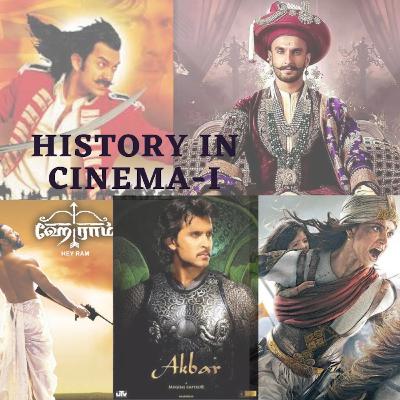
This episode moves away slightly from any history of cinema. It talks of history as depicted IN cinema. In the first part of this three-way conversation, a film-maker and a film scholar discuss various related issues. 'Historical fiction', the eternal struggle between the truth and artifice, when does a historical film become a historical film and much more.
Doordarshan (DD), India’s public service broadcaster is six decades old. And boy, what changes has Doordarshan seen during these years! From twice a week, educational broadcast to a 24- hour channels and a dense network of correspondents, DD has come a long way. This episode features ex-journalist and media academic Dr. Ujjwala Barve, talking of her memories of working with Doordarshan since early days, and the changes today.
The Ramadan special food offered in Mumbai's old by-lanes of Bhendi Bazaar and Muhammad Ali Road is a part of personal history of many people. As this area gets ready for massive renovation, we trace the memories of this place with a former resident and wonder how history will survive in this change.
Cinema is a ‘reflection of the society’, yes. And hence, it is also a moving document of our history. Indian cinema provides us innumerable glasses to look at the evolution of the society around us. This episode traces the evolution of settings of Hindi Cinema. From being village-centric to urban, to even being set in other countries, Hindi Cinema is slowly again becoming locally rooted, thereby completing a circle. Listen to the film critic and professor Ajit Duara discussing it.
Most of the food exchanges are so well assimilated that it is impossible to say that they once belonged somewhere else. In part two of the conversation with Keertida Phadke, we talk of food that is native to India but is shining and getting assimilated other countries and their culinary cultures.
Food is fluid. It moves with time, with people, with cultures. Food exchanges only enrich a culture and most of the food exchanges are so well assimilated that it is impossible to say that they once belonged somewhere else.This episode traces food which is not technically ‘Indian’ in origin, but has been phenomenally ‘Indian’ized. In the first part of this two-part conversation Chef and food entrepreneur Keertida Phadke talks of some such items.

History is not always past events. Sometimes you also live in truly historic times, much like the current pandemic. As the vaccine for CoVid-19 becomes the new global quest, we here talk about this facet of the current times and future history- what are vaccine trials and why do they matter. Featuring on this episode is Dr. Snajay Mehendale, a noted epidemiologist and public health researcher.
The issue of Naxalism has plagued India for more than the past five decades with no solution in sight. This episode features journalist Siddharthya Roy in conversation with Sneha Gore Mehendale discussing the history, present and the relevance of Naxalism to contemporary India.
In the later half of the 1990s, the political situation in India became super unstable with no government being steady. India saw 4 elections in those 10 years. We discuss the elections of 1996,98 and 99 in this episode.
The late 80s have a nation going through a major change where governance takes a back seat, political opportunism is ripe and social fabric is being churned and strained like never before. This episode talks about the elections of 1989 and 1991 and traces these changes.
The first non-congress government, rampant with factions, ego, and opportunism, could not even complete a full term.This episode discusses the situation in the Janata regime, the 1980 elections and how Indira returned to the power with a thumping majority.
In the middle of the stormy decade, came an unprecedented political move- the emergency from 1975 to 1977. The democracy was almost dead for 19 long months. The 1977 elections, which came after this draconian rule, decimated the Congress for the first time. In this new episode, we discuss these elections and the complicated background of that one.
The elections of 1971 happened on the backdrop of multiple major sociopolitical churnings. Indira era began a couple of years before that, decimating the political opposition and cementing her position by the victory in 1971 Bangladesh war. Things were not at all cool though. The country was going through turbulent times. In this episode, Ranjeet Rane and Sneha gore Mehendale discuss the 1971 elections, a prologue to the stormy decade.
The fourth general election of 1967 is brought a beginning of a new era. The grand old party in India getting more factionized,clear emergence of a political opposition, and India still surviving as a single country, despite predictions of doom. Sneha Gore Mehendale converses with Neha Phadke Mahajan about all of it in this episode
Moving to the 1960s, where Congress had completed a decade of power and other sociopolitical factors were playing a role in the electoral politics. importantly, the third election of 1962 also coincides with the Sino-Indian war. Joining us on the conversation is Parimal Maya Sudhakar explaining the build-up to 1962 elections and aftermath.
That is the name of the system using which India has its election. It is crucial to understand what it is as it can massively swing elections this way or that way. Sneha gore Mehendale discusses this important phenomenon with Neha Phadke Mahajan and notes a few interesting statistics of electoral wins and misses due to FPTP.
Did you know that the second general elections of India in 1957 is when the first incident of booth capturing was recorded?!Listen to this episode that talks about such interesting things along with the backdrop of the 1957 elections and the aftermath.
The implementation of the Mandal commission's report had deep rooted repercussions, especially in the northern India.What were these effects? Where are we with reference to the issue of caste-based reservations? What does the future hold? Is there any other way of implementing reservations?Dr.Vikas Pathak offers insights in his conversation with Sneha Gore Mehendale.
1990s remain one of the most turbulent decades of the modern India, and one of the three Ms that caused this turbulence was 'Mandal'. The report of Mandal commission, advocating caste based reservations, specifically, OBC quota in central government jobs and PSUs, was implemented in 1990. In this episode, Sneha Gore Mehendale and Pradnya Shidore take an overview of 'affirmative action' that India has seen and what exactly is this much controversial term "mandal".


Download from Google Play

Download from App Store
 United States
crisp content and nicely narrated. I hope in future they will produce more content. thank you for your efforts
charu majumdar was terrorists. thank god he is killed
Nice podcast - Crisp and clear. Keep going!!!
Thanks for building such a useful podcast about INDIA :)
Only selective and propaganda specific representation. hence unsubscribing this channel.
Why Ram Janma Bhumi word is not included? As you say that the concept of religion never affected the urban lifestyle, let me remind you the ISIS. Pseudo truth and incomplete data is not expected a person like you.
Bad composition and truncated reality towards a specific community. Never expected. Prgnya is again again intervening in discussion.
Amazing effort. Keep up the good work !!