DiscoverPhantom Power
Phantom Power
Claim Ownership

Phantom Power

Author: SpectreVision Radio

Subscribed: 98Played: 1,788
Share

Description

Sound is all around us, but we give little thought to its invisible influence. Dr. Mack Hagood explores the world of sound studies with the world's most amazing sound scholars, sound artists, and acoustic ecologists.


How are noise-cancelling headphones changing social life? What did silent films sound like? Is listening to audiobooks really reading? How did computers learn to speak? How do race, gender, and disability shape our listening? What do live musicians actually hear in those in-ear monitors? Why does your office sound so bad? What are Sound Art and Radio Art? How do historians study the sounds of the past? Can we enter the sonic perspective of animals?


We've broken down Yoko Ono's scream, John Cage's silence, Houston hip hop, Iranian noise music, the politics of EDM, and audio ink blot tests for blind people. Phantom Power is the podcast that both newcomers and experts in sound studies, sound art, and acoustic ecology listen to--combining intellectual rigor and great audio.


SpectreVision Radio is a bespoke podcast network at the intersection between the arts and the uncanny, featuring a tapestry of shows exploring the anomalous, the luminous, and the numinous. We’re a community for creators and fans vibrating around common curiosities, shared interests and persistent passions.


⁠spectrevisionradio.com⁠


⁠linktr.ee/spectrevision⁠

96 Episodes
Reverse
How much of your life is preprogrammed? Presets, or default settings on technology, can be found everywhere, from radios to apps to appliances. A preset is meant to enable the user, but it constrains the user at the same time. According to author Amy Skjerseth, they also reinforce—but sometimes challenge—economic, political, and social norms. Skjerseth's new book examines the fascinating histories of common presets, with a special focus on audio technologies. Using capitalist, queer, and feminist critique, she shows how, from the popularization of the push-button car radio in the 1930s to the Auto-Tune era and the advent of AI, artists have co-opted preset technologies to reconfigure ways of seeing and hearing and develop new forms of artistic and cultural expression. Amy Skjerseth is Assistant Professor of Popular Music at the University of California, Riverside, and coeditor of The Routledge Companion to Voice and Identity. Cited Media: Books: Amy Skjerseth - Preprogrammed: How Electronic Presets Changed Music and Media (2026) Rick Altman - Silent Film Sound (2004) Paula Harper - Viral Musicking and the Rise of Noisy Platforms (forthcoming) Ada Lovelace - Notes on the Analytical Engine (1843) Articles: Lisa Nakamura - Indigenous Circuits: Navajo Women and the Racialization of Early Electronic Manufacture (2014) Podcasts: Hyperfixed - A Button is a Promise (2026) Phantom Power - Ep. 24: Voice of Yoko (2021) Phantom Power - Analog Revolutionaries with Theodore Gordon (2026) Video: Suzanne Ciani - David Letterman Show appearance (1980) Clara Rockmore - The Swan (1976) Performance: Anna Friz & Jeff Kolar - The Other Spectrum (2025) Chapters: 0:00 Intro2:51 Defining the Preset9:01 AI, Cake Mix & Consumer Agency15:24 Theater Organs & Mood Music23:35 Synthesizers & Sample Packs29:16 Women in Music Technology35:06 Algorithmic Culture & Auto-Tune44:51 Self-Optimization vs Creative Friction Click here to read the full transcript Learn more about your ad choices. Visit megaphone.fm/adchoices
Today on a very special pre-Halloween episode of Phantom Power, we try to make contact with the dead using digital audio technology. We are trying Instrumental Transcommunication (ITC) with ITC practitioner Joshua Sean and cultural scholar Leila Taylor, who focuses on the esoteric, horror, and the occult. Join us, if you dare….  Joshua Sean is the owner and founder of Zero-G ITC, an organization dedicated to Instrumental Trans-Communication Engineering Research and Development, Theory and Design. Joshua is an audio scientist and engineer and the inventor of PRISM, an analog emulation system that utilizes quantum dynamics and chaotic light photon interactions to isolate communication anomalies. You can find his ITC livestreams at YouTube. Leila Taylor is a Brooklyn-based writer, speaker, and designer whose work focuses on the intersection of history, horror and the gothic in contemporary culture. Leila is author of Sick Houses: Haunted Homes & the Architecture of Dread and Darkly: Black History & America’s Gothic Soul. Her work has appeared in outlets like the New York Review of Architecture, Lapham’s Quarterly, and Repeater Book of the Occult. She’s given talks on the eerie and the esoteric for the Miskatonic Institute of Horror Studies, Morbid Anatomy, The Collective for Radical Death Studies, and The Occult Humanities Conference. By day, she is Creative Director for Brooklyn Public Library.  Cited Media: Books: Leigh Eric Schmidt - Hearing Things: Religion, Illusion, and the American Enlightenment (2000) Leila Taylor - Sick Houses: Haunted Homes and the Architecture of Dread (2025) Leila Taylor - Darkly: Black History and America's Gothic Soul (2019) Tariq Goddard & Eugene Thacker - The Repeater Book of the Occult: Tales from the Darkside (2021) Friedrich Jürgenson - Voices From Space (1964) Konstantin Raudive - Breakthrough: An Amazing Experiment in Electronic Communication with the Dead (1971) Emanuel Swedenborg - The Animal Kingdom (Regnum Animale) (1745) Audio: Konstantin Raudive - Breakthrough (1971) Édouard-Léon Scott de Martinville - Au Clair de la Lune (1860) Film: Daniel Drasin - Calling Earth (2018) Chapters: 0:00 Intro7:10 Defining ITC15:03 Early Sound Recording20:26 Jürgenson & Raudive30:28 Raudive's Three Methods33:51 The Prism System38:29 Live ITC Demonstration46:54 Listening & Wrap-Up Click here to read the full transcript Learn more about your ad choices. Visit megaphone.fm/adchoices
Theodore Gordon is a musician, musicologist, and scholar of science and technologies studies. He’s interested in the mystery of the black box of audio technology. We know that there are inputs and outputs in this now ubiquitous music technology, but whatever happens in between remains mysterious and unseen. In this episode Ted and I explore how this black box has allowed musicians to imagine synths in revolutionary ways, by discussing three visionary musicians who had very different ideas about technology in the 1960s and '70s: Morton Subotnick, Pauline Oliveros, and Sun Ra. In Phantom Power news, we have just released a new free digital zine! It's called Nothing is Background: Experimental Artists and Thinkers on Sound, Attention, and the Resonant World. It features portraits of 16 guests from past Phantom Power episodes who have shared their ideas an inspirations exclusively for this zine. Whether you’re a musician, sound scholar, or casual listener, I think you'll find a lot of inspiration here to deepen your sensory contact with the world in this era of digital discontent. Subscribers will have already received an email link to download the zine for free, and if you are yet to subscribe, and want to get your hands on a copy, you can pick it up for free Nothing Is Background. And finally, in celebration of the release of Nothing is Background and Phantom Power at Talk Low Festival, we are hosting a limited time giveaway of a hat and shirt of your choosing from our fantastic merch line on the Phantom Power store! You must be subscribed at any level, free or paid, by October the 31st to be automatically entered to win, so if you aren’t already, you can subscribe to Phantom Power here. Cited Media: Music: Lejaren Hiller & Leonard Isaacson - Illiac Suite (1957) Karlheinz Stockhausen - Gesang der Jünglinge (1956) Morton Subotnick - Silver Apples of the Moon (1967) David Behrman - New Sounds in Electronic Music (1967) Wendy Carlos - Switched-On Bach (1968) Roland Kayn - Cybernetics (1969) Gershon Kingsley - Popcorn (1969) Hot Butter - Popcorn (1972) Sun Ra - Atlantis (1969) Sun Ra - My Brother the Wind (1970) Sun Ra - Nuits de la Fondation Maeght / The Cosmic Explorer (1971) Pauline Oliveros - Reverberations: Tape & Electronic Music 1961–1970 (2012) Books: Theodore Gordon - The Composer's Black Box (2025) Norbert Wiener - Cybernetics (1948) Thomas Patteson - Instruments for New Music (2015) Louis Chude-Sokei - The Sound of Culture (2015) Andrew Pickering - The Mangle of Practice (1995) Sun Ra - The Immeasurable Equation (1972) Abraham Moles - Théorie de l'information et perception esthétique (1966) Articles & Papers: Claude Shannon - A Mathematical Theory of Communication (1948) Harald Bode - A New Tool for the Exploration of Unknown Electronic Music Instrument Performances (1961) Film: Sun Ra - Space is the Place (1974) Chapters: 0:00 Intro 2:28 Phantom Power News 6:34 The Composer's Black Box 16:24 The Tape Music Center & Buchla's Box 29:35 Pauline Oliveros: Attention & Sensation 39:08 Sun Ra: The Illegible Instrument 47:03 The Cosmic Explorer 51:25 Outro Click here to read the full transcript Learn more about your ad choices. Visit megaphone.fm/adchoices
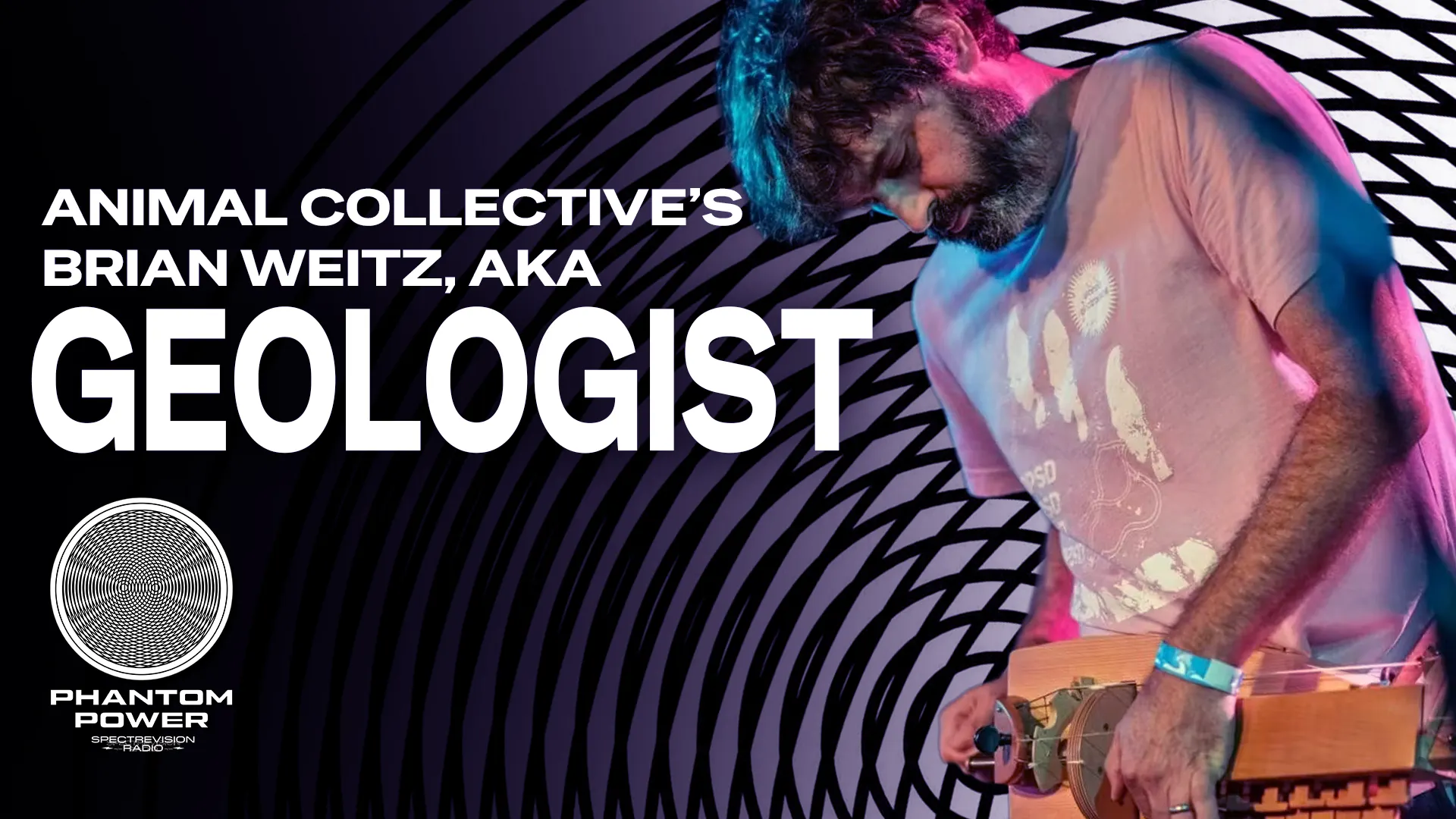
Best known as Geologist, Animal Collective’s Brian Weitz injects synthesizers, samples, animal sounds, and field recordings into that band's enchantingly strange sound world. Recently, Weitz has been on a creative tear, releasing a solo album and several other projects, including Croz Boyce with Avey Tare. In our interview, he talks about sonic texture, the internet’s influence on music culture, and his obsession with the hand-cranked medieval instrument, the hurdy-gurdy. In this conversation, we talk about sound, technology, and the music business: the first sounds that caught Brian's young ear; his love of that classic turn of the millennium technology the MiniDisc player; Animal Collective’s determination never to sound too “trad”; the strange opportunities and pressures of early internet fame; And the hurdy-gurdy--that infernal machine that fuels so much of Brian's recent creativity. Phantom Power members will get the full interview, including Brian’s background in ocean conservation—we talk about scuba diving the recordings of seals and walruses that found their way into Animal Collective tracks. Plus Brian's reading and listening recommendations. You can become a member at mackhagood.com . And Croz Boyce will perform at Cincinnati’s Talk Low Music Festival on Saturday, September 26, at the Contemporary Arts Center. Phantom Power is proud to sponsor Talk Low, and I hope to see some of you there. Cited Media: Albums: Michael Jackson - Thriller (1982) Panda Bear - Panda Bear (1999) Animal Collective - Spirit They're Gone, Spirit They've Vanished (2000) The Strokes - Is This It (2001) Animal Collective - Campfire Songs (2003) Animal Collective - Sung Tongs (2004) Animal Collective - Feels (2005) Animal Collective - Merriweather Post Pavilion (2009) Animal Collective - Meeting of the Waters (2017) Floating Points, Pharoah Sanders & The London Symphony Orchestra - Promises (2021) Randall Poster - For the Birds: The Birdsong Project (benefiting Audubon Society & Macaulay Library, Cornell) (2022) Motherfuckers, JMB & Co (2025) Geologist - Can I Get a Pack of Camel Lights (2026) Avey Tare & Geologist present Croz Boyce - Croz Boyce (2026) Climax Golden Twins - Imperial Household Orchestra David Crosby - If I Could Only Remember My Name (1971) Valentin Clastrier - solo hurdy-gurdy record New Psychoactives - Animal Collective side project (SoundCloud) Series & Platforms: Daryl Hall - Live at Daryl's House (web series) Fugazi - Live Archive Series Artists: Crosby, Stills & Nash Sonic Youth Chapters: 0:00 Intro5:15 Early Musical Memories12:27 New York Scene & Early Records16:05 Band Philosophy & Internet Era22:00 Music Business & Fan Community27:40 Croz Boyce & Recent Work31:58 Naming Croz Boyce36:48 The Hurdy-Gurdy41:17 College Radio & Keiji Haino47:32 Outro Click here to read the full transcript Learn more about your ad choices. Visit megaphone.fm/adchoices
In the early 2010s self-taught guitarist Tashi Dorji was recording improvised guitar explorations in his home near Asheville, North Carolina. These self-released outings drew on his unique mix of musical influences from the Buddhist music of his childhood in Bhutan to the Western music he discovered through shortwave radio and bootleg tapes of MTV videos. Subsequently inspired by punk rock as well as the outsider guitar styles of John Fahey, Derek Bailey, Mark Ribot, and Sir Richard Bishop, Tashi was developing a percussively rhythmic sound all his own. Guitarist Ben Chasny of Six Organs of Admittance was so inspired by Tashi Dorji's playing that he started a record label to release Tashi’s self-titled vinyl debut in 2014. Since then, Tashi's released records on Drag City, collaborated with musicians like John Dieterich of Deerhoof and Tony Buck of the Necks, and toured with Godspeed, You! Black Emperor. Tashi is going to be coming to Cincinnati to take part in the Talk Low Music Festival, which is running September 24th through 27th. He'll be performing with Faith Coloccia on Saturday, September 26th. Phantom Power is a sponsor of the Talk Low Festival, which features a great lineup of adventurous music link in the show notes. So I thought this would be a great opportunity to talk improvised music with someone who has dedicated his life to it. Tashi has developed a philosophy of improvisation that challenges ideas of permanence, hierarchy, and value. We discuss the radical openness of improv in life and music and we talk about the record that opened his ears to open tunings, as well as how a condenser microphone and a pair of headphones changed his relationship to the guitar. We also discuss his early life in Bhutan, that tiny country located in the Eastern Himalayas between China and India. Of course our members will get an extended version of the conversation, including Tashi's recommendations of things to read, listen to and do more information at http://mackhagood.com . Visit Tashi Dorji’s Bandcamp. Cited Media: Albums & Records: Tashi Dorji - Blue Twelve (2014) Tashi Dorji - We Will Be Wherever the Fires Are Lit (2024) Tashi Dorji - Low Clouds Hang, This Land Is On Fire (2026) Ry Cooder & Vishwa Mohan Bhatt - A Meeting by the River (1993) Joe Pass - Virtuoso (1974) Nirvana - Nevermind (1991) Neil Young - Heart of Gold (1972) Raphael Rogiński - Plays John Coltrane and Langston Hughes (2024) Miles Davis Sun City Girls 75 Dollar Bill Pavement Bonnie “Prince” Billy Tesla Cinderella Metallica Slayer Jon Bon Jov Soundgarden Alice In Chains Butthole Surfers Smashing Pumpkins Midnight Oil Michael Jackson Books: Dan DiPiero - Book on Improvising in Everyday LifeLaozi - Tao Te Ching (~6th Century BCE)Emma GoldmanAlexander Berkman Articles & Interviews: Andy Slater - On Visual Impairment and Sound ArtVijay Iyer - Writings on ImprovisationMark Masters - Retrospective on Tashi Dorji Chapters: 0:00 Intro & Welcome3:00 Guitar Influences & Touring5:00 Recording & Sound Discovery10:00 Patterns & Prepared Guitar16:00 Philosophy of Improvisation21:00 Collaborating with Others24:00 Musical Origins in Bhutan29:00 Shortwave Radio & Western Rock34:00 Leaving Bhutan for America43:00 Buddhism & Recent Work49:33 Outro To read the full transcript click here. Learn more about your ad choices. Visit megaphone.fm/adchoices
loading
Comments