


Jack Dappa Blues Heritage Preservation Radio
Subscribed: 60Played: 504
Subscribe

© Jack Dappa Blues Heritage Preservation Radio
Description
Jack Dappa Blues Heritage Preservation Foundation (JDBHPF) is a nonprofit established in 2011, officially becoming a 501 (c) 3 in 2016 to create public programs that raise cultural and ethnic awareness of Black traditional music, traditional art, folklore, oral histories, and the experiences of Black people in the United States. Standing on the foundation of the Blues People's legacy, JDBHPF works to celebrate, preserve, and conserve Blues music and culture while highlighting the many events in American history that have cultivated our communities and musical expressions.
118 Episodes
Reverse

On this episode, I speak with Brei Carter, Country Singer-Songwriter, about her journey in Music and her signing with Brown Lee Entertainment For Exclusive Global Music Distribution & Digital Marketing.
Emerging crossover country and southern pop recording artist Brei Carter proves that faith, patience, and time sometimes pay off. Growing up in Monroe, Louisiana, with a solid, southern upbringing, Brei’s family raised her on several authentic southern staples: the Bible, Lone Star Missionary Baptist Church’s choir, Charley Pride, Loretta Lynn, Aretha Franklin, and no shortage of familial love and devotion. However, before she became the dynamic and vivacious country singer she is today, Brei was busy earning a Bachelor's in Business from the University of Louisiana in Monroe, a Master's in International Relations from Webster University, and a Doctorate in Theology from New Foundation Theological Seminary. She is also a proud Veteran of the U.S. Army, where she served as an enlisted soldier and officer. Having moved to Nashville soon after, Brei has quickly established herself in the songwriter's community as a smooth and sometimes edgy songstress who melds country, soul, and southern pop into one fused style. Her first single at country radio, “Gave Him A Girl,” was immediately recognized as “cute and catchy” by country music journalist and historian Robert K. Oermann in his weekly DISClaimer review column for Music Row Magazine. Brei made her CMA Fest debut in 2022, along with a performance on WoodSongs Old Time Radio Hour. Her growing catalog of new music includes her debut album Brand New Country, released in Fall 2022, and new music on the way in 2023 slated for April & June. Carter is quickly proving herself to be a welcomed addition to the emerging new styles of country music in today’s diverse musical landscape.

Louisiana BLUES VIXEN GEMINIIDRAGON is set to take over the BLUES MUSIC community with her latest single JUST THE WAY IT IS from her upcoming album FIGHTING FIRE WITH FIRE!
From the murky bayous of Louisiana, comes a fresh face to the Blues music scene. A vocal dynamo GeminiiDRAGON has channeled her love for the late 60s era and 70s blues and AOR bands/artists the likes of Muddy Waters, Howlin' Wolf, Albert King, Freddie King, Stevie Ray Vaughn, Koko Taylor, Jimi Hendrix, ZZ Top, Janis Joplin, Fleetwood Mac, Cream and Led Zeppelin and the supergroup Arc Angels, to name a few, into a ferocious mix of blues-rock soul…. Blues on Steriods!!!
More on GeminiiDragon here https://www.youtube.com/watch?v=HQ4TKJUrJUo
To Donate to Jack Dappa Blues Heritage Preservation Foundation follow this link https://www.paypal.com/paypalme/LamontJack/

Many Black Academic Scholars are also active practitioners in our respective cultures and traditions. That doesn't negate their ability to teach, mentor, or share skills and tricks of the trade with the folk. It actually makes them even more qualified. Some feel Black Scholars who are educated or formally trained cannot teach or pass on the folk tradition. I see it differently, and here's why.
Charlotte Forten Grimke
NAMA HARLEM (New Amsterdam Musical Association)
Colored Musicians Club
John Wesley Work III
DONATE
Join Patreon

THE BLUES SOCIETY is a re-evaluation of the 1960s seen through the lens of the Memphis Country Blues Festival (1966-1969). It’s the story of Blues masters like Furry Lewis
and Robert Wilkins, who had attained fame in the 1920s but were living in obscurity by the 1960s. It’s also the story of a group of white artists from the North and the South who created a celebration of African American music in
a highly segregated city. THE BLUES SOCIETY follows the festival from its start in 1966 as an impromptu happening, through a period of cross-pollinization with New York’s East Village scene, and up to the 1969 Festival, which mushroomed into a 3-day event and garnered substantial print and television coverage including an appearance on Steve Allen’s national PBS show, Sounds of Summer.
Festival co-founder and legendary music Executive Nancy Jeffries says, “Everyone remembers the 60s as a party, but there was a seriousness of purpose to what we were doing.” Furry Lewis worked for decades sweeping the city streets, so the efforts to recognize his musical accomplishments echo the 1968 Sanitation Strike, where each worker’s sign proclaimed “I AM A MAN,” underlining theracist refusal to honor African Americans’ basic humanity. Reaching into the
present, the film ends in a 2017 concert where Rev. John Wilkins returns to the stage he last shared with his father 48 years earlier. What is the legacy of the Memphis Country Blues Festival, and who do the blues belong to in 2020?
On this episode, I will speak to Filmmaker and Scholar Augusta Palmer, daughter of Robert Palmer, one of the founding members of the Memphis Country Blues Society, who, with her team, worked relentlessly to get this film to the public.
Joining Augusta in this episode will be The American Songster Don Flemons, who is featured in the film.

In February of 2024, the Mississippi John Hurt Museum burned. The fire, believed to have been set intentionally, happened immediately after the Legendary Mississippi Blues Pioneer's cabin received landmark status. That was not the first or last attack on the Hurt Family museum, land, or legacy. A week later, the sheriff's office began investigating a break-in at the historic store located on County Road 41 in the Teoc community, where the Mississippi John Hurt marker was stolen.
The executor of the estate and granddaughter of Hurt, Mary Francis Wright, has been fighting for a long time the many racialized attacks on her family's land and legacy. Mary and Shannon Evans have been working to keep the integrity and safety of the location and family.
In this episode, I will speak with Mary and Shannon about the fire and many other assaults they have endured.

Today, I speak with Candice Ivory about her new project, When The Levee Breaks.
As said on her website
After releasing three acclaimed albums of jazz-driven original songs, vocalist Candice Ivory reveals a whole new sound on When the Levee Breaks: The Music of Memphis Minnie. Raised in Memphis and based in St. Louis, Ivory hails from an illustrious musical family that shaped Memphis’s secular and sacred sounds. Her great-uncle was the singer and guitarist Will Roy Sanders of the Fieldstones, one of the premier Memphis blues bands from the 1970s to the 1990s. Ivory grew up in the church, and by the age of eleven, she was singing in a choir that featured the soon-to-be-famous R&B artist D’Angelo. When the Levee Breaks brings together all of her formative musical experiences in a tribute to Memphis Minnie (1897-1973), whose powerhouse vocals and compositional creativity served as inspiration for Ivory’s own innovations as the Queen of Avant Soul. Produced by singular guitarist-bassist Charlie Hunter, a onetime D’Angelo collaborator, Ivory’s When the Levee Breaks is a midnight run to the crossroads, where jazz, blues, gospel, and R&B all converge.
https://candiceivory.com/
paypal.me/LamontJack
Join Patreon
🎙️ From Slave Seculars to The Blues: Preserving & Conserving Black American Folklore Pt. 2 – The Legacy of Black Spirituals and Hymnals 🎶Join us for Part 2 of our deep dive into the evolution of Black American music, as we explore how Black Spirituals, hymnals, and Slave Seculars informed the Blues. In this episode, we uncover the sacred and secular traditions that shaped the foundation of the blues, from the sorrowful expressions of spirituals to the raw storytelling of early blues songs.We’ll break down the two distinct styles of Black hymnals—one rooted in oral tradition and the other shaped by formal musical training—and discuss how class and education influenced Black religious music. We’ll also examine how field hollers, lined-out hymns, and call-and-response structures carried over into the blues, creating a continuous thread of Black cultural expression.Expect a mix of history, storytelling, and audience participation as we connect the past to the present.🔥 Tune in and join the conversation as we honor, preserve, and celebrate Black musical heritage! 🔥Songs Played Title• The Old Ship of ZionNames• Johnson, Warren G. (Performer)• Gregory, Richard (Performer)• Richardson, Zema (Performer)• Winrow, Anthony (Performer)• Work, John W. (John Wesley), 1901-1967 (Collector)• Holloway High School Quartet (Performer)Created / Published• Murfreesboro, Tennessee, 1941Headings• - African Americans--Southern States--MusicSource Collection• John Work Collection of Negro Folk Music from the Southeast (AFC 1941/035)Repository• American Folklife CenterTitle• John the RevelatorNames• Work, John W. (John Wesley), 1901-1967 (Collector)• Heavenly Gate Quartet (Performer)Created / Published• Nashville, Tennessee, 1941Headings• - African Americans--Southern States--Music• - The performers of this song are identified by Bruce Nemerov as the Heavenly Gate Quartet. "In the spring of 1941 John Work recorded the Heavenly Gate Quartet at his house...(AFS #5163-64)" -- article by Bruce Nemerov.• - Heavenly Gate Quartet, unaccompanied vocals.Medium• Sound disc : analog ; 12 in.Call Number/Physical Location• AFC 1941/035: AFS 05163a01Source Collection• John Work Collection of Negro Folk Music from the Southeast (AFC 1941/035)Title• Po' Boy Long Way From HomeNames• Work, John W. (John Wesley), 1901-1967 (Collector)• Chestain, Sonny (Performer)Created / Published• Georgia, 1941Headings• - African Americans--Southern States--MusicSource Collection• John Work Collection of Negro Folk Music from the Southeast (AFC 1941/035)Repository• American Folklife CenterTitle• Rock My Soul in the Bosom of AbrahamNames• Work, John W. (John Wesley), 1901-1967 (Collector)• Unidentified vocal quartet (Performer)Created / Published• Fort Valley, Georgia, 1941Headings• - African Americans--Southern States--MusicSource Collection• John Work Collection of Negro Folk Music from the Southeast (AFC 1941/035)Repository• American Folklife CenterDigital Id
In this episode, we explore the rich cultural legacy of Black American music, focusing on the evolution from slave seculars—non-religious songs of survival, work, and resistance—to the development of the blues. Through stories, historical insights, and music, we uncover how enslaved African Americans used music to communicate, preserve their identity, and confront hardship. They also used their traditional expression to resist and revolt against ideologies and beliefs not part of their traditions. We also highlight the contributions of early folklorists, musicians, and modern artists who continue to keep these traditions alive. Join us as we celebrate the resilience and creativity that shaped American music and culture.
January 31 marks a pivotal moment in American history—the passing of the 13th Amendment in 1865, which abolished slavery. But freedom was more than a legal decree; it became a living story told through the rhythms of the blues, the wisdom of Black folklore, and the resilience of Afro-Indigenous traditions.
On this episode, we explore how the fight for liberation shaped cultural expressions that endure today. Discover the powerful connections between Black American folklore, the birth of the blues, and the often-overlooked histories of Afro-Indigenous communities. From the trickster tales of Br’er Rabbit to the haunting melodies of the Delta blues, this is a story of survival, resistance, and the unbreakable spirit of a people who turned struggle into song.
Join us as we honor the roots, the rhythms, and the resistance woven into the fabric of Black history.

On this episode, I speak with Shirley Moody-Turner, an associate professor of English and African American Studies and founding co-director with Gabrielle Foreman of the Center for Black Digital Research/#DigBlk. She is an Author and award-winning educator that says, “As a young girl growing up in Buffalo, NY, I felt a deep longing to learn more about my family history.
Shirley has worked to unearth those stories and many others. She has authored, edited, and written many books, essays, and journals depicting the African American story through a folkloric and ethnographic lens. She is highlighting and honoring the Black men and women scholars like her who have significantly contributed to the Blues and Black narrative of the Americas.
Her website also states, “Honoring the legacy of the intellectuals and activists I study, I also work in partnerships to carry these histories out into communities beyond the university. Through the Center for Black Digital Research/#DigBlk and the Black Women’s Organizing Archive, I work with extraordinary individuals to help public and scholarly audiences forge meaningful collaborations with the shared mission of bringing the buried and scattered histories of early Black organizing to digital life. “

In this episode of the African American Folklorist, I speak with Sherley Spears, NAACP Unit 6219 President, President of the National Historic Landmark Fort Concho, and founder of the Buffalo Soldier Project. The National Historic Landmark Fort Concho Museum preserves the structures and archeological site features for pride and educational purposes, serving the San Angelo, Texas community.
One significant story coming from Fort Concho and the San Angelo community is the contributions and community development of and by the Buffalo Soldiers. In 1866, Congress established the 9th, 10th, 24th, and 25th U.S. Cavalry Regiments for enlisted colored people in the Army. Eventually, troops from each of these regiments served at Fort Concho. These black troops would be given the name ”Buffalo Soldiers," allegedly, by the Indian tribes because of their dark, thick, curly hair resembling buffalo hair. Fort Concho, originally established in 1867, was built for soldiers protecting frontier settlers traveling west against Indian tribes in the area.
A notable member of the San Angelo community of that time was Elijah Cox. Elijah enlisted in the military and was stationed at Fort Concho, in San Angelo, Texas in 1871. Elijah was a fiddler he and his son, Ben played for all of the dances at the Fort. Elijah, born and remained a freeman, settled in San Angelo, Texas, and would learn the songs of the slave from ex-slaves now soldiers. Elijah would become the traditional bearer of these songs as he played fiddle, guitar, and sang. You can hear my podcast on his story here.
https://youtu.be/jOV68xA9EBE
These, and much more crucial historic narratives are being preserved by Ms. Sherley Spears and the organizations adamant of raising the awareness of African American contributions to the establishment and sustainability of Fort Concho & San Angelo, Texas.
https://sanangelonaacp.org/
https://fortconcho.com/home/about/mis...

The term Soul Food and Southern Style food were not an initial naming convention for the meals eaten in the households I grew up in. We ate what grandma cooked. What granddad bought, for auntie and momma to prepare. As time went on, the meals of my family began popping up in stores around our community, then particular spaces across the nation by the name “Soul Food” or “Country Kitchen.” I remember Country Kitchen specifically, because it was on the route home from church, and on special occasions my family and I would stop there to order meals. The food was good, not as good as my grandma, or mother’s, but non the less we enjoyed. The irony is as I matured in the space of being a folklorist, I wondered why we paid for meals identical to what we ate at home. And when and why did my grandma’s and mother’s meals receive this name. To us it was just dinner. To many people, it’s just dinner, lunch or breakfast.
As I pondered this, I began to remember the great times we had as a family, either around the dinner table, or sprinkled around my grandparents home. My grandparents had five children, and their children had children. So it would be a full house. I began to think about the activities that took place during those times. As a folklorist these are the questions, research and interests we dive into, and in diving, I am introduced to Foodways.
As heard on WKU PUBLIC RADIO & NPR
Dr. Raymond Summerville joins me, as he is the African American Folklorist of February, to discuss the importance of having more Black Folklore scholars in the field to lead the discourse of our narrative, traditions, literature, and the dissemination of found research that represents the Black American experience. He also dives into his beginnings and what inspired him to write his book, In Proverb Masters: Shaping the Civil Rights Movement.Dr. Raymond Summerville is an alumnus of North Carolina Agricultural and Technical State University (BA, BS, and MA in English and African-American Literature) and the University of Missouri-Columbia (PhD in English with a concentration in Folklore, Oral Tradition, and Culture). His research interests include African American history, African American literature, postcolonial studies, paremiology, phraseology, hip-hop, blues, and other folklore genres. He currently teaches at Fayetteville State University in North Carolina.
On this episode, speak with Dr. Anika Wilson, The African American Folklorist of the Month for March! Wilson discusses her book, methodology, scholarship, and positionality as a Black Academic in the field. Anika Wilson (she/her) is Associate Professor and former chair of the Department African and African Diaspora Studies at UW-Milwaukee. She earned her doctorate in Folklore and Folklife Studies at the University of Pennsylvania and specializes in informal narratives (gossip, rumor, etc.). Her book Folklore, Gender, and AIDS in Malawi: No Secret Under the Sun (2013) was awarded the Elli Kongas Maranda Award for feminist scholarship in folklore in 2014. She teaches course topics related to African and African diasporic societies, expressive cultures, spirituality, and gender relations. Her current research project focuses on spirituality, sacredness, and the environment in southern Africa. ( American Folklore Society )
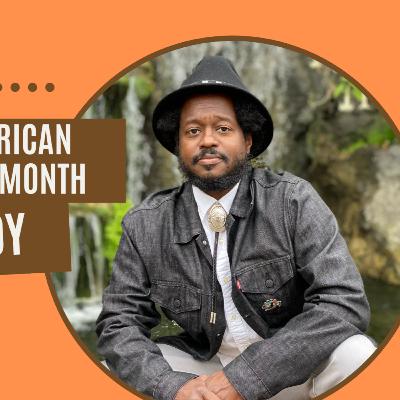
African American Folklorist of the Month - Larry Handy
Larry Handy discusses with me the concept of Ethnopoetic theory (a method for analyzing and recording oral poetry and performances to capture the poetic elements of the original performance) and his love for archiving and being a librarian. Handy is a “Folklife Poet” and shares with us the meaning; he also dives deep into activism and protests. Larry lives in California, and we recorded this interview at the height of the California wildfires when he was a few miles away. In sharing his Journey to Folklore, he discusses Folk Consciousness and his "Tour of Duty," an LA Protest Memoir.
BIO:
Larry Handy is a folklife poet who leads the award-winning
poetry band Totem Maples. His fiction, nonfiction, and poetry appear in such journals as The Coachella Review, Cog, Mosaic: Art and Literary Journal, Proximity, Quiddity, Rivet, Roi Fainéant, Storylandia, Straight Forward Poetry, and elsewhere. He holds an MFA in creative writing and writing for the performing arts from the University of California, Riverside,
and a master’s in library science from Emporia State University. TWB Press published his horror novelette Paper Cuts: 1000 Paper Cranes. His essay “What to Do When Grandma Has Dementia” was nominated for a Pushcart Prize and
was listed in The Best American series under Notable Essays and Literary Nonfiction of 2016. He is either practicing Chinese martial arts or running 26.2-mile marathons when not writing. Southern California is his home.

This is part one of the Jack Dappa Blues Podcast Series in affiliation with Lonestar Blues & Heritage Festival about Henry Thomas, also known as Henry Ragtime Texas Thomas featuring our recurring guest The American Songster Dom Flemons.
On this episode we delve into the unique and wide musical range of Henry Thomas whos songs represent the oldest of the African American Traditional music. He also played a traditional African American instrument called the "Quill". The history and role of the A&R. Early recording industry methods, and the fact that Henry, as well as other early African American Songsters, played songs of the plantation. Henry Thomas was one of the oldest black musicians whoever recorded 23 cuts on Vocalion Records between the years of 1927 - 1929. his music is a great opportunity to hear what African American Traditional music sounded like near the end of the 19th century. And in this era, they are just introducing the world to folk music through records/Vinyl.

On this episode, we speak about, Why is B.OB. Essential in an era we are supposed to be united and integrated? What do we expect from a B.O.B. that we don’t expect from anyone else? And most of all, How do I determine where I spend my Money?
The criteria for the last question is broken down by :
Customer Service
Products
Locations
We also discuss what is needed in the community. Are there any B.O.B.'s filling those voids, or are they just opening and operating the business that has become culturally popular?
B.O.B = Black Owned Business
MASKS OFF POWERED BY BLACK LOVE:
Hosts
Lamont Jack Pearley
Roscoe McCoy
Coach Black

On this episode, I speak to Actor, Historian and Blues Dance NY Instructor/Dj Odysseus Bailer on the importance of Blues Dance to the tradition of the Blues People, and the great program and community of Blues Dance NY, which is dedicated to fostering community and encouraging life-long learning through a shared passion for blues dancing.
Odysseus also shares his journey with Blues dancing and music, as it pertains to the African American experience.

The “Blues Narrative: Blues People, Covid-19, and Civil Unrest” focuses on African Americans born between 1945 and 2004. The article delves into the establishment of homes, lifestyles, and traditions on a concrete terrain with Southern and country values, and shares how those values not only weathered the storm of many generations but how they armed interviewees to defend what some call an all-out attack on the Blues People in the present day. This is an ongoing project conducted from the perspective of a folklorist and ethnographer.
This episode, i speak with Phoenix Moon, a Colonial America historian, Forensic genealogist, Civil Rights Activist. Grassroots Political Legist.

On this episode of The African American Folklorist, I share the story of the born free, African American Traditional Music Practitioner Elijah Cox, who was a fiddler, Buffalo soldier, and recorded in 1935 at the age of 93 for the Library of Congress Elijah Cox was also interviewed and recorded for the Born in Slavery: Slave Narratives from the Federal Writers' Project, 1936-1938, which now lives can be found of the Library Of Congress Website.
As I share the story of Elijah, I make the case that he was and utilized the tools of the folklorist.
Written, Produced and Edited by Lamont Jack Pearley -
Credits for sound design & Music
Elijah Cox - Run up on The Mountain, Slavery Days, Can’t put the saddle on the ol great mule
Lamont Jack Pearley - Blues Journey & Underground Slide
Excerpts from "Fife and Drum Music of the American Revolution: Military Music in America series, vol. 1," produced by the Company of Military Collectors & Historians, Washington, D.C. with George P. Carroll, Director of Music -- from about 1976.
(Improved audio from my earlier upload of this same.) https://www.underthehome.org Music Performer: Sturbridge Colonial Militia Music License Original Source: Sound Clip of Gunfire Original Source: Painting Title: Battle of Bunker Hill
ember 1941 (part 2 of 6)
Contributor Names - Lomax, Alan, 1915-2002 (Interviewer), Sturz, Elizabeth Lyttleton (Interviewer), Johnson, George (Interviewee), Jones, Lewis Wade, 1910-1979 (Interviewer) Johnson, Charles Spurgeon, 1893-1956 (Interviewer), Work, John W. (John Wesley), 1901-1967 (Transcriber) Created / Published Mound Bayou, Mississippi, 1941
Railroad Song, Contributor Names - Work, John W. (John Wesley), 1901-1967 (Collector), Gibson, Gus (Performer) Created / Published Georgia, 1941
Negro blues and hollers, Contributor Names, Stearns, Marshall Winslow, compiler. Lomax, Alan, 1915-2002, recordist. Work, John W. (John Wesley), 1901-1967, recordist. Jones, Lewis Wade, 1910-1979, recordist. House, Son, performer. Edwards, Honeyboy, performer. Martin, Fiddlin' Joe
The Boll Weevil, Contributor Names - Work, John W. (John Wesley), 1901-1967 (Collector), Ezell, Buster (Performer) Created / Published Georgia, 1941
Coon Gi'nt (Coon jive), Contributor Names - Work, John W. (John Wesley), 1901-1967 (Collector), Stripling, Sidney (Performer)Created / Published Georgia, 1941
Rock My Soul in the Bosom of Abraham, Contributor Names - Work, John W. (John Wesley), 1901-1967 (Collector), Unidentified vocal quartet (Performer), Created / Published, Fort Valley, Georgia, 1941
John the Revelator, Contributor Names - Work, John W. (John Wesley), 1901-1967 (Collector), Heavenly Gate Quartet (Performer), Created / Published Nashville, Tennessee, 1941
If I Had My Way I'd Tear the Building Down, Contributor Names - Work, John W. (John Wesley), 1901-1967 (Collector), Heavenly Gate Quartet (Performer) Created / Published Nashville, Tennessee, 1941
Remember to Subscribe to the podcast and the Newspaper!

Comments

Download from Google Play

Download from App Store
 United States