


 Claim Ownership
The Medieval World
Subscribed: 217Played: 3,286
Subscribe

© Copyright 2018 All rights reserved.
Description
Welcome to The Medieval World Podcast, where we explore fun and interesting pieces of medieval history. Each Friday, I publish a new episode. In addition to episodes, check out my lectures below. If there’s an episode or series you would like to see, let me know via email at themedievalworldpodcast@gmail.com. Also, you can follow me on twitter at: https://twitter.com/wjb_mattingly . I am also starting to create videos of my lectures at https://www.youtube.com/channel/UCxmN86fC3uYC9JW-hKV4Z1w.
80 Episodes
Reverse

In this episode, we look at the assassination of Pope Boniface VIII at the hands of Philip IV of France and his cronies in 1303.
Heavy Interlude by Kevin MacLeod is licensed under a Creative Commons Attribution license (https://creativecommons.org/licenses/by/4.0/)
Source: http://incompetech.com/music/royalty-free/index.html?isrc=USUAN1100515
Artist: http://incompetech.com/

In this episode, our subject is Medieval Beasts. We look at a species of beasts known as Cynocephaly, or dog-headed men. No, these aren't werewolves.
Heavy Interlude by Kevin MacLeod is licensed under a Creative Commons Attribution license (https://creativecommons.org/licenses/by/4.0/)
Source: http://incompetech.com/music/royalty-free/index.html?isrc=USUAN1100515
Artist: http://incompetech.com/

In this episode we look at the time Rollo had one of his Viking friends kiss the foot of King Charles the Simple of Francia.
Music:
Heavy Interlude by Kevin MacLeod is licensed under a Creative Commons Attribution license (https://creativecommons.org/licenses/by/4.0/)
Source: http://incompetech.com/music/royalty-free/index.html?isrc=USUAN1100515
Artist: http://incompetech.com/
Epic Journey by Yung Logos

This is a dramatization of the Song of Roland. It takes the entire epic and reduces it to just a 7 minute reading.
Key Figures:
Roland
Oliver
Ganelon
Bishop Turpin
Charlemagne
Saracen King

There is something magical about the written word. It connects us to the past in a way no other technology can. With the advent of writing, the historian's profession was born. In this chapter, we will be exploring the earliest writing cultures. Throughout the chapter, pay particular attention to how environment shapes writing. We will look closely at twowriting cultures: Mesopotamia and Crete. It should be noted, my intention in this chapter is not to present a chronological history of these regions but rather present an examination of the writing culture of each respective place. If you would like a more chronological treatment of these regions, please see the links at the end of the chapter.
Welcome to the Ancient Mediterranean. Take a moment to familiarize yourself with it because it's going to be our home for many lectures to come. It is impossible to study Rome without first contextualizing its place within the Mediterranean and the reason for this can be explained by simply analyzing the name of this body of water. Mediterranean. Stop and think about this word. Have you ever considered what it means? If you go to Saudi Arabia and ask what it is called, the Arabic word will be a cognate of the same word in all Western languages. It is Latin in origin and those who speak Italian, French, or Spanish may find a few familiar words embedded within its name. Mediterranean is a combination of two Latin words: medius, which means middle, and terra which means land, world, earth. Roughly translated Mediterranean means "the middle of the world."
After the Mycenaean culture collapsed, Greece entered into a period where no written record exists. This would become known as the Greek Dark Ages (c. 1200-900 BCE). During this period, historians are entirely dependent upon archaeological records. Our historical records are circumspect at best because they were written centuries after the period. Nevertheless, they are valuable. These sources shall frame our discussion.
When the Dark Ages end in the eighth century BCE, we enter a new period of Greek history. Historians call this period Archaic Greece. It will last from the reemergence of writing in the 8th century to c. 480 BCE. The reason why we enter a new period is because of this reemergence of writing. Writing is not, however, the only change that occurs. It is the symptom of political, economic, and social changes that occurred during the eighth century. The changes of the eighth century shall frame our discussion.
At the end of the Dark Ages, a new system was firmly entrenched across Ancient Greek. This new system was that of the poleis, the plural of polis. You have heard this term numerous times in previous lectures. Polis, as you should know by now, is often translated as "city-state". It is dangerous to use this term, however. The polis does not have a true definition in modern English. That is because the concept of the ancient Greek polis does not survive in the English speaking world. City-state is merely a close translation. To rectify this problem, I recommend thinking about the polis in Greek terms by asking a fundamental question. What was a polis? This question will frame our entire lecture.
In an earlier lecture, I emphasized the role of geography in the Ancient Mediterranean in general. In this lecture, I want to zoom in on Ancient Greece and study its geography. As we will see throughout this lecture, geography and proximity to water defined how certain civilizations developed in Ancient Greece. I also want to expose you to the names of Ancient Greek locations, i.e. the Peloponnese, Attica, etc. These will be vital for future lectures, so as we go through this lecture make sure to take time and familiarize yourself with these terms. In addition to this, I want to also discuss the general way in which Ancient Greek militaries organized themselves. In the previous lecture, I spoke of how the polis organized the military and declared war. In this lecture, I am more interested in what battle formations looked like and how the militaries of various poleis were generally structured. As will become clear in future lectures, the way in which the Ancient Greek poleis organized themselves militarily was both a strength and a weakness, so great a weakness, in fact, that it would ultimately lead to their downfall when Macedonia, a kingdom in the north moves southward to conquer them.
This lecture on Sparta is the beginning of a few lectures in which we explore some of the poleis of Ancient Greece. As we saw in the previous lectures, the Ancient Greek world had many different poleis with many forms of government. In this lecture, I want to look at one specific polis, Sparta. In this lecture and the next two on Thebes and Athens, I want to pay particular attention to what made each polis unique. In other words, what made Sparta, Sparta and what made a Spartan, a Spartan.
In the past few lectures, we have seen how certain poleis structured their government and we have learned a bit about Ancient Greek geography and military organization. In this lecture, we begin discussing the fifth century. We are going to focus in this lecture on the Persian Wars. I will spend very little time discussing the salient elements of the Persian Wars. Instead, I will provide a quick overview so that I can discuss the effects of the war. In the next lecture, we will be looking at the Peloponnesian War. The way in which the Persian War ended and the subsequent decades of political changes to Ancient Greece sets the stage for the Peloponnesian War.
In the last lecture we witnessed the Persian Wars. We saw that the Greeks ultimately defeated the Persians as they advanced into Greece twice during the early fifth century. We also saw that these invasions resulted in three chief shifts in Greece. First, the Greek poleis were temporarily unified in the Delian League. Second, we saw that Athens took advantage of the Delian League to expand their own empire. And third, Sparta challenged Athenian authority and formed the Peloponnesian League. All of this took place between the 480s and 440s. By the 430s, the divisions in Greece were so strong that civil war had become inevitable. This civil war is called the Peloponnesian War and it shall be the focus of this lecture. This was the most pivotal war in Ancient Greek history because it will set the Greek poleis up for failure and invasion from Macedonia.
In the last lecture, we saw the rise and fall of Alexander the Great. This lecture will be quiet brief as I am less interested in historical events and people and more interested in a concept that spread after the death of Alexander the Great. This concept his Hellenism.
In my lectures on Rome, I detail the rise of Rome in the Italian Peninsula. This lecture is one of three designed to discuss Rome in the contexts of Hellenism. Remember, when Greek power waned and even after the death of Alexander the Great, Hellenism remained very much alive. In these three lectures, we will be examining how Rome interacted with Greek kingdoms by examining a series of wars, The Pyrrhic War, the Macedonia Wars, and the Achaean War. This lecture studies the first of these, the Pyrrhic War.
Achilles - Strings by Kevin MacLeod is licensed under a Creative Commons Attribution license (https://creativecommons.org/licenses/by/4.0/)
Source: http://incompetech.com/music/royalty-free/index.html?isrc=USUAN1100463
Artist: http://incompetech.com/
In the previous lecture, we examined the Pyrrhic War between Rome and King Pyrrhus of Epirus. I noted that this was the first war in which Rome came into contact with Hellenistic and Greek military tactics on the battlefield. In this lecture, we are going to pick up nearly 60 years after its conclusion in 272 with the Macedonian Wars which will begin in 214 and not end until 148 BCE.
Achilles - Strings by Kevin MacLeod is licensed under a Creative Commons Attribution license (https://creativecommons.org/licenses/by/4.0/)
Source: http://incompetech.com/music/royalty-free/index.html?isrc=USUAN1100463
Artist: http://incompetech.com/

In this episode, we look at murder (and a battle) in the Basilica of Saint-Martin in Tours, France.
Music:
Heavy Interlude by Kevin MacLeod is licensed under a Creative Commons Attribution license (https://creativecommons.org/licenses/by/4.0/)
Source: http://incompetech.com/music/royalty-free/index.html?isrc=USUAN1100515
Artist: http://incompetech.com/
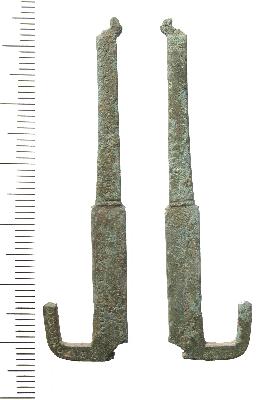
In this episode, we look at some dirty riddles from Anglo-Saxon England and a fart so powerful that it blinded a man.
For translation and commentary on the riddles, see:
https://theriddleages.wordpress.com/riddles-by-number/
For a good book on the Exter Book, check out:
https://amzn.to/3dT4jr9
For a cheap translation of the Canterbury Tales, here:
https://amzn.to/3dUeuMm
For updates on episodes, follow me on twitter: https://twitter.com/wjb_mattingly
If you want to reach me, my email is themedievalworldpodcast@gmail.com
Music:
Heavy Interlude by Kevin MacLeod is licensed under a Creative Commons Attribution license (https://creativecommons.org/licenses/by/4.0/)
Source: http://incompetech.com/music/royalty-free/index.html?isrc=USUAN1100515
Artist: http://incompetech.com/

In this episode, we look at an account of a hobgoblin in ninth-century France. This account comes from a ninth-century Carolingian author named Notker who wrote a biography of Charlemagne.
For a copy of Notker's biography, see:
https://amzn.to/2zXobLl
I also reference the M.A. Thesis of a certain Klayton Amos Tietjen at the University of Tennessee. For this thesis, see:
https://trace.tennessee.edu/utk_gradthes/4784/
For updates on episodes, follow me on twitter: https://twitter.com/wjb_mattingly
If you want to reach me, my email is themedievalworldpodcast@gmail.com
Music:
Heavy Interlude by Kevin MacLeod is licensed under a Creative Commons Attribution license (https://creativecommons.org/licenses/by/4.0/)
Source: http://incompetech.com/music/royalty-free/index.html?isrc=USUAN1100515
Artist: http://incompetech.com/

In this episode, we look at birds generally as they existed in the minds of medieval people. We talk about the different ways in which medieval people hunted, ate, used, and envisioned birds.
For Valerie Garver's book, Women and Aristocratic Culture in the Carolingian World, see:
https://amzn.to/36D8Bk6
For updates on episodes, follow me on twitter: https://twitter.com/wjb_mattingly
If you want to reach me, my email is themedievalworldpodcast@gmail.com
Music:
Heavy Interlude by Kevin MacLeod is licensed under a Creative Commons Attribution license (https://creativecommons.org/licenses/by/4.0/)
Source: http://incompetech.com/music/royalty-free/index.html?isrc=USUAN1100515
Artist: http://incompetech.com/

Comments

Download from Google Play

Download from App Store
 United States