DiscoverThe Dream Job
The Dream Job
Claim Ownership

The Dream Job

Author: Rami Wehbi, DO

Subscribed: 89Played: 457
Share

Description

The Dream Job Podcast by Match Day Health helps you land your dream career. Each week, gain insights from industry experts, career coaches, and successful professionals. Tune in for practical advice, inspiring stories, and insider tips to guide you to your dream job.

To learn more visit https://www.matchday.health/
76 Episodes
Reverse
In this episode, I’m joined by Dr. Nirav Shah, a neurologist turned health tech innovator. Dr. Shah shares his incredible journey from stroke neurologist to founding a startup that transformed patient care with wearable tech. We dive into how he built software that integrates FDA-approved devices for remote monitoring, allowing ICU-level care from home. Dr. Shah breaks down the challenges of launching a healthcare startup and the shift in patient care through remote monitoring.Quotes:"Wearables aren’t just gadgets—they’re game-changers in chronic care management." - Dr. Nirav Shah"We built a platform to bring ICU-level care right into patients’ homes." - Dr. Nirav Shah"The shift to remote monitoring isn’t just about convenience—it’s about saving lives." - Dr. Rami"Tech is finally catching up to medicine, and we’re just getting started." - Dr. Nirav Shah"The future of healthcare is about getting ahead of disease, not just reacting to it." - Dr. RamiShow Notes:How wearable tech is revolutionizing remote patient care.The role of wearables in providing ICU-level monitoring at home.The future of chronic disease management with remote technology.The process of building a successful health tech startup.The impact of FDA-approved devices on patient outcomes.Links:https://www.matchday.health/ https://www.physicianonfire.com/ 
In this episode, I'm joined by Dr. Mohit Joshipura, the VP of Clinical Affairs at OpenLoop. Mohit shares his incredible journey from practicing internal medicine to becoming a key player in the digital health space. We dive deep into the world of clinical operations and what it takes to transition from a traditional medical career to leading in health tech. If you're looking to pivot your career and want to understand the nuts and bolts of clinical operations, this episode is a goldmine.Quotes:"You can’t be experienced without getting experience. Sometimes, you just need someone to take that leap of faith in you." - Dr. Mohit Joshipura"As clinicians, we tend to underestimate ourselves when it comes to getting involved beyond the exam room." - Dr. Mohit Joshipura"The transition from being a clinician to a health tech operator is far easier than the reverse." - Dr. Mohit Joshipura"In health tech, every conversation and LinkedIn update is an opportunity to grow your brand." - Dr. Mohit Joshipura"It’s like residency all over again baptism by fire, drinking from a fire hose, building a plane while flying it." - Dr. Mohit JoshipuraShow Notes:The challenges of transitioning from clinical practice to digital health.How to build a career in clinical operations.The importance of cross-functional communication in health tech.Why humility and adaptability are key in the startup world.How to balance clinical rigor with operational demands.Links: https://www.matchday.health/https://www.linkedin.com/in/mohit-joshipura-md-9083201/https://openloophealth.com/?utm_source=linkedin 
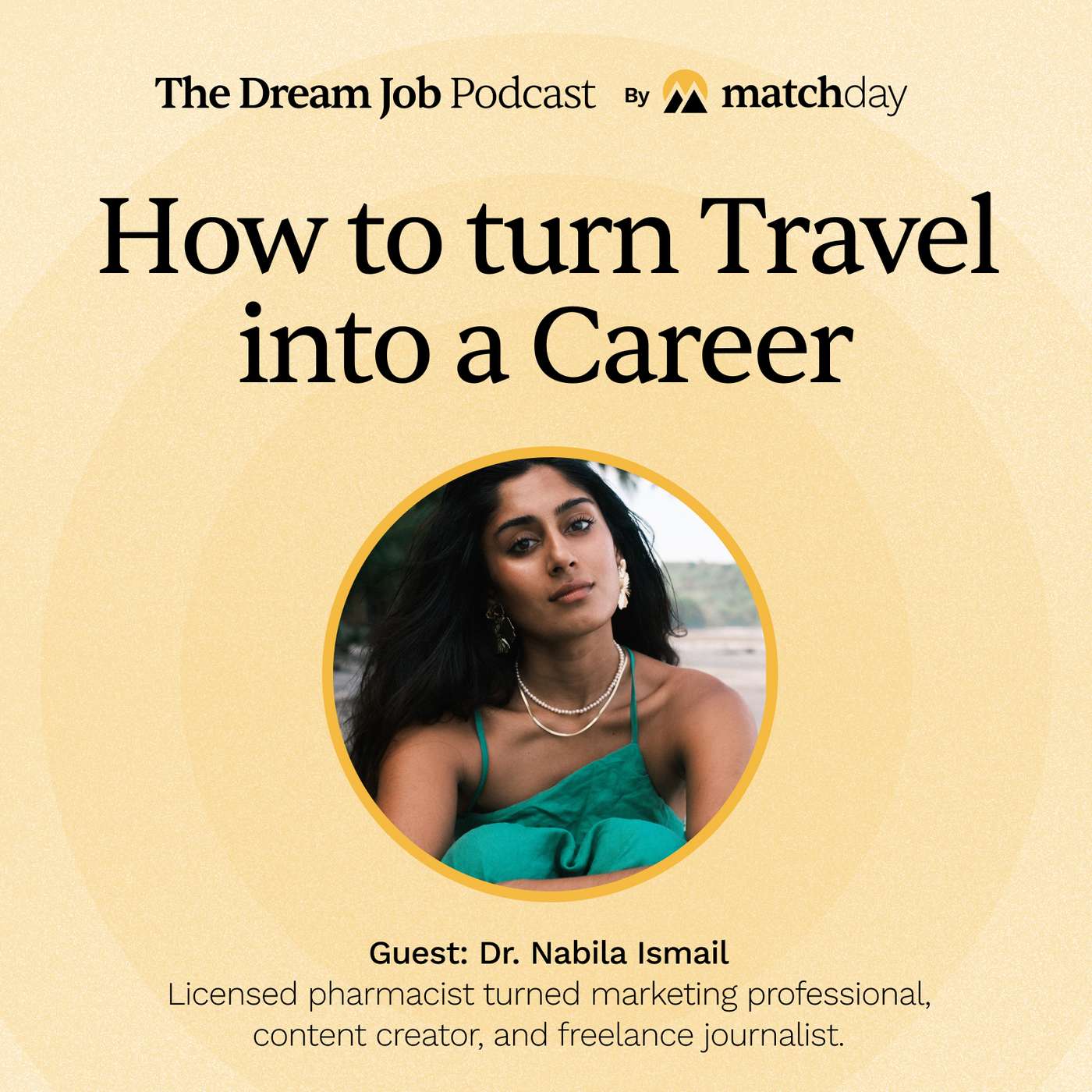
Today, we're diving into a transformative journey with Dr. Nabila Ismail, and how she Turned Travel Into a Career. Nabila is a pharmacist turned entrepreneur and travel enthusiast. We explore her bold transition from a traditional pharmacy career to a multifaceted role in marketing, travel, and consulting. Learn how she navigated the challenges of pivoting careers, leveraged her unique skills, and embraced a life of passion and purpose.Quotes:"Staying curious and talking to people outside your field can open doors you never knew existed." – Dr. Nabila Ismail"Once you make one pivot, you realize it’s possible, and it gets easier to dream bigger." – Dr. Nabila Ismail"Don't wait for the perfect moment; create a better future for yourself one step at a time." – Dr. Nabila IsmailShow Notes:Transitioning from a pharmacy career to entrepreneurshipThe role of curiosity and networking in career developmentBuilding a personal brand and leveraging social mediaBalancing professional goals with personal passionsOvercoming fear and embracing changeHow to use your unfair advantage in the healthcare industryConnect with Dr. Nabila Ismail:https://www.linkedin.com/in/nabila-ismail-pharmd/ https://doseoftravel.co/ Links:https://www.matchday.health/
In today's episode, I'm thrilled to welcome Tiffany Ashton, a seasoned professional in the clinical research industry, who has spent over 20 years navigating and mastering her career path. Tiffany shares her journey from Clinical Research Coordinator to Clinical Trial Manager and offers invaluable insights into various roles within clinical research, including the highly coveted Clinical Research Associate (CRA) position."Clinical research is a vast field, and there's a role for everyone. The key is finding where you fit best and building your expertise from there."Tiffany talks about the day-to-day responsibilities of a Clinical Trial Manager, the importance of resilience and adaptability, and the potential career paths and salary expectations in this field."We often think of clinical research as just doctors and patients, but there's a whole ecosystem behind the scenes making it all possible."Quotes:"Clinical research is a vast field, and there's a role for everyone." - Tiffany Ashton"We often think of clinical research as just doctors and patients, but there's a whole ecosystem behind the scenes making it all possible." - Tiffany AshtonShow Notes:Exploring career paths in clinical research: CRC, CRA, CTMThe daily life of a Clinical Trial ManagerEssential qualities for success in clinical researchSalary expectations and career progressionThe role of Medical Science Liaisons and Medical MonitorsStrategies for breaking into the clinical research fieldLinks:https://www.matchday.health/https://www.linkedin.com/in/tiffany-ashton-clinessentials/https://clinessentials.com/New to Clinical Research and Want to Learn More?https://clinessentials.com/new-to-clin-res/ Join Tiffany for the next Clinical Trial Manager Training Course:https://clinessentials.com/ctm-training-course/
Join Dr. Rami and Luke Snedeker as they discuss the booming field of clinical research and how healthcare professionals can transition into rewarding roles as principal investigators. Learn about the importance of diversity in trials, the various paths to starting your own research site, and the immense opportunities available for clinicians. Perfect for anyone looking to explore new horizons in their medical career.Quotes:"Clinical research gives people hope. It offers another opportunity to engage with their doctors beyond the standard of care." - Luke Snedeker"We need more patients enrolled in studies and there's more studies starting than existing sites can handle right now." - Luke Snedeker"If you want to get involved as a physician, there's lots of people that want to work with you. Just do your due diligence." - Luke SnedekerShow Notes:The journey from medical assistant to CEO of a clinical research site.Key qualities needed for success in clinical research.How to leverage your practice to start a clinical research site.The critical role of diversity in clinical trials.Opportunities for international medical graduates in research.Exploring part-time and full-time roles in clinical research.Links: https://www.matchday.health/https://www.matchday.health/post/clinical-research-insights-luke-snedeker
Welcome back to The Dream Job Podcast by Match Day Health! After a break in 2022, we're excited to return with a fresh focus to help you land your dream career. Formerly known as Beyond Medicine, our podcast now brings you insights from industry experts, career coaches, and successful professionals.In this episode, we introduce our new direction, aiming to provide practical advice, inspiring stories, and insider knowledge. You'll hear from guests who have navigated their career paths and share actionable tips to help you achieve your dream job.Subscribe to The Dream Job Podcast on Spotify or your favorite platform, and join us each week for more insights and inspiration. Your dream job is just a podcast away!
To join our private health community. Check out https://www.beyondmedicinegroup.com/Casey Mcpherson is a Musician and Artist on a mission to find a cure for his daughter Rose. Rose is a 6-year-old girl who was born with a rare genetic disease. Faced with a grim prognosis, Casey set out on a path to find a cure for his daughter by starting a lab a building a team to find a cure. You can learn more about Rose here at the To Cure a Rose Foundation. To connect with Casey, you can find him on Linkedin here. https://www.linkedin.com/in/caseymcpherson/Episode Notes:1. What is the story of Casey and Rose. 2. The problem with rare genetic disease funding.3. Running a genetic disease research company.4. The moment of diagnosis. Facing denial. Grieving. Finding Purpose. 5. What is Rose like.6. The problems of finding a cure for rare genetic diseases. 7. How does gene therapy work?8. What Casey has learned in this process. 
Doctors, Founders, Health-Tech nerds. Join our group to find a collaborative/supportive community to help guide you and support you in your health-tech journey. We share job postings, consulting opportunities, articles, news, and content and facilitate networking. Join our community at https://www.beyondmedicinegroup.com/community
To become part of the Beyond Medicine community join us at www.beyondmedicinegroup.comDr. David Canes is a fellowship-trained Urologist who specializes in cancers of the prostate, kidney, and bladder. Dr. Canes is among the most experienced robotic surgeons in the Greater Boston area.David is the Founder of Wellprept a SAAS company built to help unburden doctors from distributing patient information. To learn more about David, you can check out his website here @ https://drcanes.com/To learn more about Wellprept visit https://wellprept.com/
Join the BMG community at https://www.beyondmedicinegroup.com/Watch the full episode on YouTube & Subscribe! https://www.youtube.com/channel/UCpbRzNdbtHJMfhPfCi12qWwMaxwell is a Resident Physician (PGY3) at Emory University receiving training in both diagnostic and interventional radiology. He is also the host of The DaVinci Hour Podcast where here interviews physicians, executives, medtech innovators, and entrepreneurs making an impact on healthcare. Maxwell is passionate about medical innovation and currently working as a Co-PI on a grant-funded medical device development project involving a collaboration between Emory and Georgia Tech.To learn more follow maxwell at:The DaVinci Hour Podcasthttps://www.dviacademy.com/the-davinci-hourDaVinci AcademyYouTube: https://www.youtube.com/c/DaVinciAcademyMedWebsite: https://www.dviacademy.com/My social accounts:IG: @maxwellcoopermdLinkedIn: https://www.linkedin.com/in/maxwellcoopermd/
Dr. Komatireddy is passionate about providing real end-to-end lifestyle and behavioral change support for patients looking to live healthier and more fulfilling lives.  To learn more about Dr. Komatireddy and connect with a precision behavioral change team, visit daytona.healthJoin the BMG community at https://www.beyondmedicinegroup.com/
Dr. David Mou is the Chief Executive Officer of Cerebral, a leading tele-mental health company committed to improving access to high quality care. In addition to his leadership at Cerebral, David is on faculty at Harvard Medical School and serves as the Director of the Innovations Council for Massachusetts General Hospital's Psychiatry Department. Previously, David was President, Co-founder and Chief Medical Officer of Valera Health, a tele-mental health service that was able to reduce hospitalizations for patients with serious mental illness. David has been named 'Top 10 under 35 for Healthcare' by LinkedIn, as well as '40 under 40' for healthcare innovation by MedTech Boston. David is a Soros Fellow, a Gates Scholar, a Horatio Alger National Scholar, and a member of World Economic Forum Global Shapers and the Academy of Achievement. He graduated from Harvard College with a degree in neurobiology, and earned his MD MBA from Harvard Medical School and Harvard Business School. His writings have appeared in the New England Journal of Medicine and Stat.If you are a Physician, Founder or Investor in digital health then head to beyondmedicinegroup.com to join the community!
Jani is passionate about helping people make more informed healthcare decisions. After having a family member fall ill from a preventable condition, Jani co-founded imaware™ in 2018 to empower individuals to proactively screen for health conditions such as cardiovascular diseases and autoimmune conditions from their own homes in order to engage their doctors sooner.The mission of imaware™ is to reduce the number of individuals with undiagnosed illness through at-home screening. Utilizing small-volume sample collection, and microarray lab-testing equipment with high sensitivity and specificity, imaware™ provides consumers actionable reports and insights. Once aware of their health and data, patients can engage their doctors sooner to treat and manage these conditions.If you're interested in learning more about health-tech and networking with founders, investors, & other physician innovators you can submit our form at www.beyondmedicinegroup.com/community
Visit the Beyond Medicine Group website: beyondmedicinegroup.com
Today, we are joined by Dr. Daniel Paull. Dr. Paull is an orthopedic surgeon, founder and CEO of Easy Orthopedics.A surgeon by training, and a medical field disruptor by passion and author of the book, So You got Into Medical School…Now What?I have been following his Linkedin posts for quite a while and I resonate deeply with his posts, that's why I brought him to the show today.   Are today's doctors softer than old-fashioned doctors? We talk about the constant fears and doubts that surround us after residency and the widespread "Pseudo stability trap" that we, as physicians, still believe in. We talk about our personal experience with an existential crisis and Dr. Paull tells us what helped him overcome his.Quotes: "Look, when you're seeing a patient,there's an algorithmic ways to treat somebody, but you have to take into account their social, their economic, and their emotional situation. And that's where the kind of art of medicine comes in." - Dr. Daniel Paull "I think that's where a lot of the disconnect is where someone says, I don't like practicing medicine. Really what they might be is they don't like practicing medicine the way they are practicing it now. There's a big disconnect from how you kind of learn what medicine maybe should be like in medical school to how it's actually carried out in residency afterwards" - Dr. Daniel Paull"I mean, nobody really forms a business because things are good. You form it because things aren't good. There's a problem either where you're working or there's some problem you're trying to solve or something's not going right." - Dr. Daniel Paull"To make it through medical training, you have to be so stubborn. Like, I thought I was one of the most stubborn people I knew. And then I went to med school. I'm like, oh, everybody's stubborn." - Dr. Daniel Paull"We need people out not only seeing patients, but we need people on the other side of things, developing technology, working with big business, fighting for physician rights and trying to make a better system, because the reason we're in this mess in the first place is because doctors decided not to care about business. - Dr. Rami"If you don't focus on the business part of your practice, somebody else will do it for you. And you probably won't like it" - Dr. Daniel Paull"When you go on your residency interview, take note of how happy the people are when you're interviewing. And if all of them are happy, it's probably good. If they're all miserable, don't go there because you're not going to be an outlier, you will be miserable too." - Dr. Daniel PaullShow Notes: The reasons for an existential crisis What helped Dr. Paull overcome his existential crisis What is destroying your health The constant fears and doubts that surrounds us after residency The reality of medicine today Why you should be a disruptive type The "pseudo stability trap"How its to be a doctor and be part of the status quo at the same time The difficulties of speaking out about the system that you are in The  disagreements between doctors in orthopedics Are today's doctors softer than old fashioned doctors? How the residency works When do you need an MBALinks:https://easyorthopedics.com/Buy Dr. Paull's book on Amazon: https://www.amazon.com/You-Into-Medical-School-What/dp/0990940047/ref=sr_1_fkmrnull_1?crid=1TSQFDZHEAG3V&keywords=so+you+got+into+medical+school+now+what&qid=1554077339&s=gateway&sprefix=so+you+got+into+me%2Caps%2C163&sr=8-1-fkmrnull
Intro:Dr. Aleah and I dive deep into the difficulties, misconceptions and everything that we believe is wrong with medicine. "None of us know how to market ourselves or find the right people because, you know,  we've been brainwashed. Thats just like, you are a clinician, thats what you are."Dr. Aleah shares some of the most common problems with our medical curriculum and the importance of have skills that complement your medical career. We have an honest conversation about the barriers that we face as doctors, why doctors should know about finances and how to make extra real money during medical residency. "We already know this, that hospital systems make a lot of money off of residents and the care that they provide"  We talk about the insane and overwhelming medical residency journey and how to keep your sanity during the process. How to take calculated risks, and the danger of over self-sacrifice and not having boundaries in medicine. Quotes: "I'd rather watch the system burn, than see all my colleagues burn" - Dr. Rami"If you actually finish your medical degree and then don't do residency, you actually cant even volunteer to help people " - Dr. Rami"Boundaries are good but we cant put a boundary with patients" - Dr. Aleah"Boundaries tend to benefit both parties, maybe not initially, but in the long run they do" - Dr. AleahShow notes:The importance of business in medicine; The emergence of the gig economy for clinicians; The barriers that we face as doctors; How to make extra real money during medical residency;How to be resilientThe importance of boundaries in medicine.
Kyle Claussen is the CEO of Resolve, a company that assists, ensures and advises doctors as they transition in their medical careers.   Medical school can be very challenging and difficult, you go through a very exhausting process just to realize in the end that you were not prepared for negotiating a contract, the pitfalls of non-compete agreements or any part of the business side of medicine. That's why Resolve exists. Kyle explains to us how the the lack of preparation and training disadvantages and disempowers doctors.Finding the right practice, analyzing an opportunity and negotiating a contract, are some of the features Resolve offers to help physicians around the country. Find out more at Resolve or to use their services, click here: https://www.resolve.com/ use the discount code BM10 for 10% off any of their services.
Rusha Modi MD MPH is a physician, public health expert, patient advocate, and digital health consultant focused on the conversations that can push society forward and make us stronger at the broken places.Dr. Rusha and I dive into the world of politics, why it's important for physicians to play a active role in politics and some politically sensitive topics around vaccine mandates and Trump's 2024 political campaign. Sponsors:Resolve Physician Agency: Use code BM10 for 10% off any services listed on their site. Click here to visit the site!
Dr. Ann Tsung, NASA flight surgeon and part-time emergency medicine and critical care physician, discusses tips for fulfillment, productivity and following one’s curiosity. Dr. Tsung remembers being fascinated by outer space ever since she was nine years old. Motivated by her background as the immigrant daughter of a single mother, Dr. Tsung had an intense commitment to her goals — a commitment that, today, manifests in “habit-stacking.” She often wakes up at around 5 a.m., takes a cold shower, then tackles her hardest task of the day. As a flight surgeon, Dr. Tsung helps astronauts reach peak performance in space flight by following them through pre-training and going through launch and landing. While astronauts are in space, flight surgeons sit at mission control for eight-hour shifts to be there for any medical contingencies. “We’re basically their primary care physician, but a little bit more because we learn the physiological changes of space,” NASA flight doctors have specialized practice in the effects of g-force, vibrations and radiation on astronauts’ bodies. Dr. Tsung had initially planned to be an emergency medicine physician full-time but, after completing her residency, felt that something was missing. So she returned to her passion for space, and urged listeners to follow their gut instincts too. To connect with Dr. Tsung, follow her on LinkedIn.
Ruby is a seasoned commercial health exec in the biotech, healthcare and healthtech industries. She is CEO and Co founder of MDisrupt, the world’s first platform for connecting clinicians and scientists with digital health companies. After working with high profile companies including 23andMe, Ruby has expert insights when it comes to how tech and healthcare collide.
loading
Comments