



 Claim Ownership
The Geek In Review
Subscribed: 28Played: 2,504
Subscribe

© Greg Lambert & Marlene Gebauer
Description
Welcome to The Geek in Review, where podcast hosts, Marlene Gebauer and Greg Lambert discuss innovation and creativity in legal profession.
330 Episodes
Reverse
In this year-end episode of The Geek in Review, hosts Marlene Gebauer and Greg Lambert are joined by legal tech experts Niki Black, Principal Legal Insight Strategist at AffiniPay, and Sarah Glassmeyer, Director of Data Curation at Legal Technology Hub, to recap the top stories of 2024. From the evolution of generative AI in legal tech to groundbreaking acquisitions, the conversation delves into the successes and challenges that shaped the year in the legal industry.
The discussion kicks off with a look at AI's growing role in legal research and practice management. Greg recalls the controversial Stanford report that questioned the reliability of AI tools marketed as hallucination-free. The guests explore the importance of unbiased evaluations, the complexity of defining legal research, and the rapid pace of AI development that often outpaces regulatory and academic studies. Sarah highlights the need for peer-reviewed analysis to guide the effective use of these tools, while Niki emphasizes the user-friendly interfaces that generative AI brings to legal software.
Marlene shifts the conversation toward the challenges of integrating AI into law firms’ existing frameworks. The hosts and guests discuss the hesitancy of document management systems to adopt generative AI due to trust and security concerns. Niki and Sarah examine how firms are adapting to AI by organizing data more effectively and addressing client expectations. They also reflect on the potential of AI to bridge access-to-justice gaps, with tools that empower self-represented litigants and underserved communities.
The episode takes a closer look at notable mergers and acquisitions in 2024, such as Bloomberg’s acquisition of Dashboard Legal and Thomson Reuters’ purchase of SafeSign Technologies. Sarah raises concerns about the consolidation of the legal tech market, warning of diminished innovation and competition. Niki observes how cloud-based technologies have facilitated these integrations, making it easier for companies to offer comprehensive solutions that touch multiple aspects of legal practice.
Wrapping up, the group forecasts trends for 2025, including regulatory developments around AI and shifting priorities within law firms regarding tech adoption. While some predictions are cautious, like Sarah’s concern over the impact of external political factors on the tech workforce, others remain optimistic about the growing sophistication of legal tech. The episode concludes with reflections on how the industry can better prepare junior lawyers and law students to navigate an increasingly AI-driven landscape.
Join Marlene, Greg, Niki, and Sarah for this insightful look back at 2024 and an exciting glimpse into the year ahead. As always, we thank our listeners for tuning in, and we encourage you to share this episode with colleagues and connect with us on LinkedIn or Blue Sky!
Listen on mobile platforms: Apple Podcasts | Spotify | YouTube
Twitter: @gebauerm, or @glambertEmail: geekinreviewpodcast@gmail.comMusic: Jerry David DeCicca
TRANSCRIPT

This week we welcome back Laura Leopard and Phil Flora from Leopard Solutions to discuss their latest innovation, the PROWESS platform. This newly launched tool aims to transform the way corporate legal departments manage and evaluate their relationships with outside counsel. As Leopard Solutions embarks on this new phase after its acquisition by SurePoint, Laura and Phil delve into how PROWESS brings unprecedented capabilities to legal teams by centralizing data, enhancing decision-making, and simplifying the selection process of legal talent.
Laura explains that the PROWESS platform was born out of the need to streamline the outdated methods many in-house legal teams use to locate outside counsel. Rather than relying on personal contacts or spreadsheets, PROWESS leverages Leopard Solutions' extensive database of over 6,000 law firms to offer data-driven insights. The platform allows legal departments to search for attorneys and law firms by specialization, diversity metrics, and even billing structures, providing a comprehensive overview that helps corporate counsel make informed, strategic choices for their legal needs.
One of the key features of PROWESS is its 360-degree firm report and ranking system, powered by Leopard Solutions' unique data-driven methodology. Phil explains how the platform’s rankings go beyond traditional metrics, focusing on firm growth, retention, and diversity within the attorney ranks. By incorporating continuous updates and client feedback, the ranking system serves as a real-time indicator of a firm’s standing in the market. Over time, the platform will enable in-house teams to provide feedback on engagements, further refining the rankings and enabling firms to showcase the quality of their work.
The PROWESS platform also offers law firms an opportunity to proactively market their strengths. Law firms can contribute their own data to the platform, such as alternative fee arrangements and attorney billing rates, which helps them stand out in searches. Laura and Phil highlight how this “passive marketing” tool allows firms to differentiate themselves in a competitive market, as corporate clients can explore and assess options they may not have previously considered. Phil emphasizes that this feature is particularly valuable for smaller and mid-sized firms, allowing them to compete alongside larger firms by showcasing their specific expertise.
In closing, Laura and Phil share their vision for the future of PROWESS. They envision it evolving into a more comprehensive marketplace, potentially allowing firms to bid on posted matters. Both are excited about the potential for increased transparency and efficiency in the legal industry as PROWESS matures, facilitating stronger relationships between law firms and in-house legal teams. With plans to integrate AI-driven features and client feedback mechanisms, Leopard Solutions is poised to shape the future of legal talent management and engagement.
Listen on mobile platforms: Apple Podcasts | Spotify | YouTube
Twitter: @gebauerm, or @glambertEmail: geekinreviewpodcast@gmail.comMusic: Jerry David DeCicca

This week, we talk with a team of innovation leaders from the law firm Faegre Drinker. The guests included Shawn Swearingen, Chief Innovation Officer; David Gross, Design Lab co-founder; and Ruben Gonzalez, Design Lab Director. The discussion centered around the relaunch of Faegre Drinker's Legal Design Lab in Scottsdale, Arizona, exploring its origins, evolution, and impact on legal problem-solving.
The Legal Design Lab's inception traces back eight or nine years when an associate at the firm, Helen Chacon, reconnected with her Stanford Law School friend Margaret Hagan, who was pioneering the concept of legal design. Intrigued by the idea of applying design thinking—a user-focused, empathetic approach to problem-solving long used in other industries—to the legal field, the firm embarked on a deep dive into the methodology. This included David (DJ) Gross auditing courses at Stanford's D-School and team members like Kate Rozavi designing courses on visual advocacy at the University of Minnesota Law School.
The relaunch and relocation of the Design Lab to Scottsdale were influenced by several factors, notably the firm's merger that expanded its geographic footprint and the practical considerations brought about by the COVID-19 pandemic. The move allowed the firm to acquire a significantly larger and more cost-effective space. With input from architects, designers, and Margaret Hagan herself, the new lab was designed to be a flexible, creative environment featuring movable furniture and an industrial aesthetic, fostering collaboration and innovation.
Throughout the podcast, the team shared concrete examples of how design thinking has been instrumental in solving complex legal challenges. One such example involved simplifying a profitability tool for lawyers by using a color-coded system akin to credit score reports, making it more accessible and actionable. Another highlighted the use of tennis balls to demystify crystallography during a jury trial, showcasing how visual aids and empathetic explanations can lead to successful outcomes. These instances underscore the lab's focus on user-centric solutions and visual advocacy to enhance understanding and efficiency in legal processes.
The guests also discussed the challenges of integrating design thinking within the traditional legal framework, particularly in encouraging open-mindedness and collaborative participation among lawyers and clients. They emphasized the importance of a learning mindset, active listening, and the willingness to embrace creativity and risk-taking. To further disseminate these ideas, the team mentioned an eBook available on their website, aimed at introducing legal professionals to design thinking and visual advocacy concepts.
Links:
Faegre Drinker Design Lab video
Faegre Drinker Picks Arizona for the Next-Gen Design Lab, American Lawyer
E-book – Design Thinking and Visual Advocacy for Lawyers Two Point Oh! (FREE)
Innovations in Visual Advocacy – Leading the way for design thinking in law, Harvard Law School Center on the Legal Profession.
Advancing Company Goals – Design sprints that unlock Innovation, Corporate Counsel.
Listen on mobile platforms: Apple Podcasts | Spotify | YouTube
Twitter: @gebauerm, or @glambert
Email: geekinreviewpodcast@gmail.com
Music: Jerry David DeCicca
Transcript

In this episode of The Geek in Review, hosts Greg Lambert and Marlene Gebauer, along with special co-host Toby Brown of DV8 Legal Strategies, discuss the subscription-based legal services model with Mathew Kerbis, founder of Subscription Attorney, LLC, and Jack Shelton, co-founder of Aegis Space Law. The guests share their experiences and insights on adopting a subscription-based model as an alternative to the traditional billable hour.
Mathew Kerbis explains that his inspiration for transitioning to a subscription and flat fee model stemmed from the realization that many attorneys, including himself, could not afford their own billable rates. He emphasizes the importance of automating processes and leveraging technology to manage workflow and client needs efficiently, especially when offering lower-priced services.
Jack Shelton, whose firm focuses on the commercial space industry, shares his motivation for adopting a subscription model. He highlights the benefits of predictability and cost transparency for clients, particularly startups and small to medium-sized businesses. Shelton also discusses the development of in-house software to streamline complex analyses and improve accuracy and record-keeping for clients.
The guests explore the challenges and opportunities of scaling and sustaining a subscription-based model. Kerbis notes that the model is highly sustainable due to the predictability of monthly recurring revenue, while Shelton emphasizes the importance of refining processes and forms to ensure efficiency and effectiveness.
Looking to the future, Kerbis predicts that the rapid advancement of AI and the changing nature of legal practice will lead to a significant shift in the industry within the next five years. He suggests that if big law firms do not adapt, there may be a mass exodus of young associates seeking better work-life balance and the opportunity to start their own practices. Shelton, while agreeing with Kerbis to an extent, remains cautious about predicting a flood of lawyers leaving big law due to their risk-averse nature.
Listen on mobile platforms: Apple Podcasts | Spotify | YouTube
Contact Us: Twitter: @gebauerm, or @glambertEmail: geekinreviewpodcast@gmail.comMusic: Jerry David DeCicca
Transcript
In this episode of The Geek in Review, we sit down with Narrative founder John Tertan to talk about law firm pricing, messy data, and why substance matters more than shiny tools. We pick up from our first meeting at the Houston Legal Innovators event, where John had the pricing and KM crowd buzzing, and ask what he is hearing from those teams as they look toward 2026. John explains how Narrative focuses on “agentifying” business-of-law work, starting with pricing and analytics, so firms stop guessing and start grounding decisions in better data. The goal is simple, improve decisions for pricing teams, finance, marketing, and partners who want to win work that also makes financial sense.John walks through the pain points that drive firms to seek out Narrative, from low realization and high write-offs to tedious non-billable work and a lack of trust in the data behind pitches and budgets. Many firms track key metrics in scattered spreadsheets, checked once in a while rather than used as a daily guide for strategy. Narrative steps into that gap by improving the accuracy of historical matter data, identifying the right reference matters for new proposals, and supporting alternative fee structures. John explains how this foundation supports better scoping, more confident pricing conversations, and far stronger alignment between firm goals and client expectations.We also dive into John’s founder journey, which runs from Freshfields associate to innovation work, then through venture-backed tech in other sectors before returning to legal. That mix of big law, startup experience, and prior success with HeyGo shapes how he builds Narrative. John talks about serving “mature customers” who expect more than a slick interface, they expect real understanding of their business, their politics, and their constraints. Relationships sit at the center of his approach, not only with clients and prospects, but also with advisors, former firm leaders, and legal tech veterans who guide both product and go-to-market strategy.The name “Narrative” is no accident, and John explains why time entry narratives sit at the heart of his product. Those lines of text describe what lawyers did, for whom, and why, yet they often sit underused in billing systems. Narrative improves and structures that data, then uses it to highlight scope, track what remains in or out of scope, and surface early warnings when matters drift away from the original plan. John talks through the life cycle, from selecting comparable matters, through modeling AFAs and scenarios, to monitoring work in progress and feeding lessons back into future pricing efforts. Along the way, better transparency supports stronger trust between partners and clients.We close by asking John to look ahead. He shares his view on how firms will move toward more sophisticated pricing models and better measurement, while the billable hour continues to evolve rather than vanish overnight. Stronger baselines, cleaner matter histories, and better tracking create room for fee caps, success components, and other structures that clients want to sell internally. John also shares how he stays informed through alerts, networks, and a new chief of staff who helps turn those insights into resources for pricing and finance professionals. For listeners who want to learn more or follow Narrative’s work, John points them to narrativehq.com and invites outreach from anyone wrestling with data, pricing, or margin questions inside their own firm.Listen on mobile platforms: Apple Podcasts | Spotify | YouTube[Special Thanks to Legal Technology Hub for their sponsoring this episode.]Email: geekinreviewpodcast@gmail.comMusic: Jerry David DeCicca

This week on The Geek in Review, we bring together a trio of Canadian legends from the legal web to celebrate the 20th anniversary of the Canadian Law Blog Awards, better known as the Clawbies. Steve Matthews of STEM Legal and Slaw.ca, Sarah Sutherland of Parallax Information Consulting and former president and CEO of CanLII, and legal market analyst and Substack author, Jordan Furlong join us to talk about how legal publishing has changed over two decades and where it heads next. Along the way, we share a little host pride, since 3 Geeks and a Law Blog picked up a Friend of the North Clawbies back in 2011. Canada remembers, even if the trophy cabinet looks a little full on our side of the border.We start with Steve’s long-running mantra: do not build your professional home on rented land. For years he pushed lawyers toward blogs and owned domains, warning that social platforms could change rules overnight or simply fall apart. That warning came into sharp focus as Twitter morphed into X and law Twitter scattered toward BlueSky, Mastodon, Threads and other venues. Jordan talks about deleting years of tweets rather than leaving a personal archive tied to a platform he no longer trusts, then describes how his own publishing shifted from long-form blogging at Law21 to a Substack newsletter model that feels more like a curated living room of engaged readers than a noisy town square.From there, Sarah introduces one of our favorite phrases in the episode, “law’s eternal September,” where a constant wave of new technology, including generative AI, keeps the justice system and the information world in permanent transition. We explore how legal publishers now balance automation and human judgment, with AI helping on classification, annotations, and summaries, while editors and authors still play a central role in verification and context. We share our own experience with AI-assisted prep for the show, and how a human guest had to correct outdated biographical details. That leads to a broader point about the need for trusted, non-AI sources that give researchers, lawyers, and readers a place to check facts and assumptions before sharing work with clients or the public.Jordan, Steve, and Sarah then turn to the Clawbies themselves and the theme they have set for the upcoming awards year: “the year of the truth teller.” In an era of disinformation, sloppy AI content, and reputation-damaging LinkedIn posts, lawyers and legal professionals gain real value by standing out as accurate, consistent voices who care about community as much as client work. Steve explains how the Clawbies now cover blogs, newsletters, podcasts, Tik Toks, and other formats, while still focusing on authenticity and public legal education. We also learn about the “humble Canadian rule,” where nominators highlight one to three other voices, while the organizers quietly take a closer look at the nominator’s own work in the background. The mission stays the same: surface new voices, new formats, and generous contributors who strengthen public conversation.We close with a look ahead. Steve predicts more structured, list-driven use of newer platforms like BlueSky for targeted conversations, while Sarah points to growing centralization as giants such as Thomson Reuters, LexisNexis, and Clio blend publishing and practice software. Jordan sees a fractured present, with silos and distrust, but also anticipates a future pull toward recombination, where readers gravitate to sources and bundles that feel trustworthy again. Through it all, the three guests encourage anyone interested in writing, podcasting, or other media to choose a format that fits personal strengths, commit to thoughtful output, and focus on truth-telling over pure marketing.[Special Thanks to Legal Technology Hub for their sponsoring this episode.] Email: geekinreviewpodcast@gmail.comMusic: Jerry David DeCicca

This week we welcome Jiyun Hyo, co-founder and CEO of Givance, for a conversation about moving legal AI past shiny summaries toward verified work product. Jiyun’s path runs from Duke robotics, where layered agents watched other agents, to clinical mental health bots, where confident errors carry human cost. Those lessons shape his view of legal tools today: foundation models often answer like students guessing on a pop quiz, sounding sure while drifting from fact.A key idea is the “last ten percent gap.” Many systems reach outputs that look right on first pass yet slip on a few crucial details. In low-stakes tasks, small misses are a nuisance. In litigation, one missing email or one misplaced time stamp risks ruining trust and admissibility. Jiyun adds a second problem: when users ask for a tiny correction, models tend to rebuild the whole output, so precision edits become a loop of fixes and new breakage.Givance aims at that gap through text-to-visual evidence work. The platform turns piles of documents into interactive charts with links back to source files. Examples include Gantt charts for personnel histories, Sankey diagrams for asset flows, overlap views for evidence exchanges, and timelines that surface contradictions across thousands of records. Jiyun shares early law-firm use: rapid fact digestion after a data dump, clearer client conversations around case theory, and courtroom visuals that help judges and juries follow a sequence without sketching their own shaky diagrams.Safety, supervision, and security follow naturally. Drawing on robotics, Jiyun argues for a live supervisory layer during agentic workflows so alerts surface while negotiations or analyses unfold rather than days later. Too many alerts, though, create noise, so tuning confidence thresholds becomes part of product design. On security, Givance works in isolated environments, strips identifiers before model calls, and keeps architecture model-agnostic so newer systems slot in without reopening privacy debates.The episode ends on market dynamics and the near future. Jiyun sees mega-funded text-first platforms as market openers, normalizing AI buying and leaving room for second-wave multimodal tools. Asked whether the search bar in document review fades away, he expects search to stick around for a long while because lawyers associate a search box with control, even if chat interfaces improve. The bigger shift, in his view, lies in outputs, more interactive visuals that help legal teams spot gaps, test case stories, and present evidence with clarity.Listen on mobile platforms: Apple Podcasts | Spotify | YouTube[Special Thanks to Legal Technology Hub for their sponsoring this episode.] Email: geekinreviewpodcast@gmail.comMusic: Jerry David DeCiccaTranscript:
We recorded this episode live at the TLTF Summit and the energy in the room made it feel like the perfect place for a conversation about growth, training, and the rapid climb of legal tech. We grabbed our gear, claimed a corner in the podcast room, and pulled in two guests with front row seats to the changes hitting the industry. Joining us were Kyle Poe from Legora and our friend and guest host, Zena Applebaum of Harbor. The Summit attracts a focused group of founders, investors, and leaders, and the four of us jumped straight into what this event represents and what attendees hope to get from it.Kyle had been on the job for only two months, but Legora moves at a pace that feels closer to dog years. In that short time the team doubled, a new round of funding closed, and the company introduced a major product release. Kyle walked us through Legora’s new Portal experience, which brings clients inside the legal workflow in a controlled, collaborative environment. Instead of long email chains and static work product, the Portal supports shared editing, direct review of diligence work, and a more responsive model for client engagement. In an era when clients expect quick turnarounds, this shift sets up a new dynamic for firms.Zena added helpful perspective from her prior trips to TLTF. She described the Summit as a place that rewards conversation, curiosity, and hallway exchanges. It is also a place to study the different stages of the legal tech journey, from early ideas on the startup stage to the seasoned players on the scale stage. She also brought timely news of Harbor’s acquisition of Encore Technologies, a move that strengthens Harbor’s ability to support training and adoption workflows across firms and corporate legal teams. Her focus on education paired well with Kyle’s insights on how Legora approaches enablement through its team of legal engineers.Training became the heart of the conversation. We compared old habits with the expectations of a generation of associates who have been taught to avoid AI until they enter a firm. Kyle stressed the need to anchor attorney training in real use cases and to give them early wins so they build trust in the tools. He described the shift from task-based training to workflow-based thinking. We also talked about how AI is influencing both the pace and structure of client service. Kyle shared examples of how Legora uses prior work product to build integrated workflows, such as interrogatory response generators that pull from a full library of past responses. This not only speeds up production but also increases consistency and helps attorneys understand the reasoning behind revisions. Zena pushed the idea even further, noting that these systems give associates a chance to study the rationale behind changes in a way that human reviewers rarely have time to provide. This leads to better training and stronger validation of the final work product.We closed with our crystal ball question. Kyle sees more adoption on the horizon but also anticipates uneven impacts across different practices as firms figure out how to adjust their business models. Zena pointed to the operational challenges ahead, especially the pressure to invest in data management and cloud infrastructure that supports true AI enablement. Her message was clear. If firms want the benefits later, they need to start organizing the foundations now. This episode blends optimism with realism, and it highlights the practical work ahead for firms, vendors, and everyone in between. Tune in for the full conversation and get ready for a lively discussion recorded right in the middle of the Summit buzz.Listen on mobile platforms: Apple Podcasts | Spotify | YouTube[Special Thanks to Legal Technology Hub for their sponsoring this episode.] Email: geekinreviewpodcast@gmail.comMusic: Jerry David DeCicca

In this episode of The Geek in Review, we welcome three powerhouse guests—Cas Laskowski, Taryn Marks, and Kristina (Kris) Niedringhaus—who are charting a bold course for Artificial Intelligence & the Future of Law Libraries. These three recently co-authored a major white paper, Artificial Intelligence and the Future of Law Libraries (pdf), which we see as less of a report and more of a call to arms. Together, we explore how law librarians can move from reactive observers of AI’s rise to proactive architects shaping its ethical and practical integration across the legal ecosystem.Cas Laskowski, Head of Research Data and Instruction at the University of Arizona College of Law, shares how the release of ChatGPT in 2022 jolted the profession into action. Librarians everywhere were overwhelmed by the flood of information and hype surrounding AI tools. Cas’s response was to create a space for collective thinking and planning: the Future of Law Libraries initiative and a series of roundtables designed to bring professionals together for strategic collaboration. One of the paper’s most ambitious recommendations—a centralized AI organization for legal information professionals—aims to unify those efforts, coordinate training, and sustain a profession-wide vision. Cas compares the idea to data curation networks that transformed academic libraries by pooling expertise and reducing duplication of effort.Kris Niedringhaus, Associate Dean and Director of the University of South Carolina School of Law Library, takes the conversation into education and training. She makes a compelling case that “AI-ready librarians,” much like “tech-ready lawyers,” need flexible skill-building models that recognize different levels of engagement and expertise. Drawing from the Delta Lawyer model, Kris calls for tiered AI training—ranging from foundational prompt literacy to higher-level data ethics and system design awareness. She also pushes back against the fear surrounding AI in academia, noting that students are often told not to use AI at all. We couldn’t agree more with her point that we’re doing students a disservice if we don’t teach them how to use these tools effectively and responsibly. Law firms now expect graduates to come in with applied AI fluency, and that expectation will only grow.When we turned to Taryn Marks, Associate Director of Research and Instructional Services at Stanford Law School’s Robert Crown Law Library, the discussion moved to another key recommendation: building a centralized knowledge hub for AI-related best practices. Taryn describes how librarians are eager to share materials, lesson plans, and policy frameworks, but the current efforts are fragmented. A shared repository would “reduce duplication of effort” and allow ideas to evolve through open collaboration. It’s similar to how standardized models like SALI help the legal industry align without giving away anyone’s secret sauce. We loved this idea of a commons where librarians, educators, and technologists work together to lift the entire profession.As we explored the broader implications, all three guests agreed that intentionality is key. Cas emphasizes that information architecture—the design of how knowledge is gathered, tagged, and retrieved—is central to AI’s success. Kris points to both the promise and peril of automated legal decision-making, warning that “done well, AI can expand access to justice; done poorly, it can amplify bias.” And Taryn envisions a future where legal information professionals are trusted collaborators across the entire lifecycle of data and decision-making.Listen on mobile platforms: Apple Podcasts | Spotify | YouTube[Special Thanks to Legal Technology Hub for their sponsoring this episode.] Email: geekinreviewpodcast@gmail.comMusic: Jerry David DeCicca

This week on The Geek in Review, Greg Lambert and Marlene Gebauer sit down to compare notes from a busy conference season. Marlene shares her experience at the American Legal Technology Awards where The Geek in Review was honored for excellence in journalism. She recounts the surreal joy of being recognized among friends and peers in legal tech, including fellow nominees like Steve Embry, and how a spontaneous speech turned out to be one of the night’s highlights. The duo reflects on how events like this underscore the sense of community that continues to define the innovation side of the legal industry.Greg takes listeners behind the scenes at ClioCon, describing it as one of the most energetic user conferences around. He dives into his conversation with Clio CEO Jack Newton and how the company’s recent vLex acquisition signals a bold expansion into the Big Law space. With $900 million in funding, Clio appears ready to bridge the divide between small-firm technology and enterprise-level workflows. Greg also teases an illuminating hallway chat with Ed Walters, now at Clio Library (formerly Fastcase), about the major leap forward in legal research accuracy driven by improvements in RAG (retrieval-augmented generation) and vector database indexing.Marlene offers her own takeaways from the Association of Corporate Counsel (ACC) Annual Meeting, where AI and governance dominated the agenda. She describes a landscape where in-house lawyers are wrestling with both the promise and peril of generative AI, from shadow AI concerns to data hygiene challenges. Her biggest surprise was seeing law firms themselves exhibiting at the ACC conference, signaling a shift toward direct engagement between firms and their corporate clients in shared learning spaces.Together, Greg and Marlene unpack the emerging themes of human-centered governance, the evolving role of AI in matter management, and the race among vendors to automate core workflows without losing the human touch. From Clio’s plans to build AI-driven workflow mapping that could auto-draft documents, to Marlene’s caution about how bespoke law firm processes might resist one-size-fits-all automation, their discussion paints a picture of a profession both accelerating and self-checking at once.The episode winds down with lighter reflections on travel mishaps, conference after-parties, and the long arc of Richard Susskind’s The End of Lawyers? conversation—still ongoing, now infused with cautious optimism about AI’s role in expanding access to justice. As always, they end where The Geek in Review thrives: at the intersection of humor, humility, and the hopeful chaos of legal innovation.Listen on mobile platforms: Apple Podcasts | Spotify | YouTube[Special Thanks to Legal Technology Hub for their sponsoring this episode.] Email: geekinreviewpodcast@gmail.comMusic: Jerry David DeCiccaTranscript:
Artificial intelligence has moved fast, but trust has not kept pace. In this episode, Nam Nguyen, co-founder and COO of TruthSystems.ai, joins Greg Lambert and Marlene Gebauer to unpack what it means to build “trust infrastructure” for AI in law. Nguyen’s background is unusually cross-wired—linguistics, computer science, and applied AI research at Stanford Law—giving him a clear view of both the language and logic behind responsible machine reasoning. From his early work in Vietnam to collaborations at Stanford with Dr. Megan Ma, Nguyen has focused on a central question: who ensures that the systems shaping legal work remain safe, compliant, and accountable?Nguyen explains that TruthSystems emerged from this question as a company focused on operationalizing trust, not theorizing about it. Rather than publishing white papers on AI ethics, his team builds the guardrails law firms need now. Their platform, Charter, acts as a governance layer that can monitor, restrict, and guide AI use across firm environments in real time. Whether a lawyer is drafting in ChatGPT, experimenting with CoCounsel, or testing Copilot, Charter helps firms enforce both client restrictions and internal policies before a breach or misstep occurs. It’s an attempt to turn trust from a static policy on a SharePoint site into a living, automated practice.A core principle of Nguyen’s work is that AI should be both the subject and the infrastructure of governance. In other words, AI deserves oversight but is also uniquely suited to implement it. Because large language models excel at interpreting text and managing unstructured data, they can help detect compliance or ethical risks as they happen. TruthSystems’ vision is to make governance continuous and adaptive, embedding it directly into lawyers’ daily workflows. The aim is not to slow innovation, but to make it sustainable and auditable.The conversation also tackles the myth of “hallucination-free” systems. Nguyen is candid about the limitations of retrieval-augmented generation, noting that both retrieval and generation introduce their own failure modes. He argues that most models have been trained to sound confident rather than be accurate, penalizing expressions of uncertainty. TruthSystems takes the opposite approach, favoring smaller, predictable models that reward contradiction-spotting and verification. His critique offers a reminder that speed and safety in AI rarely coexist by accident—they must be engineered together.Finally, Nguyen discusses TruthSystems’ recent $4 million seed round, led by Gradient Ventures and Lightspeed, which will fund the expansion of their real-time visibility tools and firm partnerships. He envisions a future where firms treat governance not as red tape but as a differentiator, using data on AI use to assure clients and regulators alike. As he puts it, compliance will no longer be the blocker to innovation—it will be the proof of trust at scale.Listen on mobile platforms: Apple Podcasts | Spotify | YouTube[Special Thanks to Legal Technology Hub for their sponsoring this episode.] Email: geekinreviewpodcast@gmail.comMusic: Jerry David DeCiccaTranscript:

Few people understand the intersection of legal practice, data analytics, and diversity like Catherine Krow, Managing Director of Diversity and Impact Analytics at BigHand. In this episode of The Geek in Review, hosts Greg Lambert and Marlene Gebauer sit down with Krow to trace her journey from a high-powered trial lawyer to an influential legal tech leader. After seventeen years at firms like Orrick and Simpson Thacher, Krow’s turning point came when a client challenged her team’s billing after a major courtroom victory—a moment that sparked her mission to fix what she calls the “business of law.”That single moment led to the creation of Digitory Legal, a company designed to give law firms the data and transparency they desperately needed but didn’t yet value. Krow describes how her framework—plan, measure, refine—became the basis for improving cost predictability and strengthening client trust. When BigHand acquired Digitory Legal in 2022, Krow’s vision found a larger stage. Now, her “data refinery” powers better pricing, resource allocation, and even equity within firms. As she explains, clean data doesn’t only improve profitability, it reveals hidden inequities in work allocation and helps firms retain their most promising talent.Krow also digs into one of her favorite topics: “data debt.” Law firms are drowning in data but starved for information. She explains how poor data hygiene—like inconsistent time codes and messy narratives—has left firms unable to use their most valuable resource. BigHand’s impact analytics tools attack this problem head-on, transforming raw billing data into usable intelligence that drives decision-making across finance, staffing, and diversity efforts. And while the technology is powerful, Krow is clear that solving data debt is as much a cultural challenge as it is a technical one.Another major theme is the evolving role of business professionals within law firms. Krow argues that lawyers’ traditional discomfort with financial forecasting and project management is holding firms back. Her solution? Combine legal expertise with the commercial acumen of allied professionals. Together, they can meet client demands for budgets, accountability, and measurable value—especially as AI begins to reshape how legal services are delivered and priced.The episode closes with Krow’s broader reflection on the next decade of legal innovation. She warns that the biggest shift ahead isn’t about AI or analytics—it’s about mindset. Firms that embrace data-driven decision-making now will define the future of law; those that don’t will be left behind. Through her work at BigHand, Krow is helping to ensure that future is both more efficient and more equitable.Links:Impact Analytics Software | BigHandLaw Firms: Nail Pricing at the Buying Moment to Win Work and Safeguard Your MarginsThe Million Dollar Problem Law Firms Can No Longer IgnoreBigHand 2025 Annual Legal Pricing and Budgeting Trends AnalysisNavigating The Million Dollar Problem: Resource Management for Profitability, Client and Talent RetentionListen on mobile platforms: Apple Podcasts | Spotify | YouTube[Special Thanks to Legal Technology Hub for their sponsoring this episode.] Email: geekinreviewpodcast@gmail.comMusic: Jerry David DeCicca Transcript:

This week we are joined by Anusia Gillespie, Enterprise Lead at vLex and debut novelist, as she shares her unique vantage point on the intersection of legal technology and the human side of law. Anusia traces her journey from commercial real estate finance attorney to global innovation leader, with roles at Harvard, UnitedLex, and Eversheds Sutherland, all driven by a mission to help lawyers by rethinking the systems they work in. Along the way she discovered that business-of-law blind spots, like a shocking embezzlement incident early in her career, revealed deeper structural issues that inspired her focus on system change.Anusia describes how legal tech adoption often falters when lawyers’ reactions—especially negative ones—are misunderstood. Far from being a setback, she sees strong reactions as opportunities to engage skeptics and convert them into champions. She shares a vivid example from her current work at vLex, where an initially frustrated lateral partner became one of the firm’s most enthusiastic adopters after receiving attentive support and seeing immediate client impact. The conversation pivots to Anusia’s new novel Soul Toll, which blends contemporary and fantasy storytelling to examine the personal cost of high-performance legal culture. The book’s central metaphor, the “soul toll,” measures the tradeoff between meaningful work and draining obligations. Through her protagonist Ember, a high-achieving lawyer on a seemingly predestined path, Anusia explores how professional ambition can be engineered and how easy it is to let subtle daily tolls overwhelm the soul. Her goal is to give lawyers and other readers a practical framework for assessing that balance in their own lives.As AI reshapes legal work, Anusia argues that lawyers need both the courage and the space to “fight for their light,” a phrase she uses as both a personal mantra and a rallying call in the novel. She emphasizes that the industry’s relentless pace will not slow down on its own, so lawyers and firm leaders must deliberately set boundaries and create pauses to prevent burnout. The discussion also explores how technology can relieve drudgery while prompting a new definition of professional competence that values human insight as much as efficiency.Anusia closes with a challenge to law firm leaders: confront the mindsets shaped by the billable hour and empower lawyers to think beyond six-minute increments. From her perspective, real change begins in how lawyers structure their time and measure success. Whether she is leading enterprise strategy at vLex or writing visionary fiction, Anusia keeps a single purpose in view—helping lawyers build healthier, more sustainable careers. Listeners can find Soul Toll on Amazon and connect with Anusia on LinkedIn to continue the conversation.Order Soul Toll today on AmazonListen on mobile platforms: Apple Podcasts | Spotify | YouTube[Special Thanks to Legal Technology Hub for their sponsoring this episode.] Email: geekinreviewpodcast@gmail.comMusic: Jerry David DeCiccaTranscript:

Daniel Lewis joins us this week to trace a path from Ravel Law to LexisNexis to LegalOn, with a throughline of data-driven thinking and practical outcomes for lawyers. Stanford roots shaped early work on judicial analytics, then a front-row view inside a global publisher broadened focus to content, guidance, and the daily reality of in-house teams. That experience pointed straight at contract review as a top pain for corporate counsel, which led to LegalOn’s product mission and global push.Data access still shapes progress. Case law digitization advanced through projects like Harvard’s archive, yet comprehensive coverage, secondary sources, and news remain guarded by incumbents. Daniel explains why large datasets give scale, why startups face steep hurdles, and why thoughtful product scope matters. The lesson, build where data, workflow, and user value intersect.LegalOn’s hybrid approach blends large models with attorney-built playbooks, practice notes, and suggested clause language. Consistency matters more than clever one-offs, so reviews align to standards, not model whimsy. Daniel shares a memorable demo from a rival where a phantom “California Code section 17” alert appeared, a cautionary tale that underscores the need for guardrails, verification, and explainability.Conversation turns to multi-step agents and matter management. Picture an intake email from sales, missing key fields. An agent requests what is needed, opens a matter, applies a tailored playbook, highlights non-negotiables and fallbacks, then keeps stakeholders informed as work progresses. LegalOn also converts existing playbooks and prior redlines into AI-ready guidance, reducing setup chores while preserving organizational risk preferences.Finally, Daniel outlines new muscles for legal teams. Daily AI usage shifts time from line-by-line edits to judgment, negotiation strategy, and process leadership. Tech fluency, business orientation, and change leadership rise in importance, along with a steady diet of outside-legal analysis from voices like Ben Thompson and Benedict Evans. The message, free lawyers from sludge, raise the ceiling on strategic work, and build for long-term improvement across the legal function.Listen on mobile platforms: Apple Podcasts | Spotify | YouTube[Special Thanks to Legal Technology Hub for their sponsoring this episode.] Email: geekinreviewpodcast@gmail.comMusic: Jerry David DeCicca Transcript:

This week, we talk with Gabe Pereyra, President and co-founder at Harvey, about his path from DeepMind and Google Brain to launching Harvey with Winston Weinberg; how a roommate’s real-world legal workflows met early GPT-4 access and OpenAI backing; why legal emerged as the right domain for large models; and how personal ties to the profession plus a desire to tackle big societal problems shaped a mission to apply advanced AI where language and law intersect.Gabe’s core thesis lands hard, “the models are the product.” Rather than narrow tools for single tasks, Harvey opted for a broad assistant approach. Lawyers live in text and email, so dialog becomes the control surface, an “AI associate” supporting partners and teams. Early demos showed useful output across many tasks, which reinforced a generalist design, then productized connections into Outlook and Word, plus a no-code Workflow Builder.Go-to-market strategy flipped the usual script. Instead of starting small, Harvey partnered early with Allen & Overy and leaders like David Wakeling. Large firms supplied layered review, which reduced risk from model errors and increased learning velocity. From there the build list grew, security and data privacy, dedicated capacity, links to firm systems, case law, DMS, data rooms, and eDiscovery. A matter workspace sits at the center. Adoption rises with surface area, with daily activity approaching seventy percent where four or more product surfaces see regular use. ROI work now includes analysis of write-offs and specialized workflows co-built with firms and clients, for example Orrick, A&O, and PwC.Talent, training, and experience value come next. Firms worry about job paths, and Gabe does not duck that concern. Models handle complex work, which raises anxiety, yet also shortens learning curves. Harvey collaborates on curricula using past deals, plus partnerships with law schools. Return on experience shows up in recruiting, PwC reports stronger appeal among early-career talent, and quality-of-life gains matter. On litigation use cases, chronology builders require firm expertise and guardrails, with evaluation methods that mirror how senior associates review junior output. Frequent use builds a mental model for where errors tend to appear.Partnerships round out the strategy. Research content from LexisNexis and Wolters Kluwer, work product in iManage and NetDocuments, CLM workflows via Ironclad, with plans for data rooms, eDiscovery, and billing. Vision extends to a complete matter management service, emails, documents, prior work, evaluation, billing links, and strict ethical walls, all organized by client-matter. Global requirements drive multi-region storage and controls, including Australia’s residency rules. The forward look centers on differentiation through customization, firms encode expertise into models, workflows, and agents, then deliver outcomes faster and at software margins. “The value sits in your people,” Gabe says, and firms that convert know-how into systems will lead the pack.Listen on mobile platforms: Apple Podcasts | Spotify | YouTube[Special Thanks to Legal Technology Hub for their sponsoring this episode.] Email: geekinreviewpodcast@gmail.comMusic: Jerry David DeCicca Transcript
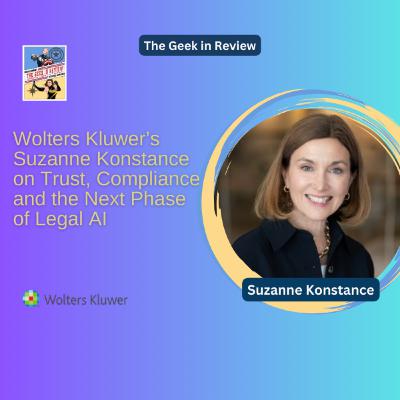
This week we sit down with Suzanne Konstance, Vice-President and General Manager for Legal and Regulatory US at Wolters Kluwer. She outlines how the company supports professionals in highly regulated fields with software and authoritative content. Operations span multiple countries with a deliberately local approach, where teams design solutions for each market. Listeners get a clear view of scope, from enterprise legal management to recent additions such as Brightflag, alongside deep subject expertise.Konstance explains a core focus on regulatory compliance across securities, tax, IP, and employment. The aim is simple, help clients stay out of court. Continuous change drives editorial work, with authors and editors tracking shifts, executive orders, and practical effects. Provenance, version history, and context matter, supported by structured meta tagging which helps search and AI retrieve the right source every time.In a segment on trust, the conversation moves to standards for accuracy and auditability. Clients tell Wolters Kluwer quality outranks speed for research, so the team emphasizes authoritative sources and transparent sourcing. Konstance walks through a recent non-exclusive content license with Harvey for primary law from US and German collections, part of a broader collaboration strategy which also includes VitalLaw AI and new cross-border features. The goal is a reliable workflow where answers cite sources, show currency, and fit real practice.Real user labs reinforce these priorities. At AALL, librarians worked hands-on in a sandbox session with no guided prompts, pushing tools to limits and asking tough questions. One theme dominated, transparency, with live citations and source trails visible during use. Editors remain in the loop to curate likely questions, collect feedback, and refine outputs, while openness about progress helps teams separate market sizzle from dependable results.Looking ahead, Konstance expects roles to shift toward managing agents and setting clear instructions, similar to supervising a room full of interns, with strong expertise still required for oversight. Teams will need to train newcomers on fundamentals, auditing, and controls, so technology serves professionals, not the reverse. She also shares sources she follows, industry conversations with customers, conferences, LinkedIn, X, plus guidance from a long-standing internal Center of Excellence for AI. For more on Wolters Kluwer initiatives, listeners can visit wolterskluwer.com and explore the Legal and Regulatory section along with the AI hub.Also, check out Jerry David DeCicca and his new album, Cardiac Country.Links:Wolters Kluwer Legal & Regulatory U.S. page Wolters Kluwer's AI centerThe press release announcing the content licensing agreement with HarveyVitalLawListen on mobile platforms: Apple Podcasts | Spotify | YouTube[Special Thanks to Legal Technology Hub for their sponsoring this episode.] Blue Sky: @geeklawblog.com @marlgebEmail: geekinreviewpodcast@gmail.comMusic: Jerry David DeCiccaTranscript:
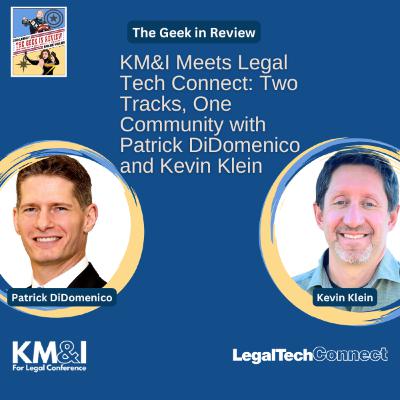
This week we are joined by Patrick DiDomenico and Kevin Klein, two longtime builders of knowledge programs and legal tech gatherings. They walk through the evolution of KM&I for Legal, now entering year three, and the debut of its co-located counterpart, Legal Tech Connect. Both events run in New York on October 22 and 23, with a single community, two distinct agendas, and one big goal, stronger conversations across buyers, builders, and backers of legal tech.Patrick traces the roots, from the ARK KM era to the launch of KM\&I, then to twisting Kevin’s arm to join as a producer. A larger home opened the door to ambitious programming, Ease Hospitality at 3rd and 40th near Grand Central. Think bright rooms, live plants, strong AV, plenty of seating, and an adjacent tenant lounge with coffee, terrace, and breakout nooks. Lessons from last year show up in smart touches, an overflow room streaming the main stage for those who need to handle calls or email without missing core content, longer breaks for real conversations, and, yes, food worthy of repeat trips.Format matters here. KM&I holds firm on peer-to-peer sessions led by law firm professionals. Providers participate through tight five-minute spotlights between talks, plus optional demo rooms during generous coffee breaks and lunch. Legal Tech Connect flips the lens, product stories on stage, founder journeys, market forces, and regulatory themes. A crossover ticket lets attendees roam freely between both programs. Breakouts return by popular demand, a C-suite roundtable, KM 101 for newcomers, a track for KM attorneys and PSLs, and a managers and directors forum that grew from attendee feedback.Themes thread across both days. ROI from AI and KM tools appears throughout, from data strategy as a differentiator to co-development case studies. Expect a lively take on the rise of the legal engineer, with skills for scaling tools and driving adoption, plus a frank discussion about where these roles sit inside firms. Professor Michele DiStefano opens with client centricity, drawing on her research and book, with every attendee receiving a copy. She then moderates a session at Legal Tech Connect on how legal tech companies sell to law firms, bridging provider goals with buyer needs. Another panel stages the AI conversation among a partner, pricing director, client, and innovation lead, a timely look at value, billing, and collaboration.The bigger story is community. Patrick and Kevin highlight the peer network that forms in hallways and over coffee, mentors found by chance, and ideas that travel home in workable form. Legal Tech Connect brings investors and founders into the mix, which raises the quality of dialogue on funding, product focus, and adoption. Looking ahead, they predict fewer conferences, higher quality bars, and a shift toward substance over appearance. Listeners who want more details, including registration, should visit kmniforlegal.com and legaltechconnect.com. The two events sit side by side in October, and the goal is simple, leave with practical ideas, new contacts, and a clearer view of where legal innovation heads next. Listen on mobile platforms: Apple Podcasts | Spotify | YouTube[Special Thanks to Legal Technology Hub for their sponsoring this episode.] Blue Sky: @geeklawblog.com @marlgebEmail: geekinreviewpodcast@gmail.comMusic: Jerry David DeCiccaTranscript:

This week we are joined by Mirat Dave and Danish Butt of Swiftwater & Co. as they step into the studio to make a simple claim, investigations and legal operations should serve the business, not slow the business. Mirat traces a path across law, technology, and global risk, then explains why a team blending strategy with implementation drew him to Swiftwater. Danish shares a wry origin story from early e-discovery days and outlines Swiftwater’s north star, the seven C’s, connecting, caring, collaboration, creating, curiosity, courage, and confidence. The tone stays pragmatic, no hype, and a few laughs land along the way.Global scope often triggers the “Germany is different” objection. Mirat acknowledges regional nuances, then reframes the discussion, most of the process is common across borders. The move that matters is standardization plus smart technology, including AI, to shift from linear headcount answers to scalable capacity. The payoff is speed, consistency, and lower risk. The team urges leaders to act like business owners, align processes to growth, margin, assets, and purpose, and resist the reflex to hire without redesigning the work.Budget hurdles come next. Leaders struggle to win funds for process change or platforms, while headcount requests sail through. The fix is storytelling backed by math, present a structured plan, expected savings, and a clear ROI in the language a CFO or GC uses daily. Danish widens the lens on metrics, many teams still track counts and cycle times, while value measures like revenue protected or reputation preserved sit at the bottom of the list. The guidance is to flip that order, tie decisions to value, and approach AI as a set of pointed use cases with measurable outcomes, not a monolith.Legal ops gets a moment in the spotlight as the quiet power. Danish reminds listeners that service functions exist to help the organization win, recognition matters, yet trust erodes when tools take center stage over results. Mirat presses the enablement mindset with a memorable image, legal, risk, and investigations are the pit crew, the business is the driver. Faster pits win races. He shares examples, a government contractor lifted renewal success by turning compliance visibility into proactive reminders and playbooks. In investigations, trend analysis by region, level, and timing surfaces fixes that reduce incoming allegations, lighten workloads, and raise quality.The crystal ball stays practical. Danish advises teams to treat AI as a working style backed by a two-year plan, prepare data, pick targets, and avoid both freeze and frenzy. Mirat expects investigation platforms to evolve from reporting systems into work systems, triage, plan creation, interview guidance, and repeatable playbooks that lift speed and consistency.Listen on mobile platforms: Apple Podcasts | Spotify | YouTube[Special Thanks to Legal Technology Hub for their sponsoring this episode.] Blue Sky: @geeklawblog.com @marlgebEmail: geekinreviewpodcast@gmail.comMusic: Jerry David DeCicca Transcript:
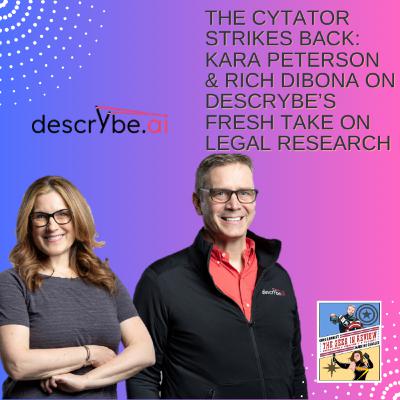
This week, we welcome back Kara Peterson and Rich DiBona of Descrybe to talk about the company’s rapid growth and its expanding role in legal research. Since their last appearance, Descrybe has not only built out new tools but also entered academia by joining the curriculum of more than 350 universities around the world. Kara reflects on her earlier career in legal education and how this new partnership feels like coming full circle. Together, she and Rich share how Descrybe is positioning itself to fill the gap left by other providers while keeping affordability and accessibility at the core of their mission.A major highlight of the discussion is Descrybe’s unique approach to legal citators. Unlike traditional tools that often provide a blunt “treatment” of a case, Descrybe’s citator allows issue-level analysis and even introduces a “backwards citator.” This means researchers can see not only how later courts interpreted a case but also how the judges who wrote the opinion cited and treated earlier authorities. Rich explains the technical challenges involved in training their system on 30 million citations, while Kara describes how these innovations give researchers new storytelling and analytical power when building arguments.The conversation also dives into the Legal Research Toolkit, Descrybe’s paid tier that offers a collection of tools designed for professionals who need more advanced case law analysis. While the company continues to provide free access to its core research platform, the toolkit adds features such as issue explorers and advanced citator functions. Kara emphasizes the company’s deliberately simple pricing model, which prioritizes trust and accessibility. At just $10 a month for non-commercial use and $20 for commercial users, the service is priced more like everyday software than the traditional high-cost legal research platforms.The discussion moves into broader industry trends, including the wave of acquisitions by major players like Thomson Reuters and Clio. Kara and Rich note that while consolidation is reshaping the market, it also leaves space for new entrants to innovate. With data becoming the most valuable commodity in legal tech, Descrybe is building curated and clean datasets across statutes, regulations, state constitutions, and even attorney general opinions. Both guests highlight the importance of accuracy, data hygiene, and minimizing hallucinations, explaining how their closed-system approach helps ensure that results remain grounded in actual legal documents rather than speculative AI outputs.Finally, the episode touches on ethics, recognition, and the future. Descrybe recently won the Anthem Award for Ethical AI, a nod to its safeguards against hallucinations and commitment to transparent data practices. At ILTACon, the team found themselves impressing not only potential clients but also leaders from larger companies who were curious about how such a lean startup was able to achieve so much. Looking ahead, Kara predicts the pace of change in legal technology will only accelerate, challenging law firms to keep up, while Rich warns of the commoditization of AI capabilities and stresses the importance of staying ahead of the curve. Together, they bring both humor and insight, reminding listeners that the legal research market is shifting quickly and that affordability, accuracy, and ethics will shape its next chapter.Listen on mobile platforms: Apple Podcasts | Spotify | YouTube[Special Thanks to Legal Technology Hub for their sponsoring this episode.] Blue Sky: @geeklawblog.com @marlgebEmail: geekinreviewpodcast@gmail.comMusic: Jerry David DeCicca

In this episode of The Geek in Review, we welcome back Pablo Arredondo, VP of CoCounsel at Thomson Reuters, along with Joel Hron, the company’s CTO. The conversation centers on the recent release of ChatGPT-5 and the rise of “reasoning models” that go beyond traditional language models’ limitations. Pablo reflects on his years of tracking neural net progress in the legal field, from escaping “keyword prison” to the current ability of AI to handle complex, multi-step legal reasoning. He describes scenarios where entire litigation records could be processed to map out strategies for summary judgment motions, calling it a transformative step toward what he sees as “celestial legal products.”Joel brings an engineering perspective, comparing the legal sector’s AI trajectory to the rapid advancements in AI developer tools. He notes that these tools have historically amplified the skills of top performers rather than leveling the playing field. Applied to law, he believes AI will free lawyers from rote work and allow them to focus on higher-value decisions and strategy. The discussion shifts to Deep Research, Thomson Reuters’ latest enhancement for CoCounsel, which leverages reasoning models in combination with domain-specific tools like KeyCite to follow “breadcrumb trails” through case law with greater accuracy and transparency.The trio explores the growing importance of transparency and verification in AI-driven research. Joel explains how Deep Research provides real-time visibility into an AI’s reasoning path, highlights potentially hallucinated citations, and integrates verification tools to cross-check references against authoritative databases. Pablo adds historical and philosophical perspective, likening hallucinations to a tiger “going tiger,” stressing that while the risk cannot be eliminated, the technology already catches a significant number of human errors. Both agree that AI tools must be accompanied by human oversight and well-designed workflows to build trust in their output.Looking to the future, Joel predicts that the adoption of AI agents will reshape organizational talent strategies, elevating the importance of those who excel at complex decision-making. Pablo proposes “ambient AI” as the next frontier—intelligent systems that unobtrusively monitor legal work, flagging potential issues instantly, much like a spellchecker. Both caution that certain legal tasks, especially in judicial opinion drafting, warrant careful consideration before fully integrating AI. The episode closes with practical insights on staying current, from following AI researchers on social platforms to reading technical blogs and academic papers, underscoring the need for informed engagement in this rapidly evolving space.Listen on mobile platforms: Apple Podcasts | Spotify | YouTube[Special Thanks to Legal Technology Hub for their sponsoring this episode.] Blue Sky: @geeklawblog.com @marlgebEmail: geekinreviewpodcast@gmail.comMusic: Jerry David DeCiccaAcademic Papers:Weekly research for trends.scholar.google.com,ssrn.com,arxiv.orgFrançois Chollet: Balanced AI insights. x.com/fcholletfchollet.comJason Wei (OpenAI): Reinforcement learning updates. x.com/jason_d_weopenai.com/blogGeoffrey Hinton: AI research insights.x.com/geoffreyhintonRichard Sutton: Reinforcement learning and philosophical takes.incompleteideas.netReinforcement Learning: An Introduction (Book):http://incompleteideas.net/book/RLbook2020.pdfSeminal work by Turing Award winner.University of Alberta Lab: https://rlai-lab.github.ioCurrent research on scalable AI methods.Blue Sky: @geeklawblog.com @marlgebEmail: geekinreviewpodcast@gmail.comMusic: Jerry David DeCiccaTranscript

Comments

Download from Google Play

Download from App Store
 United States