


 Claim Ownership
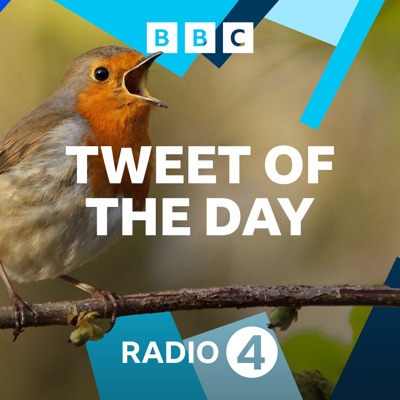
Tweet of the Day
Subscribed: 1,065Played: 10,399
Subscribe

© (C) BBC 2026
Description
Discover birds through their songs and calls. Each Tweet of the Day begins with a call or song, followed by a story of fascinating ornithology inspired by the sound.
711 Episodes
Reverse
Non-fiction writer Polly Atkin tells the story of a magical moment when a grey wagtail joined her swimming by a waterfall in a tree-lined gorge.Produced by Sophie Anton for BBC Audio in Bristol.Featuring audio recorded by Jarek Matusiak from Xeno-Canto (Grey Wagtail -XC360715).
The zoologist and writer Jo Wimpenny shares a story of a close encounter with a red kite in the Chiltern Hills, which swooped in to steal some food. This has become a more common experience in the area with the bird's population having grown by over 1,000% since the 1990s. Jo points out that although the return of a species that lives so well alongside humans won't always be welcomed, it's helpful to remember our shared past, like when hundreds of years ago red kites were valued for clearing streets of carrion and waste.Produced by Sophie Anton for BBC Audio in Bristol.This programme features audio recorded by Simon Elliott from Xeno-Canto (Red Kite - XC1070598).
For ornithologist and wildlife researcher for BBC's Springwatch, Jack Baddams, March is 'siskin season'. As a licenced bird ringer, he puts ID rings on wild birds so we can learn more about their lives. One of Jack's favourite bird encounters while ringing was during a bird ringing demonstration for the public. The crowd was fascinated by a female siskin with its delicate citrus green and yellow plumage, but then she became even more amazing when they discovered she was already wearing a ring of Swedish origin. Produced by Sophie Anton for BBC Audio in Bristol.This programme features audio from Xeno-Canto recorded by Simon Elliott (Eurasian Siskin - XC594919).
Naturalist and TV presenter Mike Dilger remembers spending a bird breeding season 30 years ago surveying the Cetti's warbler. The Cetti's has a secretive nature, and like most birders Mike is more familiar with its explosive song rather than it's appearance, which has been described as ‘someone dropping a saxophone in a reed-bed’. Since Mike's foray into the world of conservation science in the mid-nineties the population of the Cetti's warbler has increased rapidly in the UK, most likely due to milder winters.Produced by Sophie Anton for BBC Audio in Bristol.This programme features audio from Xeno-Canto recorded by Simon Elliott (Cetti's Warbler - XC792549).
CEO of the British Trust for Ornithology Juliet Vickery fell in love with dippers while studying them during her PhD in south-west Scotland. She finds them packed full of character, and perfectly adapted to life between water and land. Dippers have to make sure their complex song is heard above the sound of rushing water, and for Juliet the combination of bubbling bird song and bubbling brook is completely magical.Produced by Sophie Anton for BBC Audio in Bristol.
In 2024 and 2025 expedition leader and film-maker Roland Arnison kayaked along the west coast and isles of Scotland to find and record the sounds of seabird species. As part of his quest he stopped on the island of Lunga, a protected area for its breeding seabird colonies and incredible place to spot them. One night Roland climbed the cliffs to find a colony of Manx shearwaters and recorded them calling from their burrows.Presented by Roland Arnison and produced by Sophie Anton for BBC Audio in BristolThis programme features audio recorded on Lunga by Roland Arnison.
The writer Horatio Clare remembers the buzzards of his childhood, which soared above his home in the Black Mountains in south Wales.Produced by Sophie Anton for BBC Audio in Bristol.
Poet Liz Berry lived near the Wren's Nest Nature Reserve in the Black Country for years, but it was only recently that she stopped and listened to a real wren there. It made her think how the bird was hiding in the place name, which is one of Britain's most important geological sites. The wren's latin name Troglodytes troglodytes means 'cave-dweller', reminding Liz of the folk that used to work in the mines that have shaped the Wren's Nest landscape.Produced by Sophie Anton for BBC Audio in Bristol.
Every Spring wildlife filmmaker Hannah Stitfall heads out to look for long-tailed tits. She hopes to film them building their nests - intricate, domed structures built out of moss, feathers and spider silk. Unlike many other small birds, the long-tailed tit is capable of cooperative breeding, and will help relatives raise their chicks if their own don't survive. For Hannah the long-tailed tit is one of the quiet wonders of the countryside, and a reminder that even the smallest creatures live fascinating lives.Produced by Sophie Anton for BBC Audio in Bristol.
The non-fiction writer Polly Atkin is particularly fond of owls. Tawny owls surround her home in Grasmere in Cumbria, and she has observed the wintering of short-eared owls at the coast. One which remains elusive is the highly secretive long-eared owl, which Polly has never seen in the wild. Considered to be thinly but widely-spread in the UK, they are a scarce breeding species and very difficult to survey. Polly recalls stories from centuries ago of large colonies of long-eared owls resident in the Cumbrian woodland.Polly Atkin is the author of The Company of Owls (Elliott & Thompson).Produced by Sophie Anton for BBC Audio in Bristol.
As a child, the entomologist George McGavin found a dead gannet on the beach, and set about extracting the skull for his collection. He was fascinated to discover the hundreds of pointed barbs in its mouth. Now years later he marvels at this clever bit of evolution which prevents fish falling out of gannets' beaks as they dive into the water then become airborne again.Produced by Sophie Anton for BBC Audio in Bristol.
CEO of the British Trust for Ornithology Juliet Vickery is particularly fond of brent geese, having studied them on the Norfolk coast for three winters. They are our smallest goose, which migrate from the Arctic Circle every year. She describes what she learnt about fluctuations in their population, and the fascinating connection with lemmings in the Siberian tundra.Produced by Sophie Anton for BBC Audio in Bristol.This programme features recordings from Xeno-Canto by David Darrell-Lambert (XC994302 and XC994306)
The writer Horatio Clare has a message from the rooks, pointing out the ways they differ from crows.Produced by Sophie Anton for BBC Audio in Bristol.This programme features audio from Xeno-Canto recorded by Olivier Swift (Rook - XC703729)
Conservation biologist Tolga Aktas shares his fascination with watching jackdaws. He was struck by the contrast between its black plumage and piercing pale eyes, which they likely use as a communication tool. Jackdaws form large, noisy communal winter roosts with other species, and aren't afraid to mob predators behaviour which Tolga finds spectacular to see.Presented by Tolga Aktas and produced by Sophie Anton for BBC Audio Production in Bristol.
The poet and non-fiction writer Polly Atkin observes the wintering of short-eared owls in Cumbria. They are the UK's most nomadic owl, with residents joined by migrants from Scandinavia, Iceland and Russia, seeking a gentler version of the season. Fellow owl-lovers have told Polly of the moment they arrive exhausted at the coast, and she has watched a pair nest in a building site near the sea, concerned how they would survive.Polly Atkin is the author of The Company of Owls (Elliott & Thompson).Presented by Polly Atkin and produced by Sophie Anton for BBC Audio Production in Bristol.This programme features recordings from Xeno-Canto by Lars Edenius (XC731000 and XC731272 - Short-eared owl)
For poet Liz Berry, December is the robin's month, when our hearts are warmed by its singing under frosty streetlights. She wonders if its midwinter song is one of the reasons why we feel close to robins, and imagine them as our companions in the thin places between living and dying. Liz tells the story of how the robin brought her hope during a difficult pregnancy, inspired by its fierceness and willingness to survive. Presented by Liz Berry and produced by Sophie Anton for BBC Audio in Bristol.This programme features a recording by Martin Billard from Xeno-Canto (XC871726 - European Robin)
The author and journalist Horatio Clare reflects on the cultural history of the human relationship with pheasants. Its Latin name Phasianus Colchicus links the pheasant to the ancient kingdom of Colchis on the shores of the Black Sea, made famous in Greek mythology as the land of the Golden Fleece. These large, colourful long-tailed birds are native to Asia, and likely journeyed to western Europe with the Romans, becoming a symbol of wealth and status. The Normans are credited with popularising the shooting of pheasants in the 11th century, an industry which today releases an estimated 30-45 million captive-bred pheasants into the British countryside every year.Presented by Horatio Clare and produced by Sophie Anton for BBC Audio in Bristol.This programme features audio from Xeno-Canto recorded by Simon Elliot, David M and Tanguy Loïs (XC155202, XC640749 and XC727854 - Common Pheasant).
In the season where starlings gather to murmurate in our winter skies, poet Paul Farley is admiring this dazzling bird up close. Every spring a pair of starlings used to nest in a hollow wall in the house where Paul grew up, and he never got tired of studying its dark iridescent plumage. Laying in bed at night Paul would hear the starlings' impressive mimicry, and remembers the sound of a radio being tuned and even human voices, imagining that these intelligent birds have been curiously studying us.Presented by Paul Farley and produced by Sophie Anton for BBC Audio in Bristol.This programme features a recording by Oliver Swift from Xeno-Canto (XC710439 - Common Starling)
When nature writer Amy-Jane Beer moved to her current home, it seemed like the perfect rural dream. However, there then came an insistent knocking sound every morning - a pair of carrion crows would tap the windows, affronted by their reflections. Amy describes watching and learning to love these birds, which she sees as her quirky, idiosyncratic neighbours.Presented by Amy-Jane Beer and produced by Sophie Anton for BBC Audio in Bristol.Featuring a recording by Martin Billard from Xeno-Canto (Carrion Crow - XC929595)
The home of poet and non-fiction writer Polly Atkin is surrounded by tawny owls. They are the most common owl in Britain, ranging from 20,000 to 50,000 breeding pairs, though we don't know exactly how many. Polly describes hearing the first melancholy call of a tawny owl in autumn, echoing around the lake at Grasmere. Kept awake by chronic illness, the owls' nighttime calls remind Polly that we are not alone, the sound means company, community and home.Polly Atkin is the author of The Company of Owls (Elliott & Thompson).Presented by Polly Atkin and produced by Sophie Anton for BBC Audio in Bristol.

Comments

Download from Google Play

Download from App Store
 United States