


 Claim Ownership
BELOW THE LINE PODCAST
Subscribed: 45Played: 832
Subscribe

© Copyright 2018 All rights reserved.
Description
Welcome to Below the Line, the film industry podcast that looks at moviemaking from the crew’s perspective. My name is Skid — I’m a former Assistant Director and your host. Each week I sit down with production friends, both old and new, to share stories from their time on set.
Each episode dives into a specific film, television series, or theme relevant to working in Hollywood. Subscribe wherever you get your podcasts, or browse the episodes below — you might discover something new about one of your favorites.
Have thoughts about an episode or feedback on the podcast? I’d love to hear from you: skid@belowtheline.biz
Each episode dives into a specific film, television series, or theme relevant to working in Hollywood. Subscribe wherever you get your podcasts, or browse the episodes below — you might discover something new about one of your favorites.
Have thoughts about an episode or feedback on the podcast? I’d love to hear from you: skid@belowtheline.biz
290 Episodes
Reverse
Oscar night is almost here, and Below the Line closes out its 2026 Oscar series with a look at the Academy Award for Best Original Song.
This week, Skid is joined by returning guests Chris Molanphy, Louis Weeks, and Tom Peyton to break down the five nominees — a lineup that ranges from chart-topping K-pop to blues-infused cinematic spectacle, intimate indie folk, and even a rare operatic outlier.
As the ceremony approaches on March 15, the panel weighs not only which song will win, but how each nominee functions inside its film — and what that says about the evolving relationship between movies and popular music.
Among the highlights:
Diane Warren’s Dear Me — her 17th nomination — and a candid conversation about formula, legacy nominations, and the Academy’s enduring embrace of one of its most persistent contenders
Why Golden from K-Pop Demon Hunters has become the category’s undeniable frontrunner — and how its structure, performance demands, and cultural impact set it apart
The scope and ambition of I Lied to You from Sinners, and how its blend of blues tradition and cinematic storytelling makes it more than just a “song”
An operatic curveball in Sweet Dreams of Joy from Viva Verdi! — and what happens when a classical aria sits beside pop craftsmanship
Nick Cave and Bryce Dessner’s Train Dreams, a meditative, image-driven piece that bridges songwriter performance and filmic atmosphere
The conversation moves easily between technical craft and big-picture questions: What makes a song “original” in today’s industry? Should Best Original Song reward chart success, narrative function, or musical innovation? And in an era of streaming metrics and algorithmic pop, what still feels distinctly human?
🎧 Press play and go Below the Line on Best Original Song — and get ready for Oscar night. For more, visit belowtheline.biz.
As Oscar night draws near, Below the Line turns to one of the most emotionally powerful — and hotly debated — categories of the year: the Academy Award for Best Original Score.
In Episode 11 of our 2026 Oscar series, Skid is joined by returning panelists Chris Molanphy, Louis Weeks, and Jennie Armon to break down the five nominees recognized at the 98th Academy Awards: Bagonia, Frankenstein, Hamnet, One Battle After Another, and Sinners.
With just over a week until the ceremony on March 15, the conversation balances prediction, perspective, and deep craft analysis — examining not only who might win, but what each score is attempting to accomplish.
The discussion covers:
Jerskin Fendrix’s anarchic, genre-bending approach to Bagonia — and whether creative “broken communication” can be a feature rather than a flaw
Alexandre Desplat’s lush, violin-forward score for Frankenstein and what makes it feel both classical and quietly subversive
Max Richter’s restrained work on Hamnet, including the complicated legacy of “On the Nature of Daylight” and how previously composed music intersects with Oscar eligibility
Johnny Greenwood’s immersive, pulse-driven soundscape for One Battle After Another — and why some scores only reveal their full power in context with picture
Ludwig Göransson’s sweeping, thesis-driven score for Sinners, a front-runner that uses music not just to support story, but to make an argument of its own
Along the way, the panel debates what the Academy tends to reward in this category: traditional orchestral craftsmanship, avant-garde experimentation, cultural resonance, or sheer emotional impact. They also spotlight overlooked scores from the year and reflect on how film music continues to evolve — especially as composers move fluidly between pop, concert, and cinematic worlds.
As the 98th Academy Awards approach, this episode offers both a critical deep dive and a celebration of how music shapes the movies we love.
🎧 Press play — or watch the full conversation on YouTube — and join us Below the Line as our 2026 Oscar series heads into its final stretch. For more, visit belowtheline.biz.
Costume design defines character before a word is spoken — through silhouette, texture, and the quiet language of fabric.
For Episode 10 of Below the Line’s 2026 Oscar series, Skid is joined by Liz Vastola, Austin Wittick, and Allison Choi Braun to examine the nominees for the Academy Award for Best Costume Design at the 98th Academy Awards. Drawing on their experience across period drama, contemporary storytelling, and large-scale production, the panel evaluates this year’s field with a focus on research, construction, collaboration, and narrative clarity.
As with the rest of this year’s Oscar series, the conversation is available both as an audio podcast and as a full video episode on YouTube.
Our discussion explores:
The physical craftsmanship behind Avatar: Fire and Ash, and how tangible garments support performance even in a digitally expansive world
In Frankenstein, how heightened color and silhouette push beyond strict period realism to create something emotionally immediate
How Hamnet uses restraint — muted palettes and softened textures — to support its interior storytelling
The meticulous 1950s tailoring in Marty Supreme, and what period specificity reveals about character and class
Blending Americana, music culture, and horror in Sinners, where aging, multiples, and continuity become storytelling tools
The collaborative relationship between costume designers and directors, and how early visual conversations shape the entire production
Throughout the episode, the panel reflects on how costume design operates at every scale — from the smallest accessory to the broadest color arc — and how these choices work in concert with lighting, production design, performance, and theme.
🎧 Press play — or watch the full conversation on YouTube — and join us Below the Line for Episode 10 of our 2026 Oscar series as we head into the final stretch. For more, visit belowtheline.biz.
Cinematography is where intention meets execution — in the choice of lens, the placement of light, and the movement of the camera.
For Episode 9 of Below the Line’s 2026 Oscar series, we turn to the nominees for the Academy Award for Best Cinematography at the 98th Academy Awards. Skid is joined by cinematographers Patrick Cady and David Tuttman, who return to examine this year’s field from the inside — balancing technical precision, aesthetic philosophy, and the lived reality of production.
As with the rest of this year’s Oscar series, the conversation is available both as an audio podcast and as a full video episode on YouTube.
In this episode, the conversation explores:
• The “military operation of joy” behind Frankenstein — and how large-format photography, depth of field, and camera movement supported a unified creative vision
• The disciplined exposure control and 1970s-influenced grit of Marty Supreme, shot largely on film with exacting precision
• The ambitious VistaVision approach of One Battle After Another, and why certain sequences demand to be seen on the biggest screen possible
• The bold format shifts and musical visual language of Sinners, including the challenge of blending IMAX, 70mm, and intimate close-ups
• The natural-light philosophy of Train Dreams, and why “lighting with fire” is anything but simple
• Patrick’s case for five additional films he believes deserved recognition — and what that reveals about how deep this year’s cinematography field really is
Along the way, Patrick and David reflect on film versus digital workflows, lens design, aspect ratios, shutter angle choices, and the subtle collaboration between cinematography, production design, and performance. The discussion moves easily between the granular (film stocks, lenses, exposure latitude) and the philosophical (joy in the process, trust between departments, and how cinematography shapes story without announcing itself).
🎧 Press play — or watch the full conversation on YouTube — and join us Below the Line for Episode 9 of our 2026 Oscar series. For more, visit belowtheline.biz.
Best Director may not be the top prize — but it’s the category that sparks the loudest arguments.
In Episode 8 of Below the Line’s 2026 Oscar series, Skid is joined by Katie Carroll, Bill Hardy, and Shaun O’Banionto break down the nominees for the Academy Award for Best Director at the 98th Academy Awards. With years of shared on-set experience and a long-running panel dynamic, the conversation is sharp, occasionally irreverent, and grounded in what it actually takes to steer a production at this level.
As with the rest of this year’s Oscar series, the conversation is available both as an audio podcast and as a full video episode on YouTube.
Our discussion ranges across:
Chloé Zhao’s restraint in Hamnet, and how stillness and intimacy compete against larger canvases in this category
The spirited (and sometimes hilarious) divide over Marty Supreme — its length, its chaos, and the argument over what discipline looks like on screen
Paul Thomas Anderson’s command of tone in One Battle After Another, and the logistical confidence required to orchestrate narrative sprawl
Joachim Trier’s delicate handling of memory and performance in Sentimental Value, and the quiet authority behind that control
Ryan Coogler’s genre-blending ambition in Sinners, and the risks that come with expanding the boundaries of a franchise
The case for Frankenstein as a nomination that could have reshaped the race — and why its absence sparked genuine debate at the table
The episode carries the easy banter of collaborators who’ve spent years dissecting this category together — complete with side bets, mock outrage, and the occasional good-natured jab — but underneath the laughs is a serious respect for the director’s role: holding the vision, protecting performance, and keeping a sprawling production aligned from prep through post.
🎧 Press play — or watch the full conversation on YouTube — and join us Below the Line for Episode 8 of our 2026 Oscar series. For more, visit belowtheline.biz.
Sound is where performance, environment, and emotion converge — shaped first on set and refined in the mix.
In Episode 7 of Below the Line’s 2026 Oscar series, Skid is joined by Steve Morrow (Production Sound Mixer) and Don Sylvester (Sound Editor) to examine the nominees for Achievement in Sound at the 98th Academy Awards. Together, they explore how production and post-production intersect to support performance, pacing, and dramatic tension.
As with the rest of this year’s Oscar series, the conversation is available both as an audio podcast and as a full video episode on YouTube.
Our discussion explores:
The immersive racing soundscape of F1, and how layered engine recording, ambisonics, and dynamic mixing place audiences inside the cockpit
The evolving vocal treatment and tonal balancing in Frankenstein, where horror, romance, and creature design must coexist within a unified sonic world
How One Battle After Another uses vehicles, space, and environmental texture to reinforce character perspective
Capturing live musical performance and choreographed chaos in Sinners, where production sound and post must move in lockstep
The blurred boundary between music and environment in Sirāt, and how subtle soundscapes shape perception as much as spectacle
Why production sound and sound editing are inseparable disciplines when it comes to protecting performance
A brief look at shortlist contender Warfare, and what makes immersive combat sound both technically complex and emotionally overwhelming
Throughout the conversation, Steve and Don reflect on the practical realities of their craft — from mic placement and set noise to mix decisions and audience psychology — offering a detailed look at how sound both grounds and elevates cinematic storytelling.
🎧 Press play — or watch the full conversation on YouTube — and join us Below the Line for Episode 7 of our 2026 Oscar series. For more, visit belowtheline.biz.
Judging production design means considering not just what we see, but how an entire world was constructed to function on screen.
This week on Below the Line, Skid is joined by Bob Shaw (Production Designer), Regina Graves (Set Decorator), and Kerry Weeks (Leadman) to examine the nominees for Achievement in Production Design at the 98th Academy Awards. Representing three distinct roles within the art department, they offer a grounded, practical look at how these films constructed their environments — from large-scale builds to the smallest graphic detail.
As with the rest of this year’s Oscar series, the conversation is available both as an audio podcast and as a full video episode on YouTube.
Our discussion ranges across:
The operatic scale and extensive builds of Frankenstein, from castle interiors to laboratory design — and whether grandeur ultimately serves or overwhelms the story
The period authenticity of Hamnet, including the recreation of Shakespeare’s Globe and the delicate balance between research and creative interpretation
The layered Lower East Side streets of Marty Supreme, where signage, storefront graphics, and textural detail quietly anchor a frenetic narrative
The cohesive, character-driven environments of One Battle After Another, where homes, dojos, and lived-in interiors feel organic rather than theatrical
The tonal shift in Sinners, and the ongoing challenge of aging sets just enough — especially when audience expectations of “period” don’t always align with historical reality
How decisions about wear, grit, and cleanliness can subtly shape credibility without drawing attention to themselves
Why contemporary or less “showy” films like Black Bag are often overlooked despite meticulous design work
Additional standouts from the year, including Train Dreams and Song Sung Blue, which demonstrate how tonal precision and environmental detail can carry as much weight as larger-scale builds
Across the conversation, the three perspectives reveal how production design succeeds not only through bold visual statements, but through coordination — between design, dressing, graphics, lighting, and performance — so that nothing feels isolated from the world of the film.
🎧 Press play — or watch the full conversation on YouTube — and join us Below the Line for another chapter in our 2026 Oscar series. For more, visit belowtheline.biz.
Animated feature filmmaking is defined by endurance — years of development, constant iteration, and creative risks that often aren’t visible on screen.
This week on Below the Line, Skid is joined by Kent Seki and Camille Leganza to discuss the nominees for Best Animated Feature at the 98th Academy Awards. Drawing on their extensive experience in animation, they look closely at how different creative pipelines, production cultures, and storytelling ambitions shape this year’s unusually diverse slate of nominees.
As with the rest of this year’s Oscar series, the conversation is available both as an audio podcast and as a full video episode on YouTube, offering listeners the option to watch the discussion or engage with it in its traditional audio form.
Our discussion ranges across:
The long development paths behind animated features — and what creative “endurance” really looks like in practice
Why Arco stands out for its visual authorship, unconventional time-travel structure, and optimistic view of the future
The creative challenges behind Elio, including director transitions, tonal recalibration, and ambitious visual experimentation
How K‑Pop Demon Hunters became an unexpected cultural phenomenon through bold genre blending and stylistic risk
The visual restraint, emotional specificity, and rapid production schedule that define Little Amélie or the Character of Rain
The scale, scope, and world-building demands of Zootopia 2, and why sequels can be harder than originals
How audience expectations, box-office performance, and cultural context intersect with Academy recognition
What this year’s nominees suggest about the evolving identity of animated feature filmmaking
The conversation presents animated features as works of sustained creative commitment — films shaped as much by patience, resilience, and collaboration as by technology or visual style.
🎧 Press play — or watch the full conversation on YouTube — and join us Below the Line as the 2026 Oscar series continues. For more, visit belowtheline.biz.
Makeup and hairstyling are among the most visible crafts in filmmaking — shaping how an audience understands age, history, and identity before a word is spoken.
This week on Below the Line, Skid is joined by Yvonne De Patis-Kupka, Angela Nogaro, and Lynda Armstrong for an in-depth discussion of the nominees for Achievement in Makeup and Hairstyling at the 98th Academy Awards. Drawing on a wide range of experience across film and television, they examine how hair and makeup choices shape character, period, genre, and emotional tone — and how those choices are evaluated within a single, highly competitive Oscar category.
As with the rest of this year’s Oscar series, the conversation is available both as an audio podcast and as a full video episode on YouTube, giving listeners the option to watch the discussion or continue enjoying the show in its traditional audio format.
Our discussion ranges across:
The contrast between large-scale prosthetic work and more restrained, character-driven approaches to makeup and hair
How transformation functions differently across genres, from the mythic world of Frankenstein to the grounded period realism of Sinners
The challenges of evaluating culturally specific styles, including the kabuki-influenced work in Kokuho
When subtlety becomes the hardest achievement — and why “natural” work can be the most demanding
The relationship between budget, resources, and creative problem-solving, particularly in films like The Ugly Stepsister
How continuity, aging, and wear are tracked over time to support long-form storytelling
The ongoing difficulty of judging hair, makeup, and prosthetics together within a single Oscar category
What this year’s nominees reveal about the Academy’s evolving expectations for the craft
The conversation highlights makeup and hairstyling as disciplines defined by precision, restraint, and collaboration — crafts that help actors fully inhabit their roles while anchoring the world of the film.
🎧 Press play — or watch the full conversation on YouTube — and join us Below the Line as the 2026 Oscar series continues. For more, visit belowtheline.biz.
This episode begins with a hypothetical question: what would it look like if Property Mastering were its own Oscar category? We explore it as part of Below the Line’s 2026 Oscar series.
This week on Below the Line, Skid is joined by Scott Buckwald and Gregg Bilson, Jr. for a deep dive into the craft of property mastering through the lens of the 98th Academy Awards. Using a fictional Oscar ballot as a framework, they explore how props function as storytelling tools — shaping character, tone, and authenticity across a wide range of films.
As with the rest of this year’s Oscar series, the conversation is available both as an audio podcast and as a full video episode on YouTube, offering listeners and viewers a closer look at how below-the-line crafts are discussed and evaluated from inside the work itself.
Our discussion ranges across:
Why property mastering sits at the intersection of design, performance, and logistics — often unnoticed, but never incidental
How props help define character and period across films like Nuremberg and Song Sung Blue
The heightened demands of genre storytelling, from the mythic scale of Frankenstein to the grounded realism of Sinners
Managing continuity and narrative logic when props evolve over the course of a story
The technical and ethical considerations involved in handling story-critical objects, from weapons to documents and artifacts
How preparation, research, and documentation allow property masters to support performance without drawing attention to the work itself
Why collaboration with actors and other departments is essential to making props feel lived-in rather than ornamental
What this hypothetical exercise reveals about how deeply props are woven into storytelling, even when they’re easy to overlook
The conversation highlights property mastering as a discipline defined by preparation, judgment, and storytelling instincts — a craft that quietly anchors performance and world-building across every genre.
🎧 Press play — or watch the full conversation on YouTube — and join us Below the Line as the 2026 Oscar series continues. For more, visit belowtheline.biz.
Continuing Below the Line’s 2026 Oscar series, the conversation turns to Visual Effects — a category that sits at the intersection of technology, craft, and storytelling.
This week on Below the Line, Skid is joined by Kent Seki and Chris Batty for a focused conversation about the Oscar nominees for Achievement in Visual Effects. Together, they look at how the category has evolved — and what separates technical accomplishment from storytelling impact.
As with the rest of this year’s Oscar series, this episode is available both as an audio podcast and as a full video conversation on YouTube, offering listeners and viewers a closer look at how visual-effects work is discussed, debated, and evaluated from inside the process.
Our discussion ranges across:
The different creative demands of large-scale spectacle versus realism-driven effects
How films like Avatar: Fire and Ash and Jurassic World Rebirth approach scale and world-building, compared to the grounded physical environments of F1 and The Lost Bus
The challenge of integrating effects into performances, locations, and production design without overwhelming the story
Why elements like fire, debris, and destruction require as much restraint as technical precision
How visual effects intersect with cinematography, editorial, and sound to maintain continuity and tone
The increasing expectation that effects choices support narrative clarity rather than novelty
What this year’s nominees suggest about how the Academy continues to define excellence in the field
Rather than focusing on predictions, the conversation looks at how visual effects decisions are made — and how those choices shape tone, performance, and story across very different kinds of films.
🎧 Press play — or watch the full conversation on YouTube — and join us Below the Line as the 2026 Oscar series continues. For more, visit belowtheline.biz.
As the 98th Academy Awards approach, Below the Line returns for its seventh annual Oscar series — beginning with Film Editing, a category that quietly shapes every other craft recognized on Oscar night.
This week on Below the Line, Skid is joined by Amy Duddleston and Christopher Angel to open the 2026 Oscar series with a focused conversation about the nominees for Achievement in Film Editing. Together, they examine how editing choices shape performance, tone, and point of view — and why the category can be difficult to evaluate without understanding what the work actually requires.
This episode also marks a first for Below the Line: these Oscar conversations are now available both as an audio podcast and as full video episodes on YouTube, offering listeners the choice to watch the discussion unfold or continue enjoying the show in its traditional audio format.
Our discussion ranges across:
Why Film Editing is often misunderstood as “most editing” rather than best judgment
The distinct editorial challenges behind this year’s nominees, including F1, Marty Supreme, One Battle After Another, Sentimental Value, and Sinners
How performance-driven films ask editors to prioritize restraint over visibility
The editor’s role in shaping character psychology and audience alignment
When cutting calls attention to itself — and when disappearing is the hardest choice
Navigating collaboration with directors whose approaches range from highly controlled to deliberately chaotic
What this year’s nominees reveal about how the Academy continues to define the craft
Grounded in the perspective of two working editors, the conversation focuses less on prediction and more on process — unpacking how editing decisions actually function on screen, and why the craft remains essential even when it goes unnoticed.
🎧 Press play — or watch the full conversation on YouTube — and join us Below the Line as we begin our 2026 Oscar series. For more, visit belowtheline.biz.
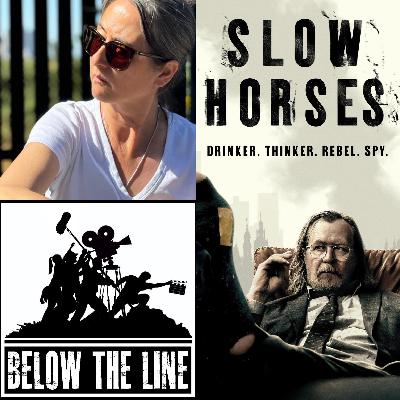
Designing for television isn’t just about building sets — it’s about knowing when to preserve them, when to break them, and how to let them evolve over time. On Slow Horses, that long view shapes every creative decision.
This week on Below the Line, Skid is joined by Production Designer Choi Ho Man, with Gianni Damaia returning as co-host, to talk about the fifth season of Slow Horses, the Apple TV+ espionage series starring Gary Oldman. Choi traces her journey on the show from supervising art director to production designer, and how designing across multiple seasons requires long-term thinking, flexibility, and restraint.
We take a deep dive into:
How Slow Horses was designed as a rolling, multi-season project, shooting in pairs of seasons with overlapping crews and compressed turnaround times
The evolution of Slough House itself, including how destruction at the end of Season Four informed the repaired, modernized, and slightly haunted version seen in Season Five
Designing spaces that reflect character psychology, from Lamb’s office to Ho’s flat
Building and rebuilding modular sets — lifts, car parks, corridors, offices — to stretch resources while preserving visual continuity
Developing MI5 Headquarters (“The Park”) as a recurring environment, mapping unseen spaces to make the building feel architecturally complete
Stitching together complex action sequences from multiple locations and stage builds, including chase scenes, stairwells, and exterior-to-interior transitions
How practical construction, visual effects, and stunt coordination intersect on large-scale action sequences involving paint, height, and confined spaces
Why face-to-face collaboration still matters, including sketches, models, and conversations that can’t be replaced by emails or message threads
Across five seasons, Slow Horses proves that production design isn’t just about creating spaces — it’s about letting those spaces absorb history, pressure, and consequence, until the environment itself becomes part of the story.
🎧 Press play and go Below the Line on Slow Horses. For more, visit belowtheline.biz.
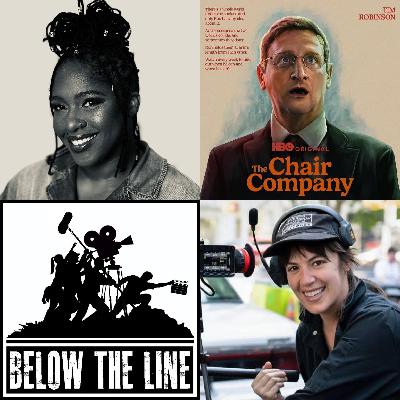
The stranger The Chair Company gets, the more seriously it has to be treated. Nothing about the show tells the audience when to laugh — its world looks ordinary, its people feel real, and that restraint is exactly what lets the absurdity land.
This week on Below the Line, Skid is joined by Costume Designer Nicky Smith and Cinematographer Ashley Connorto discuss their work on The Chair Company, the HBO series created by Tim Robinson and Zach Kanin. Together, they break down how a show rooted in off-kilter comedy relies on rigorous visual logic — from wardrobe and camera movement to pacing, texture, and point of view — to maintain its delicate tonal balance.
Our conversation ranges across:
Treating the series like a grounded crime or conspiracy drama, using mundane wardrobe and restrained visuals to make moments of surrealism hit harder
Ashley’s cinematography approach: anchoring the camera to Ron’s emotional journey, using aggressive dollies, zooms, and imperfect movement to mirror his unraveling
Nicky’s costume philosophy of thrifted, worn-in clothing — washing, distressing, and avoiding “newness” so characters feel unmistakably real
Designing visual normalcy as misdirection, allowing sudden tonal shifts to surprise the audience without breaking the world of the show
The evolving production scale from pilot to series, and how departments learned to stretch limited resources into something that feels expansive
Building key sequences like the Episode Five bar chase and the Episode Eight wedding — where every department had to stay in sync to manage the chaos
How casting, body types, and costume choices avoid stereotypes, creating a workplace and social world that feels genuinely lived-in
Setting up Season Two without knowing the destination — trusting Tim Robinson and Zach Kanin’s writing while embracing uncertainty
Rather than signaling comedy through exaggeration, The Chair Company finds its power in restraint — proving that the stranger a story becomes, the more important it is that every visual choice feels honest, deliberate, and grounded in character.
🎧 Press play and go Below the Line on The Chair Company. For more, visit belowtheline.biz.
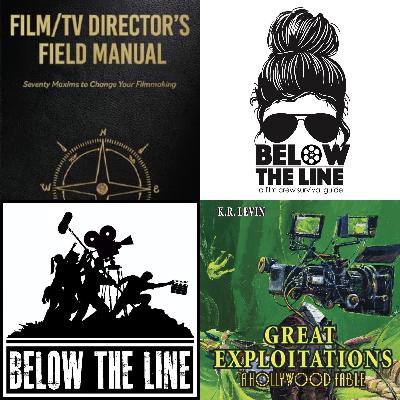
Why do people who’ve spent their careers in the trenches of production take everything they’ve learned on set and turn it into something as quiet and lasting as a book? In this episode of Below the Line, three authors with deep roots in the industry talk about translating lived experience into storytelling on the page.
This week on Below the Line, Skid is joined by Melanie Ragone, Key Grip and author of Below the Line: A Film Crew Survival Guide; Rob Spera, director, teacher, and author of the Film/TV Director’s Field Manual: Seventy Maxims to Change Your Filmmaking; and Ken Levin, longtime Property Master and author of the satirical novel Great Exploitations – A Hollywood Fable. Together, they compare notes on why they wrote their books, how decades inside the industry shaped them as authors, and what they hope readers take away — whether they work on set or simply love the stories it produces.
On the page and behind the scenes, we talk about:
How each book grew out of real experience: Melanie’s trial-by-fire years as a first-generation filmmaker and grip, Rob’s four decades directing and teaching, and Ken’s time in commercials, kids’ TV, and beyond
The shared belief that film sets are communities, not dictatorships — and why Rob rejects auteur theory in favor of leadership that listens, thanks, and makes room for crew voices
Melanie’s “love letter to crew”: honest advice about long hours, mental and physical strain, and why gratitude and basic respect from above the line can change an entire day on set
Ken’s choice to write fiction as a way to tell the truth about Hollywood’s brutality, absurdity, and mutual exploitation — especially for those working below the line
The changing economics of the industry: shorter seasons, longer gaps between shows, and why all three guests stress diversifying skills, planning ahead, and learning when (and how) to pivot
Different publishing paths — from querying hundreds of agents to choosing self-publishing for speed and creative control — and what it really takes to market a niche industry book
Who these books are for: new crew trying to survive their first shows, directors and producers who want a clearer picture of below-the-line life, and readers who just want to understand what really happens behind the camera
What’s next: Melanie’s push toward showrunning and television writing, Rob’s continuing work as a teacher and documentary filmmaker, and Ken’s “second career” as a novelist, including aviation-themed projects waiting in the wings
At its heart, this conversation is about survival, adaptation, and generosity — three industry veterans turning hard-won lessons into something that can outlast a single job, a single season, or even a single career.
🎧 Press play and go Below the Line with three storytellers who took their experience to the page. For more, visit belowtheline.biz.
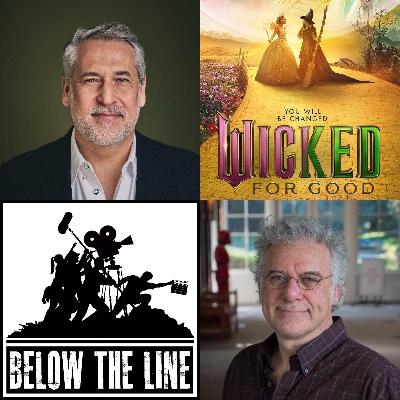
What happens when filmmaking becomes a marathon of collaboration — spanning years, thousands of shots, and the world of Oz itself? For Wicked: For Good, that was the daily reality for Film Editor Myron Kerstein and Visual Effects Supervisor Pablo Helman.
This week on Below the Line, Skid welcomes back Myron Kerstein and introduces Pablo Helman, who makes his Below the Line debut to discuss their shared journey on Wicked: For Good, the sequel to Jon M. Chu’s Wicked. Together, they reflect on what it means to sustain creative momentum through two interconnected films and the largest project of their careers.
This episode unpacks:
Building a years-long partnership between editorial and visual effects — and learning to “finish each other’s sentences” after thousands of hours together
Integrating production, post, and VFX pipelines from the earliest days of Wicked through the sequel’s final render
Designing the epic opening battle on the Yellow Brick Road, where performance, camera, and creature animation all converge
Navigating Jon M. Chu’s collaborative process — a director who, as Myron puts it, is “a collector of people” and thrives on creative dialogue
Crafting the technically complex “Girl in the Bubble” sequence — eight stitched plates, multiple reflections, and a seamless illusion that tested every department’s trust
Refining the “No Good Deed” sequence — balancing raw emotion, musical rhythm, and visual effects spectacle
Intercutting Glinda’s wedding with the imprisoned creatures to heighten tension and emotional contrast across parallel storylines
How small creative choices — like a cape’s weight, a confetti storm, or a single flash of red sky — became storytelling tools in the hands of two artists who speak the same cinematic language
What emerges is a portrait of collaboration under pressure — one built on mutual respect, relentless curiosity, and a shared belief that every frame, no matter how fantastical, should feel grounded and human.
🎧 Press play and go Below the Line on Wicked: For Good. For more, visit belowtheline.biz.

Before there were military consultants on movie sets, there were officers like Jon McBride — servicemen who understood how stories shape public perception. On this Veterans Day episode of Below the Line, we look at how the Navy’s storytellers helped connect the worlds of service and cinema.
This week, Skid is joined by Jon McBride, a former U.S. Navy officer whose service from 1964 to 1968 led him from the deck of the USS Kitty Hawk to the Navy’s Public Affairs Office in Hollywood — bridging two worlds that rarely meet but often influence one another.
We explore:
Jon’s path from Yale graduate to Naval officer during the Vietnam War era, and how chance and persistence steered him toward public affairs
Life aboard the aircraft carrier USS Kitty Hawk, where he volunteered for the ship’s public information role — discovering a talent for storytelling under pressure
How a Pentagon connection set Jon on the path to Hollywood, joining the Navy’s West Coast Public Affairs Office on Sunset Boulevard
The Navy’s relationship with the film industry — reviewing scripts, assigning project officers, and shaping depictions of sailors on screen
Behind-the-scenes memories from Operation: Entertainment, Yours, Mine and Ours, and an unexpected day serving as Dionne Warwick’s “agent”
Encounters with Ray Charles, the Blue Angels, and the surreal overlap between show business and service
How McBride’s later work with the grassroots Beyond War movement reframed his understanding of conflict and communication
Episodes like this one reflect a recurring theme for Below the Line — the shared discipline, teamwork, and creative purpose that link filmmaking and military service. Jon’s story captures that connection with humor, humility, and a deep sense of how storytelling itself can serve a mission.
🎧 Press play and go Below the Line for a Veterans Day conversation that spans from the bridge of the Kitty Hawk to the backlots of Hollywood. For more, visit belowtheline.biz.
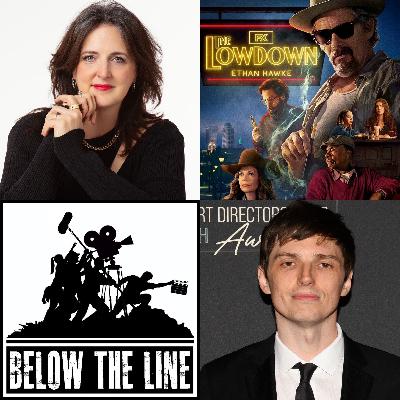
What does it take to build a world that feels as authentic as the people it represents? On The Lowdown, that meant storytelling rooted in place — and departments working in harmony.
This week on Below the Line, Skid welcomes Makeup Department Head Sharon Tabb and Production Designer Brandon Tonner-Connolly, who reunite after three seasons of Reservation Dogs to discuss their latest collaboration with creator Sterlin Harjo on the FX series The Lowdown, starring Ethan Hawke.
The discussion covers:
Continuing the collaborative spirit from Reservation Dogs — and how Sterlin Harjo’s leadership fosters creativity and respect across the crew
Finding shared visual language between makeup and production design — creating a lived-in aesthetic that balances grit, texture, and humanity
Designing the show’s Tulsa block from the ground up, building interconnected sets like Hoot Owl Books, Sweet Emily’s Diner, and nearby stores into one functioning neighborhood
Layering authenticity through local artists and real community involvement, from murals and set dressing to tattoo design
Bringing lived experience into the work — honoring real figures like journalist Lee Roy Chapman while telling a fictionalized story of truth-seekers and corruption
Sharon’s approach to Ethan Hawke’s tattoos and makeup continuity, balancing realism with subtle symbolism — and a few Easter eggs for sharp-eyed viewers
Brandon’s creation of Sweet Emily’s Diner, complete with custom wallpaper that pays tribute to Reservation Dogs in the most unexpected way
Coordinating large-scale sequences like the cop party “oner” that concludes Episode Five — blending chaos, choreography, and cinematic precision
Together, Sharon and Brandon reveal how every bruise, tattoo, and weathered wall becomes part of a larger visual story — one built from collaboration, trust, and craft in sync.
🎧 Press play and go Below the Line on The Lowdown. For more, visit belowtheline.biz.
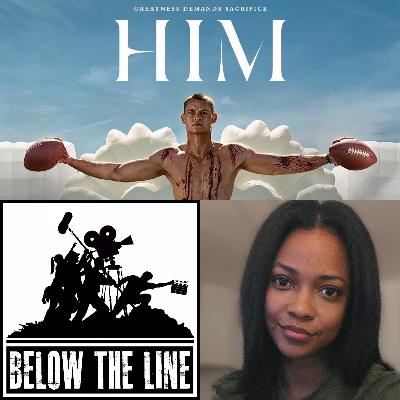
What does it mean to edit a sports horror film that blurs the line between spectacle and nightmare? For Taylor Mason, the answer was finding the rhythm that carried HIM through its shifting tones.
This week on Below the Line, Skid is joined by Film Editor Taylor Mason to discuss her work on the Universal/Monkeypaw feature HIM, directed by Justin Tipping and starring Tyriq Withers and Marlon Wayans. Joining the conversation is Christopher Angel, a regular guest and co-host of the podcast, who adds his editorial perspective.
The conversation cuts across:
Building Taylor’s creative partnership with director Justin Tipping, which began during their AFI collaborations
Taylor’s career arc through high-end assistant editing (e.g. Blade Runner 2049, Dune) before making the jump to feature editing
Shaping HIM’s hybrid genre — balancing horror, satire, and sports narrative in the edit room
Sculpting tone shifts, from unnerving silence to explosive sequences, while keeping character central
Using helmet POVs, flash cuts, and hallucinatory visuals to plunge the viewer into the chaos of football
Integrating VFX and x-ray sequences to reflect Cam’s physical deterioration and internal collapse
Bringing personal resonance to the material, informed by her father’s NFL legacy and her own complicated relationship with the sport
Cutting the film’s finale — a climax that threads horror, absurdism, and social critique
In the end, it’s rhythm that defines Taylor’s edit — balancing precision and chaos in a story that’s both savage and deeply human.
🎧 Press play and go Below the Line on HIM. For more, visit belowtheline.biz.

How do you design a world that honors Hawaiian history while telling a story on a global stage? For Production Designer Jean-François Campeau, the answer was equal parts creativity, cultural respect, and collaboration.
This week on Below the Line, Skid is joined by Jean-François “JF” Campeau, Production Designer of Chief of War, the Apple TV+ historical drama starring Jason Momoa. Two special guests from the Smithsonian Institution add their perspectives: Kalewa Correa, Curator of Hawaiʻi and the Pacific at the Smithsonian Asian Pacific American Center, and Halena Kapuni-Reynolds, Associate Curator of Native Hawaiian History and Culture at the National Museum of the American Indian.
We cover:
JF’s first reaction to the project — both inspired and intimidated by the cultural weight of the story
Research at the Bishop Museum and working closely with Hawaiian and Māori cultural advisors to ground the sets in authenticity
Constructing major builds like temples, strongholds, and the bone tower — with blessings and protocols woven into the process
Carving sacred objects from authentic materials, including shipping an ʻōhiʻa tree from Hawai‘i to New Zealand for sculpting
Collaborating with Pacific artisans on woven mats, sails, and canoes that carried both cultural and cinematic weight
Blending Hawaiian and New Zealand landscapes, balancing cultural similarities with visual continuity challenges
Jason Momoa’s insistence on filming battle sequences on real Hawaiian lava fields — including a shoot delayed by Mauna Loa’s eruption
Capturing the gravity of historically significant moments, like the Olowalu massacre carried out under Captain Simon Metcalfe, with sensitivity to sacred ground
JF’s personal reflections on how the project changed him, and the values he carried forward from working alongside Native Hawaiian and Māori communities
The conversation also touches on recommended resources for further learning, including Ke Kumu Aupuni: The Foundation of Hawaiian Nationhood by Samuel Kamaka and Fragments of Hawaiian History by John Papa Iʻi, suggested by our Smithsonian co-hosts.
Through every set, carving and detail, Chief of War builds a conversation between past and present — one that honors place, people, and story alike.
🎧 Press play and go Below the Line on Chief of War. For more, visit belowtheline.biz.

Comments

Download from Google Play

Download from App Store
 United States