


 Claim Ownership
RightsUp: The Oxford Human Rights Hub Podcast
Subscribed: 296Played: 2,917
Subscribe

© Oxford Human Rights Hub
Description
RightsUp explores the big human rights issues of the day through interviews with experts, academics, practicing lawyers, activists and policy makers who are at the forefront of tackling the world's most difficult human rights questions.
RightsUp is brought to you by the Oxford Human Rights Hub, based in the Law Faculty at the University of Oxford. Music for this podcast is by Rosemary Allmann.
(This podcast is distributed under a CC by NC-SA 4.0 license.)
RightsUp is brought to you by the Oxford Human Rights Hub, based in the Law Faculty at the University of Oxford. Music for this podcast is by Rosemary Allmann.
(This podcast is distributed under a CC by NC-SA 4.0 license.)
83 Episodes
Reverse

In this episode, Justin Winchester speaks to Professor Başak Çalı, Professor of International Law at the University of Oxford and the Head of Research at the Bonavero Institute of Human Rights. We discuss her 2025 Bonavero Report, co-authored with Dr Marcelo Lozada, ‘From Litigation to Implementation: Framing Smart Remedies in Rights-based Climate Litigation’. Join us for reflections on the report’s story, contribution, and potential to the case of climate litigation, and perhaps even beyond.RightsUp is brought to you by the Oxford Human Rights Hub.Executive produced by Meghan Campbell.Hosted by Justin Winchester.Produced and edited by Sophie Smith.Music for the series is by Rosemary Allman.

If you find yourself trying to explain how the law is actively fueling and reinforcing gender ideology in the United States, the book you will want to have on hand is Valena Beety’s ‘Pink Crime: Fighting Against the Criminalization of Motherhood, Pregnancy, and Queer Identity’. In this episode, Justin Winchester speaks to Professor Beety about no-crime convictions, substantive equality, queerness and solidarity, and much more.RightsUp is brought to you by the Oxford Human Rights Hub.Executive produced by Meghan Campbell.Hosted by Justin Winchester.Produced and edited by Sophie Smith.Music for the series is by Rosemary Allman.

International human rights law should protect and promote every individual’s human rights. But the reality is that international covenants on human rights appear remote and unattainable for the vast majority of ordinary people. This perception is supported by the structure of international human rights law, which is based on agreements between States and on the expectation that States will be true to their obligations in relation to the human rights of their own citizens. This podcast, however, recounts how international human rights can become a collaborative project, with individuals and civil society working from the grassroots upwards and from the international sphere downwards to develop and enforce human rights obligations on States.The subject matter of this journey is one of central importance: the care and education of the youngest amongst us. Our interviewees today have been a part of a process of advocating for and advancing the protection of early childhood education as a human right through collaborative ‘top-down’ and ‘bottom-up’ approaches. We will be speaking with project partners from a variety of organisations who share their experience of shaping human rights law interpretation and enforcement through practical advocacy, particularly on the right to ECCE.In the second episode of this series we speak to Ann Skelton, a South African jurist and children's rights activist, and former chairperson of the United Nations Committee on the Rights of the Child (UNCRC), Rajakumari Michaelsamy, programme manager at Right to Education Initiative (RTE) and Africa Early Childhood Network (AfECN) representatives Alicia Lutomia and Esther Nyamatini. RightsUp is brought to you by the Oxford Human Rights Hub.The Executive Producer is Meghan Campbell.This episode was produced, edited and hosted by me, Sophie Smith.Music for this series is by Rosemary Allmann.Subscribe to this podcast wherever you like to listen to your favourite podcasts.

International human rights law should protect and promote every individual’s human rights. But the reality is that international covenants on human rights appear remote and unattainable for the vast majority of ordinary people. This perception is supported by the structure of international human rights law, which is based on agreements between States and on the expectation that States will be true to their obligations in relation to the human rights of their own citizens. This podcast, however, recounts how international human rights can become a collaborative project, with individuals and civil society working from the grassroots upwards and from the international sphere downwards to develop and enforce human rights obligations on States.The subject matter of this journey is one of central importance: the care and education of the youngest amongst us. Our interviewees today have been a part of a process of advocating for and advancing the protection of early childhood education as a human right through collaborative ‘top-down’ and ‘bottom-up’ approaches. We will be speaking with project partners from a variety of organisations who share their experience of shaping human rights law interpretation and enforcement through practical advocacy, particularly on the right to ECCE.In the first episode of this series we speak to Professor Alan Stein, Senior Research Fellow in Global Health and Public Policy, who specialises in early childhood development, Olivier De Schuter, advisor to the UN special Rapporteur on Extreme Poverty and Human Rights and Professor Sandy Fredman, Professor of Law at Oxford University and Director of the OHRH. RightsUp is brought to you by the Oxford Human Rights Hub.The Executive Producer is Meghan Campbell.This episode was produced, edited and hosted by me, Sophie Smith.Music for this series is by Rosemary Allmann.Subscribe to this podcast wherever you like to listen to your favourite podcasts.
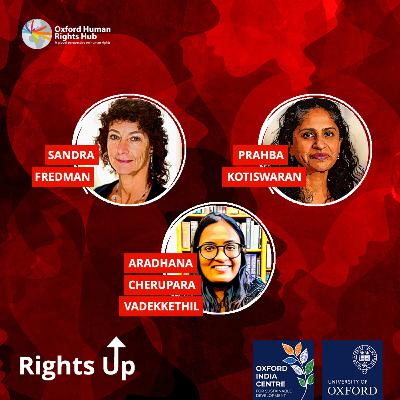
‘Rights in Crisis’, is a new RightsUp series from the Oxford Human Rights Hub in collaboration with the Oxford India Centre for Sustainable Development.The series will feature topics on human rights and related issues in India with experts sharing their insights.In our third episode for this series we discuss cash transfer schemes, in particular, unconditional cash transfer schemes. While these schemes are often designed to enhance women’s financial inclusion and autonomy, they could also reshape women’s relationship with the state. In this episode, we will explore how these initiatives navigate the fine line between empowerment, dependence and the gendered expectations that shape public policy.Want to know more?Women’s work, never done, now paid: Assessing Tamil Nadu’s Urimai Thogai schemeA Right to Care, A Right to Welfare: A Study of the Kalaignar Mahalir Urimai ThittamValuing Care, Recognising Rights, Reimagining WelfareRevaluing Unpaid Work through Unconditional Cash Transfers: The Case of the Orunodoi Scheme in AssamFrom Guarantees to Rights: Assessing Karnataka's Experiment with Basic income and Basic ServicesRightsUp is brought to you by the Oxford Human Rights Hub.This episode is in collaboration with the Oxford India Centre for Sustainable Development.Executive produced by Meghan Campbell.Hosted by Almas Shaikh and Aradhana Cherupara Vadekkethil.Produced and edited by Sophie Smith.Music for the series is by Rosemary Allman.

Comments

Download from Google Play

Download from App Store
 United States