


 Claim Ownership
Today's Catholic Mass Readings
Subscribed: 378Played: 64,316
Subscribe

© Copyright 2026 All rights reserved.
Description
For latest Catholic News, please visit us at https://www.wiredcatholic.com
This podcast contains today's mass readings from the US Catholic Conference of Bishops. The official USCCB podcast feed contains many future podcasts which requires you to scroll through a month's worth of podcasts to today's reading only. This feed only downloads the podcast of the day so today's reading will appear on top of the list. The script is based on the user's timezone so it will work globally. Please note that the USCCB podcasts are downloaded directly from the USCCB website - this feed's only purpose is ease of use and better organization in your podcast player while minimizing bandwidth by downloading only one podcast at a time. As a bonus, the show notes display the full bio of the Saint of the Day from CNA and provides a link to the full text of the readings.
If you get the wrong day's podcast you can unsubscribe from this podcast and subscribe to one of the following based on whether you are the same day, or one day ahead or one day behind the timezone of the podcast server (based in United States):
Next Day : https://www.wiredcatholic.com/todaysmassreadings+1.xml
Same Day : https://www.wiredcatholic.com/todaysmassreadings+0.xml
Previous Day: https://www.wiredcatholic.com/todaysmassreadings-1.xml
Regular Autodetect Feed: https://www.wiredcatholic.com/todaysmassreadings.xml
**************
Change Log/Feedback to Comments and Reviews:
2025-12-31 Script broke in November requiring rewrite to python. Sorry to all the users out there! But it's back up and running now. Merry Christmas and Happy New Year!
2025-03-18 Fixed Saint of the Day chapter picture. Yes I know it's been broken way too long. This should be a more durable fix.
2023-08-11 Some refactoring. Added etag header. Add Saint Picture as episode picture, notes.
2023-07-20 Fixed Saint of the Day chapter picture.
2023-03-02 Fixed the revised date format which occurred on 3/1/23 for the Mp3 which prevented downloading the link.
2023-02-04 Fixed the revised date format to the mp3 name which occurred on Feb 1. 2023 breaking the feed and resulting in 3-4 days of lost mass podcasts. Please note that have no way of responding to the reviews other than this changelog. I use the feed daily so I will usually know when it breaks but it takes me a couple of days to find the time to fix it. Keep in mind I do this in my spare time. It takes me several hours to fix these bugs. When this happens, until it is fixed please visit the USCCB site directly to get the mass podcast online at https://bible.usccb.org/daily-bible-reading. Or if you use Podcast Addict you can click transcript button from any previously working episode and that will open your browser to the correct USCCB page. Then click the forward arrow to advance to the cuurent day. This feed will usually be fixed within a couple of days.
2022-12-10 Fixed chapter Saint of Day Pics. Fixed geo dating.
2022-12-07 Fixed broken Saint of the day url and broken feed.
2022-02-05 Improved Image Getting for chapters. Deleted CNA Code.
2022-01-30 Fixed Saint Picture of Day so fallback is whats on Franciscan page
2022-01-28 Fixed some XML validation issues
2021-11-13 Fixed some XML/itunes validation issues
2021-11-05 Added Saint of the Day Picture for Podcast 2.0 as players: podcast: chapter, added podcast:transcript linked to reading
2021-04-11 Fixed typos and Saint of Day link
2021-04-08 - Fixed timezone error catching; fixed saint of the day error, added alternative saint of the day link (Franciscan media).
9-16-20 - Fixed Dead MP3 Links Broken By USCCB Website Rewrite, Prior Episodes Restarted as of 9-16-20 ]
8-12-20 - Added prior episodes per listener request]
*******
66 Episodes
Reverse
Full Text of Readings
Wednesday of the Second Week of Lent Lectionary: 232
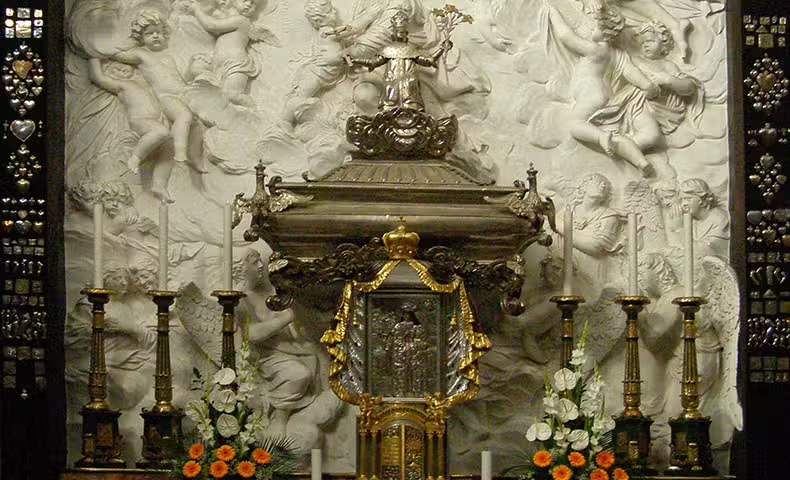
The Saint of the day is Saint Casimir
Saint Casimir’s Story
Saint Casimir, born of kings and in line to be a king himself, was filled with exceptional values and learning by a great teacher, John Dlugosz. Even his critics could not say that his conscientious objection indicated softness. As a teenager, Casimir lived a highly disciplined, even severe life, sleeping on the ground, spending a great part of the night in prayer and dedicating himself to lifelong celibacy.
When nobles in Hungary became dissatisfied with their king, they prevailed upon Casimir’s father, the king of Poland, to send his son to take over the country. Casimir obeyed his father, as many young men over the centuries have obeyed their governments. The army he was supposed to lead was clearly outnumbered by the “enemy”; some of his troops were deserting because they were not paid. At the advice of his officers, Saint Casimir decided to return home.
His father was irked at the failure of his plans, and confined his 15-year-old son for three months. The lad made up his mind never again to become involved in the wars of his day, and no amount of persuasion could change his mind. He returned to prayer and study, maintaining his decision to remain celibate even under pressure to marry the emperor’s daughter.
He reigned briefly as king of Poland during his father’s absence. He died of lung trouble at 25 while visiting Lithuania, of which he was also Grand Duke. He was buried in Vilnius, Lithuania.
Reflection
For many years, Poland and Lithuania faded into the gray prison on the other side of the Iron Curtain. Despite repression, the Poles and Lithuanians remained firm in the faith which has become synonymous with their name. Their youthful patron reminds us: Peace is not won by war; sometimes a comfortable peace is not even won by virtue, but Christ’s peace can penetrate every government repression of religion.Saint of the Day, Copyright Franciscan Media
Full Text of Readings
Tuesday of the Second Week of Lent Lectionary: 231
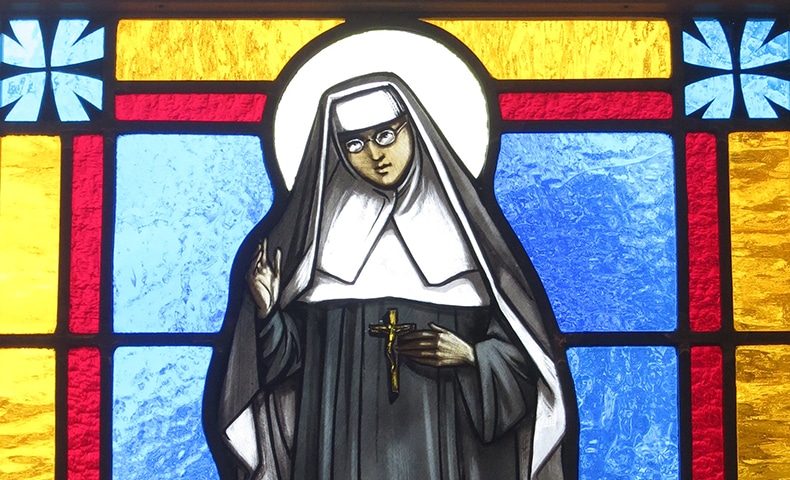
The Saint of the day is Saint Katharine Drexel
Saint Katharine Drexel’s Story
If your father is an international banker and you ride in a private railroad car, you are not likely to be drawn into a life of voluntary poverty. But if your mother opens your home to the poor three days each week and your father spends half an hour each evening in prayer, it is not impossible that you will devote your life to the poor and give away millions of dollars. Katharine Drexel did that.
Born in Philadelphia in 1858, she had an excellent education and traveled widely. As a rich girl, Katharine also had a grand debut into society. But when she nursed her stepmother through a three-year terminal illness, she saw that all the Drexel money could not buy safety from pain or death, and her life took a profound turn.
Saint Katharine Drexel had always been interested in the plight of the Indians, having been appalled by what she read in Helen Hunt Jackson’s A Century of Dishonor. While on a European tour, she met Pope Leo XIII and asked him to send more missionaries to Wyoming for her friend Bishop James O’Connor. The pope replied, “Why don’t you become a missionary?” His answer shocked her into considering new possibilities.
Back home, Katharine visited the Dakotas, met the Sioux leader Red Cloud and began her systematic aid to Indian missions.
Saint Katharine Drexel could easily have married. But after much discussion with Bishop O’Connor, she wrote in 1889, “The feast of Saint Joseph brought me the grace to give the remainder of my life to the Indians and the Colored.” Newspaper headlines screamed “Gives Up Seven Million!”
After three and a half years of training, Mother Drexel and her first band of nuns—Sisters of the Blessed Sacrament for Indians and Colored—opened a boarding school in Santa Fe. A string of foundations followed. By 1942, she had a system of black Catholic schools in 13 states, plus 40 mission centers and 23 rural schools. Segregationists harassed her work, even burning a school in Pennsylvania. In all, she established 50 missions for Indians in 16 states.
Two saints met when Saint Katharine Drexel was advised by Mother Cabrini about the “politics” of getting her order’s Rule approved in Rome. Her crowning achievement was the founding of Xavier University in New Orleans, the first Catholic university in the United States for African Americans.
At 77, Mother Drexel suffered a heart attack and was forced to retire. Apparently her life was over. But now came almost 20 years of quiet, intense prayer from a small room overlooking the sanctuary. Small notebooks and slips of paper record her various prayers, ceaseless aspirations, and meditations. She died at 96 and was canonized in 2000.
Reflection
Saints have always said the same thing: Pray, be humble, accept the cross, love and forgive. But it is good to hear these things in the American idiom from one who, for instance, had her ears pierced as a teenager, who resolved to have “no cake, no preserves,” who wore a watch, was interviewed by the press, traveled by train, and could concern herself with the proper size of pipe for a new mission. These are obvious reminders that holiness can be lived in today’s culture as well as in that of Jerusalem or Rome. Saint Katharine Drexel reminds us that holiness can take many paths, but all of them lead to God. Saint Katharine Drexel: Pray for us!Saint of the Day, Copyright Franciscan Media
Full Text of Readings
Monday of the Second Week of Lent Lectionary: 230
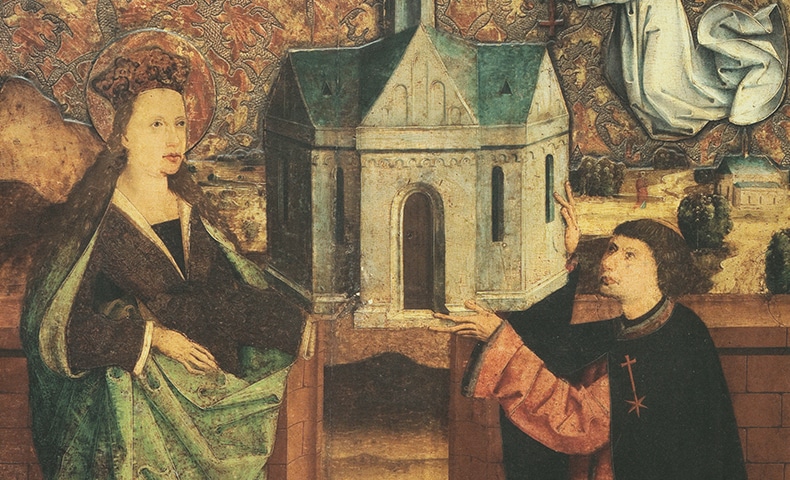
The Saint of the day is Saint Agnes of Bohemia
Saint Agnes of Bohemia’s Story
Agnes had no children of her own but was certainly life-giving for all who knew her.
Saint Agnes of Bohemia was the daughter of Queen Constance and King Ottokar I of Bohemia. She was betrothed to the Duke of Silesia, who died three years later. As she grew up, she decided she wanted to enter the religious life.
After declining marriages to King Henry VII of Germany and King Henry III of England, Agnes was faced with a proposal from Frederick II, the Holy Roman Emperor. She appealed to Pope Gregory IX for help. The pope was persuasive; Frederick magnanimously said that he could not be offended if Agnes preferred the King of Heaven to him.
After Agnes built a hospital for the poor and a residence for the friars, she financed the construction of a Poor Clare monastery in Prague. In 1236, she and seven other noblewomen entered this monastery. Saint Clare sent five sisters from San Damiano to join them, and wrote Agnes four letters advising her on the beauty of her vocation and her duties as abbess.
Saint Agnes of Bohemia became known for prayer, obedience and mortification. Papal pressure forced her to accept her election as abbess, nevertheless, the title she preferred was “senior sister.” Her position did not prevent her from cooking for the other sisters and mending the clothes of lepers. The sisters found her kind but very strict regarding the observance of poverty; she declined her royal brother’s offer to set up an endowment for the monastery.
Devotion to Agnes arose soon after her death on March 6, 1282. Canonized in 1989, her liturgical feast is celebrated on March 6.
Reflection
Agnes spent at least 45 years in a Poor Clare monastery. Such a life requires a great deal of patience and charity. The temptation to selfishness certainly didn’t vanish when Agnes walked into the monastery. It is perhaps easy for us to think that cloistered nuns “have it made” regarding holiness. Their route is the same as ours: gradual exchange of our standards—inclinations to selfishness—for God’s standard of generosity.Saint of the Day, Copyright Franciscan Media
Full Text of Readings
Second Sunday of Lent Lectionary: 25
The Saint of the day is Saint David of Wales
Saint David of Wales’ Story
David is the patron saint of Wales and perhaps the most famous of British saints. Ironically, we have little reliable information about him.
It is known that he became a priest, engaged in missionary work, and founded many monasteries, including his principal abbey in southwestern Wales. Many stories and legends sprang up about David and his Welsh monks. Their austerity was extreme. They worked in silence without the help of animals to till the soil. Their food was limited to bread, vegetables and water.
In about the year 550, Saint David of Wales attended a synod where his eloquence impressed his fellow monks to such a degree that he was elected primate of the region. The episcopal see was moved to Mynyw, where he had his monastery, now called St. David’s. He ruled his diocese until he had reached a very old age. His last words to his monks and subjects were: “Be joyful, brothers and sisters. Keep your faith, and do the little things that you have seen and heard with me.”
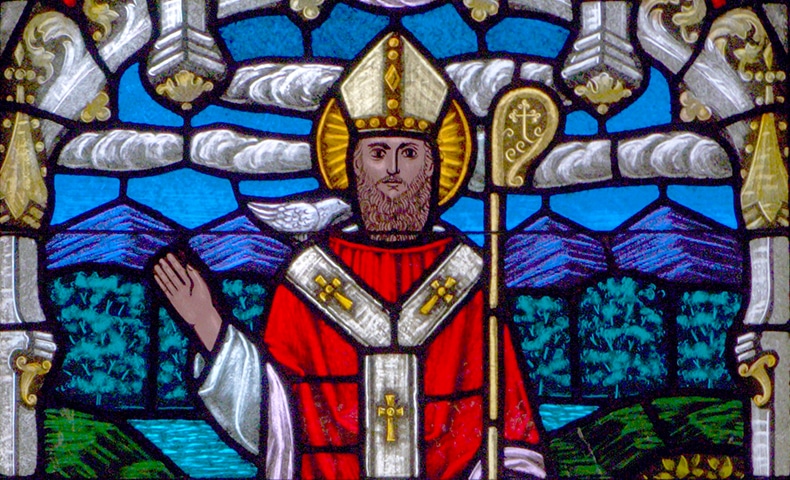
Saint David is pictured standing on a mound with a dove on his shoulder. The legend is that once while he was preaching a dove descended to his shoulder and the earth rose to lift him high above the people so that he could be heard. Over 50 churches in South Wales were dedicated to him in pre-Reformation days.
Reflection
Were we restricted to hard manual labor and a diet of bread, vegetables and water, most of us would find little reason to rejoice. Yet joy is what David urged on his brothers as he lay dying. Perhaps he could say that to them—and to us—because he lived in and nurtured a constant awareness of God’s nearness. For, as someone once said, “Joy is the infallible sign of God’s presence.” May his intercession bless us with the same awareness!Saint of the Day, Copyright Franciscan Media
Full Text of Readings
Saturday of the First Week of Lent Lectionary: 229
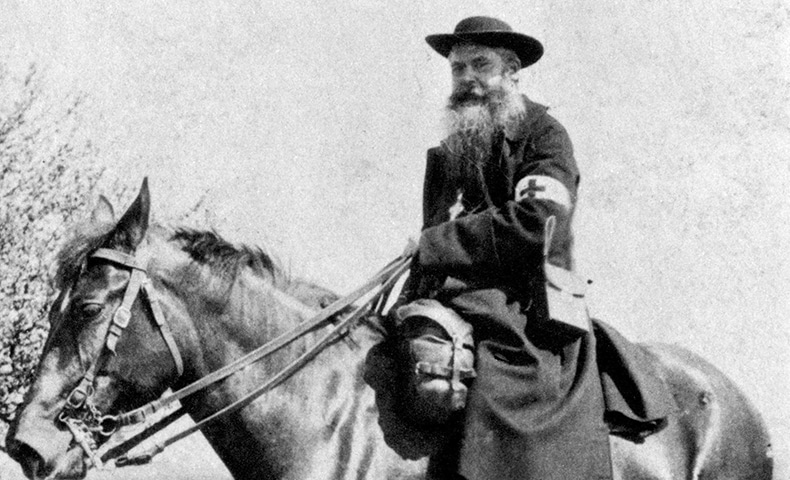
The Saint of the day is Blessed Daniel Brottier
Blessed Daniel Brottier’s Story
Daniel spent most of his life in the trenches—one way or another.
Born in France in 1876, Blessed Daniel Brottier was ordained in 1899 and began a teaching career. That didn’t satisfy him long. He wanted to use his zeal for the gospel far beyond the classroom. He joined the missionary Congregation of the Holy Spirit, which sent him to Senegal, West Africa. After eight years there, his health was suffering. He was forced to return to France, where he helped raise funds for the construction of a new cathedral in Senegal.
At the outbreak of World War I, Blessed Daniel Brottier became a volunteer chaplain and spent four years at the front. He did not shrink from his duties. Indeed, he risked his life time and again in ministering to the suffering and dying. It was miraculous that he did not suffer a single wound during his 52 months in the heart of battle.
After the war he was invited to help establish a project for orphaned and abandoned children in a Paris suburb. He spent the final 13 years of his life there. He died in 1936 and was beatified by Pope John Paul II in Paris only 48 years later.
Reflection
Blessed Daniel might be called “Teflon Dan” since nothing seemed to harm him while in the midst of war. God intended to use him in some pretty wonderful ways for the good of the Church and he willingly served. He is a good example for all of us.Saint of the Day, Copyright Franciscan Media
Full Text of Readings
Friday of the First Week of Lent Lectionary: 228
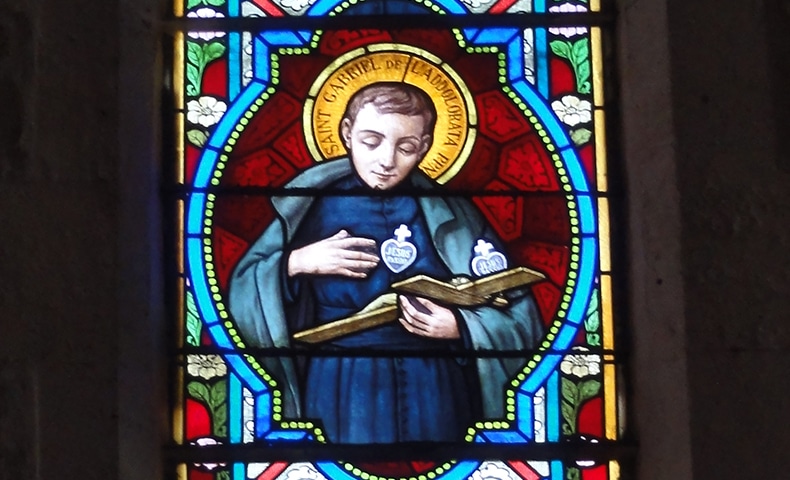
The Saint of the day is Saint Gabriel of Our Lady of Sorrows
Saint Gabriel of Our Lady of Sorrows’ Story
Born in Italy into a large family and baptized Francis, Saint Gabriel lost his mother when he was only four years old. He was educated by the Jesuits and, having been cured twice of serious illnesses, came to believe that God was calling him to the religious life. Young Francis wished to join the Jesuits but was turned down, probably because of his age, not yet 17. Following the death of a sister to cholera, his resolve to enter religious life became even stronger and he was accepted by the Passionists. Upon entering the novitiate he was given the name Gabriel of Our Lady of Sorrows.
Ever popular and cheerful, Gabriel quickly was successful in his effort to be faithful in little things. His spirit of prayer, love for the poor, consideration of the feelings of others, exact observance of the Passionist Rule as well as his bodily penances—always subject to the will of his wise superiors— made a deep impression on everyone.
His superiors had great expectations of Gabriel as he prepared for the priesthood, but after only four years of religious life symptoms of tuberculosis appeared. Ever obedient, he patiently bore the painful effects of the disease and the restrictions it required, seeking no special notice. He died peacefully on February 27, 1862, at age 24, having been an example to both young and old.
Saint Gabriel of Our Lady of Sorrows was canonized in 1920.
Reflection
When we think of achieving great holiness by doing little things with love and grace, Therese of Lisieux comes first to mind. Like her, Gabriel died painfully from tuberculosis. Together they urge us to tend to the small details of daily life, to be considerate of others’ feelings every day. Our path to sanctity, like theirs, probably lies not in heroic doings but in performing small acts of kindness every day.Saint of the Day, Copyright Franciscan Media
Full Text of Readings
Thursday of the First Week in Lent Lectionary: 227
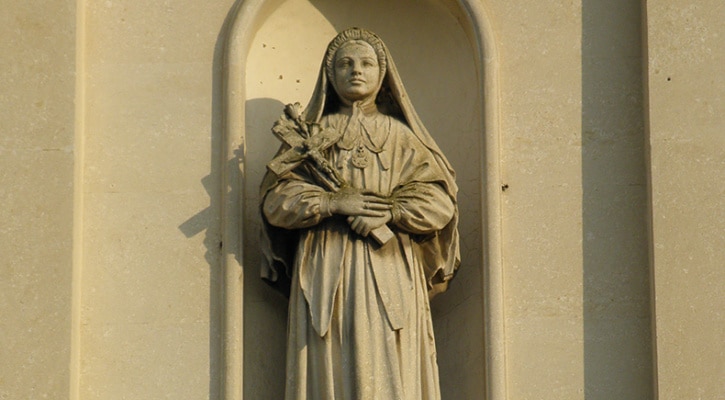
The Saint of the day is Saint Maria Bertilla Boscardin
Saint Maria Bertilla Boscardin’s Story
If anyone knew rejection, ridicule and disappointment, it was today’s saint. But such trials only brought Saint Maria Bertilla Boscardin closer to God and more determined to serve him.
Born in Italy in 1888, the young girl lived in fear of her father, a violent man prone to jealousy and drunkenness. Her schooling was limited so that she could spend more time helping at home and working in the fields. She showed few talents and was often the butt of jokes.
In 1904, she joined the Sisters of Saint Dorothy and was assigned to work in the kitchen, bakery and laundry. After some time Maria received nurses’ training and began working in a hospital with children suffering from diphtheria. There the young nun seemed to find her true vocation: nursing very ill and disturbed children. Later, when the hospital was taken over by the military in World War I, Sister Maria Bertilla fearlessly cared for patients amidst the threat of constant air raids and bombings.
Saint Maria Bertilla Boscardin died in 1922 after suffering for many years from a painful tumor. Some of the patients she had nursed many years before were present at her canonization in 1961.
Reflection
This fairly recent saint knew the hardships of living in an abusive situation. Let us pray to her to help all those who are suffering from any form of spiritual, mental, or physical abuse.Saint of the Day, Copyright Franciscan Media
Full Text of Readings
Wednesday of the First Week in Lent Lectionary: 226
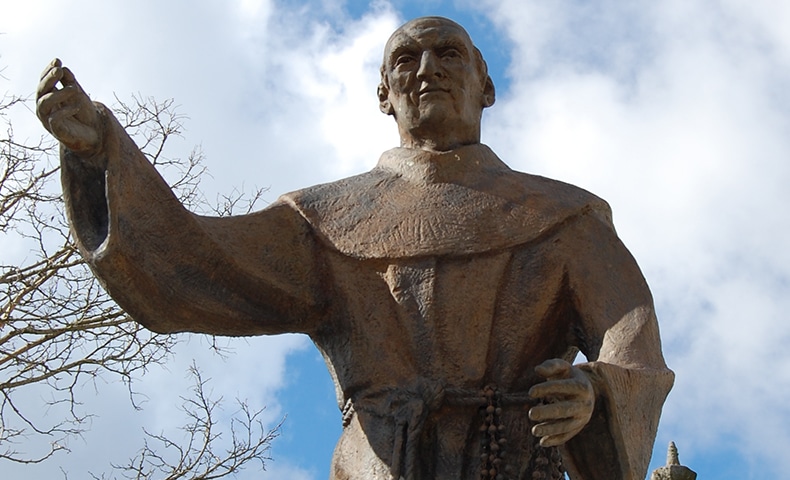
The Saint of the day is Blessed Sebastian of Aparicio
Blessed Sebastian of Aparicio’s Story
Sebastian’s roads and bridges connected many distant places. His final bridge-building was to help men and women recognize their God-given dignity and destiny.
Sebastian’s parents were Spanish peasants. At the age of 31, he sailed to Mexico, where he began working in the fields. Eventually he built roads to facilitate agricultural trading and other commerce. His 466-mile road from Mexico City to Zacatecas took 10 years to build and required careful negotiations with the indigenous peoples along the way.
In time Blessed Sebastian of Aparicio was a wealthy farmer and rancher. At the age of 60, he entered a virginal marriage. His wife’s motivation may have been a large inheritance; his was to provide a respectable life for a girl without even a modest marriage dowry. When his first wife died, he entered another virginal marriage for the same reason; his second wife also died young.
At the age of 72, Blessed Sebastian of Aparicio distributed his goods among the poor and entered the Franciscans as a brother. Assigned to the large (100-member) friary at Puebla de los Angeles south of Mexico City, Sebastian went out collecting alms for the friars for the next 25 years. His charity to all earned him the nickname “Angel of Mexico.”
Sebastian was beatified in 1787 and is known as a patron of travelers.
Reflection
According to the Rule of Saint Francis, the friars were to work for their daily bread. Sometimes, however, their work would not provide for their needs; for example, working with people suffering from leprosy brought little or no pay. In cases such as these, the friars were allowed to beg, always keeping in mind the admonition of Francis to let their good example commend them to the people. The life of the prayerful Sebastian drew many closer to God.Saint of the Day, Copyright Franciscan Media
Full Text of Readings
Tuesday of the First Week of Lent Lectionary: 225
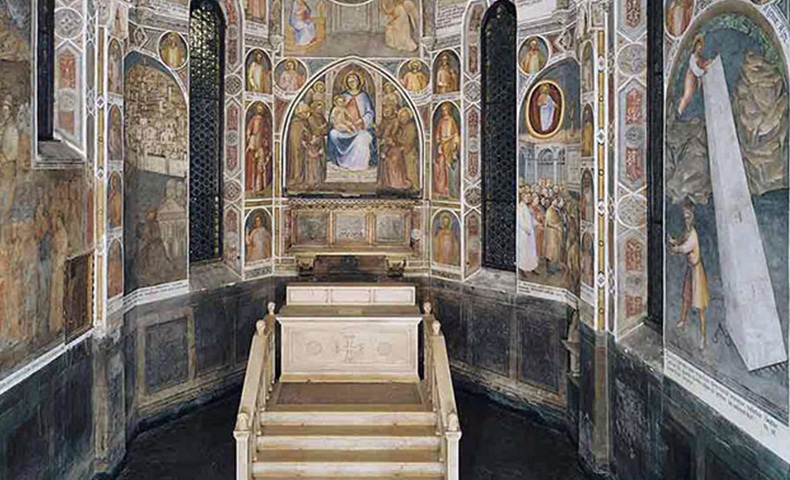
The Saint of the day is Blessed Luke Belludi
Blessed Luke Belludi’s Story
In 1220, Saint Anthony was preaching conversion to the inhabitants of Padua when a young nobleman, Blessed Luke Belludi, came up to him and humbly asked to receive the habit of the followers of Saint Francis. Anthony liked the talented, well-educated Luke and personally recommended him to Francis, who then received him into the Franciscan Order.
Luke, then only 20, was to be Anthony’s companion in his travels and in his preaching, tending to him in his last days and taking Anthony’s place upon his death. He was appointed guardian of the Friars Minor in the city of Padua. In 1239, the city fell into the hands of its enemies. Nobles were put to death, the mayor and council were banished, the great university of Padua gradually closed and the church dedicated to Saint Anthony was left unfinished. Luke himself was expelled from the city but secretly returned.
At night he and the new guardian would visit the tomb of Saint Anthony in the unfinished shrine to pray for his help. One night a voice came from the tomb assuring them that the city would soon be delivered from its evil tyrant.
After the fulfillment of the prophetic message, Blessed Luke was elected provincial minister and furthered the completion of the great basilica in honor of Anthony, his teacher. He founded many convents of the order and had, as Anthony, the gift of miracles. Upon his death he was laid to rest in the basilica that he had helped finish and has had a continual veneration up to the present time.
Reflection
The epistles refer several times to a man named Luke as Paul’s trusted companion on his missionary journeys. Perhaps every great preacher needs a Luke; Anthony surely did. Blessed Luke Belludi not only accompanied Anthony on his travels, he also cared for the great saint in his final illness and carried on Anthony’s mission after the saint’s death. Yes, every preacher needs a Luke, someone to offer support and reassurance—including those who minister to us. We don’t even have to change our names!Saint of the Day, Copyright Franciscan Media
Full Text of Readings
Monday of the First Week of Lent Lectionary: 224
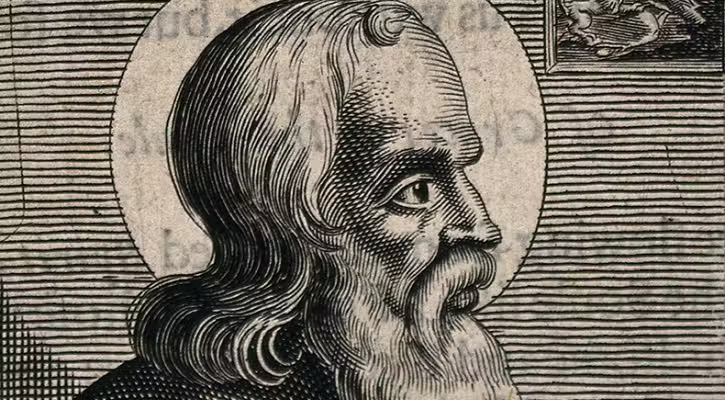
The Saint of the day is Saint Polycarp
Saint Polycarp’s Story
Polycarp, bishop of Smyrna, disciple of Saint John the Apostle and friend of Saint Ignatius of Antioch, was a revered Christian leader during the first half of the second century.
Saint Ignatius, on his way to Rome to be martyred, visited Saint Polycarp at Smyrna, and later at Troas wrote him a personal letter. The Asia Minor Churches recognized Polycarp’s leadership by choosing him as a representative to discuss with Pope Anicetus the date of the Easter celebration in Rome—a major controversy in the early Church.
Only one of the many letters written by Saint Polycarp has been preserved, the one he wrote to the Church of Philippi in Macedonia.
At 86, Polycarp was led into the crowded Smyrna stadium to be burned alive. The flames did not harm him and he was finally killed by a dagger. The centurion ordered the saint’s body burned. The “Acts” of Saint Polycarp’s martyrdom are the earliest preserved, fully reliable account of a Christian martyr’s death. He died in 155.
Reflection
Polycarp was recognized as a Christian leader by all Asia Minor Christians—a strong fortress of faith and loyalty to Jesus Christ. His own strength emerged from his trust in God, even when events contradicted this trust. Living among pagans and under a government opposed to the new religion, he led and fed his flock. Like the Good Shepherd, he laid down his life for his sheep and kept them from more persecution in Smyrna. He summarized his trust in God just before he died: “Father… I bless Thee, for having made me worthy of the day and the hour…” (Acts of Martyrdom, Chapter 14).Saint of the Day, Copyright Franciscan Media
Full Text of Readings
First Sunday of Lent Lectionary: 22
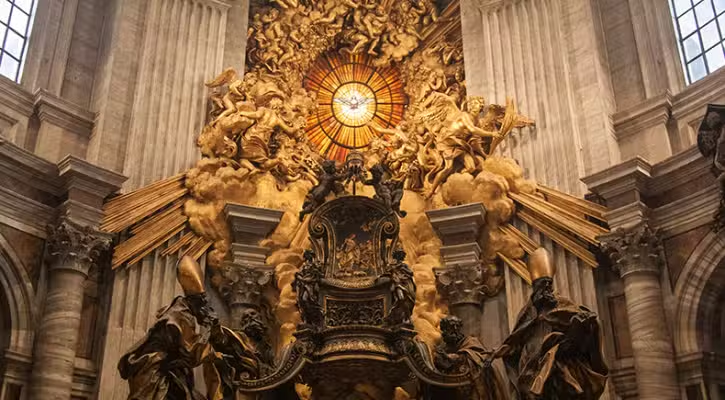
The Saint of the day is Chair of Saint Peter
The Story of the Chair of Saint Peter
This feast commemorates Christ’s choosing Peter to sit in his place as the servant-authority of the whole Church.
After the “lost weekend” of pain, doubt, and self-torment, Peter hears the Good News. Angels at the tomb say to Magdalene, “The Lord has risen! Go, tell his disciples and Peter.” John relates that when he and Peter ran to the tomb, the younger outraced the older, then waited for him. Peter entered, saw the wrappings on the ground, the headpiece rolled up in a place by itself. John saw and believed. But he adds a reminder: “…[T]hey did not yet understand the scripture that he had to rise from the dead” (John 20:9).
They went home. There the slowly exploding, impossible idea became reality. Jesus appeared to them as they waited fearfully behind locked doors. “Peace be with you,” he said (John 20:21b), and they rejoiced.
The Pentecost event completed Peter’s experience of the risen Christ. “…[T]hey were all filled with the holy Spirit” (Acts 2:4a) and began to express themselves in foreign tongues and make bold proclamation as the Spirit prompted them.
Only then can Peter fulfill the task Jesus had given him: “… [O]nce you have turned back, you must strengthen your brothers” (Luke 22:32). He at once becomes the spokesman for the Twelve about their experience of the Holy Spirit—before the civil authorities who wished to quash their preaching, before the Council of Jerusalem, for the community in the problem of Ananias and Sapphira. He is the first to preach the Good News to the Gentiles. The healing power of Jesus in him is well attested: the raising of Tabitha from the dead, the cure of the crippled beggar. People carry the sick into the streets so that when Peter passed his shadow might fall on them.
Even a saint experiences difficulty in Christian living. When Peter stopped eating with Gentile converts because he did not want to wound the sensibilities of Jewish Christians, Paul says, “…I opposed him to his face because he clearly was wrong…. [T]hey were not on the right road in line with the truth of the gospel…” (Galatians 2:11b, 14a).
At the end of John’s Gospel, Jesus says to Peter, “Amen, amen, I say to you, when you were younger, you used to dress yourself and go where you wanted; but when you grow old, you will stretch out your hands, and someone else will dress you and lead you where you do not want to go” (John 21:18). What Jesus said indicated the sort of death by which Peter was to glorify God. On Vatican Hill, in Rome, during the reign of Nero, Peter did glorify his Lord with a martyr’s death, probably in the company of many Christians.
Second-century Christians built a small memorial over his burial spot. In the fourth century, the Emperor Constantine built a basilica, which was replaced in the 16th century.
Reflection
Like the committee chair, the chair refers to the occupant, not the furniture. Its first occupant stumbled a bit, denying Jesus three times and hesitating to welcome gentiles into the new Church. But, as we know, he turned toward the light. Some of its later occupants have also stumbled a bit, sometimes even failed scandalously. As individuals, we may sometimes think a particular pope has let us down. Still, the office endures as a sign of the long tradition we cherish and as a focus for the universal Church.Saint of the Day, Copyright Franciscan Media
Full Text of Readings
Saturday after Ash Wednesday Lectionary: 222
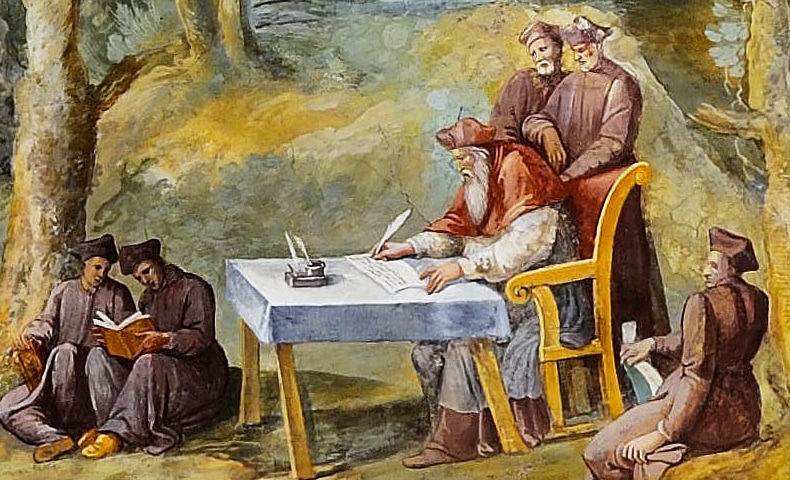
The Saint of the day is Saint Peter Damian
Saint Peter Damian’s Story
Maybe because he was orphaned and had been treated shabbily by one of his brothers, Saint Peter Damian was very good to the poor. It was the ordinary thing for him to have a poor person or two with him at table and he liked to minister personally to their needs.
Saint Peter escaped poverty and the neglect of his own brother when his other brother, who was archpriest of Ravenna, took him under his wing. His brother sent him to good schools and Peter became a professor.
Already in those days, Saint Peter Damian was very strict with himself. He wore a hair shirt under his clothes, fasted rigorously and spent many hours in prayer. Soon, he decided to leave his teaching and give himself completely to prayer with the Benedictines of the reform of Saint Romuald at Fonte Avellana. They lived two monks to a hermitage. Peter was so eager to pray and slept so little that he soon suffered from severe insomnia. He found he had to use some prudence in taking care of himself. When he was not praying, he studied the Bible.
The abbot commanded that when he died Saint Peter Damian should succeed him. Abbot Saint Peter founded five other hermitages. He encouraged his brothers in a life of prayer and solitude and wanted nothing more for himself. The Holy See periodically called on him, however, to be a peacemaker or troubleshooter, between two abbeys in dispute or a cleric or government official in some disagreement with Rome.
Finally, Pope Stephen IX made Saint Peter Damian the cardinal-bishop of Ostia. He worked hard to wipe out simony—the buying of church offices–and encouraged his priests to observe celibacy and urged even the diocesan clergy to live together and maintain scheduled prayer and religious observance. He wished to restore primitive discipline among religious and priests, warning against needless travel, violations of poverty, and too comfortable living. He even wrote to the bishop of Besancon complaining that the canons there sat down when they were singing the psalms in the Divine Office.
He wrote many letters. Some 170 are extant. We also have 53 of his sermons and seven lives, or biographies, that he wrote. He preferred examples and stories rather than theory in his writings. The liturgical offices he wrote are evidence of his talent as a stylist in Latin.
He asked often to be allowed to retire as cardinal-bishop of Ostia, and finally Pope Alexander II consented. Saint Peter Damian was happy to become once again just a monk, but he was still called to serve as a papal legate. When returning from such an assignment in Ravenna, he was overcome by a fever. With the monks gathered around him saying the Divine Office, he died on February 22, 1072. In 1828, he was declared a Doctor of the Church.
Reflection
Peter was a reformer and if he were alive today would no doubt encourage the renewal started by Vatican II. He would also applaud the greater emphasis on prayer that is shown by the growing number of priests, religious, and laypersons who gather regularly for prayer, as well as the special houses of prayer recently established by many religious communities.Saint of the Day, Copyright Franciscan Media
Full Text of Readings
Friday after Ash Wednesday Lectionary: 221
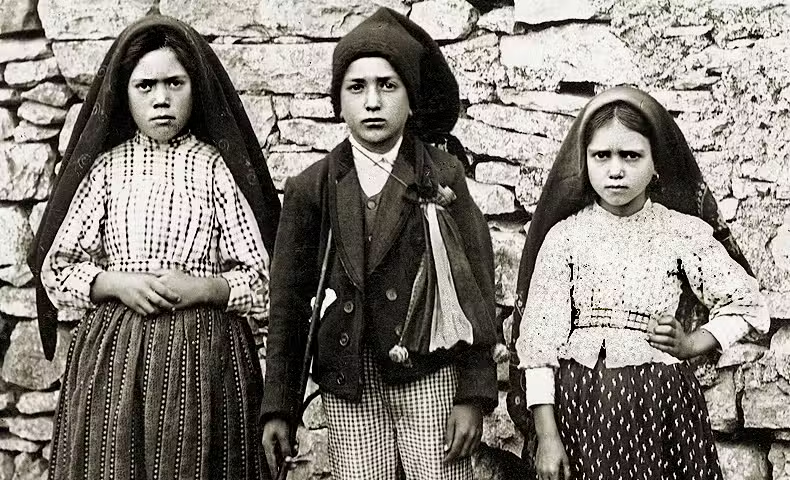
The Saint of the day is Saints Jacinta and Francisco Marto
Saints Jacinta and Francisco Marto’s Story
Between May 13 and October 13, 1917, three Portuguese shepherd children from Aljustrel, received apparitions of Our Lady at Cova da Iria, near Fátima, a city 110 miles north of Lisbon. At that time, Europe was involved in an extremely bloody war. Portugal itself was in political turmoil, having overthrown its monarchy in 1910; the government disbanded religious organizations soon after.
At the first appearance, Mary asked the children to return to that spot on the thirteenth of each month for the next six months. She also asked them to learn to read and write and to pray the rosary “to obtain peace for the world and the end of the war.” They were to pray for sinners and for the conversion of Russia, which had recently overthrown Czar Nicholas II and was soon to fall under communism. Up to 90,000 people gathered for Mary’s final apparition on October 13, 1917.
Less than two years later, Francisco died of influenza in his family home. He was buried in the parish cemetery and then re-buried in the Fátima basilica in 1952. Jacinta died of influenza in Lisbon in 1920, offering her suffering for the conversion of sinners, peace in the world, and the Holy Father. She was re-buried in the Fátima basilica in 1951.
Their cousin Lúcia dos Santos, became a Carmelite nun and was still living when Jacinta and Francisco were beatified in 2000; she died five years later. Pope Francis canonized the younger children on his visit to Fátima to commemorate the 100th anniversary of the first apparition–May 13, 2017. The shrine of Our Lady of Fátima is visited by up to 20 million people a year.
Reflection
The Church is always very cautious about endorsing alleged apparitions, but it has seen benefits from people changing their lives because of the message of Our Lady of Fátima. Prayer for sinners, devotion to the Immaculate Heart of Mary, and praying the rosary—all these reinforce the Good News Jesus came to preach.Saint of the Day, Copyright Franciscan Media
Full Text of Readings
Thursday after Ash Wednesday Lectionary: 220
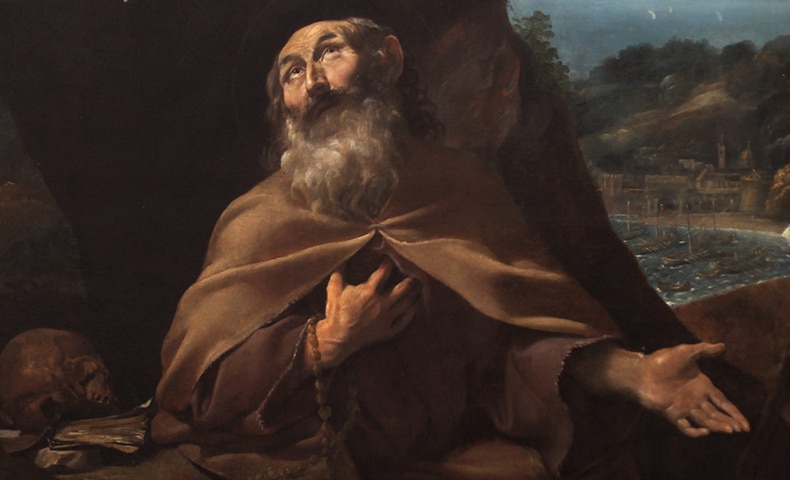
The Saint of the day is Saint Conrad of Piacenza
Saint Conrad of Piacenza’s Story
Born of a noble family in northern Italy, Saint Conrad as a young man married Euphrosyne, daughter of a nobleman.
One day while hunting he ordered attendants to set fire to some brush in order to flush out the game. The fire spread to nearby fields and to a large forest. Saint Conrad of Piacenza fled. An innocent peasant was imprisoned, tortured to confess, and condemned to death. Conrad confessed his guilt, saved the man’s life, and paid for the damaged property.
Soon after this event, Saint Conrad of Piacenza and his wife agreed to separate: she to a Poor Clare monastery and he to a group of hermits following the Third Order Rule. His reputation for holiness, however, spread quickly. Since his many visitors destroyed his solitude, Conrad went to a more remote spot in Sicily where he lived 36 years as a hermit, praying for himself and for the rest of the world.
Prayer and penance were his answer to the temptations that beset him. Conrad died kneeling before a crucifix. He was canonized in 1625.
Reflection
Francis of Assisi was drawn both to contemplation and to a life of preaching; periods of intense prayer nourished his preaching. Some of his early followers, however, felt called to a life of greater contemplation, and he accepted that. Though Conrad of Piacenza is not the norm in the Church, he and other contemplatives remind us of the greatness of God and of the joys of heaven.Saint of the Day, Copyright Franciscan Media
Full Text of Readings
Ash Wednesday Lectionary: 219
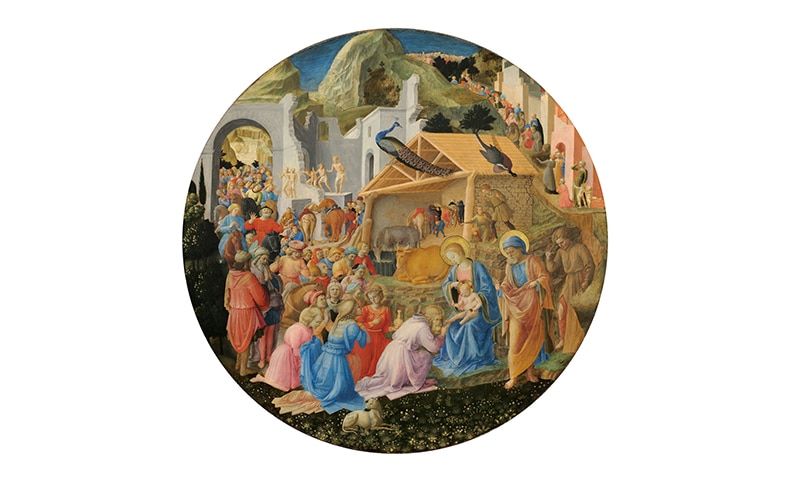
The Saint of the day is Blessed John of Fiesole
Blessed John of Fiesole’s Story
The patron of Christian artists was born around 1400 in a village overlooking Florence. He took up painting as a young boy and studied under the watchful eye of a local painting master. He joined the Dominicans at about age 20, taking the name Fra Giovanni. He eventually came to be known as Fra Angelico, perhaps a tribute to his own angelic qualities or maybe the devotional tone of his works.
He continued to study painting and perfect his own techniques, which included broad-brush strokes, vivid colors and generous, lifelike figures. Michelangelo once said of Fra Angelico: “One has to believe that this good monk has visited paradise and been allowed to choose his models there.” Whatever his subject matter, Fra Angelico sought to generate feelings of religious devotion in response to his paintings. Among his most famous works are the Annunciation and Descent from the Cross as well as frescoes in the monastery of San Marco in Florence.
He also served in leadership positions within the Dominican Order. At one point, Pope Eugenius approached him about serving as archbishop of Florence. Fra Angelico declined, preferring a simpler life. He died in 1455.
Reflection
The work of artists adds a wonderful dimension to life. Without art our lives would be much depleted. Let us pray for artists today, especially those who can lift our hearts and minds to God. Blessed John of Fiesole: Pray for us!Saint of the Day, Copyright Franciscan Media
Full Text of Readings
Tuesday of the Sixth Week in Ordinary Time Lectionary: 336
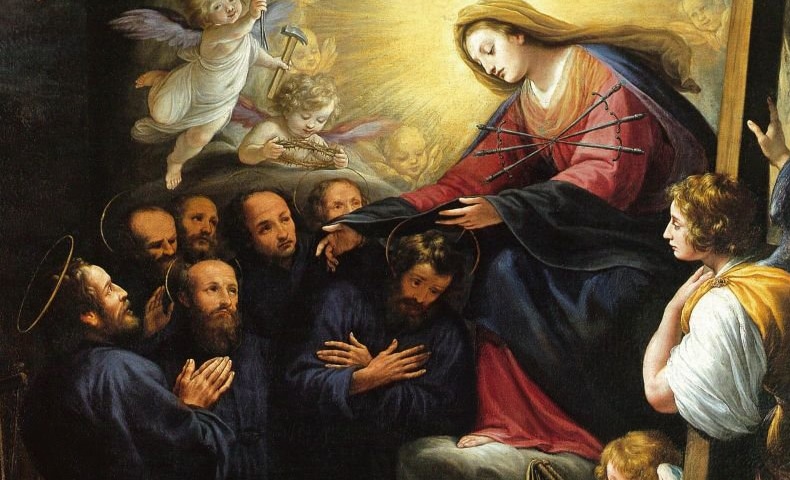
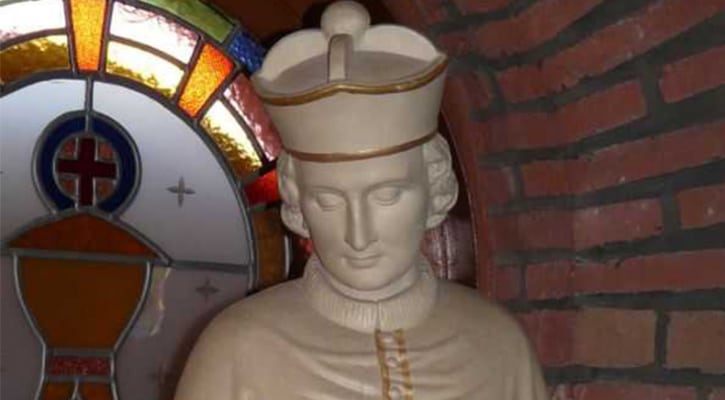
The Saint of the day is Seven Founders of the Servite Order
The Story of the Seven Founders of the Servite Order
Can you imagine seven prominent men of Boston or Denver banding together, leaving their homes and professions, and going into solitude for a life directly given to God? That is what happened in the cultured and prosperous city of Florence in the middle of the 13th century. The city was torn with political strife as well as the heresy of the Cathari, who believed that physical reality was inherently evil. Morals were low and religion seemed meaningless.
In 1240, seven noblemen of Florence mutually decided to withdraw from the city to a solitary place for prayer and direct service of God. Their initial difficulty was providing for their dependents, since two were still married and two were widowers.
Their aim was to lead a life of penance and prayer, but they soon found themselves disturbed by constant visitors from Florence. They next withdrew to the deserted slopes of Monte Senario.
In 1244, under the direction of Saint Peter of Verona, O.P., this small group adopted a religious habit similar to the Dominican habit, choosing to live under the Rule of St. Augustine and adopting the name of the Servants of Mary. The new Order took a form more like that of the mendicant friars than that of the older monastic Orders.
Members of the community came to the United States from Austria in 1852 and settled in New York and later in Philadelphia. The two American provinces developed from the foundation made by Father Austin Morini in 1870 in Wisconsin.
Community members combined monastic life and active ministry. In the monastery, they led a life of prayer, work and silence while in the active apostolate they engaged in parochial work, teaching, preaching, and other ministerial activities.
Reflection
The time in which the Seven Founders of the Servite Order lived is very easily comparable to the situation in which we find ourselves today. It is “the best of times and the worst of times,” as Dickens once wrote. Some, perhaps many, feel called to a countercultural life, even in religion. All of us are faced in a new and urgent way with the challenge to make our lives decisively centered in Christ.Saint of the Day, Copyright Franciscan Media
Full Text of Readings
Monday of the Sixth Week in Ordinary Time Lectionary: 335
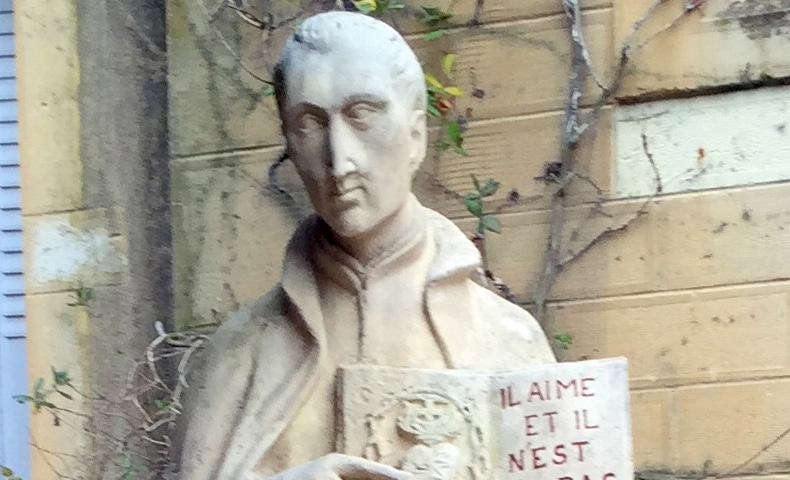
The Saint of the day is Saint Gilbert of Sempringham
Saint Gilbert of Sempringham’s Story
Saint Gilbert of Sempringham was born into a wealthy family, but he followed a path quite different from that expected of him as the son of a Norman knight. Sent to France for his higher education, he decided to pursue seminary studies.
He returned to England not yet ordained a priest, and inherited several estates from his father. But Gilbert avoided the easy life he could have led under the circumstances. Instead he lived a simple life at a parish, sharing as much as possible with the poor. Following his ordination to the priesthood he served as parish priest at Sempringham.
Among the congregation were seven young women who had expressed to him their desire to live in religious life. In response, Saint Gilbert of Sempringham had a house built for them adjacent to the Church. There they lived an austere life, but one which attracted ever more numbers; eventually lay sisters and lay brothers were added to work the land.
The religious order formed eventually became known as the Gilbertines, though Gilbert had hoped the Cistercians or some other existing order would take on the responsibility of establishing a rule of life for the new order. The Gilbertines, the only religious order of English origin founded during the Middle Ages, continued to thrive. But the order came to an end when King Henry VIII suppressed all Catholic monasteries.
Over the years a special custom grew up in the houses of the order called “the plate of the Lord Jesus.” The best portions of the dinner were put on a special plate and shared with the poor, reflecting Saint Gilbert of Sempringham’s lifelong concern for less fortunate people.
Throughout his life, Gilbert lived simply, consumed little food, and spent a good portion of many nights in prayer. Despite the rigors of such a life he died at well over age 100.
Reflection
When he came into his father’s wealth, Gilbert could have lived a life of luxury, as many of his fellow priests did at the time. Instead, he chose to share his wealth with the poor. The charming habit of filling “the plate of the Lord Jesus” in the monasteries he established reflected his concern. Today’s Operation Rice Bowl echoes that habit: eating a simpler meal and letting the difference in the grocery bill help feed the hungry.Saint of the Day, Copyright Franciscan Media
Full Text of Readings
Sixth Sunday in Ordinary Time Lectionary: 76
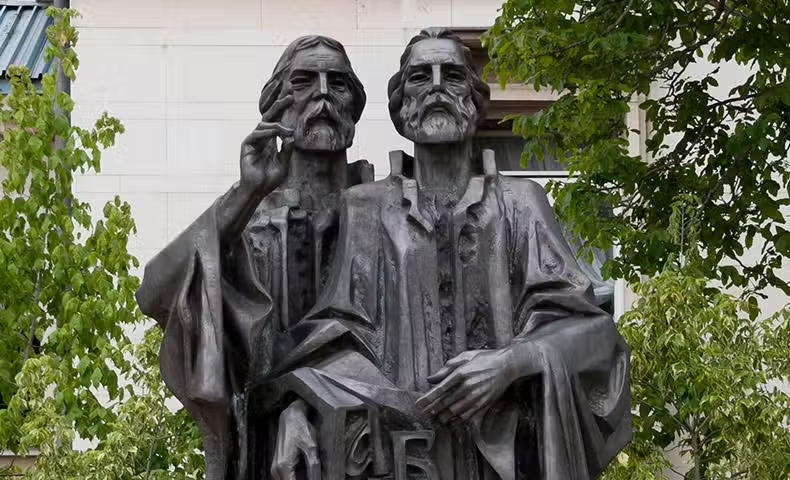
The Saint of the day is Saint Claude de la Colombière
Saint Claude de la Colombière’s Story
This is a special day for the Jesuits, who claim today’s saint as one of their own. It’s also a special day for people who have a special devotion to the Sacred Heart of Jesus—a devotion Saint Claude de la Colombière promoted along with his friend and spiritual companion, Saint Margaret Mary Alacoque. The emphasis on God’s love for all was an antidote to the rigorous moralism of the Jansenists, who were popular at the time.
Saint Claude showed remarkable preaching skills long before his ordination in 1675. Two months later, he was made superior of a small Jesuit residence in Burgundy. It was there he first encountered Margaret Mary Alacoque. For many years after he served as her confessor.
He was next sent to England to serve as confessor to the Duchess of York. He preached by both words and by the example of his holy life, converting a number of Protestants. Tensions arose against Catholics and Claude, rumored to be part of a plot against the king, was imprisoned. He was ultimately banished, but by then his health had been ruined.
He died in 1682. Pope John Paul II canonized Saint Claude de la Colombière in 1992.
Reflection
As a fellow Jesuit and as a promoter of the devotion to the Sacred Heart of Jesus, Saint Claude must be very special to Pope Francis who has so beautifully emphasized the mercy of Jesus. The emphasis on God’s love and mercy are characteristic of both men.Saint of the Day, Copyright Franciscan Media
Full Text of Readings
Memorial of Saints Cyril, Monk, and Methodius, Bishop Lectionary: 334
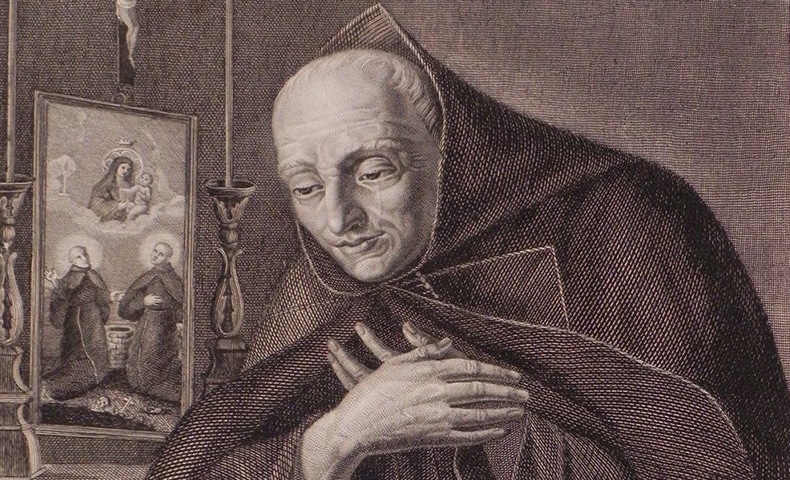
The Saint of the day is Saints Cyril and Methodius
Saints Cyril and Methodius’ Stories
Because their father was an officer in a part of Greece inhabited by many Slavs, these two Greek brothers ultimately became missionaries, teachers, and patrons of the Slavic peoples.
After a brilliant course of studies, Cyril (called Constantine until he became a monk shortly before his death) refused the governorship of a district such as his brother had accepted among the Slavic-speaking population. Cyril withdrew to a monastery where his brother Methodius had become a monk after some years in a governmental post.
A decisive change in their lives occurred when the Duke of Moravia asked the Eastern Emperor Michael for political independence from German rule and ecclesiastical autonomy (having their own clergy and liturgy). Cyril and Methodius undertook the missionary task.
Cyril’s first work was to invent an alphabet, still used in some Eastern liturgies. His followers probably formed the Cyrillic alphabet. Together they translated the Gospels, the psalter, Paul’s letters and the liturgical books into Slavonic, and composed a Slavonic liturgy, highly irregular then.
That and their free use of the vernacular in preaching led to opposition from the German clergy. The bishop refused to consecrate Slavic bishops and priests, and Cyril was forced to appeal to Rome. On the visit to Rome, he and Methodius had the joy of seeing their new liturgy approved by Pope Adrian II. Cyril, long an invalid, died in Rome 50 days after taking the monastic habit.
Methodius continued mission work for 16 more years. He was papal legate for all the Slavic peoples, consecrated a bishop and then given an ancient see (now in the Czech Republic). When much of their former territory was removed from their jurisdiction, the Bavarian bishops retaliated with a violent storm of accusation against Methodius. As a result, Emperor Louis the German exiled Methodius for three years. Pope John VIII secured his release.
Because the Frankish clergy, still smarting, continued their accusations, Methodius had to go to Rome to defend himself against charges of heresy and uphold his use of the Slavonic liturgy. He was again vindicated.
Legend has it that in a feverish period of activity, Methodius translated the whole Bible into Slavonic in eight months. He died on Tuesday of Holy Week, surrounded by his disciples, in his cathedral church.
Opposition continued after his death, and the work of the brothers in Moravia was brought to an end and their disciples scattered. But the expulsions had the beneficial effect of spreading the spiritual, liturgical, and cultural work of the brothers to Bulgaria, Bohemia and southern Poland. Patrons of Moravia, and specially venerated by Catholic Czechs, Slovaks, Croatians, Orthodox Serbians and Bulgarians, Saints Cyril and Methodius are eminently fitted to guard the long-desired unity of East and West. In 1980, Pope John Paul II named them additional co-patrons of Europe.
Reflection
Holiness means reacting to human life with God’s love: human life as it is, crisscrossed with the political and the cultural, the beautiful and the ugly, the selfish and the saintly. For Saints Cyril and Methodius much of their daily cross had to do with the language of the liturgy. They are not saints because they got the liturgy into Slavonic, but because they did so with the courage and humility of Christ. Dear Saints Cyril and Methodius: Pray for us!Saint of the Day, Copyright Franciscan Media
Full Text of Readings
Friday of the Fifth Week in Ordinary Time Lectionary: 333
The Saint of the day is Saint Giles Mary of Saint Joseph
Saint Giles Mary of Saint Joseph’s Story
In the same year that a power-hungry Napoleon Bonaparte led his army into Russia, Saint Giles Mary of Saint Joseph ended a life of humble service to his Franciscan community and to the citizens of Naples.
Francesco was born in Taranto to very poor parents. His father’s death left the 18-year-old Francesco to care for the family. Having secured their future, he entered the Friars Minor at Galatone in 1754. For 53 years, he served at St. Paschal’s Hospice in Naples in various roles, such as cook, porter, or most often as official beggar for that community.
“Love God, love God” was Saint Giles Mary of Saint Joseph’s characteristic phrase as he gathered food for the friars and shared some of his bounty with the poor—all the while consoling the troubled and urging everyone to repent. The charity which he reflected on the streets of Naples was born in prayer and nurtured in the common life of the friars. The people whom Giles Mary met on his begging rounds nicknamed him the “Consoler of Naples.” He was canonized in 1996.
Reflection
People often become arrogant and power hungry when they forget their own sinfulness and ignore the gifts God has given to other people. Giles Mary had a healthy sense of his own sinfulness—not paralyzing but not superficial either. He invited men and women to recognize their own gifts and to live out their dignity as people made in God’s divine image. Knowing someone like Giles Mary can help us on our own spiritual journey.Saint of the Day, Copyright Franciscan Media


Download from Google Play

Download from App Store
 United States
What happened to the Holy Thursday readings?