


 Claim Ownership
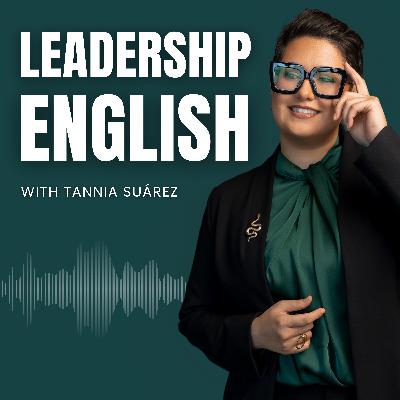
Leadership English
Subscribed: 226Played: 6,703
Subscribe

© Tannia Suárez
Description
You already speak English. So why can it still feel hard to lead in it?
Leadership English is for international executives, founders, and professionals who want to communicate with more clarity, confidence, and influence, without losing their personality or cultural identity.
I’m Tannia Suárez, an executive communication coach trusted by leaders at Apple, Google, Meta, and more.
🎙️ Real conversations + practical strategies for leading across languages and cultures.
📥 Become an Insider and I'll send you exclusive episode bonuses: https://www.tanniasuarez.com/insider
105 Episodes
Reverse
A CTO who led town halls for hundreds of people came to me convinced his English was the problem. When we looked closer, the real issue was storytelling, and it taught me something important about executive presence for non-native English speakers.In this episode, I also talk about what I want the world to stop overlooking, which is what it takes to lead in English as a second language. I walk through the invisible effort, the cost of adaptation, why we confuse familiarity with competence, and what it means to become undeniable.This conversation is for you if you lead in a language that isn’t your first and you’re ready to have that effort recognized.Also, I have some huge news… Leadership English won a Signal Award! 🏆 Thank you so much for being a part of this community and supporting the podcast!Listen to more full episodes of Leadership English here: https://www.tanniasuarez.com/podcastGet exclusive episode bonuses in the Leadership English Insiders here: https://tanniasuarez.com/insider—CHAPTERS00:00 The CTO who thought English was the problem00:48 Leadership English wins a Signal Award01:20 Thank you02:00 Who I am and why this work matters02:58 The invisible effort of leading in a second language04:20 The cost of adaptation05:25 The executive who made her audience laugh06:45 Why we confuse familiarity with competence07:27 Becoming undeniable09:04 The future of leadership doesn’t have one accent10:00 What this award really means10:54 Something to try this week—📌 Follow Tannia:Instagram: https://www.instagram.com/asktanniaLinkedIn: https://www.linkedin.com/in/tanniasuarez/Facebook: https://www.facebook.com/asktannia/TikTok: https://www.tiktok.com/@asktanniaYouTube: https://www.youtube.com/tanniasuarezSpotify: https://open.spotify.com/show/6i2KREABJOlsZmIuEoDsig?si=777b14460e6a4357Podcast: https://www.tanniasuarez.com/podcastBlog: https://www.tanniasuarez.com/blog
Congresswoman Analilia Mejía is diplomatic, but never shies away from confrontation. As the first Afro-Latina elected to the United States Congress and a daughter of Dominican and Colombian immigrants, she's spent 25 years learning how to build trust across real political and cultural differences.This conversation covers clarity of purpose as the anchor for adapting across cultures, a concrete framework for disagreeing without becoming disagreeable, and a surprising tactic she uses in the highest-stakes rooms in the country.This conversation is for you if you've ever wondered how much of your accent, your culture, or your real self you're allowed to bring into a room that doesn't look or sound like you.---Timestamps0:00 Introduction0:40 Adapting to the room versus editing who you are2:44 Clarity of purpose as a center of gravity4:33 The housing story, and what assumption got wrong7:55 Disagree without being disagreeable10:51 Letting go of microaggressions, honestly13:00 Never pick doormat13:37 The language-buffer tactic16:26 Building trust with someone who sees the world differently19:05 People power and the Overton window23:03 The best question to ask anyone you admire---THE GUESTCongresswoman Analilia Mejia represents New Jersey's 11th Congressional District. Born in Elizabeth, New Jersey, to Colombian and Dominican immigrant parents, she spent 25 years as a labor organizer, policy advocate, and coalition builder before winning a special election to Congress in April 2026. Her organizing career included leading the New Jersey Working Families Alliance, serving as Bernie Sanders's national political director during the 2020 presidential campaign, and later serving as deputy director of the Women's Bureau at the U.S. Department of Labor. As a member of Congress, she also sits on the House Homeland Security and Small Business committees.LinkedIn: https://www.linkedin.com/in/analiliafornjInstagram: https://www.instagram.com/repanalilia/ ---THE HOSTTannia Suárez is an executive communication coach who works with senior leaders, directors, and founders navigating high-stakes professional environments in English as non-native speakers.LinkedIn: https://www.linkedin.com/in/tanniasuarez/ Instagram: https://www.instagram.com/asktannia/ ---THE COMMUNITYBecome a Leadership English Insider: https://tanniasuarez.com/insider Watch more episodes of Leadership English: https://www.tanniasuarez.com/podcast
You're in a boardroom. Someone asks you a simple question, are we going to hit the numbers this quarter. You know the answer. You've known it for two weeks. But what comes out is context, and more context, and somewhere around the word "July" you can feel the room start to drift. And then, very kindly, someone asks, "Sorry, so is that a yes?"If that moment made your stomach drop, this one's for you. I walk through why over-explaining isn't actually a language problem (the people I see do this most are the ones with the most expertise, not the least English), the three layers underneath it, and why "be more concise" almost never means what you think it means. You'll leave with the exact question to ask yourself before you answer anything important, a set of openers that force the answer out first, and a one-week exercise you can start today.This one is for you if you've ever watched a room lose patience with you mid-explanation and walked away thinking it was your English, when it wasn't.📌 In this episode:0:00 The boardroom scene1:06 What's actually happening2:10 The three layers7:17 Why the usual fixes don't work8:26 The one question8:59 The before and after10:04 The openers11:21 Explaining vs. persuading and the ladder13:55 Offer the depth14:47 The silence and the intonation piece17:00 The story after the point17:50 The exercise19:37 The closing reframe20:41 The CTAIf this one hit home, I'd love for you to join my Leadership English Accelerator, where we take ideas like this one and practice them with expert feedback: https://www.tanniasuarez.com/leadership📌 Follow Tannia:Instagram: https://www.instagram.com/asktanniaLinkedIn: https://www.linkedin.com/in/tanniasuarez/Facebook: https://www.facebook.com/asktannia/TikTok: https://www.tiktok.com/@asktanniaYouTube: https://www.youtube.com/tanniasuarezSpotify: https://open.spotify.com/show/6i2KREABJOlsZmIuEoDsig?si=777b14460e6a4357Podcast: https://www.tanniasuarez.com/podcastBlog: https://www.tanniasuarez.com/blogListen to the full conversation and catch every episode of Leadership English: https://www.tanniasuarez.com/podcast🔴 Want exclusive access to episode bonuses? Join the Leadership English Insider community: https://www.tanniasuarez.com/insider-bonus#LeadershipCommunication #ExecutivePresence #BusinessEnglish
For non-native English speakers who've ever felt like the funniest, sharpest version of themselves only exists in their first language, this conversation names something rarely said out loud.Omer Haciomeroglu spent eleven years building a tech company in English, his second language, and slowly noticed a specific superpower wasn't translating: his humor. The timing, the cultural references, the split-second wit that builds trust with investors and teammates, all of it moved slower in English, and by the time the joke was ready, the room had moved on.We talk about what he calls the chokehold, the fear-based overthinking that freezes even highly capable founders mid-sentence, the invisible stress most immigrant founders carry alone, and the breakdown at a dinner table that changed how he leads. We also get into why, after eleven years and two major breakdowns, he refuses to call any of it failure, and the forty-four years it took him to fully claim his identity as a sculptor alongside his coaching work.This conversation is for you if you've ever felt like your personality gets lost somewhere between your first language and your second.---📌 In this episode:0:00 Introduction1:01 Meet Omer Haciomeroglu1:20 The "stolen superpower": losing his humor in English4:10 "By the time you communicate, it's already late"5:54 The engine brake: choking under high-stakes pressure8:01 Years of stuttering and the inner work that changed it10:12 Removing yourself from the equation12:01 The 100 open browser tabs metaphor12:46 Why simplifying reads as more competent, not less14:39 Culture, communication styles, and adapting without losing yourself16:42 The fear underneath every communication block19:06 The overthinking chokehold20:14 Intention versus expectation22:53 The debrief: how real transformation actually happens25:39 The five-minute grounding call27:31 Scar tissue, not failure29:58 The dinner where it all came out31:49 44 years to say yes to being a sculptor32:44 The fear of being seen34:20 It's like breathing, you have to do it35:34 Leaving the startup for breathing room36:22 "And, not or": integrating art, tech, and leadership37:22 Expression versus communication38:25 Closing thoughts---📌 About Omer Haciomeroglu:Omer Haciomeroglu is a founder coach and contemporary artist based in Austin, Texas. Born in Istanbul, he studied in the US and has lived across California, Sweden, and Turkey. He spent eleven years as a tech founder in deep-tech product design, hardware, software, UI/UX, and industrial design, navigating two major breakdowns he now treats as raw material rather than failure. Today he advises deep-tech founders hands-on, from post-MVP through Seed to Series B, on execution and leadership. Alongside his coaching work, he is a self-taught sculptor working primarily in animal bones and epoxy clay, an identity it took him forty-four years to fully claim.📌 Follow Omer: Instagram (@omerh.xyz) — https://www.instagram.com/omerh.xyz/ and LinkedIn (Omer Haciomeroglu) — https://www.linkedin.com/in/omerha/📌 More from Omer: https://omerh.xyz and https://www.qwake.tech---Listen to the full conversation and catch every episode of Leadership English: https://www.tanniasuarez.com/podcast🔴 Want exclusive access to episode bonuses? Join the Leadership English Insider community: https://www.tanniasuarez.com/insider---📱 Follow Tannia:Instagram: https://www.instagram.com/asktanniaLinkedIn: https://www.linkedin.com/in/tanniasuarez/Facebook: https://www.facebook.com/asktannia/TikTok: https://www.tiktok.com/@asktanniaYouTube: https://www.youtube.com/tanniasuarezSpotify: https://open.spotify.com/show/6i2KREABJOlsZmIuEoDsig?si=777b14460e6a4357Podcast: https://www.tanniasuarez.com/podcastBlog: https://www.tanniasuarez.com/blog🔔 Subscribe for weekly strategies on executive presence and leadership communication for global professionals.#LeadershipCommunication #ExecutivePresence #BusinessEnglish
For non-native English speakers who've ever said the right thing in a meeting and watched someone else get the credit for it, this episode names exactly why that keeps happening, and it isn't your English.Tannia breaks down why most executive presence training was never built with non-native speakers in mind, reverse-engineered instead from what already sounded familiar to the native English speakers writing the rules. She walks through the real mechanics of the translation lag (a timing problem, not a fluency problem), why directness needs calibration rather than a fixed formula, and why the apology for an accent costs more credibility than the accent itself ever does.This conversation is for you if you've ever felt like you were doing everything the leadership books tell you to do, and it still didn't feel like it fit.📌 In this episode: 0:00 The meeting where someone else got the credit for your point 1:06 Why the executive presence model was never built for you 2:43 The reframe: wrong scoreboard, not behind 3:14 Three things nobody tells you about executive presence 3:21 The translation lag is a timing problem, not a fluency problem 4:26 Client story: replacing nervous filler with grounded pauses 5:21 Directness isn't rudeness, it's calibration 6:35 Client story: the executive told she was too quiet 7:36 Your accent isn't costing you the room, your apology is 8:53 Client story: the executive who over-explained to compensate 9:55 The three moves to build instead11:51 Closing thoughts📌 About Tannia:Tannia Suárez is an Executive and Leadership Communication Coach who helps ambitious non-native English-speaking professionals build executive presence, communicate with clarity, and lead with confidence in English.Through her coaching practice and the Leadership English Podcast, she works with international executives across industries to close the gap between who they already are and how they're perceived under pressure.Listen to the full conversation and catch every episode of Leadership English: https://www.tanniasuarez.com/podcast🔴 Want exclusive access and bonuses? Join the Leadership English Insider community: https://www.tanniasuarez.com/insider#LeadershipCommunication #ExecutivePresence #BusinessEnglish

Comments

Download from Google Play

Download from App Store
 United States