



World Today
Subscribed: 1,425Played: 43,156
Subscribe


© Copyright @ China Plus
Description
With in-depth panel discussions on domestic and global news and current affairs, World Today gives you the story behind the headlines.
2005 Episodes
Reverse

China says it will turn aerospace into a pillar industry that improves lives and promotes industrial development. What are included in this goal? How close are these ambitions to reality, and what could they mean for you and me?
Host Dou Hongyu is joined by Quentin Parker, Director of Laboratory for Space Research, University of Hong Kong; Zhang Fan, Associate Professor of Astronomy with Beijing Normal University; Zhou Mi, Senior Research Fellow with Chinese Academy of International Trade and Economic Cooperation, to unfold China's space roadmap.
① Turkmenistan’s national leader Gurbanguly Berdimuhamedov is on a visit to China. How can the two sides align their development strategies and promote multilateralism? (00:54)
② Tehran is intensifying attacks on the Gulf region’s energy facilities after Israel hit Iran’s gas field. Does this mark a further escalation in hostilities? (13:24)
③ We explore the Chinese mainland’s plans to facilitate cross-Strait exchange and cooperation during its 15th Five-Year-Plan period. (25:00)
④ AstraZeneca says it will build a cell therapy base and an innovation center in Shanghai. As biomedicine becomes an emerging pillar industry in China, how could rising foreign investment help accelerate the sector’s development? (36:08)
⑤ Is eastern Congo closer to peace after a Washington meeting between the Democratic Republic of Congo and Rwanda? (45:50)
① China has launched a Party-wide campaign to reshape how officials correctly view governance performance. (00:44)
② JP Morgan and UBS boost Chinese asset holdings. What’s attracting global capital to China? (14:02)
③ Top U.S. security official resigns over Iran threat assessment. Does this expose cracks in Washington’s war logic? (24:19)
④ Takaichi’s U.S. gamble: Can Japan afford Trump’s price? (30:46)
⑤ Nvidia resumes high-performance chip production for China. But does China still need them? (41:43)
① China–U.S. trade talks are constructive. What does this signal for future economic cooperation and global market stability? (00:46)
② China and Vietnam launch 3+3 strategic dialogue. How could this mechanism boost regional stability and bilateral coordination? (14:52)
③ Iran refuses a ceasefire, vows to keep fighting. What impact might this have on Middle East security and U.S. strategy? (24:00)
④ AI toys and robots boom in Yiwu. What does this reveal about China’s consumer tech surge and global market potential? (33:17)
⑤ The Spanish king acknowledges colonial abuses. How could this influence Spain–Latin America relations today? (43:43)
① China US hold trade talks in Paris. What to expect? (00:47)
② China's industrial output up 6.3 pct in first two months. What does this tell us about China’s economic momentum and structural strengths as growth pressures persist globally? (13:44)
③ Key allies have been holding back after Washington urged help to secure the Strait of Hormuz. What do these reactions tell us about the bigger picture of U.S. influence over its allies? (24:16)
④ How does the war on Iran impact the US economy? (34:50)
⑤ China has become the first country in the world to approve a brain‑computer implant for commercial use. What does this milestone mean for the future of neurotechnology? (44:26)
China has adopted three major pieces of legislation — the Ecological and Environmental Code, the Ethnic Unity and Progress Promotion Law, and the National Development Planning Law — at the closing meeting of the fourth session of the National People's Congress. The passage of these landmark laws has drawn widespread attention. Why move forward with them at the very start of China’s 15th Five-Year Plan period?
Host Ge Anna is joined by Muhammad Ali Nasir, Professor of Economics, the University of Leeds, currently a visiting professor at Peking University; Einar Tangen, Senior Fellow, Center for International Governance Innovation (CIGI), a Canadian Think Tank; Dr. Zhou Mi, Senior Research Fellow, Chinese Academy of International Trade and Economic Cooperation.
① China’s annual government work report has named embodied AI as one of the emerging industries that the country will nurture. What mechanism should be put in place for this effort? What could be the ultimate value of embodied AI? (00:52)
② Iran’s president has outlined three conditions to end the war with the US and Israel. What do they tell us about Tehran’s current mindset on the war? (15:19)
③ The International Energy Agency has announced a historic release of 400 million barrels of emergency oil. To what extent can it ease supply shocks from the disruptions at the Strait of Hormuz? (24:56)
④ Jose Antonio Kast has been sworn in as Chile’s new president. What challenges will he face? (35:09)
⑤ In China, both supportive policies and risk warnings have emerged in response to the release of OpenClaw. How might the open source AI agent reshape China’s AI eco-system? (42:36)
① What has enabled China’s exports to sharply beat expectations in this year’s first two months? (00:55)
② China has set a target to increase average life expectancy to 80 years by 2030. What will it take to achieve this goal? (12:42)
③ Opposition has outweighed support in the US public opinion about Washington’s military action against Iran, according to polls conducted since the war began. Why is the war unpopular from the beginning? (23:51)
④ Speaking at the second Nuclear Energy Summit in Paris, a Chinese vice premier says China stands ready to work with countries on a more inclusive nuclear governance. What can China contribute to promoting solutions for the safe and sustainable development of civil nuclear power? (31:29)
⑤ The UK has introduced a new advisory definition of anti-Muslim hostility. What is behind a record surge in reported hate crimes against Muslims in the country? (42:10)
① China has set a target of boosting the digital economy to account for 12.5% of its GDP by 2030, which would be a significant increase from the 10.5% share achieved in 2025. What does it take to achieve this goal? (00:53)
② A conversation with Dr. Henry Tan, a political adviser from Hong Kong and CEO of Luen Thai Group. (15:03)
③ Why did China’s consumer inflation hit a three-year high in February? (24:58)
④ More than a week after the US-Israel war with Iran began, how has the conflict affected global energy supply? (35:09)
⑤ European Commission President Ursula von der Leyen has called on Europe to adopt a more realistic and interest-driven foreign policy. What does it tell us about the EU’s view on world order? (44:59)
① China’s top court and top prosecutor have delivered their respective work report at the annual session of the national legislature. How is the rule of law enhancing China’s high-quality development? (00:59)
② China’s minister of human resources and social security says the government is looking to harness artificial intelligence to create new jobs while also empowering traditional ones. How does the prospect in this regard look like? (14:13)
③ A conversation with Zhou Hanmin, a Chinese national political adviser and President of Shanghai Public Diplomacy Association, on promotion of green consumption. (24:59)
④ Mojtaba Khamenei has been selected as Iran’s new supreme leader. What might it mean to the war in the Middle East? (37:32)
⑤ Donald Trump has hosted about a dozen right-wing Latin American leaders to form a coalition against drug cartels. Why is the US president citing drugs as a primary reason for ramping up his administration’s involvement in Latin America? (45:36)
Chinese Foreign Minister Wang Yi held his annual press conference on the sidelines of the National People's Congress in Beijing. What key signals does this press conference send about China’s diplomatic priorities at a time of profound global uncertainty?
Host Ge Anna is joined by Zha Daojiong, Professor of international political economy at the School of International Studies at Peking University; Andy Mok, Professor at Beijing Foreign Studies University.
All eyes are on Beijing as Chinese Premier Li Qiang delivers the 2026 Government Work Report during the Two Sessions. What does the new economic growth target reveal about China’s priorities? And as China deepens its commitment to opening up, what opportunities lie ahead for global businesses and trading partners?
Host Xu Yawen is joined by Andy Mok, a professor at Beijing Foreign Studies University; Liu Baocheng, director of the Center for International Business Ethics at the University of International Business and Economics; and Dr. Lee Pei May, an assistant professor of political science at the International Islamic University Malaysia, to unpack China’s Government Work Report and its new five-year plan.
① How does China’s annual government work report chart the course of the country for this year and the next five years? (00:52)
② China’s foreign minister says Beijing will send its special Middle East envoy to regional countries to mediate in the Iran conflict. What has prompted China to make the decision? (24:59)
③ The US Court of International Trade has ordered the US Customs and Border Protection to process refunds on illegal tariffs imposed by President Donald Trump. Is it realistic to expect the Trump administration to do that? (36:27)
④ The European Commission has proposed a controversial industrial act to prioritize “Made in EU” goods in public support and procurement. Why is the proposed act criticized as a misguided and protectionist approach? (46:58)
① Why will economic growth and domestic demand top the agenda of China’s national legislature at its annual session? (00:54)
② A conversation with Lu Ming, a Chinese national political adviser and a professor at Shanghai Jiaotong University, on how China can boost its service consumption. (12:51)
③ China has rolled out 20 measures to boost sci-tech insurance. How is this sector offsetting the high costs and inherent risks associated with tech innovation? (24:52)
④ Donald Trump has lashed out at Britain over its limited support for US-Israeli strikes on Iran. Has Britain learned a lesson from its involvement in 2003 invasion of Iraq? (34:19)
⑤ The United Nations has expressed deep concern following a mass killing in South Sudan. Why has the country been beset by civil war, ethnic violence, poverty since it was formed in 2011? (45:25)
① The annual session of China’s top political advisory body is set to open. In what ways are consultative politics enhancing China’s democracy? (00:52)
② China has released its first national standard system covering the industrial chain and full life cycle of humanoid robots. How will the new standards support high-quality growth across the sector? (13:15)
③ Emmanuel Macron has ordered to increase the number of France’s nuclear warheads. What has prompted him to make the decision? (24:57)
④ The US and Israel’s war against Iran has spilled over into the Strait of Hormuz. What could be the conflict’s impact on global trade and economy if it continues in the foreseeable future? (34:21)
① A top meeting in China has described the next five years as a critical period for socialist modernization. How will China focus on economic development during its 15th Five Year Plan? (00:46)
② Why is Canada putting aside the frictions over the killing of a Sikh activist and seeking to re-engage with India? (10:24)
③ Iran has vowed to use all its strength to make its enemies pay a heavy price following the death of Supreme Leader Ayatollah Ali Khamenei in US-Israeli strikes. To what extent could the conflict widen? (24:58)
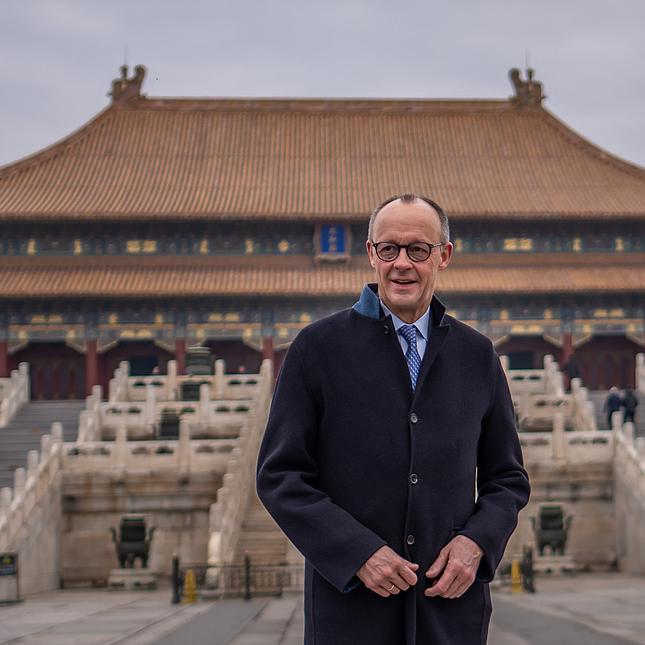
It's Friedrich Merz's first official visit to China as German chancellor. What results will he bring back to Berlin? Merz is the fifth European state leader Beijing has received in less than three months amid rising economic and geopolitical uncertainty. What implications does it carry for the future of China-EU relations?
Host Tu Yun joins Dr. Hans-Peter Burghof, a professor and the Chair of the Banking and Finance Department at the University of Hohenheim, Germany, Dr. JIN Ling, a senior research fellow leading the Department for European Studies, China Institute of International Studies, and Dr. George Tzogopoulos, the Director of EU-China Programmes and a senior research fellow at the European Institute of Nice to break down the signals, the substance, and what this moment really means.
① Meeting Germany’s Friedrich Merz in Beijing, Xi Jinping calls on China and Germany to be reliable, innovative, and cultural partners. What momentum has the German leader’s China visit injected into bilateral ties? (00:52)
② US-Iran nuclear talks resume in Geneva. Is the US military threat pressuring Iran to make concessions in negotiations? (15:13)
③ India’s Narendra Modi is on a two-day trip to Israel to strengthen security and economic cooperation between the two countries. Is his visit likely to give Israel a boost of international support? (25:14)
④ The IMF is urging the US to rein in its growing fiscal deficit, warning that public debt could climb to 140% of its GDP by 2031. What risks will this trend pose to the US and global economy? (34:37)
⑤ The French government has survived two no-confidence motions in parliament that were filed after a new energy law was adopted by decree. Why are French politics divided on energy issues? (45:14)
① German Chancellor Friedrich Merz is on a trip to China for talks on trade and other issues. What can China and Germany do together to counterbalance global uncertainties? (00:53)
② Donald Trump has touted his economic record during the State of the Union address, saying he has ushered in what he calls a golden age. What’s at stake for Trump in the address? (13:07)
③ Panamanian authorities have seized two ports on the Panama Canal from Hong Kong-based CK Hutchison. Will this case have a negative impact on China’s confidence to invest in Latin America? (24:35)
④ Gold prices are surging again as global uncertainty takes center stage. Is the rally sustainable? (34:23)
⑤ James Zimmerman, Chairman of AmCham China, gives his take on the importance of the Chinese market. (44:00)
① China’s Spring Festival holiday has delivered striking economic signals. Are we witnessing a structural shift toward experience-driven, service-led consumption in the country? (00:59)
② China has announced export control measures against 20 Japanese entities involved in boosting Japan’s military capabilities. Why is China’s concern about Japan’s remilitarization and nuclear ambitions legitimate? (11:52)
③ New Zealand’s prime minister gives his take on multilateralism and free trade. (24:07)
④ The EU has failed to approve additional sanctions on Moscow and a key loan for Kyiv. As the war in Ukraine marks its 4th anniversary, what’s its outlook? (32:35)
⑤ Cuba is grappling with fuel shortages as the US moves to choke off the country’s oil supplies, but Canada says it plans to provide assistance to Cuba. Is this generating another rift between Washington and Ottawa? (43:23)

Comments

Download from Google Play

Download from App Store
 United States