


 Claim Ownership
Angelicum Thomistic Institute
Subscribed: 174Played: 4,163
Subscribe

© All rights reserved
Description
The Thomistic Institute Angelicum encourages the study of Thomas Aquinas and the Thomistic tradition as a living voice and inspiration for Catholic theology and philosophy. For more information about the Institute's programs or upcoming events please visit our website: https://angelicum.it/thomistic-institute/
490 Episodes
Reverse
Can Science and Religion Coexist in the Modern World? | Discussion with Fr. Mariusz Tabaczek and Prof. Naglis Kardelis by Angelicum Thomistic Institute
Thomas Aquinas on how God acts in the world | Dr. Ignacio Silva by Angelicum Thomistic Institute
What we’ve learned from quantum mechanics about NIODA in nature | Dr. Robert Russell by Angelicum Thomistic Institute
Theological and Biological Anthropogenesis | Fr. Mariusz Tabaczek, OP by Angelicum Thomistic Institute
Wozu Religion? Die menschliche Gottesbeziehung bei Thomas von Aquin und Meister Eckhart | Prof. Martina Roesner by Angelicum Thomistic Institute
History of the Debates on Divine Action | Dr. Edmund Lazzari by Angelicum Thomistic Institute
Can God be Omnipotent and Kenotic? Understanding Divine Action in the Bible | Justin Schembri, O.P. by Angelicum Thomistic Institute
Theories of Causation | Thomas Davenport, O.P. by Angelicum Thomistic Institute
Comunión en la Verdad: La Sabiduría en Tomás y Buenaventura | Francisco Javier Rubio Hípola by Angelicum Thomistic Institute
A Dio attraverso la Bellezza un Approccio Tomistico | Raymund Snyder, OP by Angelicum Thomistic Institute
La conoscenza del “caso” secondo san Tommaso d’Aquino | Lorella Congiunti by Angelicum Thomistic Institute
La Teoria dell'Appropriazione di San Tommaso | Kevin O'Reilly, OP by Angelicum Thomistic Institute
Le Hibou, les Bains et la Petite Vieille | François-Xavier Putallaz by Angelicum Thomistic Institute
Thomas von Aquin und die Zehn Gebote | Ludger Schwienhorst-Schönberger by Angelicum Thomistic Institute
Ist Gottes Wesen für uns Unerkennbar? | Patrick Zoll SJ by Angelicum Thomistic Institute
Creation and Evolution: an Aristotelian-Thomistic Perspective | Mariusz Tabaczek OP by Angelicum Thomistic Institute
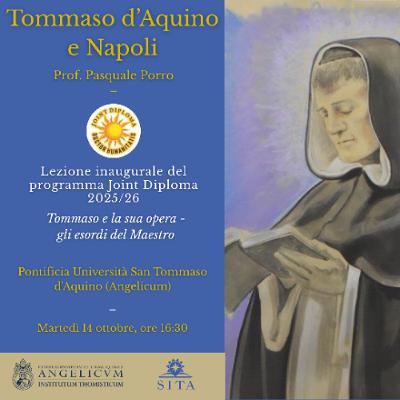
Lezione Inaugurale del Programma Joint Diploma 2025/26 | Prof. Pasquale Porro - Tommaso d'Aquino e Napoli

Why does the Vatican support an astronomical observatory? That question masks a deeper question: why does anyone choose to be a scientist? The motivation behind our choices, both as individuals and as a society, determines the questions we pursue and the kinds of answers that are found to be satisfying. It determines the kinds of answers that are found to be satisfying. And ultimately, it affects the way in which we think of ourselves.
Re-evaluating Penal Substitution and Vicarious Satisfaction
This talk addresses the central soteriological question: "Was Jesus Punished?" While it is undisputed that Jesus was punished by human authorities, this presentation argues against the proposition that He was punished by God. It critically examines the dominant theory of penal substitution (substitutio penalis) and advocates for a return to the classical model of vicarious satisfaction (satisfactio vicaria).
The presentation traces the problem’s origin to the post-Anselmian theological shift, which was radicalized by the Reformers into penal substitution. Extreme interpretations of this doctrine (e.g., L. Bourdaloue) portray God the Father as a "persecutor" discharging "divine hatred" onto His Son, creating a "toxic" image of a sadistic God while ignoring the Son's will.
Three strategies for resolving this impasse are analyzed, rejecting "finding depth in penal substitution", which introduces "darkness" into the image of God, and the concept of Stellvertretung as a dialectical evasion.
The preferred strategy is to restore the Anselmian distinction between involuntary punishment and voluntary satisfaction. The talk argues that Christ did not receive punishment but offered satisfaction. Defending this model biblically, it shows that "ransom" (lutron, Mk 10:45) is rooted in OT law (Ex 21:30) as a payment instead of punishment to avoid violence. It also refutes key penal substitution "proof texts": "made sin" (2 Cor 5:21) means "sin offering" (hattā’t); "became a curse" (Gal 3:13) means "cursed in the eyes of Israel"; and "bearing guilt" (Isa 53) signifies non-retaliation.
The talk also analyzes the position of St. Thomas Aquinas. It highlights that although Aquinas, unlike Anselm, uses the term "punishment" (poena) to describe Christ's act, he understands it as voluntarily accepted satisfaction. This is structurally distant from later penal substitution, as for Thomas: God's wrath is directed solely at sin, never at the Son, and Both act from supreme love; God the Father only permits the Passion (not positively willing it), which is the work of human freedom; and the formal, decisive element of salvation is love, not suffering itself. The talk concludes with a negative answer to the titular question, affirming a soteriology of love and voluntary satisfaction, not divine retributive punishment.
Every Sunday, Catholics pray in the Creed, "He ascended into heaven and is seated at the right hand of the Father." Patristic and medieval theologians felt they had a concrete grasp of where the "heaven" Christ ascended to actually was, but their answers are all based on very outdated views of the cosmos. Modern discussions of the Ascension sometimes shy away from the question, to the point of "spiritualizing" the event and downplaying the physicality of Christ's present state. In this talk I will argue, first, that attempts to "weaken" the physicality of Christ's glorified body threaten our understanding of the resurrection and salvation, in general, and of the Eucharist in particular. Then, I will then look at medieval theories of the place of Christ's Ascension and point out that while modern science makes those specific ideas untenable, it also offers tools to imagine a real "place" for Christ's Glorified Body.

Comments

Download from Google Play

Download from App Store
 United States