


Disruptors for GOOD | Social Entrepreneurs and Social Enterprises
Subscribed: 101Played: 4,380
Subscribe

© 2025 Causeartist
Description
Disruptors for GOOD is a podcast that showcases global social entrepreneurship and social enterprises committed to ethical fashion, impact investing, climate mitigation, sustainable travel, and businesses generating positive global impact. Through in-depth interviews, Grant Trahant, the founder of Causeartist, engages with innovative and impactful startups and brands worldwide.
345 Episodes
Reverse
What if the future of sustainable fashion starts with changing how clothing is manufactured?In this solo episode of Disruptors for Good, host Grant Trahant explores unspun, a California-based fashion technology company developing a new approach to apparel production through automated 3D weaving.Traditional clothing manufacturing involves weaving fabric, cutting it into patterns, sewing the pieces together, and shipping finished products through complex global supply chains. That process can create substantial material waste and produce inventory that may never be sold.unspun is working to change that model.How unspun's 3D Weaving Technology WorksAt the center of unspun's technology is OneWeave, an automated manufacturing system that transforms yarn directly into three-dimensional garment shapes.Instead of producing large rolls of fabric that must be cut into individual pieces, OneWeave creates shaped textile components that require fewer conventional cutting and sewing steps.The technology is designed to make clothing manufacturing more efficient, reduce material waste, and help brands produce garments closer to where they are sold.For consumers, that could eventually mean more responsive production, improved customization, and less dependence on mass-produced inventory.The Environmental Opportunityunspun's approach focuses on reducing waste and emissions by changing the manufacturing process itself.According to a comparative life cycle assessment commissioned by the company, its 3D weaving process demonstrated the potential for:53% lower global warming potential49% lower primary energy demand39% lower blue water consumptionThese findings relate to the cotton pants manufacturing scenario evaluated in that assessment. They do not apply to every garment or manufacturing application.The broader opportunity is to help fashion brands produce what customers actually need, with less wasted fabric and fewer unnecessary production steps.Listen to more episodes of Disruptors for Good on Causeartist, Apple Podcasts, and Spotify. If you enjoy the podcast, consider leaving a five-star review to help more people discover the founders and companies building solutions to global challenges.
----------------------------------------Disruptors for GOOD is powered by Causeartist, a nonprofit media company dedicated to bridging the gap between capital and culture by spotlighting founders, investors, and organizations reimagining how business can serve people and the planet.Through storytelling, events, and open-access education, Causeartist helps create a shared language of impact, inspiring more founders to build with purpose and more funders to invest with intention.By amplifying ideas and innovations across industries, Causeartist transforms awareness into action and cultivates a community where paying it forward is part of the foundation for growth.
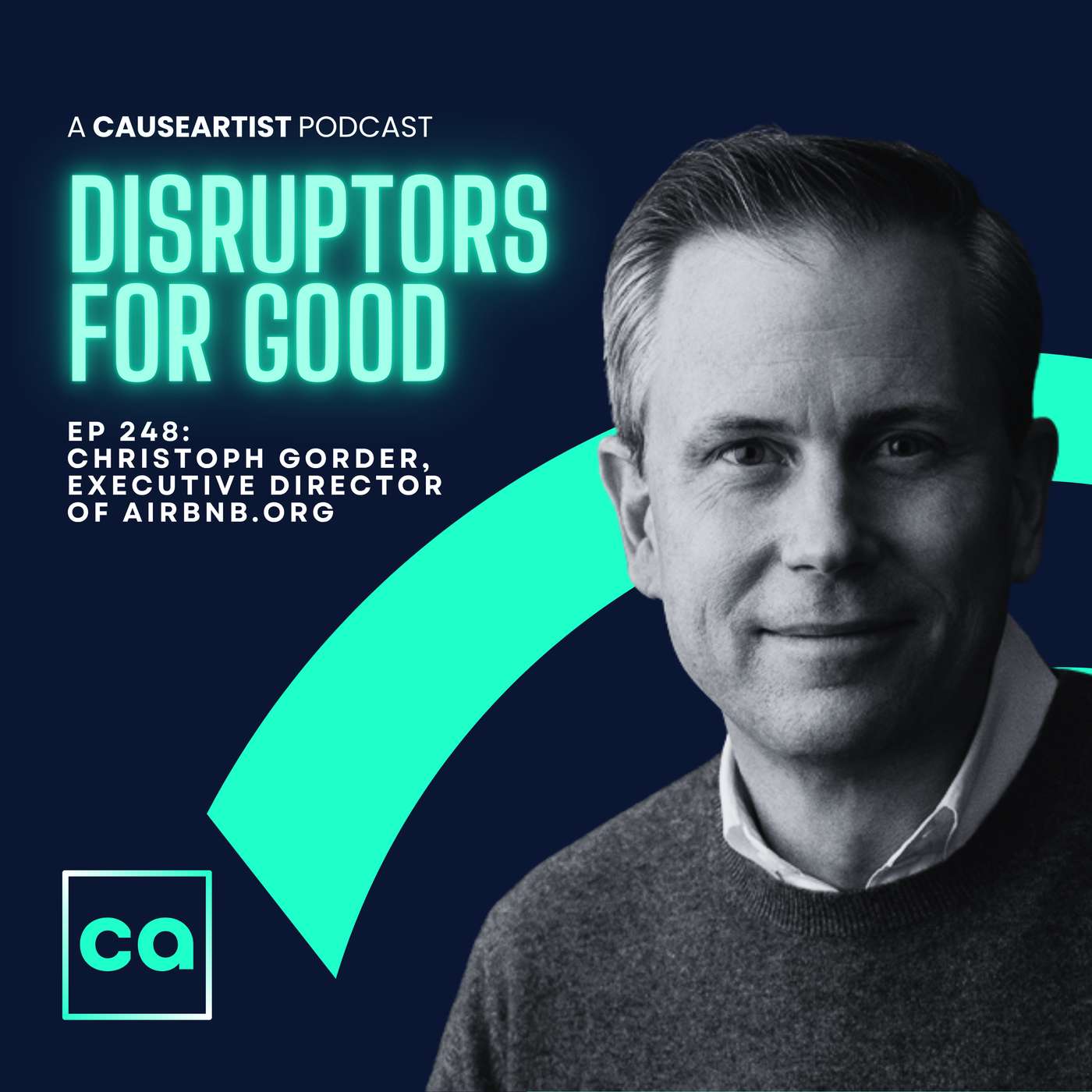
Airbnb is building social impact directly into every home stay booked through its platform.Under a new funding model announced in October 2026, Airbnb will contribute ten cents of its revenue from every completed home stay to Airbnb.org, the independent nonprofit that provides free temporary housing to people experiencing disasters, medical emergencies, displacement, and other crises.Guests will not pay more, host payouts will not change, and neither group needs to opt in. The contribution comes directly from Airbnb’s revenue.Together with additional funding and donations, the model is expected to provide $500 million to Airbnb.org over five years. The nonprofit aims to use that support to increase its annual impact from roughly 126,000 free nights provided in 2025 to one million nights per year by 2030.For this episode of the Disruptors for Good podcast, Causeartist founder Grant Trahant spoke with Christoph Gorder, Executive Director of Airbnb.org.Gorder previously spent more than a decade at charity: water, where he served as Chief Global Water Officer and helped expand the organization’s work across 22 countries. Before joining charity: water, he spent 14 years leading disaster response and international health programs at Americares.In this conversation, Gorder explains why he left an organization he loved to lead Airbnb.org, how the new funding model works, why local nonprofits remain essential, and how access to temporary housing can restore a measure of control during an otherwise destabilizing moment.The conversation also explores Airbnb.org’s expansion beyond disaster response into medical travel, resettlement, domestic violence support, and other situations where a safe place to stay can change the direction of someone’s life.
----------------------------------------Disruptors for GOOD is powered by Causeartist, a nonprofit media company dedicated to bridging the gap between capital and culture by spotlighting founders, investors, and organizations reimagining how business can serve people and the planet.Through storytelling, events, and open-access education, Causeartist helps create a shared language of impact, inspiring more founders to build with purpose and more funders to invest with intention.By amplifying ideas and innovations across industries, Causeartist transforms awareness into action and cultivates a community where paying it forward is part of the foundation for growth.
Twelve represents a compelling model for climate innovation because it is attempting to redesign the molecular foundation of products society already depends on.The company is not only developing a carbon-capture system. It is building a platform intended to turn captured carbon into useful, commercially valuable products.If Twelve succeeds, renewable electricity could become a major manufacturing input, while carbon dioxide could become an industrial resource rather than simply a waste product.The opening of AirPlant One marks a meaningful transition. Twelve is no longer working only with a laboratory concept or small pilot. It has entered the much more difficult stage of operating, financing, and scaling physical infrastructure.The company’s biggest challenge now is scale.If it can meet that challenge, the phrase “made from air” could eventually describe far more of the material world around us.In This EpisodeWe explore:How Twelve converts carbon dioxide, water, and electricity into fuels and chemicalsThe science behind its carbon-transformation platformWhy aviation is one of the company’s first major marketsHow E-Jet differs from conventional jet fuelWhat the opening of AirPlant One representsWhy early customers are essential to financing climate infrastructureThe role of corporate, project, and debt capitalThe economic and operational challenges facing power-to-liquid fuelsWhat Twelve must prove as it moves toward larger facilitiesLearn MoreVisit TwelveExplore the AirPlant platformLearn about E-Jet sustainable aviation fuelFollow Twelve on LinkedIn
----------------------------------------Disruptors for GOOD is powered by Causeartist, a nonprofit media company dedicated to bridging the gap between capital and culture by spotlighting founders, investors, and organizations reimagining how business can serve people and the planet.Through storytelling, events, and open-access education, Causeartist helps create a shared language of impact, inspiring more founders to build with purpose and more funders to invest with intention.By amplifying ideas and innovations across industries, Causeartist transforms awareness into action and cultivates a community where paying it forward is part of the foundation for growth.
Every rice harvest leaves behind a husk for every grain. While the rice grows, that husk protects it from moisture, pests, and mold. Once the grain is milled, almost none of those husks get used. Most are landfilled or burned.Modern Mill turns that waste stream into lumber's replacement. The company, which manufactures in Pike County, Mississippi, makes ACRE, a rice hull wood alternative used for siding, decking, trim, porch boards, sheet goods, and millwork.Founder and CEO Chris Guimond, a plastics engineer by training, spent years working with fillers and polymer blends for composite building products before Modern Mill patented and developed the rice husk technology behind ACRE.The more useful story is the strategy underneath. ACRE does not ask buyers to accept a tradeoff in exchange for sustainability. It competes on durability, workability, and appearance first.Founder and CEO: Chris Guimond, who holds a bachelor's and master's in plastics engineering from UMass LowellManufacturing: Pike County, MississippiProduct: ACRE, a tree-free composite made from upcycled rice hulls blended with polymersApplications: Siding, decking, trim, porch boards, sheet goods, and millworkProduction start: 2021Distribution: Two-step channel (manufacturer to distributor to dealer) across New England, the Mid-Atlantic, the Midwest, the mountain states, and the Pacific NorthwestCompany-reported impact since 2021: 20.5 million pounds of rice husks diverted from landfills, 101,000 softwood trees saved, and 69,000 acres of tropical rainforest preservedRecent news: A September 2026 partnership with GameTime to use ACRE in its EverForms playground line
----------------------------------------Disruptors for GOOD is powered by Causeartist, a nonprofit media company dedicated to bridging the gap between capital and culture by spotlighting founders, investors, and organizations reimagining how business can serve people and the planet.Through storytelling, events, and open-access education, Causeartist helps create a shared language of impact, inspiring more founders to build with purpose and more funders to invest with intention.By amplifying ideas and innovations across industries, Causeartist transforms awareness into action and cultivates a community where paying it forward is part of the foundation for growth.
What if a small business generates little income but still changes the life of the person running it?In this episode of Disruptors for GOOD, we examine new research from Prof. Lin Ong of Cal Poly Pomona and Melati Nungsari of the Asia School of Business. The researchers spent a year following eight Afghan refugee women participating in an entrepreneurship program in Malaysia.Most of the women did not report significant monthly income from their businesses. However, six rounds of interviews revealed meaningful changes that conventional financial metrics often overlook, including greater autonomy, confidence, resilience, purpose, and community belonging.The episode explores the researchers’ 3P framework for evaluating impact among displaced and transitory populations. It also asks a larger question for funders, social enterprises, and impact investors: Are we measuring what is easiest to count, or what actually matters to the people being served?IN THIS EPISODE- Why revenue, profit, and job creation provide an incomplete picture of impact- The conditions facing Afghan refugee women building businesses in Malaysia- Ten non-monetary outcomes identified across the study- How entrepreneurship affected personal agency, practical capacity, and community relationships- The meaning of proximate, portable, and preparatory outcomes- Why funder reporting requirements can unintentionally distort organizational priorities- How the 3P framework could apply beyond refugee entrepreneurship- Why entrepreneurship should not be treated as a substitute for legal rights or essential services- The limitations of the study and the need for additional researchTHE TEN NON-MONETARY OUTCOMESThe researchers identified ten outcomes that appeared consistently across the six interview rounds:1. Independence and autonomy2. Confidence and self-worth3. Mental well-being4. Skills development5. Purpose and aspirations6. Social recognition and belonging7. Family and spousal collaboration8. Work-life balance9. Social contribution10. Adaptability and resilienceThese outcomes developed over time. Autonomy and confidence often appeared first, followed by deeper changes involving family relationships, community participation, and resilience.ABOUT THE RESEARCHThe study followed eight Afghan refugee women living in Malaysia. Participants completed a six-month entrepreneurship program combining classroom instruction with one-to-one mentoring. The researchers conducted six rounds of interviews during and after the program.The average participant was 29 years old and had already spent approximately six years in Malaysia when the research began. None had the legal right to work. Their businesses included catering, tailoring, garment repair, handicrafts, and the resale of household goods and cosmetics.This was a small qualitative study conducted in one country and one program. Its findings should not be treated as representative of all refugee entrepreneurs. The research relied on self-reported experiences and does not establish that entrepreneurship caused every change participants described.FEATURED RESEARCHProf. Lin Ong and Melati Nungsari, “Proximate, Portable, and Preparatory: Non-Monetary Performance Measures for Social Enterprises Working with Transitory Populations.” Published in Sustainable Business Practices and Social Entrepreneurship by Springer Nature, 2026.Full research chapter:https://doi.org/10.1007/978-981-95-7437-7_8Tarkington Business Futures Institute:https://www.tarkingtoninstitute.org/ABOUT DISRUPTORS FOR GOODDisruptors for GOOD explores the entrepreneurs, organizations, and ideas using business and innovation to address the world’s most pressing social and environmental challenges.Discover more impact stories, companies, funders, and podcasts at:https://www.causeartist.com/
----------------------------------------Disruptors for GOOD is powered by Causeartist, a nonprofit media company dedicated to bridging the gap between capital and culture by spotlighting founders, investors, and organizations reimagining how business can serve people and the planet.Through storytelling, events, and open-access education, Causeartist helps create a shared language of impact, inspiring more founders to build with purpose and more funders to invest with intention.By amplifying ideas and innovations across industries, Causeartist transforms awareness into action and cultivates a community where paying it forward is part of the foundation for growth.

Comments

Download from Google Play

Download from App Store
 United States