


 Claim Ownership
Fire Protection Podcast
Subscribed: 142Played: 1,375
Subscribe

© 2024 - Inspect Point - Fire Protection Podcast
Description
The Fire Protection Podcast dives deep into topics of the fire protection industry. Fire alarm, sprinkler, suppression, extinguishers and other life safety systems are discussed. Leaders from all over the world talk about new technologies and processes that are helping improve the fire safety community.
98 Episodes
Reverse

Drew Slocum has spent nearly 24 years in fire protection, starting at Tyco right out of college and later at Viking, and he has sold a lot of sprinkler systems. He had never put one in himself. When a flood and FEMA rules meant rebuilding most of his house, the walls were open, so for the 100th episode of the Fire Protection Podcast he called Chris Logan of Wallace-Kent Sprinkler Systems, host of the Fire Sprinkler Podcast. Chris helped design an NFPA 13D system and came down over the summer to hang pipe with Drew.The first half is a walkthrough of the house now that the sheetrock is up. In the mechanical room Drew shows the AGF riser manifold and the Tyco RSV-1 residential valve on a single incoming water line. Household water runs through it as usual, and when a sprinkler opens the valve shuts off the domestic side so all the water goes to the fire, which saved Drew from paying for a second service. Upstairs it's about 15 Viking VK490 concealed sidewall heads on CPVC, the head Drew remembers taking off in high-end New York apartments and hotels where owners didn't want to see sprinklers. Drew also tells the hydro test story: a dry-fit fitting blew two minutes in at street pressure, and he has a photo of who put it in.Then the numbers. Drew puts the whole system at around $7,000 to $8,000 installed, and a clip from the install weekend breaks a house like this down to two people for a couple of days and roughly $2,000 in material. The insurance savings are small, maybe a few hundred dollars a year for Drew, though more homeowners insurers now offer a discount and it depends on the company. That isn't why he did it. His advice to anyone rebuilding or building new is to get a sprinkler price while the walls are open, and they ask insurers for real numbers on water damage from plumbing failures compared with sprinkler failures.The other trades had opinions. Drew's general contractor had never worked with a sprinkler contractor, the local volunteer fire department wants to push residential sprinklers after seeing the install, and the building inspector commented on the fire stopping between floors. The one holdout was the HVAC installer, who wouldn't touch the pipe because he thought a sprinkler head goes off when you touch it.Back in the studio it gets technical. Drew pulls the VK490's throw by voice in Inspect Point Assistant, and it comes back with coverage, spacing, and pressure along with the data sheet it came from. They walk through what NFPA 13D lets you leave out compared with a full NFPA 13 system, why a 13D system is there to buy the family time to get out, and why a house that burns after everyone escaped isn't a failed system. They also cover why residential heads throw water high on the walls, where most of a home's fuel sits, to hold off flashover.They wrap on the people side: Drew's first install and the math a fitter does in his head, Chris taking his son to the Cabot Canada plant for Ontario's Take Your Kid to Work Day with four generations of the family on site there, and doing about 90 percent of Drew's house in one long Saturday. Their advice for anyone with open walls is to think about a 13D system, most houses are probably 10 to 20 heads, and have it engineered. Thanks to Chris for pushing Drew to start podcasting in the first place, and to Viking SupplyNet, Viking, Tyco, and AGF for the material.Links:Fire Sprinkler Podcast: https://www.firesprinklerpodcast.comEpisode #91 with Chris Logan: https://www.inspectpoint.com/resources/podcast/the-fire-protection-podcast-episode-91-inspecting-the-inspectors-inside-fire-sprinkler-inspections-with-chris-loganInspect Point: https://www.inspectpoint.comTimestamps0:00 Cold open0:35 Episode 100: Drew's home sprinkler project with Chris Logan1:58 Thanks to Viking SupplyNet, Viking, Tyco, and AGF3:00 The hydro test and the fitting that blew3:53 The house after the sheetrock went up5:11 The AGF riser manifold and the Tyco RSV-16:14 How the RSV-1 shuts off the domestic side when a sprinkler flows7:54 Why Drew sprinklered his own house9:02 The Viking VK490 concealed sidewall10:24 What the system cost and what insurance saves12:51 From the install weekend: what it costs to sprinkler a house15:35 The GC, the fire department, and the building inspector16:45 The HVAC installer who thought the heads would go off17:50 Back in studio: VK490 data from Inspect Point Assistant22:08 NFPA 13D vs NFPA 1323:20 Why a burned house isn't a failed 13D system25:02 Drew's first install27:14 Take Your Kid to Work Day and four generations at Cabot31:17 If your walls are open, get a 13D price32:46 100 episodes34:53 Outro
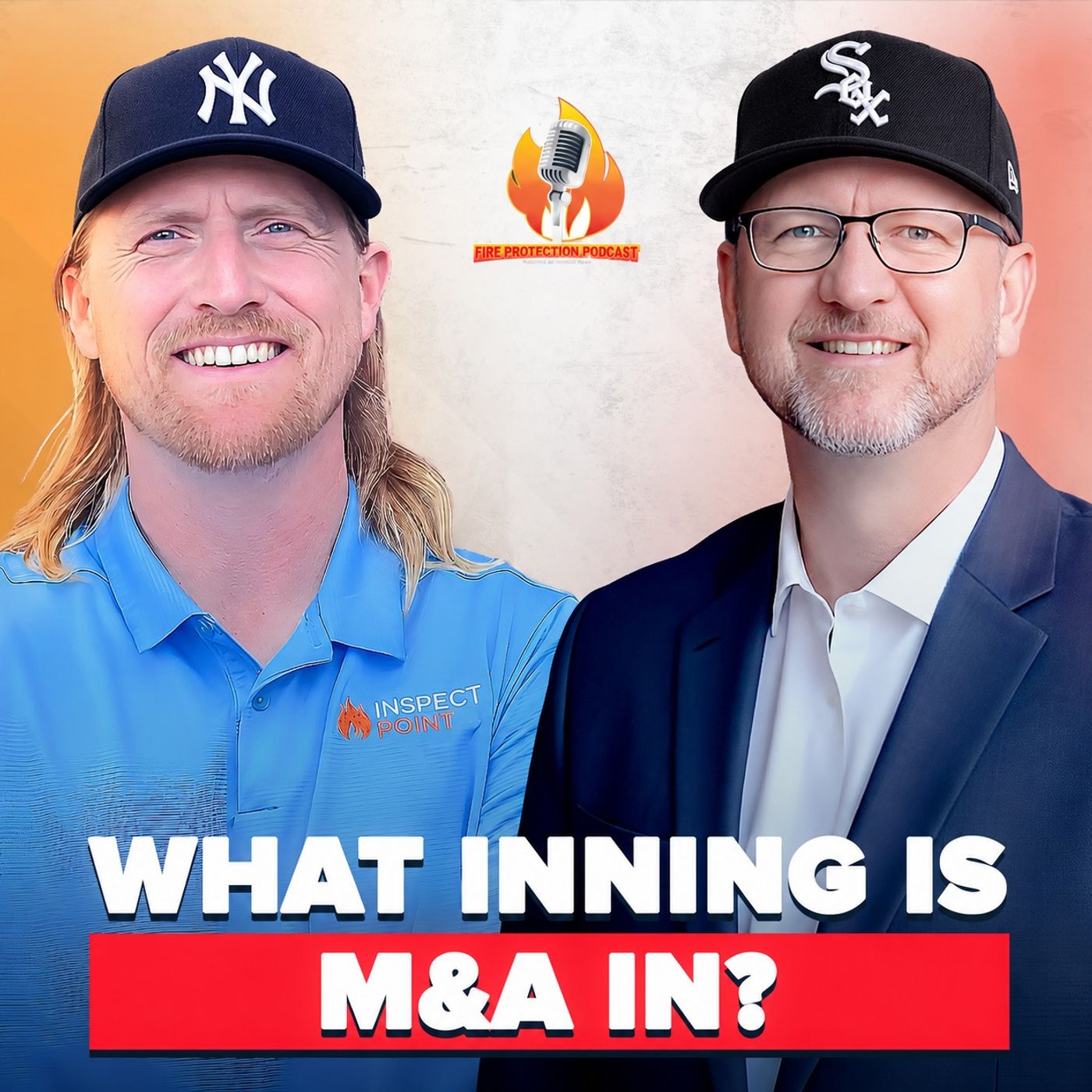
John Mackey, CEO of The Mackey Group, is back for his yearly state-of-the-industry catch-up with Drew. John advises fire and life safety owners and PE-backed platforms on M&A and growth, and his Mackey Report pulls industry research and investor-conference analysis into one set of benchmarks for what good looks like in this business.The M&A story has a new layer. The platforms that were acquiring five years ago are mega platforms now, and a second tier of companies founded eight to twelve years ago is on the same path, with many preparing for an exit in the next 18 to 36 months. By John's count about 85 percent of the market is always either growing or getting ready for a transaction. One analyst he cites in the report asks what inning M&A is in, and John puts it in the middle of the game.Newer contractors are building differently. They pick their field service software and ERP first and grow service before installation, the reverse of the playbook from six or seven years ago. That opens up the tech stack. QuickBooks runs out of room once you need job costing, the big platforms are struggling to choose between NetSuite and SAP, and John's tech stack guide comes down to one rule: understand your workflows and let them drive the software. Drew adds the piece many field service tools don't fully cover, inspection and compliance, and makes the case for a good implementation partner.The back half turns to labor. Technicians with 40 years or more in the field are retiring, and John sees AI shortening how long it takes a new tech to learn the job, as long as they still get hands-on time pulling wire and hanging pipe. He came back from NFPA without seeing a new widget, while hazards like storage at 50 feet, lithium-ion batteries, and data centers keep growing. CEOs at the bigger platforms tell him that without data centers they wouldn't have any construction right now, and he counts 140 data center permits pulled in Texas alone. They wrap with a pitch for the trades and the fall show schedule.The Mackey Group: https://mackeygroupllc.com The Mackey Report: https://mackeygroupllc.com/the-mackey-report Inspect Point: https://www.inspectpoint.com Timestamps0:00 Cold open0:18 Intro: episode 99 with John Mackey2:16 John's advisory work doubled after NFPA3:33 Mega platforms and the second tier forming under them4:21 How much M&A runway is left, and what inning we're in5:58 New contractors start with service and technology7:09 ERP, the tech stack, and letting your workflows lead11:32 Where inspection and compliance fit12:31 Inside the Mackey Report14:38 The labor gap and AI on the jobsite17:39 AI in technician onboarding, and why field time still matters19:51 What was missing from the OEMs at NFPA22:02 Data centers, pharma, and 140 permits in Texas26:17 Why it's a good time to get into the trades27:22 Fall shows and the road to episode 10031:17 Outro

Grant Lobdell is back on the show at a moment when the whole industry is paying attention. The fire at Gabriel House in Fall River, Massachusetts put a hard question in front of every contractor: how do recalled sprinkler heads stay in buildings for decades, and whose job is it to catch them?
Grant runs the lab side of Dyne Fire Protection Labs, now an NFPA Global Solutions company, and his answer starts with an honest observation: contractors handle the routine work well. It's the tests that come due 20 or 50 years after install that fall to the wayside. Dyne's whole stance is that the easier the test is to do, the more likely it gets done.
From there the conversation goes inside NFPA 25. Grant walks through how testing intervals actually get set and why they keep changing edition to edition: dry sprinklers moving from 10 to 15 to 20 years as failure-rate data came in, quick response intervals stretching as the technology proved itself. The committee isn't trying to make life difficult. The intervals are a data-driven decision, and the data keeps moving.
Then the hard part. Recalled O-ring sprinklers are not specifically called out in the standard today. As Grant puts it, if you hand him an O-ring sprinkler and it passes the test, it technically meets the standard, even though the failure rate says otherwise. He expects that to be a hot button in the next revision cycle. The codes, as the saying goes, are written in blood.
The back half is a live walkthrough: how Inspect Point structures sprinkler head data down to the individual head, tracks the right test frequency for whatever NFPA 25 edition each building is on, projects what's coming due across every building in a portfolio, and submits heads to Dyne for testing in a couple of clicks. Grant's team sends a kit, you fill the box, and the lab report lands in your inbox.

Drew brings two of Inspect Point's own onto the show this time: John Ryan, a senior solution engineer who came up through the product and engineering side, and Jimmy Snowden, who leads the support team and spent years as a technician and inspection manager before joining the company. If you've caught their monthly customer session, "Coffee with Jimmy and John," this is the same back and forth, now for the industry at large.
The heart of the conversation is data. Everybody is talking about AI, but Jimmy and John make the case that the payoff depends on what you capture and how. Plenty of companies record building data. The advantage shows up when you capture clean, standardized data at the system and asset level: manufacturers, model numbers, recalls, test dates, how an asset has performed over time. Lock that in and you can ask real questions, like how many buildings had an extinguisher that wasn't inspected last year, and start making projections instead of digging through PDFs and spreadsheets that were never built to be searched.
From there they get into the new features built on that system and asset model: fully custom question sets, components and attributes you can take as granular as you want, barcoding down to an individual cylinder or valve, fire pump curves, and the AI agents on the way.
The back half turns to codes and compliance. John talks through healthcare and the Joint Commission's January 2026 change that simplified fire-safety documentation, and why a transition everyone braced for went off quietly. Jimmy walks through the 2026 edition of NFPA 25, including a residential sprinkler head testing gap he spotted and ran past CASI, NFPA LiNK's AI assistant. And he closes with a sharp theory on why NFPA 25 is the most complex standard in the trade: a sprinkler system is full of water, and water can destroy property the same way fire can, so you're protecting against both.
Join Drew, John, and Jimmy for a real look at where fire protection data, AI, and the codes are all heading.
Topics covered:
"Coffee with Jimmy and John" and how it started
Why no two fire protection companies do the job the same way
How fire protection differs from other trades: each system, its own code
Why system and asset data, not just building data, is what makes AI useful
Custom question sets, components, attributes, and barcoding everything
Putting AI to work: prompts, projections, and agents on the way
Healthcare and the Joint Commission's January 2026 change
Inside the 2026 edition of NFPA 25 and a residential head testing gap
Why NFPA 25 is so complex: protecting against fire and water
0:00 What's in this episode1:44 Getting John and Jimmy on the mic2:16 Meet John Ryan3:33 Meet Jimmy Snowden4:27 Favorite systems: dry systems and valves5:32 "Coffee with Jimmy and John," their monthly customer session10:13 No two fire protection companies are alike11:07 Why fire protection is different: each system, its own code14:13 The real AI unlock is system and asset data15:28 New features: custom question sets, components, and barcoding17:48 Putting AI to work: prompts, projections, and agents23:50 Healthcare and the Joint Commission24:24 The January 2026 change that simplified documentation31:16 Inside the 2026 edition of NFPA 2532:12 The residential head testing gap (and asking CASI)34:22 Why NFPA 25 is so complex: fire and water36:15 Wrap-up

Shawn Mahoney of NFPA's Technical Services team joins Drew for his fourth time on The Fire Protection Podcast, and this one covers a lot of ground before landing on a problem the industry keeps stepping over: construction-site fires.
You've seen the headlines. A light wood-frame building goes up mid-construction, and the whole thing is gone, like the Denver complex that took a 238-unit building with it, or the South Park fire in North Carolina that killed two workers. Shawn's point is blunt: we already have the standard to prevent this. It's NFPA 241, the Standard for Safeguarding Construction, Alteration, and Demolition Operations, and it's been around since 1930. It's referenced by NFPA 1, NFPA 101, the IBC, and the IFC. "The biggest issue is people just aren't using it," Shawn says. The code isn't broken. Enforcement is.
Drew and Shawn dig into why adoption is so piecemeal, what real enforcement looks like (Boston shuts a site down if the fire prevention program manager isn't there), the legislative push after the North Carolina fire, and what the Fire Prevention Program Manager actually has to do day to day.
Before that, they preview the NFPA Conference & Expo in Las Vegas, including Drew's Tuesday session on AI and fire protection, how AI has reshaped the codes world through NFPA LiNK, CASI, and the new Notebooks feature, and why data centers and small nuclear reactors are creating fire-protection problems in towns that have never seen anything like them.
Join Drew for Episode 96 for a real conversation about why the standards we already have only matter if someone enforces them.
Topics covered:
Inside the NFPA Conference & Expo in Las Vegas
AI in fire protection: NFPA LiNK, CASI, and NFPA Insights
LiNK Notebooks for codes, checklists, and impairment permits
Data centers and small nuclear reactors as emerging fire risks
Light wood-frame construction fires and why they're catastrophic
NFPA 241 and the enforcement gap
The Fire Prevention Program Manager role
Timestamps
00:00 – Introduction
02:27 – Inside the NFPA Conference & Expo
05:35 – AI in Fire Protection
07:46 – Data Centers & Small Nuclear Reactors
09:13 – NFPA LiNK, CASI & NFPA Insights
12:00 – LiNK Notebooks
15:21 – NFPA 241: A Standard Since 1930
16:50 – Why Wood-Frame Construction Fires Are Catastrophic
19:07 – Referenced Everywhere, Enforced Almost Nowhere
20:36 – How Boston Enforces 241
25:54 – The Fire Prevention Program Manager Role
28:33 – Educational Videos & NFPA's YouTube Channels
30:23 – Conclusion

Comments

Download from Google Play

Download from App Store
 United States