


 Claim Ownership
AMI Podcasts
Subscribed: 55Played: 272
Subscribe

© AMI Communications Team
Description
AMI Podcasts is a unique collection of presentations, talks and lectures on Montessori principles and practice, the unique nature of childhood and natural human development, human rights and much more. At the moment, the series includes AMI AGM presentations and Maria Montessori House Talks.
47 Episodes
Reverse
The COVID-19 pandemic has caused unprecedented stress to families, trying to maintain a work-family balance. With schools and day care facilities closed, parents are solely responsible for childcare and perhaps even homeschooling. The work-family balance has become increasingly challenging and uncertainty remains around when schools will reopen. To meet the social and emotional needs of children, as well as the adults who care for them, there is need to orient ourselves to the new situation – and the sooner we accept this the faster we will be able to live a balanced life as children are looking up to us. We need to cater for the needs of children, while coexisting with the other members of the family. Montessori principles provide a good guidance on the ways to support children and lead a happy family life during these difficult times.
Montessori for Kenya organised an online talk to orient the general public on the best ways to support children and other members of the family at home to live a happy life. Guest speaker Helen Mohan Elias has vast experience in introducing Montessori principles into missionary and government schools in India and will share her knowledge on Parenting and Community engagement during these challenging times.
Music:
"Raro Bueno" by Chuzausen
From the Free Music Archive
BY NC SA
AMI Global Ambassador André Roberfroid discusses children’s rights and how they are ingrained in the work of Montessori teachers. He discusses the three core characteristics of Montessori, namely Freedom, Respect and Solidarity and how these are linked to the rights of the child.
Music:
"Raro Bueno" by Chuzausen
From the Free Music Archive
BY NC SA
Listen to the latest episode of our EsF Stories series to find out more about Bambini in Emergenza, a non-profit foundation that operates in Romania to aid abandoned children from HIV/AIDS positive mothers. Our guests in this episode are Annamaria Minardi, project manager at Bambini in Emergenza, and Mariana Uliță, a 3-6 AMI trainer and the president of the Montessori Institute of Bucharest. Together, they tell the story of Bambini in Emergenza, Montessori in Romania and the close collaboration between Bambini in Emergenza and the Montessori Institute of Bucharest. Listen here to learn more about Annamaria and Mariana's wonderful collaboration.

Educateurs Sans Frontières recently spoke with mother and daughter Luming and Lora Woellhaf, to learn more about their work in the Philippines and their foundation Mithing Pangarap. Their initiative is two-fold, and combines a thriving private Montessori school in Metro Manila with an outreach Montessori program that nurtures the educational and holistic development of children from the underserved community at Smokey mountain, a former dumpsite in Tondo, Manila.

Stories are everywhere — when we talk of history, science, mathematics, and inventions, we do not only speak of facts, we also speak of wonder and speaking to the power of the mind. We used to be great storytellers: it was a way to pass on the history of our families, the animals, villages and our land.
In today’s world, we have often outsourced our memories to written text. And here is a fascinating dilemma: we must not forget how to tell stories, and yet the written word has also given us the possibility to preserve and share our stories with people from the other side of the planet.
On 31 August 2021, AMI trainer Carla Foster shared with us The Art of Storytelling - how important it is for the elementary child, and how to perfect this art in our teachers. She was joined by Gabrielle Ahuli'i Ferreira Holt who spoke about the importance of exposure to stories and legends of cultural significance in early childhood, helping children engage deeply with their culture and also creating more meaningful connections across cultures.
Listen to the first EsF Story by Hillary Korir, who will talk about his work supporting Montessori education in Kenya. Hillary is the former Executive director of Montessori for Kenya, and has been involved in Corner of Hope from the starting point in 2010. He has now taken up a new responsibility at the Kenyan government, but will stay closely involved with Montessori for Kenya, to contribute to the growth of Montessori education, especially for those with limited resources,and to share all the experience and wisdom he has gathered over time.
On 8 March 2021, we held our second AMI Talk during which Silvia C. Dubovoy and Ama van Dantzig shared insights on equality and equity gained from their professional lives. Silvia shared an overview of the social movements and historical context that shape Montessori's particular brand of idealism. Silvia explored her ideas about the education of young girls and the link between the wellbeing of mother and child in the context of what we now know as Montessori theory and practice. In her daily life, Ama works with game-changers, pioneers and visionaries to create a brave new world. She strives to develop and support the ideas and interventions that unleash much needed societal shifts. Ama shared her passion for helping people find ingenious solutions for the challenges of our time. She also focused on the relevance of uniting people and communities in order to help leaders to take the steps to confront such challenges.
On 6 January 2021 we held a unique online session which focused on the social mission of Montessori. This was the first of a series hosted by AMI's Educateurs sans Frontières (EsF), where we reflected on the legacy of Maria Montessori and explored the application of Montessori principles in today's world. We discussed the roots of Maria Montessori as an advocate for children and looked at how Montessori principles and practice can offer a pathway to addressing some of the current global challenges.
About the speaker: Erica Moretti is assistant professor at the Fashion Institute of Technology-SUNY. She received a Ph.D. in Italian Studies from Brown University and a diploma in American Studies from Smith College. Her research interests include modern Italian intellectual and social history, biopolitics, gender studies, modern and contemporary Italian literature, and Italian colonialism. Her book the Best Weapon for Peace: Maria Montessori, Education, and Children's Rights is forthcoming with the University of Wisconsin Press.
In part three of the Corner of Hope Podcast series, the speakers reflect back on the learnings they gained along the way. They will discuss the offshoots that have been inspired by Corner of Hope and share their dreams and plans for the future of Corner of Hope and Montessori education in Kenya.
This episode's speakers:
Lynne Lawrence (Executive director AMI)
Francis Chege Waweru (Elementary teacher Corner of Hope)
Lillian Wairimu Mwaura (Mentor teacher and deputy school head)
Milcah Jerotich (Mentor teacher and school head Corner of Hope)
Hillary Korir (CEO Montessori for Kenya)
Stephan Mwangi (former student Corner of Hope)
Lyvian Cheruto (former student Corner of Hope)
Jessica Valentine is a researcher at the Department of Child Law at Leiden University. She has extensive experience as a Children’s Rights Lawyer in Australia and she graduated with honours from a master’s in Advanced Studies of International Children’s Rights and the Law. In this presentation, she gives a brief introduction to children’s rights. She talks about the history of children’s rights, the Convention on the Rights of the Child and the African Charter. She explains how children’s rights work in practice and elaborates on the complexity of children’s rights. This presentation was given to the teachers of the Corner of Hope Montessori school on 3 December 2020.
In the podcast created in celebration of the 10 year anniversary of Corner of Hope, different people involved look back on those past 10 years. Teachers, mentors, community members, AMI Executive Director Lynne Lawrence and the CEO of Montessori for Kenya, Hillary Korir, share their stories, experiences and reflections. The podcast tells the story of Corner of Hope from the very beginning through the voices of the people involved. It explains how Corner of Hope came into being and discusses the learnings along the way, as well as the plans for the future. It is an intimate podcast that reflects the various experiences and perspectives which are all part of the inspiring story of Corner of Hope.
The podcast is divided into three parts:
• part one - the beginning of Corner of Hope;
• part two - the development of Corner of Hope, the involvement of the New Canaan community, and the impact Corner of Hope has had;
• part three - a reflection of the speakers on their learnings through their involvement in Corner of Hope in which they also share their hopes and their plans for the future.
The second episode of the Corner of Hope podcast will focus on the involvement of the New Canaan community and the development of the school throughout the years. AMI Executive Director Lynne Lawrence and Montessori for Kenya’s CEO Hillary Korir will elaborate on the way the community has been involved from the very beginning and the importance of community involvement in setting up initiatives. CoH teachers, mentors and members of the New Canaan community will share how they have experienced the process of establishing the Corner of Hope school and the impact it has had on them.
This episode's speakers:
Lynne Lawrence (Executive director AMI)
Hillary Korir (CEO Montessori for Kenya)
Ann Mumbua Mweu (Mentor teacher)
Beth Kosgei (Mentor teacher)
Lillian Wairimu Mwaura (Mentor teacher and deputy school head)
Joseph Kuria (Community member New Canaan and member of the construction team)
Francis Chege Waweru (Elementary teacher Corner of Hope)
Charles Njoroge Mwangi (parent of one of the Corner of Hope students)
In the podcast created in celebration of the 10 year anniversary of Corner of Hope, different people involved look back on those past 10 years. Teachers, mentors, community members, AMI Executive Director Lynne Lawrence and the CEO of Montessori for Kenya, Hillary Korir, share their stories, experiences and reflections. The podcast tells the story of Corner of Hope from the very beginning through the voices of the people involved. It explains how Corner of Hope came into being and discusses the learnings along the way, as well as the plans for the future. It is an intimate podcast that reflects the various experiences and perspectives which are all part of the inspiring story of Corner of Hope. The podcast is divided into three parts:
• part one - the beginning of Corner of Hope;
• part two - the development of Corner of Hope, the involvement of the New Canaan community, and the impact Corner of Hope has had;
• part three - a reflection of the speakers on their learnings through their involvement in Corner of Hope in which they also share their hopes and their plans for the future.
This episode's speakers:
Lynne Lawrence (Executive director AMI)
Hellen Bwari Oyugi (Pioneer teacher Corner of Hope)
Jane Wambui (Pioneer teacher Corner of Hope)
Hillary Korir (CEO Montessori for Kenya)
Milcah Jerotich (Mentor teacher and school head Corner of Hope)
Ann Mumbua Mweu (Mentor teacher)
Beth Kosgei (Mentor teacher)
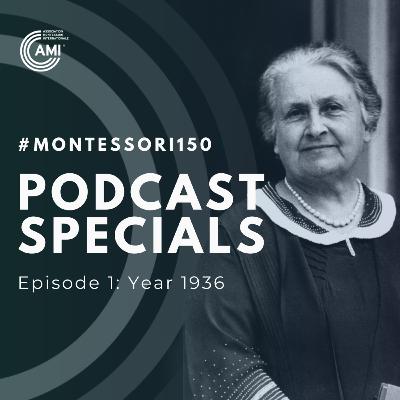
In this series of podcasts, you will be able to listen to Maria Montessori herself. In the first episode, Maria Montessori is advocating for the Rights of the Child on Dutch radio in an interview with Gustav Czopp on 31 October 1936 (in French).
In the early autumn of 1936 Maria Montessori relocated to the Netherlands at the invitation of a former graduate, Ada Pierson. This impactful decision was forced by the Civil War that raged in Spain, a country that had been her main residence for close to twenty years. Montessori did not feel comfortable returning to Barcelona, after the 1936 Congress in Oxford and was delighted when Ada Pierson's offer came to host the family in her parental home for a few months. Montessori education was popular in the Netherlands, the school infrastructure was strong and well developed, there had been an international congress and various courses, all factors we suspect to have been major aspects in reaching the decision to settle in the Netherlands.
The Dutch were of course proud and grateful that Maria Montessori was now part of their society, and yet may have been a little anxious that la Dotoressa would find fault with the Dutch schools. This is why Maria Montessori immediately made it clear in the interview that she had not come to the Netherlands to supervise or monitor existing Montessori schools, but that she was keen to show what her approach to education could mean.
"Our children are growing up in a world that requires good executive function, if they are to exercise self-control, think creatively and adjust flexibly to change. Research tells us that these are the very skills that are promoted in a Montessori environment."
Drawing on current research, including her own, Louise will talk about the role of movement in developing executive function, reflecting on how Montessori practitioners might hone their approach to helping children gain good control of the way they move their bodies to interact successfully with their environment.
__________________
Louise is an AMI trainer with many years of experience working with children in Montessori environments and is currently director of training at the Maria Montessori Institute, London.
Music:
"Raro Bueno" by Chuzausen
From the Free Music Archive
BY NC SA
In the third episode of 2019 AMI AGM Podcasts, Kathleen Guinan, a visionary leader and social entrepreneur, will talk about transforming transitional housing programmes, homeless shelters and domestic violence centres into intergenerational Montessori communities of living and learning for children, families and communities.
As CEO of Crossway Community, since the organisation’s inception in 1990, she has been a catalyst for individual and social change for women, children and families. Today, Crossway Community provides complete wrap-around support to multiple generations to prevent poverty and help families thrive. They are also developing a model intergenerational program to train family and professionals caring for aging populations.
Music:
"Raro Bueno" by Chuzausen
From the Free Music Archive
BY NC SA
Cosmic Education is one of the broadest and most interesting aspects of the second plane of development. Baiba’s Krumins Grazzini talk illustrates the evolution of the Montessori approach to education for
children from 6 - 12 years of age. Baiba also discusses how the young person progresses into
adolescence.
__________________
Baiba Krumins Grazzini is an AMI Trainer at the Elementary level, preparing students to work in Montessori schools with children from 6 to 12 years. She works as director of training at the AMI Elementary course in Bergamo, Italy, an AMI Training Centre which was founded by Mario Montessori in 1961. In addition to her work in Bergamo, Baiba has lectured in Spain, Ireland, India and in Japan, where she gave the first Elementary training course in that country.
Music:
"Raro Bueno" by Chuzausen
From the Free Music Archive
BY NC SA

Anne Kelly is the leading Montessori Dementia Consultant who has worked extensively in dementia care both residential and community for the past 30 years. She is currently the Director of Montessori Consulting and is considered a world leader in Montessori methods for ageing and dementia. Anne works with organisations around the world providing both training, mentoring and support as they move towards the development of Montessori Prepared Environments, changing the face of aged care one step at a time. In this episode of the 2019 AMI AGM Podcasts Anne talks about improvements in the quality of life of older adults with dementia in long-term care achieved through meaningful engagement.
What does resilience really mean and why is this topic so important for modern education? In our first episode of 2019 AMI AGM Podcasts, Laura Shaw discusses the resilience research and examines how the qualities of responsibility and resourcefulness contribute to developing resilience in children.
On Tuesday, 6 January 2026, Anne Kelly and Julia Ballesteros presented our AMI Talk on A Dignity-Centred Approach: Montessori Principles for Dementia and Ageing.Montessori education cultivates autonomy, equality, and community and these values were reflected and elaborated in the first talk of 2026: our speakers explored how Montessori principles have gained significant traction in dementia, disability, and aged-care settings worldwide.
As we are about to commemorate the adoption of the UN General Assembly's Declaration of the Rights of the Child in 1959 and the Convention on the Rights of the Child in 1989, this offers a great opportunity to spotlight these rights and share how adults, society, the community can promote and live these rights, so much part and parcel of the Montessori philosophy.We are delighted that you can hear from Pavithra Rajagopalan and Koen Schaap, two speakers who each will bring a different, yet complementary focus on how these rights need to be advocated for and protected in education, and how we can help prepare children and youth to become contributing members of society.Pavithra Rajagopalan is an AMI 3-6 trainer; she has worked in Montessori schools in India, the US and New Zealand. She is involved in strengthening pioneering projects related to Early Childhood Education in under-served communities. She is part of the faculty at the Sir Ratan Tata Institute, Mumbai.Pavithra will argue that a democratic spirit is not about casting our vote once every 3, 4 or 5 years. It is more about being an active participant within any framework and exercising the right and fulfilling the duty to choose to function a certain way and also shaping the way that the framework functions on a regular basis.How does education recognise this aspect of daily life and what allocations do we make for the development of the democratic spirit? Particularly in Montessori, in the various contexts—schools, parent networks, training centres, affiliates, AMI, etc. — we may recognise the need for democratic processes, but does it always translate to democratic experiences for the participants? When it does, what are the principles that we uphold?Eventually, when the experiences marry processes, we see the coming of outcomes such as adaptation and critical consciousness in the individuals.Koen Schaap is an experienced Social Science teacher at IVKO, an art-based Montessori secondary school in Amsterdam, The Netherlands. Besides teaching adolescents, he is a curriculum developer, coach and trainer at the Amsterdam Montessori Study Center.The Study Center is part of the Montessori Group of Schools in Amsterdam with over 5700 12-18 students and approximately 500 teachers.Koen will share insights from the work conducted by the Montessori Study Center Amsterdam on “Living Democracy with Adolescents in Large Urban Schools.” These schools serve around 5,000 young people (ages 12–18) from richly diverse cultural and economic backgrounds—contexts in which democratic values sometimes clash with those of the broader Western society they live in, as well as with the rise of right-wing populist parties in the Netherlands and across Europe.Koen’s presentation will explore how educators and students navigate these complexities, fostering democratic principles within learning environments that generate new understandings of participation, equity, and voice.

Comments

Download from Google Play

Download from App Store
 United States