


 Claim Ownership
Interpreting India
Subscribed: 1,986Played: 16,377
Subscribe

© 2024 Carnegie India
Description
In Season 5 of Interpreting India, we continue our exploration of the dynamic forces that will shape India's global standing. At Carnegie India, our diverse lineup of experts will host critical discussions at the intersection of technology, the economy, and international security. Join us as we navigate the complexities of geopolitical shifts and rapid technological advancements. This season promises insightful conversations and fresh perspectives on the challenges and opportunities that lie ahead.
142 Episodes
Reverse
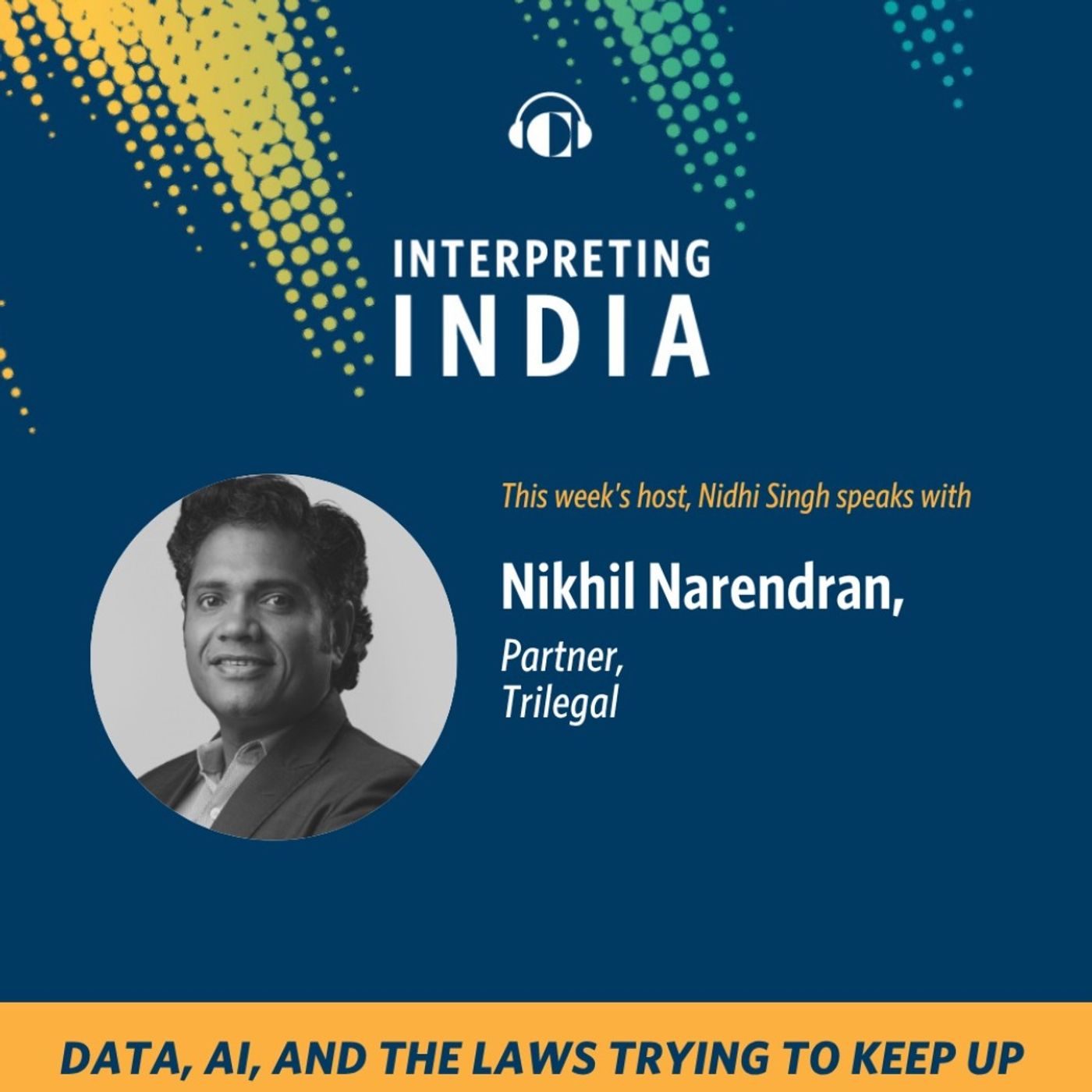
The conversation begins with a close look at India’s data protection regime, particularly the DPDP Act and its emphasis on consent. Nikhil challenges the perception that the law is overly consent-driven, pointing to a range of exemptions and alternative legal bases for processing data. At the same time, he highlights gaps in enforcement and deterrence, arguing that the current framework may struggle to address large-scale misuse of data or systemic harms.
On AI governance, Nikhil makes a case that India does not need a sweeping, EU-style AI law, at least not yet. Given India's legislative pace, enforcement gaps, and how fast AI is evolving, he thinks strengthening existing laws and making targeted amendments is a far more practical path. He does, however, flag artificial intimacy as something that deserves serious attention soon. AI-powered companionship is supercharging the loneliness economy, building emotional dependency at scale, and raising risks that no existing framework is really built to handle.
Closer to home, Nikhil offers a window into how AI is changing legal practice at Trilegal, where 75% of lawyers now use AI in their daily workflows. The firm is simultaneously building AI products, using them internally, and advising clients on AI risk, a position Nikhil sees as an advantage rather than a conflict. For him, the era of lawyers who write code and speak directly with engineers is not something to fear but a long overdue shift in what it means to practice technology law.
Episode ContributorsNidhi Singh is an associate fellow at Carnegie India. Her current research interests include data governance, artificial intelligence and emerging technologies. Her work focuses on the implications of information technology law and policy from a Global Majority and Asian perspective. She has previously contributed to the Indian Express, The Secretariat, Medianama and HinduBusiness Line.Nikhil Narendran is a Partner in Trilegal’s Bengaluru office and part of the TMT practice of the firm. He is a subject matter expert in the technology, media, and telecom communication space. Nikhil focuses on the interplay of technology, human lives, and commerce. He has substantial experience in advising companies on telecom, media and technology laws in relation to their entry into India, operations, strategy, policy, regulatory issues, disputes, and business models.
Every two weeks, Interpreting India brings you diverse voices from India and around the world to explore the critical questions shaping the nation's future. We delve into how technology, the economy, and foreign policy intertwine to influence India's relationship with the global stage.As a Carnegie India production, hosted by Carnegie scholars, Interpreting India, a Carnegie India production, provides insightful perspectives and cutting-edge by tackling the defining questions that chart India's course through the next decade.Stay tuned for thought-provoking discussions, expert insights, and a deeper understanding of India's place in the world.Don't forget to subscribe, share, and leave a review to join the conversation and be part of Interpreting India's journey.
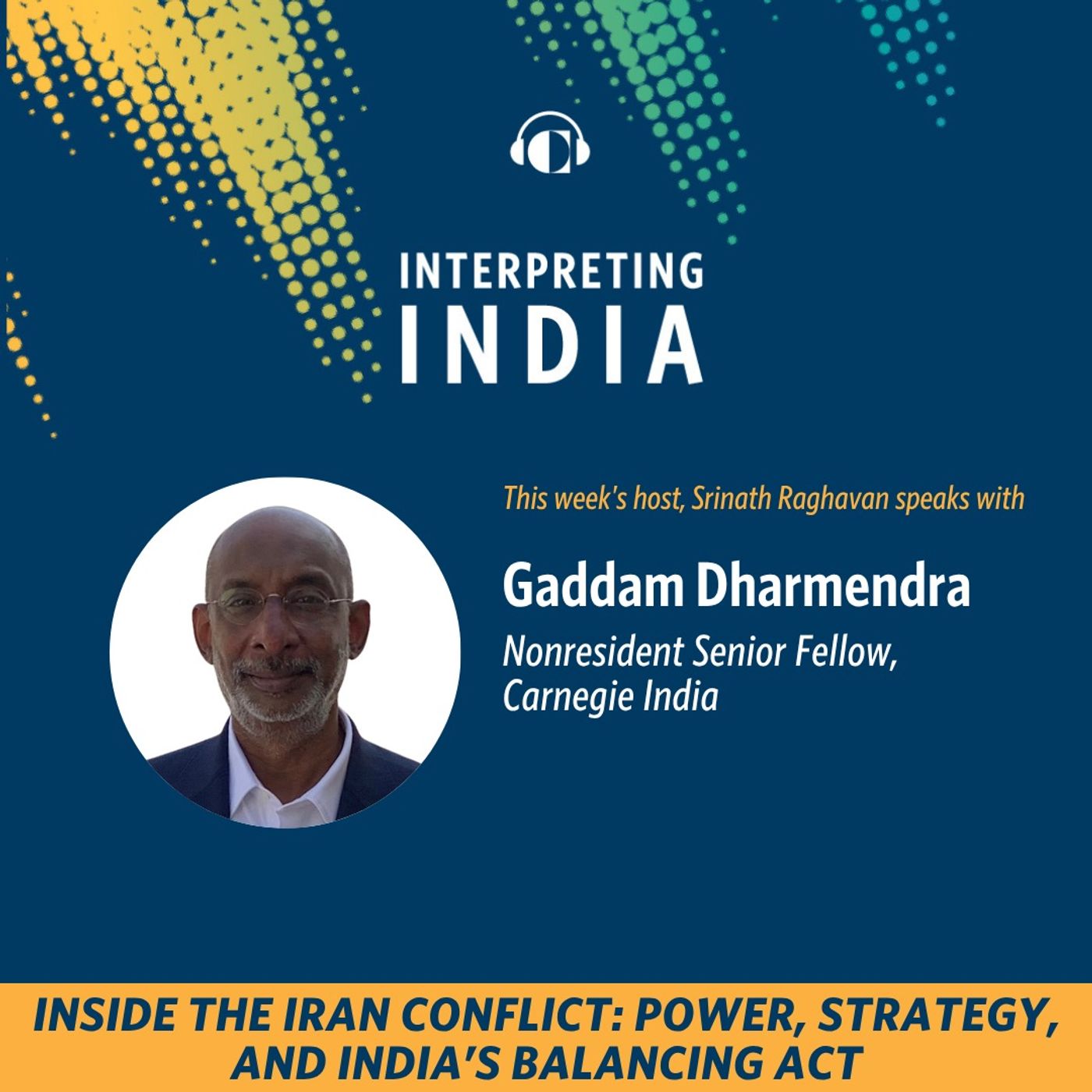
The conversation begins with a look at where the conflict stands today and how Iran has managed to absorb significant military pressure while still responding in a measured way. Dharmendra explains how the conflict has expanded beyond immediate borders, affecting energy flows and drawing in multiple countries, while also reinforcing a sense of internal unity despite economic strain.
It then turns to Iran’s internal system, where different power centres, from the political leadership to the security establishment, continue to function together even under pressure. The episode also reflects on the role of nationalism, suggesting that even in a deeply ideological state, a shared national identity plays a strong role in shaping public response during moments of crisis.
In the final part, the focus shifts to India. The discussion looks at how India manages its relationships across the region, from Iran to the Gulf, and the constraints created by sanctions and global politics. It also touches on long-term projects like Chabahar and what their future might look like. The episode closes with a broader reflection on where the region may be headed and what space there is for stability after the conflict.
Episode Contributors
Srinath Raghavan is a nonresident senior fellow at Carnegie India. He is also a professor of International Relations and History at Ashoka University. His primary research focus is on the contemporary and historical aspects of India’s foreign and security policies.
Gaddam Dharmendra is a nonresident senior fellow at Carnegie India. He joined the Indian Foreign Service in 1990 and served in various capacities in Indian Missions across the world and at the Ministry of External Affairs, South Block. His overseas assignments include stints at Indian Missions in Tehran, Dushanbe, Washington D.C., and Dhaka.
Every two weeks, Interpreting India brings you diverse voices from India and around the world to explore the critical questions shaping the nation's future. We delve into how technology, the economy, and foreign policy intertwine to influence India's relationship with the global stage.As a Carnegie India production, hosted by Carnegie scholars, Interpreting India, a Carnegie India production, provides insightful perspectives and cutting-edge by tackling the defining questions that chart India's course through the next decade.Stay tuned for thought-provoking discussions, expert insights, and a deeper understanding of India's place in the world.Don't forget to subscribe, share, and leave a review to join the conversation and be part of Interpreting India's journey.
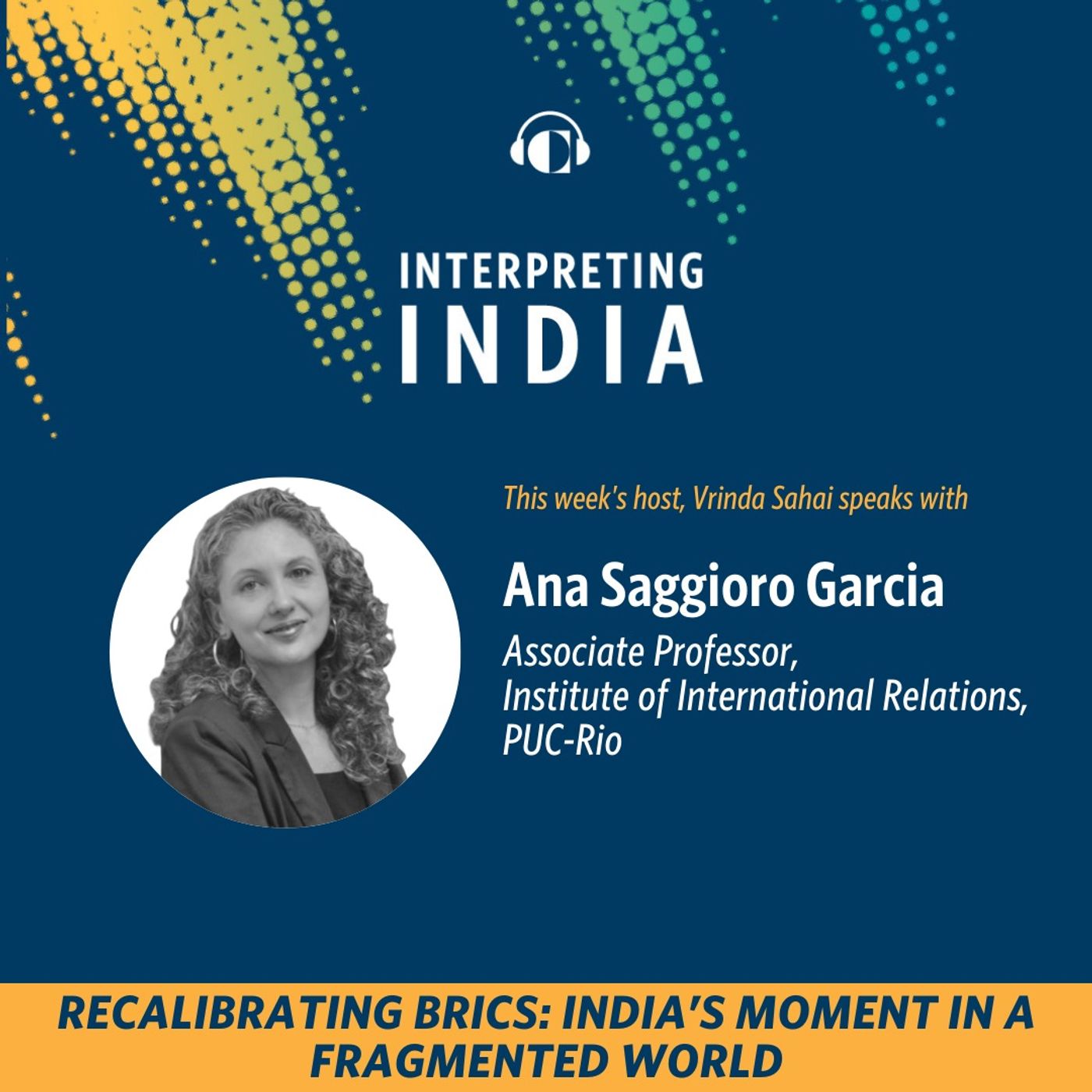
The episode begins with a reflection on Brazil’s 2025 BRICS presidency, which emphasized continuity with the bloc’s original reformist agenda—particularly the push for reform of global financial institutions and greater representation for emerging economies. While Brazil focused on trade facilitation, climate finance, and taxation cooperation, progress on deeper monetary coordination and mechanisms such as the Contingent Reserve Arrangement remained limited.
Ana Garcia also notes the gap between expectations and reality within BRICS. Despite its growing geopolitical visibility, the bloc has struggled to develop unified responses to global crises and remains economically imbalanced, with intra-BRICS trade heavily centered on China. The New Development Bank continues to expand its project financing and local currency lending but operates within global financial constraints and plays a more limited role than often perceived.
Looking ahead, India’s presidency will focus on consolidating the expanded BRICS grouping while cautiously advancing financial cooperation, climate adaptation financing, and South-South collaboration in health. The discussion concludes that India’s success will depend on pragmatic institutional progress rather than ambitious rhetoric, as BRICS navigates a complex and polarized global environment.
Episode Contributors
Vrinda Sahai is a research analyst in the Security Studies Program at Carnegie India. Her work focuses on Indian foreign and security policy, particularly, India’s strategic engagement with major powers.
Ana Elisa Saggioro Garcia is a Professor at the Institute of International Relations at PUC-Rio. Professor of the Postgraduate Program in Social Sciences at the Federal Rural University of Rio de Janeiro. PhD in International Relations from IRI/PUC-Rio and Master in Political Science from the Free University of Berlin (Germany).
Every two weeks, Interpreting India brings you diverse voices from India and around the world to explore the critical questions shaping the nation's future. We delve into how technology, the economy, and foreign policy intertwine to influence India's relationship with the global stage.As a Carnegie India production, hosted by Carnegie scholars, Interpreting India, a Carnegie India production, provides insightful perspectives and cutting-edge by tackling the defining questions that chart India's course through the next decade.Stay tuned for thought-provoking discussions, expert insights, and a deeper understanding of India's place in the world.Don't forget to subscribe, share, and leave a review to join the conversation and be part of Interpreting India's journey.
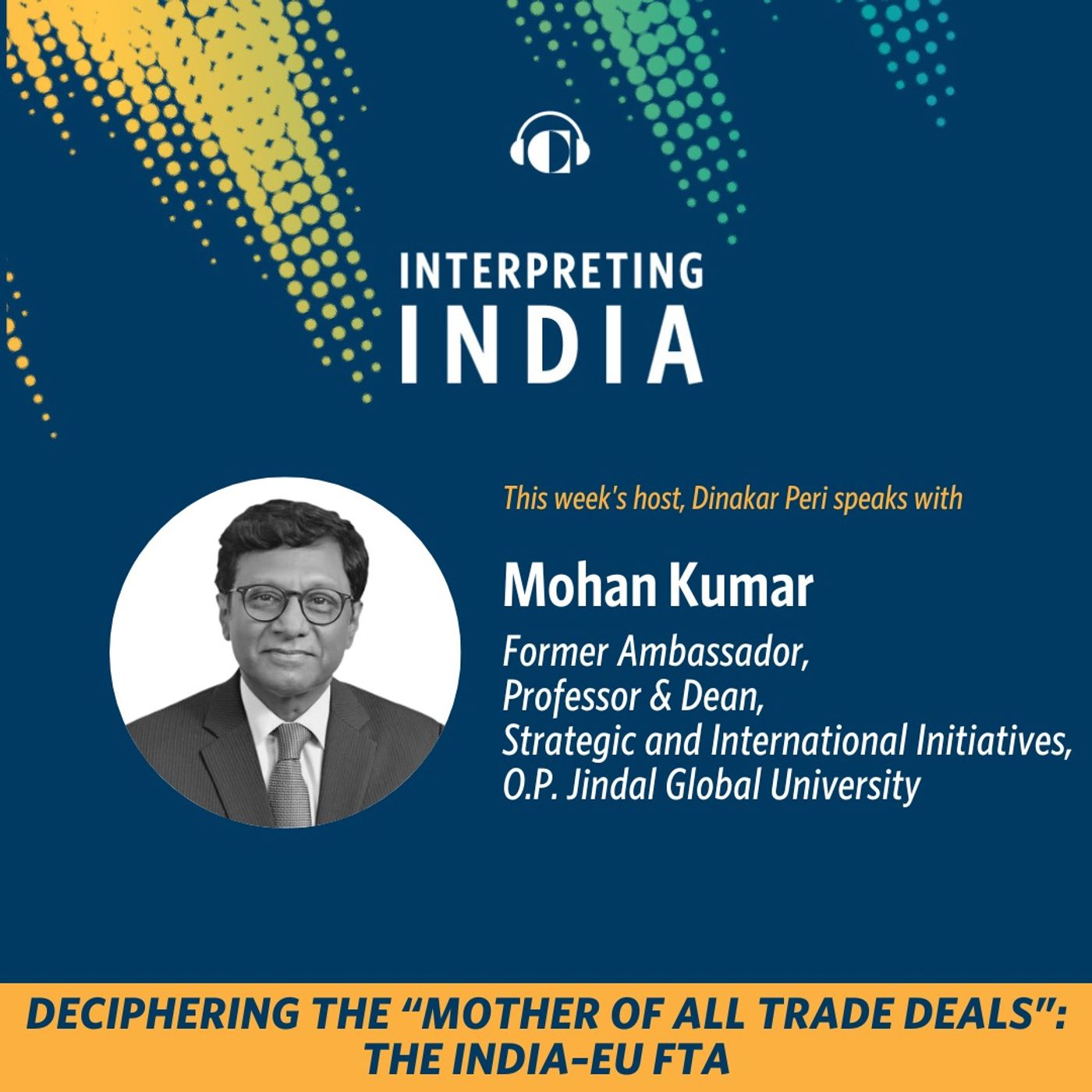
Kumar frames the India–EU FTA as a deal India needed, not one it merely chose, arguing that with the multilateral trade system weakened, FTAs have become the practical route to secure market access and signal openness to investment. He places the EU among India’s “$100 billion club” trading partners and explains why this agreement fills a gap India cannot realistically close with China, and cannot replicate with the United States in the form of a full FTA.On timing, he calls the early 2010s a missed opportunity but notes that current geopolitical conditions have raised India’s value for Europe, including Europe’s push to de-risk from China and the absence of an EU–U.S. FTA. A major thread is regulation: Kumar acknowledges the EU’s regulatory intensity, but argues India must adapt to global technical and sanitary standards, using the agreement’s timelines and technical assistance to reduce friction and help industry upgrade over time.He clarifies the trade-offs that made the deal viable: core agriculture and dairy are left out due to political sensitivities on both sides; government procurement is excluded due to India’s constraints and federal realities; and investment protection and geographical indications are kept on separate tracks to avoid a more complex EU-wide ratification path. He also describes how negotiations manage domestic sensitivities through consultation with industry, transition periods, tariff-rate quotas, and product thresholds, particularly in sectors like autos, aiming to expose firms gradually to competition while pushing manufacturing to become more competitive.In closing, Kumar argues the hard work starts after signing. He stresses that Indian industry must actually use the agreement’s tariff concessions, pointing to historically low utilization of FTAs—and that domestic reforms cannot be postponed if India wants the deal to deliver results. He highlights reforms in agriculture, labor implementation, power, and land acquisition, and ties this to a broader shift he sees globally: trade policy and security policy are increasingly moving into alignment, especially in a world of dual-use technology and tighter strategic partnerships.Episode ContributorsDinakar Peri is a fellow in the Security Studies program at Carnegie India.Ambassador Mohan Kumar has an outstanding career in the Indian Foreign Service lasting 36 years which culminated in his being India’s Ambassador to France based in Paris. Under his watch, the Indo-French strategic partnership was strengthened and consolidated further in spheres such as defense, space, nuclear & solar energy, smart cities and investment. Earlier, Mohan Kumar was India’s Ambassador to the Kingdom of Bahrain where he witnessed and dealt with a strategically complex region characterized by events such as the “Arab Spring”.
Every two weeks, Interpreting India brings you diverse voices from India and around the world to explore the critical questions shaping the nation's future. We delve into how technology, the economy, and foreign policy intertwine to influence India's relationship with the global stage.As a Carnegie India production, hosted by Carnegie scholars, Interpreting India, a Carnegie India production, provides insightful perspectives and cutting-edge by tackling the defining questions that chart India's course through the next decade.Stay tuned for thought-provoking discussions, expert insights, and a deeper understanding of India's place in the world.Don't forget to subscribe, share, and leave a review to join the conversation and be part of Interpreting India's journey.
AI progress is often measured by the number of pilots launched, but this episode argues the real unit of progress should be how many AI use cases are reliably in production and embedded into everyday systems. Shalini Kapoor distinguishes AI innovation (models, chips, and breakthroughs) from AI adoption, emphasizing that adoption is frequently harder because it demands institutional integration, behavior change, and clear accountability—especially when AI advice affects livelihoods, health outcomes, or legal decisions.Tanvi Lall explains “pilot purgatory” as the frustrating middle state where use cases never move beyond controlled deployments. She shares how recurring barriers—compute constraints within real institutions (not just cloud credits), fragmented workflows, late-stage safety design, lack of sustained funding, and weak organizational readiness—prevent diffusion. The conversation highlights the UCAF approach to defining a use case as a commitment to improve a specific outcome for a specific persona in a specific context, and why trust and accountability are as central as the technology layer.The episode also explores “horizontal enablers” that make scale possible—data readiness, multilingual language support, voice interfaces for last-mile access, workforce integration, and guardrails. A detailed example (Mahavistar in Maharashtra) illustrates what scaling can look like when government partnership, data pipelines, voice infrastructure, safeguards, and long-term funding align. Finally, the guests look ahead to what AI adoption in India could look like over the next five years, arguing that the most impactful AI will feel “ordinary”—quietly embedded into routine decisions—supported by shared adoption infrastructure rather than one-off pilots.Episode ContributorsNidhi Singh is a Senior Research Analyst at Carnegie India.Shalini Kapoor is the Chief Strategist for Data and AI at the EkStep Foundation. Her work focuses on building practical pathways for AI adoption, with emphasis on institutional integration, accountable systems, and population-scale impact.Tanvi Lall is the Director for Strategy at People Plus AI. Her work focuses on AI use cases, adoption barriers, and developing frameworks that help move AI from pilots to sustained deployment and real-world outcomes. 00:00 Introduction to AI Adoption Challenges01:37 Understanding AI Adoption vs. Innovation04:55 Pilot Purgatory: The Stagnation of AI Projects08:48 Fragmented Adoption: Real-World Examples12:13 Barriers to AI Adoption: Mindset and Behavior Change16:01 Defining Good AI Use Cases20:00 Horizontal Enablers for AI Success26:26 Case Study: Mahavistar's Impact on Farmers34:34 Future of AI Adoption in India40:29 Optimism for AI Diffusion and AdoptionReadingsAI Adoption Journey for Population Scale by Shalini Kapoor and Tanvi Lall
Every two weeks, Interpreting India brings you diverse voices from India and around the world to explore the critical questions shaping the nation's future. We delve into how technology, the economy, and foreign policy intertwine to influence India's relationship with the global stage.As a Carnegie India production, hosted by Carnegie scholars, Interpreting India, a Carnegie India production, provides insightful perspectives and cutting-edge by tackling the defining questions that chart India's course through the next decade.Stay tuned for thought-provoking discussions, expert insights, and a deeper understanding of India's place in the world.Don't forget to subscribe, share, and leave a review to join the conversation and be part of Interpreting India's journey.
As AI systems grow more powerful, the computational infrastructure behind them has become a strategic resource, one that is unevenly distributed across the world. This episode takes a deep look at the three layers of compute sovereignty: where data centers are located, who owns them, and who manufactures the chips that power them. Zoe explains how access to compute has quickly shifted from a technical issue to a core question of economic resilience and sovereignty.The conversation unpacks new research showing how few countries actually host advanced AI-relevant data centers, and how global dependencies on companies like Nvidia shape strategic decisions. Adarsh and Zoe discuss the implications for countries that are “compute deserts,” the growing push toward sovereign capabilities, and why a binary view of sovereignty is misleading. They also explore how countries are attempting to secure compute, through public investment, regional collaborations, and new transnational initiatives.Finally, the episode examines the emerging tension between the pursuit of compute sovereignty and the environmental and socioeconomic costs of data centers. As global investments flow into AI infrastructure, Zoe argues for a more grounded, people-centric approach to AI strategy, one that balances access, sustainability, and long-term national priorities amid evolving questions about the future of the AI industry.Episode ContributorsAdarsh Ranjan is a research analyst at Carnegie India where his research focuses on AI and emerging technologies, digital transformation, and technology partnerships. His current research explores India’s evolving policy on AI compute and digital transformation in Global South countries.Zoe Jay Hawkins is the co-founder and deputy executive director of the Tech Policy Design Institute. Zoe brings extensive experience designing tech policy from government, big tech, academic and think tank perspectives. Zoe worked for the Australian government across communications, innovation, and foreign policy portfolios, as a ministerial adviser and in the public service. She is a Research Associate at the University of Oxford and an expert researcher for the OECD, having started her career at the Australian Strategic Policy Institute.
Every two weeks, Interpreting India brings you diverse voices from India and around the world to explore the critical questions shaping the nation's future. We delve into how technology, the economy, and foreign policy intertwine to influence India's relationship with the global stage.As a Carnegie India production, hosted by Carnegie scholars, Interpreting India, a Carnegie India production, provides insightful perspectives and cutting-edge by tackling the defining questions that chart India's course through the next decade.Stay tuned for thought-provoking discussions, expert insights, and a deeper understanding of India's place in the world.Don't forget to subscribe, share, and leave a review to join the conversation and be part of Interpreting India's journey.
The conversation explores how cybersecurity is integral to space operations, drawing parallels with traditional air defense strategies. Blount discusses the historical context of cybersecurity in space, the role of international law, and the challenges posed by non-state actors. He emphasizes the need for a holistic approach to cybersecurity that includes both space-based and terrestrial components, and the importance of international cooperation in addressing these challenges.Blount warns of the increasing threats from cyber-attacks on space assets and the need for robust legal frameworks to ensure accountability and security. He calls for the development of comprehensive cybersecurity strategies that integrate space and cyberspace, ensuring resilience against a wide range of threats.How can nations protect their space assets from cyber threats? What role does international law play in governing space cybersecurity? How should countries collaborate to enhance global space security?Episode ContributorsP. J. Blount is assistant professor of space law at Durham University. He is also a visiting scholar at Mae Fah Luang University in Chiang Rai, Thailand. Previously, he served as a Lecturer in Law at Cardiff University, an adjunct professor for the LL.M. in the Air and Space Law at the University of Mississippi School of Law, a Postdoctoral Researcher at the University of Luxembourg, an adjunct professor at Montclair State University, and a Visiting Scholar at the Beijing Institute of Technology School of Law. Tejas Bharadwaj is a senior research analyst with the Technology and Society Program at Carnegie India. He focuses on space law and policies and also works on areas related to AI in military domain, Defence tech and Cybersecurity.
Every two weeks, Interpreting India brings you diverse voices from India and around the world to explore the critical questions shaping the nation's future. We delve into how technology, the economy, and foreign policy intertwine to influence India's relationship with the global stage.As a Carnegie India production, hosted by Carnegie scholars, Interpreting India, a Carnegie India production, provides insightful perspectives and cutting-edge by tackling the defining questions that chart India's course through the next decade.Stay tuned for thought-provoking discussions, expert insights, and a deeper understanding of India's place in the world.Don't forget to subscribe, share, and leave a review to join the conversation and be part of Interpreting India's journey.
The episode challenges the familiar “open versus closed” framing of AI systems. Sharma argues that openness is not inherently good or bad—it is an instrumental choice that should align with specific policy goals. She introduces a seven-part taxonomy of AI—compute, data, source code, model weights, system prompts, operational records and controls, and labor—to show how each component interacts differently with innovation, safety, and governance. Her central idea, differential openness, suggests that each component can exist along a spectrum rather than being entirely open or closed. For instance, a company might keep its training data private while making its system prompts partially accessible, allowing transparency without compromising competitive or national interests. Using the example of companion bots, Sharma highlights how tailored openness across components can enhance safety and oversight while protecting user privacy. She urges policymakers to adopt this nuanced approach, applying varying levels of openness based on context—whether in public services, healthcare, or defense. The episode concludes by emphasizing that understanding these layers is vital for shaping balanced AI governance that safeguards public interest while supporting innovation.How can regulators determine optimal openness levels for different components of AI systems? Can greater transparency coexist with innovation and competitive advantage? What governance structures can ensure that openness strengthens democratic accountability without undermining safety or national security?Episode ContributorsChinmayi Sharma is an associate professor of law at Fordham Law School in New York. She is a nonresident fellow at the Stoss Center, the Center for Democracy and Technology, and the Atlantic Council. She serves on Microsoft’s Responsible AI Committee and the program committees for the ACM Symposium on Computer Science and Law and the ACM Conference on Fairness, Accountability, and Transparency.Shruti Mittal is a research analyst at Carnegie India. Her current research interests include artificial intelligence, semiconductors, compute, and data governance. She is also interested in studying the potential socio-economic value that open development and diffusion of technologies can create in the Global South.Suggested Readings Unbundling AI Openness by Parth Nobel, Alan Z. Rozenshtein, and Chinmayi Sharma. Tragedy of the Digital Commons by Chinmayi Sharma. India’s AI Strategy: Balancing Risk and Opportunity by Amlan Mohanty and Shatakratu Sahu.
Every two weeks, Interpreting India brings you diverse voices from India and around the world to explore the critical questions shaping the nation's future. We delve into how technology, the economy, and foreign policy intertwine to influence India's relationship with the global stage.As a Carnegie India production, hosted by Carnegie scholars, Interpreting India, a Carnegie India production, provides insightful perspectives and cutting-edge by tackling the defining questions that chart India's course through the next decade.Stay tuned for thought-provoking discussions, expert insights, and a deeper understanding of India's place in the world.Don't forget to subscribe, share, and leave a review to join the conversation and be part of Interpreting India's journey.
India’s air defense has transformed from sparse radars in the 1960s to a multilayered network anchored by the Integrated Air Command and Control System (IACCS), linking radars, interceptors, and layered missile systems into a cohesive shield. Air Marshal Diptendu Choudhury underscores how decades of preparation, constant operational readiness, and the stress test of Operation Sindoor demonstrated the value of Army–Air Force integration and cost-effective counters to drones and missiles. He emphasizes that air defence is no longer just about protection—it is about extending reach into adversary airspace and enabling India’s offensive air power to operate with confidence.Looking ahead, Choudhury warns that the deepening China–Pakistan partnership, the economics of interception, and production scalability will shape India’s strategic calculus. He calls for IACCS to evolve into an Integrated Aerospace Command and Control System, expanding beyond airspace into near-space and space-based surveillance to achieve full-spectrum aerospace domain awareness. Building resilient, cyber-secure, and future-ready defences, he argues, is essential to preserving India’s edge against threats ranging from drones to ballistic missiles.How can India balance cost-effective counters against drones with the need for high-end missile defenses? What does China–Pakistan military cooperation mean for India’s future two-front strategy? How should India integrate space-based systems into its air defence to achieve true aerospace domain awareness?Episode ContributorsAir Marshal (Retd.) Diptendu Choudhury, Former Commandant, National Defence College, Delhi. An experienced pilot with over 5000 sorties on fighters, he has commanded a fighter squadron, IAF’s prestigious Tactics Air Combat Development Establishment, two frontline fighter wings, and has extensive experience in the development and execution of air operations at Command, Air Force and Joint Operations levels. He has been the Senior Air Staff Officer of WAC, Air Defence Commander of two operational Commands, AOC of IAF’s Composite Operational Battle Response and Analysis Group, as well as the ACAS Inspections, and Director Air Staff Inspections and Operational Planning and Assessment Group.Dinakar Peri is a fellow in the Security Studies program at Carnegie India. Earlier, he was a journalist with The Hindu newspaper covering defense and strategic affairs for almost 11 years. He is an alumnus of the U.K. Foreign Office’s Chevening South Asia Journalism Program and the U.S. State Department’s International Visiting Leadership Program.
Every two weeks, Interpreting India brings you diverse voices from India and around the world to explore the critical questions shaping the nation's future. We delve into how technology, the economy, and foreign policy intertwine to influence India's relationship with the global stage.As a Carnegie India production, hosted by Carnegie scholars, Interpreting India, a Carnegie India production, provides insightful perspectives and cutting-edge by tackling the defining questions that chart India's course through the next decade.Stay tuned for thought-provoking discussions, expert insights, and a deeper understanding of India's place in the world.Don't forget to subscribe, share, and leave a review to join the conversation and be part of Interpreting India's journey.
The episode opens with Bhatt framing the global stakes: from drones on the battlefield to AI-powered early warning systems, militaries worldwide are racing to integrate AI, often citing strategic necessity in volatile security environments. Mohan underscores that AI in conflict cannot be characterized in a single way, applications range from decision-support systems and logistics to disinformation campaigns and border security.The conversation explores two categories of AI-related risks:Inherent risks: design flaws, bias in datasets, adversarial attacks, and human–machine trust calibration.Applied risks: escalation through miscalculation, misuse in targeting, and AI’s role as a force multiplier for nuclear and cyber threats.On governance, Mohan explains the fragmentation of current disarmament processes, where AI intersects with multiple regimes, nuclear, cyber, conventional arms, yet lacks a unified framework. She highlights ongoing debates at the UN’s Group of Governmental Experts (GGE) on LAWS, where consensus has been stalled over definitions, human-machine interaction, and whether regulation should be voluntary or treaty-based.International humanitarian law (IHL) remains central, with discussions focusing on how principles like distinction, proportionality, and precaution can apply to autonomous systems. Mohan also emphasizes a “life-cycle approach” to weapon assessment, extending legal and ethical oversight from design to deployment and decommissioning.A significant portion of the conversation turns to gender and bias, an area Mohan has advanced through her research at UNIDIR. She draws attention to how gendered and racial biases encoded in AI systems can manifest in conflict, stressing the importance of diversifying participation in both technology design and disarmament diplomacy.Looking forward, Mohan cites UN Secretary-General António Guterres’s call for a legally binding instrument on autonomous weapons by 2026. She argues that progress will depend on multi-stakeholder engagement, national strategies on AI, and confidence-building measures between states. The episode closes with a reflection on the future of warfare as inseparable from governance innovation—shifting from arms reduction to resilience, capacity-building, and responsible innovation.Episode ContributorsShimona Mohan is an associate researcher on Gender & Disarmament and Security & Technology at UNIDIR in Geneva, Switzerland. She was named among Women in AI Ethics’ “100 Brilliant Women in AI Ethics for 2024.” Her areas of focus include the multifarious intersections of security, emerging technologies (in particular AI and cybersecurity), gender, and disarmament. Charukeshi Bhatt is a research analyst at Carnegie India, where her work focuses on the intersection of emerging technologies and international security. Her current research explores how advancements in technologies such as AI are shaping global disarmament frameworks and security norms.ReadingsGender and Lethal Autonomous Weapons Systems, UNIDIR Factsheet Political Declaration on Responsible Military Use of AI and Autonomy, US Department of StateAI in the Military Domain: A Briefing Note for States by Giacomo Persi Paoli and Yasmin AfinaUnderstanding the Global Debate on Lethal Autonomous Weapons Systems: An Indian Perspective by Charukeshi Bhatt and Tejas Bharadwaj
Every two weeks, Interpreting India brings you diverse voices from India and around the world to explore the critical questions shaping the nation's future. We delve into how technology, the economy, and foreign policy intertwine to influence India's relationship with the global stage.As a Carnegie India production, hosted by Carnegie scholars, Interpreting India, a Carnegie India production, provides insightful perspectives and cutting-edge by tackling the defining questions that chart India's course through the next decade.Stay tuned for thought-provoking discussions, expert insights, and a deeper understanding of India's place in the world.Don't forget to subscribe, share, and leave a review to join the conversation and be part of Interpreting India's journey.
The episode begins with Kapoor explaining the origins of AI Snake Oil, tracing it back to his PhD research at Princeton on AI's limited predictive capabilities in social science domains. He shares how he and co-author Arvind Narayanan uncovered major methodological flaws in civil war prediction models, which later extended to other fields misapplying machine learning.The conversation then turns to the disconnect between academic findings and media narratives. Kapoor critiques the hype cycle around AI, emphasizing how its real-world adoption is slower, more fragmented, and often augmentative rather than fully automating human labor. He cites the enduring demand for radiologists as a case in point.Kapoor introduces the concept of “AI as normal technology,” which rejects both the notion of imminent superintelligence and the dismissal of AI as a passing fad. He argues that, like other general-purpose technologies (electricity, the internet), AI will gradually reshape industries, mediated by social, economic, and organizational factors—not just technical capabilities.The episode also examines the speculative worldviews put forth by documents like AI 2027, which warn of AGI-induced catastrophe. Kapoor outlines two key disagreements: current AI systems are not technically on track to achieve general intelligence, and even capable systems require human and institutional choices to wield real-world power.On policy, Kapoor emphasizes the importance of investing in AI complements—such as education, workforce training, and regulatory frameworks—to enable meaningful and equitable AI integration. He advocates for resilience-focused policies, including cybersecurity preparedness, unemployment protection, and broader access to AI tools.The episode concludes with a discussion on recalibrating expectations. Kapoor urges policymakers to move beyond benchmark scores and collaborate with domain experts to measure AI’s real impact. In a rapid-fire segment, he names the myth of AI predicting the future as the most misleading and humorously imagines a superintelligent AI fixing global cybersecurity first if it ever emerged.Episode ContributorsSayash Kapoor is a computer science Ph.D. candidate at Princeton University's Center for Information Technology Policy. His research focuses on the societal impact of AI. He previously worked on AI in the industry and academia at Facebook, Columbia University, and EPFL Switzerland. He is a recipient of a best paper award at ACM FAccT and an impact recognition award at ACM CSCW.Nidhi Singh is a senior research analyst and program manager at Carnegie India. Her current research interests include data governance, artificial intelligence and emerging technologies. Her work focuses on the implications of information technology law and policy from a Global Majority and Asian perspective. Suggested ReadingsAI as Normal Technology by Arvind Narayanan and Sayash Kapoor.
Every two weeks, Interpreting India brings you diverse voices from India and around the world to explore the critical questions shaping the nation's future. We delve into how technology, the economy, and foreign policy intertwine to influence India's relationship with the global stage.As a Carnegie India production, hosted by Carnegie scholars, Interpreting India, a Carnegie India production, provides insightful perspectives and cutting-edge by tackling the defining questions that chart India's course through the next decade.Stay tuned for thought-provoking discussions, expert insights, and a deeper understanding of India's place in the world.Don't forget to subscribe, share, and leave a review to join the conversation and be part of Interpreting India's journey.

The episode opens with an in-depth discussion about the value of open source as a model of development and how the definitional contours of open-source AI differ from those of traditional open-source software. The discussion also explores the characteristics and challenges that distinguish open-source AI models from conventional software development approaches.The discussion goes on to address recent strategic shifts in the AI industry towards more open development, sparked by developments like DeepSeek's open-source R1 model and leaked internal assessments suggesting that open-source communities may be outpacing tech giants.The discussion also explores the complex trade-offs between open and closed AI development. While open-source models offer transparency, democratization, and innovation benefits, they also present cybersecurity vulnerabilities and potential national security risks. Nadh addresses concerns about jailbreaking vulnerabilities in open models, using DeepSeek's recent security lapses as an example, while also examining the limitations and risks of closed proprietary systems.Nadh also provides his perspective on India-specific considerations, including the government's IndiaAI Mission and the decision to develop a homegrown large language model, and discuss the strategic implications of India's approach, which is not expected to be open-source at first, and the potential for India to make meaningful progress in driving open-source AI development as a matter of policy. Episode Contributors Kailash Nadh is the chief technology officer of Zerodha, India’s leading stock brokerage platform, where he has led its technology and product stack development since 2013. He is also the co-founder and director of FOSS United, a non-profit foundation based in Bangalore, that aims to provide grassroot support to free and open-source software projects and communities in India. In addition to being a full-stack software developer with more than two decades of technical experience, Nath holds a PhD in artificial intelligence and computational linguistics. His most recent writings also provide a compelling analysis of open-source software developments and AI breakthroughs, including in the Indian context. Shruti Mittal is a research analyst at Carnegie India. Her current research interests include artificial intelligence, semiconductors, compute, and data governance. She is also interested in studying the potential socio-economic value that open development and diffusion of technologies can create in the Global South.
Every two weeks, Interpreting India brings you diverse voices from India and around the world to explore the critical questions shaping the nation's future. We delve into how technology, the economy, and foreign policy intertwine to influence India's relationship with the global stage.As a Carnegie India production, hosted by Carnegie scholars, Interpreting India, a Carnegie India production, provides insightful perspectives and cutting-edge by tackling the defining questions that chart India's course through the next decade.Stay tuned for thought-provoking discussions, expert insights, and a deeper understanding of India's place in the world.Don't forget to subscribe, share, and leave a review to join the conversation and be part of Interpreting India's journey.

In this conversation, Aadil Brar and Saheb Singh Chadha examine how China's strategic behavior across the India-China border, Taiwan Strait, and South China Sea reflects a broader effort to create regional influence and redefine border security under Xi Jinping. Aadil explains how Beijing frames these actions as issues of national sovereignty, using military presence and political rhetoric to entrench its claims.They explore the “chain reaction” thesis, which suggests that China prepares for simultaneous tensions on multiple fronts in anticipation of external responses—especially in the event of a Taiwan contingency. This perspective, Aadil argues, helps explain China’s sustained activity along the LAC.The discussion also delves into China’s efforts to normalize military exercises around Taiwan, making it harder to distinguish military exercises from wartime operations. While these tactics project strength, they may also be prompting diplomatic recalibration as China confronts the strategic consequences of its assertiveness.Episode ContributorsAadil Brar is a TV reporter for TaiwanPlus News based in Taipei. Prior to this, he was the China News Reporter for Newsweek and wrote columns for The Print India. His experience includes working with the BBC World Service and National Geographic, covering topics such as international affairs, geopolitics, environmental conservation, and border conflicts. In 2016, he received the National Geographic Young Explorer Grant.Saheb Singh Chadha is a senior research analyst in the Security Studies Program at Carnegie India. His research focuses on China’s foreign and security policies, India-China relations, and India’s military modernization. He is broadly interested in the geopolitics of South Asia and the Indo-Pacific.Additional ReadingsViews From Taipei: Essays by Young Indian Scholars on China by Vijay Gokhale, Suyash Desai, Amit Kumar, and Aadil Brar
Every two weeks, Interpreting India brings you diverse voices from India and around the world to explore the critical questions shaping the nation's future. We delve into how technology, the economy, and foreign policy intertwine to influence India's relationship with the global stage.As a Carnegie India production, hosted by Carnegie scholars, Interpreting India, a Carnegie India production, provides insightful perspectives and cutting-edge by tackling the defining questions that chart India's course through the next decade.Stay tuned for thought-provoking discussions, expert insights, and a deeper understanding of India's place in the world.Don't forget to subscribe, share, and leave a review to join the conversation and be part of Interpreting India's journey.

Saheb and Suyash begin by laying out where the PLA stands today in terms of its strengths, weaknesses, and the factors driving its evolution. While the PLA has made major strides in modernizing across land, air, sea, space, and cyber, it still struggles with issues like deep-rooted corruption, a lack of well-trained personnel, and delays in meeting its own ambitious goals.The discussion dives into how the PLA is preparing for a potential Taiwan contingency through new mobilization efforts, localized recruitment (especially in border regions like Tibet), and more frequent joint military exercises. Suyash argues that despite these efforts, the PLA still isn’t ready for a full-scale operation anytime soon. They also examine China’s changing nuclear posture, including its gradual shift toward a “launch on warning” approach. Even though both India and China adhere to no-first-use policies, new developments in missile systems and strategic signaling are quietly reshaping the region’s security dynamics.Finally, the episode looks at what all this means for India. With growing military capabilities on both sides, we may be entering a period of “armed coexistence”—a tense, yet controlled standoff that defines the new normal along the India–China border.Episode ContributorsSuyash Desai is a nonresident fellow at the Foreign Policy Research Institute (FPRI) and a political scientist specializing in China’s defense, foreign policies, and nuclear strategy. His research focuses on Chinese military affairs, security and foreign policy issues, nuclear strategy, India-China relations, and strategic and security developments in East Asia and the Indo-Pacific region. Saheb Singh Chadha is a senior research analyst in the Security Studies Program at Carnegie India. His research focuses on China’s foreign and security policies, India-China relations, and India’s military modernization. He is broadly interested in the geopolitics of South Asia and the Indo-Pacific.Additional ReadingsViews From Taipei: Essays by Young Indian Scholars on China by Vijay Gokhale, Suyash Desai, Amit Kumar, and Aadil Brar
Every two weeks, Interpreting India brings you diverse voices from India and around the world to explore the critical questions shaping the nation's future. We delve into how technology, the economy, and foreign policy intertwine to influence India's relationship with the global stage.As a Carnegie India production, hosted by Carnegie scholars, Interpreting India, a Carnegie India production, provides insightful perspectives and cutting-edge by tackling the defining questions that chart India's course through the next decade.Stay tuned for thought-provoking discussions, expert insights, and a deeper understanding of India's place in the world.Don't forget to subscribe, share, and leave a review to join the conversation and be part of Interpreting India's journey.

In this conversation, Saheb and Amit examine the three major structural dilemmas facing China’s economy: a persistently low domestic consumption rate of around 40 percent of GDP, making China an outlier among large economies; the Chinese state’s reluctance to adopt fiscal stimulus due to its ideological opposition to welfarism; and a sharp slowdown in real estate investment that has had ripple effects across the broader economy. They also discuss how China’s enduring trade surpluses, particularly with the U.S., EU, and India are generating international pushback. Despite high trade volumes, Amit highlights the limited nature of Chinese investment in India, noting that economic outreach from China is driven less by genuine market interest and more by geopolitical calculations. The episode further explores why China’s engagement with regions like Africa, Latin America, and Southeast Asia cannot substitute for the demand found in Western markets. The episode also looks at how India’s large and growing consumer market could make it a prime destination for companies relocating under the China Plus One strategy, even if Chinese firms themselves remain reluctant to invest directly. Finally, the discussion draws a clear line between China’s diplomatic messaging and its actual economic practices, revealing a gap that continues to shape global perceptions.Episode ContributorsAmit Kumar is a Staff Research Analyst at the China desk of the Indo-Pacific Studies Programme. With a broader focus on China, he studies issues at the intersection of the economy, technology and security. His work encompasses writings on the Chinese economy, domestic politics, foreign policy, and India-China trade and security issues. Saheb Singh Chadha is a senior research analyst in the Security Studies Program at Carnegie India. His research focuses on China’s foreign and security policies, India-China relations, and India’s military modernization. He is broadly interested in the geopolitics of South Asia and the Indo-Pacific.Suggested ReadingsViews From Taipei: Essays by Young Indian Scholars on China by Vijay Gokhale, Suyash Desai, Amit Kumar, and Aadil BrarReview of Foreign Direct Investment (FDI) policy for curbing opportunistic takeovers/acquisitions of Indian companies due to the current COVID-19 pandemic by Ministry of Commerce & Industry De-risking India’s Trade with China: Identifying Strategic and Critical Vulnerabilities by Amit KumarChina isn't Ready to Shift to a Consumption-Driven Economy by Amit KumarIs India Warming up to Chinese Investment? By Amit KumarChina’s Economy: What Everyone Needs to Know by Arthur R. KroeberChina’s Western Horizon: Beijing and the New Geopolitics of Eurasia by Daniel S. Markey
Every two weeks, Interpreting India brings you diverse voices from India and around the world to explore the critical questions shaping the nation's future. We delve into how technology, the economy, and foreign policy intertwine to influence India's relationship with the global stage.As a Carnegie India production, hosted by Carnegie scholars, Interpreting India, a Carnegie India production, provides insightful perspectives and cutting-edge by tackling the defining questions that chart India's course through the next decade.Stay tuned for thought-provoking discussions, expert insights, and a deeper understanding of India's place in the world.Don't forget to subscribe, share, and leave a review to join the conversation and be part of Interpreting India's journey.

The conversation delves into the shifting contours of global space governance, touching on the rise of dual-use technologies, the importance of transparency and norms in space activities, and the need for trusted partnerships. Samson outlines how India and the U.S. can work together to ensure space remains a stable and secure domain, citing examples from recent dialogues and space exercises. This episode underscores the importance of rules-based order in space and the benefits of integrating space cooperation into broader diplomatic frameworks of both countries, including under the Quad and the U.S.-India strategic tech and defence partnership.Episode ContributorsVictoria Samson is the Chief Director for Space Security and Stability at the Secure World Foundation, with over 25 years of experience in military space and security issues. She has served as a senior analyst at the Center for Defense Information and is a leading voice in advancing norms of responsible space behavior.Tejas Bharadwaj is a senior research analyst with the Technology and Society Program at Carnegie India. He focuses on space law and policies and also works on areas related to applications of artificial intelligence and autonomy in the military domain and U.S-India export controls. Tejas is also part of the group that works in convening Carnegie India’s annual flagship event, the “Global Technology Summit” co-organized with the Ministry of External Affairs, Government of India.
Every two weeks, Interpreting India brings you diverse voices from India and around the world to explore the critical questions shaping the nation's future. We delve into how technology, the economy, and foreign policy intertwine to influence India's relationship with the global stage.As a Carnegie India production, hosted by Carnegie scholars, Interpreting India, a Carnegie India production, provides insightful perspectives and cutting-edge by tackling the defining questions that chart India's course through the next decade.Stay tuned for thought-provoking discussions, expert insights, and a deeper understanding of India's place in the world.Don't forget to subscribe, share, and leave a review to join the conversation and be part of Interpreting India's journey.

Episode NotesLt Gen P. R. Shankar outlines the evolution of India’s defense industry and how it is nurturing a growing ecosystem of indigenous production. He highlights that India’s armed forces have always been adequately equipped for national defense, the key question being whether it can develop a defence industry that would enable it to act as a regional power.The discussion explores the historical structure of India’s defence sector, traditionally dominated by public sector organizations such as the Defence Research and Development Organisation (DRDO). It traces the gradual but significant entry of private players into the defence industry, marking a shift towards a more diversified and dynamic ecosystem. Gen. Shankar emphasizes that meaningful reform in procurement processes does not necessarily require more rules; rather clarity of intent, domain expertise, and better coordination among the armed forces, bureaucracy, political leadership, and industry. A key highlight of the episode is the artillery modernization program, which serves as a successful case study of long-term strategic planning and sustained execution, offering valuable lessons for other sectors and weapon systems. The conversation also delves into the relevance of international defense partnerships for deeper co-development and interoperability. Finally, broader reforms such as the introduction of positive indigenization lists, a more robust export policy, and the inclusion of startups and academic institutions like the Indian Institutes of Technology, are seen as critical to strengthening India’s defense industry. Episode ContributorsLt Gen P.R. Shankar (Retd.) is the former Director General of Artillery in the Indian Army and currently a professor in the Aerospace Department at IIT Madras. He has played a key role in India’s artillery modernization and frequently writes on strategic and defense issues. He also runs a YouTube channel, Gunner’s Shot, focusing on defense and geopolitical affairs.Saheb Singh Chadha is a senior research analyst in the Security Studies Program at Carnegie India. His research focuses on China’s foreign and security policies, India-China relations, and India’s military modernization. He is broadly interested in the geopolitics of South Asia and the Indo-Pacific. He is also a researcher on a project examining the nature and dynamics of cross-border violence and its impact on civilian communities.Further reading:The Indigenisation of India’s Defence Industry by Dhruva Jaishankar.Framework to restrict Chinese components in military drones submitted to defence ministry by Smruti DeshpandeCCS clears mega deal for big indigenous artillery guns by Rajat PanditIndian defence firms need to invest more in innovations and R&D to keep pace with global standards: ReportDefence Procurement Overhaul: MoD Aims To Cut Delays, Faster Acquisitionshttps://pib.gov.in/PressReleseDetailm.aspx?PRID=2114546®=3⟨=1https://www.business-standard.com/external-affairs-defence-security/news/indian-defence-exports-from-brahmos-to-akash-who-are-the-major-buyers-124102800396_1.html
Every two weeks, Interpreting India brings you diverse voices from India and around the world to explore the critical questions shaping the nation's future. We delve into how technology, the economy, and foreign policy intertwine to influence India's relationship with the global stage.As a Carnegie India production, hosted by Carnegie scholars, Interpreting India, a Carnegie India production, provides insightful perspectives and cutting-edge by tackling the defining questions that chart India's course through the next decade.Stay tuned for thought-provoking discussions, expert insights, and a deeper understanding of India's place in the world.Don't forget to subscribe, share, and leave a review to join the conversation and be part of Interpreting India's journey.

Anirudh Suri outlines the current AI landscape, discussing how the U.S. and China dominate the AI space while other nations, including India, strive to carve their own niches. The discussion focuses on India's AI strategy, which has emphasized well on compute resources and the procurement of GPUs. However, Suri argues that India's AI ambitions will remain incomplete unless equal emphasis is placed on talent, data, and R&D.Key challenges in these areas include the migration of top AI talent, the lack of proprietary data for Indian researchers, and insufficient investment in AI R&D. The conversation also explores potential solutions, such as creating AI research hubs, encouraging data-sharing frameworks, and fostering international partnerships to accelerate AI innovation.Episode ContributorsAnirudh Suri is a nonresident scholar with Carnegie India. His interests lie at the intersection of technology and geopolitics, climate, and strategic affairs. He is currently exploring how India is carving and cementing its role in the global tech ecosystem and the role climate technology can play in addressing the global climate challenge.Shatakratu Sahu is a senior research analyst and senior program manager with the Technology and Society program at Carnegie India. His research focuses on issues of emerging technologies and regulation of technologies. His current research interests include digital public infrastructure, artificial intelligence, and platform regulation issues of content moderation and algorithmic accountability. Additional ReadingsThe Missing Pieces in India’s AI Puzzle: Talent, Data, and R&D by Anirudh SuriIndia’s Advance on AI Regulation by Amlan Mohanty, Shatakratu SahuIndia’s Opportunity at the AI Action Summit by Shatakratu SahuIndia’s Way Ahead on AI – What Should We Look Out For? by Konark Bhandari
Every two weeks, Interpreting India brings you diverse voices from India and around the world to explore the critical questions shaping the nation's future. We delve into how technology, the economy, and foreign policy intertwine to influence India's relationship with the global stage.As a Carnegie India production, hosted by Carnegie scholars, Interpreting India, a Carnegie India production, provides insightful perspectives and cutting-edge by tackling the defining questions that chart India's course through the next decade.Stay tuned for thought-provoking discussions, expert insights, and a deeper understanding of India's place in the world.Don't forget to subscribe, share, and leave a review to join the conversation and be part of Interpreting India's journey.

 1
1Peter Harrell outlines the Trump administration's evolving approach to tariffs and their implications for U.S.-India trade relations. The discussion covers the impact of proposed reciprocal tariffs, which could significantly affect Indian exports, and explores opportunities for India to leverage cooperation with the U.S. on Chinese overcapacity as a strategic bargaining tool.The conversation also delves into India’s EV policy aimed at attracting Tesla, its semiconductor supply chain challenges amid U.S. scrutiny of Chinese exports, and the potential for India to benefit from a collective tariff approach with the U.S. and the EU against Chinese overcapacity.Episode ContributorsPeter Harrell is a nonresident fellow at the Carnegie Endowment for International Peace. He also serves as an attorney advising companies and investors on international legal, regulatory, and geopolitical risks. As a member of Carnegie’s American Statecraft program, Harrell’s research focuses on issues of U.S. domestic economic competitiveness, trade policy, and the use of economic tools in U.S. foreign policy.Konark Bhandari is a research fellow with the Technology and Society Program at Carnegie India, focusing on U.S.-India relations, trade policy, and emerging technologies.Additional ReadingsThe U.S.–India Initiative on Critical and Emerging Technology (iCET) from 2022 to 2025: Assessment, Learnings, and the Way Forward by Rudra Chaudhuri and Konark Bhandari. The Geopolitics of the Semiconductor Industry and India’s Place in It by Konark Bhandari.Time to Reset the U.S. Trade Agenda by Peter Harrell.
Every two weeks, Interpreting India brings you diverse voices from India and around the world to explore the critical questions shaping the nation's future. We delve into how technology, the economy, and foreign policy intertwine to influence India's relationship with the global stage.As a Carnegie India production, hosted by Carnegie scholars, Interpreting India, a Carnegie India production, provides insightful perspectives and cutting-edge by tackling the defining questions that chart India's course through the next decade.Stay tuned for thought-provoking discussions, expert insights, and a deeper understanding of India's place in the world.Don't forget to subscribe, share, and leave a review to join the conversation and be part of Interpreting India's journey.

This episode explores the trajectory of India-U.S. relations as Donald Trump embarks on his second term as president. Arun K. Singh provides a detailed analysis of the highs and lows during Trump’s first administration. He highlights major milestones like the revival of the Quad, the recognition of India as a major defense partner, and the Strategic Trade Authorization-1 that enabled advanced technology access. Simultaneously, he addresses challenges such as tariffs, trade deficits, and immigration policies that strained the partnership.Looking ahead, the discussion focuses on the implications of Trump’s "America First" approach, the complexities of U.S.-China competition, and its ripple effects on India. The episode unpacks the importance of the Quad framework, technology partnerships under the iCET, and defense cooperation as pillars of bilateral engagement. Ambassador Singh also reflects on Trump's political signaling, unpredictability, and how India can leverage its strong ties with the U.S. to address mutual challenges in trade, technology, and the Indo-Pacific region.Episode ContributorsArun K. Singh is a nonresident senior fellow at Carnegie India. Singh has extensive experience across the globe, including as India’s ambassador to the United States, Israel, and France.Vrinda Sahai is a research assistant and program coordinator with the Security Studies Program at Carnegie India. Additional ReadingsBridging East and West: India’s Pursuit of Stability Amid China, Russia, and U.S. Dynamics by Rudra Chaudhuri, Vijay Gokhale, D. B. Venkatesh Varma. The U.S.–India Initiative on Critical and Emerging Technology (iCET) from 2022 to 2025: Assessment, Learnings, and the Way Forward by Rudra Chaudhuri, Konark Bhandari. New Grammar of India-U.S. Relations by Rudra Chaudhuri. India-U.S. Relations Beyond the Modi-Biden Dynamic by Arun K. Singh. #IndiaUSRelations #TrumpSecondTerm #QuadRevival #StrategicPartnership #iCET #IndoPacific #USChinaCompetition #DefenseCooperation
Every two weeks, Interpreting India brings you diverse voices from India and around the world to explore the critical questions shaping the nation's future. We delve into how technology, the economy, and foreign policy intertwine to influence India's relationship with the global stage.As a Carnegie India production, hosted by Carnegie scholars, Interpreting India, a Carnegie India production, provides insightful perspectives and cutting-edge by tackling the defining questions that chart India's course through the next decade.Stay tuned for thought-provoking discussions, expert insights, and a deeper understanding of India's place in the world.Don't forget to subscribe, share, and leave a review to join the conversation and be part of Interpreting India's journey.


Download from Google Play

Download from App Store
 United States
🔴✅📺📱💻ALL>Movies>WATCH>ᗪOᗯᑎᒪOᗩᗪ>LINK>👉https://co.fastmovies.org
audio quality is very poor