


 Claim Ownership
The Ancient Art of Modern Warfare
Subscribed: 125Played: 2,293
Subscribe

© Copyright 2019 All rights reserved.
Description
Exploring how the practice of war changes while the fundamental nature and principles of war are unchanging. Host is COL Chris Mayer, USA RET, former member of the Advance Warfighting Working Group and the U.S. Government's expert on Private Military Companies. Includes Strategy, Revolution in Military Affairs, Hybrid Warfare, Cyber warfare, mercenaries, PMSC, Laws and Customs of War
131 Episodes
Reverse
In the last episode, I said that I would compare we know about Operation Epic Fury against the Weinberger-Powell doctrine for the use of American military force. I need to push that off for a week. Current events – and some pushback from my previous episode – require me to revisit my assessment of Just Cause in our attacking Iran. I stand by my initial assessment in Episode 128, which I recorded before our attack. In that episode I expressed my opinion that Humanitarian Intervention was a valid argument for both Just Cause and Last Resort. Nonetheless, I included a caveat from that episode where I said that the reality of a military operation against Iran would probably look different than what I proposed. It has, and so a review is important.
Holst, G. The Planets: Mars Bringer of War, downloaded from Internet Archive
Kiilstofte, J., The Cavalry, Machinamasound (Licensed)
I keep on trying to podcast about other things and current events keep distracting me. In my previous episode in this series, “The Persian Problem, I described some conditions under which U.S. military action against Iran would meet the Jus Ad Bellum criteria of Just War Theory. That description was, at the time I posted it, theoretical. Now we have the reality of having initiated combat operations. In this episode, I will review what I said in the previous episode and compare it to what we can see so far in this current conflict.
Music:
Holst, G. The Planets: Mars Bringer of War, downloaded from Internet Archive
Kiilstofte, J., The Cavalry, Machinamasound (Licensed)
By the time anyone reads or listens to this podcast, the situation with Iran may be completely different than when I write this. In keeping with the intent of this podcast series, however, I thought it might be worthwhile to explore the possibility of intervention in Iran in a way that is in line with the enduring principles of war. In doing this I am not advocating such an intervention. Neither do I express any opinion about whether or not it is even a good idea. My intent is to frame a possible military intervention within the framework of time proven successful strategy and Just War criteria. Given the record of U.S. military interventions following the first Gulf War, I am confident that whatever we do regarding Iran will completely ignore that framework.
Music:
Copland, A. & United States Marine Band. (2000) Fanfare for the Common Man. unpublished, Washington, DC. [Audio] Retrieved from the Library of Congress, (Fair use for educational purposes.)
Wagner, R. and the USMC Band, Siegfried’s Funeral (Public Domain)
Can strategic bombing of cities ever be justified? In the previous episode of this podcast series (E126), Col. Altieri said that the air force always considers itself revolutionary. Before I began recording, he cited strategic bombing in World War Two as both revolutionary and consistent with Clausewitz’s concept of making things so painful that the enemy will not continue to resist. I responded, saying that strategic bombing of the civilian population was a war crime and violates Just War criteria. Afterwards, I thought my response might have been hasty. In this episode, I re-look the idea of strategic bombardment, not as we might see it today, but as it was believed during WWII. In any examination of history, we need to see things as they were understood by those making decisions at that time, not from our current perspective.
Music: Holst, G. The Planets: Mars Bringer of War, downloaded from Internet Archive
The philosopher of war, Carl von Clausewitz, described three legs that support the architecture of war: Primordial violence, the play of chance, and reason. Clausewitz aligned the element of chance the military. Every revolution brings unintended consequences -- the free play of chance. A revolution in military affairs, therefore, means exponential chance to affect the other legs of that trinity. Did the predicted revolution in military affairs come about? Are we at the threshold of one? Is that a good thing or an unacceptable risk that must be avoided? Can we avoid it? Colonels Jayson Altieri and Robert Waring, US Army Retired and instructors in our War Colleges, join me to discuss some of these questions. This is longer than my recent podcasts, but I think it will be worth your time.
Music:
Liszt, F., and the USMC Band, Les Preludes. Public Domain
Beatles, Revolution (1968). (Unpublished take) Downloaded from Internet Archives, Identifier# 680904f-revolution-take-1 (Fair use for education)
The inevitable never happens. It is the unexpected always.
-- J.M. Keynes 1938
Almost everyone plays with predicting the future. Persons who speak with presumed authority and say that some outlandish thing is inevitable often get a lot of media attention. The more media attention, the more people come to think that the outlandish thing really is inevitable. In warfare, I have lived through the inevitability of guerilla warfare as the model for all future warfare; the inevitable demise armored warfare, the transformation of maneuver warfare; counter-insurgency warfare as the inevitable future war form; and more recently, that drones will so dominate the battlefield, that all previous forms of warfighting will be obsolete. In my opinion, inevitability has a rather bad track record. From time to time in these podcasts, I will revisit some of these predictions and see which of these were inevitable and which were overcome by reality.
The information in these podcasts is solely my own opinion and do not represent the position of the U.S. Department of Defense, or any other organization I am or have ever been associated with.
Certified 100% natural intelligence. No artificial intelligence was used in making this podcast.
References:
Pournelle, J., The Mercenary, (1977, republished 1986, ISBN 9780671655945)
Recompiled with other works of the series and published as:
Pournelle, J. and Stirling, M., The Prince (2002) (ISBN 0-7434-3556-7)
Heinlein, R., Starship Troopers, (1959) ISBN 978-0450044496
Music: Kiilstofte, P. Mercenaries, Machinamasound (Licensed)

The idea that we would invade Greenland is about the stupidest idea I ever heard. I find it difficult to believe that anyone believed that implying the United States might use military force was anything other than a negotiating tactic. An ill-advised negotiating tactic, but still, nothing more than that. Putting aside the fear and anger generated from different sources there are concerns and questions to be addressed, particularly as Greenland continues to move on its path to independence from Denmark.
Outside References:
The United States and Greenland, Part I: Episodes in Nuclear History 1947-1968 https://nsarchive.gwu.edu/briefing-book/nuclear-vault/2025-06-03/united-states-and-greenland-part-i-episodes-nuclear-history
Trump is Right About Greenland – Wrong about How to Secure It: https://www.justsecurity.org/128707/trump-right-greenland-wrong-secure/
Music:
Traditional, The Army Strings, Garryowen (Public Domain)
Recently, there has been controversy over public statements from some politicians about the responsibility of members of the armed forces to disobey unlawful orders. In theory, there should be nothing objectionable about that. Members of the armed forces, from the lowest enlisted to the highest general or admiral, receive regular instruction on the laws and customs of war and our responsibilities under the Constitution. In this episode, I describe what that means and where the responsibility to promptly and effectively execute orders ends.
Music Credits:
Wagner, R. and the USMC Band, Siegfried’s Funeral (Public Domain)
Hagman, R., Main Theme from “She Wore a Yellow Ribbon,” from The Wild West - The Essential Western Film Music Collection, (Fair use for educational purposes.)
Kiilstofte, J., The Cavalry, Machinamasound (Licensed)

This series on Terrorism is wrapping up with the problem of state sponsored terrorism. This form of international terrorism is most clearly a method of warfare, with the state using terrorist organizations as deniable proxies in armed conflict. International law, however, does not recognize that form of terrorism as war, but as criminal acts subject only criminal jurisprudence. This situation does little to stop this war form or to protect those who should be protected under the laws and customs of war.
The information in these podcasts is solely my own opinion and do not represent the position of the U.S. Department of Defense, or any other organization I am or have ever been associated with.
Certified 100% natural intelligence. No artificial intelligence was used in making this podcast.
References:
Articles 2 and 3 of the four Geneva Conventions of 1947
Protocol II Additional to the Geneva Conventions of 1947
Melzer, N. and the International Committee of the red Cross, Interpretive Guidance on the Notion of Direct Participation in Hostilities (2009)
Carter, C. “Analyzing the Criminal Justice and Military Models of Counterterrorism: Evidence from the United States” (Ph.D. Dissertation) (2017)
Music credits:
Holst, G. The Planets: Mars Bringer of War, downloaded from Internet Archive
Mozart, W.A. and Berlin Philharmonic Orchestra, Requiem in D Minor, downloaded from the Internet Archive, https://archive.org
In the last few episodes, I explained that international terrorism can be considered a war form and how it has been practiced through history. I described that, according to international law, terrorism is a crime and should be addressed as such. I also described how criminal laws are frequently inadequate to deal with terrorism used as a form of warfare. This leads to the question of how states deal with this in practice.
The information in these podcasts is solely my own opinion and do not represent the position of the U.S. Department of Defense, or any other organization I am or have ever been associated with.
Certified 100% natural intelligence. No artificial intelligence was used in making this podcast.
Music credits:
Mozart, W.A. and Berlin Philharmonic Orchestra, Requiem in D Minor, downloaded from the Internet Archive, https://archive.org
Liszt, F., and the USMC Band. Les Preludes, Public Domain
If terrorism, unlawfully attacking civilian targets to achieve a political outcome, is a modern war form, a different manner of armed conflict. When terrorist attacks are planned, organized, and operate from a foreign country, or otherwise use that country as a safe haven, what are the options of the attacked State in using military force to fight this new form of armed conflict? This episode of the Ancient Art of Modern Warfare looks at the authority and limitations of the war making powers of a state to do that. In this episode, I do not look at the right or wrong of any particular State or any particular operation. This episode only sets the context for the potential use of military force against international terrorist organizations.
The information in these podcasts is solely my own opinion and do not represent the position of the U.S. Department of Defense, or any other organization I am or have ever been associated with.
Certified 100% natural intelligence. No artificial intelligence was used in making this podcast.
Principal Reference:
Office of the General Counsel, Department of Defense, Department of Defense Law of War Manual (2023), https://media.defense.gov/2023/Jul/31/2003271432/-1/-1/0/DOD-LAW-OF-WAR-MANUAL-JUNE-2015-UPDATED-JULY%202023.PDF
Music:
Kiilstofte, P. Mercenaries, Machinamasound (Licensed)
Liszt, Les Preludes, perfomed by the USMC Band. Public Domain
I decided to change the trajectory of this series. Rather than continue with the history of terrorism, I am jumping ahead to how terrorism fits within the overarching philosophy of war. The manifestation of terrorism as it has evolved in the past century is not inconsistent with our understanding of war. Understanding that will help us to understand the ways and means to defeat it.
The information in these podcasts is solely my own opinion and do not represent the position of the U.S. Government, the Department of Defense, or any other organization I am or have ever been associated with.
References:
UN Office of Drugs and Crime, Introduction to International Terrorism, https://www.unodc.org/documents/e4j/18-04932_CT_Mod_01_ebook_FINALpdf.pdf
Office of the General Counsel, Department of Defense, Department of Defense Law of War Manual (2023), https://media.defense.gov/2023/Jul/31/2003271432/-1/-1/0/DOD-LAW-OF-WAR-MANUAL-JUNE-2015-UPDATED-JULY%202023.PDF
Music:
Kiilstofte, P. Mercenaries, Machinamasound (Licensed)
Liszt, Les Preludes, perfomed by the USMC Band. Public Domain

This continues my description of terrorism and warfare. The previous episode defined terrorism. This episode traces terroristic attacks from the Bible to the First World War and how it differed from modern terrorism. World War One had profound impacts on almost every aspects of human civilization and this included the use of terror to achieve political ends.
The information in these podcasts is solely my own opinion and do not represent the position of the U.S. Government, the Department of Defense, or any other organization I am or have ever been associated with.
References:
UN Office of Drugs and Crime, Introduction to International Terrorism, https://www.unodc.org/documents/e4j/18-04932_CT_Mod_01_ebook_FINALpdf.pdf
Office of the General Counsel, Department of Defense, Department of Defense Law of War Manual (2023), https://media.defense.gov/2023/Jul/31/2003271432/-1/-1/0/DOD-LAW-OF-WAR-MANUAL-JUNE-2015-UPDATED-JULY%202023.PDF
Music:
Kiilstofte, P. Mercenaries, Machinamasound (Licensed)
Liszt, Les Preludes, perfomed by the USMC Band. Public Domain

What is terrorism? Is it something as old as warfare or something that has changed the nature of war? Is fighting terrorism the same as counterinsurgency? Despite more than two decades of the so-called War on Terror, we seem no closer to ending terrorism that we were when the Black September group attacked the Olympic Village in 1972. Before we can propose solutions to a problem, we must start by defining the problem. According to Socrates, the first step in defining a problem is defining terms. Defining terrorism is the subject of this episode of the Ancient Art of Modern Warfare.
References:
UN Office of Drugs and Crime, Introduction to International Terrorism, https://www.unodc.org/documents/e4j/18-04932_CT_Mod_01_ebook_FINALpdf.pdf
Office of the General Counsel, Department of Defense, Department of Defense Law of War Manual (2023), https://media.defense.gov/2023/Jul/31/2003271432/-1/-1/0/DOD-LAW-OF-WAR-MANUAL-JUNE-2015-UPDATED-JULY%202023.PDF
Music:
Kiilstofte, P. Mercenaries, Machinamasound (Licensed)
Liszt, Les Preludes, perfomed by the USMC Band. Public Domain

I am reluctant to post much of anything about the current armed conflict in Gaza. As the saying goes, the first casualty in war is the truth, and the truth of this saying is manifest in Gaza. It is almost impossible to separate information from information operations by either side. The International Committee of the Red Cross cites allegations of grave beaches of the law of war by both sides. In previous episodes I described how war crimes make reaching peace even more difficult than it usually is. Nonetheless, if achieving peace seems insurmountable, a cease fire leading to non-kinetic conflict resolution may be possible if we listen and put pressure on each sides stated war aims.
These podcasts do not necessarily represent the views of the Department of Defense, the Army War College, or any other organization I am associated with
Music
Liszt, F. and Royal Philharmonic Orchestra, Totentanz, https://download.stream.publicradio.org/podcast/minnesota/classical/programs/free-downloads/2020/10/27/daily_download_20201027_128.mp3?listeningSessionID=0CD_382_200__6cca22efd3d270af449f392040641d0331631df3
Copland, A. & United States Marine Band. (2000) Fanfare for the Common Man, unpublished, Washington, DC. [Audio] Retrieved from the Library of Congress, (Fair use for educational purposes.)
Mozart, W.A. and Berlin Philharmonic Orchestra, Requiem in D Minor, downloaded from the Internet Archive, https://archive.org
Photo: Palestinian News & Information Agency. CC
It seems that the time has come in Putin’s war on Ukraine that both sides indicate a willingness to negotiate. But negotiate what? This episode moves on from what is necessary for a sustainable peace, what Putin’s real goals are in his war on Ukraine, and propose a possible path forward. I introduced this possible path in In Episode 104. This episode sets that idea in the context of the previous two episodes and the recent political and military developments.
Music:
Copland, A. & United States Marine Band. (2000) Fanfare for the Common Man, unpublished, Washington, DC. [Audio] Retrieved from the Library of Congress, (Fair use for educational purposes.)
Mozart, W.A. and Berlin Philharmonic Orchestra, Requiem in D Minor, downloaded from the Internet Archive, https://archive.org
Reference Book: Walsh, M. (2025). A rage to conquer: Twelve battles that changed the course of Western history (First edition). St. Martin’s Press.
Although diplomacy should not end when fighting begins, there are two conditions in war where one or more parties will seek to negotiate peace. One is when victory looks improbable, the other is when it looks certain. Which of these conditions is emerging in Ukraine? More importantly, which of these two conditions does Putin perceive as operative? In either condition, is negotiation leading to a sustainable peace realistic? Answering that question requires understanding what Putin really wants from his war, and what he will accept to get out of it.
Reference: Samuel Charap, Khrystyna Holynska, Russia’s War Aims in Ukraine, http://www.rand.org/t/RRA2061-6
Music: Holst, “The Planets: Mars Bringer of War,” downloaded from the Internet Archive https://archive.org/details/lp_holst-the-planets_gustav-holst-leopold-stokowski-los-angeles

Recently, Pope Leo XIV used the anniversary of the atomic bombing that ended WW2 to call for the rejection of war as a means to resolve conflicts. In ending war, or keeping war from breaking out, we must remember that war is a tool for resolving pre-existing conflicts. Ending war requires identifying and resolving those conflicts so that they do not become the seeds for future wars.
Music: Liszt, Les Preludes, US Marine Corp Band (Public Domain)
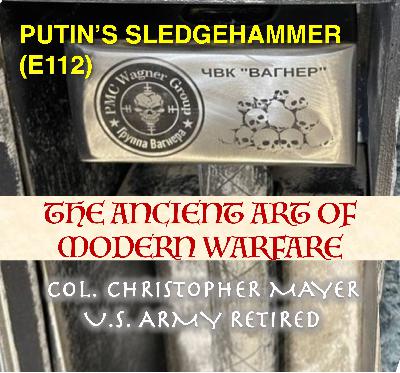
Putin’s Sledgehammer: The Wagner Group and Russia’s Collapse into Mercenary Chaos, by Professor Candace Rondeaux is a must read for anyone interested learning how Russia came to rely on mercenary-like organizations in its global strategy and how it has used them. This book is not just about Yevgeny Prigozhin and Wagner, not even about Russia's other quasi-mercenary actors. It is an excellent summary of how Russia has come to be what it is since the collapse of the Soviet Union. The opening section alone is worth the cover price of the book. This is an extensive who is who of Russian oligarchs, generals, and mercenaries. Putin’s Sledgehammer is not what one might consider a dry academic thesis. Professor Rondeaux tells this story better than any spy-thriller, better because it is true. Like most true stories, it seems more fantastical than any political fantasy. It tells why Russia intervened in Syria, Africa, Ukraine, and elsewhere, who are the players in developing that strategy, and how they implemented it. In shining the spotlight on Russia, the United States and the West in general is not let off the hook. The West did not simply stand aside while Russia pursued a global strategy through mercenary means. Western political leaders, however, made the mistake of thinking that Russia would turn away from its disruptive approach and accept the Western rules-based order if only given the proper incentives and sanctions. The West failed and continues to fail to understand Russia just as Russian leaders continue to misinterpret and misapply ways and means employed by the U.S. and its allies. In summary, Putin’s Sledgehammer is an outstanding single source for anyone interested in Russian imperial aspirations and the unconventional means it uses in pursuit of those goals.
References:
Rondeaux, C. (2025). Putin’s sledgehammer: The Wagner Group and Russia’s collapse into mercenary chaos (First edition). PublicAffairs.
The Ancient Art of Modern Warfare:
Episode 2: “What Are Russian Private Military Companies?” (2019)
Episode 4: “The Difference Between Russian Quasi-Mercenary Organizations and Western PMSCs” (2019)
Episode 6: “Meeting the Challenge” (2019)
Episodes 35-39: On Mercenary Warfare (2021)
Episode 54: “Russian Mercenaries” (2022)
Episode 63: “Why Wagner” (2023) (Which contains one guess that may have been true at the time, but was ultimately unreliable.)
Episode 75: “Wagner Decapitated?” (2023)
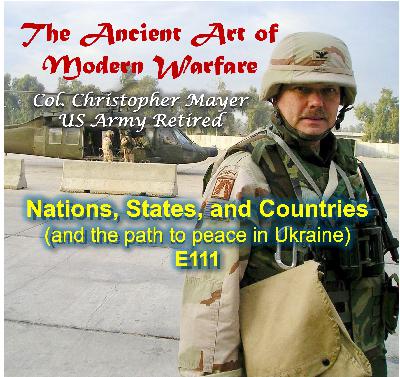
I am picking up my podcast series where I left off, addressing the challenges of peace. War is an act of violence among nations or states, affecting entire countries. These terms, nations, states, and countries are not synonymous. Confusing these terms leads to misunderstanding, misinterpretation, or can be used to create misperceptions. In this episode I try to clarify the difference among nations, states, and countries. Understanding the differences and relationships among these terms is important to analyzing the actual and claimed objectives of warring parties and to identify emotion driven propaganda that obstructs the path to peace.
The information in these podcasts represents only my own thoughts, and not those of any organization I am, or have ever been associated with. (Some of what I say may be completely opposed to official position of some of the organizations.)
Music:
Liszt, Les Preludes, perfomed by the USMC Band. Public Domain
Copland, A. & United States Marine Band. (2000) Fanfare for the Common Man. unpublished, Washington, DC. [Audio] Retrieved from the Library of Congress, (Fair use for educational purposes.)

Comments

Download from Google Play

Download from App Store
 United States