


 Claim Ownership
The Great Women Artists
Subscribed: 2,575Played: 73,711
Subscribe

© All rights reserved
Description
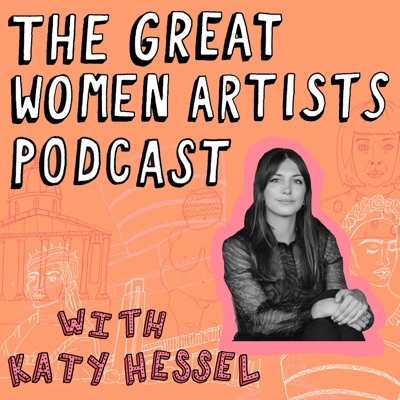
Created off the back of @thegreatwomenartists Instagram, this podcast is all about celebrating women artists. Presented by art historian and curator, Katy Hessel, this podcast interviews artists on their career, or curators, writers, or general art lovers, on the female artist who means the most to them.
186 Episodes
Reverse

TODAY on the GWA Podcast is curator and writer Lisa Le Feuvre, on the acclaimed land artist NANCY HOLT!
The curator of over 75 exhibitions, including Casting a Glance: Dancing with Smithson at Marian Goodman Gallery, and Joan Jonas: An Island Departure at Farnsworth Art Museum among many others, Lisa Le Feuvre is also the executive director of the Holt Smithson Foundation, where she dedicates her work to the two pioneers of twentieth century art, hailed for their site specific interventions in the land – Robert Smithson and Nancy Holt, the latter of whom we are very excitedly discussing today.
Born in 1938 in Massachusetts and raised in New Jersey, Holt worked for over five decades across poetry, photography, film, outdoor, public sculpture commissions, room-sized installations and more. Central to the group of artists living and working in New York City in the 1960s, Holt, with Smithson, ventured further afield to the great expansive desert of the American West, and it was here where she found her language. From her Sun Tunnel works, made up of concrete tubes, each oriented so that the sun pours through them on the summer and winter solstices, to Trail Markers, images that document her trails through the natural landscapes and ancient monuments of the UK. Holt, through her art, always thinks about how humans orient themselves or understand their place in the world, on both a macro and micro level. While she works with myriad materials, in a sense, her tools are light and space, language and the cosmos, as she consistently explores humanity's relationship to the earth. As she once said, “I feel the need to look at the sky, at the moon and the stars, is very basic, and it is inside all of us. So when I say my work is an exteriorization of my own inner reality, I mean, I am giving back to people through art what they already have in them.” And I can't wait to find out more.
Nancy Holt at Goodwood Art Foundation, until 1 Nov: www.goodwoodartfoundation.org/art/nancy-holt-2026/
THIS EPISODE IS GENEROUSLY SUPPORTED BY THE LEVETT COLLECTION: www.famm.com/en/ www.instagram.com/famm_mougins // www.merrellpublishers.com/9781858947037
Follow us: Katy Hessel: @thegreatwomenartists / @katy.hessel
Sound editing by Tory Pope
Co-produced with Molly Lafosse
Music by Ben Wetherfield
It's a new season of The Great Women Artists Podcast and we're kicking things off with the esteemed ceramicist and writer, Edmund de Waal!
Hailed for his ceramic works that come in the form of fragments, cylindrical pots, individually or collectively, or that use techniques such as the Japanese kinsugi - broken ceramics put back together with a gold liqueur to beautify its cracks and imperfections - de Waal has become one of the most renowned artists working in pots today. Speaking about his work, he has said, “my fantasy is that people will look at my pots and think: rigorous, yet passionate and humane.”
Born in 1964, de Waal grew up mostly in the deanery beside Canterbury Cathedral. He made his first pot aged five, glazing it in opalescent white, as he recalled, and aged seventeen, took an apprenticeship with the potter Geoffrey Whiting before travelling to Tokyo. Here he not only studied ceramics but became acquainted with his Uncle Iggy's collection of netsuke traditional miniature wood ivory carvings, which he uses as the starting point for his extraordinary family memoir, The Hare with Amber Eyes. In the nineties, he moved to London, shifting his focus from stoneware to porcelain, and experimented with objects from teapots, bottles and jugs. De Waal has since installed over four hundred vessels at the V&A in London, created a Library of Exile that brought together two thousand books from exiled writers that now lives in London's Warburg Institute, plus exhibitions and interventions at the Frick, the Huntington, the British Museum and, meaningfully, the Musée de Camondo on the Rue de Monceau in Paris, next to where his ancestors, the Ephrussi, lived.
Many might be familiar with de Waal’s pots, but his writing is just as brilliant. From writing imagined letters to Count Moise de Camondo, to his beautiful books The White Road and Archive. This autumn, Edmund will publish two more - How to Begin, a personal meditation of creative mentorship, and a second edition of The Pot Book, a global survey of ceramic craft and design, which includes unnamed Chinese artisans from the third millennium B.C. to contemporary artists like Theaster Gates. But more importantly for this conversation, Lucie Rie, the great Viennese born, London based potter, to whom we will deep dive for the second part of this episode. And I can't wait to find out more!
THIS EPISODE IS GENEROUSLY SUPPORTED BY THE LEVETT COLLECTION: www.famm.com/en/ www.instagram.com/famm_mougins // www.merrellpublishers.com/9781858947037
Follow us: Katy Hessel: @thegreatwomenartists / @katy.hessel
Sound editing by Tory Pope
Co-produced with Molly Lafosse
Music by Ben Wetherfield

TODAY on the GWA Podcast is the esteemed painter Joan Snyder. Hailed for her large-scale gestural canvases that pulsate with colour, line and text, and are often layered with, buried in, or imploded with images of flowers, faces, or bodies, Snyder's all-encompassing works are nothing but electric. Sometimes large scale, with brushstrokes that populate the canvas like gemstones or musical scores with a whole range of keys: look at Snyder's work for a while, and it's like whole worlds emerge. Simultaneously soft but violent, beautiful yet aggressive, her works can evoke every season of emotion, just as she once wrote in her journal in 1972: "The strokes in my painting speak of my life and experiences. They are sometimes soft, they sometimes laugh, and are often violent. They bleed and cry. I speak of love and anguish, of fear, and mostly of hope."
Born in 1940, Snyder came to art not straight away, but by chance during her studies at Rutgers University, when she was studying sociology in preparation for a career in social work. But it was under the mentorship of Billy Prichard that she pivoted to art, showing just how important teachers can be. Today we meet Joan in her Brooklyn studio, where she remains one of the legendary artists of her time. A recipient of a MacArthur Fellowship and an American Academy of Arts and Letters Award, and in museum collections all over the world, Snyder, at 85 – nearly 86 – is painting more than ever and this summer, will take to Paris for her upcoming show, Earthsongs at Thaddaeus Ropac Paris, and I cannot wait to find out more.
Joan Snyder: Earthsongs opens 6 June at Thaddeus Ropac Paris https://ropac.net/exhibitions/796-joan-snyder-earthsongs/
THIS EPISODE IS GENEROUSLY SUPPORTED BY THE LEVETT COLLECTION: www.famm.com/en/ www.instagram.com/famm_mougins // www.merrellpublishers.com/9781858947037
Follow us: Katy Hessel: @thegreatwomenartists / @katy.hessel
Sound editing by Tory Pope
Co-produced with Molly LaFosse
Music by Ben Wetherfield

TODAY on the GWA Podcast: a very special bonus episode with Lubaina Himid, on her British Council Commission for the British Pavilion at Venice Biennale 2026, "Presenting History: Testing Translation".
Returning to the podcast for the second time, Lubaina Himid is an acclaimed Lancashire-based artist working in paintings, sculpture, installations, archives, and more, whose career spans from the 1980s – when she was established as one of the leaders and trailblazers of Britain's Black Arts movement – to the 2020s, where she uses her art and her training in theatre to create all-encompassing works that tackle silenced histories. While you can go to episode 33 to hear a deep dive into Himid's life and work, today we are focusing on her pavilion for Great Britain at the 61st Venice Biennale!
An event that happens every two years, thought of as the most important space to showcase art and artists, the Venice Biennale revolves around a central exhibition, this year curated by the late Koyo Kouoh, titled "In Minor Keys", and is often a signifier to define not just what is happening in the world, but how we can understand it through art. The rest of the Biennale is made up of pavilions – think of it like the Olympics of art, whereby countries have exhibition spaces, nominating an artist to stage a show to compete for the gold medal equivalent, The Golden Lion.
For the British Pavilion this year Himid will showcase large multi-panel paintings drenched in her signature vibrant palette. In conversation with the British Pavilion's neoclassical architecture, the installation will present Britain as welcoming and airy, brimming with potential, albeit with an underlying sense of unease as the texts, images, and soundscape (made in collaboration with artist Magda Stawarska) subtly introduce tension. And I can't wait to find out more.
Lubaina Himid's British Council Commission for the British Pavilion at the Venice Biennale will run from the 9th of May to the 22nd of November, 2026, and is curated by Ese Onojeruo.
––
THIS EPISODE IS GENEROUSLY SUPPORTED BY THE LEVETT COLLECTION: www.famm.com/en/ www.instagram.com/famm_mougins // www.merrellpublishers.com/9781858947037
Follow us: Katy Hessel: @thegreatwomenartists / @katy.hessel
Sound editing by Mikaela Carmichael
Music by Ben Wetherfield
TODAY on the GWA Podcast: esteemed art historian Briony Fer on the avant-garde icon, Sophie Taeuber-Arp.
The Professor of History of Art at University College London and a Fellow of the British Academy, Briony Fer is one of the leading art historians in the world. Writing and publishing extensively on modern and contemporary art, specialising in the history of abstraction in the 20th century, Fer has curated monumental exhibitions on artists such as Anni Albers at the Tate Modern, Louise Bourgeois at the National Museum, Oslo, Eva Hesse at the Fruitmarket, Mel Bochner at Whitechapel, and more
But the reason we are speaking with Fer today is because she has also just curated an exhibition “Sophie Taeuber-Arp: The Rule of Curves” at Hauser & Wirth Paris, and published a stunning book on the great artist, dancer, performer, puppet maker, bag weaver, teacher, stained-glass maker, sculptor, architect, and so much more, Sophie Taeuber-Arp…
Born in Switzerland in 1889, Taeuber-Arp is famously associated with the Dada movement, a group of artists who formed post-devastation of World War I to make sense of a nonsensical world. Performing dance routines set to Hugo Ball poetry and turning to her geometric abstractions, full of explosions of colour, that can look equally mechanical as they are made with a human hand – as Fer writes, "diagrammatic and decorative” – Taebuer-Arp was at the forefront of modernism, conjuring new ways of working with form and colour, and exploring – and twisting – the grid, the icon of modern art, for the modern world - and I can’t wait to find out more.
The book: https://shop.hauserwirth.com/products/sophie-taeuber-arp-la-regle-des-courbes-the-rule-of-curves
THIS EPISODE IS GENEROUSLY SUPPORTED BY THE LEVETT COLLECTION: www.famm.com/en/ www.instagram.com/famm_mougins // www.merrellpublishers.com/9781858947037
Follow us: Katy Hessel: @thegreatwomenartists / @katy.hessel
Sound editing by Mikaela Carmichael
Music by Ben Wetherfield

Comments

Download from Google Play

Download from App Store
 United States