


 Claim Ownership
Attention — Audio Journal for Architecture
Subscribed: 102Played: 385
Subscribe

© 2026 Attention — Audio Journal for Architecture, Architecture Exchange
Description
Attention is an audio journal for architectural culture that uses the medium of sound and spoken word to capture a dimension of architecture otherwise lost in print. By precluding visual media, Attention strikes a distance between the distraction economy of much online media, creating an intimate and reflective space for the in-depth development of ideas and issues. Through interviews, roundtable debates, oral histories, field recordings, the exploration of archival recordings, experimental music and soundscapes, reportage and audio essays, Attention investigates issues of concern to contemporary architectural culture, theory and practice.
64 Episodes
Reverse
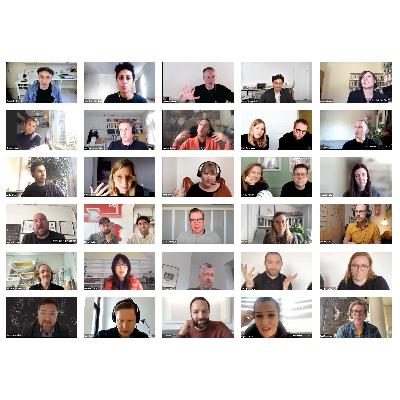
In this episode, titled “Pluralism is Not Enough,” Joseph Bedford offers some provisional thoughts interpreting the situation of this generation of academic architects in the United States. He argues that, in contrast to previous generations concerned with the digital and pragmatism, this generation has reasserted architecture’s cultural, critical and disciplinary autonomy. Yet he also argues that this generation needs to reassert architecture’s relationship to a broad ideological field, beyond merely the single ideology of pluralism alone, in order to ensure that architecture as a cultural enterprise remains truly political and to enable the discipline to continue to advance.
In this episode, Tim Cox reflects on this issue of attention, and reads the aesthetic and ideological output of the interviewees as in conversation with the discipline of architecture’s waning cultural authority. He argues that this generation’s adoption of pluralistic language is a response to contemporary labor conditions in the neoliberal university, and questions what power architects and academics can legitimately exert over our built environment.
In this episode we hear from this generation on their experience with building practice in contemporary America. The cohort is focused on moving away from speculative or gallery work and towards substantial built projects, but they describe the challenges in getting a small, academic building practice off the ground. They highlight the ways that academic bona fides no longer translate to meaningful commissions. Whereas prior generations were rewarded for their disciplinary mastery, they find themselves lacking professional expertise, competing against more resourced corporate firms, and feeling that their perspective as designers is no longer valuable to clients.
In this episode we address the affordances and constraints of architectural academia. This generation highlights the important freedom academia provides to work through ideas that are not directly applicable to architecture as a service industry, but they also acknowledge the ways that labor structures like the tenure track process, or fellowships, push designers towards exhibitions, installations, competitions, and speculative work instead of a building practice. The group also comments on how the broader context of higher education in America, it’s neoliberalization and ballooning tuition costs, impacts architectural academia as a space of learning and a space of architectural production.
In this episode, we heard this generation struggle with their ambivalence around the discipline of architecture, which they saw as essential for maintaining a shared conversation, but also as exclusionary, politically suspect, and frequently irrelevant to the broader world. There was consensus around a need to expand the discipline, returning to this generation’s political and ideological commitments to liberal pluralism. Excitement around the changing discipline, especially in pedagogical contexts, went hand in hand with anxiety around maintaining architectural expertise, whatever that may be.
In this episode, our discussion of contemporary architectural theory is framed by the question of why there is no contemporary discipline-defining book of theory like Delirious New York, Complexity and Contradiction, or Animate Form. This generation explains the myriad reasons why this is the case, from their professional priorities, critiques of singular authors, the rise of the internet, the professionalization of writing about architecture, and their simple lack of interest. The group also discusses the theorization that does exist today, and their own approach to writing.
In this episode, we hear about the lack of ideological debate and disagreement within contemporary academic architectural culture. This generation airs their critiques of the performative, chauvinistic, binary debates of the past and argue instead for a pluralistic approach to ideology, where the approaches of varying practitioners can coexist without producing conflict. The merits of this approach remain an open question. This group emphasized how pluralism foregrounds diversity and inclusion, while others saw the ideological attitude as problematically apolitical, aligned with the incentives of social media, unable to push design forward, or complicit with the status quo of the market.
In this episode, we address the political context of the interviews: the after effects of 2020’s COVID-19 pandemic and George Floyd uprisings. This moment produced a politicizing discourse within architecture which asked academics to address politics through pedagogy, aesthetics, and labor practices. Despite a shared feeling that the political concerns of the moment were critical, there was anxiety and ambiguity around how architecture could represent, or be instrumental for, progressive politics.
In this episode, we hear about the difficulty of constructing coherent aesthetic camps in this generation, exemplified by responses to Michael Meredith’s “Indifference, Again” (2017). Instead, we list a range of aesthetic keywords that this generation identified as representing areas of interest: formlessness, informality, discrete parts, messiness, crudeness, simple construction, and familiar forms. The group discusses the importance of tooling one’s aesthetics to an audience outside of architectural academia, and question what authorship looks like today
In this episode we hear from this generation on their relationship to the digital. They discuss broad, societal experiences like watching the internet and social media emerge, and they grapple with the broken promises of connection and progress that these technologies once represented. Within architectural culture, they unpack their relationship to digital tools for design and fabrication, and outline why they have rejected parametricism for a less instrumental and more critical adoption of technology— a position described as post-digital.
In this episode we trace the genealogies of this generation through academic lineages, their movements through the geography of American Academia, and the post-critical or projective discourses which defined much of their time as students.
In this introduction we hear from Joseph Bedford addressing what this issue is about, who he interviewed, what their work is about, what questions he asked everyone, why he undertook the project, and how his interests in this generation intersect with his larger interest in the fate and future of theory, and the understanding of architecture as a discipline.
In this episode we hear from the group of American academic architects that has been brought together by this issue of attention. The group pushes back against their characterization as a generation, though there are throughlines in the group— namely their responses to the digital project, the crash of 2008, and their individual, pluralized approaches to architecture.
In this episode, Megan Eardley interviews the artist, puzzle-maker, and escape room designer Laura E. Hall about the design of escape rooms for the public, building community, and the politics of play. Together, they reflect on the popular appeal of detective work in an era of corporate dragnet surveillance.
In this episode, Megan Eardley interviews the investigative journalist and veteran beat reporter Caryn Dolley about the use of biometric and building surveillance devices in organized crime networks. With reference to her journalism and research for her book “The Enforcers” (2019), Dolley describes the movement of illicit and counterfeit goods through night clubs and the duplication of the state security apparatus in post-Apartheid South Africa.
In this episode, Megan Eardley introduces Issue 7 by relating contemporary spatial practices to the literary detective story and present day political realities of surveillance, state violence, and justice work.
Like proof, evidence typically refers to things, traces, marks, or signs, that can be studied to establish relevant facts and evaluate competing theories. But while proof has been associated with tests and verification procedures since the thirteenth century, evidence (or the Latin evidentia) refers to something that is “manifest to the senses” and “obvious”– there in a way that is not subject to dispute. To examine evidence is thus to contend with the politics of presence, practices of display, and conditions of access. In this episode, Megan Eardley discusses these concerns with Eyal Weizman, who is a critical proponent for forensic research in architecture today.
In this episode, Megan Eardley invites listeners to reflect on the way that detective work operates between form and event. She interviews the artist Janice Kerbel about the use of detective work in pieces such as “Bank Job” (1999), “Doug” (2014), and “Sink” (2018). They discuss how detection can be built into form, Kerbel’s experiments using plans to foreclose events, her relationship to language and writing, and how she seeks to reclaim small spaces within which we can act freely.
In this episode, Megan Eardley interviews the writer and artist Bryan Finoki. He describes how he came to study the security industry and reflects on his process of harvesting his own field recordings, synthesized sounds, and files scraped off the web, to make Dark Freqs, an original sound composition produced for Attention and this issue on Detective Work.
This episode presents Dark Freqs, an original sound piece by Bryan Finoki. Please note that the piece incorporates recordings of police brutality.

Comments

Download from Google Play

Download from App Store
 United States