Discover
Sidewalk Talk
Sidewalk Talk
Author: Traci Ruble
Subscribed: 20Played: 1,021Subscribe
Share
© Copyright Sidewalk Talk, 2025 All rights reserved.
Description
In 2015 one woman decided to sit on a sidewalk to listen to strangers to understand what was making us sick, lonely, and divided. Today over 8000 people join Traci Ruble in their endeavor to cultivate their own heart-centered listening in a world that values talking at, fixing, advice giving, and therapizing.
Listen in as Traci talks to all different kinds of people and practice listening with heart and you hear the podcast.
To join, you can visit www.sidewalk-talk.org
Listen in as Traci talks to all different kinds of people and practice listening with heart and you hear the podcast.
To join, you can visit www.sidewalk-talk.org
106 Episodes
Reverse
How might sweeping shifts in both religion and medicine in the nineteenth-century impact a wide array of things we face today like loneliness and racism? When the mind began ruling over the body we saw society shift and loneliness, racism, and mental illness rise.
Dr. Fay Bound Alberti is a cultural historian, writer, and UKRI future leader’s fellow who studies the history of medicine and the human body. Her books include Matters of the Heart, The History of Medicine and Emotion, This Mortal Coil, the Human Body in History and Culture, A Biography of Loneliness The History of an Emotion.
Listen in as Dr. Bound Alberti finds a glimmer of hope in what feel like hopeless times. She pinpoints the exact moments in which we started to separate body, mind, and spirit and how it ushered in the world that we now have. She plants seeds of possibility that Covid-19 just might reconnect our bodies, minds, and spirits in a way that could usher in the social transformation that could end discrimination and loneliness and improve our health. The key, she says, is the body.
Episode Timeline:
[00:09] Intro
[01:21] Meet Dr. Fay Bound Alberti
[03:16] -Emotions and relationships
[04:32] History of Separating The Mind And The Body
[07:14] The need for structural change and social change
[13:45] Covid-19 Destigmatizing Loneliness
[17:05] Shared meaning as a barrier against loneliness
[22:20] Psychotherapy Being Limited By Insurers
[23:16] -The body as the solution
[23:52] Medicalized approaches to loneliness
[30:35] Loneliness and prejudice
[35:58] Dr. Fay Bound Alberti’s Wish To Listeners
[37:43] - Outro
Resources Mentioned:
Book: Matters of The Heart: History, Medicine, and Emotion
Book: This Mortal Coil: The Human Body In History and Culture
Book: A Biography of Loneliness: The History of an Emotion
UKRI Future Leaders
Standout Quotes:
Loneliness is being created and induced by our sensory experiences. [24:46] - Dr. Fay Bound-Alberti
“Where people feel connected to others, either spiritually or even in a secular sense through environmentalism or movements or networks that make people feel imaginatively connected to some world outside of their own. I think that's that provides a barrier against loneliness.” [16:51] - Dr. Fay Bound-Alberti
“One of the most important things for me about studying the history of medicine in the history of emotion is the ways in which some of the things that are entrenched in our society around racism, around sexism, around gender difference, they're rooted in what we think about the body, what we think about identity, what a person is capable of. And a lot of those ideas that were developed in the 19th century have not been sufficiently challenged.” [32:41] - Dr. Fay Bound-Alberti
Did you know that you can use your breath to activate your body and become more receptive? In this episode, Traci will have an in-depth conversation with Jamie on the breathing room and the power of a pause.
Jamie McHugh is a somatic movement specialist, a multidisciplinary artist, and a fine art photographer. He lives on the Mendocino coast of California. Listen in as Jamie shares his journey into becoming the person he is today, and he will give some essential pieces of information that we all can take home to make the world a better place for all of us.
Episode Timeline
[00:09] Intro
[01:01] Meet Jamie
[07:55] Traci’s first encounter with Jamie
[11:13] Jamie’s photography and how it is serving the community
[15:42] Grounding and centering
[19:55] The play impulse
[21:36] Reclaiming your birthright
[26:50] The mystery and power of breathing
[40:14] Reclaiming the breath for you and the world
[46:26] Jamie’s nuggets of Wisdom
[48:23] Outtro
Standout Quotes
“ Let your consciousness really focus as much as you like. When you're ready to just let it wander, and that rhythm of condensing and expanding is, for me just part of the rhythm of life.”Jamie McHugh [13:22]
“The planet is a creative process that is emerging and has so much variation. In a way, as human beings as members of the planet, not independent of the planet, but members of the planet, we have that same capacity to explore and experience all of these kinds of sensory-motor delights when we just give over to gravity.”-Jamie McHugh[18:19]
“ There is more to us than our pain and suffering at any one moment.”- Jamie McHugh [23:25]
“If you have at least 20 different ways to breathe, you can meet varying challenges.” -Jamie McHugh [27:22]
Resources Mentioned
Anna Halprin
Tamalpa Institute
Bonnie Bainbridge Cohen
Emilie Conrad
Breathing Room Events With Jamie McHugh
Connect:
Find | Sidewalk Talk Podcast
At sidewalk-talk.org
On Instagram: @sidewalktalkorg
On Twitter: @sidewalktalkorg
Find | Traci Ruble
At Traciruble.com
On Instagram: @TraciRubleMFT
On Twitter: @TraciRubleMFT
On Facebook: @TraciRubleMFT
Find | Jamie McHugh
At www.somaticexpression.com
www.NatureBeingArt.org
SUBSCRIBE TO THIS PODCAST
On Spotify
On Apple Podcasts
On Google Podcasts
On Spotify
When it comes to privilege- knowing the difference between righteous and self-righteous speech can make all the difference when you’re communicating what's in your heart.
Today, I’m joined by Parker Palmer— nationally recognized educator, author and social change activist. He shares his thoughts on white privilege and how it can inhibit our connections when left unconfessed. We discuss the work of Ibram Kendi and explore what it means to be an anti-racist.
Episode Timeline:
[00:09] Intro
[00:58] Meet Parker Palmer
[02:18] His passion for connection
[03:31] Parker’s recent projects and new book
[06:22] Being selective about his time and energy
[07:50] Connecting across racial lines
[11:54] Post 2016 elections- have things gotten worse?
[14:15] White privilege and how we indict ourselves
[21:03] Ibram Kendi’s thoughts on racism
[22:14] White supremacy comes in many forms
[27:25] Inevitable mistakes in our efforts to be anti-racist
[30:31] Collaboration and power
[36:39] Parker Palmer's advice for you
[39:43] Outro
Resources Mentioned:
The Center for Courage and Renewal
On the Brink of Everything by Parker Palmer
Let Your Life Speak by Parker Palmer
A Hidden Wholeness by Parker Palmer
How to Be an Antiracist by Ibram X. Kendi
Standout Quotes:
“We must take this impulse to be connected and use it to connect across those lines because that's where the learning is. That's where the juice is.” - Parker Palmer [11:36]
“We have to have not only conversation, and which includes listening and speaking across racial lines or other lines of divide. We need to have conversations within our own tribe.” - Parker Palmer [19:40]
“My work, our work the Center for Courage and Renewal's work is, is the kind of conversation where people can listen at a level of depth where they suddenly find themselves saying, whoa, I, this other person is talking about themselves, but I just learned something about myself. And that those are precious, precious conversations.” - Parker Palmer [27:00]
“We miscalculate how we come into power... Power is not something that we hold as individuals. Power is something that we generate collectively as all of the great social movements have proven.“ - Parker Palmer [32:26]
“I think one of the greatest wounds that we find around the Earth is people who feel unseen, unheard and unappreciated. That's a very painful life to live. You know, ‘here I am. Nobody sees me, nobody hears me, nobody appreciates what I do,’ and there are millions, millions and millions of people who show up every day and to all kinds of settings who have that. - Parker Palmer [34:22]
Connect:
Find | Sidewalk Talk Podcast
At sidewalk-talk.org
On Instagram: @sidewalktalkorg
On Twitter: @sidewalktalkorg
Find | Traci Ruble
At Traciruble.com
On Instagram: @TraciRubleMFT
On Twitter: @TraciRubleMFT
On Facebook: @TraciRubleMFT
Find | Parker Palmer
At Couragerenewal.org
On Twitter: @parkerjpalmer
On Facebook: @parkerjpalmer
SUBSCRIBE TO THIS PODCAST
On Spotify
On Apple Podcasts
On Google Podcasts
On Spotify
Stand Out Quotes:
We, as adults, have to take responsibility for teaching kids emotional skills. Children who know how to use their feelings wisely are healthier, happier and they are better learners.
We have to give the people we care about permission to feel and express all of their emotions. Emotions are data to help us make better choices in life.
We all overestimate our ability to read another person's feelings.
Biography:
Marc Brackett, Ph.D., is founding director of the Yale Center for Emotional Intelligence and professor in the Child Study Center, Yale School of Medicine at Yale University. His grant-funded research focuses on: (1) the role of emotions and emotional intelligence in learning, decision making, creativity, relationship quality, and mental health; (2) the measurement of emotional intelligence; and (3) the influences of emotional intelligence training on children’s and adults’ health, performance, and workplace performance and climate. Marc has published 125 scholarly articles and has received numerous awards, including the Joseph E. Zins Award for his research on social and emotional learning and an honorary doctorate from Manhattanville College. He also is a distinguished scientist on the National Commission on Social, Emotional, and Academic Development and on the board of directors for the Collaborative for Academic, Social, and Emotional Learning (CASEL).
Marc is the lead developer of RULER, a systemic, evidence-based approach to social and emotional learning that has been adopted by over 2,000 public, charter, and private pre-school through high schools across the United States and in other countries, including Australia, China, England, Italy, Mexico, and Spain. RULER infuses social and emotion learning into the immune system of schools by enhancing how school administrators lead, educators teach, students learn, and families parent. Research shows that RULER boosts academic performance, decreases school problems like bullying, enriches classroom climates, reduces teacher stress and burnout, and enhances teacher instructional practices. Marc is the author of Permission to Feel (Celadon/Macmillan), which will be released in September of 2019.
Show Notes:
In this episode, Dr. Brackett is committed to teaching emotional intelligence as you can hear it deeply touches his own personal story of being bullied in school. He does not create a cheesy "fix it all" mentality to teaching emotional intelligence. Instead, his work is thoughtful, research-backed, and he is calling us all in to do better in understanding our own feelings so we can then understand the feelings of others.
What makes Marc unique is his own willingness to share his vulnerable story, to challenge institutions with grace, and his understanding of social injustices that may not afford some kids and schools the support they need to teach emotional intelligence.
Follow along as you learn about Ruler. And apply it in your own life. This is definitely a book you will want to get and share with your kids, colleagues at work, and in any workplace where you currently live. We need to give each other permission to feel and stop sending the "get over it" or "quit being so emotional" message that is deeply harmful to us humans.
Episode Summary:
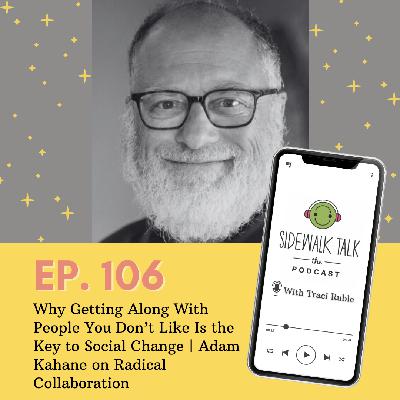
What if learning to collaborate with people you don’t trust—or even like—wasn’t revolutionary, but just healthy adulting?
In this episode of The Sidewalk Talk Podcast, Traci Ruble sits down with renowned facilitator and author Adam Kahane, known for guiding some of the world’s most complex social change efforts. Drawing from his influential books Power and Love and Collaborating with the Enemy, Adam invites us to rethink what it means to stay in dialogue across difference.
From attachment theory to political polarization, this conversation unpacks why radical engagement, abiding presence, and cohabitating with difference are essential relational muscles for our time. Adam also shares stories from the field and reminds us why walking and talking might be more powerful than we think.
If you’ve ever wondered how to work with people you disagree with—without giving up your integrity—this conversation is for you.
Timestamps:
00:00 – Welcome to Sidewalk Talk
01:07 – Meet Adam Kahane: Global facilitator, author, bridge-builder
04:13 – Adam’s surprising journey into conflict transformation
06:34 – Talking, listening, and the root of human connection
09:12 – What it takes to facilitate across divides
15:04 – Why connection is more powerful than persuasion
17:18 – Walking + talking = underrated healing tools
22:52 – Growth through pauses and discomfort
23:38 – The overlooked wisdom of cohabitation
25:38 – Adulting 101: Working with people we disagree with
27:18 – The dance between conflict and care
28:07 – “Abiding” and staying with the tension
29:39 – Attachment theory, differentiation, and dialogue
30:48 – Power, love, justice—and learning to hold all three
33:10 – What gets in the way of true collaboration
42:55 – Why radical engagement is the future
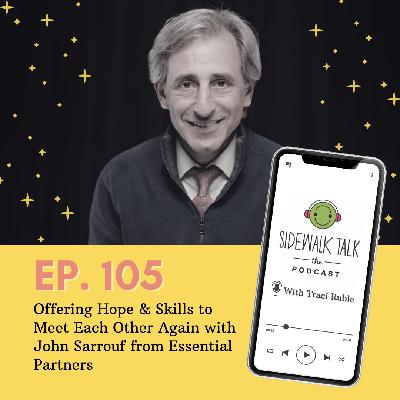
In this heartfelt conversation, Traci Ruble, founder of Sidewalk Talk, sits down with John Sarrouf, co-executive director of Essential Partners, to explore the deeper threads of human connection and the transformative power of dialogue across our differences. Together, they delve into what it truly takes to create genuinely safe spaces where conversations don’t just happen—they flourish. With over two decades of experience facilitating courageous dialogues and mediating complex conflicts, John generously shares insights on how deep and authentic listening can heal societal divides and enrich personal relationships. Tune in for practical, soulful strategies to engage in conversations that open hearts, expand understanding, and remind us of our shared humanity.
Essential Partners has been at the forefront of bridging divides for over 35 years. They offer trainings, free dialogue guidebooks, and workshops focused on listening across political divides, racial divides, conversations around the war in the Middle East, and more.
John Sarrouf is co-executive director at Essential Partners, helping people talk about tough topics—and stay connected while doing it. Over two decades, he's skillfully guided dialogues around the role of guns in American life, police and the Black community, Israel-Palestine, Muslim-Jewish interfaith relations, human sexuality in the Christian church, and racial and ethnic diversity. John has supported independent dialogue programs at universities, museums, and civic groups across the U.S., sparking meaningful conversations nationwide.
With a master's in dispute resolution from UMass Boston, John co-founded the Peace and Conflict Studies program at Gordon College and teaches reconciliation at the European Center for the Study of War and Peace in Zagreb, Croatia.
Episode Timeline
00:00 Welcome to Sidewalk Talk
00:47 Meet John Sarrouf of Essential Partners
04:56 Unpacking Assumptions in Conflict
09:39 Vigilance and the Cost of Polarization
12:54 How to Create Authentic Connections
17:00 Inside the Essential Partners Dialogue
22:13 Reflecting Together on Shared Wisdom
22:29 Humanizing Each Other Through Dialogue
22:59 Embracing Complexity in Conflict
24:03 Why Feeling Seen Matters
24:39 How to Have Constructive Conversations
25:56 The Art of Generous Listening
33:57 Navigating Power with Sensitivity
38:23 Finding Hope in Reconciliation
40:25 Closing Reflections and Gratitude
Standout Quotes
We make assumptions rather than asking questions and listening deeply to the answer. (John)
I really wonder if this polarization and this threat thing is contributing massively to our loneliness. (Traci)
… it does feel like we are in a time when sharing our full selves with people feels dangerous. (John)
We may be political adversaries in this particular moment, but we have to be thinking of ourselves as neighbors. And I have to care what, what the impact is on you. (John)
Despair is our common enemy. Despair will keep us from each other. And our only way through this moment is with the sense of hope that we can meet each other again. (John)
Connect:
Find | John Sarrouf
At whatisessential.org
On Instagram: @essentialpartners
On YouTube: @essentialpartners
On Facebook: @essentialpartners
On LinkedIn: @JohnSarrouf
Find | Sidewalk Talk
At sidewalk-talk.org
On Instagram: @sidewalktalkorg
On YouTube: @sidewalktalkorg
On Facebook: @Sidewalktalksf
On LinkedIn: @SidewalkTalkOrg
Find | Traci Ruble
At Traciruble.com
On Instagram: @TraciRubleMFT
On YouTube: @TraciRubleMFT
On Substack: @RelatingWell
On Facebook: @TraciRubleMFT
SUBSCRIBE TO THIS PODCAST
On Apple Podcasts
On Google Podcasts
On Spotify
On YouTube
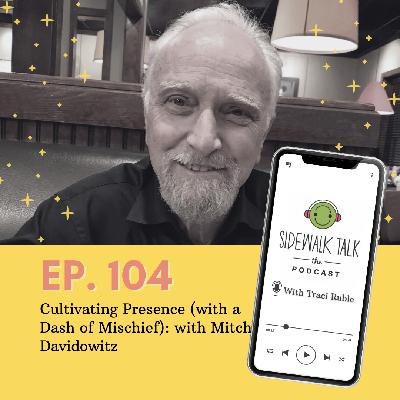
Cultivating Presence (with a Dash of Mischief): A Conversation with Mitch Davidowitz
In this episode, Traci Ruble, founder of Sidewalk Talk, sits down with longtime therapist and Vipassana practitioner Mitch Davidowitz to explore something that feels harder than ever: being present. Together, they wander into the heart of what it means to show up—truly and fully—for ourselves and others.
Mitch brings decades of wisdom wrapped in humility, humor, and a touch of rascal spirit. The two dig into the medicine of deep listening, the rebellious act of slowing down, and why love and compassion aren’t just soft concepts—they're radical practices in a fractured world.
This conversation is part invitation, part provocation: What if staying present is the real revolution? What if mischief is a doorway to wisdom? And what if, in this wild world, just being someone who cares deeply is a contribution worth being proud of?
About Mitch Davidowitz
Mitch Davidowitz, MSW, M.Ed, Ed.S. is a psychotherapist, writer, photographer and inspirational teacher known globally. His work is a confluence of his decades of intensive mindfulness training and being a clinician for the past 45 years. Mitch has trained healthcare and mental health professionals around the United States in the compassionate care of those facing loss since 1984. Mitch has appeared on radio and television to provide education about the challenges that mourners and those supporting them experience.
He is currently in private practice outside of Boston, Massachusetts seeing clients nationally and globally with a wide range of issues. His approach is diverse and deeply informed by his mindfulness training.
In addition to his clinical background, Mitch began intensive retreat practice in Vipassana meditation in 1974 with Anagarika Sujata. He continued these trainings extensively with Jack Kornfield, Joseph Goldstein and Sharon Salzberg. Baba Ram Dass was also one of his primary teachers.
Episode Timeline
00:00 Introduction to Sidewalk Talk
01:04 Meet Mitch Davidowitz: Therapist and Vipasana Practitioner
04:08 The Journey to Heart-Centeredness
08:05 Love, Compassion, and Advocacy
16:58 The Power of Discipline and Meditation
21:53 The Changing Landscape of Human Suffering
25:19 Rising Anxiety and Insecurity
26:24 Guilt and Happiness Amidst Suffering
27:49 The Power of Small Acts
29:30 Introducing Playfulness and Mischief
31:03 Therapeutic Approaches and Personal Growth
36:25 The Importance of Listening
38:53 Reflections and Future Plans
45:00 Closing Thoughts and Encouragement
Standout Quotes
One can be very fierce and very strong from a place of empathy. (Mitch)
It's not that I spend my days lighting candles and sticks of incense. It's not that we don't get annoyed. But we look and see what leads to well-being. What leads to contraction? What leads to openness and connectednes,s and what leads to estrangement?
That doesn't mean not confronting people with things that are not right, you know?
It's not indifference. But it's not reactivity.
It takes a lot more strength and power to stand down and sit up and invite someone to share with you how they came to their thoughts and beliefs.
Joseph Goldstein, one of my mindfulness teachers, said just assuming the position every day at the same time awakens those mind states that we're trying to cultivate.
People are more afraid, people feel more vulnerable, and so what happens is that that is setting off and triggering other things that have happened that made them feel unsafe.
We can't save the world, but we can save the moment. We can show up in a way that restores this sense of belief in each other, of the fundamental goodness of humanity. Even though there's so much darkness, we do need to remind each other about hope and restoring the belief that good people are here available.
help bring down the suffering on the planet.
I'm helping people not to take themselves so seriously.
Carl Jung said, Know all the theories, master all the techniques, but when sitting with someone who's a human soul, just be another human soul.
Connect:
Find | Mitch Davidowitz
On LinkedIn: @MitchDavidowitz
Facebook @MitchDavidowitz
Find | Sidewalk Talk
At sidewalk-talk.org
On Instagram: @sidewalktalkorg
On Twitter: @sidewalktalkorg
On Facebook: @Sidewalktalksf
On LinkedIn: @SidewalkTalkOrg
Find | Traci Ruble
At Traciruble.com
On Instagram: @TraciRubleMFT
On Twitter: @TraciRubleMFT
On Facebook: @TraciRubleMFT
SUBSCRIBE TO THIS PODCAST
On Apple Podcasts
On Google Podcasts
On Spotify
On YouTube
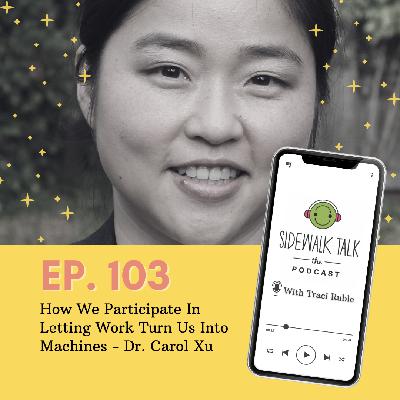
In this episode of the Sidewalk Talk podcast, host and founder Traci Ruble speaks with Dr. Carol Xu, who holds a PhD in management science and engineering from Stanford University, about the intricacies of human connection. They explore Carol’s expertise in cross-cultural communication and management, her personal journey through burnout and depression, and the innovative practices she employs to foster creativity and resilience in organizations.
Their conversation covers a range of topics, from the impact of T-groups on interpersonal communication to the challenges of maintaining humanizing practices within organizational structures. Carol highlights the importance of grounding, intentional listening, and striking a balance between emergent strategies and structured plans to sustain meaningful connections—both personally and professionally.
Episode Timeline
00:00 Introduction to Sidewalk Talk
01:04 Revisiting Conversations: Tracy's Experience
01:28 Meet Carol Hsu: Cross-Cultural Communication Expert
05:52 Carol's Journey: From Academia to Burnout
09:24 The Importance of Human Connection in Organizations
14:08 Balancing Growth and Humanization in Organizations
20:31 Emergent Strategies and Human Awareness
26:32 Humanizing the Workplace
28:36 The Role of Power in Hierarchies
32:04 Understanding Liminal Space
35:22 Communication Dojo and T Groups
38:39 The Importance of Foundational Layer
45:46 Final Thoughts and Gratitude
Resources Mentioned
https://www.presentofwork.com/
https://www.presentofwork.com/relational-agility
Standout Quotes
“ That humility is really important. Like sometimes just admit that. Hey, we don't know what we're doing.” (Carol)
“ Once an organization is big enough, and then once it wants to control some things, and thenit starts a metric system and then it starts measuring people. Once you do that, people will tend to switch off their internal kind of sensibility and awareness, and then they try to fit that mode.” (Carol)
“ Oftentimes what's easily measured is actually not the underlying thing you want. ” (Carol)
“ The symbolism of that story is so fascinating. You're saying if we mechanize ourselves, we die.”(Traci)
“Empower people to tap into, to really tap into the overlap between the personal and organizational. ” (Carol)
“ In some ways, we have a tendency as humans to turn ourselves into a machine. We have a tendency to take things for granted. It doesn't matter if it's at the workplace or at the house, at the home front.” (Carol)
“ Efficiency, has a place. However, it also can easily get abused. And I think in today's societies, a lot of places that doesn't really need a hierarchy, has hierarchy just because people don't really have any other alternative models.” (Carol)
“If you're using oppression to fight oppression, you're on the wrong track.” (Traci)
Connect:
Find | Sidewalk Talk
At sidewalk-talk.org
On Instagram: @sidewalktalkorg
On Twitter: @sidewalktalkorg
Find | Traci Ruble
At Traciruble.com
On Instagram: @TraciRubleMFT
On Twitter: @TraciRubleMFT
On Facebook: @TraciRubleMFT
Find | Dr. Carol Xu
At www.presentofwork.com
On LinkedIn: @jiacarolxu
SUBSCRIBE TO THIS PODCAST
On Apple Podcasts
On Google Podcasts
On Spotify
On YouTube
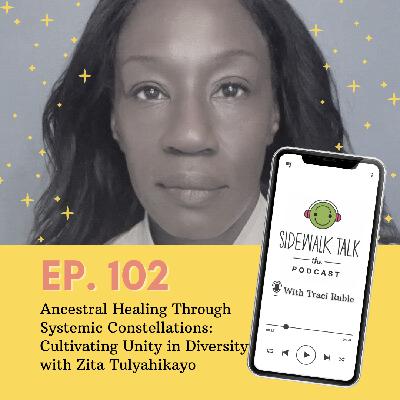
Ancestral Healing Through Systemic Constellations: Cultivating Unity in Diversity with Zita Tulyahikayo
In this episode of the Sidewalk Talk Podcast, host Traci Ruble interviews Zita Tulyahikayo, a clinical hypnotherapist, and systemic coach, about the profound impact of systemic family constellations. They discuss the importance of understanding one's ancestral roots and the transformative power of non-verbal, empathetic connection. They highlight upcoming initiatives like the Listening Bus Tour and share personal stories of healing and clarity through constellations' work, all while challenging conventional views on unity, diversity, and personal growth.
00:00 Introduction to Sidewalk Talk
01:16 Meet Our Guest: Zita Tule Hikayo
02:25 Upcoming Listening Bus Tour
04:21 Zita's Background and Expertise
07:35 The Importance of Ancestral Connections
12:01 Understanding Systemic Family Constellations
21:27 Personal Stories and Transformations
30:05 Memories of Sugarcane Fields
30:49 Ancestral Connection and Gratitude
33:17 Journey to Peru with Mother
34:40 Personal Reflections and Warrior Lineage
36:36 Systemic Constellations and Family Dynamics
39:14 The Complexity of Unity and Diversity
43:30 The Brutal and Beautiful World
46:31 Purpose and Passion in Life
52:24 Final Reflections and Farewell
Resources Mentioned
Zita’s Substack
The Lawyer (Magazine)
Standout Quotes
We know now that genetic information and memories are stored and passed through us. So the, the cells that would become me were in my mother when my mother was in my grandmother's womb. (Zita)
I always say you have a close bond with people who you meet as friends. But usually if you had the chance to look in the past, you'd find that you were distant relatives. And often we're more genetically closely related to our friends than we are to our actual family members. (Zita)
I think, our strongest muscle, empathy, our capacity to empathize or feel. information in our body, which then gets transmitted into meaning which we turn into words. (Zita)
We're all in trances all the time. My job work is waking people up out of trances that don't really suit them very well. And putting them into a better trance, which supports their, you know, growth and learning…(Zita)
What Constellations does is it gives you another aspect or two or three or four of the story so you have a fuller picture and with the fuller picture, the truth, which was once just your truth. (Zita)
Connect:
Find | Sidewalk Talk
At sidewalk-talk.org
On Instagram: @sidewalktalkorg
On Twitter: @sidewalktalkorg
Find | Traci Ruble
At Traciruble.com
On Instagram: @TraciRubleMFT
On Twitter: @TraciRubleMFT
On Facebook: @TraciRubleMFT
Find | Zita Tulyahikayo
At www.lifetherapywithzita.com
On Instagram: @life_therapy_withzita
On LinkedIn: @ZitaTulyahikayoFRSA
On Twitter: @LifeTherapyZita
SUBSCRIBE TO THIS PODCAST
On Apple Podcasts
On Google Podcasts
On Spotify
On YouTube
Redefining Friendship and True Curiosity (Mixed With A Lot of Laughter) with Dr. Todd Kashdan
In this most laugh-filled episode of all time, Traci sits down with Dr. Todd Kashdan, author of The Art of Insubordination and one of the world’s leading voices in well-being, curiosity, and psychological resilience. As a self-proclaimed fan of Todd’s work, Traci and Todd talk about his groundbreaking insights, including the profound narratives from his wellness lab, where meaning and purpose are untethered from wealth or social status. And Todd performed free therapy for Traci about her trauma raising curious kids in a not-so-curious small town.
Todd shares a sneak peek into his upcoming book on life purpose and meaning, challenges conventional ideas about anger management and relationships, and emphasizes the transformative power of curiosity and social connection. Whether it’s building resilience in the face of stigmatization or embracing diverse perspectives, this conversation is packed with practical wisdom and thought-provoking ideas to inspire impactful change in your life and relationships.
About Dr. Todd Kashdan
Dr. Todd B. Kashdan is a Professor of Psychology at George Mason University and a leading authority on well-being, curiosity, and resilience. With over 225 peer-reviewed articles and recognition as one of the top 1% most-cited scientists globally, Todd has received the American Psychological Association Award for Distinguished Scientific Early Career Contributions.
His bestselling books include Curious?, The Upside of Your Dark Side, and The Art of Insubordination. His work has been featured in The Atlantic, The New York Times, Harvard Business Review, and Time Magazine. Beyond academia, Todd is a sought-after keynote speaker and consultant, working with organizations like Microsoft, Mercedes-Benz, and the U.S. Department of Defense. A twin dad to twin 17-year-olds (plus one more!), Todd is on a mission to populate the world with great conversationalists.
Episode Timeline
00:00 Exciting Announcement: Sidewalk Talk Listening Bus Tour
00:34 Tour Schedule and Community Involvement
01:53 The Mission of Sidewalk Talk
03:02 Introducing Today's Guest: Dr. Todd Cashton
04:26 Diving into Purpose and Meaning with Dr. Todd Cashton
04:45 Exploring Curiosity and Connection
24:06 Debunking Pop Psychology Myths
30:49 The Four Stages of Handling Emotions
33:12 Exploring Relationship Science and Psychological Strengths
34:48 Navigating Social Interactions and Self-Perception
38:32 Motherhood and Social Anxiety
50:09 The Importance of Redemption and Second Chances
57:52 The Essence of Friendship
01:00:26 Podcast Conclusion and Final Thoughts
Resources Mentioned
Todd’s Substack (Substack)
Todd’s Personal Website (Website)
The Art of Insubordination (Book)
Curious? (Book)
The Upside of Your Dark Side (Book)
Standout Quotes
One of many messages that I'd love people to know is that being idiosyncratic and having strange, bizarre, passionate hobbies, that is the unique elixir that makes you so socially attractive to other people. (Todd)
Curiosity speeds up intimacy between two people. (Traci paraphrasing Todd)
So you move from competitiveness to companionship and that's really what you want to be doing when you're experiencing really great pain is you don't even have to talk to somebody. You really just have to be near somebody that is willing to have some semblance of care and desire for you to be around. (Todd)
If you went to the bathroom and had a glowing orange bowel movement, would you share that detail with your partner? And if you answer the same way, you're probably going to get along well. So now there's a second question that supercharges even more likely that the two of you will get together.
It's that you have your body, you, you have your ability to observe your body from a distance. You have your mind, you're able to observe your mind from a distance. And that allows you to actually have space so that trauma and negative life events don't have a big enough impact on you because you could see there's a part of you that comes out unharmed because you could look at what happened to you with your mind's eye. (Todd)
Connect:
Find | Todd Kashdan
At www.toddkashdan.com
On LinkedIn: @ToddKashdan
Find | Sidewalk Talk
At sidewalk-talk.org
On Instagram: @sidewalktalkorg
On Twitter: @sidewalktalkorg
On Facebook: @Sidewalktalksf
On LinkedIn: @SidewalkTalkOrg
Find | Traci Ruble
At Traciruble.com
On Instagram: @TraciRubleMFT
On Twitter: @TraciRubleMFT
On Facebook: @TraciRubleMFT
SUBSCRIBE TO THIS PODCAST
On Apple Podcasts
On Google Podcasts
On Spotify
On YouTube
Come hang out with us for an honest and heartfelt conversation about power, rank, and privilege in human relationships. Eight incredible panelists—psychotherapists, community and culture healers, and facilitators from around the world—share personal stories, deep reflections, and real-life insights about how power shapes our lives in complex and surprising ways, even in how we see each other.
This isn’t about quick fixes, but you’ll walk away with some practical ideas to try and maybe a fresh perspective on your own relationship with power. Watching this group come together and hold space for such a rich exchange is like a balm for the soul.
Big love to Sadaf, Aryan, and Liz for staying up through the night to join us from India and Australia—you made this global conversation even more special.
Episode Timeline
00:00 Introduction to Sidewalk Talk
01:04 Meet the Panelists
01:52 Defining Power, Rank, and Privilege
02:46 Personal Reflections on Power
04:49 Opening the Discussion
07:04 Exploring Power Dynamics
08:21 The Complexity of Power in Relationships
11:25 Interpersonal Power and Freedom
14:10 Power in Professional and Personal Contexts
21:56 Embodied Power and Conceptual Power
40:54 The Role of Community and Responsibility
46:00 Understanding Privilege and Power
46:55 The Role of the Body in Power Dynamics
48:33 Initiation and Spiritual Growth
49:53 Relationality Beyond Human Interactions
54:12 The Myth of Independence and Interdependence
57:03 The Importance of Grief and Healing
01:02:06 Stories of Authenticity and Connection
01:07:04 Children's Wisdom and Gender Identity
01:15:22 Closing Reflections and Gratitude
Standout Quotes
Defining Rank, Power and Privilege:
Power is the ability to get things done. And privilege is like the power in a certain context that will give you access to the resources more easily than the other. And rank is the accumulation of power, but that is … contextual and situational depending on the field that you're in. (Sara Huang)
Regulation What We Feel As Power:
If we can regulate what's happening in here, then we can share whatever gifts, whatever love we have and find the pathways, not just to individual power, but to shared influence and relationship inside of it. (Eric Fitzmedrud)
How We Use The Word Privilege:
But I feel a lot of the concepts we use, for me, they don't hit the mark to help us develop our deepest powers, and they don't help us to be authentic with each other. So when I hear, just take the word privilege. Usually, I find in the discourses that I hear, people use [privilege] as an accusation, “You're privileged,” or they use it as an apology, “Oh, I'm so privileged.” And I've been thinking about privilege lately. Privileges is random. It's random. We don't choose the race, ethnicity, gender, sexual orientation, whatever thing. We don't choose any of that. You get your circumstances in life. And then you make something of it. (Dawn Menken)
Shame, Blame, and Guilt:
We've misunderstood shame, blame, and guilt. We think they're emotions, and they're not. They're actually where we go to hide from emotions. So when I hear them in the room, the first question I ask is, “What are you trying not to feel?” And often, it's just deep grief and sadness. And often, we'll take the shame, blame, or guilt so we don't have to take responsibility. And in a culture that's an adolescent adult culture, we want all of the freedoms and none of the responsibilities. Responsibility is the ability to respond, and so for me, that's stepping into our own agency. (Quanita Roberson)
More Than Human World:
Because a lot of the things I'm really interested in as someone who is trying to do my little bit to repair wisdom culture, is so much about that relationality with the sort of the more than or other than human world, as well as our relationship and our superiority and exceptionalism to the rest of the world. (Liz Scarf)
Comfort vs Safety and Victim vs Truth of Who We Are:
I think we often mistake comfort for safety. And we've moved into a culture that actually glorifies victimization. Instead of what communities, a part of communities job is to remind us of the truth of who we are. (Quanita Roberson)
Embodying Power:
I think words are too little to define how we embody power. And I feel that is also one of the problems that I think the world is having at the moment is. We talk, we conceptualize power a lot, but we don't embody it. So when it comes to the real situations, the person is talking so much about power and systemic oppression, and this big jargon but is not even able to stand up for themselves because they're not embodying it. Like they're, they have no experience, they don't have any modeling for that. (Aryan Somaiya)
We Misuse Power To Protect Against Loss:
That misuse of power is the protection against loss. That when we misuse power we’re protecting our hearts from ever knowing that somehow love could be perfect. We're protecting our hearts from knowing that we lose love. We're protecting our hearts from knowing that people die. We're protecting our hearts from knowing that people fail us. We're protecting our hearts from knowing that we're real shitheads to one another and we hurt each other. And so we'll misuse power. And I just I'm sitting with that a lot these days. (Traci Ruble)
Submission:
Submission is power. (Aryan Somaiya)
Harmful Power Narratives That Live In Us:
Power for me was always harm. Whoever had it was the person that harmed. And so, for me, my relationship to power is complicated, right? Because for me, it's bad. So you better not have any personal power. And I'm not so sure I feel about people that have the power. And what that means then is then what the heck am I doing in my life? Because I don't have it for myself, and I certainly judge and, prosecute other people that have it, because to me, it's all bad. I'm not saying that I believe that anymore, but I'm saying that lives inside of me, that relationship to power. (Traci Ruble)
Conflict Between Power Rules and Our Values:
…where power is playing out and rank is playing out about who gets to catch whose eye, walking down the street. And it made me think of the experience I have when I'm walking to the shops and I might pass a man on the street. And in the moment, I feel like, yeah, patriarchy is requiring me to acknowledge your existence here. I have to make some kind of eye contact or smile at you or acknowledge you somehow. Like I feel that, as a woman, that I am supposed to do that. So of course, I want to do it. I'm just like, I know I want to pretend this person doesn't exist actually, because I don't want to be forced to have to do that. It feels oppressive in the moment, right? But then my own values, I really appreciate, I really value community friendliness. And I think the acknowledging of each other in public is really important, right? To being a really safe and healthy and friendly culture, I really like that. So in that moment, that kind of power issue around, gender and whatever puts me in a little bit of a complex or conflict against my own personal values. (Liz Scarfe)
Becoming Aware of Power Scarcity:
…my experience working with couples is that when fear or a desire for control is motivating the pursuit of influence, it tends to be fleeting, and it tends to be fragile. I become afraid that my ability to have influence will be taken away from me and somebody else will gain the levers of power or control. But if I'm motivated out of love and connection, then my influence endures and I find it easy to cede the floor, to listen to the needs or the influence and be influenced as well. And so when that shows up in couples, a lot of the conversation about rank comes in about who perceives themself as having skill in whatever's happening in the relationship. Who perceives their partner as having influence in the relationship? And a lot of what I work with is people who are unaware of their power and influence through the levers of critique, feedback - through speaking louder, being physically bigger, holding positions or identities of power or privilege race or identity, and the unconsciousness of that. (Eric Fitzmedrud)
Systemic power problems are happening in our close relationships:
We don't experience patriarchy or caste or class as this sort of big monster that's going to come and meet us on the road, right? We experience all these systems in our relationships. So it's the mother, the friend, the father, the colleague who is going to be patriarchal, who's going to be homophobic or transphobic or whatever. So the systems are going to show up in our relationships, actually, right? It isn't this abstract concept we'll meet outside somewhere. And we have more agency in that two or three or four-person relationship. Which we sometimes forget because we think that the systemic oppression is so big. So I can't change patriarchy. So what's the point sort of thing, but the interface with patriarchy is probably in a relationship. And there we do have some agency. So it's that power that gets spoken about quite less about what we can do in these smaller ecosystems that we exist in. Just because we can't erase that systemic problem doesn't mean we shouldn't engage here in the two, three, or four person unit. (Sadaf Vidha)
Parenting and Power With Kids:
How aware are we with our power when we talk to kids? Can we encourage them in their relationship to us? And parents often forget that we are the first authorities. We are the first power folks in the child's life. And I always tell parents when I work with them, “Hey, if your kid isn't free to bring in an opinion with you or to disagree, don't you expect them to stand up to peer pressure. They won't be able to do it.” We are the playground for all of that. (Dawn Menken)
Resources Mentioned
Diamond Leadership Training https://diamondleadership.com/power-intelligence-training/
Connect:
Find Our Guests:
Eric Fitzmedrud - https://www.dre
Listening and Cultural Repair
Lana Jelenjev is a community alchemist and cultural repair expert who is aware of the importance of creating courageous spaces for deep human connection. Lana shares her journey from the Philippines to the Netherlands and how her cultural background shapes her work. They discuss neurodiversity, cultural wounds, and the concepts of salutogenesis and post-traumatic growth. Lana highlights the need for recognizing and celebrating our strengths, as well as the importance of understanding our historical and familial contexts.
Episode Timeline
00:00 Introduction to Sidewalk Talk
01:07 Meet Lana Gelinjev
01:50 The Importance of Regulated Nervous Systems
02:35 Lana's Journey and Achievements
05:38 Creating Brave Spaces for Cultural Repair
18:22 Understanding Cultural and Family Histories
23:52 Navigating Cultural Guilt and Pride
28:47 Discovering Ancestral Roots
29:45 Embracing Ancestral Strengths
30:26 Salutogenic Approach to Healing
34:07 Positive Experiences and Wellness
43:05 Redefining Power and Anger
48:17 Celebrating Wholeness and Identity
51:06 Final Reflections and Gratitude
Resources Mentioned
Lana’s Substack (Substack)
Lana’s Personal Website (Website)
Neurodiversity Academy (Website)
Refugia (Website)
Standout Quotes
It really got me thinking of how much of our history and our culture has so many wounds [and so many] identities attached to it that we often neglect. (Lana)
We often think of personal development as individual. And yet, you know, what we bring in as humans, as individuals, is very much cultural. So how can we also peel into these layers and understand what needs to be healed and what needs to be expressed and what needs to be acknowledged? And for that to happen, we need to be open to sharing all this and being in these conversations in the first place, which, I can imagine for a lot of people, can be really triggering. (Lana)
For me, one of the things that I go back to is my own regulated state, I often refer to as yes, hurt people, hurt people, and settled bodies, settled bodies. So for me going into this type of conversation, I need to take agency in terms of how am I showing up? (Lana)
What is our lens around productivity? For me I can say for us Filipinos, our lens around productivity has been so tied up with our colonial history. Being told countless times as Filipinos that we were lazy, and we were branded by the Spaniards as lazy, and there were stories created about Filipinos being lazy. (Lana)
…we've had so many founders, um, talk to us about, Ooh, it's so difficult to show up and be visible because, you know, I don't think I'm worthy or I don't feel that I'm enough. So this concept around being enough, is something to unpack, you know, like where did this start and how did this start and how far can you trace it back? (Lana)
Connect:
Find | Lana Jelenjev
At www.lanajelenjev
On Instagram: @our_refugia
On LinkedIn: @LanaJelenjev
Find | Sidewalk Talk
At sidewalk-talk.org
On Instagram: @sidewalktalkorg
On Twitter: @sidewalktalkorg
On Facebook: @Sidewalktalksf
On LinkedIn: @SidewalkTalkOrg
Find | Traci Ruble
At Traciruble.com
On Instagram: @TraciRubleMFT
On Twitter: @TraciRubleMFT
On Facebook: @TraciRubleMFT
SUBSCRIBE TO THIS PODCAST
On Apple Podcasts
On Google Podcasts
On Spotify
On YouTube
How to set boundaries that stick and the brain stuff behind boundaries with Juliane Taylor Shore
As always please consider following the Sidewalk Talk podcast and leaving a review. It helps more folks find the work of Sidewalk Talk and the amazing guests we host on the podcast.
Juliane Taylor Shore, LMFT, LPC, SEP, is a therapist, author, and teacher dedicated to creating spaces where people can cultivate self-compassion, self-trust, empowerment, and integrity. Juliane regularly teaches and speaks to audiences around the world, translating the latest insights in neurobiology into practical tools that foster meaningful brain change.
In this conversation, Traci and Juliane dive into Juliane’s work with complex trauma and her study of neurobiology, which inspired her to write a brain-savvy book on setting boundaries. Together, they explore what’s happening in the brain during moments of connection and threat—and, most importantly, what to do about it. Pssst, this will help a ton with listening on the sidewalk.
Above all, this episode offers a little love transfusion. Juliane’s excitement, compassion, and authentic humanity shine through, making her a wonderful model for all of us who strive to listen with heart—whether on the sidewalk or beyond.
Episode Timeline
00:00 Introduction to Sidewalk Talk
01:04 Meet Julianne Taylor Shore
01:46 Julianne's Unique Approach to Therapy
06:05 Understanding Boundaries
13:58 The Pleasure of Listening
24:28 Brain States and Boundaries
33:21 Exploring the Concept of Specialness
35:19 Building a Relationship with Your System
37:10 Navigating Emotions and Reactions
45:06 Self-Trust and Intuition
49:36 Interconnectedness and Boundaries
56:10 Closing Thoughts and Appreciations
Resources Mentioned
Setting Boundaries that Stick (Book)
STAIR Training with Juliane (Training)
Standout Quotes
When your brain has assessed that you're relatively okay, now connection and bonding and collaboration are physiologically available to you. (Juliane)
Boundaries are something you do in response to some limit or request not being met. And I always thought the boundary was the limit or the request. (Traci)
All my boundary work actually came out of how do I help people be with this hard reality? Like, your brain sees the world differently than the person's brain next to you. Because you have different histories and different contexts and how you're making sense of all this information that's coming at you is unique to you. (Juliane)
I call it listening with acceptance. And it's really, can you let yourself bear witness to someone else's thinking and feeling spaces without needing to change those internal spaces in them for you to be okay. So if I listen with acceptance, then it's cool for you to be you. I don't need you not to be you for me to be all right. And that's separate from behavior. I really want to separate that out. Not every behavior is okay. But thoughts and feelings, that's somebody becoming themselves through time. (Juliane)
Connect:
Find | Julian Taylor Shore
At www.julianetaylorshore.com
On Instagram: @JulianeTaylorShore
On LinkedIn: @JulianeTaylorShore
On Facebook: @JulianeTaylorShore
Find | Sidewalk Talk
At sidewalk-talk.org
On Instagram: @sidewalktalkorg
On Twitter: @sidewalktalkorg
On Facebook: @Sidewalktalksf
On LinkedIn: @SidewalkTalkOrg
Find | Traci Ruble
At Traciruble.com
On Instagram: @TraciRubleMFT
On Twitter: @TraciRubleMFT
On Facebook: @TraciRubleMFT
What does empathy have to do with design thinking and pipe cleaner hats?
Lee is a design thinker, an engineer, and a community builder. She founded a community innovation lab, Design Dream Lab, where anyone with a giving heart can make an impact and dream of a better future. Lee loves building and fostering creativity through everyday experiences and finds joy in connecting dots with other fun-loving and joyful human beings.
Lee currently serves as a Service Design Experience Lead at Pfizer.
When she is not playing at work, she brings amazing people together to build the future that we desire.
Traci was introduced to Lee just because. Traci never even knew Lee was a bit of a celebrity who made and wore pipe cleaner hats. She had worn them for a year and was covered in a beautiful New Yorker article and video expose. You are in for inspiration and a positive sparkle in your day when you listen to Lee’s creative nudges and design thinking ethos.
Episode Timeline
[00:09] Intro
[0:58] Meet Lee Kim
[4:01] Lee describes the hat she is wearing for our podcast interview.
[5:14] How “wearable Tracy” pipe cleaner hats were birthed.
[8:33] A family feud repaired through empathy and design thinking.
[14:44] Playing empathy kaleidoscope game at Queens Library in New York.
[21:00] Creating an end-of-life vision in a New York City Park
[27:32] Defining Design Thinking
[33:47] Our failed design prototypes are necessary for lighting our path
[40:34] Parting wish to listeners
[43:32] Outro
Resources Mentioned
New Yorker Piece on Silly Hats (Article / Video)
Design Dream Lab (website)
Memory Kaleidoscope (website)
Standout Quotes
“...it's impossible to achieve 100 % empathy because even if you were born in the same time go through the same life as a twin or someone, your life is different. So you can never actually 100 % empathize with that person. But as a person who is curious, what we can do is we could try, attempt to be that person.” (Lee)
“Oftentimes it is us just helping each other to grow to be a better person rather than us trying to create products to make the world better. (Lee).
“The perspective shifting reframing of the questions from the lens of the person who's going through it always start the design thinking process. And that is what designers do.” (Lee)
“So what excites me about design thinking is it's never a lone game. There are always partners who are going to come along the journey with you.” (Lee)
“And you create prototypes not to prove you're right. You create prototypes to see what you can learn more about the person. And then you go test and iterate, and then you come back to, Okay, this is what we think can help you.” (Lee)
“...the solution is communication. The solution is sharing their lived experiences, not the theory that you can find in research papers.” (Lee)
“I think it's important for me to at least know that to myself, am I true to myself.” (Lee)
Connect:
Find | Sidewalk Talk
At sidewalk-talk.org
On Instagram: @sidewalktalkorg
On Twitter: @sidewalktalkorg
Find | Traci Ruble
At Traciruble.com
On Instagram: @TraciRubleMFT
On Twitter: @TraciRubleMFT
On Facebook: @TraciRubleMFT
Find | Lee Kim
At www.designdreamlab.org
On LinkedIn: @leekim
SUBSCRIBE TO THIS PODCAST
On Apple Podcasts
On Google Podcasts
On Spotify
On YouTube
In this enlightening episode of The Sidewalk Talk podcast, your host Traci Ruble engages in a thought-provoking conversation with Dr. Eric Fitzmedrud, a prominent couple's therapist specializing in male sexuality. Their discussion delves into the complex world of male sexuality, consent, and the significance of emotional intelligence within relationships.
Traci expresses her deep admiration for Dr. Fitz's work and the unique lens through which he views male sexuality, emphasizing his dedication to issues related to consent and patriarchy.
One of the highlights of the episode is the exploration of Dr. Fitz's groundbreaking book published this week, "The Better Man: A Guide to Consent, Stronger Relationships, and Hotter Sex." Traci feels so strongly about the potential of this book to radically alter sex from a pressure tug-of-war between partners to something magical.
Dr. Fitz underscores the importance of men reconnecting with their tender hearts and nurturing authentic relationships. He argues that this is key to unlocking their true power and satisfaction.
The conversation takes an intriguing turn as they discuss the potential conflict between tenderness and sexiness. Dr. Fitz illuminates how embracing tenderness can create safety within relationships and enhance intense sexual experiences.
Episode Timeline
[00:09] Intro
[0:58] Meet Dr. Eric Fitzmedrud aka “Dr. Fitz”
[7:33] Men’s power comes from their tenderheartedness
[9:04] Different erotic styles.
[11:37] Consent leads to more pleasure
[18:08] Gender essentialism and what transmen can teach all men about sexual pleasure.
[23:51] How sexual shame shows up.
[32:04] How to liberate men from patriarchy?
[37:51] Dr. Fitz’s message to Sidewalk Talk listeners
[39:50] Outro
Resources Mentioned
The Better Man: A Guide to Consent, Stronger Relationships, and Hotter Sex (Book)
Standout Quotes
“...our love, our capacity to connect, our capacity to be in genuine, authentic relationship, is where our deepest power comes from - men or people of any gender.” (Dr. Fitz)
“Consent culture can take place in the therapist's office or the boardroom or anywhere we meet and connect with each other.” (Dr. Fitz)
“We get caught in these conflicting messages with very few messages that confirm for us the innate essence of goodness in us, that our sexuality is good, that our desire and capacity for love is real and needed in the world.” (Dr. Fitz)
“...a penis being hard ejaculating the way that you think it ought to or somebody's told you it ought to, isn't essential to being a man. It isn't essential to being a good lover, because that trans man over there can be a good lover too.” (Dr. Fitz)
“...if we don't attend to the flowing water of sexuality, it's still flowing. And if we don't attend to where it's going, it will continue filling up whatever reservoir we've bottled it up into until it will overflow our boundaries and it will feel out of control for us.” (Dr. Fitz)
Find | Sidewalk Talk
At sidewalk-talk.org
On Instagram: @sidewalktalkorg
On Twitter: @sidewalktalkorg
Find | Traci Ruble
At Traciruble.com
On Instagram: @TraciRubleMFT
On Twitter: @TraciRubleMFT
On Facebook: @TraciRubleMFT
Find | Dr. Eric Fitzmedrud
At www.drericfitz.com
On Instagram: @drericfitz
On Facebook: @drericfitz
On TikTok: @drericfitz
On LinkedIn: @drericfitz
On Twitter: @drericfitz
Reinventing Masculinity Will Allow Men to Live Longer Happier Lives | Ed Frauenheim
Ed Frauenheim is a consultant and co-author of four books, including A Great Place to Work For All and Reinventing Masculinity: The Liberating Power of Compassion and Connection.
Ed and Traci share how old-school masculinity has harmed both of their lives. Ed gives concrete instructions on what all of us can do today to begin to reinvent masculinity.
Episode Timeline
[00:09] Intro
[0:58] Meet Ed
[4:16] Ed’s Heartbreaks
[8:25] Liberating masculinity from “bad guy branding”
[11:55] Expressing feelings instead of getting violent
[16:45] Men’s earliest friendships
[23:03] Why men don’t listen
[28:34] Men as unconscious ATM machines
[39:47] Attachment wounds in marriage
[45:50] Underneath men’s anger is a broken heart
[47:40] Closing
[49:35] Outro
Resources Mentioned
Reinventing Masculinity (Book)
Standout Quotes
“I've had my own heartbreaks, you might say, or a lot of sadness and struggle and shame around not fitting into the typical categories and not meeting the expectations of being a winner, a high-performing professional that rises to the top of an organization, a clutch sports performer, even a lady killer.” (Ed)
“...elevating how important it is to be compassionate and connected as men today.” (Ed)
“I'm interested in justice and liberation from confining roles that our society puts on all of us.” (Traci)
“It's borne out in the data that when men really adhere to those conventional beliefs very strictly, they don't live as long. They have worse health outcomes in general.” (Ed)
“The single biggest factor for health and a long, happy life is friendships.” (Ed)
“Men get this message at some point, especially in adolescence, that you’ve got to be the smartest guy in the room. And to be curious and ask questions is seen as weak, and we can't be weak. We smush out that curiosity.” (Ed)
“We've been told to be courageous and we are often courageous in the physical realm, in the financial realm, but not necessarily the realm of feelings.” (Ed)
“You can tell how hungry we are as men, as human beings for connection.” (Ed)
Connect:
Find | Sidewalk Talk
At sidewalk-talk.org
On Instagram: @sidewalktalkorg
On Twitter: @sidewalktalkorg
Find | Traci Ruble
At Traciruble.com
On Instagram: @TraciRubleMFT
On Twitter: @TraciRubleMFT
On Facebook: @TraciRubleMFT
Find | Ed Frauenheim
At www.edfrauenheim.com
On LinkedIn: @edfrauenheim
SUBSCRIBE TO THIS PODCAST
On Apple Podcasts
On Google Podcasts
On Spotify
On YouTube
Dawn Menken, PhD. has been working in the field of psychology and facilitator development for over 35 years. She is an internationally respected educator, therapist, leadership coach, and conflict resolution specialist. She co-founded the Process Work Institute, a not-for-profit graduate school dedicated to the training of facilitators, where she co-created its Masters's programs and served as academic dean for more than a decade. She is the author of Facilitating a More Union: A Guide for Politicians and Leaders, which offers a radical and innovative approach to political discourse. She is also the author of the award-winning book Raising Parents Raising Kids: Hands-on Wisdom for the Next Generation. In all of her endeavors, she is moved to improve social discourse and inspire more meaningful civic engagement.
Join Traci and Dawn as they explore the foundations of process work and how it can help us shift out of polarization. Dawn reads the most beautiful speech she would give to the Charlottesville rioters. In this speech she overcomes her terror as a Jewish woman and models how we all can confront our addiction to “other” by speaking both ferociously and compassionately.
Episode Timeline
[00:09] Intro
[0:58] Meet Dawn
[4:19] Professor Ben Thompson introduces Dawn to Arnold Mindell’s work during a class on the books of Carlos Castaneda about the Yaqui Mexican Indian Sorcerer, Don Juan Matus
[9:29] What is the Dreambody?
[11:47] Working On Body Symptoms
[17:25] Norms or how we “should” be and busting out of stereotypes
[21:11] The embodied unconscious
[25:14] Otherizing and polarizing as a global human tendency
[31:56] Dawn’s speech to the white nationalists in Charlottesville
[36:09] Breaking our own addiction to othering people
[43:32] Outro
Resources Mentioned
Facilitating a More Perfect Union (Book)
Raising Parents Raising Kids (Book)
The Process Work Institute
Standout Quotes
“...it's more about trying to explore what is emergent and trying to happen in you.” (Dawn)
“I want to add the idea that we don't just have a platform and advocate for our one-sided views, but the facilitator or the leader must position herself also as a facilitator because you're not just leading one section of the world. We have to find a way to get along and to facilitate dialog.” (Dawn)
“It's about the human tendency to otherize someone.” (Dawn)
“This whole idea of otherizing is about how we also, as individuals, marginalize different parts of ourselves. Wholeness is really about connecting and getting on with that with which we marginalize internally, in our relationships, and in the world at large. (Dawn)
“With all my years on this planet Earth, I am more interested in my larger goals of democracy and people getting along.” (Dawn)
“...how to reach out to a side that you feel is so repulsive to you, and at the same time, take a stand. How to do both at the same time.” (Dawn)
“I want to tell those protesters that deep down you have more in common with those whom you battle. You're looking for your place, that precious feeling of belonging and pride. (Dawn)
It is the deepest human longing for all people who risk everything and flee violent circumstances to reside in these United States of America. There is room enough for all of us. (Dawn)
We all need to feel our pride and sense of home without denigrating others. It is the only way forward. Feel pride in your vision to live in a country that insists on freedom and belonging for all people. (Dawn)
Being one-sided is very addictive.
If you have a humanistic view, if you have a view of people and community, the deepest religions talk about that. If you want to connect, if you want to understand and get along, then you have to go beyond your one-sided position. (Dawn)
Connect:
Find | Sidewalk Talk
At sidewalk-talk.org
On Instagram: @sidewalktalkorg
On Twitter: @sidewalktalkorg
Find | Traci Ruble
At Traciruble.com
On Instagram: @TraciRubleMFT
On Twitter: @TraciRubleMFT
On Facebook: @TraciRubleMFT
Find | Dr. Dawn Menken
At www.dawnmenken.com
On Instagram: @processworkinstitute
SUBSCRIBE TO THIS PODCAST
On Apple Podcasts
On Google Podcasts
On Spotify
On YouTube
Rosa supports leaders and groups around the world to work creatively with divergent perspectives. Her mission is developing our collective capacity to transform friction into useful energy and greater insight. Author of From Conflict to Creative Collaboration, a manual on Dynamic Facilitation. She also just finished her Ph.D. so soon we should say Dr. Rosa Zubizaretta. This has freed up her time to take on new clients after some time steeped in academia.
What would happen if helping a neighbor with a conflict was as normal as waking up in the morning? What if our companies had an ethos that conflict is not only natural but good and has a hearty system for restoring after conflict? That is what Traci and Rosa discuss as well as why we need to not start with our most difficult political rivals but make resolving conflict with those close to us our first order of business.
Episode Timeline
[00:09] Intro
[1:41] Meet Rosa
[3:21] Rosa’s contribution to the Sidewalk Talk Bus Tour
[5:23] German and European ties
[7:16] We need each other
[8:51] De shame yourself
[11:42] Common causes of conflict
[15:43] How conflict is in heaven
[18:56] Dominic Barter’s restorative circles
[25:40] Start where it is easy
[33:30] Love wrestling with your husband
[38:08] Passionate conflict is an energy turbine
[41:32] The roots of violence
[46:18] Closing
[48:35] Outro
Resources Mentioned
From Conflict to Creative Collaboration (Book)
Standout Quotes
“I just want to start with the fact that as human beings, we get into messes with each other” (Rosa)
“Anybody can learn how to hold space productively for another person and listen deeply.” (Rosa)
“If the 99 % could figure out how to do collaboration between us, we'd be so F* strong,” (Rosa)
“But we grew up in a culture where we do not learn how to confront people with love. ” (Rosa)
“Conflict happens when we're at our edge. It's like, there's an edge there. There's something that I don't know or understand yet, or something's getting triggered or something. And so it's a potential growth place. ” (Rosa)
“I think conflict is a potentially renewable, sustainable source of energy ” (Rosa)
“We just have to open the space so that we are not butt heads against each other, but that that passion gets harnessed.” (Rosa)
Connect
Find | Sidewalk Talk
At sidewalk-talk.org
On Instagram: @sidewalktalkorg
On Twitter: @sidewalktalkorg
Find | Traci Ruble
At Traciruble.com
On Instagram: @TraciRubleMFT
On Twitter: @TraciRubleMFT
On Facebook: @TraciRubleMFT
Find | Rosa Zubizarreta
At www.diapraxis.com
www.co-intelligence.institute
On LinkedIn: @rosazubizarreta
SUBSCRIBE TO THIS PODCAST
On Apple Podcasts
On Google Podcasts
On Spotify
On YouTube
Julio Maria Muhorro is a power coach, facilitator, and speaker. He uses his 10 years of experience in management, training, and research to enable entrepreneurs, leaders, and organizations to tap into their power so that they can engage with their stakeholders from a place of deep purpose, sharpen their offerings to deliver innovative services and digital products and tell transformational stories to drive long-lasting social and economic impact.
Join Traci in a conversation with Julio where Traci asks Julio, “How can I use my power wisely?” Julio will lay out three concrete steps you will need to take and give you a heads-up on the significant resistance you will likely meet. This is a podcast where you will likely want something to take notes with nearby.
Episode Timeline
[00:09] Intro
[2:58] Meet Julio
[3:48] It isn’t about wealth and achievement
[6:57] Saudade - Portuguese word to long to be with
[11:16] It’s what you do with your power that counts
[13:01] The will of nature and the will of the divine trumps human will
[16:08] Three steps to using your power
[25:54] Powerful on the sidewalk
[29:55] Sharing your power with the right people
[34:15] Boundaries and what is sacred
[40:30] Closing
[42:42] Outro
Resources Mentioned
Never Been Done Before Global Facilitator’s Community
Standout Quotes
“Power is tricky because we are real shitheads with power.” (Traci)
“Power is not something that it can be given or taken from you because you are powerful because you exist.” (Julio)
“...remember, you're not controlling your life. You are leading the co-creation of it.” (Julio)
“A lot of the times there is a disassociation between what people are saying about you and how you see yourself.” (Julio)
“We show up today not based on our performance and results that we achieved in the past, but based on what we believe is possible in the future.” (Julio)
“It's getting in alignment with all the different wills, the human will, the natural will, and the divine will to choose the right people to be in this virtuous circle with.” (Traci)
“What will it take for you to live in power now? Not to rest in power, not to have a powerful moment or a powerful day tomorrow, but to live in power now.” (Julio)
“If you're not able to see the sacredness in you, everything else will fall apart. Because even if people are trying to honor that sacredness, you don't feel as though you deserve it. So you will sabotage it, you will deflect it.” (Julio)
Connect:
Find | Sidewalk Talk
At sidewalk-talk.org
On Instagram: @sidewalktalkorg
On Twitter: @sidewalktalkorg
Find | Traci Ruble
At Traciruble.com
On Instagram: @TraciRubleMFT
On Twitter: @TraciRubleMFT
On Facebook: @TraciRubleMFT
Find | Julio Maria Muhorro
At Link Tree
On Instagram: @liveinpowernow
On LinkedIn: @juliomuhorro
On TikTokr: @liveinpowernow
SUBSCRIBE TO THIS PODCAST
On Apple Podcasts
On Google Podcasts
On Spotify
On YouTube
Thomas Lanthaler drops into hot spots of crisis all over the world and helps people make decisions to get through the chaos as peacefully as possible.
He is an experienced international crisis leader, experiential facilitator, and speaker with nearly two decades of experience across 30 countries. Thomas is the Founder and CEO of The Crisis Compass. This cross-sectoral consultancy acts as a partner and guide to companies genuinely interested in working with a crisis as a means for innovation. He advises leaders on all aspects of human-centered crisis management, confident decision-making, and making businesses crisis-ready using innovative tools to deal with uncertainty and challenging situations - all centered around learning and communication to reframe crises into means of reinvention.
In this episode of the Sidewalk Talk podcast, you will get an inside view of the life of a humanitarian crisis manager and learn what crisis management even is. Then you will have the chance to go on a deep and soulful journey with Thomas as he experienced a new way of thinking about community care and self-responsibility while training with aboriginal leaders in Australia.
Episode Timeline
[00:09] Intro
[0:58] Meet Thomas
[7:35] Becoming a crisis manager
[11:17] Fatherhood and how children are natural crisis managers
[13:32] What is crisis management
[17:21] When we label things a crisis
[25:15] What are your non-negotiables?
[31:40] Ritual and spirituality
[39:17] An earth-based practice of collectivism
[48:46] Closing
[49:40] Outro
Resources Mentioned
Navigating Beyond Crisis (Book)
Standout Quotes
“If you make a small difference with just one person, you've already made a difference.” (Thomas)
“A crisis is not an event. A crisis is basically the aftermath of it.” (Thomas)
“If it's not a life or death crisis, no one is dying in front of you, there's always time.” (Thomas)
“I deserve the acceptance here, but I also have to give acceptance because others are different and they will see it differently.” (Thomas)
“I'm talking about the awareness, what it does to me if I actually let go.” (Thomas)
“We're trying to do what you just talked about, sitting there on the land, trying to practice collectivism.” (Traci)
Connect
Find | Sidewalk Talk
At sidewalk-talk.org
On Instagram: @sidewalktalkorg
On Twitter: @sidewalktalkorg
Find | Traci Ruble
At Traciruble.com
On Instagram: @TraciRubleMFT
On Facebook: @TraciRubleMFT
Find | Thomas Lahnthaler
At www.thecrisiscompass.com
On LinkedIn: @thomaslahnthaler
On Medium:@thomas-89340
Subscribe to this podcast
On Apple Podcasts
On Google Podcasts
On Spotify
On YouTube


