



 Claim Ownership
Sales Gravy: Jeb Blount
Subscribed: 3,682Played: 82,102
Subscribe


© 2024 Jeb Blount, All Rights Reserved
Description
From the author of Fanatical Prospecting and the company that re-invented sales training, the Sales Gravy Podcast helps you win bigger, sell better, elevate your game, and make more money fast.
442 Episodes
Reverse

Morgan Keim, founder of Ocean Ridge Capital, raised over $400 million in venture capital before he turned 35. One of his companies alone pulled in over $300 million pre-revenue—convincing pension funds and VCs to invest hundreds of millions in a company that hadn’t made a single dollar yet.
On a recent Sales Gravy podcast, he broke down exactly how he did it. The surprising truth? It had almost nothing to do with the pitch itself.
“Your single biggest tools in your toolkit are going to be your eyes and ears,” Morgan said. “It’s about listening and seeing where your prospect is and what they really want. That might be different than the words they use.”
Consider this: only 7% of communication comes from actual words. Another 38% comes from tone, and the remaining 55% shows up in body language and nonverbal cues.
If you’re in high-ticket sales, you’re probably spending most of your time perfecting that 7%, while missing the other 93% of what your prospect is really telling you.
What You’re Missing in Every Conversation
Most salespeople obsess over crafting the perfect email. They rehearse their pitch until it’s flawless. They tweak their value proposition endlessly. All of that lives in the 7% of communication that comes from words.
Meanwhile, prospects are giving away everything you need to know through their tone, body language, and the questions they ask—or avoid.
Morgan learned this quickly when raising capital for a food tech startup. Different investors wanted completely different things, even when they all said they cared about “returns.”
One investor cared deeply about sustainability and environmental impact.
Another focused purely on velocity of capital and exit timelines.
A third had unusual mandates that weren’t apparent until Morgan listened carefully in person.
“It all comes down to having a real understanding of the emotion that person’s feeling, the desired state of where they want to be,” Morgan explained. “Living in that reality of who they are and what they want.”
High-ticket sales often fall apart here. Salespeople treat follow-up like a broadcasting exercise: same message, same pitch, same value proposition to everyone because it’s “efficient.”
Efficiency without effectiveness is wasted motion.
The Language Barrier Costing You Deals
There’s a language of entrepreneurial speak, a language of corporate speak, and a completely different language people use at home. You might communicate seamlessly with colleagues, but explaining your day to your spouse can feel like speaking a foreign language.
The same disconnect happens between you and your prospects. Most sellers speak “sales language,” while their buyers speak business or personal language. Top salespeople code-switch naturally. They pick up on how prospects talk, the patterns they use, and the words that matter to them—and mirror that style back.
In high-ticket sales, you’re asking someone to make a significant investment. They need to feel understood before they’ll trust you with that decision.
Take an HR leader versus a marketing leader in the same organization:
HR cares about employee retention, engagement, and compliance.
Marketing focuses on campaign ROI, conversions, and brand lift.
The same pitch to both? One will check out halfway through the first sentence.
Understanding Their Desired State
Make the prospect the hero of the story. Put your ego aside. Stop thinking about your quota. Focus entirely on their desired outcome.
Morgan never leads with what Ocean Ridge Capital offers. He starts by understanding their situation:
Are they trying to create passive cash flow?
Looking for tax efficiency after selling a business?
Building generational wealth for grandchildren?
Each scenario requires completely different emotional framing. A person focused on legacy thinks about family and long-term impact, while a recent entrepreneur selling for eight figures cares about protecting capital and deploying it efficiently. Same product, completely different language. Send the same follow-up email to both, and you’re solving the wrong problem for one of them.
How This Changes Your Follow-Up Strategy
Once you realize that 93% of your communication lives outside words, your follow-up strategy has to change. Morgan uses multiple channels:
Video messages let him read facial expressions and body language.
Phone calls provide tone, pacing, and emphasis that email strips away.
Handwritten notes show he’s willing to slow down in a world that automates everything.
Educational content positions him as a resource, not just a seller.
He runs A/B/C testing across messaging angles because he can’t assume he knows what a prospect wants. When someone doesn’t respond to initial outreach, he shifts to “passive value creation”—delivering insight, education, and context—while still prospecting actively through multiple channels.
Every touchpoint adds value. Every channel gives a new way to read the prospect, learn their language, and adjust.
What to Do on Your Very Next Call
Here’s your homework. Not next week. Not when you have time. On your very next sales call:
Spend five minutes reading the room before you pitch anything. Notice:
When their energy shifts.
Words they repeat.
Moments they lean in or check out.
Mirror it back. If they say, “We’re building something sustainable,” don’t respond with, “Our solution drives ROI.” Stay in their language. Stay in their world.
Try a different channel. Been emailing for weeks with no response? Pick up the phone. Send a 60-second video. Mail a personalized note.
The mechanics haven’t changed. You still need multiple touches. But if you ignore tone, body language, and emotional state, you’re having a completely different conversation than your prospect is.
Why This Approach Wins
High-ticket sales are about human connection more than polished words. Prospects respond to feeling understood, recognized, and respected. The words you say matter far less than how you convey empathy, awareness, and relevance.
Morgan’s results speak for themselves: reading the unspoken signals and adapting builds trust, shortens sales cycles, and secures investments that others can’t reach.
High-ticket sales aren’t only about what you say—they’re about what you see. Pay attention, and everything changes.
–
Take your follow-up strategy to the next level. Download the FREE ACED Buyer Style Playbook and learn how to read what your prospects really want.

Here’s a question that cuts to the heart of what makes sales hard: What do you do when your commodity is identical to every competitor’s, the buyer knows it, and the only lever they want to pull is price?
That’s the challenge Ash from Chennai, India brought to me on a recent Ask Jeb episode. Ash works as a trader importing textile goods from Asian manufacturers and selling them into Spanish-speaking markets in South America and Spain. No proprietary product. No unique features. Pure commodity, all the way down.
And yet Ash is holding customers. Getting repeat orders. Building relationships across borders and languages. He just needed a framework to understand why it was working and how to make it work even harder.
The Trap Every Commodity Salesperson Falls Into
When everything looks the same, most salespeople default to one of two bad moves: race to the bottom on price, or get paralyzed trying to explain a value they can’t articulate.
Here is the brutal truth. Your buyer already knows the product is a commodity. They know they could go direct to the factory and cut you out entirely. They are not confused about that. What they are evaluating is whether the risk and hassle of cutting you out is worth the savings. Your job is to make sure the answer is always no.
That requires you to stop thinking about what your product does and start thinking about what YOU do.
Three Reasons Customers Keep Buying From Ash
When I asked Ash why his good customers keep coming back, he gave me three answers that every salesperson in a commodity business needs to write down.
You make it easy. Ash speaks Spanish. His customers speak Spanish. If they go direct to a Chinese or Vietnamese factory, they face language barriers, cultural friction, and communication breakdowns. Ash eliminates all of that. Business people will pay for less hassle. Time is money, and you are saving them both.
You are someone they like and trust. Ash follows up. He wishes customers a happy New Year. He remembers what matters to them. That is not fluff. That is relationship equity that compounds over time. When customers feel like they can trust you, when a familiar voice picks up the phone, they do not want to start over with a stranger.
You reduce financial risk. In Ash’s business, buyers put down a 20% deposit, sometimes a hundred thousand dollars or more, and pay the balance when the container arrives. The nightmare scenario is that container showing up full of the wrong product. Ash’s company has been operating for over 20 years. They do what they say they are going to do. That longevity is not just a stat. It is a security blanket.
The Power of the Micro Story
Knowing your value is half the battle. Being able to articulate it when a buyer pushes back on price is the other half.
Here is what I told Ash: You need stories. Not case studies. Not bullet points. Short, vivid, real stories that make the risk of cutting you out feel tangible.
Something like this: “I get it. You could go directly to the factory and save ten percent. Some of my customers tried that before working with me. One of them got a container full of product that was not what they ordered. It cost them more than they saved, and they had no one local, no one they trusted, to help them fix it. That is why they work with me now.”
That story is doing three things at once. It validates the buyer’s instinct to compare prices. It quantifies the real cost of the cheaper alternative. And it positions you as the solution to a problem they have not had yet but definitely do not want.
If you are newer to sales and do not have your own stories yet, go talk to your senior teammates. Read industry articles. Find examples of what goes wrong when buyers skip the middleman. Then make those stories part of your standard value conversation.
Not Every Buyer Is Your Buyer
This is the part that stings a little, but it is important. Some buyers are going to push back on your margins until the conversation goes nowhere. They will tell you the price they need, and if you cannot hit it, they will walk. That is okay.
What they are telling you is that they do not value what you bring to the table. They want the cheapest option, and that is a legitimate business decision. They are just not your customer.
Your job is not to convert every skeptic. Your job is to keep your pipeline full and find the buyers who genuinely value ease, safety, and responsiveness. Those are the ones who become long-term accounts. Those are the ones who, two or three years in, cannot imagine buying from anyone else.
Ash is already doing this well. He has visited customers in Mexico, Colombia, and Spain. He has done office meetings and factory tours. When a customer says yes to a visit, they are telling you something: you matter to us. That is what I call an engagement test, and Ash is passing it.
Your Value, Packaged Simply
In commodity sales, your pitch does not need to be complicated. It needs to be consistent. Here is how I would frame it every time a buyer pushes back:
I make this easy for you. I am responsive. And your money is safe with me.
Then back each of those up with a story.
That is the whole game. Not features. Not specs. You.
When you are tired and ready to wrap up the day, remember this: the prospecting you do today pays you for the next three months. Pick up the phone and make one more call. The buyers who value what you do are out there. Go find them.
Want to take this to the next level in person? Join Sales Gravy at one of our live events, where we work with sales professionals and leaders to build the skills, mindset, and habits that drive elite performance. See all upcoming events at salesgravy.com/live.

You’ve heard people say, “Sales is a grind.”
And they’re right. Sales requires relentless effort. You’ve got to make the calls, run the process, deal with internal roadblocks, handle piles of rejection, and show up every day with a smile on your face, ready to do it all over again.
But the dirty little secret is that plenty of salespeople push through the grind day after day and still don’t seem to get ahead. They put in the effort and work hard, but get nowhere. All grind, but little progress.
Here’s the truth they don’t always tell you: You can grind yourself into the ground and still fail if you don’t have the right mindset and belief system underpinning that effort.
To keep it real, I’m the person who shouts from the rooftops that you’ve got to “grind to shine.” I say that in my book Fanatical Prospecting. It’s printed on coffee mugs. I love that mantra because it’s about doing the things other people are unwilling to do.
But raw grind isn’t always enough. Sometimes, we need to pair grinding it out with tenacity.
Tenacity is a Sustainable Sales Trait
In sales, tenacity is a more sustainable trait than raw grind or pure persistence because tenacity combines persistent determination with process certainty and strategy.
Grind is about doing the daily, repetitive, rejection-dense work required for success, but it can quickly lead to frustration and burnout when it isn’t paired with enduring faith that the hard work is going to pay off.
Tenacity, on the other hand, is grinding combined with the absolute certainty that what you expect to happen is eventually going to happen.
That’s the difference between the rep who grinds hard for a quarter, feels that they are getting nowhere, and burns out because they’re not seeing results, and the sales professional who consistently runs the sales playbook, without immediate evidence that it’s working, because they have faith that the process will eventually produce their desired outcomes.
Uncertainty Causes You to Constantly Change Your Approach
One big problem with grinding without certainty is that when results don’t show up on your impatient timeline, you start changing everything.
You make 100 calls this week using one approach. Next week, you try a different script. The week after that, you switch your targeting. Then you read an article about social selling and abandon cold calling altogether.
You’re working hard, but you’re also second-guessing every move. You change your messaging before you’ve run it long enough to know if it works. You abandon techniques after a handful of attempts. You skip or change steps in your company’s sales process after a couple of deals don’t go your way.
When you put in massive effort, but spread that effort across ten different approaches instead of trusting the proven process and playbook long enough to let it produce results, you end up in an exhausting, demoralizing quagmire of chaos and eventually give up.
The True Meaning of Process Certainty
When I say “certainty,” I’m not talking about positive thinking or affirmations or manifestation or any of that rah-rah motivational stuff.
Certainty in sales means knowing—not hoping, but knowing—that if you do the right things the right way for long enough, the outcomes are inevitable. That you get the Sales Gravy.
That’s what allows tenacious salespeople to keep grinding when others quit. They’re not grinding on blind faith. They’re grinding on proven evidence that the process works.
For example, in Fanatical Prospecting, I explain the 30 Day Rule, which states that the prospecting you do in any given 30 days tends to pay off over the next 90 days.
The 30-day rule is always in play. It is proven. It is truth. But you’ll never see it work if your prospecting is sporadic rather than consistently executed every single day.
The Three Types of Certainty that Power the Tenacity Engine
If you want to develop real tenacity—the kind that sustains you through tough markets, rough quarters, and slumps—you need to build certainty in three core areas.
1. Certainty in Your Value
You need conviction that what you’re selling genuinely improves your customers’ businesses in a meaningful way.
When you have that certainty, something shifts. You stop feeling like you’re bothering people or being pushy and start feeling like you are helping them. That you belong there.
And buyers can feel this difference. They sense and respond to your confidence, enthusiasm, and passion for helping them. Which gives you even more certainty.
2. Certainty in Your Process
You need confidence that your sales process and playbook actually work.
Most sellers have been provided a proven, repeatable approach to building pipeline, qualifying opportunities, running discovery, handling objections, building consensus, negotiating, and closing business.
If you don’t have a process, read or listen to my books Fanatical Prospecting, The LinkedIn Edge, Sales EQ, Objections, Virtual Selling, and Inked. Collectively, these books give you a powerful playbook for success.
But regardless of whether you get your playbook from your company or me, believing that it will work for you is a choice and mindset that only you can step into.
If you are constantly second-guessing the process every time things don’t work out the way you want them to, you are doomed to frustration and failure. You’ll be a slave to flavor-of-the-day thinking and winging it from call to call and situation to situation.
But when you trust the process, you’ll be steady, consistent, and confident. And you’ll relax because you know that you won’t win every time, no one does, but over time, because your process is proven, win probability is in your favor.
3. Certainty in Probability
This is the big one. You need certainty that the math works in your favor over time.
The simple truth is that sales is a numbers game played with human emotions. Not every call will book a meeting. Not every meeting will turn into an opportunity. Not every opportunity will close.
But if you control the inputs—activity level, message quality, process execution—the outputs become predictable and win probability bends in your favor.
Ultra-high performers understand this at a bone-deep level. They know their numbers and conversion rates. This gives them certainty that the statistics are working in their favor.
On the other hand, the reps who are winging it are sky high when something goes well and in the dumps when things don’t—without knowing what they did in either situation to affect the outcome. And it is on this emotional roller coaster where they eventually burn out and quit.
Top performers never board this emotional roller coaster because they’re anchored to math, not mood.
How to Transform Sales Grind into Certainty-Fueled Tenacity
Maybe you’re thinking, “Jeb, this all sounds great, but how do I build this certainty that you speak of?”
Fair question. Here are four ways:
Track Process Metrics, Not Just Outcomes
If you only measure outcomes—meetings set, deals closed, revenue generated—you’re going to struggle with certainty during the lag time between the grind and results.
So instead, track the inputs like calls, conversation ratios, meetings, next step advances, or proposals delivered.
When you measure the right activities, you can see progress and celebrate small wins even when results aren’t there yet. This builds certainty that the process is working, which sustains your effort through the gap.
Practice Until You Don’t Have to Think
Competence begets certainty. Competence comes from practice and repetition.
Role-play your cold calls. Rehearse your discovery questions. Murder-board your presentations. Practice, practice, practice your sales story, messaging, and handling objections. Record yourself doing it and watch it back.
When you’ve practiced something until it is pure muscle memory, you don’t get nervous when it matters. You don’t freeze up or get embarrassed when you fumble. You execute with relaxed confidence.
Emotionally Detach from Individual Deals
The fastest way to lose certainty is to attach your identity to one opportunity.
Tenacious sellers want to win every deal, but they don’t need to win every deal to feel okay about themselves. They treat each opportunity like one at-bat in a long season.
Emotional detachment isn’t indifference. It’s a form of professionalism. It’s caring about the outcome without being controlled by it.
Install a Mental Script for Rejection
When you get rejected, it hurts, and your brain immediately tries to explain why. When you are in pain, it is super easy to default to stories that weaken your mindset and belief system. You say things to yourself like, “I’m not good at this or this isn’t working.”
Tenacious sellers consciously replace that story with self-talk that maintains certainty. “Not now isn’t never.” “This is part of the math.” My inputs are correct, I executed my process, but this just wasn’t the right time for this buyer.”
This is how top salespeople think because they know that the greatest threat to tenacity isn’t the rejection, it’s the meaning you assign to the rejection.
Grinding Without Certainty is Just Another Form of Suffering
Sales will always be a grind. The calls don’t make themselves. The pipeline doesn’t fill itself. The deals don’t close themselves.
But grinding without certainty is just another form of suffering. It’s unsustainable. Eventually, you get frustrated, burn out, and give up.
Certainty doesn’t eliminate the hard work, but it does make the hard work sustainable.
So if you’re grinding right now and not seeing the results you want, don’t just grind harder. Build certainty.
Get clear on the value you deliver. Trust your process. Know your numbers. Track the inputs. Practice your craft.
Because tenacity isn’t about being tougher than everyone else. It’s about being certain enough to keep going when everyone else quits.
And remember, when you are tired, worn down, and feel like you can’t take another objecti
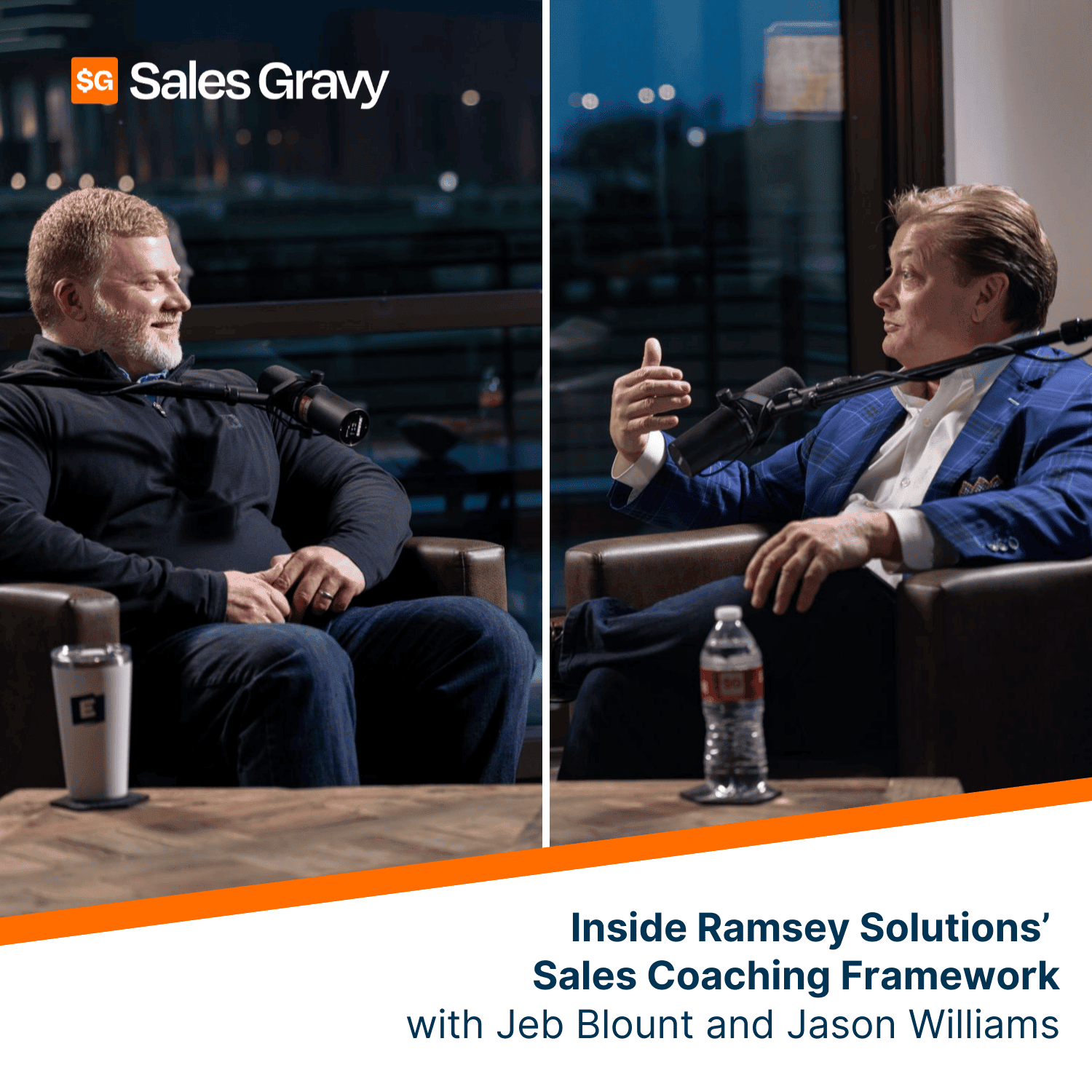
I spent an afternoon at Ramsey Solutions in Tennessee with Jason Williams, Vice President of Sales for the EntreLeadership Division. What stood out wasn’t the size of the operation or the fancy building. It was walking into a room where sales reps genuinely wanted to talk to their leader.
Most sales floors feel like number factories. Reps avoid their managers. One-on-ones get rescheduled. And everyone wonders why performance stays flat despite “investing in our people.”
Sales leaders say coaching matters. They talk about developing talent. Then they spend their days staring at dashboards and asking why the team isn’t getting better.
Real sales coaching looks nothing like what most organizations call coaching. And after watching Jason work, I’m reminded why so few leaders actually get this right.
What Sales Coaching Actually Looks Like
Jason told me about one of his reps who started missing quota. Here’s what usually happens: Manager pulls up the CRM, points at red pipeline metrics, asks what happened. The conversation goes nowhere. Rep gets defensive, makes excuses, promises to work harder. Nothing changes.
Jason took a different approach. He asked about his rep’s life. Turned out he was stressed about buying his first house. That weight was bleeding into his work, affecting his confidence on calls, making him hesitant to push for commitments.
So Jason got into the field with him. He listened to calls. He rode along on appointments. He watched where deals were actually stalling. Then they debriefed what he observed. “Here’s what happens when pricing comes up.” “Let’s tighten how you handle that objection.” Zero mention of quota or pipeline metrics.
The rep turned it around because someone cared enough to understand what was broken and help him fix it.
That’s what coaching looks like. Managers react to outcomes they can’t change. Coaches focus on behaviors that create future outcomes.
Why Most Leaders Don’t Coach
The biggest barrier isn’t that leaders don’t want to coach. Most genuinely do. The problem is they don’t know what they’re looking for because they never see their reps in action.
Think about last week. How many discovery calls did you listen to? How many demos did you observe? How many customer meetings did you attend just to watch your rep work?
If the answer is zero, you’re coaching from spreadsheets instead of reality. You’re looking at lag indicators (closed deals, pipeline value, activity counts) and trying to diagnose skill gaps without ever seeing the skills in action.
Jason blocks time every week to observe his reps. He’s not there to supervise them or take over calls. Just to watch. Then the coaching becomes specific. He can say, “when that prospect brought up budget concerns, you deflected instead of asking questions,” instead of just “you need to handle objections better.”
You can’t coach what you don’t see.
The second barrier is culture. In typical organizations, admitting weakness feels dangerous. You’re supposed to be confident, crushing it, always having answers. So problems stay hidden until they show up in the numbers.
By then, it’s too late to coach. You’re in damage control.
Creating an Environment Where Problems Surface Early
Jason builds what he calls a “safe space” for his team. When a rep is struggling, he starts the conversation with curiosity instead of judgment. He asks open questions about what they’re experiencing, where they’re getting stuck, what feels hard right now.
When reps admit struggles, he treats it as useful information, not a character flaw. A rep says, “I’m nervous on C-suite calls,” and Jason’s response is “okay, let’s work on that,” not “you shouldn’t be nervous.”
Then he follows through. If someone admits they’re stuck, he actually helps them. He role-plays the situation. He rides along on the next similar call. He provides tools and frameworks. The rep sees that honesty led to help, not punishment.
Over time, reps learn that surfacing problems early gets them solved. Hiding problems just makes things worse. So they start talking about what’s actually happening instead of pretending everything is fine while their numbers slide.
The first time someone admits a weakness and you respond with frustration, you train the entire team to stay quiet. Managers say they want transparency. Few consistently reward it.
How to Actually Build a Coaching Culture
If you want to coach instead of manage, you have to make developing people the primary job.
Jason is clear that his main responsibility is making his reps better. Everything else supports that goal. Pipeline reviews and forecasting matter, but they exist to serve sales coaching, not the other way around.
Protecting coaching time is non-negotiable. One hour per rep per week, minimum. When conflicts come up, the internal meeting gets moved, not the coaching session.
Getting better at coaching matters too. Most of us got promoted because we were individual contributors. Nobody taught us how to develop other people. So we replicate whatever leadership we experienced, which is usually mediocre.
Your reps practice selling every day. You should practice coaching. Role-play difficult conversations with your peers. Practice giving feedback. Work on observation skills. Treat coaching like the professional skill it is.
And you have to measure what matters. If you only track team revenue, you’ll optimize for short-term numbers at the expense of development. Start measuring coaching conversations. Track whether your reps are improving on specific skills. Monitor how long it takes new hires to ramp.
When I walked through Ramsey Solutions that day, I could feel the difference. Reps weren’t avoiding their leader. Retention was better. Performance was compounding over time instead of bouncing around based on whoever happened to be hot that quarter.
What Happens Next
Look at your calendar from last week. How much time did you spend observing your reps versus reviewing their numbers? How many true coaching conversations did you have versus pipeline reviews?
If that ratio doesn’t reflect what you say your priorities are, you’ve found the gap.
Your reps don’t need another dashboard. They need a leader who sees the work, understands where it’s breaking down, and knows how to help them improve.
Sales coaching isn’t reacting to results. It’s shaping the behaviors that create them. The question is whether you’re willing to make that your real job.
—
Ready to build a stronger sales team? Download our FREE Small Business Guide to Sales Training and get the framework for developing high-performing reps.

Here is a question that should keep every sales leader up at night: What do you do when your team has gotten so comfortable managing their existing accounts that they have stopped prospecting for new ones?
That is the challenge Jeff Velez brought to a recent episode of Ask Jeb. Jeff works in the real estate services industry, where referrals from agents, brokers, and affiliates drive most of the business. Retention matters. Relationships matter. But because there is always natural attrition, his team has drifted into full farmer mode.
If you are shaking your head right now, you are not alone. This is one of the most common and most dangerous patterns I see in sales organizations today.
The Farmer Mentality Is Killing Your Pipeline
Your book of business is shrinking a little bit every single day. Accounts churn. Contacts leave. Referral partners move on. If your team is not consistently bringing in new logos, you are not standing still. You are moving backward.
The reason salespeople drift into pure farming mode is just pure human nature. The bigger a rep’s book gets, the more comfortable they become. They are making money. Things are fine. Why grind through cold calls and new outreach when warm conversations with happy clients feel so much easier?
And here is the other thing: calling invisible strangers is hard. The people in your existing accounts are happy to hear from you. The people you are prospecting to are not. That gap in friction is exactly why reps gravitate toward the path of least resistance every single time.
The solution is not to yell at your salespeople. This is a leadership problem, not a salesperson problem. If you want your team to prospect, you have to build a system and a culture that makes prospecting non-negotiable. That starts with you.
Leaders Are Repeaters
If you want your team to prospect, you have to talk about it constantly. Every team meeting. Every one-on-one. Every morning huddle. Leaders are repeaters. You set the tone by what you say, what you measure, what you celebrate, and how you show up.
That means when someone brings in a new logo, you ring the bell louder for that than you do for an account renewal. Renewals matter. High margin, great for the business. But if you want prospecting behavior, you have to reward and celebrate prospecting outcomes. Make sure you are not accidentally incentivizing people to farm existing account growth rather than hunt new business. That is a trap I have walked into with more organizations than I can count.
You also need to take the guesswork out of who your team should be calling. Sales leaders who expect their reps to build their own prospecting lists and figure out their own targeting are setting their people up to fail. Build the list. Point them in the right direction. Get them in position to win. Then run prospecting blocks together. And I mean together. Do not send your team to the phones and retreat to your office. Lead from the front.
Split the Job When You Can
One of the hardest things about managing a referral-driven or relationship-heavy business is that you need people who can both hunt and farm. And the honest truth is that most people are not equally gifted at both. Hunters tend to get new business but sometimes burn relationships. Farmers build and maintain accounts beautifully but stop hunting the moment their book is comfortable.
If your business can afford it, split the role. Have dedicated hunters focused on new logo creation. Have dedicated farmers or account managers focused on retention and expansion. Most small and mid-size organizations cannot do this fully, which means your leaders have to work twice as hard to build systems that force both behaviors.
When you cannot split the job, you have to build structure into the day. Block time every morning specifically for new logo prospecting. It does not have to be a huge window. An hour. Two hours. But it has to be protected, consistent, and non-negotiable. And the leaders have to be visibly engaged in it, not hiding behind their screens while their people make calls. That single behavior sends more of a message than any speech ever will.
This Is a Long Game
Here is what I told Jeff, and what I will tell you: do not expect this to change overnight. Cultural shifts in sales organizations are slow and painful. You will have reps who resist. You will have leaders who get uncomfortable holding people accountable because they do not want the friction.
Push through it anyway. Stake it in the ground. If you stay consistent in your messaging, your structure, and your expectations, you will start to see movement in twelve to eighteen months. New business will start coming in. Your team will start to feel the momentum. And that momentum builds on itself.
I am dealing with this in my own organization right now. We got comfortable with our existing customers and pulled back on new outreach. The book feels fine until the day it does not, and by then you have already lost ground you cannot easily recover. A shrinking book is not sustainable. Full stop.
Your Action Plan
If you are a sales leader:
Reset the expectation now. Make it clear that prospecting for new logos is part of the job description, not optional. Put it in writing. Talk about it constantly.
Fix your compensation structure. If you are paying higher on renewals than on new business, fix that. You are paying for the behavior you are getting.
Run prospecting blocks with your team. Not near your team. With your team. Lead from the front.
Give them the list. Stop expecting reps to research, target, and build their own outreach pipeline. That is a leadership function.
Celebrate new logos loudly. Ring the bell. Make it a bigger deal than anything else you celebrate.
If you are a sales rep:
Do not wait for your leader to force you. The reps who prospect consistently, even when their book is comfortable, are the ones who build the most durable careers.
Treat your book like a leaky bucket. Something is always draining out. Your job is to fill it back up, every single day.
Pick up the phone. Calling strangers is uncomfortable. Do it anyway. That discomfort is exactly what separates average reps from elite ones.
The message is simple. A book of business that is not growing is a book of business that is dying. This is who we are. This is what we do. We prospect, every day, without exception.
Want to take this to the next level in person? Join Sales Gravy at one of our live events, where we work with sales professionals and leaders to build the skills, mindset, and habits that drive elite performance. See all upcoming events at salesgravy.com/live.

I’m going to ask you a question that might sting a little. As a sales professional, are you just friction with a friendly face?
Think about it. A whole lot of salespeople are good people. They’re polite, fun to be around, and are good conversationalists. They are good at building relationships and getting along with people.
They’re the type of people that buyers say they like.
The problem is, those buyers who say that they like them often don’t buy from them. They stall. Ghost. Go dark and say things like, “Let’s circle back next quarter.” But they don’t pull the trigger on purchases.
When push comes to shove, they justify not buying with words like, “We really liked you and thought you had a great presentation, but in the end decided to go in a different direction.”
The truth is that they went in that direction not because of the relationship (they truly liked you). Not because your product isn’t competitive or that your solution wasn’t a fit (they were). And not because they thought your intentions were bad (you wanted the best for them).
They decided not to do business with you because dealing with you over the course of the buying process was too much work. And by the way, buyers don’t experience your good intentions. They experience your process.
So today, I’m going to give you a wake-up call and a fix. Because in the age of AI, people expect seamless, frictionless buying experiences. And they compare you—consciously or not—to the easiest experience they’ve had anywhere. Not just to your competitors.
How Salespeople Become Friction for Buyers
Let me paint you a picture.
A buyer sits through a discovery call. You’re friendly. You build rapport. You ask good questions, and they ask hard questions. You end the call with, “Thank you for your time today. I’ll get with my team and send over answers to your questions.”
They say okay, and you end the call.
A week goes by, and they don’t hear from you because you moved on to the next thing on your list and forgot to follow up with your team and them.
Finally, after a week and a half, they remind you that you haven’t provided any answers to their questions.
Embarrassed, you jump on it and send over the answers. But it’s not your best work because you were under the gun and moving too fast.
Three days later, you email: “Hey! Just checking in. Wanted to see if I answered your questions.”
The buyer is busy. They’ve got a million things going on, and they’re irritated because you didn’t give them the complete answers they were looking for. And now your email is another item piled onto their overflowing plate.
They don’t respond. So you send another email: “Bumping this to the top of your inbox.” (Trust me, overwhelmed people just love it when you bump stuff to the top of their inbox.) You create even more irritation.
Then you call and leave a voicemail: “Just following up on the answers I sent you.”
You’re thinking: I’m being persistent. I’m doing my job.
They’re thinking: You made me follow up on you to get the answers I needed, then you failed to give me what I want, and now this is suddenly urgent.
From their perspective, no matter how nice you’ve been, you are friction. Your delay slowed down their decision-making process, the conversation was left open-ended, and now all they have are loose ends, and you’re driving them nuts.
The Hard Truth About Relationships in the Age of AI
Here’s the brutal truth: Relationships are vitally important. Trust matters. But relationships only carry you so far if buying from you isn’t easy or pleasurable.
You can be likable and still be a drag. You can be “a great person” and still be the person the buyer avoids—because every step with you along the decision-making process comes with friction.
And the thing about friction is that it shows up in small ways that feel normal to you but are exhausting to your buyer. Here are just a few examples:
Meetings that end with no decision map or next steps
Follow-up messages that add no new value
Slow answers to simple questions
Stakeholders have to push you
The buyer is repeating the same story over and over because you are not listening and taking notes
Your failure to follow through when you say you will
Proposals that are generic marketing documents rather than valuable insight, value bridges, and recommendations
AI Just Set the NEW B2B Sales Bar
This problem is getting worse right now because of AI. And I don’t mean this in some hypey, “AI is changing everything” way.
I mean, AI is retraining buyers. Buyers are being conditioned to expect frictionless experiences: instant answers, clear options, smart recommendations, and smooth paths from questions to answers to decisions.
So when they hit your sales process, and it feels like walking through mud, they notice. They may not say it out loud, but their behavior says it for them. They stall faster. They ghost faster. They lose patience faster.
This is a big part of what I talk about in my bestselling book, The AI Edge. Your edge isn’t that you use AI to crank out more activity. Your edge is that you understand the expectation shift and use AI to help you reach that new bar.
In the age of AI, the new bar is FASTER with less FRICTION. For this reason, you need to combine your gift for connecting with people and developing relationships with leveraging AI to:
make progress faster, follow up faster
answer questions and provide clarity faster
give insight faster
understand your buyers’ organizations and problems faster
deliver proposals and recommendations faster
help your buyers feel trust and certainty faster.
All with less friction for your buyers.
How to Conduct a Sales Friction Audit
To gain insight into how buyers may view you, take a hard look in the mirror and run a Sales Friction Audit. This takes five minutes, and it will tell you exactly what’s killing your deals.
Score yourself 1 to 5 on these seven areas:
Clarity: After every interaction, does the buyer know exactly what happens next?
Speed: Do you respond at the speed of the buyer’s curiosity or the speed of your internal process?
Effort: Are you reducing the buyer’s workload or adding to it?
Progress: Do your meetings create decisions and movement, or just conversation?
Packaging: Do you make it easy for the buyer to share your insights, information, and recommendations internally to their team?
Certainty: Do you reduce uncertainty and risk, or do you create more?
Reliability: Do you do what you say, when you say, without reminders?
Now, after you add this all up, if you don’t like the number, don’t get defensive. Change your mindset.
Because the fix is simple: Stop trying to be liked and start making it easier to work with you. Because if you are just friction with a friendly face, in today’s marketplace, you are going to get crushed by competitors who are friendly, competent, fast, and frictionless.
But I want to be crystal clear: Frictionless doesn’t mean spineless. It doesn’t mean you turn into a people-pleasing slave to your buyer’s every whim. It certainly doesn’t mean handing out discounts like candy to make buyers happy.
It means you run a sales process with structure, discipline, and competence, and that you understand that the buying experience and how you sell matter more than what you sell.
Two Easy-to-Implement Ideas for Eliminating Friction in Your Sales Process
Here are two easy actions you can implement immediately to reduce friction in your sales process.
End Every Meeting with a Map and Next-Step Commitment
The map is clear on who does what, by when, and what done looks like.
Too many sales calls end with vague commitments. “I’ll send you some information.” “Let’s reconnect next week.” “Think about it and let me know.”
That’s not a map or a next step. Those loose ends are friction.
A map sounds like this: “Here’s what happens next. I’m going to send you a detailed proposal by Wednesday at noon. You’re going to review it with your team on Friday. We’ll reconvene on Monday at 2 PM to give it a thumbs up or thumbs down. Will this work for you?”
A map is clear, specific, and has no ambiguity. You are leading the process and driving it forward to a conclusion.
Turn Proposals into Recommendations
Don’t dump choices on the buyer and say, “Let me know what you think.” Give options AND your recommended path.
“Based on what you’ve told me, here are three options. Option A is the safe play. It has the lowest risk but only a moderate impact. Option B is my recommendation because it solves your core problem and gives you room to scale. Option C is the aggressive play. It’s also a higher investment with the highest potential return and the highest risk. Here’s why I’m recommending Option B . . .”
In a world filled with uncertainty, your confident, assertive, expert advice reduces friction and helps your buyer make faster decisions.
How AI Can Give You the Edge for Removing Friction
Now here’s where AI comes in. If we’re honest, most sellers use AI to write emails. That’s fine, but it’s not the edge.
The edge is using AI to remove friction for the buyer and to shorten the distance from interest to decision.
Generate decision-ready call recaps: outcomes, risks, open items, next steps, deadlines
Speed up the process of understanding your buyer’s organization and beef up your industry-specific business acumen
Create a one-page business case that the buyer can forward internally, along with stakeholder-specific FAQs
Record your meetings so that you never forget anything the stakeholders tell you and use those recordings to speed up the process of crafting personalized proposals and expert recommendations.
Wake Up B2B Salespeople. The World Has Changed.
The bottom line is that the relationships you build are crucial but not enough, because people do business with people they like, trust, and who remove friction from the buying process. They reward sellers who engineer a buying experience that feels seamless.
But if you are just friction with a friendly face and buying from

Brad Beeler, author of Tell Me Everything and retired Secret Service agent who has conducted more criminal polygraphs than anyone in the agency’s history, was clearing a house on a search warrant when he came across two dogs: a pitbull and a Chihuahua.
His focus locked on the pitbull. The stereotype. The threat.
Meanwhile, the Chihuahua circled behind him and jumped up, latching onto him right between the legs while his partner stood there laughing.
We assign horns and halos fast. Brad learned that lesson with dogs. You learn it every time a prospect shuts down before you finish your introduction.
Horns mean danger. Hurtful. Someone here to take from me.
Halo means safe. Helpful. On my side.
Over 25 years of getting people to confess to federal crimes, Brad discovered something powerful: the same instincts that get hardened criminals to talk work in conference rooms. The techniques that break through with people who have every reason to lie also work on prospects who have every reason to brush you off.
Because in both environments, trust determines everything.
Why Building Trust With Prospects Is Harder Than You Think
Your brain’s been running this horns-and-halos program for 300,000 years. When something rustled in the bushes, you made a split-second decision: climb a tree or fight. That quick judgment kept you alive.
The moment you walk into a prospect meeting, their brain assigns you horns automatically. You are the salesperson. The interruption. The person asking for their budget. In their mind, you represent risk before you ever speak.
It happens on cold calls. You say, “Hi, this is…” and they are already calculating how to end the conversation. On discovery calls. In demos. At conferences when you introduce yourself. Every single time.
You are fighting ancient wiring every time you engage a buyer. So what can you control? The first 90 seconds.
How to Build Trust in the First 90 Seconds
We remember first impressions and last impressions. In most meetings, it begins and ends with a handshake.
Brad puts antiperspirant on his right hand. He warms his hands before entering a room. He holds eye contact for one second. Faces the person straight on. Slows his pace. Lowers his tone.
It sounds mechanical. But every one of these micro-decisions either confirms horns or begins to build a halo.
Wet handshake? You’re nervous, unprepared, not confident in what you’re selling.
Avoiding eye contact? You’re hiding something or you don’t believe in your own pitch.
Talking too fast? You’re trying to get something past them before they catch on.
When you control these variables, people’s guard comes down faster. You’re giving their brain evidence that maybe, just maybe, you’re not the threat they assumed you were.
The Trust-Building Technique Most Salespeople Get Wrong
Brad would sit across from murder suspects and open with one line: “I need you to help me understand.”
Humans are hardwired to explain. When you position yourself as the learner, something shifts. They become the expert. Their guard drops. They start talking.
Most salespeople walk in ready to educate. Your deck. Your case studies. Your demo. You’re there to prove you know their problems better than they do.
Sometimes that works. But think about what it communicates: “I already know what’s wrong with your business. I just need you to agree with me and sign here.”
Instead, try:
“Walk me through what happens when your team processes a new order.”
“Help me understand how you’re handling onboarding right now.”
“What’s your biggest bottleneck?”
Invert the dynamic. You’re not there to impress them. You’re there to learn from them. Once buyers start explaining their world, they reveal what matters.
The workaround their team built. The spreadsheet that breaks every month. The process leadership thinks is automated but is completely manual.
That’s the information that moves your deal forward.
How to Build Rapport Before the Real Conversation Starts
Before interrogating two suspects, Brad bought them food. Popeyes for one. McDonald’s for the other. Twenty-two dollars total.
The next day, the woman’s on a jail call: “Yeah, they got me with the McDonald’s. That’s why I confessed.”
It was not about the food. It was about comfort. Lowering the guard. Creating what Brad calls a confessional environment where people feel safe telling the truth.
You’re probably not buying prospects lunch before your first call. But the principle still applies.
Show up five minutes early so they don’t feel rushed. Ask about their weekend before diving into business. Acknowledge that you know their time is valuable. Turn your camera off if they seem uncomfortable on video. Send the agenda beforehand so there are no surprises.
These are small friction eliminators. They signal: I’m not here to ambush you. I’m not trying to catch you off guard. We’re having a conversation, not a pitch.
The prospect who feels safe tells you what’s really going on. The prospect who feels ambushed gives you the corporate line and ends the call early.
What Happens When You Actually Build Trust With Buyers
When buyers move you from horns to halo, everything changes.
They stop filtering their answers. They tell you what keeps them up at night. They admit where the process breaks. They share internal pressure you would never see in a polished demo.
I’ve watched this play out hundreds of times. The rep who asks better questions closes more deals than the rep with the better demo. The rep who makes prospects comfortable gets to real problems faster than the rep with the perfect pitch.
Brad spent 25 years getting people to confess to federal crimes. He still warms up his hands before handshakes. Still slows his speech. Still positions himself as someone who needs to learn.
Why? Because building trust isn’t about personality or natural charisma. It’s about technique. These methods work because they’re based on how humans actually operate, not how we wish they operated.
And when buyers tell you the truth, you can actually help them.
—
Download our free Sales EQ Book Club Guide to master the emotional intelligence skills that help you read prospects and close more deals.

Let me ask you: What if the biggest thing standing between you and your next closed deal had nothing to do with your product knowledge, your pricing, or your pitch? What if it came down to three simple micro behaviors that most salespeople never bother to master?
I was speaking to a group of students and marketing professionals at BYU-Idaho recently, and this question came up in a great way. We were talking about what actually drives buying decisions, and I shared something I believe with every fiber of my being: your prospect’s emotional experience with you as they walk through their decision journey is a more consistent predictor of outcome than any other variable.
Read that again. Their emotional experience. Not your features. Not your price. Not your killer deck.
People are asking five questions as they go through a decision to buy:
Do I like you?
Do you listen to me?
Do you make me feel important?
Do you understand me?
Can I trust you?
If you can get to yes on all five, you win. And the micro behaviors below are exactly how you do it.
Micro Behavior #1: Read the Room
Authenticity without respect for your audience is arrogance.
I know that sounds blunt, but I mean it. I see salespeople all the time who show up however they want to show up, dressed however they feel like dressing, presenting however they feel comfortable, and then wonder why the deal stalled. Being “authentic” does not mean ignoring your buyer. It means showing up for your buyer.
When I was in outside sales doing field work, I had clothes hanging in my car on a hanger. If I was walking into a company where everyone wore suits, I put on a jacket and a tie. If I was walking into a manufacturing plant full of people in polo shirts, I changed in the parking lot. When I sold in Clemson, South Carolina, I wore a Tiger tie. I’m a Georgia Bulldog, but I was in their house. Showing up in Clemson with a Dawgs tie would have cost me the deal before I ever opened my mouth.
Reading the room is not fake. It is the highest form of respect you can show another person. It says: I see you. I came prepared for you. You matter to me.
That one shift, from showing up for yourself to showing up for your buyer, will change your results immediately.
Micro Behavior #2: Shut Up and Listen
This is the easiest and fastest way to be likable on the planet, and most salespeople still will not do it.
When you give another human being your full, undivided attention and actually listen to them, they fall in love with you. I am not exaggerating. I said this to the students at BYU-Idaho and I will say it here: if you just listen to people, they will do almost anything you ask them to do.
Why? Because the most insatiable human need is the need to feel important. To feel like you matter. And when you give someone your full attention, you are filling that need in a way that almost nobody else in their life is willing to do.
The mechanics are simple. Ask a great question. Then shut up. Resist every urge to jump in, interject, or start mentally composing your response while they are still talking. Just listen.
The reason this is hard is that when our mouth is not moving, we do not feel important. We feel like we are losing ground. We feel like silence is weakness. It is not. Silence and attention are your greatest sales weapons.
Micro Behavior #3: Tell Them Their Own Story Back to Them
This one is where everything clicks together.
Once you have listened, here is what you do when you open your mouth: tell them the story they just told you, back to them, in the context of how you can help them.
Let me say that one more time because it is that important.
When words come out of your mouth, you should be telling your prospect the story they just told you about themselves and their situation, framed around how you can solve their problem. That is it. That is the whole game.
This answers the question every buyer is silently asking: “Does this person actually understand me?” And even if you do not get every detail right, if they can see you are genuinely trying to understand, they will still feel it. They will still think: this person cares about me.
When you can read the room, listen without an agenda, and reflect their story back to them in a way that connects to your solution, you have answered yes to four of those five buying questions before you ever ask for anything.
One More Thing: The Pipe Is Life
I was asked at the end of that BYU-Idaho session: “If you could leave us with one thing, what would it be?”
My answer was immediate. The pipe is life.
It does not matter how likable you are. It does not matter how well you listen. It does not matter if you have mastered every micro behavior in this post. If you do not have a pipeline, none of it matters. The number one reason salespeople fail is an empty pipeline. And the number one reason pipelines are empty is that salespeople stop doing the prospecting work every single day.
Especially on the days you are tired. Especially at the end of the day when you just want to go home. Feed the pipe. Pick up the phone. Make one more call.
Join Sales Gravy at our next live workshop event. These are high-energy, immersive experiences built to sharpen your mindset, your skills, and your pipeline. Get the details and register at salesgravy.com/live.
One of the most vivid memories from my childhood was the day I was bucked off my pony, Macaroni. I was only six years old. We were in an arena where my mother was giving me my very first riding lessons.
Macaroni was stung by a bee, and she reacted by bucking. I couldn’t hang on, and I landed hard on my back. It knocked the breath out of me. I gasped for air. Then, as I finally caught my breath, I started bawling at the shock of being involuntarily dismounted.
My mom caught the pony, led her back over to me, and gently told me to dust myself off and get back on. But by this time, I was sobbing the way kids do when they’ve cried so hard that they can’t stop.
Failure is Just a Bruise
I shook my head and refused to get back on the pony. My mother tried her best to calm me down and reason with me, but I still refused to get back on.
Then she took a different tactic and got tough. Her stern, direct tone of voice made it clear that she was not asking me to get back on the pony—she was telling me. That’s what I remember the most because my mom had never talked to me like that before and has rarely ever used that tone and directness since.
“Get up, and get back on that pony now!” she admonished.
She was unmovable. Like Teflon. My tears and pleading made no difference. I knew I had no choice, so I stood up, shaking. Still trying to catch my breath, she helped me get back on the pony.
Right there in the riding ring, at six years old, I experienced one of the most pivotal lessons of my life. My mother taught me that failure is just a bruise, not a tattoo.
She wasn’t being cruel; she was being protective—protective of my future self, the one who might otherwise have carried an irrational fear of horses, or an ingrained habit of backing down at the first taste of adversity into the rest of my life.
She knew that if she had let me off the hook and let me walk away from that pony, there was a good chance that I’d never get back on again. That the fear I felt when I landed on my back in the sand would grow and gain a life of its own. That I would vow to never let the pain and embarrassment of falling off happen to me again, and with that, my brush with failure would become permanent.
Failure Can’t Really Bite You
The truth is, failure is usually a short-lived event. Yes, it’s jarring, unexpected, and can momentarily knock the breath out of you. But it doesn’t have to be the defining chapter of your story.
That’s what my mother understood so well in that riding ring. She insisted that I face my fear, effectively telling me, “Hey, the worst part’s over. Now that you’ve experienced fear and failure, get back on and prove to yourself you can handle it.”
Because once you push through that initial sting, you discover that the fear can’t really bite you unless you give it teeth in your own mind.
When Failure Becomes Permanent
For far too many people, though, the pain of failure does become permanent. Instead of allowing themselves a moment to dust off and try again, they walk away in defeat—often without fully grasping the long-term impact of that decision.
Rather than letting the bruise fade, they opt to memorialize failure in their minds, assigning it more meaning than it deserves. They replay the embarrassment and pain over and over, until it becomes an unspoken vow: “Never again.”
And in that single choice, a brief setback can morph into a defining moment in which they forfeit the chance to learn, grow, and eventually experience the sweetness of victory.
Think about how this scenario plays out in everyday life. Maybe you dream of learning a new skill—painting, playing guitar, writing a book, starting a podcast—but in your first attempt, you falter or feel foolish. Rather than chalking it up to “beginner’s missteps,” you decide: “I’m terrible at this; I’ll never try again.”
And that small bruise becomes a tattoo right there, on the spot. You miss out on the personal growth, the fun, and potentially incredible experiences you would have discovered if you’d simply dusted yourself off and tried again.
Sales is a Tapestry of Failure
In sales, this avoidance of failure is just as prevalent, if not more so, because the stakes often involve your income or your reputation at work.
One day, you run a sales call that goes terribly off the rails—the prospect is disinterested, you get flustered, or you stumble on a key question. You come away feeling embarrassed, incompetent, maybe even humiliated if it happened in front of your sales manager.
That single negative experience can color your perception of future calls. You avoid that type of call, that kind of prospect, or that particular approach. You remember that unpleasant feeling so vividly that you decide it’s “safer” never to try again.
So many sales reps finally gain the courage to cold call a C-level executive at a high-value prospect. Then freeze when they get a hard objection, leaving them feeling small and insecure. Instead of analyzing what went wrong, adjusting their approach, and trying again, they vow, “I’m never calling anyone that high up again.”
And while that might spare them from momentary embarrassment and discomfort, the long-term consequences are enormous. Their pipeline shrinks and income tanks because they’re playing it safe. And, ultimately, their career crashes because they’re afraid to push outside of their comfort zone.
Sales Failure: Where the Bruise Can Really Hurt
Sales can be bruising. Each rejection takes a piece out of you and can feel like a blow to your self-worth. It’s easy to internalize it. Over time, a string of “no’s” can erode your confidence, making the idea of picking up the phone and calling prospects feel daunting.
Our minds can often be drama queens. When something painful happens, we cling to that memory and replay it, each time piling on new layers of negativity—“I can’t believe I said that,” “What was I thinking,” “I’m so stupid.” In reality, the prospect might barely remember it or might even respect your courage. But to you, it’s all-consuming.
But remember, a “no” in sales is rarely personal. Often, it’s circumstantial—maybe the prospect is having a bad day, or their budget cycle doesn’t align with your proposal, or they had a negative experience with a different vendor and brought that baggage with them into your presentation.
The more you detach your self-worth from the outcome, the less likely you are to see these “no’s” as permanent markers of failure. Instead, you’ll shift your mindset. You begin to view failure as data that you can use to gain insight into how to improve. You start to treat each rejection as a chance to refine your approach.
Success Stories are Forged in Failure
The true success stories in sales almost always come from people who learned to pick themselves up, analyze the failure, and adapt. They didn’t let the fear of failure overshadow their potential for greatness.
The best salespeople—and frankly, the happiest people—know that failure is inevitable. Rather than avoiding it, they embrace it. They feel the pain just like anyone else, but recognize that bruises eventually fade. You just have to keep moving forward in order to heal.
At the end of the day, resilience in the face of failure is a choice. It doesn’t always feel like one, especially in the raw moments right after you’ve messed up, taken a big hit, or find yourself on your back in the dirt.
But as soon as you reclaim your power to stand up, brush off the dust, and climb back on—whether it’s a literal or figurative pony—you’ll find your perspective shifting. Failure no longer holds you hostage. It becomes a footnote in a broader story of your determination and personal growth.
Failure is Only Final If You Make That Choice
So, the next time you bomb a sales call, lose a deal you thought was a lock, get yelled at on a cold call, or face an embarrassing situation in front of your peers, remember: you get to choose. Will this be just a bruise, or will you sear it into your psyche, turning it into a tattoo of permanent self-doubt?
My challenge to you this week is when things go wrong, to look up and get up. Get back on the phone. Set another meeting. Propose the next big idea. Trust yourself to learn, adapt, and keep going. Will yourself to stop and make one more call.
Because failure is only final if you decide to never get back on that pony again.
If you haven’t grabbed our FREE guide, 25 Ways to Ask for an Appointment on a Cold Call, download it now at salesgravy.com/cold-calling-guide/.

If you’ve only sold sexy products with cool demos and unique features, you’re probably missing the fundamentals that separate good salespeople from great ones.
Marcus Chan, CEO of Venli Consulting and recent guest on the Sales Gravy podcast, learned to sell in the trenches of commoditized selling: uniforms, facility services, telecom. Industries where you’re locked in multi-year contract cycles, competing against five other vendors who offer the exact same thing, and selling at two to three times the market price.
“In order to get really, really good at selling in the commoditized market, where price seems to be the only factor… you have to learn how to get really good at the sales process,” Chan explains. “You have to be able to take someone who has what I call a latent pain—pain they don’t realize—get them to active and create urgency to move.”
No flash. No sizzle. Just selling.
And that’s exactly why it works.
The First-to-Market Delusion
Chan was talking with a client recently. They’ve closed $5 million in revenue in 12 months. Apple, Fortune 500 companies, massive wins. They’re first to market in a brand new category. Zero competitors.
Their sales team is flying high.
“That’s fantastic,” he told them. “Now what’s your plan for when competitors show up in three years?”
Silence.
Here’s what happens: you get drunk on the product. You don’t have to build real sales skills because the product does the heavy lifting. Then the market matures. Competitors launch. Your “unique” features become nothing new.
Most teams operate under the belief that they’re different. They talk about their proprietary technology, their best-in-class service, and their innovative approach. Meanwhile, buyers are looking at five vendors saying the exact same things.
This isn’t just true for uniforms and telecom. It’s true for SaaS, consulting, financial services. Any market that’s been around longer than 18 months gets commoditized fast.
The question isn’t whether you’re in a commoditized market. The question is whether you know how to sell when you are.
What Commoditized Selling Actually Teaches You
When Chan was selling uniforms at three times the competitor’s price to buyers locked into five-year contracts with other vendors, he had nothing to lean on except process.
He couldn’t say, “Look at this cool new feature.” The uniforms were uniforms. Same fabric. Same colors. Same everything.
He had to learn three skills most salespeople never develop:
Moving buyers from latent pain to active pain. Most buyers don’t think they have a problem. They’re comfortable. They’re “fine” with their current vendor. Your job is to help them realize what they’re losing by staying put, and make it real enough that they care.
Creating urgency when the status quo is locked in. When a buyer is in year three of a five-year contract, there’s zero natural urgency. You have to create it. You have to make the pain of waiting worse than the pain of switching.
Navigating complex, multi-stakeholder sales cycles without a product demo to fall back on. You need the operations manager, the finance team, and the C-suite to all agree that switching vendors is worth the headache. And you need to do it without any bells and whistles to distract them from the hard questions.
The Hidden Advantage Nobody Talks About
Mastering commoditized selling makes everything else easier.
Learn to sell uniforms at a premium price, and differentiated products become simple. The hard skills transfer—objection handling, stakeholder navigation, urgency creation.
But the real value is that your process becomes your product.
In commoditized markets, you compete on how you sell. Your discovery process. Your ability to diagnose the real problem. Your consultative approach. The way you make the buyer feel heard and understood.
That’s what buyers remember and what separates you from the five other vendors in their inbox.
Stop Hiding Behind Your Product
Chan sees it all the time with sales teams from “sexy” industries. They lead with features because they can. They lean on their demo because it works. They let the product do the selling.
Until it doesn’t.
Because eventually, every market commoditizes. Your competitor launches the same feature. Buyers stop caring about your “innovative solution” and start asking about price.
The salespeople who win in commoditized markets win because of process, not product. They’ve mastered diagnosis, urgency, and navigating complexity when there’s nothing shiny to distract the buyer.
A Commoditized Market Is the Best Sales Training Ground
If you’re selling in a commoditized market right now, congratulations. You’re getting an education most salespeople never get—how to compete when you’re “just another vendor,” how to create value when the product doesn’t, how to win on process instead of features.
Sell commodities at premium prices to buyers locked into competitor contracts, and you can sell anything. Master the fundamentals where there are no shortcuts, and those fundamentals become automatic.
Move to a market with actual differentiation, and you don’t just have a good product—you have a good product and the skills to sell it.
Winning in Commoditized Selling
The best training ground for sales isn’t the hottest SaaS company or the coolest startup. It’s the “boring,” commoditized industries where the product doesn’t do the work for you. Where you have to diagnose the problem, create urgency, and navigate complexity without flash to hide behind.
The skills you build when nothing else can save you? Those are the skills that make you unstoppable everywhere else.
—
If you want to sharpen the fundamentals that win in any market, start with prospecting. Download the free Seven Steps Prospecting Sequence Guide and build a process that creates urgency and fills your pipeline on purpose.

Here’s a question that’ll make every salesperson’s blood pressure spike: What do you do when your cold call gets an objection in the first five seconds because prospects immediately stereotype you as something you’re not?
That’s the challenge facing Rick VanNess from Albuquerque, New Mexico. Rick co-founded a company that helps healthcare providers collect on older insurance claims (the ones sitting out 45-90 days that billing departments struggle to get paid). His team augments existing billing operations rather than replacing them.
But here’s the problem: The second Rick mentions what he does, billing directors immediately think “outsourcing” and shut down the conversation. They’ve either had bad experiences with outsourcing or they’re terrified of losing their jobs to a vendor that promises to do it all.
If you’ve ever been stereotyped, dismissed, or written off before you could even explain what you actually do, you know exactly how frustrating this is. And it’s costing you deals.
The Fatal Mistake: Arguing Instead of Agreeing
When a prospect says “We already have billing” or “We don’t outsource,” most salespeople instinctively go into argument mode. They try to explain how they’re different, how they’re not really outsourcing, how their service is special.
This is exactly the wrong move.
Here’s the brutal truth: When you argue with a prospect’s reflexive response, you’re fighting against their primary concern. For a billing director, that concern isn’t whether you can help them. It’s whether you’re going to cost them their job.
Think about that for a second. You’re calling someone whose entire world revolves around protecting their position, especially in an age where AI and automation are threatening white-collar jobs left and right. Their antenna is already up. They’re listening for any reason to say no.
So when you argue with their objection, you’re actually validating their fear. You’re making them dig in deeper.
The Power of the Ledge-Disrupt-Ask Framework
Instead of arguing, try this: Agree with them.
When Rick hears “We already do billing” or “We don’t outsource,” here’s what I told him to say:
“That’s perfect, because none of my customers do outsourcing. They all have internal billing departments. What we do is complement what they’re already doing by picking up the really hard things like collecting on insurance claims that have been sitting for 45 to 90 days and getting them paid faster.”
Notice what’s happening here? You’re using the Ledge framework that top performers use to handle objections:
Ledge: A simple statement that settles your brain and lowers tension (“That’s perfect…”)
Disrupt: Pattern interrupt that reframes the conversation (“…because none of my customers do outsourcing”)
Ask: Move toward a meeting (“Wouldn’t it make sense for us to take a few minutes to see if this could help you?”)
You’re not fighting them. You’re joining them on their side of the table, then pivoting to the real problem you solve.
Lead With the Problem, Not Your Solution
Here’s another critical mistake Rick was making: He was leading with his pricing model (“no risk to you, you don’t pay until we collect”).
While this might sound like a great selling point to you, to a prospect it sounds like every other too-good-to-be-true pitch they’ve heard. It creates skepticism rather than interest.
Instead, focus obsessively on the problem you solve. For Rick’s business, that’s the money sitting in accounts receivable that billing departments are too busy to collect. According to industry data, many practices have millions sitting out there at 45+ days.
That’s pure profit that’s not in the business. That’s real money being left on the table.
When you frame your prospecting messaging around the problem rather than your solution mechanics, you create curiosity and urgency. Save the pricing conversation for when you’re actually negotiating an agreement.
The Multi-Level Prospecting Strategy
One of the most powerful insights from my conversation with Rick was this: Don’t limit yourself to just one contact at the organization.
Rick was focusing solely on billing directors and managers because they’d at least give him 15 seconds. But there’s a better approach.
Go bottom-up and top-down simultaneously:
Bottom-up: Call claims adjusters and billing clerks. They don’t care what you’re selling. But they’ll tell you exactly what’s broken in their organization. Ask questions like “How much money do you have sitting out there over 45 days that you’re struggling to collect?” These narrators give you the stories and data points you need.
Top-down: Use that intelligence to reach the CFO. Now you’re not pitching a service. You’re providing insight about their business: “I spoke with your team and discovered you have $5 million in receivables sitting at 45+ days. Here’s how we help organizations like yours collect 80% of that money 40% faster.”
Middle-out: Armed with data from below and endorsement from above, the billing director conversation becomes completely different. You’re not a threat. You’re a resource.
This is straight from the Sales EQ playbook: Read the room, understand everyone’s motivations, and position yourself as the person who makes everyone’s life better, not worse.
Stand in Their Shoes
The breakthrough moment in any prospecting challenge comes when you stop thinking about your message from your perspective and start viewing the world through your prospect’s lens.
When you call a billing director, their number one job is to protect their position. When you call a CFO, their primary concern is whether this conversation is worth their time. When you call someone lower in the organization, they’re just trying to get through their day without more headaches.
Your job isn’t to convince them you’re different. Your job is to meet them where they are, validate their concerns, and then show them how what you do makes their specific situation better.
That’s how you stop getting objections and start closing.
The Bottom Line
Stop fighting your prospects’ reflexive objections. When they say “We already have that” or “We don’t need outsourcing,” the worst thing you can do is argue with them.
Instead, agree with them. Everyone you work with already has that. Then pivot to the gap you fill and the problem you solve.
Save your solution mechanics for later. Lead with problems, not pricing. And remember: The best salespeople aren’t the ones who argue the hardest. They’re the ones who listen the deepest and position themselves on the same side of the table as their prospects.
That’s how you break through buyer resistance. That’s how you build trust. And that’s how you win deals others walk away from.
Want to master the art of breaking through buyer resistance? Join us at Outbound 2026 in Las Vegas this November, where we’ll be diving deep into strategies for overcoming objections, building rapport, and closing more deals. Learn more and grab your ticket at salesgravy.com/live.

You’re at a networking event and someone corners you. For the next ten minutes, they talk nonstop about their vacation, their dog, their new car. You’re not having a conversation. You’re trapped in their monologue. You’re annoyed. You tune out. You start looking for the exit.
That’s exactly how your prospects feel when you make yourself the star of the conversation.
What Is Sales Main Character Syndrome?
Sales main character syndrome is when you position yourself as the hero instead of your prospect. You see it everywhere:
On the phone: You launch into a five-minute pitch about your company history before asking a single question.
In email: You send giant blocks of text about features without mentioning their actual problems.
On LinkedIn: Your connect request immediately hits them with “Here’s my product, here’s my calendar link, let’s meet.”
No matter the channel, it all leads back to the same place: your product, your company, your agenda.
Prospects don’t care about your product yet. They care about their problems, their goals, and what’s at stake in their world. When you make it all about you, you trigger resistance. Buyers feel sold to instead of collaborated with. And that leads to ghosting, objections, and stalled deals.
Nobody wants to sit through a feature dump. People need relevance. They want to feel heard and know you actually get them.
The Real Cost of Sales Main Character Syndrome
Sales main character syndrome has consequences that will wreck your quota.
Prospects disengage. When you focus on yourself and your product instead of the buyer and their needs, they tune out. Calls feel like lectures. Emails read like brochures. Messages get deleted without a response. Lose their attention, and you’ve lost your shot.
You miss the real opportunities. By making the interaction about yourself, you fail to ask the right questions. You don’t hear what’s actually going on in their world. You can’t identify the true pain points, the real goals, or what’s actually motivating them. So you pitch solutions that don’t align with what they need. You waste discovery time chasing the wrong problems.
Destroy trust before it’s built. Your prospects stop seeing you as a helpful guide. Instead, you’re just another salesperson pushing a product. Without trust, everything gets harder and long-term relationships become impossible.
The cost is too high. So how do you flip the script?
The Mindset Shift: From Hero to Trusted Guide
Your job is to be a trusted guide, not the hero. Think Yoda, not Luke Skywalker.
Your prospect is the hero of their own story. They’re the ones facing the challenge, making the decision, and living with the outcome.
When prospects feel like the main character, they engage more. They open up. They trust you. And trust moves deals forward.
Here’s a simple three-step framework you can use in every conversation.
Step #1: Change Your “I” to “Why”
Stop starting conversations with:
“I want to show you…”
“I’d love to introduce…”
“I think you’ll like…”
Your buyers don’t care about your “I.” They care about their “why.”
Why should this matter to them? Why is it relevant right now? Why does it solve a problem they’re actually facing?
Lead with “why,” and the focus shifts from your agenda to their reality. You’ll stop sounding like a salesperson and start being seen as someone who understands their world.
Before: “I’d love to show you our new platform and walk you through all the features we’ve built.”
After: “Companies in your industry are losing 20% of their pipeline to manual data entry errors. Here’s how to fix that.”
One is about you. The other is about them.
Step #2: Define What You Solve, Not What You Sell
Most salespeople can rattle off what they sell. A platform. A service. A software solution. That’s not what your buyer cares about.
Buyers don’t wake up thinking, “I need a new vendor today.” They wake up thinking, “I need to fix this problem that’s making my life harder.”
When you define the problem you solve instead of the product you sell, you build immediate value. You position yourself as a partner in their success, not just another pitch in their inbox.
Product-focused: “We’re a sales engagement platform with email sequencing, call tracking, and analytics.”
Problem-focused: “We help sales teams stop losing deals to slow follow-up and inconsistent outreach.”
Stop leading with what you sell and start leading with what you solve. Conversations convert faster when prospects see themselves in the problem you’re addressing.
Step #3: Listen to Hear, Not to Respond
The biggest mistake in sales? Listening just long enough to jump in with your answer.
Most reps wait for their turn to talk. They’re mentally preparing the pitch while the buyer is still speaking. It feels efficient. It’s actually ineffective.
Listening to hear means shutting up long enough to understand. You catch the nuance. You pick up on the emotion. You uncover the hidden pain points that competitors miss because they’re too busy pitching.
Slow down. Tune in. Let your buyer feel heard. That’s when trust starts to build and when real opportunity opens up.
Your Challenge: Put It Into Practice This Week
The shift from sales main character syndrome to trusted guide isn’t complicated. But it does require awareness and intention. You have to catch yourself when you’re about to launch into your standard pitch. Pause and ask, “Am I making this about me or about them?”
Your prospect is the hero. Your job is to guide them to success. Make it about them. Lead with relevance. Listen deeply. Watch what happens when you get this right.
Because the most successful salespeople aren’t trying to be impressive. They’re trying to be useful.
Make your prospect the main character in every conversation. Do it consistently, and you won’t have to chase attention. You’ll earn it.
—
Stop getting tuned out. Download the Free ACED Buyer Style Playbook and learn how to speak your buyer’s language.

Imagine that you’re so angry about a business deal gone wrong that you grab a chisel, find a slab of stone, and spend hours carving your complaint. That’s exactly what a Mesopotamian merchant did in 1750 and made sales history.
The merchant was furious because he’d been promised high-grade copper, but the final product was subpar. That angry customer complaint is now sitting in the British Museum, 4,000 years later. The tablet reads: “What do you take me for? That you treat someone like me with such contempt?”
If you think dealing with issues in the sales process is a modern problem, you’re off by about four millennia.
Sales Hustle Is Ancient
We talk about sales like it’s a modern corporate invention. CRMs and automated sequences are new, but the art of the deal and dealing with angry customers? That’s been around since humans started trading.
The copper merchant in 1750 BCE wasn’t just selling copper. He was managing client expectations, handling logistics, and clearly failing at quality control. The core practices of B2B sales—promise, delivery, and relationship management—haven’t changed.
1600s: Sales Becomes a Profession
Fast forward to 1600, and you see the founding of the East India Trading Companies. They were some of the first corporations that allowed people to buy shares in a business.
One of the East India Trading Companies was owned by “the 17 gentlemen”—a group of wealthy investors who funded global trade expeditions. They kept spices like nutmeg, pepper, and cinnamon flowing across continents. The spices were so valuable that they were practically currency.
This was B2B sales at scale. Shareholders’ expected returns. Merchants negotiated deals across continents. The stakes were massive, and so were the profits.
This era established something critical to modern sellers: the separation between ownership and operation. The 17 gentlemen didn’t sail the ships or negotiate every spice deal. They hired people to do it. Sales stopped being a personal trade and became a repeatable profession with accountability structures built in.
1851: Visibility and Competition Arrive
The Great Exhibition in London in 1851 was the world’s first massive B2B trade show in sales history. Thousands of exhibitors. Hundreds of thousands of attendees. A giant glass building called the Crystal Palace.
Nearly 200 years later, sales pros still pack convention centers, set up booths, and fight to stand out in a sea of competitors.
This is where B2B sales became visible. You weren’t just competing against one or two local merchants anymore. You were standing next to dozens of alternatives, all promising similar value. Differentiation became mandatory.
Following up meant writing a letter and waiting weeks for a response. Today, if you’re not following up within 24 hours, you’re losing to competitors who are.
1957: Reach and Leverage Scale Up
The first inside sales team was formed at a company called Dial America in 1957. Before that, if you wanted to sell, you hit the road. Door-to-door, city-to-city, face-to-face. Every single deal required physical presence.
The telephone changed everything. Suddenly, salespeople could work virtually, reach more prospects, and close deals without leaving the office. One seller could now have 20 conversations in a day instead of three. The math of sales productivity fundamentally shifted.
Fast forward to today, and inside sales is the dominant model. The tools have evolved—Zoom calls, screen shares, digital demos—but the core principle remains: you don’t need to be in the same room to build trust and close deals.
From Stone Tablets to Instant Messages: Why Speed Matters Now
Think about the effort that the merchant put into carving his complaint into stone. He didn’t fire off a quick email. He didn’t leave a one-star Google review. He created a permanent record that would outlive both him and the seller by thousands of years.
Today, complaints are easy. Maybe too easy. A customer can blast you on LinkedIn, tank your review scores, or CC your entire executive team on an email thread—all before lunch.
Every major shift in B2B sales increased speed. Trade shows multiplied visibility. Telephones let sellers reach 20 prospects a day instead of three. Email collapsed follow-up from weeks to hours. Social media made reputation instant and permanent.
In 1750 BCE, you had time to respond. Now, you have hours—maybe minutes. Each acceleration rewarded the sellers who could execute fast without sacrificing quality. The ones who couldn’t keep up disappeared.
Why This Timeline Matters More Than You Think
We’re in another massive shift in sales history. AI, automation, predictive analytics—the pace is relentless. It’s easy to think everything has changed. Zoom out 4,000 years, and the pattern emerges: speed accelerates, but the core practices stay the same.
So the next time you get a harsh email from a customer, remember that stone tablet. You don’t have to worry about your failure being displayed in a museum 4,000 years from now. But you do have to worry about your reputation spreading across the internet in hours.
The tools change, the pace accelerates, but the rule is simple: earn trust, deliver value, and handle problems before they handle you.
You just saw how history teaches that speed and execution have always mattered — and now AI is the biggest shift we’ve seen yet. If you want to turn the disruption into an advantage, download The FREE AI Edge Book Club Guide.

Here’s a question that’ll frustrate every salesperson reading this: What do you do when you prospect, set the meeting, block the time on your calendar, and then… your prospect no-shows?
That’s the challenge Emily Weissmueller faces every single day. Emily is a former elementary school teacher who pivoted into K-12 edtech sales eleven years ago. She works with special education administrators, and like so many salespeople in 2026, her meetings are primarily virtual.
She’s doing everything right: prospecting consistently, securing appointments, sending calendar invites. But when it’s time for the meeting? Hit or miss. Sometimes they show up. Sometimes she’s sitting there waiting while nobody logs on.
If you’ve ever stared at a Zoom room alone wondering if your prospect forgot about you, you know exactly how this feels. And if you’re wondering whether confirmation emails help or hurt, you’re asking the wrong question entirely.
The Virtual Meeting Paradox
Let’s be honest about something: Virtual meetings are throwaway appointments for both sides.
When you had to drive four hours to meet someone in person, both parties had serious skin in the game. You invested time, gas money, and effort. Your prospect blocked their calendar knowing you were making the trip. Neither of you would casually blow that off.
But virtual meetings? They’re low commitment on both ends. No one’s driving anywhere. It’s just a calendar block that can easily get bumped by the next urgent thing that pops up. And when you’re selling into education like Emily is, where everything moves infinitely slow and decision-makers are incredibly risk-averse, you’ve got even more working against you.
The question isn’t whether to send a confirmation email. The real question is: How do you stack the deck so heavily in your favor that prospects feel obligated to show up?
The Commitment and Consistency Framework
There’s a principle in human behavior called commitment and consistency. When people commit to something, they typically feel compelled to follow through. Otherwise, they feel guilty. And guilt is actually useful because you can leverage it to reschedule when someone doesn’t show.
But the goal isn’t to make prospects feel guilty after they no-show. The goal is to engineer so many small commitments throughout the process that they show up in the first place.
Here’s the system that works:
Step 1: Confirm Verbally When You Set the Meeting
When your prospect agrees to meet, always repeat it back: “Okay, so I’ve got you on Thursday, January 26th at 2:00 PM. Did I get that right?”
When they say yes, that’s commitment number one. You’re putting it in their brain. You’re making it real.
Then say this: “Let me grab your email and I’ll send you a meeting invite for your calendar just to make it convenient for you.”
This does two things. First, it confirms you have the right email. Second, it gets another yes. That’s commitment number two.
Step 2: Send a Meeting Invite That Actually Helps
Most meeting invites are useless. They say “Meeting with Jeb Blount” or “Sales Call” and include seventeen different international dial-in numbers that nobody needs.
Here’s what your meeting invite should look like:
Title: Emily Weissmueller (Company Name) + Prospect Name (School Name) – Why We’re Meeting
Location: Virtual Meeting (then paste the meeting link, nothing else)
Notes: Keep it simple. Here’s the meeting link. If it’s a phone option, include just that number. Then add: “If anything changes, here’s my direct number and email.”
When your prospect looks at their calendar the morning of the meeting and sees this, they know exactly who you are, why you’re meeting, and how to join. You own the moral high ground.
Step 3: Send a Video (This Is Non-Negotiable)
The next morning after you set the meeting, pull out your phone and record a 20-30 second video. Look at the camera. Smile. Sound excited.
“Emily, this is Jeb at Sales Gravy. Thank you so much for agreeing to meet with me. I’m so excited to spend time learning about you and your mission for helping these kids. Just want to confirm our meeting is on January 26th at 2:00 PM. The invite is on your calendar. I can’t wait to see you.”
Send that via email.
Now think about what you’ve just done. You’ve made it personal. You’ve shown effort. You’ve demonstrated that you actually care about this conversation. It’s exponentially harder for them to no-show because they can see you’re a real human who invested time in this relationship.
This philosophy is about going the extra mile to demonstrate that you’re different, that you care, and that this matters.
Step 4: Leave a Voicemail the Day Before
The afternoon before your meeting, when you know your prospect is likely gone for the day, call and leave a voicemail.
“Hey Emily, this is Jeb. I’m so excited to meet with you tomorrow. I’ve been thinking about your school and the ways we might be able to help. I can’t wait to learn more about what you’re trying to accomplish for these kids. Just a reminder, our meeting is at 2:00 PM tomorrow. All the info is in your calendar. If anything changes, give me a call.”
You’re doing the heavy lifting. You’re reminding them. You’re expressing genuine interest in their world, not just your sale.
Step 5: The Morning-Of Email (Optional)
Here’s where the A/B testing comes in. Some salespeople swear by the morning-of confirmation email. Others think it gives prospects an easy out.
My take? Test both approaches and track your show rates. Do half your appointments with the morning email, half without it, and see which converts better. Even a 2-3% improvement in show rate compounds significantly over a year.
If you do send the morning email, make it about them: “Emily, I’m really looking forward to our conversation today at 2:00 PM. I can’t wait to learn more about your mission and see if there’s a way we can support what you’re building.”
Play to their heartstrings. People love talking about themselves and their work. Make it easy for them to want to show up.
What to Do When You Send a Confirmation Email
Now, if you’re going to send a confirmation email, there are specific scenarios where it’s absolutely required:
You’re driving four hours to meet someone in person
You’re bringing executives or your boss to the meeting
It’s a final presentation or closing meeting with a major opportunity
Multiple stakeholders are coordinating calendars
In those cases, you’re not just confirming—you’re protecting your time and theirs. You’re making sure you don’t waste an executive’s schedule or drive across the state for nothing.
But for a standard first appointment? The video and voicemail sequence will outperform a confirmation email every single time.
The Real Problem: Systems, Not People
No-shows aren’t a people problem. They’re a systems problem.
When you build a repeatable prospecting system that includes verbal confirmation, calendar invites with clear details, personal video, and day-before voicemail, you engineer commitment at every stage.
You’re not hoping prospects remember. You’re not relying on their calendar notifications. You’re building a runway that allows them to land in the meeting because you’ve made it nearly impossible for them to forget or blow you off.
And when someone does no-show after all that effort? You own the moral high ground. You can call back with confidence: “Hey, I know things come up. I sent the video, left the voicemail, and had everything on your calendar. Let’s get this rescheduled because I’m genuinely excited to learn about what you’re working on.”
That conversation is dramatically different than calling back after sending one email and hoping for the best.
The Efficiency Multiplier
Think about what happens when your show rate improves by even 10%. If you were setting ten appointments per week and six were showing up, that’s a 60% show rate. Bump that to seven showing up, and you’re at 70%.
That’s one extra conversation per week. Four extra conversations per month. Forty-eight extra conversations per year.
If your close rate is 20%, that’s nearly ten additional deals per year just from improving your meeting show rate. That’s the power of sales execution at the highest level.
Your Action Plan
If you’re struggling with no-shows, implement this system immediately:
For every appointment you set:
Confirm it verbally when you schedule it
Send a detailed calendar invite with clean formatting
Record and send a personal video the next day
Leave an enthusiastic voicemail the day before
A/B test the morning-of email and track results
Track these metrics:
Total appointments set
Show rate percentage
No-show rate
Reschedule success rate
After 30 days, analyze what’s working and double down on it.
The Bottom Line
Virtual meetings are easy to ignore. That’s just reality in 2026. Your prospects are busy, distracted, and constantly reprioritizing.
Your job isn’t to guilt them into showing up. Your job is to build a system that makes showing up feel like the obvious, natural choice because you’ve demonstrated care, invested effort, and made it personal.
Stop sending one confirmation email and hoping for the best. Start building commitment through repetition, personalization, and genuine interest in your prospect’s world.
That’s how you fill your calendar with meetings that actually happen. That’s how you stop wasting time staring at empty Zoom rooms. And that’s how you build a sales career based on systems, not hope.
Meetings happen by design, not by luck. Build the runway. Land the meeting. Close the deal.
Ready to Master the Complete Prospecting System?
The tactics in this article are just the beginning. If you want to learn the complete methodology for filling your pipeline with qualified appointments that actually show up, join us at an upcoming Sales Gravy Live Event. You’ll get hands-on training in prospecting, qualification, objection handling, and closing from Jeb Blount and the Sales Gravy team. Don’t leave your sales success to
You’ve got a champion. Someone inside the account who gets it. They love your solution, they’re fighting for your proposal, and they’re feeding you intelligence about the decision-making process.
So you’re golden, right?
Wrong. One reorganization, one promotion, one departure, and your deal could vanish overnight.
Research from LinkedIn Sales Solutions analyzed thousands of enterprise deals and found something most salespeople refuse to believe: sales teams that build relationships with multiple stakeholders inside an account are 34% more likely to win.
That’s the difference between hitting quota and missing it. Between a banner year and a brutal one.
Why Single-Threaded Deals Die
On average, 4-7 people influence a complex B2B buying decision.
Even if you nail the pitch, you’re still just one voice in a conversation happening behind closed doors. A conversation where people you’ve never met are raising objections you’ll never hear. Where priorities you don’t know about are shifting the criteria.
Your champion can be dismissed as “the person who likes that vendor.” But when you’ve got three advocates from different departments? Consensus wins deals.
Your Champion Won’t Stick Around
One in five of the people you’re counting on right now won’t be in their role twelve months from now. They’ll get promoted, reassigned, poached by a competitor, or laid off in the next restructuring.
When that happens to your sole contact, your deal doesn’t just stall. It dies. The new person in that role has zero relationship with you, zero context on your solution, and zero incentive to champion something their predecessor started.
But if you’ve built what top performers call “account insulation”—relationships with two, three, or four people across different departments and levels—the web flexes when someone leaves. It doesn’t break.
Weak Ties Matter More Than You Think
We’re trained to go deep with our primary contact. Build trust. Understand their pain points. Tailor every message to their specific needs.
That’s not wrong. It’s just incomplete.
In complex selling scenarios, influence often spreads through what researchers call weak ties—the casual, adjacent connections that link clusters of strong relationships. These are your amplifiers.
A brief introduction. A shared article. A helpful insight that makes someone in operations remember your name when your solution comes up in a meeting you’re not in. These loose connections become the difference between a deal that stalls and one that scales.
Think about how deals from referrals close. They close twice as fast as deals that start cold. Accounts with multiple contacts grow larger, stay longer, and refer more business. The pattern is clear.
Get enough internal referrals, and you stop being the vendor someone works with. You become the partner everyone trusts.
Five Mistakes That Keep You Single-Threaded
Account multithreading fails most often before it ever really begins. Not because it is hard, but because salespeople sabotage it with impatience, poor judgment, or misplaced effort. If you recognize any of these behaviors, they are costing you leverage inside the account.
Trying to build fifty superficial relationships instead of multiple deep, meaningful connections. Spray and pray doesn’t work in prospecting, and it doesn’t work in account multithreading.
Asking for referrals before you’ve built credibility. You can’t extract value before you’ve created it.
Failing to nurture the relationships you’ve already initiated. You can’t plant seeds and never water them.
Ignoring the law of reciprocity. If you don’t offer value first—business insights, useful data, relevant introductions—people won’t feel any obligation to help you. You’ll burn through goodwill and get nothing back.
Wearing out your welcome. If you’ve reached out multiple times with relevant insights and gotten silence, that’s a signal. Move on.
How to Build Your Account Web With Multi-Threading
Start by mapping the web of people connected to your account. Decision makers, influencers, skeptics, the quiet analysts whose opinions shape what the decision makers think. Write it down. Visualize the relationships you have, the ones you need, and the blank spaces in between.
Then ask questions that open doors and show you recognize the decision is bigger than one person.
“Who else on your team would have a point of view on this?”
“Would it be helpful if I shared what other departments are doing with similar tools?”
“Is there someone else who should see this?”
Or use my favorite: “I need your advice on this.” That phrase invokes reciprocity and dramatically increases the probability they’ll give you the referral.
When trust is formed, asking for a direct referral becomes an act of generosity rather than an intrusion. Frame it around value, not obligation.
“Would you be willing to introduce me to your colleague in operations? I think she’d have an interesting take on what we’re talking about.”
“If anyone else on your team might benefit from this, would you mind sharing my name?”
People say yes far more often than you think when you ask this way.
The Quiet Chorus That Closes Deals
The more people who trust you, the faster and further your message travels inside the account.
You’ve got accounts in your pipeline right now sitting on a single thread. One job change, and that deal you’ve been nursing for months vanishes overnight.
Stop searching for the one perfect contact. Start building a small community inside every account.
It’s not a single voice that carries your deal through. It’s three voices in three different departments saying the same thing about you when you’re not in the room.
Protect Your Pipeline with Discipline
Account multithreading isn’t complicated, but it requires discipline and a shift in how you approach relationship-building. If you’re ready to protect your pipeline, increase your win rate by 34%, and build accounts that grow instead of churn, start mapping your key accounts today. Identify the blank spaces. Ask better questions. Build the web before you need it.
Ready to close more deals? Explore Keith Lubner’s courses on Sales Gravy University.
“You know, at the core of Working Genius, what it does is it allows us to avoid guilt and judgment—guilt about ourselves and judgment of others.”
That’s Patrick Lencioni, bestselling author and organizational health expert, talking about his breakthrough Working Genius productivity framework on the Sales Gravy podcast. If you’re leading a sales team, this explains why high performers thrive in some roles and burn out in others.
Right now, you probably have high performers who are miserable, rockstars who’ve lost their spark, and top reps who suddenly can’t hit quota. And you’re wondering—did you hire wrong, did someone lose their edge, or do you need to have “the conversation”?
What if the problem isn’t the person at all?
The Real Reason Your Best People Are Struggling
Not all work is created equal, and your sales reps aren’t wired to do all of it.
Lencioni stumbled on this insight while reflecting on himself. He’d show up to work loving his job and the people he worked with, yet swing from energized to frustrated without understanding why.
His colleague asked, “Why are you like that?” Over a few hours, Lencioni and his team pinpointed six distinct types of work. Depending on which type you’re doing, you’re either energized or drained.
Five years later, over 1.5 million people have taken the Working Genius assessment. Why? Most organizations force talented people into work that drains them, then blame them when they struggle.
Most sales leaders hire a closer for their ability to seal deals, then wonder why they can’t prospect. They promote a quota-crusher into management, then watch them implode under administrative responsibilities. Or move an account manager into new business development and act shocked when performance tanks.
The talent was there all along, but their positioning was wrong.
Six Types of Work—and Why Most People Only Excel at Two
Patrick Lencioni identified six distinct types of work that exist in every organization:
Wonder (W): Spotting opportunities, asking big-picture questions
Invention (I): Creating new solutions, processes, or systems
Discernment (D): Evaluating ideas, figuring out what will work
Galvanizing (G): Rallying the team, getting people moving
Enablement (E): Supporting others, clearing obstacles, making things happen
Tenacity (T): Following through, finishing tasks, closing deals
Here’s what matters: most people are strong in two, competent in two, and are drained by the remaining two.
And there are no good or bad geniuses. Your closer with natural Tenacity isn’t more valuable than your strategic thinker with Wonder and Discernment. Your rep who rallies the team (Galvanizing) isn’t better than the one who quietly enables everyone behind the scenes. Different geniuses are valuable in different ways. The goal is to build a team where all six are represented, and people work in their areas of strength.
Force someone into work that drains them, and sales team performance tanks. Leave them in their genius zones, and energy and results skyrocket.
Stop Judging Your People (And Yourself)
You’ve probably got a rep right now who frustrates you. Maybe they’re brilliant in client meetings but terrible at following up. Maybe they generate incredible account strategies, but can’t stand the daily grind of outbound prospecting. Maybe they close deals but never update the CRM.
Your first instinct is to judge them. “They’re not coachable.” “They don’t care about the details.” “They’re lazy.”
Working Genius removes that judgment. It shows you that their struggle isn’t about character—it’s about wiring. A rep isn’t bad at follow-up because they don’t care. They’re bad at it because Tenacity isn’t their genius. A rep isn’t a bad team player because they don’t remove obstacles for others. Enablement isn’t their strength.
And here’s the part most sales leaders miss: you need to stop judging yourself, too. You feel guilty that you hate certain parts of your job. You think you should be better at forecasting, or administrative work, or whatever drains you. But guilt about your own limitations makes you harder on your team.
When you accept that you’re not built to excel at everything, you can extend that same grace to others. You stop punishing people for being human and start positioning them for success.
Start With Self-Reflection
Which activities give you energy? Which leave you drained?
I’ll be honest about my own wake-up call. I travel over 300 nights a year, giving keynotes and working with clients. Last summer, I got to the point where I thought I was going to have a mental breakdown. Days stacked with short calls, client check-ins, alignment meetings, and podcasts. I was furious when I got to the office, and furious when I left because those days completely destroy my brain.
I’m a wonderer and a thinker. I need space to ideate. Without that time, I can’t function. So I implemented a new rule: no more than two meetings per day. I understood my working genius and restructured my time.
Once you see your own patterns, look at your team. Track what lights people up and what slows them down. Patterns emerge quickly.
How to Apply Working Genius to Your Sales Team
We had a team member at Sales Gravy who was noticeably unhappy. Not complaining out loud, just clearly not thriving. When we looked at what the job required versus their working genius profile, the answer was obvious. We had them doing work completely opposite of their natural abilities. Once we restructured their role to align with their strengths, everything changed.
Here’s how you can apply it:
Pair complementary geniuses. Big-picture thinkers need execution-focused partners. Strategic planners need implementers. Someone strong in Wonder and Invention but weak in Tenacity needs to work with someone who loves finishing and closing.
Restructure roles around natural strengths. Don’t force people into weaknesses. Reassign or support tasks that drain them.
Be intentional with promotions. Top performers don’t automatically make good managers. Your best individual contributor may hate administrative work. Your best manager may dislike strategic planning. Know what fits before making moves.
Have your team take the assessment. Get everyone’s working genius profile. Put it at their workstation. Use it in real-time during team meetings when you’re trying to figure out why something isn’t working. We do this at Sales Gravy, and it’s transformed how we work together.
The Bottom Line
Your sales team isn’t broken, but your understanding of how they work might be.
When you force talented people into roles that clash with their natural strengths, you get frustration, underperformance, and attrition. Then you blame the person and start hiring again.
Everyone has areas of frustration. Everyone faces work they aren’t naturally good at. Working Genius doesn’t let people avoid the draining tasks—but it helps you understand why some work feels impossible, build teams that complement each other, and stop punishing your people for being human.
Stop judging that rep who struggles with CRM updates. Stop feeling guilty that you hate certain parts of your job. Start positioning people where their natural abilities can shine.
Over 1.5 million people have discovered their working genius. Most of them wish they’d found it sooner. Visit workinggenius.com and take the assessment. Use coupon code GRAVY for 20% off.
Here’s a question that hits every sales professional right in the gut: What do you do when your email prospecting tanks and you’re staring at response rates that are circling the drain?
That’s the question Tara asked on a recent episode of Ask Jeb on The Sales Gravy Podcast, and it’s one I hear constantly from SDRs, account executives, and even sales managers who’ve convinced themselves that cold calling is outdated.
If you’re nodding along, thinking email is the future and cold calling is dead, you need to wake up. Email efficiency is going down without bounds, and if you’re not picking up the phone, you’re leaving money on the table.
The Hard Truth About Email Prospecting
Let me be blunt: Your email isn’t failing because the channel is broken. It’s failing because what you’re doing is terrible.
Before you blame the medium, look in the mirror. Did people ignore your email because you sent them something genuinely personalized and valuable? Or did they ignore you because you followed up thirteen times in five days? Did they ghost you because your seven colleagues already called them that same day?
The brutal reality is that most salespeople treat email like a spray-and-pray numbers game. They blast generic messages, add zero personalization, and then wonder why nobody responds. Meanwhile, they avoid the one thing that actually works: picking up the phone and having real conversations.
Why Cold Calling Will Always Matter
Cold calling isn’t going anywhere. It never has been, and it never will be.
You want to know why? Because sales is a human business. People buy from people they trust, and you can’t build trust through automated emails that sound like they were written by AI.
A phone call gives you something email never can: the ability to prove you’re a real human being who’s genuinely there to help, not just to pitch and sell.
When you call someone and say, “Hey, I sent you an email last week with this case study because I saw you talked about this at the Outbound Conference,” you’re showing them you did your homework. You’re not just another robot in their inbox.
Here’s a line I love: “Would I be the worst salesperson in the world if I didn’t also try to call you?” It’s honest, it’s human, and it cuts through the noise.
You Don’t Know What to Say? Make the Calls
The number one excuse I hear from salespeople: “I don’t know what to say.”
Here’s my advice: Make one hundred calls and talk to people. They’ll teach you.
You’re going to learn what not to say. You’re going to start seeing patterns in how your prospects think, what problems they face, and what language matters to them.
This is how you develop business acumen that separates you from the pack. You can’t learn it behind a keyboard.
I was in an alignment call today with a new client, and they said, “You totally understand us.” Why? Last week, I was with a business adjacent to their industry, learned their language, and pulled that knowledge into the next call.
Use Tools to Compress Your Learning Curve
Use tools like ZoomInfo to accelerate your learning curve. At Sales Gravy, we use it every day to find information about people, see what they’re doing on our website, and get intent signals that build our lists automatically.
You can use these tools to learn the language of industries you’re breaking into. You can see company news, understand their challenges, and show up on calls sounding like you belong.
But here’s the key: The tool doesn’t make the call for you. It gives you the ammunition. You still have to do the work.
Be Strategic and Resourceful
Here’s a strategy most salespeople are too lazy to try: If you’re having trouble getting through to a decision maker, call someone else in the company who’ll actually talk to you.
Selling HR services? Call a sales rep. They’ll talk your ear off about the company and might even make an introduction.
Try this: “Hey, I know you’re in sales. I’ve been trying to get hold of Joseph for nine months. Is there any way you could help me out?”
That’s not being cheesy. That’s being resourceful. But you have to be genuine. You can’t just ask for something without building rapport.
Your Action Plan
If you’re struggling with email effectiveness:
Pick up the damn phone. Stop making excuses about why cold calling doesn’t work. It works if you work it.
Get comfortable being uncomfortable. Introducing yourself to strangers will never be easy, but it’s the price of admission for being great at sales.
Use data strategically. Build sequences that interweave multiple channels over 30, 60, 90 days. Email, phone, LinkedIn, video. Give yourself the best odds.
Don’t oversell on the cold call. A little interest isn’t an invitation to vomit your pitch. Your job is to earn the next conversation.
Make one more call. At the end of the day, when you’re tired, make one more call. That’s where discipline separates winners from everyone else.
The Bottom Line
Email isn’t dead, but it’s not a magic bullet. Cold calling isn’t outdated. It’s the foundation of everything we do in sales.
Stop hiding behind your keyboard. Stop blaming the tools. Stop making excuses.
The shortest path to a meeting is through a real conversation. That’s how you build relationships, develop trust, and separate yourself from every other salesperson who’s too afraid to dial.
Get outside your skin. Be genuine. Be there to help. And pick up the phone.
Ready to take your prospecting skills to the next level? Join us at one of our upcoming Sales Gravy LIVE events where you’ll learn directly from top sales leaders and get hands-on coaching to transform your results.
On this first Monday of the second month of the year, it’s time for a gut check. First, we need to check where we are against our new year goals. Next, we need to take stock of our first month’s sales performance and make adjustments.
We’re just a little more than 30 days away from our New Year’s intentions, resolutions, and goals. A month ago, we set out into the new year with hope and ambition that this year would be our best ever and that we’d make positive lasting changes in our lives.
It’s Easy to Slip Off the Track
You’ll remember that discipline is sacrificing what you want now for what you want most. But as time goes by and sticking with new habits gets more challenging, it’s easy to forget what motivated us to make the changes in the first place. It’s easy to let down our guard and go back to our comfort zone.
The farther away we get from our intentions, the more likely it is that we allow our discipline to slip and get off track. It’s just human nature.
Small Slips in Discipline Can Add Up Quickly
Let’s say you kicked off the new year determined to have your best sales year ever, and you knew that meant filling your pipeline daily by getting Fanatical about Prospecting. But upon reflection, you realize that days have passed since you picked up the phone, knocked on a door, or talked with customers.
You’ve been making excuses to avoid the very activities that move you closer to your goals.
I’ll admit that it happened to me just this past week. This month has been non-stop travel — 12 flights, 10 cities, 8 keynotes, 5 full days delivering training to sales teams. Toward the end of the week, I got tired, made excuses, and let my exercise and nutrition routine slide.
This was something I promised myself I wouldn’t do when the year started. I know that if I don’t stop right now and recommit to my goals, then there is a good chance that I’ll continue down this negative path — because it’s easy.
Revisit Your Goals and Resolutions
This is exactly why NOW is a good time for a gut check and a look in the mirror. Pause and carve out time today to revisit your goals, resolutions, and intentions.
Sit down and think about what you decided to achieve back in early January. Visualize what it was that motivated you. Picture what you want most and where you want to be at the end of this year.
Go back and re-listen to the Money Monday episodes on building a personal business plan, reflection vs. regret, and why personal goals are essential for sales discipline.
Then recommit to your goals. Remember the feelings you had when you set them, and make an intentional decision to get back on track.
Evaluate Your First Month’s Performance Against Your Sales Goals
Next, step back and evaluate your first month’s sales performance. As you do, you’ll likely find one of three scenarios:
You Crushed It – You had a killer month and blew your goals out of the water.
You Were Average – You hit quota or did “okay,” but you know you’re capable of much higher performance.
You Bombed – You missed your number and ended the month worse than you hoped.
Great Sales Month
If You Crushed it, and you’re at the top of the ranking report, fantastic, congratulations!
But be very careful not to let off the gas. It’s likely you worked very hard last month to achieve these results. There will be the temptation to take a breather.
Trust me, if you do, this complacency will come back to bite you.
Now is the time to recommit to doing the activity that fueled your success last month so you don’t end up with a lackluster February and a disastrous March.
In other words, you’ve set the foundation for a huge year, take advantage of what you have accomplished, and keep the pedal to the metal!
Average Sales Month
If you had an average or just OK month — maybe you hit quota, maybe you came close, but you know you’ve got more in the tank — then it’s time for some honest self-reflection.
Ask yourself:
What held you back from greatness?
What could you have done differently that would have resulted in higher sales productivity?
Maybe you needed to prospect harder. Perhaps you could have pushed a little harder to close some of your pipeline opportunities. It could have been that your pipeline wasn’t big enough from the start, and you ended up scrambling to make your numbers, but otherwise, you did everything right.
It’s okay, you haven’t hurt yourself. You are still in a good position to have a great year. But you’ll need to identify your performance gaps and plan to overcome them in February.
This is a good time to sit down with your coach or mentor, break down your performance, and get guidance on where you can make tweaks and get better.
If you don’t have a coach and you want to talk with someone, go to https://salesgravy.com/coach to get help.
Bad Sales Month
If you bombed, if your month was downright awful, then you’re going to need to move fast to make adjustments.
Getting behind the eight ball at the beginning of the year is no fun. You don’t want to chase your tail for the rest of the year.
The key is taking positive action now. Rather than dwelling on the negatives — which is super easy to do — pull your head up and start breaking down what happened.
Empty Pipe
Did you have an empty pipeline, so you had nothing to close? That happens to a lot of salespeople in the first month of the year. Go back and listen to the How to Fix an Empty Pipeline Now Money Monday episode from a few weeks ago. Use that lesson to help you fix the problem.
Closeable Opportunities that Pushed
Were there closeable pipeline opportunities that simply pushed into this month? Make sure you’re on top of them so they don’t vanish for good. But also make sure you have the pipe to cover this month, so you’re not solely depending on last month’s leftovers.
Shortcutting the Sales Process
Is it possible that you might have been skipping steps in the sales process? This will often happen when you are in a desperate and stressed emotional state. This is a big clue that it is time to get back to the basics and fundamentals of selling— and get disciplined about following a proven sales process.
This may be a very good time to take some courses on Sales Gravy University and read (or listen) to books like Sales EQ that can help you dial in your sales process.
Recommit to Your Sales Goals
We all slip. We all make mistakes. Discipline can waver, especially once the initial excitement of a new year fades. But you have the power to step back into your resolutions and do the daily work required to achieve your goals.
Whether you crushed it, coasted, or crashed, the key to getting February off to a strong start is to recommit.
Make the decision — say it out loud: “I’m going to be better in February than I was in January.”
Need help setting winning Sales Goals? Check out our FREE Goal Planning Guide
“Buyers want a machine, a sales machine, not a mystery. If the sales machine only works because of the founder, it’s not that valuable. It’s actually quite risky.”
Chris Spratling, founder of Chalkhill Blue Limited and author of The Exit Roadmap, shared this on a recent episode of the Sales Gravy podcast. He works with business owners preparing to sell their companies, helping them get operations, finances, and sales engines ready for new ownership. That insight cuts straight to the reason so many founder-led businesses hit a ceiling they can’t break through.
If you are a founder who still carries most of the revenue, or you have a founder-led sales team that depends on you to close critical deals, this is bigger than exit planning. It determines whether your business can grow beyond your personal capacity.
The Golden Handcuffs Problem
You built the business. You know the product better than anyone. You can sell it without thinking.
That is exactly where the risk starts.
When major clients only trust you, when your sales process lives in your head, when new reps struggle to replicate what comes naturally to you, you aren’t running a sales operation. You are running a one-person engine with a support team around it.
Spratling calls this the “golden handcuffs.” It looks like success from the outside, but underneath, it creates dependency. Every time you step in to save a deal, you reinforce the idea that the business only works when you are involved.
Most founders focus on how this affects valuation at exit. Fewer recognize the more immediate cost. That dependency limits how fast the company can grow right now.
https://www.youtube.com/watch?v=VEBLyaOy9XQ
Where Founder-Led Sales Breaks Down
The transition from founder-led sales to a functioning team is where momentum often stalls.
You hire your first salesperson. They do well. Then a second. Then a third. Suddenly, deals slow down, messaging gets inconsistent, and you find yourself pulled back into conversations you thought you had delegated.
They don’t sell the way you do. They miss cues you catch instinctively. They hesitate where you would push forward. So you jump in, coach through objections, and close deals yourself.
What feels like instinct is actually a method you developed through hundreds of conversations. The problem isn’t that your team lacks talent, but that your approach has never been translated into something they can use without you standing next to them.
As long as that stays true, scale will remain out of reach.
Turning Intuition Into a Usable Process
The hardest shift for founder-led teams is codifying what the founder does without thinking.
You know which deals are worth pursuing. You know when to apply pressure and when to step back. You know how to redirect a conversation when resistance shows up. That knowledge is pattern recognition built over time, and it can be used to create a process.
Start by defining how deals actually move through your pipeline. Not a generic framework pulled from a template, but the real stages your customers pass through, with clear criteria for each transition. What has to be true before a lead is qualified? What information must be present before a proposal goes out?
Then look at discovery. What questions do you ask every time? What do you listen for before positioning your solution? Which objections show up consistently, and how do you respond when they do?
The goal is to document the structure beneath the conversations so that someone else can navigate the same terrain with confidence.
Why Your CRM Is Not Pulling Its Weight
Most founder-led teams have a CRM, but they only use it to track contacts and deal size.
However, a functioning, high-performing sales system treats the CRM as a learning tool. That means capturing more than surface-level data. It means recording what buyers actually say, why deals move forward, where they stall, and who influences the decision.
When that information is tracked consistently, patterns become visible. You see which prospects convert fastest, which objections actually kill deals, and where momentum typically breaks down.
That insight does more than improve forecasting. It gives you a concrete way to train new reps based on real deals you have closed, not abstract theory.
Three Steps to Build a Sales Engine That Does Not Depend on You
The objective isn’t to remove yourself from sales completely. It’s to make your involvement a choice rather than a requirement.
Step 1: Define Clear Qualification Criteria
Your team needs to know which leads are worth pursuing and which ones are a waste of time. If you’re constantly redirecting their focus, you haven’t defined “good fit” clearly enough. Get specific—industry, company size, buying triggers, decision-making structure.
Step 2: Create Documented Playbooks
How do you handle discovery? What’s your approach to proposals? How do you navigate the closing process? Your team needs a framework they can adapt. Think decision trees, not scripts. “If they say X, then ask Y. If they push back on Z, here’s how to reframe it.”
Step 3: Transfer Client Relationships
If every major client relationship is tied to you personally, your business is fragile. Start introducing your team into those relationships now. Bring them to calls. Have them lead the follow-up. Shift trust from you as an individual to your company as a whole.
What This Looks Like in Practice
Record your next three sales conversations, with the customer’s permission. Review them carefully. Note the questions you asked, when you asked them, and how you responded to resistance. Identify what made you confident that the opportunity was real.
Turn those insights into a simple framework your team can follow. Have them use it. Watch where it works and where it breaks. Refine based on what you see.
Done consistently, this process creates a system new hires can step into within months. It won’t make them identical to you, but it will make them effective without constant rescue.
The Real Test
You will know your found-led sales team has scaled when you can step away for two weeks without monitoring email, chat messages, or “quick calls” with prospects.
And when you come back, the pipeline has moved forward.
If that thought terrifies you, you don’t have a sales team. You have an expensive support staff for your one-person operation.
Building a sales operation that runs without you isn’t about making yourself irrelevant. It’s about making your business transferable and scalable, whether you’re planning an exit in three years or just trying to grow past your own capacity right now.
Because at some point, your ability to personally close deals stops being your greatest asset and starts being your biggest bottleneck.
The question is whether you’ll recognize that point before it costs you the next stage of growth.
If you want to start turning founder intuition into a repeatable sales system, download our free Small Business Guide to Sales Training. It walks through the frameworks that help teams scale without depending on a single closer.
Here’s a question that’ll change how you think about this profession forever: What’s the one moment that reveals you’re built for sales success?
For most people, that moment never comes. They stumble into sales, struggle with the stereotypes, and either quit or spend their entire career fighting against what they think selling is supposed to be.
But for those of us who get it, there’s a moment of clarity so powerful it changes everything. Mine happened in high school when I was chasing a girl and ended up on the yearbook staff. Thirty days later, I handed over $3,800 in checks while everyone else struggled to hit their $300 quota.
The Sales Crack Moment
When Mr. Hall at Hall’s Hardware Store wrote me that first check for a yearbook ad after I had done little more than ask outright for the money, something clicked. This wasn’t complicated. Walk in, shake hands, present value, and people give you money.
While my classmates were paralyzed by the same stereotypes you hear today (“I’m not a salesperson”), I was out there having conversations. That’s all prospecting really is. Talking to people.
The gasp in that room when I revealed my numbers? That was better than the money. That was the competitive fire igniting. That was me realizing I could outwork, outsell, and out-earn anyone if I just committed to the process.
https://www.youtube.com/watch?v=J7dOBVvYHCs
The Discipline Problem Most Sellers Miss
Here’s what nobody tells you about sales success: It’s not about talent. It’s not about charisma. It’s about the ruthless execution of proven processes.
By the time I was 21 or 22, I was making $300,000 in the early nineties. That’s equivalent to making close to a million today. Not because I was special, but because I understood something fundamental that most people never figure out: The more people you talk with, the more you sell.
And here’s the beautiful part. There are lots of people to go talk with. The pipeline never runs dry if you’re willing to fill it.
The Three Non-Negotiables for Modern Sellers
The future of selling is blending. Not choosing between video and phone and in-person. Blending all of them based on one critical question: What communication channel gives me the highest probability of capturing my desired outcome at the lowest cost of time, energy, and money?
When I started selling, we had two channels. Maybe three if you count snail mail. Phone and in-person. That’s it. Today? You’ve got a dozen ways to connect. WhatsApp lets you text, call, and video chat almost instantly. The options are endless.
But here’s where Gen Z sellers (and honestly, every generation) screw this up: They get single-siloed.
“I’m only good at email.”“I only do video calls.”“I hate the phone.”
That mindset is killing your income potential. You need to be good at everything. Master every channel. Because the channel doesn’t matter. The outcome does.
Synchronous Beats Asynchronous Every Single Time
Here’s the second non-negotiable to sales success: Stop hiding behind asynchronous communication.
We do deals in a synchronous world. Real-time conversations. Phone calls. Video meetings. Face-to-face interactions. If you think you can close business through email threads and text messages, you’re delusional.
Why? Because robots can write better emails than you can. AI can craft more persuasive text messages. But sales is the ultimate human career in the age of AI precisely because of the human connection required in synchronous conversations.
Lead with phone calls. Get face-to-face when the deal size justifies it. Use video when it makes sense. But always, always prioritize real-time conversations over digital hide-and-seek.
Ask Questions and Actually Listen
The third non-negotiable is mastering the art of asking great questions and listening to the answers.
People make five decisions before they buy from you: Do I like you? Do you listen to me? Do you make me feel important? Do you get me and my problems? Do I trust and believe you?
Notice what’s not on that list? Your product features. Your company’s awards. Your clever sales pitch.
They’re evaluating you. Your ability to connect. Your capacity to understand. Your commitment to making them feel important.
And the only way to get five affirmative answers to those questions is through synchronous conversations where you ask intelligent questions and actually listen to what they’re telling you.
The Make It Rain Principle
When Mr. Rouse made me editor of the yearbook after I brought in $3,800, I learned something that shaped my entire career: When you can make it rain, you can get anything you want.
That principle holds true whether you’re selling yearbook ads in high school or enterprise software to Fortune 500 companies. Revenue solves problems. Performance opens doors. Results create opportunities.
Most people in sales stumble into it. They took the job because it was available. They stick with it because the money’s decent. But they never commit to mastering the craft.
The question isn’t whether sales chooses you. The question is whether you choose sales. Whether you commit to being good at every communication channel. Whether you prioritize synchronous conversations over digital convenience. Whether you master the art of asking questions and listening.
Those fundamentals never change. The technology evolves. The channels multiply. But the core truth remains: Talk to more people, in real time, with genuine curiosity about their problems, and you’ll make more money than you ever thought possible.
That’s how you achieve sales success. That’s how you go from yearbook ads to seven figures. That’s how you make it rain.
Want to master the fundamentals of prospecting and build your own rocket ship career? Join us at Sales Gravy LIVE: Fanatical Prospecting Bootcamp. Two days of intensive training where you’ll learn the exact systems and processes that turn ordinary sellers into top performers.


Download from Google Play

Download from App Store
 United States
this was great interview on how to start a podcast lots of great tips