


The Ashish Sinha Show
Subscribed: 15Played: 481
Subscribe

© Ashish Sinha
Description
Ashish Sinha, in conversation with thought leaders from business and product space. Expect candid conversations and notes from him on startups, life and everything in-between.
136 Episodes
Reverse
In this conversation, Ashish Sinha interviews Arvind Narayanan, professor of computer science at Princeton University and co-author of the book AI Snake Oil (https://amzn.to/402Ayiw), discussing the impact of AI on various sectors, the differences between generative and predictive AI, the challenges of AI agents, and the future of AI technology.
We explore the importance of human-AI collaboration, the role of reasoning in AI, and the need for better evaluation criteria to build trust in AI systems. Narayanan emphasizes the necessity for technical breadth over mastery in the evolving job market and shares practical applications of AI in education and research.
Unique Quotes from the Conversation
On Predicting Creative Success
"The success of cultural products relies on chance elements that cannot be predicted in advance."
This highlights the inherent unpredictability of creative ventures, whether driven by AI or humans.
--
On Generative AI in Programming
"It’s not that AI writes better code, but it takes so much of the drudgery and boring parts out of it."
A reminder that AI is a tool to enhance, not replace, human creativity in programming.
--
On Predictive AI’s Ethical Concerns
"These tools are only slightly better than random at making really consequential decisions about people."
A critique of the overreliance on AI in life-altering decisions like hiring or criminal justice.
--
On the Capability-Reliability Gap
"The capability-reliability gap means these systems are not reliable right now."
An acknowledgment of AI’s limitations, emphasizing the need for better testing and accountability.
--
On Preparing for the Future of Work
"Technical mastery is less valuable than having technical skills combined with a breadth of skills."
Advice for future professionals to combine technical expertise with adaptability and interdisciplinary thinking.
--
Takeaways
The unpredictability of success in creative products is a key theme.
Generative AI is widely recognized, but predictive AI poses ethical challenges.
AI agents must be more than just wrappers around models.
Benchmarking AI in complex environments is a significant challenge.
The capability reliability gap highlights the unreliability of current AI systems.
Human-AI collaboration is crucial for effective AI deployment.
Inference scaling is a promising area for improving AI performance.
Trust in AI is at risk due to rapid deployment without proper evaluation.
Future engineers should focus on technical breadth and adaptability.
Manasij is the founder of o-founder and CEO of ZapScale, a B2B SaaS platform aimed at enhancing customer success for small businesses.
Before this he started ThreadSol, a very boring B2B company building fabric management solutions for the apparel industry which was acquired by Coats.
Manasij has written a wonderful book : The Economy Class founder and in this conversation, we talk about the evolving nature of GTM for SAAS businesses, the rise of AI snake oil selling (esp in B2B) and well..samosas.
Enjoy the conversation.
Contact centers/ support offices are changing and what was seen as a boring space is..the HOTTEST space in the Gen AI world!
In this episode of the Ashish Sinha Show, I talk to Gaurav Singh, founder of Verloop on how contact centers are evolving, how the ICPs are evolving and importantly, how does BPO2.0 will look like.
In this episode, we talk about:
1. Gaurav’s journey from B2C to B2B / Enterprise
2. How ICPs are evolving in GenAI era.
3. How Gen AI products also compete with companies’ CTOs/Product Managers
4. Outcome based pricing: How close are we to achieve that?
5. Enterprise LLMs: Is it a fad?
6. Why new-age enterprise products cannot be boring or unsexy.
7. Advice to Indian founders building global SAAS, especially on HQ/incorporation location
8. Tips to early stage startups on how to build trust / collect ‘logos’.
9. If you are building a global SAAS, does it make sense to raise funding from Indian VCs?
..and so much more!
Masters of AI segment of the podcast brings deeper insights from founders / practitioners building AI-native businesses, deep in the trenches (and are way beyond fancy demos).
Welcome to a new season of this podcast where I speak with Masters of AI, i.e. founders / leaders building AI applications using AI.
Expect a mix of SAAS, prosumer and consumer startup founders and leaders sharing their learning building a growing AI native businesses.
-------
Vijay Rayapati is a tech entrepreneur who earlier sold Minjar to Nutanix and is now building AtomicWork, an AI-powered ITSM platform.
In this conversation, Vijay and I talk about
his startup journey
Finding PMF in AI led world. And how PMF has evolved over the last few years
Choosing the right problem statements
Choosing the right target market (hint: GDP matters, but there is a product side to it)
Vijay's tips to entrepreneurs building global SAAS businesses from India
Enterprise AI: How are CXOs evaluating AI solutions
Do subscribe, share and like this conversation :)
Welcome to BigIdeas - a show where I bring to you, big ideas from some of the world’s best thinkers across a diverse set of topics ranging from AI to mental health, science to philosophy.
Today, my guest is Shane Parrish. Shane Parrish is widely known for creating Farnam Street, a blog, podcast and learning community. He is also the author of several books and his latest one is Clear Thinking - you should check it out.
In this conversation, we explore various aspects of mental models to parenting and everything in between.
Get Shane’s latest book Clear Thinking: https://amzn.to/3SzNHuz
The show is done in partnership with BigIdeas app, an app that brings you big ideas from the world’s best non-fiction books, podcasts, articles and YT videos - for free!
Get it (on Android, iOS) : https://bigideas.onelink.me/oCN2/get
Show notes: https://nextbigwhat.com
-------------
Contact us at team@nextbigwhat.com for any partnership inquiries.
Founders are often confused whether to bootstrap or raise funding?
First of all, there is no right or wrong answers here.
"What'ever floats your boat" is a generic advice, but there has to be a better framework for founders to make a well-informed decision.
At scale (say $100mn+ revenue or Series D onwards_, startups are all about 2 things
Control i.e. ability to control your decisions, your destiny, your path. Given the gen AI world we live in where companies are getting disrupted with each and every new model launch, you need to have a lot of control on your decision making. This also helps you move fast, take quick decisions and not be at the mercy of your competition’s agility.
GrowthOf course, nobody wakes up saying ‘I want to build a slow growth business’. We all want high growth business - but here is the reality: growth comes at a cost. And we all have seen what happened to those high-growth businesses of 21,22 (ZIRP era). They don’t even have money to pay salaries to their employees. Founders are left with neither growth nor control of their business.
So what’s the right framework to look at this dilemma? Enters 2 by 2 :)
Do review/share your feedback.

Each and every startup has its own unique journey of finding Product market fit. But a broader theme is to understand what goes inside PMF, what are some of the core challenges, decisions that a company can look at and more.
In this episode, Sajith Pai of Blume Ventures and Prukalpa of Atlan share their experience of PMF - Sajith as a VC and Prukalpa as a founder
This conversation was part of ProductGeeks Conf, India’s largest conference for teams that ship (in partnership with Sequoia Capital and Reverie) and was recorded on FWD app, the learning superapp that enables you to upskill on a daily basis.
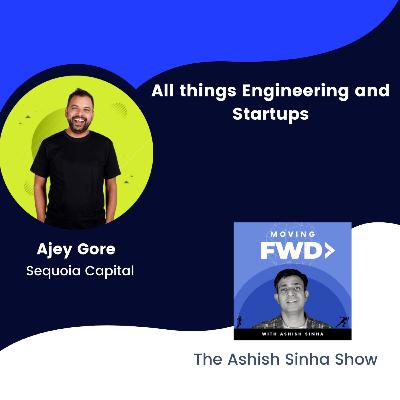
Startups are an act of balance – especially in the early days when you are setting up the foundation for scale.
Are you spending the right amount of effort in engineering? Are you *over-engineering* the product? How can you get the architecture right? Well, there are no right or wrong answers – but all we need is access to great perspectives.
In this conversation which happened at Productgeeks conf, Ajey Gore, CTO/tech operating partner at Sequoia and ex-CTO of Gojek brings you actionable wisdom on engineering. Some of the topics Ajey will discuss:
Approach to software architecture
Approach to building the right engineering and people org.
Build decision/models around people / engg orgs.
Understanding what are 1-way, 2-way decisions.
TTL value of decisions and people in the organization.
Build vs Buy vs. Assemble decisions.
and a lot more.
This conversation was part of ProductGeeks Conf, India’s largest conference for teams that ship (in partnership with Sequoia Capital and Reverie) and was recorded on FWD app, the learning superapp that enables you to upskill on a daily basis.

This conversation, recorded as part of Productgeeks Conf brings you a lot of great insights from Kunal Shah. Some of the topics we discussed:
What is your take on fund raising spree?
How do you build a team?
How did you build a good design team?
Do you maintain a journal of sorts, what's your decision making process and how has it evolved?
Being a founder, how do you maintain the spirit and motivation for your team always up to the mark when the things are not working fine?
What are your thoughts on single founder vs multiple founders?
If you are evaluating an idea, what do you look into an idea beyond delta 4?
This conversation was part of ProductGeeks Conf, India’s largest conference for teams that ship (in partnership with Sequoia Capital and Reverie) and was recorded on FWD app, the learning superapp that enables you to upskill on a daily basis.
Zerodha defies all standard norms of building a tech startup. While the world is going gaga over number of engineers, Zerodha builds and scales with..well just a handful of engineers.
33 member team powering the country’s largest stock brokerage platform! In this deep community cast, Zerodha's CTO, Kailash shares it all in conversation with Ashish Sinha.
How has Zerodha evolved over time, from the v0 of the tech product to today?
How do you think cos. Should really approach Engg? Right now, the mentality is to throw money at the problem, but what’s the elegant way?
Being bootstrapped, how did you hire quality talent and later manage to retain it. Also in the current market how are they dealing with it?
Zerodha that it allows its tech team full autonomy?
how to build the right team that embodies this sentiment?
Design principles
Release Cycles and Technical Decision Making at Zerodha
How to use customer feedback for product improvement?
How to approach product development from the user's perspective?
Consumable APIs: Building an ecosystem.
This conversation was part of ProductGeeks Conf, India’s largest conference for teams that ship (in partnership with Sequoia Capital and Reverie) and was recorded on FWD app, the learning superapp that enables you to upskill on a daily basis.
Meesho is known for its strong customer-obsessed product culture. While it might work in the early days, how do you scale that up given the hypergrowth Meesho is going through?
How do you work across different teams ensuring they are all aligned? How do you ensure customer obsession? Meesho CPO, Kirti Varun shares it all @ProductGeeks Conf, India’s largest conference for teams that ships.
The communitycast, i.e. conversation along with the community happened on FWD app, a learning platform that enables you to upskill on a daily basis.
Chingari is among the early players in Web 3.0 space and there are many questions around the model itself - for e.g with the launch of GARI token, what are the changes to Chingari model? In terms of business and product?
And how can a private company issue tokens? What does the community own and not own? And what about the creators in Chingari? How do they benefit?
Well, we discuss all these questions (and more) in this wonderful AMA (was conducted on FWD app). Note that this is a community podcast - i.e. the first 20 minutes are QnA with Ashish, followed by the community.
![How & Why is a Startup incorporation different [ eLagaan Whiteboard Friday]](https://s3.castbox.fm/bb/05/50/894582ff4e80ab9c9fd802b1568139bc4d_scaled_v1_400.jpg "How & Why is a Startup incorporation different [ eLagaan Whiteboard Friday]")
Since startups are fundamentally different from regular businesses, the way they should be structured is also very different.
The current episode of eLagaan Whiteboard Friday talks about what factors you should look at while incorporating your startup so that you do not end up making changes frequently and saving much needed efforts and time during critical events like fund raising etc.
For queries: hello@eLagaan.com
#startup #funding #eLagaan #nextbigwhat
ESOP has been one of the most critical tool in startups to attract and retain talent. This makes it imperative to implement ESOP effectively and efficiently to gain maximum advantage from the same.
The current episode of eLagaan Whiteboard Friday talks what an ESOP is, what are the various important aspects that you should know if you are planning of implementing ESOP in your startup. It also looks at important regulatory aspects and process to be followed so that its a great experience for both the startup and employees.
For queries: hello@eLagaan.com
#startup #funding #eLagaan #nextbigwhat
The Government of India has been making changes to existing laws and compliance systems to make it faster, easier and more responsive for startups, thereby making India a preferred Startup destination and boost the overall ecosystem.
The current episode of eLagaan Whiteboard Friday talks about such changes that has been implemented and how it impacts your startup. This will help founders to tap the true potential of Government's policies and make best use of them while fostering their startup.
For queries: hello@eLagaan.com
#startup #funding #eLagaan #nextbigwhat
The Startup India program is designed to boost the ecosystem in India and help them grow faster through multiple incentives and support extended by multiple Government agencies. Over the years it has been refined and made more attractive and really useful for startups.
The current episode of eLagaan Whiteboard Friday talks in details about the Startup India program and help you understand it completely. Right from the incentives it offers, the eligibility criteria and real benefits that you get when registered with them. It also talks about whether and how you can go about registering and getting enrolled to the program.
For queries: hello@eLagaan.com
#startup #funding #eLagaan #nextbigwhat
When you are raising investment, the investors will conduct a detailed due diligence on various functions of the startup. A due diligence is very different than a regular audit that your CA undertakes for sake of regulatory filings.
The current episode of eLagaan Whiteboard Friday looks at due diligence on various Internal policies of your startup. This is wide area covering almost all policies and practices that have been implemented across the startup, e.g. financial control & tracking, HR policies & employee benefits, terms of service, Privacy policies & systems etc. This gives you an insight on what the scope of due diligence shall be, what documents are needed and how you can accelerate the process by ensuring readiness of the key documents.
For queries: hello@eLagaan.com
#startup #funding #eLagaan #nextbigwhat
When you are raising investment, the investors will conduct a detailed due diligence on various functions of the startup. A due diligence is very different than a regular audit that your CA or Lawyer undertakes.
The current episode of eLagaan Whiteboard Friday looks at due diligence on Legal Agreements & Contracts. This is a critical aspect and covers all types of agreements the startup has executed till date e.g. employment contracts, services agreements, shareholders agreement, terms of use, privacy policy, mentor/ advisor agreements etc. This gives you an insight on what the scope of due diligence shall be, what documents are needed and how you can accelerate the process by ensuring readiness of the key documents.
For queries: hello@eLagaan.com
#startup #funding #eLagaan #nextbigwhat
 1
1When you are raising investment, the investors will conduct a detailed due diligence on various functions of the startup. A due diligence is very different than a regular audit that your CA undertakes for sake of regulatory filings.
The current episode of eLagaan Whiteboard Friday looks at due diligence on Payroll functions of your startup. This is an important aspect as it covers all transactions related to your team, freelancers, contractors etc. This gives you an insight on what the scope of due diligence shall be, what documents are needed and how you can accelerate the process by ensuring readiness of the key documents.
For queries: hello@eLagaan.com
#startup #funding #eLagaan #nextbigwhat
When you are raising investment, the investors will conduct a detailed due diligence on various functions of the startup. A due diligence is very different than a regular audit that your CA undertakes for sake of regulatory filings.
The current episode of eLagaan Whiteboard Friday looks at due diligence on secretarial records of your startup. Secretarial due diligence has been a single most important aspect that could delay the process severely if they have not been maintained properly. This gives you an insight on what the scope of due diligence shall be, what documents are needed and how you can accelerate the process by ensuring readiness of the key documents.
For queries: hello@eLagaan.com
#startup #funding #eLagaan #nextbigwhat

Comments

Download from Google Play

Download from App Store
 United States