



 Claim Ownership
Learn English with Bob the Canadian
Subscribed: 6,283Played: 329,787
Subscribe

© Bob the Canadian
Description
If you want to learn English you've come to the right place. I'm Bob the Canadian and I make videos on Youtube (Just search for "Bob the Canadian" on Youtube!) as well as podcasts right here to help you learn English. Each week I teach a lesson and I host a question and answer session about the English language. During these sessions I will my best to answer as many questions as I can that you have about the English language!
613 Episodes
Reverse
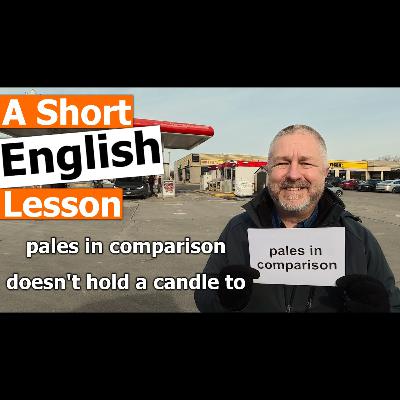
In this English lesson I wanted to help you learn the English phrase pales in comparison. So when you're talking about two things and one thing is significantly bigger or better or different in a way than something else, we say that it pales in comparison.Here would be a good example. Today is a beautiful day, but it pales in comparison to the day we had a few days ago when it was 15 degrees Celsius. So this day isn't as good as the other day. You might also use this to talk about a sports team.You might say, this year's team is good, but it pales in comparison to the team from 10 years ago that won the championship. The other phrase I wanted to teach you today is doesn't hold a candle to. And this is also a very similar phrase to do a comparison.If you're talking about two things and you say one thing doesn't hold a candle to the other thing, it means the first thing isn't as good as the second thing. So when people talk about sports again, they might say, you know what? Your team is good, but it doesn't hold a candle to my team, basically meaning my team is better.So to review, if something pales in comparison, it's not as good as something else, or it's not as big, or it can even be something bad. Like that storm pales in comparison to the one we had five years ago. So. So it can also be a negative thing and then doesn't hold a candle to is very similar.When you compare two things, it means the one thing is certainly more significant or bigger or different or worse than the other. But hey, let's look at a comment from a previous video. This comment is from Mohd Ags. Thanks for the short lesson, Bob the Canadian.There's been a lot of talk about banning the Canadian curling team from the Olympics because they touched the stone and people were like, that'll teach them not to cheat. Oh, nice use of the phrase. But not only did they get away with it, they even won the gold medal. P.S. phrases for the future pales in comparison and doesn't hold a candle to.Thanks for the suggestions. My response, I was a bit embarrassed about that. Not only did we double touch, we also claimed that we didn't and it was on video. Oh, well, I'm not sure it really makes a difference anyways. Maybe they should just allow double touching. Thanks for the phrases.Yeah, thanks Mohd for that. Thanks for the phrases and thanks for the comment. So, yeah, should they just allow double touching? Should that be what they do? I'm not sure if that would be the best solution. I don't know a lot about curling. You might be wondering, though, why am I here today? So this is the gas station.You might be able to guess why I'm here today. It's because I want to talk about gas prices. So gas prices are about to go through the roof. We're at $1.37.9 cents. I hope you can see that on the video.Because of things that are happening in the Middle East, it looks like gas prices are about to go through the roof. That's a good phrase. But that price pales in comparison to what we were paying over a year and a half ago or two years ago. We used to have an extra tax on it, so I think it was closer to a dollar fifty.And then I wanted to show you this bus, because someone in the last video. I forget who it was. It might have been Unsal commented on how it was cool to see the bus. The yellow bus like they normally just see in the movies. Might have been Vitor. Actually, sometimes I get people confused.I probably shouldn't say names when I'm remembering what people have left in comments, but, yes, that is what most school buses in North America look like. I would say 80, 90% of them probably look like that. I know in some US States, they might look a little bit different, but certainly in my part of Canada, that's what a school bus looks like.And that's what a gas station looks like. So, anyways, thanks for watching. You guys are awesome. Got a little bit of a loud truck going by there.

In this English lesson I will help you learn words and phrases that can be used to describe people in English. These aren't easy words like short and tall, but rather more advance words we use to describe someone's personality and behaviour in English. Once you know these words, you'll be able to describe friends, family members, and colleagues with ease.In this English lesson you'll learn words and phrases like: absentminded, awkward, clumsy, cruel, arrogant, jealous, adorable, generous, warm, impatient, aggressive, polite, calm, vulgar, lovable, violent, funny, lazy, honest, dishonest, loyal, and many more!I hope you enjoy this free English class about describing people! Have a great day!
 1
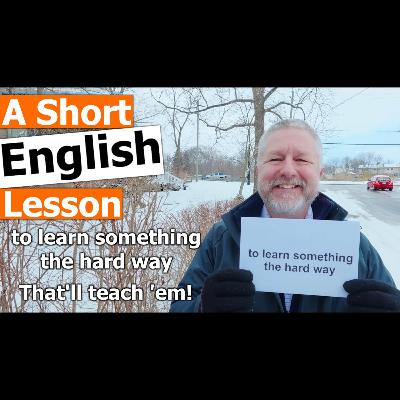
1Read along to practice your English and to learn the English phrases TO LEARN SOMETHING THE HARD WAY and THAT'LL TEACH'EM!TRANSCRIPT:In this English lesson, I wanted to help you learn the English phrase to learn something the hard way. This is a phrase... It's kind of a funny phrase because it means someone has learned something in a very difficult way. I should just give you an example so you know what I'm talking about.If you have the stove on and you accidentally touch the burner, you've learned something the hard way. You've learned that you shouldn't touch the burner on the stove when it's hot. When a small child first sees a candle and they all... they put their finger close to the flame and suddenly pull their finger away, they have, they've learned something the hard way.There are many things like this. When people first walk on ice, when people move to Canada and they first walk on ice and they slip and fall, they've learned the hard way that ice is slippery. I shouldn't laugh, but it happens sometimes.People just aren't aware of how slippery it is. The other phrase I wanted to teach you today is a little meaner. And it's the phrase that'll teach 'em, which is short for that will teach them or that will teach you or that will teach him or her. It simply means you see someone fall on the ice and in your mind you think that'll teach them, that'll teach them not to walk so quickly on the ice next time.Again, not a very nice thing to say. Kind of mean and kind of rude. But it's when you see someone do something where you would use the phrase to learn something the hard way. And then you say if you're really mean and rude, or you think if you're less mean and rude, that'll teach them.So to review to learn something the hard way, if you hit your thumb with a hammer, you have learned the hard way that a hammer is very hard and it will hurt you. And that if you put your thumb in a dumb spot and hit your thumb with a hammer and someone sees you, they might say, that'll teach them.But hey, let's look at a comment from a previous video. This comment is from Tacagero, and the comment is, Incredibly clean sidewalks. I see no snow at all. Very beautiful. Spring is around the corner, I guess. And my response, we try to keep things tidy, but as things warm up, the mud will come.Well, we've actually, thanks, Tacagero, for that comment. We've actually gone kind, of the other way here, in Ontario, Canada. Right now, as you can see, there's snow again. It's a little bit... I think it's starting to melt a little bit.That might also just be from the road salt. But, let me check if the snow is packy. Yeah, it's packy snow. So if you wanted, you could build a snowman today. That means it's probably one degree and the snow is starting to melt a little bit.And that makes it packy. It makes it what we call packing snow. And you can make a snowman. Maybe I should do that when I get home today. But, what were we talking about? Super clean sidewalks. Even when there is snow, the sidewalks are kept very clean.And I'm not sure if you can see there's actually salt. That little crystal there that I'm moving around with my foot is actually a salt crystal. And we put salt on the sidewalks, to make sure they don't freeze and get slippery.And so people who recently moved to this snowy climate don't fall. And have people say, that'll teach them, or so they don't have to learn something the hard way. I also wanted to show you this. As things start to melt, we have quite a bit of water flow in the local creek.Sometimes this creek dries right up, but today, as you can see, it's running quite well and it will go even higher as we get more and more snow melt in the area. Anyways, thanks for watching this short English lesson. I'll see you next week with another one.Bye.

In this English lesson, I’ll help you learn two of the nicest phrases you can use in everyday English conversations. These simple phrases help you sound friendly, polite, and natural when you finish talking with someone you know well. Whether you meet an old friend at the grocery store, run into a coworker in town, or catch up with family you haven’t seen in a while, these expressions will help you leave a great impression.You’ll learn how to use phrases like “it was nice seeing you.” “It was great to see you." and “It was nice talking with you.” along with when and why native English speakers use them.I hope this lesson helps you take another step forward in your English learning journey. Thanks for watching, and I’ll see you in the next English lesson!
I'm not a Science expert, but I know enough to be able to teach an English lesson about it. Join me for an in depth look at the words and phrases we use when talking about Science in English!In this English lesson you'll learn words and phrases like: experiment, microscope, test tube, lab coat, telescope, magnifying glass, petri dish, goggles, bunsen burner, and many more!I hope you enjoy this free English class about Science!

Read along to practice your English and to learn the English phrases TO PLAY DUMB and DUMB LUCK.TRANSCRIPT:In this English lesson, I wanted to help you learn the English phrase to play dumb. In English, when you play dumb, it means you pretend you don't know something when you actually do. The most common example would be when someone does something they're not supposed to, and then when asked about it, they might play dumb.If you watch a TV show and the cops arrest the criminal, the criminal might play dumb and say, I don't know what you're talking about. I didn't steal that car. As a teacher, sometimes I'll catch students doing something, and then when I ask them what they were doing, they play dumb.They pretend that they didn't do what I saw them do. The other phrase I wanted to teach you today is dumb luck. Dumb luck simply means that something happens to you that's good and it's not because of anything that you've done to make it happen.So a great example of this would be you suddenly, let me see. I'm trying to think. A good example of dumb luck would be you're driving along and you lose control of car in the snow, but you don't go in the ditch. But it has nothing to do with you steering properly or anything.It's just dumb luck. You didn't go in the ditch because of dumb luck. So to review. To play dumb means to pretend you don't know something when you actually do, usually when someone's accusing you of doing something wrong. And dumb luck simply means to be extremely lucky.And you had no... not because of anything that you did. Sorry, I'm a little distracted with all the traffic this morning. I'm doing this during morning rush hour in my town. But, hey, let's look at a comment from a previous video. This comment is from Tammy.Yes, my son likes to use the expression, oh, shoot from time to time. Thank you. And my response is it's better than the alternative, which is kind of a minor, vulgar, word. And then Tammy says, you can say that again. Great use of the phrase. You can say that again, Tammy.And thanks for the comment. So, yes, I am here in my local town. You can see behind me. Let me get you guys a little further away so you can see a bit more. You can see behind me that, well, there's a school bus over there because kids are getting picked up for school.As you know, I teach in the afternoon now, so I'm here in the morning shooting my video. Yes, I did leave my tripod all by itself over there on the sidewalk. We're hoping no one takes it. And this is what I look like.There I am in the window, shooting my video on a nice quiet morning here in town. I do have to admit a couple of things. One, in spite of the fact that I love winter, I do find it way easier to make videos when the weather's a bit warmer.You can see that I'm just wearing a jacket right now. Actually, these... These windows really do help. You can see I'm just wearing a light jacket right now. You can see that people are out and about, just wearing a ball cap instead of a winter hat.There's even just people standing, checking their phones. Like, even just last week or a week and a half ago, that would not have been happening. It was far too cold for people to be outside and being somewhat leisure or to be moving at a slower pace.So in spite of the fact that I love winter, I must admit, it is much nicer being out here today. I am putting my hand in my pocket occasionally, though, just to warm it up a little bit. But, yeah, this is just much nicer than it was.Anyways, I hope you enjoyed this little English lesson, and I'll, see you next week with another one. Bye.

In this English lesson I'll help you learn vocabulary that describes those days when the sun isn't shining. You’ll learn words and phrases like overcast, drab, dreary, gloomy, blah, glum, and miserable so you can describe the forecast and your feelings with confidence.In this English class you’ll hear clear explanations, simple examples, and natural sentences so you can use these words in everyday conversation. Whether you're talking about the weather, your mood, you’ll sound more fluent and expressive.I hope you enjoy this English lesson about a dreary day!

In this English lesson, I will help you learn some verbs we use to talk about buying and selling. These verbs are perfect to use when talking about shopping, business purchases, and online orders.In this English lesson, you will learn these verbs: to buy, to sell, to purchase, to pay, to charge, to spend, to afford, to order, to refund, to return, to make an offer, to accept an offer, to negotiate, to discount, to resell, to trade, to invoice, and more!By the end of this free English class, you will be able to talk about prices, payments, orders, and simple business situations with more confidence and accuracy. I hope you enjoy this English lesson about buying and selling.
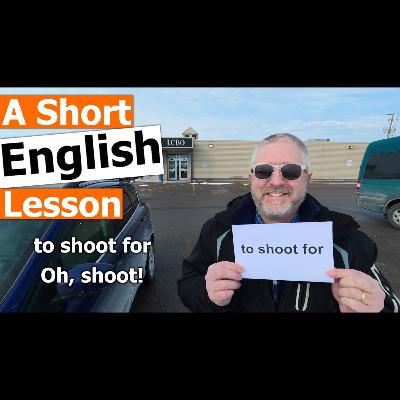
Read along to practice your English and to learn the English phrases "to shoot for" and "Oh, shoot!"TRANSCRIPT:In this English lesson, I wanted to help you learn the English phrase to shoot for. When you shoot for something, it means you're planning to do that. If you were to ask me, Bob, how many videos, how many English lessons are you going to put out on this channel? I'm going to shoot for one per week.I'm going to try and put out one video per week. I know in the past, I was putting out two per week, but I feel like as I relaunch this channel, I think I'm going to shoot for one English lesson per week. And I will probably shoot for putting that English lesson out on Wednesdays.So it's Tuesday right now, if you haven't figured it out. So when you shoot for something, it means you plan on doing that. The other phrase I wanted to teach you today is the phrase oh, shoot. And this is just a really nice way of saying a different word so that you don't say that word, which is kind of a curse word or swear word.When you say oh, shoot, it's an exclamation that you make when something goes wrong. If I dropped this paper, I'd be like, oh, shoot. But if I wanted to say something a little bit more crude, if, I wanted to use a swear word, I would use the word that starts with the same two letters and ends with the same letter, but instead of two O's, it has an I in the middle.And I think you know what I'm talking about. It's not a super, like, bad swear word, but it is a swear word. So. So when you say oh, shoot, it simply means, something just went wrong. So to review, when you shoot for something, it means you are aiming for that, you are trying to accomplish that.And when you say oh, shoot, it's the same as saying oh, sh. Maybe I'll just switch and go to a comment from a previous video instead of actually saying that word. Let me get the comment out. This comment is from Judit or Aerosmith77.It was a really good start with two videos. Do I remember well, your videos were cut for 4 minutes and 8 seconds. This video lasted 4 minutes and 18 seconds. Is it planned this way also? Thank you for the video and my response. I used to stop at exactly four minutes, but now I tend to go over a bit if I go too long the transcript doesn't fit in the description box below the video.There is a 5,000 character limit, so I shoot for four minutes. So thanks, Judit. Thanks, Aerosmith77 for that comment. So, yes, if I talk for too long or if I talk too fast, then, the transcript doesn't fit in the description below the video.So I usually try to aim for about four minutes, because that's kind of like the sweet spot. I guess I say about 5,000 letters or that many words. Hard to kind of explain this. I say about 5,000 letters in about four minutes.This is getting boring. I should show you something exciting. Let me switch quickly and say, here is a camper van, or more of a camper. I guess it's a little big to be called a camper van. I'm not sure what this is doing in my local town.It is not camping season. I also think there's a dog inside, so I'm not going to go close to that at all. If you remember, a few years ago, I had a bad experience with two dogs running out, and, they were pretty vicious. Not from a camper, but, while I was walking down the road.But, I'm not sure what that's doing out and about. Oh, like, I got 30 seconds left. I have to be careful here. I... I'm not sure what that's doing out and about in February, but, as you can see, I have no winter hat and no gloves because I think it might actually be one degree now, I thought earlier it was minus two or minus one, but, man, it feels a lot warmer than that.So, anyways, thanks for watching this short English lesson, and I'll have another one ready for you, in a week. Bye.
In this English lesson I will help you learn about regional differences in the English language. What might seem like a mistake in one place, might actually be fine in another.In particular I talk about the verbs to bring and to take, which to native English speakers in my area can be used interchangeably in different situations.I hope you enjoy this English lesson. Have a great day!

In this English live lesson I'll spend about 1 hour answering all of your questions about the English language. Come and enjoy the time together in the chat with other English learners and pick up a few things! I'm sure you'll enjoy it!In this live English class you can ask me questions about the English language, or anything else that you've been wanting to ask a native English speaker, and I'll do my best to answer them. I'm always happy to help!This English lesson is from Saturday February 7, 2026.

In this fun and practical English lesson, you’ll learn quirky, everyday idioms and expressions that native speakers use all the time in real conversations. These sayings can sound strange at first, but once you understand them, they make your English sound more natural, relaxed, and confident.In the English class I'll help you learn phrases like: an apple a day keeps the doctor away, to hold your horses, to spill the beans, to hit the nail on the head, to bark up the wrong tree, to pull someone’s leg, to go off the rails, to be on thin ice, to throw in the towel, and many more! You’ll hear what each one means, when people use it, and how it to pronounce each one.By the end of this lesson, you’ll be able to recognize these playful expressions when you hear them and start using them naturally in your own speaking. I hope you enjoy this English lesson about idioms!
Read along to practice your English and to learn the English phrases "in good shape" and "in bad shape"In this English lesson, I wanted to help you learn the English phrase in good shape. When we say something is in good shape, it means that, well, let's say we're talking about a vehicle. That would mean it has no rust on it. The engine runs really, really well. The thing is in good shape.The thing is, not falling apart. That would be the opposite. You can also use this to talk about people. If you say he's in good shape, it usually means he has some muscles and he's healthy. He's not overweight. He's in good shape. The other phrase I wanted to teach you today is the phrase in bad shape.Now, if I was talking about a vehicle and I said it was in bad shape, that would mean it's probably rusty. It probably has holes in the side. When you try to start it, it might not start the first time it is in bad shape.But when we talk about people, this means something slightly different. If you're in good shape, you're healthy and you have muscles and you're not overweight. But when you're in bad shape, it sometimes means that you're hurt. After a car accident, you might say, oh, he's in bad shape.He has a broken arm and he has a broken leg. Then that person would be in bad shape. So it doesn't mean the opposite of healthy. It more means, like, injured. So to review, if a car is in good shape, it means that it looks really good.The paint looks good, the engine runs very smoothly. If a person's in good shape, it means that they're healthy and muscular and go to the gym a lot. If a car or something else is in bad shape, it means it probably has rust on it and the engine doesn't run well. If a computer is in bad shape, it means it just doesn't turn on all the time.And if a person is in bad shape, it usually is used to describe them after something like a car accident when they have, injuries. But, hey, let's look at a comment from a previous video. This comment is from Mahsa.Hello, Bob. Oh, hello, Mr. Bob. You haven't been active on this channel in the last few months. What was the reason in my response, And I have said this a number of times, so sorry if you've heard this a million times. I broke my collarbone last summer, and it has taken a while for me to feel a hundred percent.I also had a very busy schedule in the fall at school. Now I'm feeling much better, and my schedule is much nicer. So, thanks, Mahsa, for that, question. And, it was fun to be able to kind of let you know the reason and I'll explain in a little more detail.I didn't just break my collarbone. I also tore a hamstring. And that seems to have caused it to take a long time for me to heal. But I have been feeling pretty good since last fall. But in the school year, there are semesters.And last semester, or in my school year, not every school has that. I had, to teach period two and three. So I basically was at work almost like it was full time. When I normally teach part time, I either teach for most of the morning or most of the afternoon.And so that was a little different for me. I've never had that schedule before. And it was, hard to get used to. I found I was spending more time at work than I should have been. By the way, this van, it's in good shape, sort of, but it is starting to rust a little bit.It's our least reliable vehicle. It's not on the road right now. We take it off the road in the winter, because we don't have as many drivers. Two of my kids are at university. So yeah, my semester, last semester was really busy. Now I'm teaching in the afternoons.So when I go to work, on a Monday, when, I go to work this Monday, I will... Oh, by the way, it's the weekend right now. I'm recording this early. I should have told you that. Not that that's that important. Anyways, I don't have to go to work until about 10 or 11 in the morning.Anyways, that's it for this little short lesson. I'll see you next week with another short English lesson.
In this practical English lesson, you’ll learn three simple but powerful habits that can help improve how you study English. I'll talk about why repetition really works, how consistency is a great addition to repetition, and why learning English requires the ability to challenge yourself.You’ll hear clear, real-life advice on how to use repetition the smart way, and how small daily routines can make your English improve faster and more naturally. I will also share a personal example from learning French, plus easy ideas you can use right away with videos, subtitles, and reading.Finally, we look at the third key habit: challenging yourself. If you always stay in your comfort zone, your English stays there too. In this lesson, you’ll learn why gradually using harder material is essential for real progress and how to do it without feeling overwhelmed. I hope you enjoyed this short, motivating lesson for serious English learners who want steady, real results! Have a great day!
In this English lesson I'll help you learn cold and snowy English words and phrases. It's been freezing cold, wintery, and snowy here lately so this lesson topic was pretty easy to make. If you live somewhere that has cold winters, or if wintery weather is something you want to learn how to talk about in English then I think you'll enjoy this lesson.In this English lesson I'll help you learn words and phrases like: polar vortex, to do donuts with a car, black ice, snow squall, to brave the cold, whiteout, drifting, snowdrift, snow day, snowplow, and many more!I hope you don't get too cold as you enjoy this free English class about snowy, wintery weather! Have a warm and cozy day!
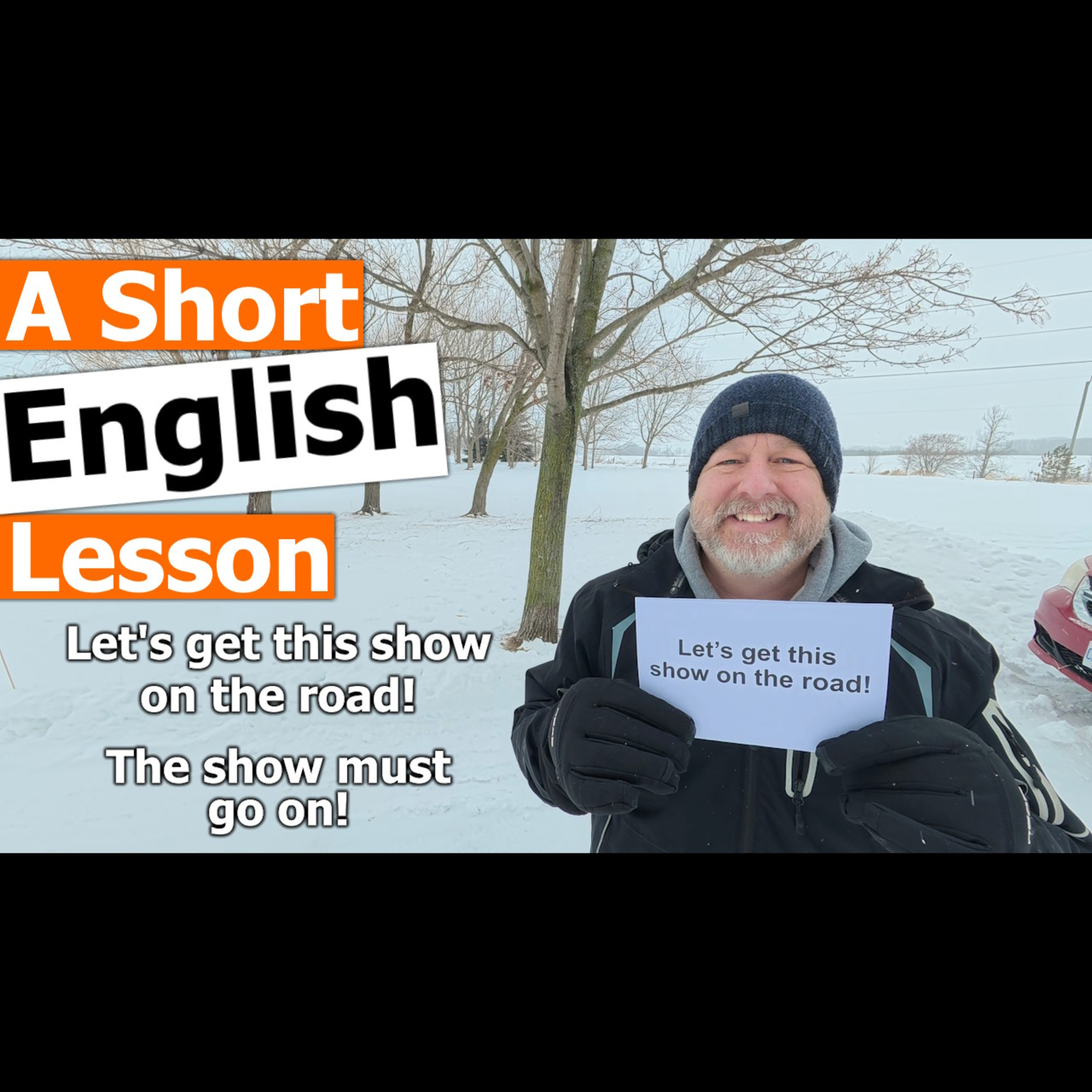
Read along to practice your English and to learn the English phrases "Let's get this show on the road!" and "The show must go on!"Okay, let's see if I remember how to do this. Here we go. In this English lesson, I wanted to help you learn the English phrase, let's get this show on the road. This is kind of a humorous phrase we use when we are starting to do something at the beginning of a school year.I might say to my colleagues, okay, let's get this show on the road. It basically means, let's get the school year started. I haven't posted a video on this channel for a long time, since the end of May last year. And so I thought it would be a good time to get this show on the road again.Yeah, I think I remember how to do this. And now what do I say? I say, the other English phrase I wanted to teach you today is the show must go on. So this is another thing that we say. Usually when something is already happening and then maybe something happens to disrupt it, and then someone might say, you know, the show must go on.And this is all related to the theater. So if you were in a play and if one of the actors was injured, someone else would play their part because the show, the show must go on. So to review, let's get this show.This is hard to do with gloves. Let's get this show on the road simply means it's time to get something started. And when you say the show must go on, it means that, whatever it is that you are doing must continue in spite of things may be going wrong.But hey, let's look at a comment from a previous video. This comment is from... Let me get my glove back on here. Let me do the mouth glove trick. Oh, now I can't undo the paper. I'll get better at this, by the way.This comment is from Unsal. Hello. Mr. Bob had a sports injury a while ago, so he paused this channel. Thankfully, he's doing much better now and has started. Okay, I'm back. Apparently the first printout didn't have all the words on it, so this one does.This comment is from Unsal and he's responding to someone called jathebest, who was asking about me, way back in May, I think six months ago. Hello. Mr. Bob had a sports injury a while ago, so he paused posting on this channel. Thankfully, he's doing much better now and has started sharing content again on his other channel called Learn English with Bob the Canadian.He also talked about what happened there. I recommend checking it out. There's lots of helpful content. Have a great day. Bye. And then my response, which is actually from today thanks for directing people to my main channel, Unsal, and thanks for the kind words. So, yes, thank you, Unsal, for that.And, yeah, it's been a bit of a break. Right. This channel has been on pause. I, have never really indicated whether I was going to start doing it again. I thought I might start doing it again. I had this plan where I might do one video a month.And that never really materialized. And to be honest, I feel like I just finished a really busy semester and now I think I have time to do some videos on this channel again. I'm going to start with one per week. I know I used to do two per week. And I am going to try and do, a balance of some in town and some here at home so people get a view of what's going on.And then, just an update, if you want to know. I am holding this camera at full length with the arm where I broke my collarbone and it feels great. So I think I am on the mend. I think things are getting a lot better. I know it's been months, but apparently when you're older like me, it does take a while, to heal.So what should I do? I should show you a bit of the property as I talk. You can see we have some very, very deep snow piles here. And I should make sure that I don't turn you too quickly because I'm using a different camera now.I used to use the DJI Pocket 3, but now I'm using a DJI Action 6. The reason I've switched is the Action 6 keeps everything in the background in focus.
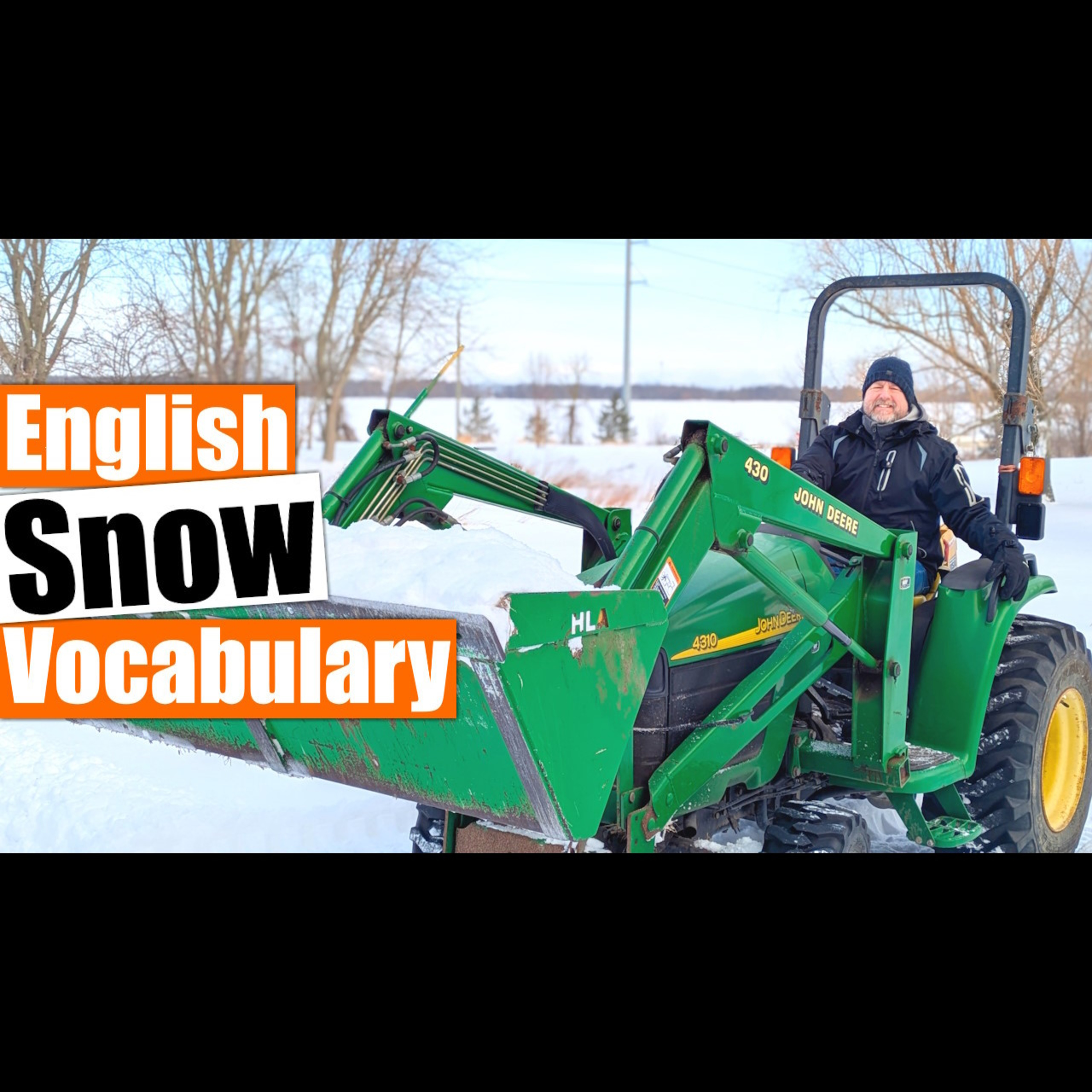
In this English lesson, I'll help you learn words and phrases English speakers use when talking about dealing with snow. If you live in a snowy place or just want to understand winter conversations better, this lesson has you covered. Jen brought out an extra camera, and the drone, so enjoy the learning, and enjoy the views!In this English class I'll help you learn common words and phrases like to plow snow, to push snow, to clear snow, to clean your driveway, to scrape snow, and to dump snow, along with useful winter nouns like snow drift and snow pile. You’ll hear how these phrases are used in real situations after a night of heavy snow and being snowed in.By the end of this lesson, you’ll be able to talk naturally and confidently about snow removal and winter work after a storm in your next English conversation.I hope you enjoy this English lesson about snow removal!

In this English lesson, you’ll learn common verbs that English speakers use when talking about physical, hands-on work. These are the action verbs people use when they’re building something, fixing a problem, setting things up, or working directly with tools, equipment, and materials.In this English class you'll learn the following verbs: to attach, to mount, to coil, to hoist, to wind, to secure, to fasten, to adjust, to tighten, to loosen, to hang, to roll up, to wrap, to install, to clamp, to connect, to link, to tie, to hook, to place, to position, to align, to suspend, to assemble, to disassemble, to reinforce, to replace, and to repair.Each verb is explained with clear examples so you can see how it’s used in real, practical situations.By the end of the lesson, you’ll be able to talk about physical tasks with more confidence and precision in English. I hope you enjoy this English lesson about hardworking verbs!Note: This is the audio portion of a Youtube English lesson which you can watch right here: https://www.youtube.com/watch?v=oJ7LgCnIeA8 or by searching Youtube for, "Bob the Canadian Hardworking"

In this English lesson, I'll help you learn common words and phrases that English speakers use to describe people who have lots of money. These phrases are very common in everyday conversation, movies, TV shows, and news stories. Understanding them will help you sound more natural and better understand real spoken English.In this lesson, you'll learn words and phrases like: well-off, loaded, well-to-do, doing well for themselves, more money than they know what to do with, money to burn, filthy rich, and made of money. You’ll learn what each phrase means, and I'll give some example phrases for each one.By the end of this lesson, you’ll be able to talk about wealth and financial success clearly and confidently. I hope you enjoy this English lesson about describing rich people! Have a great day!Note: This is the audio portion of a Youtube English lesson which you can watch right here and the full transcript is in the description there: https://www.youtube.com/watch?v=AHpyC1mKcd4 or by searching Youtube for, "Bob the Canadian Rich"

In this English lesson, I’ll help you learn words and phrases that English speakers use to talk about the challenges and difficulties of everyday life.Everyone has good days and rough days. Life isn’t always easy, and we all deal with ups and downs in different ways. In this lesson, I’ll cover common issues that can make daily life feel harder, including things that affect our thoughts, our emotions, our relationships, and our personal well-being.In this English class, you’ll learn vocabulary and phrases such as: getting up on time, having a big mouth, too many responsibilities, anger issues, overeating, lack of motivation, social media, self-esteem, being overworked, being underpaid, relationship problems, and more.I hope this lesson helps you better understand and talk about real-life struggles in English.Note: This is the audio portion of a Youtube English lesson which you can watch right here and the full transcript is in the description there: https://www.youtube.com/watch?v=yFmJWWUVr9k or by searching Youtube for, "Bob the Canadian Struggles and Problems"


Download from Google Play

Download from App Store
 United States
Hi Bob! It looks strange but from 551 episodes it doesn’t play. I mean I can’t listen to the audio here in podcasts :( Can you check? May be there is an issue with audio format or codecs? Thanks a lot.
Hi, I really enjoy your podcast. If you write down the terms, we can learn more.
great
💓
nice👍
🧚🧞
Like
Thank you Bob, this lesson covers huge hole in my English
💎❤️
thank you dear Bob 🍀🌷
thanks, Bob. so useful. How can I have your title we you talk to? I want to see your speak
perfect
perfect
perfect, i really enjoyed learning these words.
Thank you, Bob! It’s cool that you run podcasts.
🙏❤️
great
✅❤️
🙏💓
you are one of the best 💓