


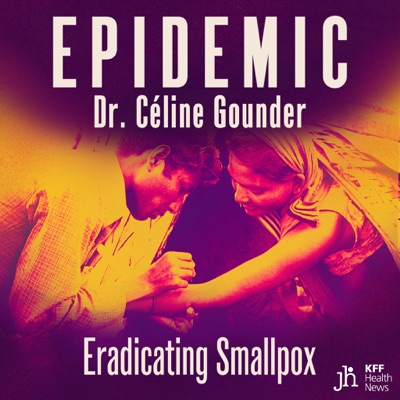
EPIDEMIC with Dr. Celine Gounder
Subscribed: 3,199Played: 125,241
Subscribe

© All rights reserved
Description
Eradicating Smallpox: The Heroes that Wiped out a 3,000-Year-Old Virus
One of humanity’s greatest triumphs is the eradication of smallpox. This new eight-episode docuseries, “Eradicating Smallpox,” explores this remarkable feat and uncovers striking parallels and contrasts to recent history in the shadows of the covid-19 pandemic.
Host Céline Gounder brings decades of experience working on HIV in Brazil and South Africa, Ebola during the outbreak in New Guinea, and covid-19 in New York City at the height of the pandemic. She travels to India and Bangladesh to bring never-before-heard stories from the front lines of the battle to wipe smallpox off the face of the Earth.
“Epidemic” launched in early 2020 and quickly became a key source of reporting on the rapidly unfolding coronavirus pandemic. The show premiered at No. 1 in health and fitness and No. 1 in medicine on the Apple Podcast charts.
One of humanity’s greatest triumphs is the eradication of smallpox. This new eight-episode docuseries, “Eradicating Smallpox,” explores this remarkable feat and uncovers striking parallels and contrasts to recent history in the shadows of the covid-19 pandemic.
Host Céline Gounder brings decades of experience working on HIV in Brazil and South Africa, Ebola during the outbreak in New Guinea, and covid-19 in New York City at the height of the pandemic. She travels to India and Bangladesh to bring never-before-heard stories from the front lines of the battle to wipe smallpox off the face of the Earth.
“Epidemic” launched in early 2020 and quickly became a key source of reporting on the rapidly unfolding coronavirus pandemic. The show premiered at No. 1 in health and fitness and No. 1 in medicine on the Apple Podcast charts.
95 Episodes
Reverse
 1
1In 1975, smallpox eradication workers in the capital of Bangladesh, Dhaka, rushed to a village in the south of the country called Kuralia. They were abuzz and the journey was urgent because they thought they just might be going to document the very last case of variola major, a deadly strain of the virus. When they arrived, they met a toddler, Rahima Banu.She did have smallpox, and five years later, in 1980, when the World Health Organization declared smallpox eradicated, Banu became a symbol of one of the greatest accomplishments in public health.That’s the lasting public legacy of Rahima Banu, the girl.Episode 8, the series finale of “Eradicating Smallpox,” is the story of Rahima Banu, the woman — and her life after smallpox.To meet with her, podcast host Céline Gounder traveled to Digholdi, Bangladesh, where Banu, her husband, their three daughters, and a son share a one-room bamboo-and-corrugated-metal home with a mud floor. Their finances are precarious. The family cannot afford good health care or to send their daughter to college.The public has largely forgotten Banu, while in her personal life, she faced prejudice from the local community because she had smallpox. Those negative attitudes followed her for decades after the virus was eradicated. “I feel ashamed of my scars. People also felt disgusted,” Banu said, crying as she spoke through an interpreter. Despite the hardship she’s faced, she is proud of her role in history, and that her children never had to live with the virus. “It did not happen to anyone, and it will not happen,” she said.Voices From the Episode:Rahima BanuThe last person in the world to have a naturally occurring case of the deadliest strain of smallpoxNazma BegumRahima Banu’s daughterRafiqul IslamRahima Banu’s husbandAlan SchnurFormer World Health Organization smallpox eradication program worker in BangladeshFind a transcript of this episode here.“Epidemic” is a co-production of KFF Health News and Just Human Productions.To hear other KFF Health News podcasts, click here.Subscribe to "Epidemic” on Apple Podcasts, Spotify, Google Podcasts, Pocket Casts, or wherever you listen to podcasts. Hosted by Simplecast, an AdsWizz company. See pcm.adswizz.com for information about our collection and use of personal data for advertising.
The 1970s was the deadliest decade in the “entire history of Bangladesh,” said environmental historian Iftekhar Iqbal. A deadly cyclone, a bloody liberation war, and famine triggered waves of migration. As people moved throughout the country, smallpox spread with them.In Episode 7 of “Eradicating Smallpox,” Shohrab, a man who was displaced by the 1970 Bhola cyclone, shares his story. After fleeing the storm, he and his family settled in a makeshift community in Dhaka known as the Bhola basti. Smallpox was circulating there, but the deadly virus was not top of mind for Shohrab. “I wasn’t thinking about that. I was more focused on issues like where would I work, what would I eat,” he said in Bengali.When people’s basic needs — like food and housing — aren’t met, it’s harder to reach public health goals, said Bangladeshi smallpox eradication worker Shahidul Haq Khan.He encountered that obstacle frequently as he traveled from community to community in southern Bangladesh.He said people asked him: “There's no rice in people's stomachs, so what is a vaccine going to do?”To conclude this episode, host Céline Gounder speaks with Sam Tsemberis, president and CEO of Pathways Housing First Institute.He said when public health meets people’s basic needs first, it gives them the best shot at health.In Conversation With Host Céline Gounder:Sam TsemberisFounder, president, and CEO of Pathways Housing First Institute@SamTsemberisVoices From the Episode:ShohrabResident of the Bhola basti in DhakaIftekhar IqbalAssociate professor of history at the Universiti Brunei DarussalamShahidul Haq KhanFormer World Health Organization smallpox eradication program worker in BangladeshFind a transcript of this episode here.“Epidemic” is a co-production of KFF Health News and Just Human Productions.To hear other KFF Health News podcasts, click here.Subscribe to "Epidemic” on Apple Podcasts, Spotify, Google Podcasts, Pocket Casts, or wherever you listen to podcasts. Hosted by Simplecast, an AdsWizz company. See pcm.adswizz.com for information about our collection and use of personal data for advertising.
Global fears of overpopulation in the ’60s and ’70s helped fuel India’s campaign to slow population growth. Health workers tasked to encourage family planning were dispatched throughout the country and millions of people were sterilized: some voluntarily, some for a monetary reward, and some through force. This violent and coercive campaign — and the distrust it created — was a backdrop for the smallpox eradication campaign happening simultaneously in India. When smallpox eradication worker Chandrakant Pandav entered a community hoping to persuade people to accept the smallpox vaccine, he said he was often met with hesitancy and resistance.“People's bodies still remember what was done to them,” said medical historian Sanjoy Bhattacharya.Episode 6 of “Eradicating Smallpox” shares Pandav’s approach to mending damaged relationships.To gain informed consent, he sat with people, sang folk songs, and patiently answered questions, working both to rebuild broken trust and slow the spread of smallpox. To conclude the episode, host Céline Gounder speaks with the director of the global health program at the Council on Foreign Relations, Thomas Bollyky. He said public health resources might be better spent looking for ways to encourage cooperation in low-trust communities, rather than investing to rebuild trust. In Conversation With Host Céline Gounder:Thomas BollykyDirector of the global health program at the Council on Foreign Relations@TomBollykyVoices From the Episode:Chandrakant PandavCommunity medicine physician and former World Health Organization smallpox eradication worker in India@pandavcs1Gyan PrakashProfessor of history at Princeton University, specializing in the history of modern India@prakashzoneSanjoy BhattacharyaMedical historian and professor of medical and global health histories at the University of Leeds@joyagnost Find a transcript of this episode here.“Epidemic” is a co-production of KFF Health News and Just Human Productions. To hear other KFF Health News podcasts, click here.Subscribe to “Epidemic” on Apple Podcasts, Spotify, Google Podcasts, Pocket Casts, or wherever you listen to podcasts. Hosted by Simplecast, an AdsWizz company. See pcm.adswizz.com for information about our collection and use of personal data for advertising.
In spring 1974, over a dozen smallpox outbreaks sprang up throughout the Indian state of Madhya Pradesh. Determined to find the source of the cases, American smallpox eradication worker Larry Brilliant and a local partner, Zaffar Hussain, launched an investigation.The answer: Each outbreak could be traced back to Tatanagar, a city run by one of India’s largest corporations, the Tata Group.When Brilliant arrived at the Tatanagar Railway Station, he was horrified by what he saw: people with active cases of smallpox purchasing train tickets. The virus was spreading out of control.Brilliant knew that to stop the outbreak at its source, he would need the support of the company that ran the city. But he wasn’t optimistic the Tata Group would help.Still, he had to try. So, Brilliant tracked down a Tata executive and knocked on his door in the middle of the night.Brilliant’s message: “Your company is sending death all over the world. You're the greatest exporter of smallpox in history.”Much to his surprise, the leaders of Tata listened.Episode 5 of “Eradicating Smallpox” explores the unique partnership between the Tata Group and the campaign to end the virus. This collaboration between the private and public sector, domestic and international, proved vital in the fight to eliminate smallpox.To conclude the episode, host Céline Gounder speaks with NBA commissioner Adam Silver and virologist David Ho about the basketball league’s unique response to covid-19 — “the bubble” — and the essential role businesses can play in public health. “We need everyone involved,” Ho said, “from government, to academia, to the private sector.”In Conversation With Host Céline Gounder:Adam SilverCommissioner of the NBADavid HoDirector and CEO of the Aaron Diamond AIDS Research CenterVoices From the Episode:Larry BrilliantFormer World Health Organization smallpox eradication worker in India@larrybrilliant Find a transcript of this episode here.“Epidemic” is a co-production of KFF Health News and Just Human Productions.To hear other KFF Health News podcasts, click here.Subscribe to “Epidemic” on Apple Podcasts, Spotify, Google Podcasts, Pocket Casts, or wherever you listen to podcasts. Hosted by Simplecast, an AdsWizz company. See pcm.adswizz.com for information about our collection and use of personal data for advertising.
At noon ET on Thursday Sept. 14, Epidemic host Céline Gounder and her guests will come together for a live web event. Click here to register for the event.In Conversation With Host Céline Gounder:Helene D. Gayle, a physician and an epidemiologist, is president of Spelman College. She is a board member of the Bill & Melinda Gates Foundation and past director of the foundation’s program on HIV, tuberculosis, and reproductive health. She spent two decades with the Centers for Disease Control and Prevention focusing primarily on HIV/AIDS prevention and global health.William H. “Bill” Foege is an epidemiologist and a physician, and was a leader in the campaign to end smallpox during the 1970s. Foege is featured in Episode 2 of the “Eradicating Smallpox” docuseries.Submit your questions for the panel here. Hosted by Simplecast, an AdsWizz company. See pcm.adswizz.com for information about our collection and use of personal data for advertising.

Comments

Download from Google Play

Download from App Store
 United States