


 Claim Ownership
The Leadership Hacker Podcast
Subscribed: 27Played: 637
Subscribe

© Copyright 2020 All rights reserved.
Description
This is the leading Podcast for Leadership globally. You’ll listen to top authors, C-suite executives and leadership coaches and unlock tips, ideas, insights along with top leadership hacks. It’s your way to tap into some of the best and most experienced leaders and business coaches in the world.
124 Episodes
Reverse

Dr Ciela Hartanov was part of the founding team of The Google School for Leaders and Head of Next Practice Innovation and Strategy at Google, She is a psychologist and human behavioural expert and is the founder and CEO of Humcollective, in this episode, you can learn:
Why some leaders run towards disruption with excitement yet others will be afraid?
How we become our own psychological architects.
What is "Innovating Next Practice?”
The four perspectives of emergent mindset.
Join our Tribe at https://leadership-hacker.com
Music: " Upbeat Party " by Scott Holmes courtesy of the Free Music Archive FMA
Transcript: Thanks to Jermaine Pinto at JRP Transcribing for being our Partner. Contact Jermaine via LinkedIn or via his site JRP Transcribing Services
Find out more about Ciela below:
Ciela on LinkedIn: https://www.linkedin.com/in/cielarose/
Ciela on Twitter: https://twitter.com/CHartanov
Humcollective Website: https://www.humcollective.co
Full Transcript Below.
----more----
Steve Rush: Some call me Steve, dad, husband, or friend. Others might call me boss, coach or mentor. Today you can call me The Leadership Hacker.
Thanks for listening in. I really appreciate it. My job as the leadership hacker is to hack into the minds, experiences, habits and learning of great leaders, C-Suite executives, authors, and development experts so that I can assist you developing your understanding and awareness of leadership. I am Steve Rush, and I am your host today. I am the author of Leadership Cake. I am a transformation consultant and leadership coach. I cannot wait to start sharing all things leadership with you.
Dr. Ciela Hartanov is a special guest on today's show. She's an ex-Google executive, psychologist and the founder and CEO of humcollective. But before we get a chance to speak with Ciela, it's The Leadership Hacker News.
The Leadership Hacker News
Steve Rush: It's been a while since we've dug into the history books to find those lessons of leadership that we can draw on. So, I thought we'd start with a couple today. In the early 1960s, a marine biologist and author, Rachel Carson was working to overcome some immense personal and professional challenges. On top of writing what would ultimately become Silent Spring. Her watershed book, exposing the dangers of synthetic pesticides and their impact on the environment. Carson was fighting a battle on a whole other front, cancer. Professor, Nancy Cohen, chronicled the stories of her and others for Harvard Business School and Cohen focused on attitudes and actions in the face of crisis that made a positive difference to the world. Carson's moment of forging her crucible, stretched out for more than two years, Cohen writes, this long slow burn demanded again and again, that she find her way back from the perceptive despair and then recommit to her mission.
Her ability to stay the course, finish her book and exert enormous impact was fueled only by her unrelenting dedication to a mightier cause. Despite being played by a series of health complications that took great physical and emotional tolls. Carson remained staunchly committed to her mission. Cohen described it as to bring the wonders of the natural world to the public and to spotlight the responsibility we each have to protect the earth and to sustain all life and Cohen notes that unlike many other prominent leaders throughout history known for their charisma or aggressiveness and assertiveness. Carson was shy in retiring, almost quite introvert whose leadership approach was characterized by a quiet, determination, resilience, and stone wall commitment to doing purposeful and driven work.
Frederick Douglas was an abolitionist like Carson. He was driven by deep sense of mission. After escaping from slavery in 1838, he used his experience in bondage to become a leader in the anti-slavery movement and a champion for black freedom. In her book Cohen notes. Douglas realized that in order to enact large scale change, he had to be self-committed and to create his own internal, moral, intellectual, and emotional infrastructure, a framework for both understanding the power of slavery and how to consistently and effectively combat it. Douglas devoted a great deal of effort to building his framework within himself. He then used us to develop an effective leadership style. This would've been thorny and complicated work. We can often imagine the series of conversations he'd ever had with himself as he started to work through his own architecture. Cohen had written that these internal discussions had formed a cornerstone of Douglas's leadership, helping him make day to day choices, communicate with the mission and navigate through the moments of doubt and despair. All individuals who aspire to lead effectively must build their own foundation.
Throughout his life. Douglas used his perspective and personal experiences as tools to fight for social change. He also used his writing and public speaking to inspire others, to stand with him and Douglas recognized that making a significant impact required motivating and empowering his fellow citizens and used his communication progress to achieve that objective successfully. Cohen goes on to write. We long for a leader like Frederick Douglas, who understood that the country could only achieve its full potential when Americans faced and write the critical wrong that Douglas led from the lecture hall and from the newspaper stand, which was as much or more than he did through the offices of elite politicians. He believed that positive change began with ordinary citizens and his work, a leader to help them affect the individuals who governed them. So, their leadership hack here is, whether you are a mid-career professional or an emerging senior leader or brand new to leading others.
The stories that these iconic individuals in part are important, real-life lessons that we can learn from. So, by fostering engagement and cohesion, amongst your team, finding a purpose that connects your passion and developing a leadership approach that informs how you inspire and mobilize others. You can become a more courageous leader and take your career to the next level. That's been The Leadership Hacker News. Big shout out to Karen, one of our regular listeners. Who's introduced us to the work of Professor Nancy Cohen. If you've got any insights or stories that you want us to showcase, please get in touch.
Start of Podcast
Steve Rush: Dr. Ciela Hartanov is our special guest on today's show. She was part of the founding team and the Google School of Leaders. She was Head of the next practice Innovation Strategy at Google. She's now a Psychologist and a Human Behavioral Expert and the founder and CEO of humcollective, and innovation strategy firm, preparing organizations for the future. Ciela, welcome to The Leadership Hacker Podcast.
Dr. Ciela Hartanov: So lovely to be here. Thank you for having me.
Steve Rush: So, I'm really fascinated to learn about how you meandered through corporate life to end up leading humcollective. Tell us a little bit about the journey?
Dr. Ciela Hartanov: Well, meander would be a good description of how I think careers are built these days. When I started graduate school, I actually thought I was going to be an academic and that was my presumed path. And there was a sister school to my school that I was attending in cultural psychology in IO psych school. So, I started moonlighting and wondering, hmm, what are these other students doing? What are they learning? And I realized, you know, it was fascinating because I was learning a lot about culture, human behavior, and organizations from a very specific sort of academic lens. But on the IO psych side of the school, they were actually working with organizations, and they had projects where they were working with leaders who were struggling. And I just became really intrigued about how do you apply the theory in practice?
Steve Rush: Right.
Dr. Ciela Hartanov: So, I started moonlighting even more and ended up doing sort of a dual degree in cultural psychology and human behavior with a sort of a subset in IO psych so that I could actually bring the theories and practices into organization. So, I abandoned the academic path and went into corporate. I started with a leadership consultancy called the Ken Blanchard Companies, which is a small family run company, which is very unique family run companies are, which we can talk about. If that's interesting to you?
Steve Rush: Very well known nonetheless.
Dr. Ciela Hartanov: [Laugh], yeah. And he wrote The One Minute Manager, which many people know is sort of a seminal leadership book. And I think that was an introduction to me around, gosh, how interesting? How leadership becomes this really critical and evergreen part of organizations. And so, I had firsthand ability to see that inside this consulting practice. And I had a wonderful mentor who threw me into a job that frankly I was not qualified for, but she saw something in me and said, hey, why don't you go and reorganize our international consulting practice. And I got to travel a lot, to England and Singapore and other places. Rethinking the structures and practices. So that was my first sort of foray into change management, and it really stuck. So, I have a real system thinking mind. So, I was like, okay, this seems like the right path for me. And at the same time, I was finishing my doctorate degree and this same mentor just pushed me out of the nest. And she said, I think you've done all you can do here, which was a really seminal moment for me and my career. And I ended up at that point moving into tech and I stayed in technology firms for the remainder of my career until now where I'm running my own consulting practice. So, it's like, I've come full circle.
Steve Rush: Yeah, indeed. Of course, you were part of that massive growth in Google.
Dr. Ciela Hartanov: Yes.
Steve Rush: That must have been a fascinating time in you
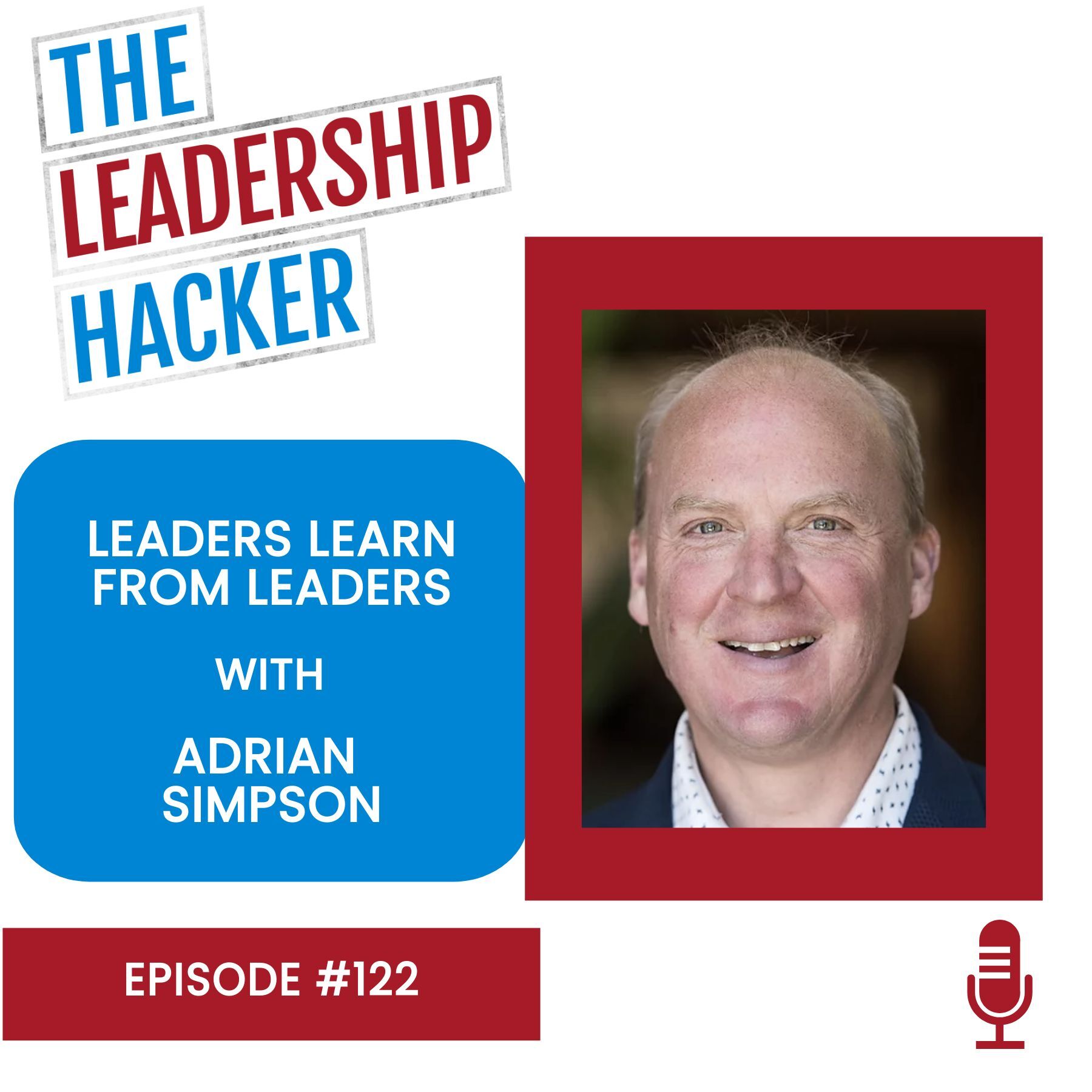
Adrian Simpson is a Co-founder of Wavelength leadership group; for over 20 years he's taken top leaders into the boardrooms and shop floors of the world's most successful, innovative and admired companies. Today you can learn about:
What makes a great leader?
Why leaders learn best from leaders?
How great leaders talk candidly about failure.
The secrets behind some global transformative cultures.
Join our Tribe at https://leadership-hacker.com
Music: " Upbeat Party " by Scott Holmes courtesy of the Free Music Archive FMA
Transcript: Thanks to Jermaine Pinto at JRP Transcribing for being our Partner. Contact Jermaine via LinkedIn or via his site JRP Transcribing Services
#some audio issues in this show – thanks for your patience.
Find out more about Adrian below:
Adrian on LinkedIn: https://www.linkedin.com/in/adrian-simpson-b600139/
Adrian on Twitter: https://twitter.com/AdieSimpson
Wavelength on Instagram: https://www.instagram.com/wavelengthleadership/
Wavelength Website: https://www.wavelengthleadership.com
Full Transcript Below
Steve Rush: Some call me Steve, dad, husband, or friend. Others might call me boss, coach or mentor. Today you can call me The Leadership Hacker.
Thanks for listening in. I really appreciate it. My job as the leadership hacker is to hack into the minds, experiences, habits and learning of great leaders, C-Suite executives, authors, and development experts so that I can assist you developing your understanding and awareness of leadership. I am Steve Rush, and I am your host today. I am the author of Leadership Cake. I am a transformation consultant and leadership coach. I cannot wait to start sharing all things leadership with you
Adrian Simpson is a special guest on today's show. For over 20 years he's really been immersing himself in amongst some of the top firms around the world, including the likes of Apple, Tesla, Netflix, and Google. And we're going to dive into some of those leadership secrets, but before we do, it's The Leadership Hacker News.
The Leadership Hacker News
Steve Rush: Purpose is a real key part of all leaders’ capabilities, but often leaders get it wrong. Commonly, we see leaders think that purpose should be the same as their company's vision, mission, or purpose, but it shouldn't. Believe writing a leadership purpose statement is not a onetime exercise at all. It's something that should evolve, and it should connect the individual to the purpose of the organization. It's incredibly important and it needs deep insight and deep thoughts. So, what is leadership purpose? Your leadership purpose is your statement about who you are as a person and how you bring those unique qualities into your world.
First and foremost, leadership purpose is about your values and what's important to life for you. It's often also considered as your why statement or your reason, your beliefs. Think about your leadership purpose statement as being your beacon, enabling people to have a real clear understanding of what your direction in life and work is. In doing so, it'll help you drive the right behaviors on a daily basis and keep you engaged when circumstances around you can be challenging. It doesn't need to be overly complicated. Your leadership purpose statement must be a living and breathing document that you can share so, others understand it too. And it'll likely change as you change as a person, or your career grows or changes shape. So, you should always update it regularly. And remember your leadership purpose will not only help keep you grounded, and you stay on your path, will help you be a better leader and the leader you're meant to be. Most important, it sets a declaration of the kind of support you're prepared to give as a leader for the people around you. So, they can also buy into your journey. So simply put, think about the purpose, your why, and make sure it describes your values, your beliefs, and your vision, and how that aligns to the organization that you work and serve with. That's been The Leadership Hacker News. Let's dive into the show.
Start of Podcast
Steve Rush: Adrian Simpson is a Co-founder of Wavelength leadership group. For over 20 years he's taken top leaders into the boardrooms and shop floors. Some of the world's most successful, innovative and admired companies, including Alibaba, Netflix, Apple, Tesla, Lego, and Google but a few. Andrew, welcome to The Leadership Hacker Podcast.
Adrian Simpson: Thanks, Steve. It's great to join you this morning.
Steve Rush: Really looking forward to diving into some of the lessons learned from some of these huge conglomerates, but tell us a little bit about you, your background and how you've arrived to do what you've done?
Adrian Simpson: Gosh, so yeah, so a very, very brief resume. Started my career in retail with John Lewis Partnership then decided at sort of age 21 to go off to University in Manchester, did a degree in business and marketing. And just after University, I managed to stumble into a role with the incredible Tom Peters Group. And for those that aren't old enough, Tom Peters was certainly in the 1980s, nineties, the most successful management guru of his time, his Jim Collins of his day, who wrote an amazing book called In Search of Excellence and sold many millions of copies and to give us sort of sense. So, I was putting him on stage in the 1990s at about $120,000 U.S. dollars a day back in those days.
So, and then one day, yeah, after being at the Tom Peters Group where I was helping put him on stage and find some, he really wrote about companies that had kind of amazing cultures that really just sort of got it. And indeed, I'm still visiting some of the companies he wrote about wrote about 30 years ago, like Southwest Airlines. The phone rang and a small innovation company called What If was on the phone. And one thing led to the other and a conversation snowballed into a coffee, a coffee into a lunch, a lunch into a come join us. And I moved into to join What If for 11 years. When I joined, we were 10 people when I left, there were 355 countries. And it was the ride of my life and had an incredible opportunity there to provide our clients with some inspirations, started running for the study tour events, and then 14 years ago made the jump to co-found Wavelength.
Steve Rush: So, what is it specifically that Wavelength do?
Adrian Simpson: Our specialism is bringing the outside world in. Basically, we scour the world looking for examples of practitioners. What are the leaders? The organizations that have compelling stories to share with our clients and really providing our clients with a combination of what I would call inspiration, education and provocation. And our hypothesis really is at the level at which we operate at, is the leaders learn best from leaders. So, as I mentioned, sort of, you know, scouring the world, looking for practitioners you know, got real experience on topics that our clients were interested in. Albeit, you know, I was literally in America 10 days ago with a group of 20 leaders from all around the world. We had clients from Australia, from India, from Japan, from the Middle East, six across North America, the rest from across Europe, from lots of different organizations.
They flew into Dallas Texas on a Saturday. We began on a Sunday morning with a sort of half day workshop. And then for the first day and a half, we spent going inside the legendary Southwest Airlines and Ritz Carlton, really focusing on excellence in culture and leadership and service. So, they can value the three and a half days, looking at innovation, disruption, new business models, what's next? And what's next? Next. Doing some set piece visits but also doing some incredible things like going for drives in the world's first, fully autonomous robots, taxis operated by crews to have no drivers in them at all [laugh] or doing metaverse meetings in the metaverse, Oculus quest headsets.
So, we do things like that to very, very intense one-week immersions for very senior business leaders. We have at the other end of the spectrum, we have a digital only program called inspire, which is every single month. Typically, on a third Thursday of the month, we take a cohort of leaders from lots of different client companies live inside a great business, somewhere around the world of an audience with a really accomplished leader. Last week we hosted a session with Alastair Campbell on mental health. Next week, we have the former Prime Minister of Denmark. Helle Thorning Schmidt on how to lead the country. We've got Jesper Boring coming up IKEA Chief Exec. We've hosted Alan Jope Unilever's Chief Exec. We are hosting Tim Steiner, Ocado Chief Exec in September, and they are just short, sharp, regular doses of live world class inspiration for our clients. And we've got amazingly 700 people signed up to that program from around the world. So, we do, you know, whether it's digital only, short, sharp, live inspiration, whether it's weeklong, or we have other programs, one called connect, which is sort of, has about 50 people on it and is UK based, it runs about nine months or whether it's just, you know, helping clients bring speakers in for a particular offsite or conference. But again, any speakers we will use, will be practitioners.
Steve Rush: How awesome. So, you managed to really bump shoulders with, and as you said, immerse other leaders with these great leaders from around the world. What's the reason your focus is heavily aimed at making leaders learn from other leaders.
Adrian Simpson: I just think there is a relevancy that you cannot get and that applicability that you cannot get from any other kind of learning when it comes to leadership is in my view. Now I'm not for a second saying there is not a role for, you know, academics and business schools and some kind of provocative, rigorous thinking. I think there is a role for that, but I suppose my best sort of summary when I had a chief

Martine Kalaw is the author of The ABC’s of Diversity, she’s a speaker and DEI consultant helping individuals and organizations overcome unconscious beliefs and implicit bias. In this insightful show you can learn about:
Martine’s fascinating story from being a stateless, undocumented person to CEO
What diversity really means, looks and feels like
How has the hybrid world has impacted firms approach to DE&I?
The ABC’s of Diversity
Join our Tribe at https://leadership-hacker.com
Music: " Upbeat Party " by Scott Holmes courtesy of the Free Music Archive FMA
Transcript: Thanks to Jermaine Pinto at JRP Transcribing for being our Partner. Contact Jermaine via LinkedIn or via his site JRP Transcribing Services
Find out more about Martine below:
Martine on LinkedIn: https://www.linkedin.com/company/martinekalawconsulting/
Martine on Twitter: https://twitter.com/martinekalaw
Martine on Instagram: https://www.instagram.com/martinekalaw/
Martine’s Website: https://martinekalaw.com
Full Transcript Below
----more----
Steve Rush: Some call me Steve, dad, husband, or friend. Others might call me boss, coach or mentor. Today you can call me The Leadership Hacker.
Thanks for listening in. I really appreciate it. My job as the leadership hacker is to hack into the minds, experiences, habits and learning of great leaders, C-Suite executives, authors, and development experts so that I can assist you developing your understanding and awareness of leadership. I am Steve Rush, and I am your host today. I am the author of Leadership Cake. I am a transformation consultant and leadership coach. I cannot wait to start sharing all things leadership with you
Our special guest on today's show is Martine Kalaw. Martine is a DEI expert; she's worked with some of the world's top companies, helping them navigate through their organization's diversity, equity and inclusion, and created more diverse and inclusive workspace. She's also the author of The ABCs of Diversity. Before we get a chance to speak with MartinE, It's The Leadership Hacker News.
The Leadership Hacker News
Steve Rush: We all know that telling stories is a great leadership skill. So today I'm going to have a go. Once upon a time there was a beautiful kingdom ruled by a Prince. He took over the kingdom after the death of his father, the King, after a few months of ruling, the kingdom things started testing. There was no rain. Drought had brought losses to farmers and killed many animals, birds, and precious plants in the forest. It was followed by an unknown disease that caused loss of many lives. After a few months of pain, things started to improve gradually, but before they could recover completely, an enemy took over the kingdom, killing many people and imprisoning them. The young King managed to escape. He planned to meet his childhood friend, a King of a neighboring kingdom. On his way he was thinking about the past. He was born to be bred King of this powerful and wealthy nation.
Now he's lost everything. He believed that he was cursed because nothing had happened to his father. It had only happened to him. When he reached the neighboring kingdom, and he met his friends. The guards did not allow him to pass because he looked dirty, and bedraggled. He tried many times to get access to the kingdom but failed miserably. Being cast outside the kingdom, he eventually took a job so he could buy food and clothes. Several weeks had passed and he'd now earned enough and ate enough. So, they allowed him to look presentable. So, he set off in a chance to get through the guards and to meet with his friend. After carefully navigating the guards and entering the kingdom. He was greeted warmly by his friend, the King of the neighboring kingdom, after explaining the sad story and things that had happened to him.
The King took pity and ordered his people to give him a herd of a hundred sheep. While grateful, the King was a little surprised as it was expecting much more than just a hundred cheap. He was a King after all. He doesn't want to be a shepherd. Down on his luck. He realized there was no way out. After a few days of grazing his herd, group of wolves attacked his herd and killed all of them. And while the wolves were merely feasting on this new herd, the king ran away. He returned to his only allied at this time, his friend, the King from the neighboring kingdom. This time he gave 50 sheep in pity. But once again, he failed to protect the walls. He returned for a third time, and this time the King gave him 25 sheep with a clear message of, there are no more sheep.
And this time the young King decided if he didn't protect his herd, he knew that he would be on his downers. So, this time he took a different approach. He examined the environment. He understood where the wolves were living, the areas where they would attack. He built additional fences and guards around the herd to protect them. He set up a schedule to monitor those key places and key times when he knew that the wolves would be most active, a few years had passed, and its herd had grown into a thousand sheep. His activities were monitored by his friend, the King and in recognition of his great feat in growing a herd, his friend had ordered his ministers to give him a whole state to rule. He asked his friend, why did you not give me the state to rule when I first come to help you? His friend, the King replied. The first time you came for me for help. Your mindset was like you were born and bred to be a leader. You were expectant. And the truth was far from it.
The King went on to say, you may have been born with wealth, pride, and power, but you have never had proper education and training to lead your people. So, when I gave you the herd, I wanted you to learn how to manage and lead others. Dear friend, I have seen you suffer, return, be resilient, work out a plan. And now I believe you're ready to lead. The moral of the story and leadership hack if you like, is that, just being born into a powerful family or being born with privileges, doesn't mean you'll be successful. Being a manager or leading people in higher position does not make you a leader. Being in charge, such as a King or a Manager or a CEO does not make you a leader. Holding position is just a position. Leadership is a behavior and leadership is a service. The most important role of a leader is to build and develop other leaders. That's been The Leadership Hacker News. Let's dive into the show.
Start of Podcast
Steve Rush: Martine Kalaw is a special guest on today's show. She's an author, speaker and DEI consultant. She's the founder of Martine Kalaw Enterprises and her firm offers strategy development, implementation, and education, and helps organizations overcome unconscious beliefs and implicit biases. Martine also published her second book, The ABCs of Diversity. Martine, welcome to the show.
Martine Kalaw: Thank you so much for having me, Steve. I'm excited to be here
Steve Rush: Now, you have a most fascinating backstory. There are not many people that you can say. I understand how that is because there's not many people would understand your position. Just tell us a little bit about that backstory and how that's really given you the passion to do what you do?
Martine Kalaw: Yeah, certainly. Born in Zambia from the Democratic Republic of Congo. My mother and biological fathers were from there and having been raised in the U.S. but having spent seven years of my life as an undocumented immigrant and stateless individual in the United States in removal or deportation proceedings for seven years has really shaped the work that I do around DEI, in the years that I, you know, navigated through. One being orphaned, two, being undocumented, three, being stateless. I was exposed to various communities. I actually had to, you know, I had to learn how to pivot into different communities as I navigated the world on my own. And so, what this taught me was to, it gave me a different perspective on how people show up and view different circumstances.
It also gave me a level of sensitivity in how to and putting myself in somebody else's shoes and trying to see things from their perspective. And so, for that reason, I feel like I can be a bridge builder in a lot of ways across different communities. I also knew from my experience of being undocumented and stateless, I also understand the importance of having individuals invest in you rather than help you when you're marginalized, right. When your part of an underrepresented community, that's how we actually strengthen our communities, how we strengthen our workforce, is when individuals who have access recognize the access that they have and, or privileged, and some people are not comfortable with that word and then extend that to others and bring them in and do it in a way that's not charity like, and they're not positioning themselves as saviors, but really they're investing in others because they know they're also gaining something back. And in that way, we strengthened our communities. And so that was the experience I had as an undocumented immigrant and stateless person was setting it up so others can invest in me. And then once I, you know, navigated through my journey. Sharing that and passing that forward to my mentees and other people within undocumented stateless community, but then tying it into the larger conversation of diversity, equity, and inclusion.
Steve Rush: Yeah, and I guess what you've really described is so extreme in its diverse experience, but to your point, gives you that sensitivity to be able to be really thoughtful in your approach, right?
Martine Kalaw: Right, absolutely. And just having seen, and just the intricacies of bias and discrimination in various facets. I mean, people don't necessarily think about immigration, and you know, statelessness and think of diversity, equity and inclusion, but it's a subset of it.
Steve Rush: Yeah.
Martine Kalaw: And certainly, it's nuan

Timothy Bradshaw is former British Army Intelligence Officer and graduate of the Royal Military Academy, Sandhurst. His work as a Covert Human Intelligence Officer and Target Acquisition Patrol Soldier saw him recruit and run foreign agents worldwide and influence the outcome of extremely sensitive and dangerous situations. Recently, he’s been running aid missions to the Ukraine. He’s a keynote speaker and author of the book, “Because I Can”.
This is packed full of leadership lessons including:
Leaders need to make decisions under pressure, how different was that in the military and what can we learn from that.
The secret sauce to resilience and overcoming challenges.
Why wanting to quit is normal and how can we overcome that.
Why is the military approach to leadership is a good blueprint for business.
Join our Tribe at https://leadership-hacker.com
Music: " Upbeat Party " by Scott Holmes courtesy of the Free Music Archive FMA
Transcript: Thanks to Jermaine Pinto at JRP Transcribing for being our Partner. Contact Jermaine via LinkedIn or via his site JRP Transcribing Services
Find out more about Tim below:
Tim on LinkedIn: https://www.linkedin.com/in/timothy-bradshaw/
Tim’s Books: Because I Can
Tim on Twitter: https://twitter.com/TimBecauseICan
Tim on Instagram: https://www.instagram.com/timothy.bradshaw/
Tim’s Website: https://www.timothybradshaw.net
Full Transcript Below
----more----
Steve Rush: Some call me Steve, dad, husband, or friend. Others might call me boss, coach or mentor. Today you can call me The Leadership Hacker.
Thanks for listening in. I really appreciate it. My job as the leadership hacker is to hack into the minds, experiences, habits and learning of great leaders, C-Suite executives, authors and development experts so that I can assist you developing your understanding and awareness of leadership. I am Steve Rush, and I am your host today. I am the author of Leadership Cake. I am a transformation consultant and leadership coach. I cannot wait to start sharing all things leadership with you
Our special guest on today's show is Tim Bradshaw. He's a foreign British Army Intelligence Officer and recruited and run foreign agents worldwide as a Human Intelligent Officer. He's also the author of a great book, Because I can, but before we get a chance to speak with Tim, it's The Leadership Hacker News.
The Leadership Hacker News
Steve Rush: Leadership is about us everywhere. And I wanted to dive in to find some funny, and innovative ways of us, bringing some of those leadership lessons to life. So, if ever you've watched a movie Star Wars or any of the Star Wars Trilogy, you'll find loads of leadership lessons packed within there. Yoda is one of my favorites. He has this great saying that said. Do or not do, there is no try. And I'm often using that lighthearted analogy with any of my coaching conversations, but a long time ago in a galaxy far away, the leadership lessons were created amongst this epic series of films.
So, here's a few, it's been proven that being born with talent is not enough. As we all know, Luke Skywalker is born with a natural talent to be a Jedi. Yet when, we watch the movies. We know that was not a given. He had to work hard at that. We watched Luke come to grips with putting himself in challenging situations and homing in on that force. And there are traits of good leadership, but true leadership takes place, self-reflection and mentoring, which we also saw through their relationship with Yoda. Adaptability is also a key leadership lesson throughout the Star Wars movies, all of those Star Wars movies demonstrate that life does not always go to plan. And if you are rigid in your plans are stuck in your ways, you're not going to win. From Han Solo, adapting, a broken hyper drive by hiding by the rubbish shoot instead of a surprise alliance along the way. If you're able to adapt and think quickly, you're able to lead a team through any surprises. We know it's okay to ask for help as leaders. Sometimes you can't get yourself out of a situation without calling on someone else. When Princess Leia was in a bind, she'd always know the right people to call and ask for help without hesitation. Some good leaders need other good leaders to advise them on their journey. And the one thing that is really true across all of the movies that chasing power is the path to the dark side. Leaders undeniably have power and authority, but leadership is much more than that. Once you begin to be at attracted to power and to chase power, you are heading to the dark side. Good leadership is all about sharing power and authority and creating more leaders. It's about people with good ideas and evolving those good ideas so that everyone becomes more powerful. So, the next time you hear yourself saying, I'll try, just think you've been Yoda. Do or don't do, there is no try. Let's get into the show.
Start of Podcast
Steve Rush: Timothy Bradshaw, is a special guest on today's show. He's a former British Army Intelligence Officer and graduate of the Royal Military Academy of Sandhurst. His work as a Covert Human Intelligent Officer and Target Acquisition Patrol Soldier saw him recruit and run foreign agents worldwide and influence the outcome of extremely sensitive and dangerous situations. Recently Tim's been running missions to Ukraine, delivering really, really important aid. He's a keynote speaker and he's also the author of the book, Because I can. Tim, welcome to the show.
Timothy Bradshaw: Thanks Steve. Thanks very much for having me on.
Steve Rush: Really looking forward to getting into the diverse world of Timothy Bradshaw. And remember from the first time that you met and how you described what you did in the army and in your work as an Intelligence Officer, I think I might have called you the James Bond [laugh] at the time.
Timothy Bradshaw: I mean, that's very flattering and unfortunately every time somebody says that I caught so much flack off all of my friends, but.
Steve Rush: [Laugh].
Timothy Bradshaw: I'll take it Steve. I've definitely been called worse things.
Steve Rush: I think your response to me at the time, Tim, if I remember rightly was, and you might have had the work of James Bond, but you certainly didn't have the dinner suits and the expense account.
Timothy Bradshaw: No, absolutely not. And I'm still waiting for the Aston Martin as well.
Steve Rush: That's it, yeah. So, tell us a little bit about you Tim, your early backstory and give that listens a little bit of a spin through to how you've arrived to do what you do.
Timothy Bradshaw: It's not that exciting, Steve really, which I think is almost kind of the point. You know, we talk about resilience and all this sort of stuff and actually I haven't done anything that essentially anybody else couldn't have done if they wanted to. I did my A-levels. I finished school. I kind of looked at university alongside everybody else and realized that I was doing that really, because that was kind of what everybody else did. Not really what my sort of passion was, and maybe there's a bit of a theme there that'll continue. So, I was offered a place to go to the Royal Military Academy, Sandhurst. I literally just turned 18 in the October and went in the January. So was really very young. I quite often laugh when we talk about leadership.
My first ever job out of school was sort of leading 37 soldiers aged 19, by the time I got to that point. And frankly probably wasn't very good at it. Who's very good at their first ever job out of school, but I had a lot of training, and a lot of backups. So, made the best I could really. I've kind of never really done anything else. So very much experienced based career, I guess. And I did that and that was the kind of the mid-nineties. And I went out to Germany. Ironically, it's really funny looking back now, I say funny, slightly tongue in cheek, but obviously we were very much kind of the end of the sort of cold war doctrine and everything we were looking at was very much basically about the Russian Army coming across the Eastern German planes which with what's going on now, obviously out in Ukraine, seems a little bit surreal, to be honest.
Steve Rush: Yeah.
Timothy Bradshaw: But anyway, and I sort of did that for a bit and it was bit of a lull really, an activity, certainly for the sort of regular army at the time. And then I pursued a career in training after I served out my commission and subsequently once sort of Iraq and Afghanistan kicked off, I looked to go back to the military. I felt as though I had kind of unfinished business and hadn't finished serving yet. I've always had quite a strong desire to serve rightly or wrongly. So, I decided to go back and a friend of mine had said to me, oh, you should look at, you know, look at reserves and I said, crikey you’re joking. You know, to me, the TA sort of, as was, was dad's army. And, you know, that's absolutely not the case anymore. So, I went through a patrol selection course, which is a particularly arduous sort of running over the Hills, big ruck sacks, small teams, very much becoming self-reliant, self-sufficient, relying on your teammates in small groups as a buildup, really to go towards Afghanistan. And then I kind of thought to myself, well, if I'm going to do this, I want to do something that perhaps my interim years as a civilian brings something to the party rather than putting me behind the curve. So Human Intelligence is, is exactly that, it's about building relationships and influence. And actually, you know, we always sort of joke, but if you having to use the cars as the guns, you've kind of got it wrong, essentially. It's absolutely about building relationships and influencing people. So, bit of a sucker for punishment, really, I put myself through yet another grueling selection process.
Steve Rush: [laugh].
Timothy Bradshaw: Its theme isn't it, really. And we did that. I passed a course and then what ensued was

Frank Forencich is an internationally-recognized leader in health and performance education. A Stanford University graduate in human biology and neuroscience, he has over 30 years teaching martial arts and neuro health education. Frank holds black belt in both Karate and Aikido. He’s a multiple author, including the book, Beware False Tigers: Strategies and Antidotes for an Age of Stress. We can learn lot’s from Frank, including:
What are “False Tigers” and how to recognize them.
The "primate's predicament" and "the state of the human-animal."
How to notice the big stressors of our time - The real tigers?
The consequences of high stress on business leaders?
Join our Tribe at https://leadership-hacker.com
Music: " Upbeat Party " by Scott Holmes courtesy of the Free Music Archive FMA
Transcript: Thanks to Jermaine Pinto at JRP Transcribing for being our Partner. Contact Jermaine via LinkedIn or via his site JRP Transcribing Services
Find out more about Frank below:
Frank on LinkedIn: https://www.linkedin.com/in/frankforencich/
Frank’s Books: https://www.goodreads.com/author/show/507966.Frank_Forencich
Frank on Twitter: https://twitter.com/ExuberantAnimal
Frank on Instagram: https://www.instagram.com/exuberant_animal/
Frank’s Website: https://www.exuberantanimal.com
Full Transcript Below
Steve Rush: Some call me Steve, dad, husband, or friend. Others might call me boss, coach or mentor. Today you can call me The Leadership Hacker.
Thanks for listening in. I really appreciate it. My job as the leadership hacker is to hack into the minds, experiences, habits and learning of great leaders, C-Suite executives, authors and development experts so that I can assist you developing your understanding and awareness of leadership. I am Steve Rush, and I am your host today. I am the author of Leadership Cake. I am a transformation consultant and leadership coach. I cannot wait to start sharing all things leadership with you
If ever you wonder what the relationship was with the animals in the Savannahs of Africa and our own emotional intelligence, you can find out today. Frank Forencich is an internationally recognized leader in health and performance education. Having studied human biology and neuroscience. He's dedicated his life to understanding the relationship we have with our brains. But before we had a chance speak with Frank, it's The Leadership Hacker News.
The Leadership Hacker News
Steve Rush: You'll know if you're a regular listener, there's always top tips and ideas to help you on your way. But we're going to flip that round today and look at things that we can avoid. So here are the five common mistakes that both young and experienced leaders make and how to avoid them. Number one, in properly delegating work, failing to properly delegate work is a number one, common leadership blunder, good leaders, hand out assignments, according to skills and interest. Don't assign a writing assignment to a developer and vice versa. You know, that just makes no sense, right? Another way to innovate and get results is to award certain work with those who volunteer for it. By taking a chance, you might discover unique skills from the person who least expect it. Number two, communicating poorly, feel like you're not providing enough feedback to your team. And it's time to revisit the lines of communication, make it a priority to have open communication, regardless of who it is. Reiterate this need to have weekly meetings, stress the importance of timely replies. Just as long as your team will answer, and you do the same. You can create a huge swell of energy that's positive. Overcommunication in a crisis is even more relevant, but the hack is to set out sometimes and set out some expectations of what it is you are intending to send and receive from your team. Number three, focusing too much on strategy and not enough on day-to-day tactics.
Some leaders get blindsided by the alluring strategy rather than the day to day, but it’s these everyday tactics require strong focus in order to arrive at your final solution in the first place. I used to call these BBCs or basic, but critical behaviors, things that you expect to see happen that are task driven and focused on outcomes. They're all people centric, and you're able to connect the dots to your strategy, but those daily basic routines help you on your longer journey. Number four, failing to balance a hands-off approach with micromanaging. Many leaders are either two hands off or they over manage. The optimum solution is to find the balance between the two and to help you get there, accountability and empowerment are the two triggers. Get your accountability and empowerment imbalance you create more leaders and high performance.
Number five. Forgetting to teach, train, motivate, and reward. Ongoing training and learning and development is not only vital for the individual, but for the entire company. There are thousands of online seminars for pretty much any discipline, especially in things like digital, many are free. And for those that aren't, you might be able to pay them through relationships. Doesn't have to be a direct cost. And of course, the biggest learning comes from doing. The experiences you have that naturally occur across your organization. Sometimes helping people recognize that actually that is exactly what's happening. They are learning is part of that process. Next is motivation. Now you've pretty much worked out I would imagine that you can't actually motivate anybody, but you can create the right environment for those to be motivated in whether it be a senior group of people or junior staff. It's more important that you find those good old-fashioned things that are really important to them. Understanding their internal and intrinsic motivations will really help you connect the dots and the purpose of the work that they do. The things that make them tick.
And it's a mistake, but many leaders just don't even ask, what is it that motivates you? And lastly, reward, if an employee excels, provides more bonuses, small gestures of thanks, doesn't have to be huge amounts of bonuses, but again, linked to intrinsic motivation can make a world of difference. And of course, it'll be different for everyone, but find out, ask a question, how do you like to be rewarded? And you'll also get some great data that you can rely on as a leader.
Leadership mishap and blunder are an inevitability. We're going to do it. The most important thing is to learn from those blunders along the way. So as leaders, we can truly be in the service of our teams. That's been The Leadership Hacker News. And thank you to Rebecca, one of our listeners who encourage us to look at this from a different lens to flip the context and to look at this as a lesson learned activity, let's dive into the show.
Start of Podcast
Steve Rush: Frank Forencich is a special guest on today's show. He's an internationally recognized leader in health and performance education. He's a Stanford University graduate in human biology and neuroscience. As over 30 years, teaching martial arts and experience around health and education. Frank holds black belt in both karate and aikido and his many research trips across the world, including Africa, has helped him really get into and study the human origins and ancestral environment. And that's where he got his inspiration from his new book, Beware False Tigers: Strategies and Anecdotes for an Age of Stress. Frank, welcome to The Leadership Hacker Podcast.
Frank Forencich: Delighted to be here.
Steve Rush: So, I'm really intrigued at how you can get two black belts and two martial arts, as well as all of the experience you pull together.
Frank Forencich: [Laugh].
Steve Rush: And written many books, Frank. So, I can't wait to get into the journey. Perhaps for our audience. You could just give us a little bit of the backstory as to how you've arrived to do what you do today?
Frank Forencich: Right, well, I first became interested in the martial arts in my early twenties. And this was when I was an undergraduate at Stanford and I was studying human biology and I was fascinated with physicality and with movement. And I thought that there was something there that was very important. And as an educational experience, the martial art was just fantastic for me. It was a time to feel really focused. And I had a lot of really fantastic teachers. And at the same time, I had a professor in human biology who said, if you really want to understand the human animal, you have to go to Africa and study our history. And so, I took him up on that and little by little, all these various pieces started to come together. And later on, I studied athletic training and massage therapy and it's been a really exciting journey to look at the human body where it came from and how it functions. So, I've, been exceptionally lucky in this to have all these opportunities to do.
Steve Rush: And many scholars that kind of walk in your path almost have gone to Africa into the Savannahs and have used that as a backdrop to really understand human behavior, as well as animal behavior, haven't they?
Frank Forencich: Right, and I think it's so essential that we are involved in this because the modern world is kind of an illusion. We tend to believe that the world has always been the way it is now, and we've kind of parachuted into the modern world. But in fact, we have a history, and that history is deep and important.
Steve Rush: And that history I suspect that you talk about is where we had no distractions. We were kind of in our original settings and that's how we were programmed physiologically to behave, right?
Frank Forencich: Right, you can study the stuff directly. But I think for people who haven't studied it is to have a look at the movie. The Gods Must Be Crazy. And you might remember that one where, the first half of the movie, actually the first 20 minutes of the movie, they look at the lives

Dr Bob Nelson is author of the multimillion-copy bestseller 1001 Ways to Engage Employees, he’s also is president of Nelson Motivation, Inc. and the world's leading authority on Employee Recognition and Engagement. He has published 31 books that have sold over 5 million copies that have been translated into over 30 languages. In the humorous and insightful show you can learn:
How "Work" and "Fun" go together in the most successful workplaces to motivate employees
Why do employees rank “Fun” at the top of the list at the Best Companies to Work for
What the best companies do to find the latest value in employee reward programs beyond gift cards and handshakes
Innovative and creative ways businesses can amplify their culture and increase productivity with “Fun"
Join our Tribe at https://leadership-hacker.com
Music: " Upbeat Party " by Scott Holmes courtesy of the Free Music Archive FMA
Transcript: Thanks to Jermaine Pinto at JRP Transcribing for being our Partner. Contact Jermaine via LinkedIn or via his site JRP Transcribing Services
Find out more about Dr Bob below:
Dr Bob on LinkedIn: www.linkedin.com/in/drbobnelson
Dr Bob on Twitter: https://twitter.com/DrBobNelson1
Website: https://drbobnelson.com
Full Transcript Below
----more----
Steve Rush: Some call me Steve, dad, husband, or friend. Others might call me boss, coach or mentor. Today you can call me The Leadership Hacker.
Thanks for listening in. I really appreciate it. My job as the leadership hacker is to hack into the minds, experiences, habits and learning of great leaders, C-Suite executives, authors and development experts so that I can assist you developing your understanding and awareness of leadership. I am Steve Rush, and I am your host today. I am the author of Leadership Cake. I am a transformation consultant and leadership coach. I cannot wait to start sharing all things leadership with you
Today's special guest is Dr. Bob Nelson. He's a world's leading authority on employee recognition, motivation and engagement. Dr. Bob has authored over 30 books, which have collectively sold over five million copies. Before we get a chance to speak with Bob. It's The Leadership Hacker News.
The Leadership Hacker News
Steve Rush: In the news today. We're going to explore how social media can really make a difference to any business of any kind anywhere. So, we're going to look at a fast-food joint when from a local eatery to internet stardom, thanks to iconic memes and a catchy theme tune. And this is a story of Binley Mega Chippy. Now, for those that are in North America and around the world, a chip shop in England is a place where you go to buy French fries and fast food. It started out as unassuming, local, fast-food joint, and it's now arguably the most famous fast-food joint on the planet. For years, it was just like any other English eatery, serving French fries, chips, fish, and of course, other really unhealthy, deep-fried foods.
It's not particularly attractive to look at. It's a vision of red and gold, but it's a reliable Oasis to many people in and around Coventry, but the Internet's taken Binley Mega Chippy and turned it into a TikTok fiesta for culinary destination for anybody visiting this part of England. Owner, Kamal Gandhi, 70-years-old. Now has a huge number of customers. Some of whom have apparently traveled from as far as France, America and even Australia. So how did this local chip shop go from a small fry to a huge gastronomic location of choice? Well, the first mention of Binley Mega Chippy hit the internet in just 2009, and it was a simple kind of nod to here's where we are and what we do. Fast forward to 2022, Binley Mega Chippy began to appear, but still continued on relative obscurity, not knowing what's to come. Viral hysteria hit the fast-food outlet. In 2022 when it featured in the slideshow of multiple UK, fast food joints and TikTok in April. It's first month, there were 82,000 views and 11,000 likes. Fast forward now, millions and millions of people are using this as a backdrop to other memes and are joining in with the chant of the song. Decades of research and millions of dollars and pounds of advertising who have shown that society loves a good jingle, and it helps sell a product. And the same appears to be true for fast food outlets. On the 25th of May, binleymegachippyfan53 posted just a ten second clip with a static picture with a Bingley Mega Chippy Jingle. Now for obvious marketing reasons, I’m not able to play that for you now. I'm sure you can find it if you choose to. That short clip now has just over 2 million views and has spawned various spinoffs and remixes.
And now hashtag Bingley Mega Chippy has over 500 million views and naturally people have been visiting it from all over. So having fun, better jingle, the power of the internet can change the lives of anyone and good luck to Kamal Gandhi and his store, we wish him all the success. The leadership hack here is, marketing could be as simple as a ten second clip. It could be something that you say and do. What makes a difference is that emotional connection. So, the next time you're communicating a message or you're building a story or you're creating an internal marketing campaign or external, is it going to hit those real emotional keys to get people stirred into emotional action? That's been The Leadership Hacker News. Let's dive into the show.
Start of Podcast
Steve Rush: Dr. Bob Nelson is a special guest on today's show. He's a multimillion best seller author of, 1001 Ways to Engage Employees. His latest book, Work Made Fun Gets Done. He's also the president of Nelson Motivation Inc. One of the world's leading authorities on employee recognition and engagement, and Bob's published over 31 books and sold over 5 million copies and been translated in over 30 languages. Dr. Bob, welcome to the show.
Dr. Bob Nelson: Thank you for having me, Steve.
Steve Rush: I'm really looking forward to getting into this because I remember the first time you and I met when you also then started to think about this. Over 15,000 ways to reward employees and over 1,001 ways to engage employees. It was a bit of a kind of a journey for me to get my head around those numbers. So, I'm delighted that we get a chance to dive into some of them, not all of them today.
Dr. Bob Nelson: Excellent.
Steve Rush: Before we do that, Bob, let's give our listeners a little bit of a backstory if you like on the journey that is taking you to where you are today.
Dr. Bob Nelson: Well, well, well, I've always been a writer and going back to high school, I remember my English teacher passing out papers and she stopped at my desk and she over hitch, she weighed my paper and said, best paper in five classes. And I was kind of embarrassed and surprised and went back and reread it. And, you know, and I just got the message that I could write. And so that's always been a backdrop for me, and I published my first book when I was 21, a guide on job hunting and have just recently finished my 31st book. So, it's a hard activity, somehow, I keep coming back to it, I guess, like a moth to a flame [laugh].
Steve Rush: Yeah, and do you think that moment in that English class, when that teacher kind of gave you that feedback at that time, do you think that was a catalyst for you at that point?
Dr. Bob Nelson: Well, it's certainly, anytime someone gives you feedback, I think, we all need to see how other people see us and if it's in a positive light then that's good news. You need to hold onto that one. And I think, you know, John Lynn’s said, life's what happens when you're making other plans. So, you got to work into the plans, what people tell you you're good at. And then of course, things that you enjoy doing is important as well.
Steve Rush: Yeah.
Dr. Bob Nelson: Mark Twain said the two most important days in anyone's life is the day they're born and then secondly, the day they find out why, so [laugh].
Steve Rush: That's great, yeah.
Dr. Bob Nelson: It's ongoing journey for each of us to say, what was I meant to be here for? And if you get clues from those around you, who give you feedback, you need to hold onto those and listen to those. And so, I feel fortunate for the career I've had, I've been blessed with having worked with some true experts, each which I've learned from. Ken Blanchard, went to work for, he published the One Minute Manager, which has sold 14 million copies. And so, I learned a lot from him about selling books and I got my PhD from working with Peter Drucker, the father of modern management.
Steve Rush: Yeah.
Dr. Bob Nelson: And I'm currently a personal coach for Marshall Goldsmith. Who's the number one voted executive coach in the world.
Steve Rush: That's right, yeah.
Dr. Bob Nelson: So, I've been very, very blessed to have some great people to learn from and lean on. And I like passing it on to others when I can.
Steve Rush: Yeah, and we are going to pass that on for sure today. You know, I heard something that I probably read it. You'd coached or had worked with something like 80% of the fortune 500 companies, is that right?
Dr. Bob Nelson: I have, yes.
Steve Rush: Wow.
Dr. Bob Nelson: Spanning 25 years, you get around. And that included, not that long ago, wrapped up a six-month project working for the United Nations. So that was a fun, fun activity. So, you know, life takes you a lot of interesting places and if you can go for the ride, it's usually pretty enticing.
Steve Rush: Yeah, it is. Isn't it?
Dr. Bob Nelson: I found anyway [laugh].
Steve Rush: Yeah, definitely so. So, you've managed to find a real niche or a passion, if you like for employee recognition and engagement. What was that defining moment for you when you realized actually, this is the thing that really excites you and makes you tick, and others tick as well?
Dr. Bob Nelson: Well, again to me, it's piecing together the pieces. I was taking a graduate school class and we were talking about; it was a control s

Simon Alexander Ong is an award-winning life and executive coach, keynote speaker, an author of the book Energize. This show is packed full of leadership hacks, tools and ideas that will get you energized, including:
How we can awaken our power.
The benefits of rewiring our energetic state.
Why we need to manage our energy and not our time.
How to supercharge our impact.
Join our Tribe at https://leadership-hacker.com
Music: " Upbeat Party " by Scott Holmes courtesy of the Free Music Archive FMA
Transcript: Thanks to Jermaine Pinto at JRP Transcribing for being our Partner. Contact Jermaine via LinkedIn or via his site JRP Transcribing Services
Find out more about Simon below:
Simon on LinkedIn: https://www.linkedin.com/in/simonalexanderong/
Simon’s Book: https://getenergizebook.com
Simon on Twitter: https://twitter.com/SimonAlexanderO
Simon on Instagram: https://www.instagram.com/simonalexandero/
Simon’s Website: https://www.simonalexanderong.com
Full Transcript Below
----more----
Steve Rush: Some call me Steve, dad, husband or friend. Others might call me boss, coach or mentor. Today you can call me The Leadership Hacker.
Thanks for listening in. I really appreciate it. My job as the leadership hacker is to hack into the minds, experiences, habits and learning of great leaders, C-Suite executives, authors and development experts so that I can assist you developing your understanding and awareness of leadership. I am Steve Rush, and I am your host today. I am the author of Leadership Cake. I am a transformation consultant and leadership coach. I cannot wait to start sharing all things leadership with you
I'm delighted to welcome to our show today. Simon Alexander Ong. He's an award-winning life and executive coach, keynote speaker, an author of the book Energize. But before we get a chance to speak with Simon, it's The Leadership Hacker News.
The Leadership Hacker News
Steve Rush: What would you do with an extra two hours a week? Just two. Now, imagine if you could even create more free time, here's an equation I want you to think about. Structure plus discipline, equals freedom. Do you believe that to be true? The reality is, by giving us disciplines within a structure creates capacity for us to do other things. But if we get caught up in the moment, here's a few tech hacks will help us unlock capacity.
Set up email filters. in a perfect world we'd only have emails hit our inbox for those that we really needed. The reality is, our inbox gets inundated with emails, not only internally, but from marketeers and those who choose to spam us. Given the fact we don't already have enough, right? You can set up rules that help you filter emails. There's software out there as well. But your firm will probably just let you use the one that you are used to use. But most email service providers let you automatically create labels, filters, and folders. And rule of mine, when I’m on vacation, CC into the delete box. And only if it's resent as a main message, I'd read it.
Asynchronous and automatic meetings. Now asynchronous meetings means that you don't have meetings per se, but you use other mediums to communicate through Teams or Zoom or slack or whatever it is you use. Collectively the stuff still gets done, but in a more flexible way, other ways of course is using automation. And according to a recent survey by Dialpad, 83% of professionals spend between at least four to twelve hours in back-to-back meetings.
And in my experience, I'd love it to be so few. To help you. You can use automated meeting calendars and you can ask your teams to work with that calendaring system. Also just create space and blocks so that others don't take advantage of your open calendar system. For those of you, a little late adopter to computers, talk to type functions, you might want to take a look. Speech recognition software can really speed up how you take notes, prepare meetings, and you can even use your computers, talk to type function, to dictate emails or other documents, or even play emails back to you invoice while you are walking the dog, or you are in between meetings. And while voice recognition software has come a long way. It's not perfect. So, you'll need to make sure that you use it in the right way and double check it, particularly if you're going to publish to anywhere.
And in the hybrid world, we're in, this is not necessarily a tech hack, but a hack it is nonetheless. Let somebody else do the cooking. If you're working from home, weekday meals could take up a lot of time, including the planning, shopping, preparing, cooking. And if you find yourself running late or nipping to the store, by the time you've got your produce back and you cut your vegetables, you might already have wasted another hour. You can use lots of pre-cooked meals or boxed meals to help you become more efficient in the way that you work and the way that you prepare your dinners. Our greatest commodity is time. And once we spend our time, we can't get it back. As of today, 48% of people say that they don't have enough time to do what they want. So, take control of some of the technology and some of the innovation that is around us and give it a try.
Remember, there's a bit of learning here, so you'll have to spend some time figuring out what works and what doesn't work for you. For that reason, look for apps and look for other technologies that support you in your approach to being awesome. So, get out there and have a go. That's been The Leadership Hacker in News. Don't forget you can always share your ideas and things that you want us to talk about in the show, by contacting us through our social media.
Start of Podcast
Steve Rush: Simon Alexander Ong is our special guest on today's show. He's a personal growth entrepreneur, coach, and speaker. He's also the author of the book Energize. Simon, welcome to the show, my friend!
Simon Alexander Ong: Steve, thank you so much for having me on.
Steve Rush: I'm really looking forward to today. And the whole subject of energize is probably the most timely for everybody. All of that will become much more apparent as we dive into the themes. The tagline of the book though, Simon is, Make the most out of every moment. And that's exactly what I intend to do with you. So, let's jump straight in and learn a little bit about Simon and your backstory and how you arrived doing what you're doing?
Simon Alexander Ong: Sure. So, I was born here in the United Kingdom, Steve to Malaysian parents. And I grew up with this mistaken and belief that success was determined by my job title, be a banker, be a doctor, be a lawyer, be an accountant. And so, my definition was limited to a few choices that I believe would make me successful.
Steve Rush: And it's interesting, isn’t it? Those labels kind of set you off on a trajectory, didn't they? So, you ended up in a career in banking and then before you knew it, you were doing something else, right?
Simon Alexander Ong: Definitely. I mean, I ended up going down the bank route at what was probably the worst possible time, Steve, because this was in the middle of 2007, I had just graduated, and this was also year before the financial crisis. And the first company I started was with Lehman Brothers. And so as, you know, that company collapsed into administration in September, 2008, and now while it was painful at the time, I mean, for anybody who's gone through a redundancy, it is never a nice experience, but at the same time, in hindsight, it was a blessing in disguise because it kick started for me the journey to where I am today, because it got me to question those beliefs that I had held for so long about whether they were really true and whether that was serving me or actually hurting me. And so that was where my interest in the word of entrepreneurship started. And, then it wasn't until 2012 that I really started to focus my energy on what I now get to do today, which is to coach those in leadership positions to speak at conferences and companies. And more recently having finished writing my first book,
Steve Rush: Those sliding door moments, isn't it? Where, you know, in the face of adversity, you leave a job that you'd been primed to do all of your life to then find actually it was the sliding door that opened another path.
Simon Alexander Ong: Mm-Hmm, mm-hmm. And it's interesting because when I think about that sliding door and I guess many other sliding doors as well, it's that what I've come to understand is that those moments in which we feel at the time are setbacks or failures are actually the very moments that equip us with the wisdom to create the best moments of our life, to step into a path that were completely transform what had come before.
Steve Rush: And how much of your growing up with that kind of real strong influence of your folks to say, right. You have to get yourself an academic career and get yourself into a role. How much of that you now still rely on, but in a different way?
Simon Alexander Ong: I think I rely a lot less now, obviously because I am not following those definitions now, but I think taking the, I guess the human values from my parents, from my dad's side, I think it has definitely been the hard work element. My dad has always been very committed to what he does. And I think I've taken a lot of that on board. When I do something, I want to see it through to the end. I want to make sure I've given it my best shot. For my mom's side. It has been the empathy, my mom, when you know, before she gave birth to myself and my brother, she was a nurse, and she was very understanding about what other people were going through. And she was able to connect with others in a very powerful way. And so, I think I've taken some of that on board in the work that I do, because coaching, speaking, they are very much a people business. And so, when you engage with someone, it is very important to have that level of emotional intelligence to be able t

Joseph O’Connor is the founder of the Neuroscience Coaching Centre, Co-Founder of the ICC, The International Coaching Community. Joseph is one of the worlds most renowned experts on NLP, Neuro Linguistic Programming and written dozens of articles, over 20 books and education material on NLP and Coaching. In this show you can learn about:
What Neuroplasticity is and how we could develop it.
How can we coach the brain?
The difference between experiences vs. the medical parts of the brain
What is hot cognition and why it is so important?
Join our Tribe at https://leadership-hacker.com
Music: " Upbeat Party " by Scott Holmes courtesy of the Free Music Archive FMA
Transcript: Thanks to Jermaine Pinto at JRP Transcribing for being our Partner. Contact Jermaine via LinkedIn or via his site JRP Transcribing Services.
Find out more about Joseph
Joseph’s website: https://www.coachingthebrain.com
Joseph on LinkedIn: https://www.linkedin.com/in/josephlambent/
Joseph email: joseph@thecreatorsclub.net
Full Transcript Below
Steve Rush: Some call me Steve, dad, husband, or friend. Others might call me boss, coach, or mentor. Today you can call me The Leadership Hacker.
Thanks for listening in. I really appreciate it. My job as The Leadership Hacker is to hack into the minds, experiences, habits and learning of great leaders, C-Suite executives, authors, and development experts so that I can assist you developing your understanding and awareness of leadership. I am Steve Rush, and I am your host today. I am the author of Leadership Cake. I am a transformation consultant and leadership coach. I cannot wait to start sharing all things leadership with you
The Leadership Hacker News
How many leaders does it take to change a light bulb? Well, the answer's one, however, it takes seven or eight leaders to decide that it's the right light bulb to change that it needs changing now, and that we have the right technical kit and equipment to change the light bulb. So where am I getting at here? Well, I asked a question. What is the optimum number of leaders that we need typically in a quorum to make the right decisions? There's lots of research about this. So, I dove into Harvard Business Review and Governance today. Harvard Business Review claims that seven is the right number and odd numbers in fact of any criteria is a good thing. While Governance today said it was eight to ten. Getting back to your actual number, think about the benefits of a large group. The more people you have, theoretically, the better chance you have getting the best information.
However, if that said seven or ten have really opened channels of communication, have created a flow of information through their workforce, then it is probably the right number. What is critically important however, is the diversity of that seven to ten, making sure they bring social sensitivity to situations, making sure that they reflect the true voice of their workforce in those meetings and have the real clarity understanding of expectations from not only their workforce, but their shareholders too. Going way back to the 1970s research concluded by Hackman and Vidmar on the Optum size of groups for membership, communication and outcomes actually composed an optimum size of four point six. This is based on research and science and still holds true somewhat today. Their study concluded that senior teams operate best when the optimum size of number is about seven. Correlated with our recent research, the research and studies provide evidence that the more the numbers are in a team and particularly a leadership team, the more likely the team is to encounter problems with its functioning and its outcomes. So, getting the size right, get the diversity of your team, right, tick, but let's not forget. Engagement of that team is incredibly important, and size alone is not sufficient in creating a winning success. That success depends on you as the leader of that leadership team, encouraging, engaging, and facilitating great conversations so they put their energy to the front so that you all collectively can achieve your goals. And for those listeners here today who have maybe smaller teams than seven in its entirety, who's on your personal board? How do you extend that team? So, you get diversity of thinking input and ideas. That's been The Leadership Hacker News. Let's dive into the show.
Start of Podcast
Steve Rush: Our special guest today is Joseph O'Connor. He's the founder of the Neuroscience Coaching Center, co-founder of the ICC, that's the International Coaching Community. And he's one of the most renowned experts on NLP Neurolinguistic Programming. Joseph's written dozens of articles and over twenty books on the education of NLP and coaching. In his new book, Coaching The Brain, he explores how we can use our knowledge of the brain to help ourselves and others learn. We're truly in the presence of one of the world's global thought leaders in this space. Joseph, welcome to the show.
Joseph O’Conner: Thanks Steve. It's great to be here. Many thanks for those kind words.
Steve Rush: You're very welcome. You have an incredible history. There are very few guests that I get to speak to where I already have a bunch of their books that have taught me on my journey and yours is one of those. So, I'm delighted that we have the chance to speak it through. Tell us a bit about that, journey for you?
Joseph O’Conner: Originally [laugh]many years ago, I was professional guitarist. I was a professional musician, and this got me into an interest, of course, in how we perform? You know, how people do well or not. Because if you're playing classical guitar in front of a group of people, it's quite nerve wracking. So, I found that with most players, I could teach them how to play, but I couldn't teach them how to be able to give their best in front of a challenging audience. If you see what I mean, you know, that's just the first thing. I think in any kind of skill you can teach the skill, you can learn the skill, but it's something else to actually be able to do the skill when you really need to, especially if it's under challenging conditions. So, this really got me interested, in first of all, NLP, coaching you know, in a game of all sorts of things and really how we can get out of our own way when we really need to deliver.
Steve Rush: And since then, you have really dedicated almost a lifetime's work in that subject of NLP and coaching. What were the things that really drew you into that as a genre and as a philosophy, if you like?
Joseph O’Conner: Well, I've always been interested in the inner game as it were. It's fantastic to see people who are really, really good at something, you know, whether it's athletics, music theater, presentations, teaching, it doesn't matter, in anything. You see someone who's really, really good at something and it looks easy. I can remember as a kid seeing these great guitarists and thinking, hey, I could do that. You know, that looks really easy. And then when you actually come to do it, it's not, it's quite different. So, it's like what goes on inside as it were, these great people that allow them to not only do so well, but also to make it look so easy. And I guess this is what interested me all through when I was learning anything, that inner game thing, really.
Steve Rush: And the inner game as you call it, it's almost where NLP really overlays particularly well. So, the neuro is the neocortex, the part of our brain that's kind of supportive. And then of course.
Joseph O’Conner: Yeah.
Steve Rush: Neuro and linguistic is in how we teach our brain to perform in a certain way. And it is about teaching in habits, isn't it?
Joseph O’Conner: Yes, it is. I mean, I got on to NLP [laugh] again, through music, which was funny, but yes, neuro you know, the brain, the mind, how we think? Linguistic, how we communicate? Because language is just so amazing. There aren't that many words, but the ways that we can put them together to be able to communicate with ourselves and with others is just incredible. And my father was an actor and a writer as well. So, I kind of got that quite early and then programming, because I don't think the brain really works as a computer. I think that's an out molded metaphor, but the programming in the sense of how do we accomplish things, you know, how do we actually do things? How does it all work together in order to get things done? I think that's the basis of NLP. And then of course those things in terms of, what do we want? What are our goals? What's important to us? What do we believe? How do we act? This is all really important in coaching and getting the best from ourselves and from other people.
Steve Rush: And the irony of course is, that we've all been programming our brain broadly unconsciously from the moment that we were aware of the first environmental things around us. We started that coding and programming from a very early age, often that send us on a track, which we either recognize is helpful or hold us back, right?
Joseph O’Conner: Yeah, well, you know, when we're babies and children, we just take in the world and we don't discriminate very much about it you know, we don't make judgements about it so much. So, we are very, very sensitive. I think that's the great strength of human beings. We're incredibly sensitive to each other, to language, to the messages we receive. And we're always, always looking to try and make it mean something. To try and understand it, and to help to predict what's going to happen because a random world, you know, where we just don't know what's going to happen next. We can't prepare for it. It's awful. It's an awful idea. So, we're always trying to predict, we're always trying to have ideas, beliefs, mental models that allow us to predict and find our way through the world in the best way.
And yes, we are very sensitive to this, and of course our great strength and weakness is our abi

Fred Joyal was founder of of 1-800-DENTIST, which for over 30 years has generated over a billion dollars in revenue. No he’s a keynote speaker, coach and author of the book Superbold: From Under Confident To Charismatic In 90 days. This amazing show uncovers:
What boldness really is?
The PRIDE method, so you can unlock boldness.
What “Dosage” is and what happens if we have too much or not enough.
Why having an “Every Day Action” can transform your life.
Join our Tribe at https://leadership-hacker.com
Music: " Upbeat Party " by Scott Holmes courtesy of the Free Music Archive FMA
Transcript: Thanks to Jermaine Pinto at JRP Transcribing for being our Partner. Contact Jermaine via LinkedIn or via his site JRP Transcribing Services
Find out more about Fred below:
Fred on LinkedIn: https://www.linkedin.com/in/fredjoyal/
Fred on Twitter: https://twitter.com/fredjoyal
Fred on Instagram: https://instagram.com/fredjoyal
Fred’s Website: https://fredjoyal.com
Full Transcript Below
----more----
Steve Rush: Some call me Steve, dad, husband, or friend. Others might call me boss, coach, or mentor. Today you can call me The Leadership Hacker.
Thanks for listening in. I really appreciate it. My job as The Leadership Hacker is to hack into the minds, experiences, habits and learning of great leaders, C-Suite executives, authors, and development experts so that I can assist you developing your understanding and awareness of leadership. I am Steve Rush, and I am your host today. I am the author of Leadership Cake. I am a transformation consultant and leadership coach. I cannot wait to start sharing all things leadership with you
Today's special guest is Fred Joyal. He's a speaker, author and business coach on the superpower of boldness and the author of Superbold: From Under Confident To Charismatic In 90 Days. But before we get a chance to speak with Fred, it's The Leadership Hacker News.
The Leadership Hacker News
Steve Rush: We're going to explore names, names matter. My name is Steve. Everybody introduced themselves with this one special gift that we were given from the moment of our birth. Yet, how often do we get people's names wrong? And how often do we give ourselves the permission to say, oh, I'm terrible with names, but I'm great with faces. A somewhat convenient excuse, maybe. We live and work in a really multicultural society. Our names come from all over the world and not necessarily from the location you are in, they sound different, they have different spellings, they may be shortened names that are nicknames almost in replace of their real names but come in many different ways.
Some of my kids in fact have even changed their names. Well, metaphorically changed names growing up because they thought they weren't comfortable with this particular label, but soon changed it back. Whichever way we think about our names, it's our identity. You must know how it feels when somebody gets your name wrong and that's because getting someone's name right really matters. It may take a bit of extra effort. You may have to ask them to spell it. However, often minimal effort as a leader can really engage people when they know, you know them, and this demonstrates you're willing to take an interest in them and from wherever their name derives their culture too. So, is this such a big effort? Let's have a look. The acknowledgement, firstly, that the name is tricky for you is okay. Let people know that if they have got a tricky name. That demonstrates you care enough; recognize you may need to take time to practice somebody's name.
And as much as that sounds crazy, it will make a huge impact to the relationship. Ask the person for clarification if you are unsure. I've made loads of mistakes on this podcast initially, when I've had guests come on the show and made an assumption on how their name was spelled. Only to have to re-edit episodes to get their name right. And by practicing and persevering until you do get it right, you create a bond between the individual and you, when we address your colleagues by name, especially in team settings and meetings, it helps collaboration, and that behavior will help create effective teamwork. Saying people's names is a strong signal that you see them, you value them and that you want their input. So, make this an everyday practice, greet people by their names, look in their eyes as you do so, and introduce colleagues to each other by their names and let's get it right.
So, the next time, you're not sure on how to say somebody's name. Just politely ask. I'm not sure how to say your name, please can you help me pronounce it or just be brave and go for it and ask them, did I get that right? You'll soon find out. And most importantly, demonstrate once more that you value them. That's been The Leadership Hacker News. Let's go ahead and dive into the show.
Start of Podcast
Steve Rush: Fred Joyal is a special guest on today's show. He was the co-founder of Futuredontics, the parent company of 1-800-DENTIST, which for over 30 years has generated over a billion dollars in revenue. He's just written a fantastic book called, Superbold: From Under Confident To Charismatic In 90 days. And it's an Amazon and Wall Street Journal bestseller. He's also been a TV and commercial actor as well as a standup comedian, and now sharing his learning through coaching, speaking and other business consultancy. Fred, welcome to our show.
Fred Joyal: Steve, excited to be here.
Steve Rush: So, I've just finished reading Superbold, and I can tell our listeners without hesitation. It is an amazing read. And personally, for a middle-aged guy falling into habits, I still found myself thinking, wow, that's me. So, we're going to get into some of that a little bit later, but before we do, it'll be really great for you just to share some of that very varied and wide experiences that you've picked up along the way.
Fred Joyal: Yes, I'm happy to do that. I started many years ago as a junior copywriter as an ad agency, and that was the first job I really liked. Like, it was the first groove I really found. I was wandering and trying all sorts of things. I was fairly directionless, and then when I hit the advertising world, I thought, oh, I could actually do this for a lifetime, you know, for a career. And it led me to starting my own business, which was 1-800-DENTIST, which is a referral service for dentist, where we run advertising, run a call center to attract the calls and then disseminate those calls out to dentists. And I did that for about 30 years. I owned the business and sold it about five years ago. And it was much more successful than we imagined.
But tons of twists and turns, you know, you run a business for 30 years, you know, through recessions and internet booms and busts and all of that. And plenty of good and bad things happen along the way. And that's actually what I coach businesses on now is, how to hit different potholes than I hit or not hit them at the same speed that I hit them so that they can accelerate their success.
Steve Rush: Right.
Fred Joyal: And then of course, got to the point where, you know, Superbold became an emerging theme that I really wanted to get out.
Steve Rush: So, when you hear the word Superbold, you call it Superbold because you actually have come to the conclusion. I think, as I have having read the book that it is a superpower, right?
Fred Joyal: Absolutely, yes. I mean, if I had to give my child one thing, it would be the confidence and understanding that confidence is the foundation. Boldness is taking that confidence and going into action and learning what happens when you're bold that bold people have always understood whether they learned it as children or they never unlearned it. But they learn all of these things that all of the great stuff in life really occurs when you're bold.
Steve Rush: Right.
Fred Joyal: And that's how you can have the most impact on the world.
Steve Rush: And you cite in your book, actually, a bunch of successful business leaders and entrepreneurs just share some of those that you share in the book. And actually, we probably all noticed that there is boldness that comes with that.
Fred Joyal: Yeah, certainly you know, somebody like, Sir Richard Branson is constantly making bold moves. He'll jumps from industry to industry which is a fairly reckless thing to do for most people. But he had learned that if you approach it in a certain way and you protect your downside risk, amazing things can happen. And you can take that brand from a record business to a telephone business, to a soda business, to an airline, to outer space. And now a cruise line and hotel line, all of these things, he has 400 brands under the Virgin emblem, as far as I know. Somebody like Tony Hsieh who started Zappos and he didn't start it. He actually came into Zappos as the CEO and had made millions very young. He and his brother had made a very successful exit early on that gave him tens of millions of dollars. By the time he was done, he had poured every bit of it into Zappos.
Steve Rush: Yeah.
Fred Joyal: And Zappos reached a billion dollars of revenue in 10 years. So, he generated a hundred million dollars of growth a year by just saying, I could go into the shoe business by approaching it in a completely different way and pushed all his chips in the middle of the table when he had complete financial security, but he went to the next level.
Steve Rush: And people like Elon Musk at the moment, who's continually reinventing himself, just bought Twitter. And everybody's asking the question now, what does this guy want with Twitter?
Fred Joyal: Yeah, and he's not going to tell us right away.
Steve Rush: Exactly.
Fred Joyal: But it fits into his grand scheme or it's just something he said, this has to be done differently. Just like, he looks at transportation as being needing to be disrupted and satellites and outer space. And, you know, like why would you launch a rocket and thr
Matthew Cox is the CEO and Founder of the Never Give Up Foundation, he’s a coach, speaker and Co-author of the book, The Courage to Learn Differently. In this remarkable conversation learn about:
How Matt became a successful entrepreneur despite his learning disability
How your emotions can be a gift?
What is emotional growth and how to unlock it?
How as leaders, we can tune in to the emotional needs of our teams
Join our Tribe at https://leadership-hacker.com
Music: " Upbeat Party " by Scott Holmes courtesy of the Free Music Archive FMA
Transcript: Thanks to Jermaine Pinto at JRP Transcribing for being our Partner. Contact Jermaine via LinkedIn or via his site JRP Transcribing Services
Find out more about Matthew below:
Matthew on LinkedIn: https://www.linkedin.com/in/matthew-cox-64228256/
Matthew on Twitter: https://twitter.com/MatthewLCox1
Matthew on Instagram: https://www.instagram.com/matthewlelandcox/
Matthew’s Website: http://www.matthewlelandcox.com/
Full Transcript Below
----more----
Steve Rush: Some call me Steve, dad, husband, or friend. Others might call me boss, coach, or mentor. Today you can call me The Leadership Hacker.
Thanks for listening in. I really appreciate it. My job as The Leadership Hacker is to hack into the minds, experiences, habits and learning of great leaders, C-Suite executives, authors, and development experts so that I can assist you developing your understanding and awareness of leadership. I am Steve Rush, and I am your host today. I am the author of Leadership Cake. I am a transformation consultant and leadership coach. I cannot wait to start sharing all things leadership with you
Our special guest on today shows Matthew Cox. Matthew was diagnosed with a learning disability in high school where he was told he would never attend college and he wouldn't amount to anything. However, Matthew was an incredibly successful businessman. He's the co-founder of the Never Give Up Behavioral Services and Never Give Up Foundation. But before we get a chance to speak with Matthew, it's The Leadership Hacker News.
The Leadership Hacker News
Steve Rush: For any organization to be successful. It must find a way to develop talent. It isn't always possible to hire great talent in leadership, particularly from outside the organization. So being able to develop leaders within the organization is a key success factor and will help the company grow and meet future needs. I'm going to share with you four principles that really help drive leadership development and leadership potential for 2022. The first principle is taking ownership. This is about being fully responsible for your leadership team and their personal development in that journey. And it's different from being in charge. Taking ownership is simply about empowering people around you, but being fully responsible, knowing that it's actually a shared responsibility, great leaders make it their job to keep pushing things forward. They didn't sit back and wait for tasks to be given to them. They search for new ways to improve.
That includes developing them and their teams. Learning through mistakes and continually being brave enough to make them. When everyone takes ownership, people are willing to do what's needed without finding ways to skirt responsibility. By taking ownership, this is also creates consistency and consistency creates routines, habits and patterns that others can also learn from rather than just one off activities. Principle two, use next level thinking. How do you know if you did something right? Most people look at the task. Did you accomplish it or not? Did you do what you said you were going to do or not? Well for leadership, we need to shift our thinking. Each task is important, and we consistently need to measure our productivity versus key performance. But next level leadership requires a shift in a perspective, helping people move away from linear thinking is really important. Linear thinking follows quick snap decisions without much analysis and a usually short term.
Instead, we need to think systems thinking, see the bigger picture. Interconnection between the various parts of a system. In doing so, it gives us the ability to have much broader perspectives and allow better decision making. And if we think of systems thinking as the full business system, not individual parts, it gives us the ability, much deeper, more meaningful decision-making. Principle three, respect time, your time and others. There is an old adage of time management. And if anybody's ever worked with me, you'll know that it's a myth and I encourage you to think of it that way. You can't manage time. You can only manage you. The hack here is I want you to think about reframing time management to prioritization. And if you're able to look at tasks and compare them in terms of their urgent and important status, what you need to tackle first, that creates space providing you, create the space for recovery and wellbeing in your plan, create a model of the week that you want to see happen and feature into that model time for you and for others, but also encourage others to do the same, because by respecting others' time, you'll be able to be more efficient.
You also need to micromanage and principle for focus on progress. Not perfection. Nobody is perfect and chasing for perfection means we forgo, experimenting or testing things because we don't want to screw up. You may be familiar with the terminology trial and error. By definition, there mean there will be error and that's okay. Doing so means continuous improvement. Create the space for people to feel psychologically safe so they can experiment. That means that they've learned it removes the need for criticism. The key learning here is that every time you win a step forward, it's a step of progress towards a goal, but not perfection. Of course, there are more than four principles that are going to keep us well for 2022. When we start thinking about our leadership development and I'd encourage you just to focus on what's working for you but take a step forward. Not a step back. That's been The Leadership Hacker News. Let's dive into the show.
Start of Podcast
Steve Rush: Our special guest on today's show is Matthew Cox. He's a CEO and founder of Never Give Up Foundation. He's a coach, speaker and the co-author of the book. The Courage to Learn Differently. Matt's story is even more remarkable as whilst he's an entrepreneur having sold multimillion dollar businesses in the past. He's also learning disabled. Matthew, welcome to the show.
Matthew Cox: Thank you. Well, thank you, Steve. Appreciate it.
Steve Rush: So right off the bat Matt, when you hear the word learning disabled, what does that really mean?
Matthew Cox: Well, it can go two different ways. Learning disabled is a learning disability or intellectual disability versus the physical. So, when somebody's learning disabled, they struggle either with some sort of element like dyslexia, illiteracy or something that impairs them to not learn the way what's called normal society [Laugh]
Steve Rush: Yeah.
Matthew Cox: So, it's been based on if you can't read or write, if you can't do something a certain way, you're a learning disabled. If that makes sense.
Steve Rush: It's a label that most folk aren't particularly comfortable with, but you seem to have grabbed hold of this and created it as part of your identity. I'm keen to just learn a little bit about how that came about?
Matthew Cox: Yeah, it wasn't always tough or easy. Growing up, it was trying to get, as you hear that saying, getting comfortable in your own skin. And so, throughout my youth I struggled with it like anybody. I didn't know why I wasn't able to keep up with all the other kids in the classroom. Now, if I was on the soccer field, that was another thing. I was pretty good at that. But when it came to the classroom, I hated tests. English was like a foreign language to me. So, it was tough that way. Until I got into my thirties, I finally got comfortable with it. But growing up from an adolescent to about then, it was always trying to hide things, was not comfortable. And then it just clicked one day. I just finally realized through some personal work, having a coach and having mentors, having good people around me, I finally just realized, it doesn't define who I am, and the definition of learning and art today is like reading and writings. It's not something that's been around forever. It's something we created as a society and we make decisions on scoring our kids, scoring our people around us that if they do X, then they're intelligent. So, it wasn't telling my thirties, Steve, that I finally just kind of got comfortable with it with a mentor that kind of guided me through it. And then from there on it's just been, it's, you kind of miss out, if you don't get to know me. So, when I do presentations, I don't stress anymore if I spell wrong on the board.
Steve Rush: Yeah.
Matthew Cox: I've kind of embraced it, which is freedom in its own self.
Steve Rush: So, I'm not sure many listeners actually know this either. Actually, I'm dyslexic. And I've also written a book. Albeit it, was the best couple of thousand dollars I'd ever spent hiring an editor [laugh] to rewrite my book. I'm not sure that she was anticipating the amount of work and rework that was going to be required. But I too had found that actually, stood in front of a flip chart having to write up people's notes. I was able to get away with it by just squiggling on the board and people just, not even. So, if I just got a little word blind, which often still happens by the way, I can get away with it. As long as you were confident enough, did you actually find any of that play out for you?
Matthew Cox: Oh, all the time. I have code, but before I was so forward about it, I used to try to just say, oh, I'm just going to abbreviate it or put a code up here for you.
Steve Rush: Yeah.
Matthew Cox: And I k

Our very special guests are global business guru Pepyn Dinandt and Military Cross holder, ex-army Colonel, Richard Westley OBE. They teamed up and wrote the book Business Leadership Under Fire. This is such a compelling show, packed full of hacks and lessons including:
Why establishing leadership can stop your platform burning
The “Who Dares Wins” approach to strategy and tactics
Building and managing an excellent leadership team
Team and organization structure to maximize business impact
Join our Tribe at https://leadership-hacker.com
Music: " Upbeat Party " by Scott Holmes courtesy of the Free Music Archive FMA
Transcript: Thanks to Jermaine Pinto at JRP Transcribing for being our Partner. Contact Jermaine via LinkedIn or via his site JRP Transcribing Services
Find out more about Pepyn and Richard below:
Website: https://businessleadershipunderfire.com
Pepyn on LinkedIn: https://www.linkedin.com/in/pepyn-dinandt/
Richard on LinkedIn: https://www.linkedin.com/in/richard-westley-obe-mc-66875216/
Full Transcript Below
----more----
Steve Rush: Some call me Steve, dad, husband, or friend. Others might call me boss, coach, or mentor. Today you can call me The Leadership Hacker.
Thanks for listening in. I really appreciate it. My job as The Leadership Hacker is to hack into the minds, experiences, habits and learning of great leaders, C-Suite executives, authors, and development experts so that I can assist you developing your understanding and awareness of leadership. I am Steve Rush, and I am your host today. I am the author of Leadership Cake. I am a transformation consultant and leadership coach. I cannot wait to start sharing all things leadership with you
What do you get when you smudge one of the world's global business leaders and one of the UK's top Army Colonels? The answer, Business Leadership Under Fire, our special guest today are Pepyn Dinandt and Richard Westley OBE, and they wrote the book, Business Leadership Under Fire, but before we dive in with Pepyn and Richard, it's The Leadership Hacker News.
The Leadership Hacker News
Steve Rush: Have you ever heard, focus takes you where it takes you? Inspired by a blog by Seth Godin many years ago, he had a focus of depth of field, and I'll share a story with you around how and why focus is so important. Picture the scene. There are two runners, both have exactly the same capability, exactly the same pace and the same injury, an injured left toe. The runner who's concentrating on how much their left toe hurts will be left in a dust by the one who's focused on winning.
Even if the winner's toe hurts just as much. Hurt of course is a matter of perception. Most of what we think about is, we had a choice about where to aim that focus, aim that lens of our attention. We can relieve past injustices, settled old grudges, nurse festering sorts. We can imagine failure build up its potential for destruction and calculate its odds. Or we can imagine generous outcomes that we're working on. Feel gratitude, feel compassion for those that got us here and revel in the possibilities of what's next, we have an automatic focus are instinctive and cultural choices, and that focus isn't the only ones that are available to us. Of course, those are somewhat difficult to change, which is why so few people manage to do so, but there's no work that pays off better in the long run than focusing on positive and progressive outcomes. Remember the stories that you tell yourself, your story is your story, but you don't have to keep reminding yourself of the story you've told yourself before. If that story doesn't help you change positively for the future, it's probably not the right story in the first place. So, focus on the future stories that you want to tell yourself, and guess what? Those stories become a reality. That's been The Leadership Hacker New. Really looking forward to our conversation with Richard and with Pepyn. Let's dive into the show.
Start of Podcast
Steve Rush: I'm joined by two very special guests on today's show. Pepyn Dinandt is a business executive with 30 years’ experience successfully leading and restructuring companies in challenging situations as CEO and Chairman. Or in Amsterdam, Pepyn has lived in a number of countries over the years, including Turkey, Ireland, Switzerland, South America, and UK, where he attended University and now lives with his family in Germany. And he's joined by Richard Westley, a military cross holder, who's commanded soldiers and operations at every rank from Lieutenant through to Colonel and environments of desperate situations, including Albania, Afghanistan, Balkans. He retired from the army in 2010, having been responsible for pre-deployment training for forces bound for Iraq and Afghanistan. Between them, they teamed up and wrote the book Business Leadership Under Fire: Nine Steps to Rescue and Transform Organizations, Pepyn and Richard, welcome to The Leadership Hacker Podcast.
Pepyn Dinandt: Hi Steve. Yeah, good morning. Happy to be with you.
Steve Rush: Me too. Hi Richard.
Ricard Westley: Hi Steve.
Steve Rush: So, a little bit about your backstory independently, and then we maybe find out how you kind of collided to come together to write the book. So, Pepyn, a little bit about your backstory?
Pepyn Dinandt: Well, after leaving University, I somehow ended up in Germany and after spending three years at McKinsey, which was my paid business school, as I like to say, I landed my first CEO role in Eastern Germany, which was then just, you know, unified with Western Germany. And I ran a company which had a revenue of 50 million euros, but also losses of 50 million euros. So that was my first contact with the challenge of rescuing and transforming businesses and challenging situations. And I had so much fun. I mean, obviously it was very tough at the time, but I had so much fun doing that, that I have kind of never left that type of challenge.
Steve Rush: Brilliant. And I guess it's the thrive of being able to rescue those firms that has kept you in that space, right?
Pepyn Dinandt: That, plus the fact that you know, these are environments where you need to learn, because if you're not willing to listen and learn, you know, you're going to fail. These are always very, let's say complex situations, they're fast moving, they're fluid. And you know, it really kind of sharpens your skills and obviously, you know, some cases have been more successful than others. You never have only just big successes, but I thoroughly enjoy helping teams be the best version of themselves and you know, rescue these companies, rescue these organizations.
Steve Rush: Yeah, and Richard, before what you do now, have you always been a military man?
Ricard Westley: Yes, I joined the military pretty much straight after school and spent 25 years as an infantry officer serving around the world. Almost exclusively in operations and training roles. I managed to avoid the major staff roles and the ministry of defense for my 25 years. And then I left earlier than I, perhaps needed to, but I was ready to move. And I spent the last 12 years working in a number of appointments in commercial companies and now run my own consulting business.
Steve Rush: Great. So, when did the stars align for you to both meet?
Pepyn Dinandt: Well, I have been always interested in the application of military best practices in business. And I had met about four years ago, a gentleman called Tim Collins. The famous Tim Collins and you know, I had been discussing these ideas that I had about this crossover between the military and business. And he introduced me to Richard, that's how the two of us met.
Steve Rush: And then Richard, from your perspective, what was the moment you thought, how we are going to do some business together, we're going to write a book. How did that come about?
Ricard Westley: Yeah, so Tim. I was working with Tim at the time, and he mentioned Pepyn. So, he would you be interested in a conversation. I said, well, I'm always interested in conversations, and I generally like meeting new and successful people. So, you know, Pepyn and I had initial discussions and then some supplementary conversations and started looking at some sort of solution for leaders. It was a discussion over a number of months really. And then the book was a nice fallout because at that time we were in lockdown, and I think Pepyn, and I were both looking for something else to occupy our minds. And hence the hence the book,
Steve Rush: Of course, when you think of the role that the military play versus the role that the commercial enterprises play, there's such a lot of crossovers in this sphere of leadership isn't there?
Pepyn Dinandt: Yeah, I think, you know, when we sat down and this is interesting because as Richard just said, you know, we started working together without actually having physically met each other. We were basically, you know, we got to know each other digitally and spend a lot of our early relationship on Zoom. So, you know, we used these experiences, both Richards and myself to kind of look at our learnings, our insights, you know, from good and bad experiences, as well as insights from research we did on successful leadership cases, as well as fade leadership cases and developed from that, the concept for, you know, the book, including obviously the nine steps and Richard being, you know, a very hands on guy than me. So ultimately being somebody who's you know, a hands-on executive, I think developed a book, which is very much rooted in real life experience, has a down to earth approach. We believe is straightforward to understand because it's nine steps, with which we try to really cover all angles that we believe is important for leaderships facing transformation challenges. And ultimately, we produced, we believe a very practical guide for leadership when transforming organizations.
Steve Rush: Yeah. It's a very chronological approach to how leaders can really c
Matt May is Founder and CEO of Premier Team Building and Interactive experiences, he’s also a speaker and author of the Book, "Take the Fear out of Team Building." In this engaging and fun show, you can learn:
Why “team building” is not a “bad word.”
Why grown-ups have developed fear and anxiety around play and team building?
How do you go about having fun/play yet keeping the learning real and authentic?
How do you get folks to participate who just don’t want to get involved.
Join our Tribe at https://leadership-hacker.com
Music: " Upbeat Party " by Scott Holmes courtesy of the Free Music Archive FMA
Transcript: Thanks to Jermaine Pinto at JRP Transcribing for being our Partner. Contact Jermaine via LinkedIn or via his site JRP Transcribing Services
Find out more about Matt below:
Matt on LinkedIn: https://www.linkedin.com/in/mattmayptb/
Matt on Twitter: https://twitter.com/PremierTeamBld
Matt on Instagram: https://www.instagram.com/premierteambuilding/
Matt’s Website: https://premierteambuilding.com/
Full Transcript Below
----more----
Steve Rush: Some call me Steve, dad, husband, or friend. Others might call me boss, coach, or mentor. Today you can call me The Leadership Hacker.
Thanks for listening in. I really appreciate it. My job as The Leadership Hacker is to hack into the minds, experiences, habits and learning of great leaders, C-Suite executives, authors, and development experts so that I can assist you developing your understanding and awareness of leadership. I am Steve Rush, and I am your host today. I am the author of Leadership Cake. I am a transformation consultant and leadership coach. I cannot wait to start sharing all things leadership with you
Our special guest on today shows Matt May. He's the founder and CEO of Premier Team Building & Interactive Experiences Company. He's also a speaker, an author of the book, Take The Fear Out Of Team Building. But before we get a chance to speak with Matt, it's The Leadership Hacker News.
The Leadership Hacker News
Steve Rush: The values and culture play a real part in leadership post pandemic. We're going to look at how environments have changed dramatically over the last 10 years and particularly since the pandemic. It's exposed weaknesses and for some businesses strengths and the effectiveness of company values and how they're put into practice. I want to dive in and have a quick look at how leadership drastically changes company culture and how values inform it.
There's a fantastic report from the ILM called leading through values if you get a chance to get your hands on it, which gives you much more context and detail about the things I'm going to talk to you about. And just to throw something else into the mix that helps inform culture and values, right now. I wrote an article in CEOWorld Magazine and on LinkedIn called Mind The Gen Gap. For the first time, we now have four generations in the workforce, Baby Boomers, Gen Xers, Millennials, and Gen Zers or Gen Zers if you're in the UK. And the reason this is important is because values is the principles, the rules of the game, and we all have perspectives based on our generations. And whilst these are not scientifically proven, it's a good barometer and we should take it into consideration. The ILM research found that 69% of people will reconsider a job if the company culture seems to be toxic, 77% felt that company culture was incredibly important to them and the values that their boss also brings to the culture and 56% ranked opportunities for growth as more important than their basic salary and package. So, the top values that impact on culture are having a person centered and authentic approach with the core elements, being congruence. In other words, your words and actions make sense to your employees. Being genuine in essence, empathy, having a deep understanding of what it feels like for employees of every grade and every level and an unconditional positive regard for the individual.
And only if there is a genuine approach to demonstrate these values from senior leadership. There can be congruency throughout the organization. You'd expect wellbeing of employees to be up there and of course, it is. The Chartered Institute of Personnel and Development, CIPD. Run a survey of over 3000 individuals in the UK. And the survey consistently found a 38% of workers experience work stress on a weekly basis. The problem in a lot of companies is that there is no clear standalone health and wellbeing strategy. In fact, only 8% of companies had such a strategy And at least 34% of managers expressed a need for independent authority and feel unempowered to really do anything. My observation here is if we have a people centered approach, wellbeing should be part of that, and we don't necessarily need to have a strategy or strategic. We do however need to be more thoughtful and compassionate.
And as a talent management and learning and development, professional. It’s music to my ears, to see self-directed on autonomous learning to sit up here in the top tier, there's been a significant shift away from organizations investing in organization-wide learning programs and much more focused self-directed autonomous learning and it's becoming more prominent in most company’s culture.
And this means that the company values are the basis of helping employees engage when it's meaningful and when it's right for them. But this strategy provides some challenges, too. Some people really struggle to learn on their own. They do need guidance, support, and others to help them on their journey. There are people not able to extract and absorb the information in the same way and still need that for face-to-face facilitator led sessions. And there's such a thing too, to have too much freedom. The number of possibilities can create overwhelm and anxiety. So, we have to sometimes help people direct them to the most appropriate resources.
And their last one on my list today is recognition. Remuneration is important for sure but recognizing staff for good jobs well done is most important and a significant indicator in value-based leadership. Many employees want to feel that their work is being valued and valuing values plays an important role in this because they should stipulate in some way that there is a recognition of the hard work outside of the salary and the direct results as a result of their work. This will also inform great culture and culture can be formed so that this becomes a self-fulfilling prophecy. The final thing I want to draw our attention to is your company's purpose is not your purpose and your mission, but finding that connectivity by what you do to why they do what they do will really help you find true purpose in your work, as well as in your life
Values based culture gives you the principles to accelerate progress together and purpose will anchor the activities that bring people together to drive great culture. That's been The Leadership Hacker News, lets dive into the show.
Start of Podcast
Steve Rush: Joining on the show today is Matt May. He's the founder and CEO of Premiering Building & Interactive Experiences Company. Who's putting the fun and energy back into play. He's also a speaker, an author of the book, Take The Fear Out Of Team Building. Matt, welcome to the show my friend.
Matt May: Thank you so much for having me. I'm thrilled to be here.
Steve Rush: So, I'm really looking forward to our interactive experience today. But before we get into that, maybe you can just give our listeners a little bit of the journey from where it all began in theater to you and how you ended up running in interactive experiences firm.
Matt May: Absolutely. So, I was in music and theater in high school, middle school. I always was creative. Hey, let's put on some sort of a show or a presentation or do something for the family and the parents and the yada, yada in the backyard, in the garage. And when I went to school undergraduate, I went for theater. I earned a dual major in theater and arts administration. So, I got that business side. I also was a camp counselor when I was a teenager. I went through a three-year counselor in training program as a camper. Took some psychology courses in undergrad, as well as a number of leadership courses. And I don't know if they're call all seminars or what but opportunities that were presented through a variety of organizations within the university setting. So that kind of all sorts of came together for me after I graduated school, I went to New York city and did the professional entertainment thing for a while, but I also was always kind of had an education thought in my head. So, I really did a number of different things. I finally left New York after five years. I said, I'm moving to sunnier pastures because I want to be able to have my coffee outside, whether it's January or June.
Steve Rush: That's right, yeah.
Matt May: [Laugh]. I moved to Florida in the states and really haven't looked back. But when I moved there, I started working in administration at a performing arts high school and college and had a number of different opportunities that I embraced and did. And finally sort of fell into team building per say. I happened to be bartending at a comedy show on campus at the Fort Lauderdale Performing Arts Center, the Broward Center for the Performing Arts. And the stage manager happened to be staffing an event, a team building event, just helping the company, which is actually based in Massachusetts. So not even close by. And she said, hey, do you want to do it? And I said, yeah, absolutely. And that was my first official team building as an assistant staff. And I said, oh, huh, there's something about this.
So, jump ahead, several years I was facilitating, I started doing a lot of producing because of my theatre background. I was able to do production and logistics and whatnot, and finally said, you know what? I quite honestly, I'm tired of being on the front line

Jill McAbe is a bestselling author of “It’s Go Time: Build the Business and Life You Really Want.” Jill’s recently been ranked #1 in Entrepreneur Magazine's inspiring education Entrepreneurs to watch in 2022. We dove into a bunch of topics in this awesome conversation, including:
Jill’s involuntary life reset and how that shaped her future.
What is a “hot goal” and how you don’t need willpower to achieve them.
Learn about the MOMA method.
What “all-in” really means.
Join our Tribe at https://leadership-hacker.com
Music: " Upbeat Party " by Scott Holmes courtesy of the Free Music Archive FMA
Transcript: Thanks to Jermaine Pinto at JRP Transcribing for being our Partner. Contact Jermaine via LinkedIn or via his site JRP Transcribing Services
Find out more about Jill below:
Jill on LinkedIn: https://www.linkedin.com/in/garydfrey/
Jill on Twitter: https://twitter.com/jillmcabe
Jill on Instagram: https://www.instagram.com/jillmcabe
Jill’s Website: https://www.jillmcabe.com/
Full Transcript Below
----more----
Steve Rush: Some call me Steve, dad, husband, or friend. Others might call me boss, coach, or mentor. Today you can call me The Leadership Hacker.
Thanks for listening in. I really appreciate it. My job as The Leadership Hacker is to hack into the minds, experiences, habits and learning of great leaders, C-Suite executives, authors, and development experts so that I can assist you developing your understanding and awareness of leadership. I am Steve Rush, and I am your host today. I am the author of Leadership Cake. I am a transformation consultant and leadership coach. I cannot wait to start sharing all things leadership with you
Steve Rush: Jill McAbe is a special guest on today's show. Jill is the bestselling author of Its Go Time. She's also a teacher, coach, and a business guru, but before we get a chance to speak with Jill, it's The Leadership Hacker News.
The Leadership Hacker News
Steve Rush: We all know leadership can be tough, right? Despite the success. And sometimes a glory leadership can bring, the lows can be incredibly low. The job can feel quite lonely at times, especially when you have to make unpopular decisions. As leaders, we must all deal with stress, but the very best leaders handle the ups and downs with ease. They let things slide off their backs with resiliency, grace and grit, and it's not easy to do. Leaders can't afford to break down, lose their cool and be oversensitive. Instead, they must be steadfast, tough, no matter the up and downs.
In an article from Entrepreneur Magazine, Kerry Siggins talks about five things that can make a big difference. Be determined. Determination is often overlooked as a leadership attribute but is needed to get through the difficult situations. You must be resolute in your vision, decision making and resiliency. During the early days of the pandemic, the uncertainty was unbearable. Like so many of the leaders many had to make difficult decisions about expenses and staffing. Kerry Siggins planned and kept one thing in the front of her mind, her determination to succeed. And that grew stronger than as she arrived in into the pandemic in the first place, determination helped drive her decision making and kept her focused and resolute. Know when to let things go. The flip side of determination is knowing when to say enough is enough. And when things aren't really working, and resiliency is not about consistently pushing through. Resiliency is also about letting know when to let things go to move on. There are times when you must be tough enough to back down, let go, change your mind, pivot, whatever words you want to use. Just because you think you are right doesn't make it so. So, when people around you and the evidence suggest that you are moving in the wrong direction, make the toughest decision of all and let go.
It's quite natural to get defensive when you receive tough or unpleasant news through feedback, but it doesn't mean you should allow yourself to go there just because it's a natural response. If you want a toughen up as a leader, you must handle yourself with grace and hearing hard things as being part of the way we do things. Kelly's trick for doing this is to look for the truth in the information. She recently hired a consultant to perform a leadership competency assessment for her executive team. When going through the results, she was told. The reasons you haven't got grown the company faster is it takes you too long to assess and tell the people on your team that they haven't got what it takes. You let things is slide for too long. You must give this type of feedback faster and more directly. It's a problem for you. She was hurt by the words. She was inclined to defend herself and going to say that she did give people feedback all of the time and she wasn't afraid of those conversation. But instead of vocalizing those thoughts, she analyzed what was shared by compartmentalizing, the feedback. She could see that the individual consultant was right and gave her an opportunity to reflect and adapt her approach. She looked for the truth in his words, and face to feedback with action,
Find gratitude. When most people think of gratitude, they envision what they're grateful for in life, such as family, health, and possessions. A more profound gratitude practice considers being thankful for the hard things in life as well. So, if you want to be stronger leader, you must look for the good that comes out of difficult situations. What are the hardships you're grateful for? What are the challenges that you've been faced with that you've now are faced and overcome? In her article Kerry talks about the overcoming addiction has been something she's really grateful for. And even though it causes pain is suffering for her life. She wouldn't change anything. And she's grateful for the lessons it taught her.
Stop feeling sorry for yourself. It's harsh but true. Exceptionally leaders require us to stop feeling self-centered and sorry for ourselves. Being a leader is difficult at times and can be really thankless, but that's what you've signed up for. We can't allow ourselves to take things personally. We need to let things slide off our backs. We need to make sure that we face into every opportunity. That situation with passion and energy, our job is to make good decisions for our team and our company. Not necessarily to manage people's opinions. Our job is to lead, so lead with confidence. With leadership comes great responsibility, responsibility to make good decisions, be transparent, give good feedback, with standard our setbacks and to be a great leader we must toughen up. So, the leadership hack here is finding the sweet spot between awareness, compassion, and self-care. Getting that right means you can focus on the things that matter. Thanks Kerry, for sharing the article. Thanks all for listening to our Leadership Hacker News. Let's dive into the show.
Start of Podcast
Steve Rush: My special guest on today's show is Jill McAbe. She's a bestselling author, teacher and coaching the business success and finding one's purpose, particularly around the science of high performance and change. Her bestselling book. It's Go Time. Build the Business and Life You Really Want. Teaches the order of operations for building expertise-based businesses. Jill's also been recently ranked in entrepreneur as magazine as top 10 inspiring education entrepreneurs to watch in 2022. Jill, welcome to The Leadership Hacker Podcast.
Jill McAbe: Thank you very much, Steve. I'm really happy to be here.
Steve Rush: Jill. What's really great about your backstory is it's not followed traditional path to get you to where you got to. In fact, there's lots of bumps and twists and turns along the way. And we'd love for you to maybe just share a little bit about the backstory that led you here?
Jill McAbe: Oh, wow. Alright. The super quick backstory that led me here, I would have to say as most stories do started when I was young, probably trying to figure out what I was going to be or do when I grew up, but that was a really difficult decision for me because I was very unsuccessful in school. I struggle with fairly significant dyslexia and what was called ADD now often termed a ADHD growing up. And so, I really struggled in school and my grades were poor, which made me realize that a lot of my options were limited at that time. It just felt like I wasn't going along a traditional track. And I very exceptional siblings. I like ridiculously exceptional siblings, you know, one scouted for professional sports, I'm Canadian. My older brother was invited to be a U.S. citizen upon the submission of his masters because it was so brilliant. And I had a sister who excelled in the arts and sports and academics and looked a little bit like Marilyn Monroe. So, it was really tough growing up. And my goal was simply to learn how to be successful because my mother used to, you know, worry about me and she'd say to me, Jill, some people are good at school. Others are good at life, and you'll be good at life. You're wise.
Steve Rush: That's a great lesson. Isn't it? Wise words though seriously. At such a young age, because it would be really difficult to disassociate that, you know, some people just aren't academically gifted and others are, right?
Jill McAbe: Yeah. It's interesting because when I ended up going back and doing my masters, I got (A) plus pluses across the board. So, the academics, it was really about not fitting into the way of learning that the schools liked to taught and my brain needing to comprehend information differently.
Steve Rush: Yeah.
Jill McAbe: And I think that led me. So, what got me here was frankly, a very bumpy road of trial and error. Sometimes I'd hit and I'd, you know, and I'd get a home run and I'd do really well. And other times there was a lot of hit and misses and I have spent a lifetime really studying and understanding and creating tools that help me be sma

Rhamy Alejeal is the CEO of People Processes, he's also an author and an HR guru. In this fun and engaging show we talk about:
What comes first people or processes?
What the HR systems are that business can’t live without?
The differentials between human and resources.
What common changes occurred to people and processes since the pandemic?
Join our Tribe at https://leadership-hacker.com
Music: " Upbeat Party " by Scott Holmes courtesy of the Free Music Archive FMA
Transcript: Thanks to Jermaine Pinto at JRP Transcribing for being our Partner. Contact Jermaine via LinkedIn or via his site JRP Transcribing Services
Find out more about Rhamy below:
Rhamy on Twitter: https://twitter.com/RAlejeal
People Processes Twitter: https://twitter.com/people_process
Rhamy on LinkedIn: https://www.linkedin.com/in/rhamy/
People Processes Website: https://peopleprocesses.com
Instagram: https://www.instagram.com/peopleprocesses/
Full Transcript Below
Steve Rush: Some call me Steve, dad, husband, or friend. Others might call me boss, coach, or mentor. Today you can call me The Leadership Hacker.
Thanks for listening in. I really appreciate it. My job as The Leadership Hacker is to hack into the minds, experiences, habits and learning of great leaders, C-Suite executives, authors, and development experts so that I can assist you developing your understanding and awareness of leadership. I am Steve Rush, and I am your host today. I am the author of Leadership Cake. I am a transformation consultant and leadership coach. I cannot wait to start sharing all things leadership with you
Today's special guest is Rhamy Alejeal. He's the CEO of People Processes. He's an author, an HR guru, but before we get a chance to speak with Rhamy, it's The Leadership Hacker News.
The Leadership Hacker News
Steve Rush: One of the main reasons that keep business leaders awake at night, I ask that question to my network and reached out to over a hundred business leaders. And this is the top six things that they came back with that keep them awake at night. Number one is planning, planning around the short term, financial, their tactical, their team, and their strategy. Having a bad or an ill-informed plan keeps people awake at night, which is also strange. Because number two is long term strategy. So, it goes without saying, if you don't have a short-term plan, you're never going to have a long-term strategy. But long term to me is beyond five years. Beyond the linear.
The next thing on the list was dealing with market changes and in particular, how they've responded to COVID, but generally how supply chains are moving and changing around. Hybrid working wasn’t before on the list but how they can gain access to their team's insights and behaviors while being remote and distant from them. Number five was around staff retention. We've heard lots of discussion in the past about the great resignation but holding onto real talent has become a real challenge for many business leaders and a final one coming in number six was finding enough diversity in their workforce through either gender, race, or just deep thoughts, because thoughts is about differentiation too. And there of course is then the elephant in the room. So, for those who listening to this who sleep peacefully at night, there's also a reason for that. And that reason is that you've likely gone from an intention to an action. You've made something happen. You've made a decision; you've closed it off before the end of the day. And therefore, you can do what your brain's designed to do when you get to bed and that's repair and recover. That's been The Leadership Hacker News. Thanks to a number of you in the community who have raised us as a subject that you wanted us to feature on the show. So please also get in touch if there's something that you want to hear. Let's dive in.
Strat of Podcast
Steve Rush: Joining me on the show today is Rhamy Alejeal. He's a CEO of People Processes, or if you're in North America, of course it's Process and they provide the entire HR department for your business. He's also the author of the book People Processes, How Your People Can Be Your Organization's Competitive Advantage. Rhamy, welcome to the show.
Rhamy Alejeal: Thank you so much. I'm glad to be here.
Steve Rush: Me too. Now you have a really fascinating introduction to the world of business that started much earlier than many of us. In fact, you started out your first gig when you were 13 years old and actually made a bucket load of cash as a young man. I love for you to share the story with our listeners and how you got there?
Rhamy Alejeal: Yeah, well, I was a lucky kid. I had an amazing grandmother and I loved to spend time with her. She was in insurance sales, she sold what are called Medicare Supplements. So, for people internationally, when you turned 65 in the U.S., you get to go on the Government Health Insurance Plan. There's a nationalized healthcare plan for people over age 65 called Medicare. And my grandmother would call them you know, right around their birthdays. And she got a big, long list of them. And I wanted to spend more time with my grandmother, but she would never let me spend the night on weeknights in retrospect, probably because she sure didn't want to spend [laugh] needed a couple nights off, but she told me it was because, hey, those are my cold calling nights. I can't have you come.
So, at 13 I told my granddaughter, look, I could cold call. I can figure this out. Let me cold call for you so I can spend the night. And she somewhat, I think to humor me, gave me a copy of her, you know, 24 cassettes of call training and the big Medicare Supplement Guide and scripts and told me to read and listen to it all and she'd be happy to have me cold call. Well, I don't know that she really thought I'd do it, but I did. And I loved it. And I came in and said, hey gran, I'm ready. Let me cold call for you. And she, you know, this was back in the nineties and, you know, she said, well, let's give it a shot. She sat me down at her desk, handed me the big, you know, line printed green and white paper. Came in a big, long green, you had to tear the edges off.
Steve Rush: Yeah, I remember them well.
Rhamy Alejeal: Of everybody turning 65 and a zip code and said, get to calling. And it was, you know, first call, didn't go great. But on the second call, I said, hi, this is Rhamy. I know you're turning 65 soon. And my grandmother, she helps people who are turning 65, figure out Medicare, and she'd love to meet with you. And it turns out 13-year-olds calling people turning 65 and saying, my grandmother wants to meet with you was just the perfect, [laugh] the perfect phone script for a cold approach. And it started worked very well. I wound up setting a lot of appointments for my grandmother.
And then I wound up growing that into a little bit of a dance with a couple of other agents and setting appointments for them. And by the time I was 14, I was making, you know, $50-60,000 a year setting appointment for Medicare Supplements Agents in my hometown. So that was my introduction to the world of business. It lasted for a few years before we figured out that, hey, there are some compliance problems with this, but it all went great and really gave me a good basis for understanding that world of rough cold calling and learned a lot about insurance and dealing with clients and having systems to make sure you’re consistently performing. And it was a great start.
Steve Rush: And your journey into entrepreneurialism started that way. And I think from the last time we kicked this around, didn't you end up in insurance at some point?
Rhamy Alejeal: I did, yeah. So, I worked with my grandmother till I was 16. After that I launched a lawn mowing company for a few years that also, you know, turns out mowing lawn over the summer with three other guys and some trucks make some decent money. At 19, I bought my first investment property. My wife and I bought a foreclosure in 2007, the height of the market. Moved in, it had no floors, no walls. We learned how to renovate ourselves. And after graduating, I actually launched Poplar Insurance Agency. I got my bachelor's degree in finance and economics with minors in math and physics, you know, so I could sell insurance like you do. And totally made a lot of sense to me. And over the years that company, Poplar Insurance Agency. 13 years later has morphed into People Processes and really helped me find my niche and the people I love to work with.
Steve Rush: And you've done that through a series of acquisitions, and you've now got a really successful business, which is predominantly around helping organizations with their HR and their people processes, right?
Rhamy Alejeal: That's right. It started in the insurance space of dealing with employee benefits, right? So, making sure you had attractive reasonable benefits to make sure you can attract and retain good talent in your industry. And very quickly that morphed into also managing the payroll side of the business, because that was a big part of benefits at the time, you try trying to figure out how to keep all that stuff straight, get the bills paid, which led to compliance problems and understanding. In the U.S. Obamacare, the affordable care act came out in 2013. And that really changed a lot of how benefits as a regulatory environment needed to behave. And each time the market became more complex, we either acquired a company or launched our own internal so that we could provide those services broader and broader. And by 2015 or so, we were simply functioning as an entire HR department. Not just benefits, not just payroll, not just compliance, but also looking at things like recruit and retention and performance management, retirement plans, the whole piece of it.
Steve Rush: And of course, when people hear HR, it's human and resources and they're actually quite different things, aren't they?
Rhamy Aleje

Gary Frey has served as president of a number successful companies, including Bizjournals.com, a business news portal which he helped transform from a three-person organization to a $100 million company which he sold to Microsoft. In this show you can learn about:
The most important attributes of successful leaders today
The role gratitude plays in leading others
The philosophy of just connecting with good people
How to use the Thrive-Wither self-assessment.
Join our Tribe at https://leadership-hacker.com
Music: " Upbeat Party " by Scott Holmes courtesy of the Free Music Archive FMA
Transcript: Thanks to Jermaine Pinto at JRP Transcribing for being our Partner. Contact Jermaine via LinkedIn or via his site JRP Transcribing Services
Find out more about Gary below:
Gary on LinkedIn: https://www.linkedin.com/in/garydfrey/
Gary’s Blog Page: https://gfrey.wordpress.com
Full Transcript Below
----more----
Steve Rush: Some call me Steve, dad, husband, or friend. Others might call me boss, coach, or mentor. Today you can call me The Leadership Hacker.
Thanks for listening in. I really appreciate it. My job as The Leadership Hacker is to hack into the minds, experiences, habits and learning of great leaders, C-Suite executives, authors, and development experts so that I can assist you developing your understanding and awareness of leadership. I am Steve Rush, and I am your host today. I am the author of Leadership Cake. I am a transformation consultant and leadership coach. I cannot wait to start sharing all things leadership with you
Our special guest today is Gary Frey. He's an entrepreneur, multiple C-suite executive, and now super coach. But before we get a chance to dive into the conversation with Gary, it's The Leadership Hacker News.
The Leadership Hacker News
Steve Rush: In the news today, we explore how to balance employee happiness and building business expectations. Toxic workplaces are nothing new. We've likely heard of horror stories of offices run on terror. What is new is, few workers are willing to put up with such conditions, a recent study for the Human Resources Management, SHRM. Completed the study that indicated one in five have left their job in the last five years because of company culture. So that culture is not only bad for the health of employees, but it's also bad for business with an estimated cost to businesses of being over 200 million pounds. Clearly, then keeping employees happy is critical to run a successful enterprise but needs a balance, and that balance needs to be achieved so that you get productivity too. And we can't become subservient to the needs of every employee, or we lose sight of the business needs.
In 2017, Google's apparent overcompensation of some staff politically was incorrect at the time called the F.U. Money, but colloquially led to a departure of many, and they took their hefty paychecks and used them to pursue other roles. And if you're underpaying employees so much that they can triple their salary elsewhere, well, then they should leave. However, if we allow every person who is headhunted to jump ship, we won't be left much talent at all. Those do stick around most likely to be under performers and unable to get a job elsewhere. And therefore, the companies left scrambling again. So, we have to create the right environment that fosters loyalty and motivation, so that talent feel the need to stay and want to continue on that journey. And of course, some businesses may not have the budget or flexibility to pay more, but it's still vital to show employees that ownership or leadership of a firm are doing all they can to cultivate happy and healthy work culture.
Paying more doesn't necessarily mean you get results. And this is where the key to balancing employee happiness lies. It's critical that we first communicate clearly and transparently any responsibilities that are tied to a position. If performance doesn't match that position, then there needs to be some open dialogue about standards, expectations, and the consequences of positively achieving and negatively achieving those outcomes.
And honest, candid conversations can motivate individuals to work hard, to improve their skills while simultaneously given them a reason to stay finding their purpose. There'll also be times when it's in the best interest of the employee to leave too whether we'd like them to stay or not. Someone may get an offer that comes along, gives them new opportunities. In that case, I know that moving on is likely to be best for the individual in the long term, albeit it's going to be painful for you.
The goal for each staff member is to thrive in tandem with the business and as leaders to clearly communicate honestly and identify the circumstances that will allow them to thrive and clear communication and openness fosters trust. So, show people your engage with careers so that that helps them want to succeed. And the hack here, with clarity, trust, and mutual understanding on both sides, you are more likely to achieve your expectations and outcomes and therefore standards are adhered. Expectations are met and positive consequences achieved by all. That's been The Leadership Hacker News. Dive into our social media and let us know what you'd like to talk about.
Start of Podcast
Steve Rush: Joining me on the show today is Gary Frey. He served as president as a number of successful companies, including bizjournals.com, a business news portal, where he helped transform the business from a three-person organization to a hundred million dollar plus company, which ended up selling on to Microsoft. He's now done two turnarounds and held executive positions in two Fortune 100 Companies, and now runs an incredibly successful coaching business and community. Gary, welcome to the show.
Gary Frey: Thank you so much for having me. It's great to be with you.
Steve Rush: Looking forward to diving into learning a little bit about the journey you've been on so far. And we'd like to kick things off by our guests, just giving our listeners a little bit of a perspective on how they've arrived to do what they do. So, what's the backstory for you?
Gary Frey: Oh man, we don't have enough time. I started out as a graphic designer early in my career and did my first turnaround when I was 28 years old. I had no credentials whatsoever to be able to do that. But we did in nine months, which was really cool. I thought it was going to be my forever home. It became the Morris Frey Agency. So, my name was on the door, and we grew it into a really cool creative small but powerful little juggernaut. It was only a dozen people or so when we turned it around and then caught my partner, you know, his hand in the cookie jar one too many times financially. And I had to leave my own company. And so, I always thought I'm just going to, you know, I define myself as a creative director, you know, a designer and creative director and a guy in the ad agency world.
And you know, again, kind of, I planned God laughed and my career journey has been anything but to typical. And it's been an amazing journey, actually terrifying in many times and exhilarating in other times and taking me into places that I would've never imagined. So, as you had mentioned, I've run four companies and done a couple turnarounds and I've been inside the belly of the beast of two Fortune 500 Companies and that's where the MacGyver in my title comes from actually was one of those Fortune 500 Companies, which was really cool. But you know, being able to look back in the rear-view mirror and, you know, it's easy to see patterns when you're looking backwards. It's hard to see it when you're in the fog of war.
Steve Rush: Yeah.
Gary Frey: Anyway, I'm extremely grateful. It's taken me into industries that I had no business doing, including bizjournals, you know, I was not a publishing guy and I was not, you know, a tech guy and yet, you know, I was running a .com in the middle of crazy .com stories. And I got some amazing, funny and wild stories from that time too. But, you know, on insulating glass manufacturing company, like what do I know about that? Nothing. When I look through all of these things, all of my jobs, except for two were because of somebody that knew me or had worked alongside me and saw something, typically they saw something in me that I didn't see myself.
Steve Rush: Right.
Gary Frey: So anyway, and I've had great leaders and I've had really terrible leaders and I've learned from both. So, you know, you're talking about, you know, leadership hacks, you know, that's awesome to be able to have worked under some really powerful and wonderful leaders that demonstrated servant leadership. And then under ogres that demonstrated just because you're sitting in a power perch, doesn't make you a leader.
Steve Rush: Exactly, right. So, when you head did off on your entrepreneurial journey and you started bumping into these opportunities, was there something that was common amongst them that was alluring for you? What was that one thing that drew you towards the opportunities you had?
Gary Frey: You know, it's funny. Relationships actually, quite frankly, a lot of it. And I would say early in my career, you know, there were some star gazing moments of, you know, I'm going to, you know, put my name in lights or whatever, and that was pretty short lived, you know, one thing about it, you get kicked in the teeth a few times and then you lose that luster. But one of the things early on, when I was 31, I caught my partner doing some financial impropriety things that he shouldn't have been doing and caught him twice, you know, which, you know, when you got to leave your own company and I chose to leave, because I wasn't going to destroy him, you know, he had made some bad choices, were all one stupid choice away from disaster, I think.
Steve Rush: Yeah, you're right.
Gary Frey: And I didn't want to destroy him, and I didn't want to destroy my own name. And

Matt Schlegel is the Principal of Schlegel Consulting and Evolutionary Teams, he’s an entrepreneur and ex Tech Executive and now author of Teamwork 9.0. In this show you can learn:
How Matt evolved Teamwork 9.0 and why numbers and not letters?
How Teamwork 9.0 plays to “Whole Brain” thinking
Neuroscience and the Enneagram
How to build problem solving muscles
Join our Tribe at https://leadership-hacker.com
Music: " Upbeat Party " by Scott Holmes courtesy of the Free Music Archive FMA
Transcript: Thanks to Jermaine Pinto at JRP Transcribing for being our Partner. Contact Jermaine via LinkedIn or via his site JRP Transcribing Services.
Find out more about Matt below:
Matt on LinkedIn: https://www.linkedin.com/in/mattschlegel/
Matt on Twitter: https://twitter.com/MattSchlegel
Company Website: https://evolutionaryteams.com
Full Transcript Below
----more----
Steve Rush: Some call me Steve, dad, husband, or friend. Others might call me boss, coach, or mentor. Today you can call me The Leadership Hacker.
Thanks for listening in. I really appreciate it. My job as The Leadership Hacker is to hack into the minds, experiences, habits and learning of great leaders, C-Suite executives, authors, and development experts so that I can assist you developing your understanding and awareness of leadership. I am Steve Rush, and I am your host today. I am the author of Leadership Cake. I am a transformation consultant and leadership coach. I cannot wait to start sharing all things leadership with you
Matt Schlegel is joining me on the show today. He's an author, consultant speaker, and founder of Schlegel Consulting. But before we get a chance to speak with Matt, it's The Leadership Hacker News.
The Leadership Hacker News
Steve Rush: We've all heard of the great resignation, right? However, employees say and sustainable workloads and expect are the things that are driving to quit. In a recent article by Emmy Lucas of Forbes. She describes that not only unsustainable workloads or one of the top factors contributing to the great resignation, others such as uncaring managers, inadequate compensation, lack of career development are all contributory factors. However, survey completed by McKinsey recently, which queried nearly 600 employees looked at those who'd left without another job lined up and those who returned to work. Much of the analysis of how to solve the great resignation is really focused on giving workers higher pay, better career opportunities and nicer perks and days off and mental therapy and help and better family leave. But there's been less attention paid to actual workloads employees have. And how employees plan to address that issue. 35% of respondent said unsustainable work performance expectations were they reason that they left their job without another in hand.
And the same percentage said that they would leave uncaring leaders or a lack of career development. Following these reasons were a lack of meaningful work, better support for employee health and wellbeing, inadequate compensation, but ironically compensation ranked six as a reason of leaving, suggesting that evidence that pay isn't everything. It means something, of course, the report showed that those who work in an environment, they like also find purpose in their work and have better relationships and therefore, probably stick around. When it comes to returning to work. 47% of the 600 respondents polled and about a quarter of those return to non-traditional work, whilst three quarters went back to traditional employment and of those 600 respondents who left without another job lined up, 44% of them said that they'd have little or no interest in returning to the same job doing the same work in the next six months. The highest-ranking reason for why people did return to work in the work they were doing previously was having a strong identity and policy that addresses workplace flexibility. So, post pandemic workplace flexibility includes not just ours, but flexible places, space, time, empathy, understanding. Commitments to the work that they're undertaking. So, organizations and employers really need to take a hard look at whether they're ready and can actually deliver on making the right structural changes to actually deal with things like work overload.
As we move into the next phase of change, we're already in the future of work. So, it's really important that the work itself is prioritized. We tend to want to make those quick and easy solutions, but it will take us all effort and time to readjust in the hybrid world or whatever label we choose to give it. So, my leadership hack here is. Often when people leave an organization, we conduct exit interviews. I wonder if it is time for us to have stay interviews, to really get to the heart of understanding. What's really driving the needs and desires of people who want to stay here. And if we listen, adapt, and create the right environments for our teams, our coworkers, and our organization, we're all going to be the beneficiaries of that. That's been The Leadership Hacker News. Really love for you to share any stories, insights on either our social media or through our website. Let's get into the show.
Start of Podcast
Steve Rush: Our special guest on today's show is Matt Schlegel. He's the principal of Schlegel
Consulting and Evolutionary Teams. He's an entrepreneur and ex tech executive. And now the author of teamwork 9.0. Matt, welcome to The Leadership Hacker Podcast.
Matt Schlegel: It is a delight to be here. Thank you so much for having me.
Steve Rush: It's our delight too. And we always like to kick off our shows to dive in, to find out a little bit about the man behind the magic. So, tell us a little bit about how you, Matt ended up doing what you're doing now and moved away from the tech business to help lead Evolutionary Team.
Matt Schlegel: Oh yeah. thank you so much. Yeah, so like you said, you know, I started out with a tech background, studied engineering, electrical engineering. And as I, you know, proceeded through my career, my boss came to me one day and said, hey, Matt, you know, we want you to manage a team. I'm like, why do you want me to manage a team? I know nothing about leading people. I only know about leading electrons. And he is like, don't worry, you'll be fine. Well, I'm not the type to be not worried. So, I was worried. And when I get that way, what I do is, I go and study and get my hands on everything, you know, information I could find and learn about, you know, what it is that I'm embarking on as you know, a leader of people.
So, along that journey, I encountered a system called The Enneagram and Enneagram is, you know, commonly understood as a personality system, has nine types that are in the system. And by the time I had encountered The Enneagram, I had already been exposed to other you know, personality systems in the workplace like Myers Briggs and Disc and Strengthfinders, there's a bunch of them. And so, I kind of put it into that category and, you know, I want to use it and I tried it and I used it for myself and my family just to kind of test it out. And I found that it was so powerful and fascinating and helped me understand myself in a way that I'd never understood before and understand my relationships both professionally and personally as, you know, my type interacted with the other types. And so, yeah, so, you know, that fascination just led me on this journey of exploring it more and more. I started to use it in the workplace and had incredible results and that's why I went on to build a consulting practice around that. And you know, eventually wrote my book Teamwork 9.0 to share, you know, some of the learnings that I had along the way.
Steve Rush: And was there a pivotal moment for you? Because, you know, let's speak quite frank about it. You're quite modest. You had some big roles in some big organizations, you know, you were part of the PalmPilot evolution, you know, back in the day, there must have been, you know, you were riding the crest of a corporate career at one stage and there must have been a pivotal moment you thought, you know what, I can take what I'm learning and I can share it with others, what actually happened there?
Matt Schlegel: Yeah. So, my career you know, it started out in tech. Started in San Diego, I was raised in the Bay Area. And so, when we had children, we wanted to move closer back, you know, to where our families are to raise the kids. And so, I started on the, you know, just that journey of startups and it was just exhilarating to be in that environment, and you know, and developing new products, you know, cutting edge all the way. And so, you know, being in that for, you know, 15 years or so, just very intensely, I got to the point, and I guess it was around 2007, it was during the downturn. And I just had this idea of, you know, one day I wanted to go into consulting and have my own practice.
And at that point in my career, I said well, if that's kind of what my long term path is, why not test it out? Why not see if I can start a consulting business and run a consulting business now and, you know, if it works, great, because then, you know, in my dream role, you know, earlier than anticipated. If it doesn't work out, then my Plan B, you know, go back into tech. Well, fortunately and gratefully it did work out really well. And so, I was able to just go down that path and build my consulting practice. And I've been doing it now for 15 years this year.
Steve Rush: Yeah. Excellent story. So, when you talk about The Enneagram, it's revolved around nine numbers, which I guess is what's driven the whole Teamwork 9.0.
Matt Schlegel: Right.
Steve Rush: What is it about the numbers then that is so different with what you do versus then some of the others which are letter driven like Disc and Myers Briggs and the like?
Matt Schlegel: Right, as an engineer, you know, one of the things that I found really satisfying ab
Michael Sahota is a thought leader, author, and speaker in the Agile industry. He's also the co-founder and CEO of SHIFT314, and he's joined by Audree Sahota, Chief Metaphysics Officer and also co-founder of SHIFT314, together they wrote the book Leading Beyond Change. In this amazing show we discover:
The story behind SHIFT314
What is emotional science and how that could that help me as a leader
Why leaders find it so hard to unlock the right energy in our lives
The SHIFT314 Evolutionary Leadership Framework (SELF)
Join our Tribe at https://leadership-hacker.com
Music: " Upbeat Party " by Scott Holmes courtesy of the Free Music Archive FMA
Transcript: Thanks to Jermaine Pinto at JRP Transcribing for being our Partner. Contact Jermaine via LinkedIn or via his site JRP Transcribing Services
Find out more about Michael and Audree below:
Michael on LinkedIn: https://www.linkedin.com/in/michaelsahota/
Audree on LinkedIn: https://www.linkedin.com/in/audreetara/
Michael on Twitter: https://twitter.com/MichaelSahota
Instagram: https://www.instagram.com/shift314_leadership/
Company Website: https://shift314.com
Full Transcript Below
Steve Rush: Some call me Steve, dad, husband, or friend. Others might call me boss, coach, or mentor. Today you can call me The Leadership Hacker.
Our two special guests on today's show is Michael Sahota who's the founder and CEO of SHIFT314, he's a speaker, a thought leader. And the author of Leading Beyond Change. His co-author is Audree Sahota who's also the co-founder and Chief Metaphysics officer at SHIFT314. But before we get a chance to speak with Michael and Audree, it’s The Leadership Hacker News.
The Leadership Hacker News
Steve Rush: It turns out in times of crisis, that's a perfect opportunity for us to do some self-reflection and think about what's really important to us. According to some recent research completed by Microsoft, workers' sense of worth grew during the pandemic and during 2020 during terms to crisis, so did their expectations. For almost a year of publishing the first study, Microsoft shared results of another iteration of the Microsoft world index. And it's a study run across 31 countries, 31,000 people along with analysis of trillions of productivity signals in Microsoft, 365 trends on LinkedIn and labor trends.
Some findings found that flexible working is here to stay. And leaders seemed out of touch with employees while workers were highly productive, yet also exhausted. Gen Zed or Gen Zers if you're in the U.S. needed, re-energizing due to a lack of networking opportunities. And finally, talent availability grew with the hybrid work, but the word hybrid work means so much to so many. Organizations still grapple to get an understanding of what hybrid work really means to them. What comes out in research from Microsoft is that COVID changed our relationship with work forever. 53% of employees are more like to prioritize health and wellbeing over their work compared to that pre pandemic. And in addition, 47% of responders said that they're most likely to put family and personal life first ahead of any work commitments. Employers must be ready to accommodate the needs and trends that are playing out or risk losing their talent to competitors who might offer exactly what they're looking for.
The study shows that many hybrid employees, in fact, 51% say they'll consider a switch to remote working over the next 12 months. And even more remote employees, 57% said they would consider a switch to more hybrid. And while the two data points could be confusing, they clearly speak to the role of hybrid working is here to stay, providing the flexibility needed to lead a more blended life while offering opportunities to stay connected with coworkers. And it clearly shows that deciding what's best for your talent will not be a one size fits all affair either.
Needs will be different based on the seniority within the company, the type of job, how long somebody's been with the organization, their home circumstances. It's also critically to fully understand and embrace hybrid work so that it requires more than just offering working from home. It really does mean making sure the employees feel part of their work at home and are also being seen and communicated as if they were in the office. And the final data point I wanted to share with you is that 54% of leaders felt that productivity had been negatively affected since going to a more of a remote and hybrid working environment. Although 80% of the same employees said that there had been an improvement in their productivity since that shift.
Getting people back into the office must be driven by the employees and those who want to have a real desire to build connections. But particularly for those who were joining during the pandemic and may have not yet had the opportunity to form strong relationships. And the leadership hack here is, it's not just about flexible work location, flexible environment, but most importantly, flexible mindset and a flexible mindset from business leaders who understand their talent, know that it's not the same as it was two years ago. And they also know that their needs have changed. Understanding intrinsically what's driving each individual on your team could be the one thing that really unlocks true high performance. That's been The Leadership Hacker News. Looking forward as always to hearing your tweets and information about what you'd like to hear and see on the show.
Start of Podcast
Steve Rush: I'm joined on the show today by our first ever husband and wife duo, who are also business partners, Michael Sahota is a thought leader, author, and speaker in the Agile Industry. He's also the co-founder and CEO of SHIFT314. He's developed unique IP to unlock success with agile, digital, and lean, in other new ways of working. And he's joined by Audree Sahota. Chief Metaphysics Officer, and also co-founder of SHIFT314, and Audree has a mastery over many practices and techniques for rapidly shifting consciousness, which I can't wait to explo.re. Welcome both, to The Leadership Hacker Podcast.
Audree Sahota: Thank you.
Michael Sahota: Yeah, pleasure to be here.
Steve Rush: So, first husband and wife duo, first question. Who made the first move?
Michael Sahota: That would probably be me.
Audree Sahota: Well, yeah. Considering I didn't really like Michael, when I first met him,
Steve Rush: Which is often the case, isn't it with relationships?
Audree Sahota: Right, yeah. He was kind of a thorn on my side. We actually met in India in a really incredible personal growth and transformation course that we had both been involved in for many years. And they put our classes, no, you skipped, did you skip a grade?
Michael Sahota: Yeah, I did. I did two courses back-to-back.
Steve Rush: You, only just found out now, right Audree?
Audree Sahota: Normally you're supposed to wait six months and then join the next course. And I was in the course ahead of him. I think I was in the pilot program, and he was there, and we had some mutual friends and so eventually as I got to know, Michael, I was like, oh, this guy is kind of different on the inside than what he's projecting on the outside. So, you know, it's a longer story. But what I found was that when I needed help and I was working through a really, really deep block, that was probably the biggest block that I had that was blocking all of my success in my life. We were sitting around the dinner table with a bunch of people, and I was expressing what was going on with me.
And it was like 10 o'clock at night. We had all been processing and doing these like crazy, very intense, deep, personal growth and transformation processes that included a lot of breathing and dark spaces and stuff like that. So, we were all pretty crispy and everybody one by one just kind of left the table. And it's just Michael and I sitting there and Michael's like, well, do you want to work through this issue? And I said, yeah, I want to remove this block. And he said, well, I'll only work with you if you go all the way through, like, I don't want you to stop, I want you to opt in fully into this process. And I said, yes, I'm totally ready. And so, as he was working with me and kind of holding a space and facilitating my process, which was touching into some really, really deep, deep issues, I was like crying. And it was just like really intense. And at the same time, every time he would say something as a facilitator, I would be like, oh, that's what I would say. That's exactly how I would work. And at the end of the whole entire process, which was incredibly liberating for me, I went back to my room with my roommate, and I said, hey, you know, that Michael Sahota guy just helped me with a really deep issue that I had. And he works exactly how I work, how I facilitate. And I've never met anybody like that. And she's like, oh, he's your other half. And I was like, no, not Michael Sahota, there's no way, he's not my type. And she kept saying it. And I think that, that was the moment that I knew that there was something else deeper going on, and then it went from there. Then we started discussing like our kind of, like our dreams and our hopes and our life purpose and stuff. And turns out we had the same life purpose, which is, take it away Michael.
Michael Sahota: Yeah. So, it's really about helping people evolve from their current limitations. Like this deeper level of work that gets ignored, that isn't fully addressed by traditional means to allow us to show up as the partner we want, the parent we want to be, the leader we want to be, which ultimately is what we need to create, create high performance environment. So, it's really about creating a better world, a better workplace, starting with ourselves.
Steve Rush: In my experience, having spoke to hundreds of very successful business leaders and coached many, it often starts with ourselves.
Michael Sahota: Well, yeah, th

Richard Medcalf is Founder and CEO of Xquadrant and an executive coach to some of the world's most impressive and successful CEOs and their teams. He’s also the host of the Impact Multiplier CEO Podcast. In today’s show you can learn about:
The productivity paradigm and the infinity trap.
Why we don’t need a productivity hack, we just need a mindset shift.
Why many struggle to focus on higher-value tasks and prioritization.
How to kick start our strategic thinking.
Join our Tribe at https://leadership-hacker.com
Music: " Upbeat Party " by Scott Holmes courtesy of the Free Music Archive FMA
Transcript: Thanks to Jermaine Pinto at JRP Transcribing for being our Partner. Contact Jermaine via LinkedIn or via his site JRP Transcribing Services
Find out more about Richard below:
Special Link to resources: https://xquadrant.com/hacker
Richard on LinkedIn: https: https://www.linkedin.com/in/richardmedcalf/
Richard on Twitter: https://twitter.com/rmedcalf
Podcast: https://xquadrant.com/podcast/
Company Website: https://xquadrant.com/
Full Transcript Below
----more----
Steve Rush: Some call me Steve, dad, husband, or friend. Others might call me boss, coach, or mentor. Today you can call me The Leadership Hacker.
Thanks for listening in. I really appreciate it. My job as The Leadership Hacker is to hack into the minds, experiences, habits and learning of great leaders, C-Suite executives, authors, and development experts so that I can assist you developing your understanding and awareness of leadership. I am Steve Rush, and I am your host today. I am the author of Leadership Cake. I am a transformation consultant and leadership coach. I cannot wait to start sharing all things leadership with you
Joining on today. Show is super coach Richard Medcalf. He's the founder of Xquadrant, and he's an Executive Coach of some of the world's most impressive and successful CEOs and their teams. He's also the host of The Impact Multiplier CEO Podcast. But before we get a chance to be Richard, it's The Leadership Hacker News
The Leadership Hacker News
Time is a valuable commodity that should not be wasted. A marketer is likely to be concerned with both time and money about the value they create. Luckily, plenty of thought leadership techniques are also available for those who do not mind spending time on their strategy, but don't wish to spend a lot of money on marketing. Thought leadership is a leader's best friend for promoting what they do. Recently I researched Services, a global thought leadership agency that focused on evidence-based research, published a list of techniques and ideas to help leaders in the space of thought leadership. And I'm just going to share with you the top four.
Be accessible. Thought leadership is about being visible. You can boost your visibility by making yourself accessible to others. Sharing your expertise freely and having your team do the same. Don't be afraid to speak to media outlooks or bloggers or write articles. It can all help you get your brand out there and your message to the audience.
Always create content. Consistently creating content can take time, but it also can help you build an audience for your brand. Additionally, it can help you create more ideas, content creations is an excellent way to show that you're aware of your industry. You're aware of the news and you're aware of what's trending. This can really help you become an industry leader, become more renowned so that people can see your content and become familiar with who you are and what you stand for.
Hone your problem-solving skills. Problem solving is a life skill and one you should hone. It shows that you can identify, analyze, and solve a problem. It also shows that you are innovative and capable of being an industry leader and helping others solve problems with you, demonstrates credibility. Be a leader. Thought leadership is about being a leader in your industry. This means that you should express ideas and take action when the opportunity arises. While you shouldn't strive to jump into every issue of controversy that abounds, you should also not be content to sit on the sidelines, particularly if it concerns your industry, it's all about having balance. So don't be afraid to try any these techniques for your thought leadership. It will cost you nothing. It might cost you a bit of time, but you'll get loads of value, and you'll learn along the way. So good luck with your thought leadership. That's been the leadership hacking news, and we are looking forward to sharing more news as the weeks go by. So please let us know if there's something specific, you'd like us to talk about.
Start of Podcast
Steve Rush: Joining me on today's show is Richard Medcalf. He's the Founder and CEO of Xquadrant. He's an Executive Coach and coach some of the world's most impressive and successful CEOs. He's also the host of The Impact Multiplier CEO Podcast. Richard, welcome to the show.
Richard Medcalf: Hi Steve. It's great to be here. Thank you for inviting me
Steve Rush: Looking forward to getting into the mindsets behind some of the work that you do and the work that Xquadrant do with you and your clients. But before we do that, we'd love to get the opportunity for our guests. Just give the bit of the backstory as to how you arrived doing what you do? So, tell us a little bit about Richard?
Richard Medcalf: Well, sure. Obviously talking about myself with my favorite subject. So, you've got a spare five-hour, strap in and we'll, no, just kidding. So, my background is that I'm a bit of a strange hybrid. I like to describe myself sometimes as what you get. If you take a kind of a McKinsey Consultant, a slightly unorthodox pastor, and an entrepreneur, and you put them in a blender.
Steve Rush: That’s interesting.
Richard Medcalf: I'm a Brit’, but I've lived in France now for twenty-two years. My first role having studied Oxford, got my master’s degree there. My first role was in strategy consulting. I was asked by one of the partners in that firm to come over, to help him build out the Paris office for a year or two, sounded like a good idea. And then 22 years later, I'm still here. I married a lovely French lady and have kids and everything else. So that was how life evolved. I really enjoy strategy consulting; I think have a strategic brain naturally. And that all work really well. I became the youngest have a partner in that company, worked with a whole load of really interesting clients at board level, mainly the tech and telecom space. And then I was head hunted by Cisco, just at the point I'd been in the partner role for a couple of years. And I felt, you know, perhaps it was time to do something new and keep learning. And so, I joined Cisco, obviously a huge tech company. So, I became a smaller fish in a much bigger pond and cut a long story short after about 11 years again, I had a really interesting ride at Cisco. The last role was in a small team set up by Cisco CEO to really catalyze board level business initiatives with partners and customers. I'd like to describe it as fulfilling rash commitments made by the CEO in executive meetings.
Steve Rush: Which happens a lot, right?
Richard Medcalf: Yeah, so they both get excited about, you know, let's do something together in enterprise, you know, Wi-Fi, or I don't know, in internet of things or in the cloud or whatever the subject was, and they'd get like very excited and then we'd get the phone call to say, okay, there's some excitement to the CEO level, but now you need to help these organizations find something in that space that is strategically meaningful, operationally feasible, and both sides actually want to do at the actually operational level. So, it was really interesting role. For various reasons though, I kind of started to think after a couple of years of that, you know, although it was a lot of fun, I was thinking, you know, what's the legacy I really want to create in my career, in my life? What do I want to be telling my great-grandchildren when they're on my knee? You know, at age 90 or whatever it is.
And I realized that although I love creating business results and I still love doing that. I didn't just want to tell my great-grandchildren that I helped increase, you know, AT&T and EBITDA margin by north 0.5% or whatever, you know, that wasn't quite enough. So, I decided to really look at what did I do really, really well, you know, what was my unique secret source? What’s the impact that I really wanted to make in the world? And I kind of came to the conclusion that what it was, was helping already competent successful leaders make an even bigger and more positive impact in the world. And to do that, you have to obviously make a bigger impact in your organization, in your people and on the mission that you're there to create. And I think that was for me, the heart of it, was saying, you know, how can I actually help people who have already got a success formula that works really well as evidenced by their track record?
How can I help them reinvent that success formula and think strategically and get past their own fears, perhaps of change or of failure or of stretching too far to actually create the impact that they can make? And that's really what sets me on fire today. And so, I set up Xquadrant a few years back, it's basically a small boutique coaching and consulting practice where we help leaders generally often CEOs or Founders, or sometimes other C-suite members, generally of tech firms or firms going through a lot of technology, disruption and shifts. It really help them find what their next level of impact is going to be? And to do that, it's always about thinking more strategically and operating more influentially and that's it.
Steve Rush: Got it, yeah. So, the title Xquadrant, is there something in the name there?
Richard Medcalf: Yeah, there's a few things in the name, obviously, apart from the fact that the domain name is available.
Steve Rush:

Rasha Hasaneen is the Vice President of Innovation and Product Excellence for Trane Technologies. A former executive with global businesses, Rasha also leads the Center for Healthy & Efficient Spaces as Executive Director. In this show learn about:
Why, when the world is diving into ESG and Climate measures we are not normally drawn to consider inside spaces, – why is that?
Why is how we live indoors so crucial to a sustainable future?
What is the impact on productivity loss due to unhealthy indoor spaces?
Covid 19 is not the first pandemic and not likely to be the last, learn about the “extra layer.”
Join our Tribe at https://leadership-hacker.com
Music: " Upbeat Party " by Scott Holmes courtesy of the Free Music Archive FMA
Transcript: Thanks to Jermaine Pinto at JRP Transcribing for being our Partner. Contact Jermaine via LinkedIn or via his site JRP Transcribing Services
Find out more about Rasha below:
Rasha on LinkedIn: https://www.linkedin.com/in/rashahasaneen/
Rasha on Twitter: https://twitter.com/rhasaneen
Company Website: https://www.tranetechnologies.com
Full Transcript Below
----more----
Steve Rush: Some call me Steve, dad, husband, or friend. Others might call me boss, coach, or mentor. Today you can call me The Leadership Hacker.
Thanks for listening in. I really appreciate it. My job as The Leadership Hacker is to hack into the minds, experiences, habits and learning of great leaders, C-Suite executives, authors, and development experts so that I can assist you developing your understanding and awareness of leadership. I am Steve Rush, and I am your host today. I am the author of Leadership Cake. I am a transformation consultant and leadership coach. I cannot wait to start sharing all things leadership with you
Today's special guest is Rasha Hasaneen. She's a Vice President and Executive Director, at Trane Technologies where she runs Center for Healthy & Efficient Spaces. Rasha is also a board of advisor member, a board member for a number of technology and climate tech companies and councils. But before we get a chance to speak with Rasha, it's The Leadership Hacker News.
The Leadership Hacker News
Steve Rush: In the news today, we explore whether or not organizations and leaders are taking ESG seriously. And if they do, how it can directly correlate to great results. The letters ESG of course stand for Environmental, Social and Governance, and are typically how organizations structure activities and commitments to each be it greenhouse gases and emissions and waste, that's E. Staff, labor, relations, employee safety, that's the S or board diversity in supply chain management, that's the G and while most organizations will have a view and a lens. Having tactical and focused activities can be really relevant to the business world and more and more shareholders and stakeholders, as well as customers, staff and consumers are starting to take more notice around ESG and ESG ratings.
The momentum towards ESG has not slowed with the pandemic. The crisis has intensified and reinforced the important issues of ESG. George Serafeim, a Harvard Business School Professor and ESG expert said COVID 19 has caused us to dive deeper and integrate our ESG inside organizations around them management and their strategy. And it's no longer just about feel-good issues. We're talking about even more important value drivers. So, let's have a look at how ESG can really drive shareholder return and maximize value for the organization. In one HBR Study, they found that $1 investment yielded $28 return over 20 years for companies that focused on ESG. And those that didn't focus on ESG measures only returned $14. In a recent study by McKinsey's, they explained executing ESG effectively can help combat rising operating expenses. Affecting operating profits as much as 60%. For leaders who want to reap such reports, they should immediately begin measuring ESG metrics alongside other KPIs.
Of course, companies can then demonstrate what they measure and the impact that has to returns, and ESG helps with talent too. According to Wharton, Professor Peter Cappelli. Most hiring is a result of drastically poor retention. This issue has only been compounded in recent years with Mercer Global Talent Trends, 2020, calling the great recession. Revealing that nearly half, that's 46% of C-suites believe that their organization is ill equipped to attain, attract, the right talent. Though ESG and talent may seem unrelated, they are deeply correlated. A study from Marsha McLean & McLennan found employers with an attractive ESG strategy, attract, and retained the best talent in the marketplace. In addition, saw performance roughly 25% higher than average employers. There's enormous amount of evidence pointing that ESG is a value driver and will be even more of when moving forward. So, if leaders want to win, they should be putting those three letters, ESG at the heart of their strategies. That's been The Leadership Hacker News, as always please get in touch, in news, stories or insights that you might have.
Start of Podcast
Steve Rush: Rasha Hasaneen is our special guest on today's show. She's the Vice President of Innovation and product excellence for Trane Technologies, a former executive with Global Businesses. Rasha now leads the Center for Healthy & Efficient Spaces as Executive Director for Trane Technologies, Rasha welcome to The Leadership Hacker Podcast.
Rasha Hasaneen: Thank you, Steve. It's a pleasure to be here.
Steve Rush: So, you and I have taken an absolute age to try and get together, right? With the moving schedules, global pandemic but we are finally here at last.
Rasha Hasaneen: Yes, agreed. It's been a little crazy. I mean, every time we think there's, you know, there's light at the end of the tunnel, there's more to come. And so, I think we're all trying to navigate it as best we can
Steve Rush: Indeed. And the first time you and I met, we were talking around climate change and the role that Trane Technologies plays in that. And if anything, timing's perfect because the world has just really grab hold of the whole climate change initiative, hasn't it?
Rasha Hasaneen: You bet, absolutely.
Steve Rush: Yeah. I'm looking forward to getting into that in a moment before we do, though, we love our guests to give our audience the opportunity to share their backstory and understand a little bit about how they've arrived to do what they do. Tell us a little bit about Rasha?
Rasha Hasaneen: You bet. So, I'm originally Egyptian. I moved to the United States very young. My mom came here to study. And then, you know, I spent my formative years between sort of the U.S. and the Middle East. Came back to do University, actually in Canada. So, I am also Canadian. Then worked for a few years, came back to the U.S., did a Masters, then sort of dug in on the digital side of things. So, I worked in Silicon Valley for a number of years. Decided I was really interested in sustainability with a big S, versus sort of sustainability with a little less S. Sort of doing stuff at home and composting and doing all the cool stuff. I wanted to really understand how I could impact climate change at the time.
I will not date myself by telling you when the time was, but it was before climate change was cool. But I realized that sort of the combination of digital technologies with actually the industrial world was going to have a much bigger impact than the combination of digital technologies with the consumer world, which was kind of all the rage at the time. This was the early days of Amazon, again, dating myself. The early days of Amazon. You know, I had an iPod before the iPhone came out, which a lot of listeners may not remember.
Steve Rush: Yep.
Rasha Hasaneen: But it became clear to me that actually the integration of digital and industrial was really where it was going to be. And so, I went back and did the Doctorate, focusing on sustainability, but really focusing on industrial businesses. Made my change from Silicon Valley to sort of oil and gas and power. Finished my Doctorate. And then I was really on the supply side, I would say of climate change. So, power generation, you know, fossils versus renewables, et cetera. And then at the time Ingersol Rand, which then became Trane Technologies, came to me and said, hey, how would you like to be on the demand side? And they presented a very compelling argument about what it means to be on the demand side of climate change and really understanding how to reduce consumption through efficiency and so on. And so, they convinced me, and I joined the company to do product excellence and innovation and have never looked back since.
Steve Rush: Awesome. So where did the bug come from? Because the whole career so far for you has been around sustainability.
Rasha Hasaneen: Yes.
Steve Rush: And where did that kind of a little S turn into a big S?
Rasha Hasaneen: For me, you know, I'll share a very personal story. When I was working in Silicon Valley, I got really sick. I was in the hospital for about nine days in the intensive care unit. I was very young. And until that point I was kind of invincible and so was the world. And then you kind of examine your own vulnerabilities at that point. And then, for me, it was more about what, you know, you get to a point where it was like, what do you want to do with your life? And you want to do something that matters, right? And you also want to do something you're good at, and that you enjoy. So, I knew I enjoyed building things. I enjoyed, you know, building teams from scratch, doing things that were completely new and what I loved to do.
And so, when it came to where I could apply my skillset in a way that would really help, sustainability became sort of part of the narrative for me personally, right. It was like, you know, how do we make businesses more sustainable? How do we make it better for people all over the world? Not just people in certain economic situ

Shannon Russo is the Chief Executive Officer for Kinetix, After a successful career as a finance executive Shannon founded Kinetix with the goal of creating a firm that could help growing companies get the talent they need to compete. In this special show, learn about:
How to pivot in a pandemic.
The six flavors or “potential factors” for success.
How has the workforce changed and how you need to change in it.
The Great Resignation, is it just a moment in time or a change to how we work for good?
Join our Tribe at https://leadership-hacker.com
Music: " Upbeat Party " by Scott Holmes courtesy of the Free Music Archive FMA
Transcript: Thanks to Jermaine Pinto at JRP Transcribing for being our Partner. Contact Jermaine via LinkedIn or via his site JRP Transcribing Services
Find out more about Shannon below:
Shannon on LinkedIn: https: https://www.linkedin.com/in/shannonwrusso
Shannon on Twitter: https://twitter.com/kinetixhr
Shannon on Instagram: https://www.instagram.com/kinetixhr/
Company Website: https://www.kinetixhr.com
Full Transcript Below
----more----
Steve Rush: Some call me Steve, dad, husband, or friend. Others might call me boss, coach, or mentor. Today you can call me The Leadership Hacker.
Thanks for listening in. I really appreciate it. My job as the leadership hacker is to hack into the minds, experiences, habits and learning of great leaders, C-Suite executives, authors, and development experts so that I can assist you developing your understanding and awareness of leadership. I am Steve Rush, and I am your host today. I am the author of Leadership Cake. I am a transformation consultant and leadership coach. I cannot wait to start sharing all things leadership with you
Today's special guest is Shannon Russo. She's the CEO of Kinetix, has a background as an executive with companies, such as M&M/Mars, Kidder Peabody & Company, and after riding the corporate wave, she opted to run her own firm and founded Kinetix, with a goal of creating a firm that could help grow companies, get the talent that they needed to compete. But before we get a chance to speak with Shannon, it's The Leadership Hacker News.
The Leadership Hacker News
Steve Rush: The great resignation is a real thing and it's happening to many people around the world, but of course it even impacts on global enterprises as well as global superstars in the world of business. Tesla, CEO, Elon Musk has joined the great resignation, or has he? He's tweeted numerous times over the last few months that he's quitting his job to become an influencer. But while he still sits as a CEO, his role has significantly shifted to appeal to his lifestyle choices in philanthropic adventures.
Shareholders, customers, and regulators haven't always appreciated the humor in Elon Musk's approach to his Twitter or high jinks, 2018 Tesla shares plummeted after he posted an April fool’s day message saying the company gone bankrupt. He quoted earlier this year that he was going to dispose of all of his shares and equally had a massive impact. Tesla shares fell from about 20% from November to now, as Musk has offloaded his shares. And he tweeted in December that he would be able to buy by a poll that he took whether or not to sell his stake in the car maker. So even Elon Musk, the CEO of Tesla and space exploration technologies cited to be the world richest person with a fortune and an estate worth 266 billion dollars. Even Elon Musk has been affected by the world around us over the last couple of years. So, if you're a leader, listening to this, pay attention to how our teams are performing and behaving. Some of the idiosyncrasy, and little idioms that you might notice in people's behavior could be a sign that they're being restless and actually having conversations to help people find their purpose is really what it's all about.
Finding out what your team need, want and expect from you as a boss is incredibly important as well as appealing to their intrinsic motivation, and that can really help the great resignation become the great retention. So that's been The Leadership Hacker News today. Please continue to get in touch and contact us through our social media. We'd love to listen to your insights and ideas about what we can talk about on the show.
Start of Podcast
Steve Rush: Our special guest on today show is Shannon Russo. She's the chief executive officer for Kinetix. After a successful career in finance, as an executive, Shannon founded Kinetix with the goal of creating a firm that could really help growing companies get the very best talent that they needed too to compete in a marketplace that is really tough. Shannon, welcome to the show.
Shannon Russo: Thanks Steve. Great to be here.
Steve Rush: So, I'd love to hear about your journey from finance executive to Kinetix. Tell us a little bit about kind of what happened and indeed before that?
Shannon Russo: Yeah, absolutely, thanks. Really, and it's a sort of a joke because prior to forming Kinetix, which now has been 16 years, crazy. I was a finance person for an HR company. For a workforce solutions company for the prior 10 years. So, while I was doing finance, I was helping drive the strategy for a company that was in the workforce solution space. So, I've had a much longer perspective. I think what finance gave me was really this ability to drive analytics into the HR processes and talent acquisitions specifically. And so, when I went down the path of forming Kinetix, it really was because I saw some opportunities to really bring value to clients. And it was my finance background and the analytics that I did. Sort of looking at it that helped me come up with, there's a better way, right? These multi-billion-dollar companies do it and outsource their recruitment, but smaller companies never think that they can do that. And I came up with a model in which small and growing companies up to big companies, could do it in a way that's slightly different than what it was done before. So, it kind of helped me feed what I was doing if that makes.
Steve Rush: Yeah, and I remember from the first time that we met as well, it was kind of almost born out a bit of frustration from you. Watching how others were getting it wrong and how the opportunity was just almost there for the taking, right?
Shannon Russo: Yes, well, and part of it is that the relationship between recruitment providers and clients, right. Hiring leaders and companies in my mind is very much like the real estate. I don't really like that relationship. And so that was the other thing we were trying to do is, really go at it a little bit differently. We can really provide some leverage, perspective, process, you know, a lot of that kind of stuff that, especially if you're a growing company you don't have, but we could also provide this perspective if you're a large company that said, you're doing it wrong, you're taking too long, right? You're caught up in your own things and bring that to the table and really provide value. So, it's really been an interesting ride because of that. I don't want to call it a conflict, but just difference in terms of what, the historical way that firms deal with each other, to what we've been trying to build.
Steve Rush: Right, yeah. And there's a double sword question for you.
Shannon Russo: yeah.
Steve Rush: Interesting to learn a little bit about the work you do specifically now, and just wondered as a result of the crazy world we've been in over the last couple of years, how that might have changed?
Shannon Russo: Yeah, thanks Steve. You know, what I would tell you is, the media loves to talk about the great resignation in air quotes and how this is this amazing opportunity for workers and while in some cases that is absolutely true. I think that the mist that we are living through that my team and my clients, and hiring leaders are living through painfully is, for many folks. They think that that has given them the right to be in many cases, unethical in doing things and really not to realize that this is some kind of a relationship that's happening. And when you're going down the path to get a job, you should decide who you want to be with. And if you accept a job, you should take it. So, what we are seeing is sort of the dark side of the great resignation is this willingness for people, again, to be unethical, in that. They will accept a job and then take another job before they even start and just ghost the first job.
Steve Rush: Yeah.
Shannon Russo: Just doing things that are really horrendous and somehow thinking that that's okay and the world is all about them and there's no honesty and things, it's okay if you don't want to work for someone, right. That's the whole reason that you go through this recruitment process is to figure out if it's right fit for both parties.
Steve Rush: Right.
Shannon Russo: If it's the right fit for you, take the job, don't look back. If it's not the right fit, say no, move on.
Steve Rush: Yeah.
Shannon Russo: This sort of, we're seeing it. And it's not just low end. We're seeing six figures plus people doing things horrible things like that, where they take a job and two weeks later, they take another job.
Steve Rush: Wow.
Shannon Russo: That's ridiculous.
Steve Rush: And do you see that this being generational as well? Because I think I might have shared the story with you before that when my son who's 22. His most recent job he's in now, and it is the one he stuck with. He was kind of almost lining up these opportunities and in so much as he was going to have like a juggling game at the end, when they'd all offered. And I said to him at that time, you know, hey, this isn't right. You know, focus on one role, the role that you want, because ultimately there's people in the process at the end of this. And actually, you're taking up space for other people at the same time, right?
Shannon Russo: Yes, without question you are, yep. And I do think that the younger gener


Download from Google Play

Download from App Store
 United States
A great, inspiring listen.