


 Claim Ownership
Mind Full: The Canadian Psychological Association podcast
Subscribed: 36Played: 567
Subscribe

© All rights reserved
Description
The Canadian Psychological Association's podcast Mind Full speaks with experts across Canada and the world on a variety of subjects. We frame current issues through the lens of the science of human behaviour, and focus on important topics related to the mental health of Canadians.
153 Episodes
Reverse
Psychology Month is recognized throughout February. This episode kicks off our special Psychology Month series, highlighting the ways psychology contributes to our lives in ways we might not realize.
Just about every little kid has accidents from time to time. But more than one poop accident in a month (encopresis) or more than two pee accidents per week (enuresis) might be cause for concern. Dr. Jen Theule helps explain what signs to look for, how best to potty-train kids, and how psychologists help resolve problems that might occur as children get a little bit older.
"Psychology Works" fact sheet on enuresis and encopresis: https://cpa.ca/psychology-works-fact-sheet-enuresis-and-encopresis-in-children/
Enuresis and encopresis fact sheet video: https://www.youtube.com/watch?v=B5XlyIf1Nmo
The Canadian federal budget has been released, and some changes to Canada's mental health landscape will happen as a result. Our resident economist, CPA Director of Policy and Public Affairs Glenn Brimacombe, joins Mind Full to look forward to what Canadians can expect over the next year.
As the College of Psychologists and Behavioural Analysts of Ontario (CPBAO) has proposed a number of changes to their entry-to-practice standards for psychologists, the CPA and other psychology organizations around Canada are raising concerns about those changes. Dr. Lisa Votta-Bleeker, CPA CEO, joins Mind Full to lay out those concerns, and what she sees as the dangers inherent in reducing entry-to-practice standards.
CPA's response to CPBAO: https://cpa.ca/docs/File/Press%20Release/CPA%20Response%20to%20CPBAO%20Consultation%20-%2025Nov2025_Final.pdf
Share your thoughts with the CPBAO: https://www.surveymonkey.com/r/BZ5SB8Q
The full text of the Psychology and Behaviour Analysis Act, 2021 and Ontario Regulation 193/23 Registration with the proposed amendments (in tracked changes), and a three-column chart which shows the proposed revisions to the Registration Regulation can be viewed here: https://cpbao.ca/wp-content/uploads/Consultation-Amendmenhttps://cpbao.ca/wp-content/uploads/Consultation-Amendments-to-Registration-Regulation-under-the-Psychology-and-Behaviour-Analysis-Act-2021-5.pdf
In the wake of the NBA gambling scandal, and with Canadians watching televised sports more often, now is the time to curtail the ads that normalize gambling - especially for children. Bruce Kidd and Dr. Steve Joordens from the University of Toronto return to the podcast to reiterate their warnings about the harms inherent in advertising gambling. Bruce is a Canadian Olympian and a recipient of the Lou Marsh award as Canada's top athlete. Steve is a psychologist and professor who has written about the "weaponization of psychology" in encouraging addictive gambling behaviour.
Ban Ads For Gambling website:
https://unbetgamblingads.com/about
Senator Marty Deacon's Bill S-211:
S-211 https://www.parl.ca/legisinfo/en/bill/45-1/s-211
Get involved:
https://unbetgamblingads.com/send-a-letter-you-to-mp-mpp
The world is paying attention to the current war between Russia and Ukraine. While it is devastating and horrific for the Ukrainian people, it is just the latest in more than a century of war, occupation, oppression, and resilience. What makes a person resilient? What makes a people resilient? And how does that come through in a country where violence and threats from all sides have been ongoing for lifetimes? Tomas Vanderkam's research into resilience is informed by his Ukrainian heritage, and he joins the podcast to explore both.
Tom's presentation from the CPA convention in June: https://youtu.be/YfiYZq44qF8?si=Ntl6XApWsmCeAAHa
Free Ukrainian history lecture playlist from University of Toronto: https://www.youtube.com/playlist?list=PLGDWF-S8Wt4XVNFMHOt1UvlMwg_HlP9Ov
Link to Tomas' full paper: https://www.researchgate.net/publication/384562816_Voices_of_Resilience_in_Ukraine_Psychological_Predictors_of_Resilience_in_Survivor_Narratives
Some Ukrainian resources:
A Survey of Ukrainian Historiography by Dmytro Doroshenko:
https://penelope.uchicago.edu/Thayer/E/Gazetteer/Places/Europe/Ukraine/_Topics/history/_Texts/DORSUH/home.html
The Gates of Europe: A History of Ukraine by Serhii Plokhy
https://www.goodreads.com/book/show/25255053-the-gates-of-europe
Contemporary media:
The Kyiv Independent:
https://kyivindependent.com/
Zaborona:
https://zaborona.com/en/
Donate to help Ukraine: https://u24.gov.ua/
Forensic psychologist Jeffrey Smalldon spent decades corresponding, conversing, and probing the minds of some of America's most notorious killers, from John Wayne Gacy to the Manson family. Why are we, as a society, so fascinated with history's most violent and depraved acts and events? Are Canadians different from Americans in our fascination with such horror?
Jeffrey Smalldon's book, 'That Beast Was Not Me: One Forensic Psychologist, Five Decades of Conversations With Killers': https://www.blacklyonpublishing.com/product-page/that-beast-was-not-me-one-forensic-psychologist-five-decades-of-convers
Jeffrey Smalldon's website: https://jeffreysmalldon.com/
An additional note for today's episode. Early on, we discuss the difference between Canada's recollection of historic political assassinations and America's. That Americans (and Canadians, thanks to our proximity and our consumption of American culture) know locales like Ford's Theatre where Lincoln was assassinated, Dealey Plaza in Dallas where JFK was shot, or the Lorraine Motel in Memphis, the site of the killing of Martin Luther King.
I suggested that Canadians were less likely to know that kind of detail about similar events, even though political assassinations are much rarer here. I wondered how many Canadians knew about events that had happened in their own city - the biggest political assassination in Canadian history was that of D'Arcy McGee, on of the Fathers of Confederation, on Sparks Street in Ottawa. Another was that of Pierre Laporte, murdered during the FLQ crisis in 1970. And a third was the assassination of Atilla Altıkat, a Turkish diplomat gunned down on Island Park Drive in Ottawa in 1982.
Curious after discussing these things, I mentioned them to my boss later in the day after recording this episode. While she was sort of familiar with Laporte, the other two events came as a surprise. Then I went to dinner with my mom and asked her - she was also unfamiliar with D'Arcy McGee. But more surprisingly to me, she had almost no recollection of the murder of Altıkat. I would have been a baby or toddler, and the event took place about eight blocks from where we lived at the time.
The 2025 federal budget will be delivered November 4th. Glenn Brimacombe, Director of Policy and Public Affairs at the Canadian Psychological Association, joins Mind Full to discuss the advocacy approach to the budget process. We know many things that Canadians and mental health professionals want - parity between healthcare and mental health care, for example. How are we doing in advancing those priorities, and what can the rest of us do?
CPA input on the federal budget: https://cpa.ca/cpa-provides-input-into-2025-federal-budget-august-2025/
Every year at the CPA convention, we sell orange T-shirts designed by Betty Albert to raise money for an Indigenous-led charity. In 2025 the convention was held in St. John's, Newfoundland, and the recipient of the T-shirt proceeds is First Light, an organization that works with urban Indigenous and non-Indigenous people in the city.
Stacey Howse is the Executive Director of First Light, and she joins Mind Full to tell us about the organization, their wraparound services, and the unique challenges facing urban Indigenous people in St. John's today.
September 30th Rally for Reconciliation in St. John's: https://firstlightnl.ca/community-events/orange-shirt-day/
First Light website: https://firstlightnl.ca/our-organization/
Email: info@firstlightnl.ca
Facebook: https://www.facebook.com/FirstLightNL/
Instagram: https://www.instagram.com/firstlightnl/
Mind Full episode with artist Betty Albert: https://soundcloud.com/user-389503679/podcast-betty-albert?si=1dceb9c0cf4a49d4bfb2e8b74aa599f3&utm_source=clipboard&utm_medium=text&utm_campaign=social_sharing
Criminal profiling, in the sense that we see it on TV, has less than a 50% success rate. As a tool of law enforcement, it is the equivalent of a coin flip. But seeing law enforcement use it successfully on television gives us, the viewers, a sense that these methods yield tremendous results in real life. And, maybe, makes us believe that we would be successful should we be given a similar task. Dr. Alexandra Zidenberg from the University of Montreal joins Mind Full to talk about a recent study she did with undergraduate student Vivian Mullins in RMC's Department of Military Psychology and Leadership. How much does binge-watching Criminal Minds enhance our ability to profile a suspect? Do true-crime podcasts (which usually deal with crimes that have been solved) skew our beliefs about the effectiveness of law enforcement?
Dr. Zidenberg's study with Vivian Mullins, written up in the CPA Criminal Justice Section’s Crime Scene newsletter: https://cpa.ca/docs/File/Sections/Criminal%20Justice%20Psychology/Crime%20Scene_SpringSummer2025_correction.pdf
Other articles of note:
Taking Stock of Criminal Profiling: A Narrative Review and Meta-Analysis https://journals.sagepub.com/doi/abs/10.1177/0093854806296925
Do We Mistake Fiction for Fact? Investigating Whether the Consumption of Fictional Crime-Related Media May Help to Explain the Criminal Profiling Illusion
https://journals.sagepub.com/doi/10.1177/21582440221091243
Expertise in Psychological Profiling: A Comparative Assessment
https://journals.sagepub.com/doi/10.1177/088626000015003006
Media Effects and Criminal Profiling: How Fiction Influences Perception and Profile Accuracy
https://nsuworks.nova.edu/cgi/viewcontent.cgi?article=1205&context=fse_etd/
The Hunting Warhead podcast (which really is VERY good): https://www.cbc.ca/listen/cbc-podcasts/387-hunting-warhead
A lot of the time, awards given out in school reflect academic achievement - marks and grades are quantifiable, and it's easy to determine which students are the top academic performers. But does this create too much pressure on those students who compete for those accolades? And where does it leave the students who excel in other, less quantifiable areas? Today's Mind Full guest, Dr. Linda Iwenofu, suggests a restructuring of our reward systems, from primary school to post-secondary institutions.
Schools need to rethink graduation awards, child psychologists say: https://www.ctvnews.ca/lifestyle/article/child-psychologists-say-school-awards-should-recognize-more-than-just-top-marks/
For information about Dr. Iwenofu's research and teaching: www.powerinyouthlab.com and https://discover.research.utoronto.ca/32066-linda-iwenofu
Dr. Iwenofu's clinical private practice: www.powerinyouthpsychology.com
For further reading on what leading psychologists have to say about re-imagining awards and similar recognition systems :
-Kohn, A. (2018). Punished by rewards: Punished By Rewards: Twenty-Fifth Anniversary Edition: The Trouble with Gold Stars, Incentive Plans, A’s, Praise, and Other Bribes. Houghton Mifflin Harcourt.
https://psycnet.apa.org/record/2018-36591-000
-Dweck, C. S. (2006). Mindset: The new psychology of success. Ballantine Books.
https://adrvantage.com/wp-content/uploads/2023/02/Mindset-The-New-Psychology-of-Success-Dweck.pdf
-Robinson, C. D., Gallus, J., Lee, M. G., Rogers, T. (2019). The demotivating effect (and unintended message) of awards. Organizational Behavior and Human Decision Processes. doi: 10.1016/j.obhdp.2019.03.006.
https://scholar.harvard.edu/files/todd_rogers/files/the_demotivating_effect_and_unintended_message_of_awards_vf.pdf
See my dad's Grade 11 chemistry medal from Rivers high school in Manitoba: https://bsky.app/profile/ericbollman.bsky.social/post/3lul6l3jaws2f
Contingent workers, a group which includes gig workers, contract workers, and temporary foreign workers, are a growing segment of Canada's workforce. This trend shows no signs of slowing, and as a result there is an increasing need to protect those workers, who are vulnerable to abuse and exploitation. Today's guest, Dr. Catherine Connelly, tells us about the current state of contingent work in Canada, and suggests some ways we can ensure the safety and security of Canadian contingent workers going forward.
Dr. Connelly's 2023 book 'Enduring Work: Experiences with Canada's Temporary Foreign Worker Program': https://www.amazon.ca/Enduring-Work-Experiences-Canadas-Temporary/dp/0228016681
McMaster Organizational Behaviour Laboratory: https://mobl.ca/
Dr. Connelly's McMaster bio: https://mcrew.ca/member/catherine-connelly-2/
Stompin' Tom's 'Tillsonburg': https://www.youtube.com/watch?v=YouShACK-H4
On the Mind Full podcast we are always keen on talking about music. Popular music, and the music we heard often in our formative years, can hold memories for us, and hearing a certain tune can unlock memories we might not otherwise access on a regular basis. Today's guest, Dr. Myra Fernandes, recently published a study with Pelin Tanberg and Ryan Yeung at the University of Waterloo that tells us even more about music and memory, and the specific relationship between the two.
Open access link to the study: https://link.springer.com/article/10.3758/s13421-025-01717-w
Dr. Fernandes' faculty webpage: https://uwaterloo.ca/psychology/profiles/myra-fernandes
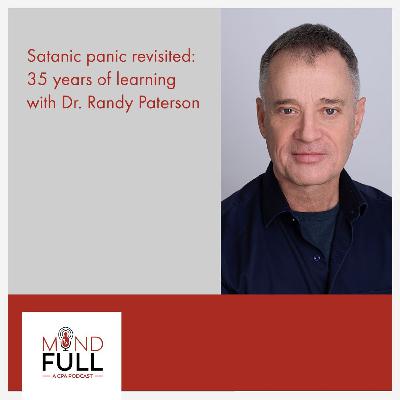
It has been more than 30 years since the Satanic Panic gripped popular culture. Millions were convinced there was an epidemic of child abuse stemming from satanic beliefs and rituals. There was no evidence to support these claims. There were TV specials, arrests, prosecutions, and even convictions - all based on something that never happened. Dr Randy Paterson joins Mind Full to look back at this phenomenon. He draws a parallel to today's QAnon beliefs, and points out psychology's role not only in explaining the panic in retrospect, but in fueling the flames in the first place.
CBC’s Uncover podcast: https://www.cbc.ca/listen/cbc-podcasts/472-satanic-panic
John Denver testifying at Tipper Gore’s Parents Music Resource Center: https://www.youtube.com/watch?v=VgSjjD6rRu4
Frank Zappa testifying: https://www.youtube.com/watch?v=hgAF8Vu8G0w
Dee Snider testifying: https://www.youtube.com/watch?v=S0Vyr1TylTE
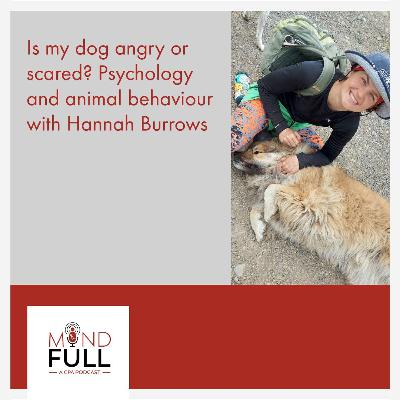
In this week's edition of People I Think You Should Meet on the Mind Full podcast, we talk to Hannah Burrows, a Master's psychology student specializing in animal behaviour. Specifically, the relationship between dogs and people. We talk about dogs, research, and the incredible things we have learned about animals over the years - crows, cuttlefish, and of course our own furry companions.
Crows and magic tricks: https://www.youtube.com/watch?v=eQa9dPGe0J8
Dogs helping endangered species through scat detection (an article by Hannah): https://kids.frontiersin.org/articles/10.3389/frym.2023.1023547
Brainwave synchronization or "neural coupling" occurs when humans and dogs look at each other, or when a human pets a dog: https://advanced.onlinelibrary.wiley.com/doi/10.1002/advs.202402493
Whale dog helping to save orcas: https://www.youtube.com/watch?v=DQ3BngMNv-g
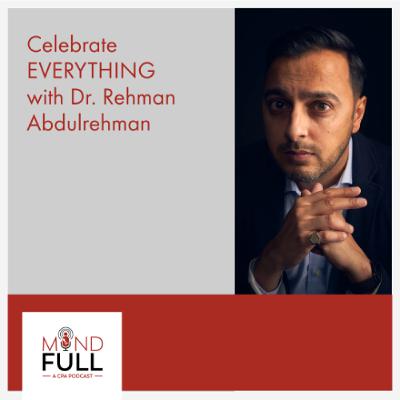
Every time we get to celebrate something, we’re a little happier as a result. A promotion, a birthday, an unusually warm and sunny day in January. The fact is, there are hundreds of reasons for a celebration, but for some reason we don’t lean into them all. Dr. Rehman Abdulrehman has a radical idea – let’s celebrate EVERYTHING!
Dr. Abdulrehman's website Lead With Diversity: https://leadwithdiversity.com/
The Celebrate Everything initiative: https://leadwithdiversity.com/ce/
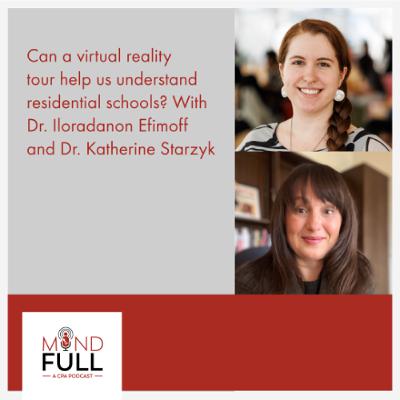
Dr. Katherine Starzyk and Dr. Iloradanon Efimoff created a virtual reality tour of a residential school. They collaborated with Survivors and computer scientists to see if a tour in this manner could change attitudes toward residential schools and reconciliation. Did it work? Well...kind of. But that doesn't mean the study wasn't worth doing! On today's episode we discuss what they learned and how even disappointing results move science and understanding forward.
Can a virtual reality residential school, developed with Survivors, improve empathy toward Indigenous people? Conversation article: https://theconversation.com/can-a-virtual-reality-residential-school-developed-with-survivors-improve-empathy-toward-indigenous-people-249996
Open-access paper 'The influence of Survivor stories and a virtual reality representation of a residential school on reconciliation in Canada': https://www.frontiersin.org/journals/social-psychology/articles/10.3389/frsps.2024.1346101/full
Open-access paper '“I definitely felt like I was there”: enacting empathy and negotiating a virtual reality Indian Residential School': https://journals.sagepub.com/doi/10.1177/11771801221117561
Missing Matoaka: https://www.missingmatoaka.ca/
Dr. Iloradanon Efimoff's lab website: https://psychlabs.torontomu.ca/iel/
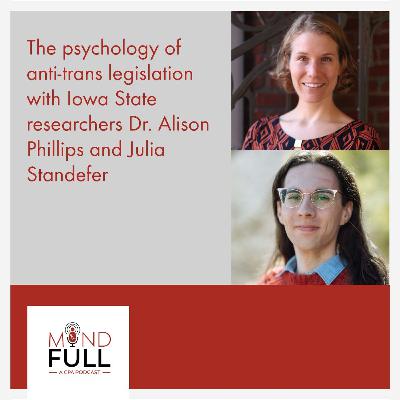
We’ve spoken on Mind Full before about anti-trans legislation, and the push to sideline the scientists doing work in the sex and gender space. But we’ve always done so from a Canadian perspective. We were curious to know how American psychologists are feeling at the moment. Dr. Alison Phillips and Julia Standefer, researchers at Iowa State University, tell us about their current situation and their recent article.
Conversation article ‘The psychology behind anti-trans legislation: How cognitive biases shape thoughts and policy’: https://theconversation.com/the-psychology-behind-anti-trans-legislation-how-cognitive-biases-shape-thoughts-and-policy-251691
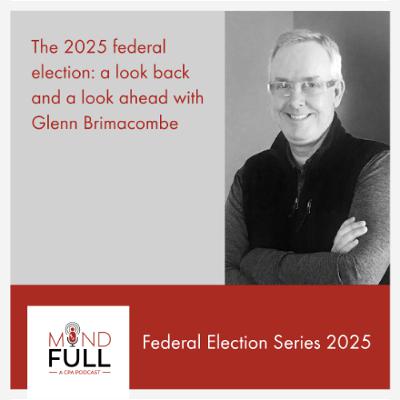
The federal election is over, and it looks like a Liberal minority. We speak with the CPA's Director of Policy and Public Affairs Glenn Brimacombe for the third time in our election series about the results, the reshaping of the federal government, and the path forward for advocacy. What is the current outlook for the health system in general? What are the possible scenarios for achieving parity between mental health coverage and physical health coverage? And what's next for Pierre Polievre and the NDP?
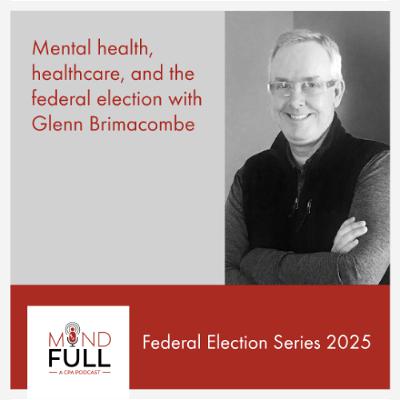
With just under two weeks until the federal election, we spoke with our director of policy and public affairs Glenn Brimacombe (again!) about public health, mental health, and what we can all do to keep those topics top of mind as we approach April 28th.
Policy Primers: https://cpa.ca/docs/File/Advocacy/CPA%20Policy%20Primer%20Final%20December%202024.pdf
Ten questions for candidates:
https://cpa.ca/docs/File/Advocacy/2025%20Federal%20Elections%20Questions%20Final%20April%208%202025.pdf
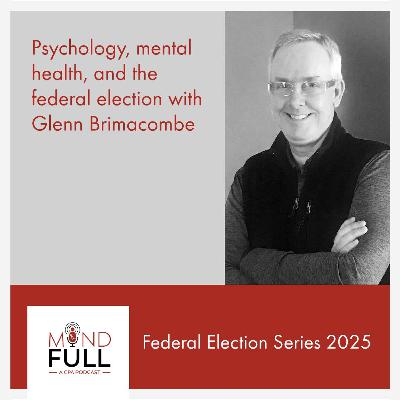
Glenn Brimacombe is the CPA's Director of Policy and Public Affairs, and a registered lobbyist. Glenn advocates for mental health funding and parity (to get mental health coverage on par with physical health coverage), and has some ideas about how to keep mental health at the forefront of the issues as an election looms.
CPA's Policy Primer 'The Federal Government & Mental Health Policy…Preparing for the Next Federal Election': https://cpa.ca/docs/File/Advocacy/CPA%20Policy%20Primer%20Final%20December%202024.pdf

Comments

Download from Google Play

Download from App Store
 United States