


Disruptors
Subscribed: 89,021Played: 819,908
Subscribe

© All rights reserved
Description
Disruptors, now in its 11th season, has become your front-row seat to Canada’s innovation story—200+ episodes exploring the people, ideas, and technologies reshaping Canada’s future.
Each episode, hosted by John Stackhouse, SVP, Office of the CEO at Royal Bank of Canada—and former Editor-in-Chief of The Globe and Mail—cuts through the hype and focuses on what you need to know.
This season, we’re leaning into urgency: the global economy is shifting, geopolitics are noisy, and Canada needs to respond. You’ll hear from founders, investors, scientists, operators, and policy leaders at the forefront. Listen for a clearer understanding of the tech and innovation shaping Canada and the world—and practical insights to help you make sense of what’s coming next.
Each episode, hosted by John Stackhouse, SVP, Office of the CEO at Royal Bank of Canada—and former Editor-in-Chief of The Globe and Mail—cuts through the hype and focuses on what you need to know.
This season, we’re leaning into urgency: the global economy is shifting, geopolitics are noisy, and Canada needs to respond. You’ll hear from founders, investors, scientists, operators, and policy leaders at the forefront. Listen for a clearer understanding of the tech and innovation shaping Canada and the world—and practical insights to help you make sense of what’s coming next.
239 Episodes
Reverse

Canada has world-class biotech science. Too often, the companies built on it grow up somewhere else. Clarissa Desjardins, co-founder and CEO of Montreal’s Congruence Therapeutics, joins John Stackhouse on the state of biotech and what Canada must do to keep more of what it builds. In this episode: • How AI is changing the way new drugs are discovered • Why China’s rise is reshaping the global industry • Why biotech stays invisible in Canada, even to investors • What it would take to grow Canadian companies to global scale at home Chapters:0:00 Will Canada's medicines come from China? 0:28 Biotech's missing place in Canada's agenda 1:32 From scientist to entrepreneur 3:47 Great science, too little commercialization 6:03 How AI is changing drug discovery 9:54 Why biotech is invisible, and underfunded 13:15 Health sovereignty and the anchor-company gap 18:33 China's rise in drug discovery 21:31 What Canada needs to do next 24:17 Closing thoughts
CONNECT & SUBSCRIBE:• Follow RBC Thought Leadership on LinkedIn• Follow John Stackhouse on LinkedIn• For more insights visit RBC Thought Leadership Hosted by Simplecast, an AdsWizz company. See pcm.adswizz.com for information about our collection and use of personal data for advertising.

Live from ALL IN 2026 in Montreal, John Stackhouse and Nora Bieberstein sit down with three German business leaders — Yvonne Denz of the Canadian German Chamber of Industry and Commerce, Robert Jozic of Schwarz Digits, and Dr. Ralf Wintergerst of Giesecke+Devrient — as Germany serves as ALL IN's Country of Honour. Recorded the same week Canada and Germany backed Yoshua Bengio's AI safety lab LawZero and built on last year's Digital Alliance, they discuss why Schwarz backed the Cohere-Aleph Alpha merger and what a deeper Canada-Germany tech partnership could mean for both economies.Chapters:0:00 Intro — live from ALL IN Montreal0:41 Co-host Nora Bieberstein joins1:20 Yvonne Denz on Germany's delegation to Canada2:02 Inside the industrial AI panel with BSF3:29 Making the case for Canada-Germany business5:36 Robert Jozic on scaling sovereign AI at Schwarz Digits6:19 Middle powers vs. the tech hegemons8:54 The Cohere-Aleph Alpha deal, on the record10:12 What Germany offers Canada11:45 Dr. Ralf Wintergerst on Germany's AI ambitions13:19 Combining Canada's AI research with Germany's industrial base14:27 The "third moment" in global AI15:32 What Canada offers Germany16:38 Building the digital euro18:34 Reflections: the globalization of AI
CONNECT & SUBSCRIBE:• Follow RBC Thought Leadership on LinkedIn• Follow John Stackhouse on LinkedIn• For more insights visit RBC Thought Leadership Hosted by Simplecast, an AdsWizz company. See pcm.adswizz.com for information about our collection and use of personal data for advertising.
At the Milken Institute's Global Dialogues Toronto, held alongside Prime Minister MarkCarney's Canada Investment Summit, three Canadian leaders took up both questions on onestage. Aidan Gomez co-founded Cohere and was a co-author of the 2017 paper that introducedthe transformer architecture underpinning today's large language models. Dave McKay leadsRBC. Evan Solomon is Canada's first Minister of Artificial Intelligence and DigitalInnovation. Susan Li of Fox Business Network moderated.The conversation runs across three arguments. Gomez makes the case that regulation should beshaped by an independent third party rather than by the largest labs, and warns aboutincumbents using rules as a competitive moat. McKay describes a practical sovereigntyproblem: the most advanced security tooling is released selectively outside the UnitedStates, which he calls an unfair playing advantage with real cyber risk for institutionsoperating elsewhere. Solomon frames the government's position as a build right or build wrong option,and argues the test is whether society comes along.Gomez closes on the case for a democratic second rail in AI, with Cohere in Canada andMistral in France as the two candidates. It is a compact view of where Canada's AI debateactually sits.0:00 Canada's claim on the technology it built0:16 Two kinds of uncertainty, one week in Toronto1:11 Who should write the rules for frontier AI1:46 Uneven access to the most advanced tools3:38 Canada's position on AI safety4:47 Development cycles are compressing6:52 Will AI change more jobs than it creates?8:41 Build right or build wrong9:41 How modern AI was invented in Canada11:58 The case for a democratic second rail12:39 Final thoughts from the panel14:42 What's next: geotech
CONNECT & SUBSCRIBE:• Follow RBC Thought Leadership on LinkedIn• Follow John Stackhouse on LinkedIn• For more insights visit RBC Thought Leadership Hosted by Simplecast, an AdsWizz company. See pcm.adswizz.com for information about our collection and use of personal data for advertising.
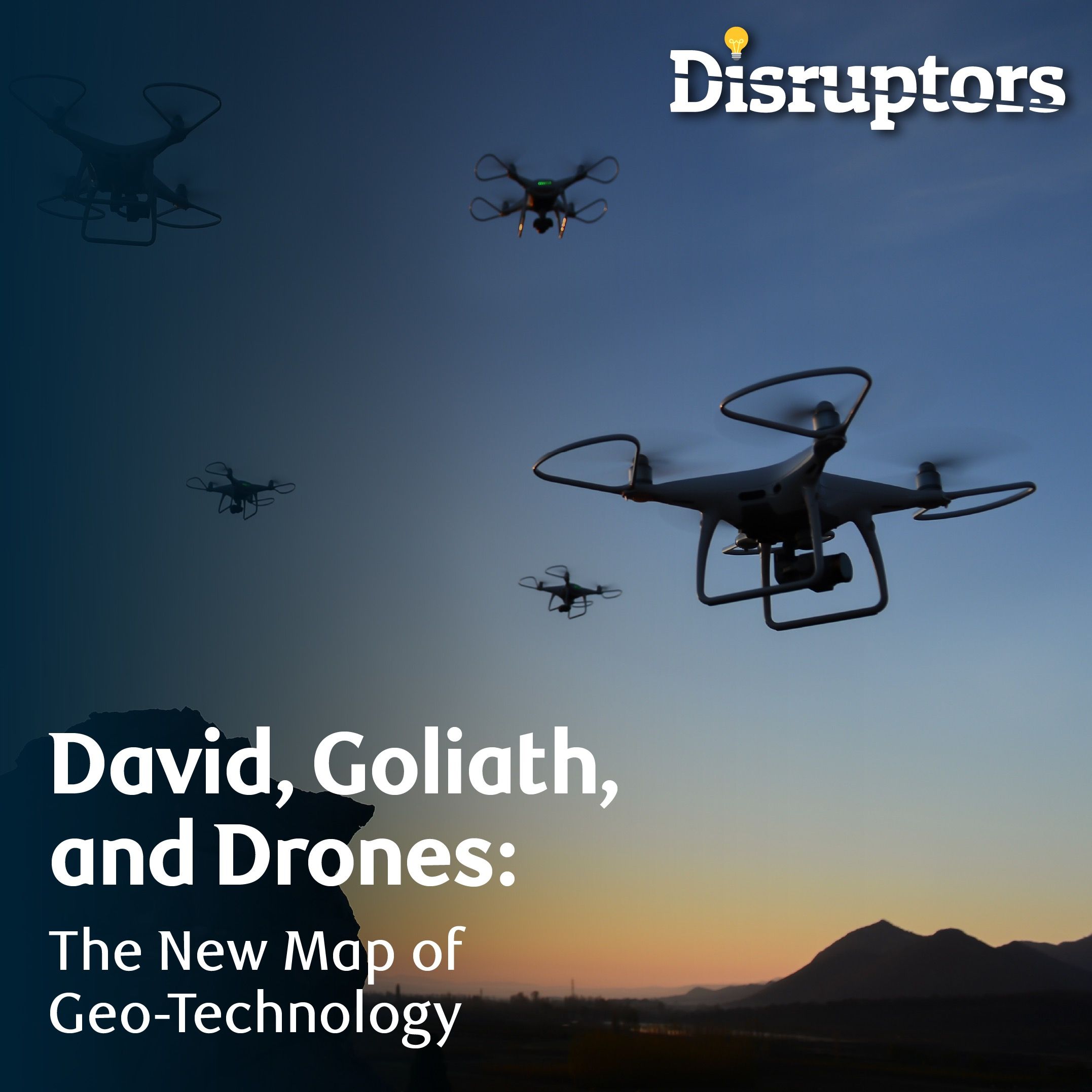
As global power dynamics shift, the intersection of technology and national strategy is defining a new Cold War race. In this season opener of Disruptors, host John Stackhouse sits down with economist and Noahpinion author Noah Smith to map out the new geopolitics of tech.Together, they unpack China’s dominance over the critical "electric tech stack" (batteries, magnets, and power electronics), why traditional military platforms are being upended by cheap drone warfare, and how middle powers like Canada, Japan, and Korea can build "Allied Scale" to compete. They also explore the true goal of modern industrial policy, the reality of AI labor disruption, and what a disabled rabbit named Giggles can teach us about resilience in a noisy world.CHAPTERS & TIMESTAMPS: 00:00 - Introduction: The Shift to Geo-Technology 01:58 - Lessons in Resilience from a Disabled Rabbit 03:07 - Great Power Competition & the New Global Tech Map 07:15 - The "Electric Tech Stack": Batteries, Magnets, and Electronics 10:03 - Rebuilding "Allied Scale" Without the U.S. 13:32 - Modern Industrial Policy: Wealth vs. Strategic Preservation 17:10 - AI, Labor Disruption, and Jevons Paradox 21:30 - Canada’s Next Move in the Geo-Tech RaceRESOURCES & LINKS MENTIONED:Substack Newsletter: Noahpinion by Noah SmithCommentary & Analysis: Bloomberg Opinion archives by Noah SmithConcepts Referenced: Rush Doshi’s "Allied Scale," Mark Carney’s commentary on global hegemons, and Jevons Paradox in economic theory.
CONNECT & SUBSCRIBE:• Follow RBC Thought Leadership on LinkedIn• Follow John Stackhouse on LinkedIn• For more insights visit RBC Thought Leadership Hosted by Simplecast, an AdsWizz company. See pcm.adswizz.com for information about our collection and use of personal data for advertising.

The world is investing billions in data centres and compute. Canada’s edge isn’t bigger boxes—it’s Trust: rules enforced at home, private information secured under Canadian jurisdiction, and a clear path for enterprise data handling in the age of AI.
That’s how “Canadian trust” becomes a competitive advantage.
This week on Disruptors: The Canada Project, John Stackhouse takes us to Waterloo to map how policy as code, Canadian residency, and lineage + audit turn trust into a speed advantage. Guests: Tom Jenkins & Shannon Bell (OpenText), with Janice Stein (Munk School).
Build it here—export it with confidence.Takeaways:OpenText new bookEnterprise Artificial Intelligence: Building Trusted AI with Secure DataRBC Thought Leadership’s Bridging the Imagination Gap: How Canadian companies can become global leaders in AI adoption
RBC Thought Leadership
CONNECT & SUBSCRIBE:• Follow RBC Thought Leadership on LinkedIn• Follow John Stackhouse on LinkedIn• For more insights visit RBC Thought Leadership Hosted by Simplecast, an AdsWizz company. See pcm.adswizz.com for information about our collection and use of personal data for advertising.

Comments

Download from Google Play

Download from App Store
 United States