


 Claim Ownership
The Innovative Leader
Subscribed: 4Played: 4
Subscribe

© The Innovative Leader
Description
Welcome to The Innovative Leader with Christy Geiger, Master Certified Coach and David Phillips, Educator, Analyst & Consultant. Our mission to equip, inspire, and transform how we LEAD in life & work. Raising the level of leadership makes a difference! Be Equipped. Get Inspired. Transform The Way you Lead.
theinnovativeleader.substack.com
theinnovativeleader.substack.com
44 Episodes
Reverse
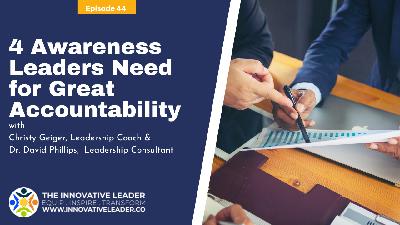
Podcast #44 | The Innovative Leader SeriesIn this episode of The Innovative Leader Series, we explore 4 critical awarenesses leaders need to master to foster accountability and build high-performing teams. As organizations face increasing complexity and rapid change, these awarenesses serve as the foundation for clarity, trust, and progress.We’ll discuss:* Clarity in Roles and Expectations – How clear goals and responsibilities empower teams and eliminate confusion.* Adaptability During Uncertainty and Change – The importance of responding intentionally to disruption while maintaining alignment.* Effectiveness in Communication – How clear, timely, and empathetic communication strengthens team cohesion and trust.* Courage in Addressing Conflict – Why tough conversations are vital for accountability and how to approach them effectively.Throughout the episode, we share practical tools like the EOS Accountability Chart and draw insights from key leadership books like Never Split the Difference and The Anatomy of Peace. These strategies will help leaders sharpen their focus and guide their teams to success in any environment. This is a public episode. If you would like to discuss this with other subscribers or get access to bonus episodes, visit theinnovativeleader.substack.com
How do you empower your employees to make decisions without you?Spoiler alert…start small. Think about the decisions you are asked every day.In this episode, Christy and David interview a special guest, Tina White. Tina provides a unique perspective based on her business experience as a CPA blended with the real world of owning an HVAC company. Today, Tina Is a business coach and owner of Panaramic, http://www.panaramicacadamy.comThey shine a light on why it is tough to let go.Tina explains how adding bowling alley bumpers to the decision-making process helps ensure your employees make the right decision and know when to ask for help.They discuss how you can share key numbers with your team without posting a copy of your financial statements in the breakroom.Listen to learn how you can start delegating today! It’s a win-win-win. You’ll boost employee morale, your customers will enjoy quick answers, and you’ll free up your time to work ON the business. This is a public episode. If you would like to discuss this with other subscribers or get access to bonus episodes, visit theinnovativeleader.substack.com
Are you ready to start having those tough conversations as a leader? Or are you still trying to avoid the conflict that comes with them? As a leader, you must learn to be courageous enough to have tough conversations that are of much interest to an organization’s operations.In this episode, Christy and David discuss the importance of having tough conversations within an organization. They explain the reasons, excuses, and doubts that envelop us as leaders and stop us from having the tough conversations that need to be had.They also discuss why many leaders avoid tough conversations because they view them as conflict and how you can change your perspective. Listen in to learn why avoiding tough conversations is costing you more than not having them. This is a public episode. If you would like to discuss this with other subscribers or get access to bonus episodes, visit theinnovativeleader.substack.com
How do you as a leader set your people up for success? In this episode, Christy and David talk about how to make things clear and smoothen out the path for your team to reach their highest level of success as a leader.They explain the importance of defining goals and clarifying roles as a leader to allow team members to work towards success.Christy and David explain the different ways you can remove obstacles by reducing ambiguity and providing resources to help your team to work effectively. Listen in to learn how you can have your leaders’ back, champion for their credibility, and much more! This is a public episode. If you would like to discuss this with other subscribers or get access to bonus episodes, visit theinnovativeleader.substack.com
How do you understand emotional intelligence as a leader? Have you embraced it as a critical part of your 4.0 leadership? In this episode, Christy and David talk about the importance of emotional intelligence in leadership and how it improves communication effectiveness.They explain why soft skills that make up emotional intelligence are way more critical than hard skills when hiring in an organization.Christy and David explain why the higher you go in leadership the more you need to strengthen your emotional intelligence to lead successfully. Listen in to learn how to change your mindset and grow your emotional intelligence skills and much more! This is a public episode. If you would like to discuss this with other subscribers or get access to bonus episodes, visit theinnovativeleader.substack.com
What exactly is vision casting and do you need it in your organization? In this episode, Christy and David talk about the meaning of vision casting and how to build a vision within an organization.They explain why a vision is a function of a pain point and how to build stories of how it looks like. Listen in to learn how a vision becomes the focal point that guides you towards your intended goal (the NorthStar).Christy and David explain the difference between mission and vision, how to align your team and operations to your NorthStar, how to work with your team as a collective in a 4.0 organization, and more!Connect with Us:· Innovative Leader: www.innovativeleader.coo YouTube: https://www.youtube.com/channel/UC0qoeyPcIFWowUa0G9zrCfw· Christy Geiger: https://synergystrategies.como https://www.linkedin.com/in/christygeiger/David Phillips: https://wdavidphillips.com/ This is a public episode. If you would like to discuss this with other subscribers or get access to bonus episodes, visit theinnovativeleader.substack.com
In this episode, Christy and David talk about reverse mentoring and what it means in a 4.0 organization.They discuss what it means, its difference from traditional mentoring, and why you should practice it asa leader.What is reverse mentoring? Reverse mentoring is about creating space for the younger and less-seasoned people in an organization to mentor the older generation. It involves more topic-basedmentoring where you’re open to learning from the new people in the organization as a leader.Why do reverse mentoring? Reverse mentoring allows you as the leader to equalize the relationshipbetween you and employees, which leads to better communication and a direct connection at all levelsof the organization. It also creates space for diversity and inclusion and its tangible value.How to get started. To build a mentoring process, try a series of things like starting a presentation day,having a challenge, practicing humble leadership, and even getting someone like a millennial summerintern to help people in the organization learn.Listen in to understand the value of practicing reverse mentoring for the organization. employees, andyou as the leader. This is a public episode. If you would like to discuss this with other subscribers or get access to bonus episodes, visit theinnovativeleader.substack.com
In this episode, Christy and David talk about lateral thinking in a 4.0 organizational environment. They discuss how lateral thinking shows up in leadership, why it matters over linear thinking, and how to exercise it. What is lateral thinking? Lateral thinking builds on traditional logical thinking. It brings creativity, problem-solving, and out-of-the-box thinking into traditional fact-based linear thinking. Lateral thinking takes the whole brain doing it with sometimes being about observation, exploring and examining, or breaking things down into pieces and looking to put them back together in a different way. Why does lateral thinking matter? The solutions to the complex problems need to be different, which requires lateral thinking. For you as a leader to innovate, you need lateral thinking. Lateral thinking draws in highly creative people.How do you do lateral thinking? Practicing in different disciplines gives you different perspectives that you’ll be able to bring to different positions. Learn to ask questions and deconstruct as a leader to get better at lateral thinking. Listen in to learn the importance of exercising linear thinking as a leader to enable your team to have a voice, to see the bigger picture, and to find solutions. This is a public episode. If you would like to discuss this with other subscribers or get access to bonus episodes, visit theinnovativeleader.substack.com
n this episode, Christy and David talk about curiosity development in an organization. They discuss what shuts curiosity down, why being curious as a leader is important, and what cultivates curiosity in an organization.What shuts curiosity down. An organizational culture that is always right and isn’t open to new ideas works to only shuts down the curiosity. A culture that lacks innovation and creativity suppresses curiosity. Your ego and biases more often kill your ability to learn and to have a new perspective, blocking your curiosity.Why you should be curious as a leader. As a leader in a 4.0 organization, you should be striving for curiosity, to not know, to be open, and to have questions as opposed to knowing and being competent. Curiosity supports your value and happiness.Curiosity cultivation starts with you as the leader which allows the team to follow suit.Listen in to learn more in-depth about curiosity and how you can cultivate a curious working environment as a leader. This is a public episode. If you would like to discuss this with other subscribers or get access to bonus episodes, visit theinnovativeleader.substack.com
How do you maximize your time? How do you get to do more done in less time? We’re living in the technological era where we have more tools and resources that we can utilize to make more use of our time.In this episode, Christy and David talk about how you can maximize your time by simplifying, automating, and upskilling your tasks. They discuss how outsourcing and decentralization of tasks will allow you to get stuff off your plate and focus on your most important leadership tasks.Listen in to learn how to automate mindless tasks with digital tools and resources so you can use your ‘mindless’ time doing more enjoyable hobbies. You will also learn the importance of upskilling in technology and also your human relational side of things like soft skills and emotional intelligence skills as a leader. This is a public episode. If you would like to discuss this with other subscribers or get access to bonus episodes, visit theinnovativeleader.substack.com
How are you handling the unexpected change happening in 2021 as a leader? Exhaustion and overwhelm lead to unproductivity, and as a leader, you want to have the right tools to be productive. So, how do you get yourself in your right frame of self in 2021?In this episode, Christy and David talk about the importance of adopting the right mindset, forming habits, and expanding your learning as a leader. They discuss the benefits of fueling your energy, especially during the pandemic by embracing change in your environment and systems.Listen in to learn the value of experimenting with practices to see which ones work better for you, to be a better leader this year.What You Will Learn:· [3:07] How to embrace your higher self who comes up with solutions to challenges that your emotional side would be incapable of tapping into.· [6:35] How to fuel yourself with positive messages of who you are and want to become through affirmations.· [8:00] The importance of forming daily habits that create the healthy, focused, and creative you.· [11:19] How to embrace your transition to practices and habits that bring you the needed energy.· [16:21] Learn how to find other ideas to spur your thinking and have other perspectives.· [21:26] The benefits of responding to COVID-19 by changing your mindset, habits, and learning.· [24:23] How to adapt to change and grow with it rather than resisting or judging it.Quotes:1. “It’s really up to us to make sure that we’re fueling with the positive messages who we are.”- Christy [6:55]2. “It’s getting back to those practices that create the healthy you, that create the creative you, and that create the focused you.”- Christy [10:21]3. “Sometimes you have grown and changed, sometimes your environment has grown and changed, and so your systems and habits have to grow and change.”- Christy [12:39]4. “Play around with them, figure out what works in that evolving habits formation process.”- David [16:02]5. “Just change one thing and it could have a cascading effect on the others.”- David [24:19]6. “As things are evolving and changing, we struggle and wrestle underneath the change because change makes us uncomfortable.”- Christy [25:24]Possible Actions to Take Consider forming daily habits of affirmations and gratitude practices to get you through stormy times when they come. Sign up for an online resource learning platform like Udemy to learn from others and expand your perspective. Experiment with small changes in your system of doing things to get your mind used to change as you make space for bigger changes.Links to Resources Mentioned· Atomic Habits by James Clear· https://www.udemy.com/· Micro-Resilience by Bonnie St. JohnConnect with Us:· Innovative Leader: www.innovativeleader.coo YouTube: https://www.youtube.com/channel/UC0qoeyPcIFWowUa0G9zrCfw· Christy Geiger: https://synergystrategies.como https://www.linkedin.com/in/christygeiger/David Phillips: https://wdavidphillips.com/ This is a public episode. If you would like to discuss this with other subscribers or get access to bonus episodes, visit theinnovativeleader.substack.com
How are you as a leader communicating and engaging your team in 2021? Communication and engagement completely transformed in 2020, and you have to be more skillful to effectively do both as a leader in 2021.In this episode, Christy and David talk about the importance of skillful and effective communication and emotionally intelligent leadership in organizations in 2021. They discuss the purpose of incorporating digital communication tools to better handle virtual and remote teams.Listen in to learn how being emotionally intelligent as a leader allows you to create a safe environment for team engagement. What You Will Learn:[1:30] The three leadership trends in 2021 considering the year 2020 was.[5:30] The importance of being an effective communicator to lead virtual teams.[7:07] How to curve out and be skilled in both face-to-face and virtual communication for effectiveness.[10:41] How communication is moving towards responsive visual and verbal communication virtually and backing it up with documentation.[15:01] How online communication tools have brought a collaborative aspect in organizations.[17:55] How emotional intelligence allows you as a leader to create a safe environment for engagement as opposed to when you’re not. [24:34] How to exercise engagement during team meetings by having authentic conversations.Quotes:“The most important skill you’re going to need as a leader is the ability to communicate.”- David [5:42]“You have to be engaged and you have to communicate and share your own ideas.”- David [17:48]“When we’re not emotionally intelligent, that is what creates unsafe places for people to show up.”- Christy [18:57]“If a leader is emotionally intelligent, you’re aware of others and what’s going on for them and you have a caring compassion for them.”- Christy [19:41]“You’ve got to be able to communicate who you are, what your mindset is, what your desires are, to communicate effectively.”- David [22:21]“If people aren’t engaging in your meetings, then you need to ask what you need to work on from a leadership standpoint to create that engagement.”- David [24:36]“Sometimes the best thing you can do is either keep quiet or ask questions.”- David [27:21]“Your job is not to solve the problems; your job is to clear the path so the team can solve problems.”- Christy [28:17]Possible Actions to TakeConsider ways you can improve both one-on-one or virtual communication by utilizing digital tools like Microsoft Teams, Slack, Google Hangouts, etc.Invite your team to have authentic conversations to allow engagement in team meetings.Be emotionally intelligent by keeping quiet and asking your team members questions as a way of providing them with a safe environment.Connect with Us:Innovative Leader: www.innovativeleader.coYouTube: https://www.youtube.com/channel/UC0qoeyPcIFWowUa0G9zrCfwChristy Geiger: https://synergystrategies.comhttps://www.linkedin.com/in/christygeiger/David Phillips: https://wdavidphillips.com/https://www.linkedin.com/in/wdavidphillips/ This is a public episode. If you would like to discuss this with other subscribers or get access to bonus episodes, visit theinnovativeleader.substack.com
Have you made the transition from a 2.0 leader to a 4.0 leader? We’re evidently living in very rapid times and change is inevitable, especially for organizations and teams. Transitioning from a 2.0 leader to a 4.0 leader is all about organizational structure and liquidity.In this episode, Christy and David talk about the difference between structure and liquidity and transitioning from 2.0 to 4.0 leadership. They discuss the benefits of flexibility and adaptability to change in transitioning from a 2.0 to a 4.0 organization or team.Listen in to learn the importance of letting go of control as a leader to allow your team member to make the necessary changes and scale the business.What You Will Learn:· [2:44] The difference between structure and liquidity, plus the challenges of structure in an organization.· [4:40] The benefits of adopting liquidity in an organization or team.· [7:21] The importance of flexibility as a leader to avoid irrelevance and ineffectiveness in a team and organization.· [10:35] The dangers of bringing new people into an intensely structured team or organization.· [14:32] How to allow processes to change by bringing people to work together.· [16:49] The power of a 4.0 organization in allowing teams to change and evolve with the times.· [21:24] How to allow people to be open and confident without fear of letting go.· [23:08] How to become a coach and not a manager to your team by allowing easy flow of communication.Quotes:1. “The difficult part about structure is that it doesn’t always allow you to adapt and bring in the necessary resources to accomplish the mission of the organization.”- David [3:47]2. “The beauty of fluidity is that people don’t own it, as they’re part of a team.”- David [7:08]3. “As leaders you can become outdated, irrelevant, and not effective.”- Christy [7:41]4. “In this age and in this world and in this time period, everything is changing and adjusting at a rapid speed.”- David [16:36]5. “When it comes to really letting go of control as leaders a lot of time, we do struggle with that because we’ve gotten used to being in control.”- Christy [17:01]6. “As a leader, one of your biggest roles is to develop leaders.”- David [23:38]7. “The challenge for a 2.0 leader in making that transition to a 4.0 leader is letting it go.”- David [20:52]Connect with Us:· The Working Genius Assessment: https://www.workinggenius.com/· YouTube: https://www.youtube.com/channel/UC0qoeyPcIFWowUa0G9zrCfw· Website: https://synergystrategies.com/podcast-master-dynamic-decision-making/· Christy Geiger: https://www.linkedin.com/in/christygeiger/· https://synergystrategies.com/· David: https://wdavidphillips.com/ This is a public episode. If you would like to discuss this with other subscribers or get access to bonus episodes, visit theinnovativeleader.substack.com
When was the last time you self-assessed yourself to find out your strengths? Maybe it’s high time you did it together with your team and share the results to help you function better as a leader. There are many assessment tools available that you can use to find out your strengths and weaknesses and that of your team.In this episode, Christy and David talk about the different ways you can assess your strengths to function better as a leader. They explain how tools like online assessments work and how to use them to become aware of who you are and how to develop. Listen in to learn the importance of getting away to self-assess every few months to avoid distractions. You will also learn why you have to understand patterns of challenges happening to you as a leader in order to solve them. What You Will Learn: • [1:44] The process of assessing your strengths, expanding your awareness of them, and developing a plan to grow those strengths.• [3:51] Some of the tools you can use to assess and identify your strengths; Stand Out Strengths Assessment, StrengthsFinder Assessment, Enneagram, etc. • [5:46] How to use assessment tools as a reflection of who you are, where you are, and how to develop towards your strengths today.• [9:38] Analyzing different types of assessment tools plus how to take an accurate assessment that shows your true authentic self.• [16:49] The value of organizations’ using assessment tests they pay for; to better understand their employees’ strengths and weaknesses. • [21:48] How assessments help you function better as a leader by understanding how similar or different you are to your team.• [24:00] How to evaluate yourself or engage a coach to understand what you need to change and how and why you do the things you do as a leader. • [29:30] Why you need to get away to get the chance to self-assess without any distractions. • [30:55] Why a 90 days frame is the best rhythm to self-assess so you don’t overwhelm yourself with change. • [34:04] The practice and discipline of skill-building to make it substantial. Quotes:1. “Assessment tools are really an inductive opportunity to assess and reflect how they fit us rather than feeling like an assessment is putting you in a box.”- Christy [6:50]2. “Sometimes when we overuse a strength, it actually becomes a weakness.”- Christy [13:50]3. “The assessments are great to expand our awareness, how we operate, communicate, and interact.”- Christy [14:13]4. “We want to use the assessments to be a starting point for conversations to understand people better.”- Christy [19:58]5. “If the same challenge is happening to you, its something with your leadership.”- Christy [28:45]6. “Schedule that self-assessment every 100-90 days so that you can evaluate on the changes that you’re making.”- David [30:45]7. “If it’s really an issue, it’s going to require work in order to upgrade it.”- Christy [34:52]Connect with Us:• YouTube: https://www.youtube.com/channel/UC0qoeyPcIFWowUa0G9zrCfw • Website: https://synergystrategies.com/podcast-master-dynamic-decision-making/ • Christy Geiger: https://www.linkedin.com/in/christygeiger/ • https://synergystrategies.com/ • David: https://wdavidphillips.com/ • Our Podcast Website: www.innovativeleader.co This is a public episode. If you would like to discuss this with other subscribers or get access to bonus episodes, visit theinnovativeleader.substack.com
We’re officially in February and you probably still feel overwhelmed from all of 2020’s baggage, right? Have you made plans for your business, what goals do you have to help you move forward? Because to be honest, 2021 doesn’t seem to be any better than 2020; but it is crucial you have goals even in the new normal.In this episode, Christy and David talk about how to approach goal setting in 2021. They discuss the assessing, planning, and having structures for accountability process and how it will help you set and implement your goals.Listen in to learn the importance of preparing to plan for your goals; so you have a clear picture of what needs and doesn’t need to be done.What You Will Learn:· [1:52] How the uncertainty and overwhelm of 2020 are dragging us from making plans for 2021.· [3:51] Learning how to assess the new situation and set goals in the existing rhythm of things.· [6:42] How to ask yourself questions of what had enabled you to move and what has stopped you from moving so you make progress towards this year’s goals.· [9:32] How to change, work when you’re most productive, and build-in time to adjust your rhythms.· [16:13] The pieces that you bring together to make your plan happen- what you do to get results.· [19:05] The power of having a plan to prepare you for your goals through research.· [22:32] Learning to involve your team in the planning process to assess what needs to be done or not to, for goals to succeed.· [25:26] Implementing the goals tweaking and testing process with the team, instead of executing major goals all at once.· [28:11] How to overcommit with several systems and activities to reach our important goals.· [32:20] The importance of telling someone about your goals to help keep you accountable.· [35:15] How to create structures to help you do what is difficult and uncomfortable for you to reach your goals.Quotes:1. “If you can get a little sense of where you’re at, it also helps you ask those questions.”- Christy [9:55]2. “If our speed has literally changed and the frequency that we’re going is actually not matching up, we have to change what we’re doing.”- Christy [10:39]3. “Trying is not is not going to move the needle either, you have to train to make it happen.”- Christy [17:12]4. “It’s not usually efficient to allow yourself to decide in the moment.”- Christy [20:17]5. “If you don’t tell somebody then that change is in your own head.”- David [32:26]6. “Micro goals within your larger goal lets you feel like you’re building momentum and you’re making progress.”- David [35:01]7. “When you’re setting your goals, you have to do it in a way that compliments your strengths and is you.”- Christy [35:51]8. “We have to be intentional in order to move what matters.”- Christy [41:36]Connect with Us:· The Working Genius Assessment: https://www.workinggenius.com/· YouTube: https://www.youtube.com/channel/UC0qoeyPcIFWowUa0G9zrCfw· IL Website: https://innovativeleader.co· Christy Geiger: https://www.linkedin.com/in/christygeiger/· https://synergystrategies.com/· David: https://wdavidphillips.com/ This is a public episode. If you would like to discuss this with other subscribers or get access to bonus episodes, visit theinnovativeleader.substack.com
In this episode of The Innovative Leader we explore 3 Questions to Discover the Next .... fill in the blank! Pivot. Great idea. Innovation. Activity. Etc. Whatever you are working on, these questions can help exercise that curiosity muscle to brainstorm and explore. It is important that we practice thinking broadly so we can see new opportunities and keep ourselves fresh and relevant! In the podcast we will talk about the questions and some ideas to use them in your work and life! Let us know what insights you have and how you have or plan to use the questions!3 Questions to Discover the Next ...#1 Why? Get to the root of things, discover the core motivation, be a child and dig deep! Watch out to not use this question to deflect or stall.#2 What If? Brainstorm possibilities; consider new variables, changing needs and times. What would happen in we did....?#3 Why Not? Discover and overcome limitations, consider what holds us back and cut off excuses, identify the goal and the greatest obstacle in the way so you can plan accordingly, do a reality check so you can plan and risk boldly but reasonably This is a public episode. If you would like to discuss this with other subscribers or get access to bonus episodes, visit theinnovativeleader.substack.com
We have noticed that not only has 2020 been this time of uncertainty and unknown, between COVID the United States elections and whatnot. But really, as we move into 2021, it seems like a lot of people maybe felt like 2021 provides fresh start. We talked about goal setting and planning for success in 2021 because a lot of times it's easy to not plan when we don't quite know's happening. So we're holding off and waiting on planning. As people either have not planned and not quite implemented it or they're holding off on their plan we're noticing some static in the environment around things that are happening.Today we wanted to talk about leadership in a frenetic time. What is it, and what do we need to do? This is a public episode. If you would like to discuss this with other subscribers or get access to bonus episodes, visit theinnovativeleader.substack.com
As we move to new year, Christy and David look at how to put together a roadmap for success in 2021. reflect & assess set goals & mindset design activity and measurable This is a public episode. If you would like to discuss this with other subscribers or get access to bonus episodes, visit theinnovativeleader.substack.com
It would sure be nice to have a crystal ball and know what is coming in 2021! Today, Christy and David take a look at the possibilities that could be there for leaders in 2021. It's also the wrap-up podcast of the year! This is a public episode. If you would like to discuss this with other subscribers or get access to bonus episodes, visit theinnovativeleader.substack.com
Building on the current era of Industry 4.0 and Web 4.0, we frequently talk about 4.0 Leaders. This is a leader who has the skills to navigate the demands of this 4.0 era. Because we are really evolving from many years of productivity and production, we refer to this era and time period of leadership as the 2.0 leader. Really the topic of leadership training and development was largely birthed during this time of the Second Industrial Revolution, which is why we say Leadership 2.0. The skills of the leaders at this time we about directing, orchestrating and being in charge. While there was a period of time where leaders have begun to embrace servant leadership, followership, the importance of the team, etc. (leadership 3.0), we are already tipping into leadership 4.0 which is a time that requires leaders to be must more flexible and curious. Progressive leaders understand these skills are essential, however in our work cultures often work places and many leaders are still very entrenched in the 2.0 leadership model. It creates conflict and frustration. How do you navigate? Do you lower your standards, conform, regress, not care, quit? How do you lead well when others don’t see the same thing you do? That is the topic for today’s podcast. Listen in and share your thoughts on how changing times require us to lead differently. This is a public episode. If you would like to discuss this with other subscribers or get access to bonus episodes, visit theinnovativeleader.substack.com

Comments

Download from Google Play

Download from App Store
 United States