


 Claim Ownership
Attention — Audio Journal for Architecture
Subscribed: 102Played: 360
Subscribe

© 2026 Attention — Audio Journal for Architecture, Architecture Exchange
Description
Attention is an audio journal for architectural culture that uses the medium of sound and spoken word to capture a dimension of architecture otherwise lost in print. By precluding visual media, Attention strikes a distance between the distraction economy of much online media, creating an intimate and reflective space for the in-depth development of ideas and issues. Through interviews, roundtable debates, oral histories, field recordings, the exploration of archival recordings, experimental music and soundscapes, reportage and audio essays, Attention investigates issues of concern to contemporary architectural culture, theory and practice.
55 Episodes
Reverse
In this episode we hear from this generation on their relationship to the digital. They discuss broad, societal experiences like watching the internet and social media emerge, and they grapple with the broken promises of connection and progress that these technologies once represented. Within architectural culture, they unpack their relationship to digital tools for design and fabrication, and outline why they have rejected parametricism for a less instrumental and more critical adoption of technology— a position described as post-digital.
In this episode we trace the genealogies of this generation through academic lineages, their movements through the geography of American Academia, and the post-critical or projective discourses which defined much of their time as students.
In this introduction we hear from Joseph Bedford addressing what this issue is about, who he interviewed, what their work is about, what questions he asked everyone, why he undertook the project, and how his interests in this generation intersect with his larger interest in the fate and future of theory, and the understanding of architecture as a discipline.
In this episode we hear from the group of American academic architects that has been brought together by this issue of attention. The group pushes back against their characterization as a generation, though there are throughlines in the group— namely their responses to the digital project, the crash of 2008, and their individual, pluralized approaches to architecture.
In this episode, Megan Eardley interviews the artist, puzzle-maker, and escape room designer Laura E. Hall about the design of escape rooms for the public, building community, and the politics of play. Together, they reflect on the popular appeal of detective work in an era of corporate dragnet surveillance.
In this episode, Megan Eardley interviews the investigative journalist and veteran beat reporter Caryn Dolley about the use of biometric and building surveillance devices in organized crime networks. With reference to her journalism and research for her book “The Enforcers” (2019), Dolley describes the movement of illicit and counterfeit goods through night clubs and the duplication of the state security apparatus in post-Apartheid South Africa.
In this episode, Megan Eardley introduces Issue 7 by relating contemporary spatial practices to the literary detective story and present day political realities of surveillance, state violence, and justice work.
Like proof, evidence typically refers to things, traces, marks, or signs, that can be studied to establish relevant facts and evaluate competing theories. But while proof has been associated with tests and verification procedures since the thirteenth century, evidence (or the Latin evidentia) refers to something that is “manifest to the senses” and “obvious”– there in a way that is not subject to dispute. To examine evidence is thus to contend with the politics of presence, practices of display, and conditions of access. In this episode, Megan Eardley discusses these concerns with Eyal Weizman, who is a critical proponent for forensic research in architecture today.
In this episode, Megan Eardley invites listeners to reflect on the way that detective work operates between form and event. She interviews the artist Janice Kerbel about the use of detective work in pieces such as “Bank Job” (1999), “Doug” (2014), and “Sink” (2018). They discuss how detection can be built into form, Kerbel’s experiments using plans to foreclose events, her relationship to language and writing, and how she seeks to reclaim small spaces within which we can act freely.
In this episode, Megan Eardley interviews the writer and artist Bryan Finoki. He describes how he came to study the security industry and reflects on his process of harvesting his own field recordings, synthesized sounds, and files scraped off the web, to make Dark Freqs, an original sound composition produced for Attention and this issue on Detective Work.
This episode presents Dark Freqs, an original sound piece by Bryan Finoki. Please note that the piece incorporates recordings of police brutality.
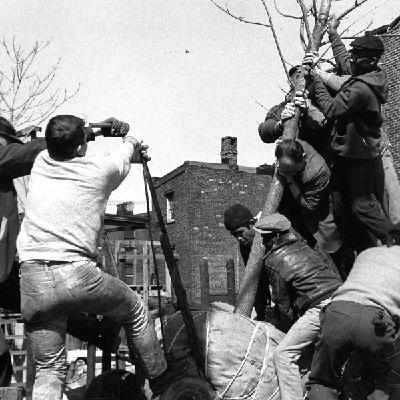
In Episode 1, Anna Goodman explains how contemporary architects in the United States often pursue community-engaged work through the design of processes. Analysis from the architectural historian Susanne Cowan helps demonstrate how this contrasts with early modern designers’ strong association of community and territory. The episode features excerpts from interviews with Jeff Hou, Maria Sykes and Mary Comerio as well as audio recordings of the work of Louis Mumford.
In Episode 2, Anna Goodman describes a shift in the way architects in the United States viewed community starting in the early 1960s. Using audio clips from participants in an experimental park and playground built under that leadership of the influential community designer Karl Linn, it documents a transition from practices that linked community to the space of the neighborhood to those that focused instead on process.
In Episode 3, Anna Goodman explores how a focus on the process of design over its products located community design at the intersection of anti-institutional activism and other social movements. It focuses on a series of events catalyzed by the construction of Berkeley’s People’s Park, using audio clips of participants provided by the Pacific Radio Archives, the documentary Design as a Social Act as well as commentary from the urban and architectural historian Anthony Raynsford.
In Episode 4, Molly Esteve describes the life and work of the architect and environmental justice advocate Carl Anthony. Using Anthony’s own words and commentary from Jah Sayers, the episode demonstrates how the Black radical tradition pushed designers and planners beyond the neighborhood to a metropolitan approach to community liberation.
This piece asks the question: “what is theory?” It begins by attempting to define “theory” as a term or as a concept, a task that involves addressing ideas of abstraction, generalization, science, discourse, language and rhetoric, as well as the persistent oppositions between theory and practice, theory and history, theory as engaged and instrumental or theory as reflective and critical.
This piece asks the question: “what is architectural theory?” It asks what the phrase “architectural theory” names for us, how architectural theory differs from theory per se, and what are its distinctive features that might remain the same despite changing historical epochs.
This piece addresses the question “how has architectural theory changed over time?” In particular, it explores the longue durée of two millennia of architectural writings in the west. In doing so the piece addresses the historicality of architectural theory in the western tradition. It asks what the big paradigm changes are that architectural theory has gone through, how it was different in earlier centuries to now, and whether there are different genres, formats, media, or dominant questions and problems that have defined it in different epochs.
This piece asks “is architectural theory Western or can it be global?” This means asking: is theory universal or is it geographically particular? Is theory inherently linked to Western notions of reason, philosophy, metaphysics, historical thought, and critique? And what is the relationship of theory to other modes of thought such as rhetoric, myth, symbolism, proverbs, moral and teachings?
This piece asks “how do you teach architectural theory?” We ask what are the ways that each person teaches architectural theory in their specific classroom and in their specific school? How do they approach this as a pedagogical challenge? Do they approach architectural theory as something to survey or to explicate (chronologically, thematically, or philosophically), or as something to do, to demonstrate, or to perform in the classroom? And what are the methods that each person uses in the classroom to teach architectural theory?

Comments

Download from Google Play

Download from App Store
 United States