Discover
The Dairy Edge
The Dairy Edge
Author: Teagasc
Subscribed: 676Played: 27,422Subscribe
Share
© Teagasc
Description
The Dairy Edge is Teagasc’s dairy podcast for farmers with the latest information, insights and opinion to improve your dairy farm performance.
Visit the show page at: https://www.teagasc.ie/animals/dairy/the-dairy-edge-podcast/
634 Episodes
Reverse
Padraig O’Connor, Dairy Technician with Teagasc in Grange, joins Stuart Childs with tips and advice for the month of February. Padraig discusses the management of the freshly calved cows as a separate group. Keeping these cows in for a few days after calving in a fresh-calved group allows recovery, easier observation and reduced bullying. Control of the colostrum group also simplifies milking management and use of available help. Padraig then talks about testing colostrum quality with a refractometer. Use a Brix refractometer (target >22%) to quickly check colostrum quality. This helps ensure adequate passive immunity for calves and flags potential diet issues. If readings are low, review the dry cow diet. Short-term protein supplementation (e.g., soybean meal pre-calving) may help improve quality. With reports of many cows over-conditioned this year, milk fever is a real risk. Padraig recommends focussing on correct dry cow minerals (especially magnesium), appropriate body condition (≈3.0–3.25), and controlled feeding for later calvers where feasible. Milk fever is a gateway disease linked to retained cleanings, mastitis, and fertility losses. Finally, Padraig advises people to prepare early for spring grazing opportunities. Even with poor weather, monitor drier paddocks and be ready to turn cows out for short (2-3 hour) grazings to reduce feed costs and support production. Set up fences and access in advance to act quickly when conditions allow; short grazing bouts can work without paddock water if cows have good access in sheds. For more episodes from the Dairy Edge podcast go to the show page at:https://www.teagasc.ie/animals/dairy/the-dairy-edge-podcast/ The Dairy Edge is a co-production with LastCastMedia.com
For this week’s Grass10 grazing management update, John Maher gives an update on the first set of figures in terms of grass supply from PastureBase Ireland. Plus he talks about the grazing management plan for the spring. Read more from this week’s Grass10 newsletter and subscribe for weekly updates at:https://bit.ly/Grass10-27thJanuary For more episodes from the Dairy Edge podcast go to the show page at:https://www.teagasc.ie/animals/dairy/the-dairy-edge-podcast/ The Dairy Edge is a co-production with LastCastMedia.com
This week’s Dairy Edge is from a recent Teagasc webinar entitled, ‘TB Update – Understanding the Recent Changes for Your Dairy Farm.’ TB continues to be a major challenge for the dairy sector, with herd incidence rising above 6% in 2024. There are now significant changes being introduced through the new TB Action Plan. James Dunne hosted the webinar and was joined by Damien Barrett, Head of the Ruminant Animal Health Programme with the Department of Agriculture, Food and the Marine, and Joe Patton, Head of Dairy Knowledge Transfer with Teagasc. Together, they outlined the key policy changes, current TB trends, and what these developments mean in practical terms for dairy farmers, particularly around herd management, animal movement and biosecurity. Link to webinar:https://youtu.be/naefVhMC-ZU Link to new TB action plan:https://assets.gov.ie/static/documents/d4cfc18d/7784-DAFM_TB_Action_Plan_LR.pdf For more episodes from the Dairy Edge podcast go to the show page at:https://www.teagasc.ie/animals/dairy/the-dairy-edge-podcast/ The Dairy Edge is a co-production with LastCastMedia.com
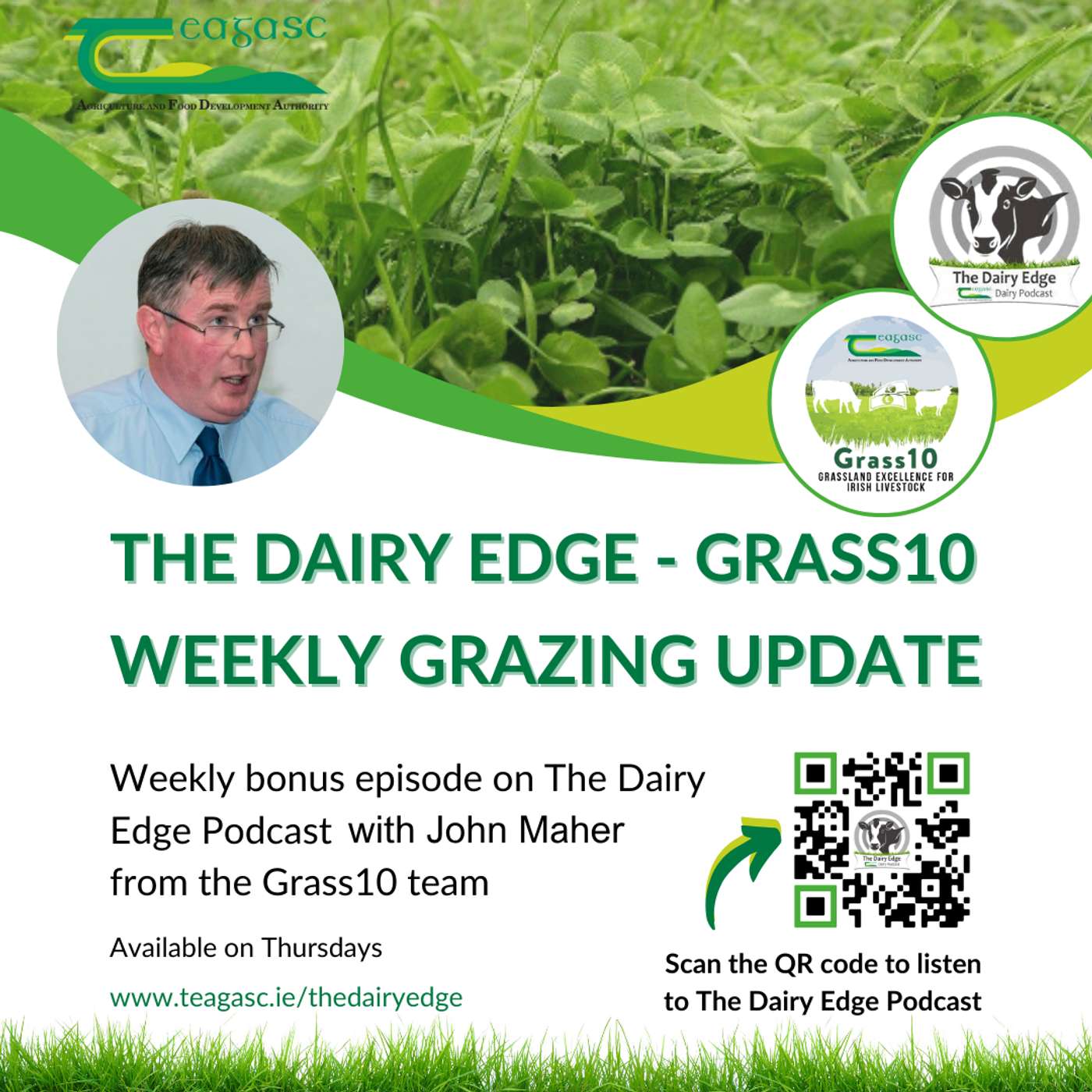
For this week’s Grass10 grazing management update, John Maher has a few tips before the grazing season gets going and he gives a summary of the farmers’ contributions from Nutrient Management Week 2026. Read more from this week’s Grass10 newsletter and subscribe for weekly updates at:https://bit.ly/Grass10-20thJanuary For more episodes from the Dairy Edge podcast go to the show page at:https://www.teagasc.ie/animals/dairy/the-dairy-edge-podcast/ The Dairy Edge is a co-production with LastCastMedia.com
Setting up the fertiliser spreader correctly is important to ensure accurate and even placement of fertiliser. John Corbett from Grassland Agro joins John Maher for the final daily episode as part of Nutrient Management Week to discuss this important aspect of nutrient application and management. Join us on the Dairy Edge each day of Nutrient Management Week for special episodes from farmers and experts and for more go to:https://teagasc.ie/news--events/news/grass10-nutrient-management-week-2026/ For more episodes from the Dairy Edge podcast go to the show page at:https://www.teagasc.ie/animals/dairy/the-dairy-edge-podcast/ The Dairy Edge is a co-production with LastCastMedia.com
For today’s episode as part of Nutrient Management Week, Grass10’s John Maher is joined by Mike Ahern who is farming near Ballyduff, Co. Waterford. Mike was the winner of the Nutrient Management category as well as the overall winner of that Grassland Farmer of the Year Competition in 2024 and he talks to John about the importance of driving growth with early fertiliser application on his farm as well as how to use GPS technology to minimise losses to ensure you get full value from the fertiliser allowances for your farm. Join us on the Dairy Edge each day of Nutrient Management Week for special episodes from farmers and experts and for more go to:https://teagasc.ie/news--events/news/grass10-nutrient-management-week-2026/ For more episodes from the Dairy Edge podcast go to the show page at:https://www.teagasc.ie/animals/dairy/the-dairy-edge-podcast/ The Dairy Edge is a co-production with LastCastMedia.com
Continuing the daily episodes as part of Nutrient Management Week, today John Maher talks about timing of applications to maximise their return, the rates to apply to find the balance between driving growth and mitigating potential environmental losses and how getting soil fertility right improves the return from applied nutrients thus being an important factor in minimising potential nutrient loss also. Plus he speaks to Mike Ahern who is farming near Ballyduff, Co. Waterford. Mike was the winner of the Nutrient Management category as well as the overall winner of that Grassland Farmer of the Year Competition in 2024.Join us on the Dairy Edge each day of Nutrient Management Week for special episodes from farmers and experts and for more go to:https://teagasc.ie/news--events/news/grass10-nutrient-management-week-2026/For more episodes from the Dairy Edge podcast go to the show page at:https://www.teagasc.ie/animals/dairy/the-dairy-edge-podcast/ The Dairy Edge is a co-production with LastCastMedia.com
As part of Nutrient Management Week, Grass10’s, John Maher, speaks to Michael Carroll from Co. Limerick. Michael was one of the joint winners of the Nutrient Management category at the 2023 Sustainable Grassland Farmer of the Year awards. He won this award for his understanding of managing slurry on his farm to drive grass growth and reduce his chemical N inputs and today he shares his way of looking at and managing slurry to reduce his chemical N input without compromising on the growth required to feed his herd as much grass as possible.Join us on the Dairy Edge each day of Nutrient Management Week for special episodes from farmers and experts and for more go to:https://teagasc.ie/news--events/news/grass10-nutrient-management-week-2026/ For more episodes from the Dairy Edge podcast go to the show page at:https://www.teagasc.ie/animals/dairy/the-dairy-edge-podcast/ The Dairy Edge is a co-production with LastCastMedia.com
Philip Murphy, Co-ordinator of the Blackwater Catchment Programme, and Pat Tuohy, Senior Researcher at Teagasc, join Stuart Childs to discuss effective use of nutrients and avoiding losses. Pat discusses recent research across 100 farms that he has completed on behalf of the Dept. of Agriculture that is showing slurry production rates are about 20% higher than the current regulatory assumptions (≈0.4 m³/cow/week vs 0.33m3). This means many farms that may currently be compliant on the basis of the current regulations, do not have sufficient physical storage, leading to pressure to spread slurry at less than ideal times. Both Pat and Philip talk about how this situation is forcing poor nutrient management decisions as when storage runs tight, farmers end up spreading slurry in poor weather/soil conditions. The return for these applied nutrients are lower and the risk of nutrient loss to water can also be greater so increased storage capacities would help take away pressure but also improve nutrient recovery subsequently. Philip speaks about the role of buffer zones for protected waterways and says that expanded buffer zone requirements (e.g. 10 m near waterways early/late in the spreading season vs 5 m for the rest of the year), risky fields, and wet soil conditions can remove 10–25% of land area from safe spreading. Storage capacity is therefore essential to provide flexibility. Both emphasise that adequate and indeed excess storage, allows slurry to be applied at the right time, rate, and place, improving nutrient efficiency, protecting water quality, avoiding soil damage from heavy machinery, and maximising the value of home-produced nutrients. For more episodes from the Dairy Edge podcast go to the show page at:https://www.teagasc.ie/animals/dairy/the-dairy-edge-podcast/ The Dairy Edge is a co-production with LastCastMedia.com
For the first Grass10 grazing management update of the year, John Maher highlights key practices to get grazing in 2026 off to a good start and he discusses the upcoming Nutrient Management Week which runs from Mon 19th-Fri 23rd January. Read more from this week’s Grass10 newsletter and subscribe for weekly updates at:http://bit.ly/13thJanuary2026 For more episodes from the Dairy Edge podcast go to the show page at:https://www.teagasc.ie/animals/dairy/the-dairy-edge-podcast/ The Dairy Edge is a co-production with LastCastMedia.com
Michelle McGrath, Calf Care Programme Manager with Animal Health Ireland, joins James Dunne on this week’s Dairy Edge to discuss the importance of good calf care and management as we move towards the busy calving period on farms. Michelle highlights best practice regarding colostrum management, calf rearing and weaning whilst also outlining what farmers can learn from the current Teagasc/Animal Health Ireland Calf Care events which are happening across the country. To find out more visit:https://teagasc.ie/corporate-events/calfcare-events/ For more episodes from the Dairy Edge podcast go to the show page at:https://www.teagasc.ie/animals/dairy/the-dairy-edge-podcast/ The Dairy Edge is a co-production with LastCastMedia.com
We’re reposting one of the most popular episodes from last year with Laurence Shalloo, Head of the Animal and Grassland Programme in Teagasc Moorepark, who joined Stuart Childs to discuss the future challenges facing the dairy industry. Laurence starts by acknowledging that there is a constant state of flux in the world now and that we are constantly adapting to change. This is no different to what we did in the run-in to the milk quota removal. Laurence talks about the pent up energy in the industry post-quota removal that has delivered a 100% increase in milk solids production from just a 50% increase in cows, indicating the advances made in terms of productivity. There are always challenges and costs were high on the agenda again in 2025 as there has been an upward shift in costs. There is a need to focus on getting on top of them again and key to that is efficiency and growing the cheapest feed we can – grass. The other challenges facing the industry include generation renewal as some of the people that have delivered the expansion are now looking for the person to carry on the business. Greenhouse gas emissions and water quality challenges also exist but are trending in the right direction and can be overcome by implementing the research. For more episodes from the Dairy Edge podcast go to the show page at:https://www.teagasc.ie/animals/dairy/the-dairy-edge-podcast/ The Dairy Edge is a co-production with LastCastMedia.com
Fermanagh man, Rodney Elliott, who is farming in the US state of South Dakota, joins James Dunne for the second part of his interview discussing recruiting and managing staff, herd breeding objectives, animal performance and herd nutrition. He also offers insights into what he has learned along the way and why he is as passionate about dairy farming today as he was 20 years ago. Image: https://www.midwestdairy.com For more episodes from the Dairy Edge podcast go to the show page at:https://www.teagasc.ie/animals/dairy/the-dairy-edge-podcast/ The Dairy Edge is a co-production with LastCastMedia.com
Fermanagh man Rodney Elliott, who is farming in the US state of South Dakota, joins James Dunne on this week’s Dairy Edge. In the first of a two part interview, Rodney outlines how he went from farming 140 dairy cows in Maguiresbridge, Co Fermanagh to operating two large scale dairy units in the US. He describes how the business has grown over time, some of the challenges met along the way and how he overcame them. Rodney discusses what farming KPIs matter in the running of the business and how he manages costs and market volatility. Image: https://www.midwestdairy.com For more episodes from the Dairy Edge podcast go to the show page at:https://www.teagasc.ie/animals/dairy/the-dairy-edge-podcast/ The Dairy Edge is a co-production with LastCastMedia.com
For this week’s episode of the Dairy Edge, in conjunction with Catherine Egan of the Beef Edge and Ciaran Lynch of OviCast, we talk to John Donlon, veterinary lecturer in Atlantic Technological University about bluetongue. John first describes the disease and explains how it presents in sheep, cattle, alpacas and other cloven hooved animals. He then explains how, in reality, the risk period should have passed at this stage of the year as midges that act as the vector for the disease should be gone by now. The cold weather is a help in that midge activity will be reduced or eliminated but that doesn’t mean the risk isn’t still there. People must remain vigilant and notify their vet and relevant authorities in the event of suspecting an animal has bluetongue. Trading implications could exist were a case to be identified in the Republic which would have ramifications for livestock movements, but currently there are no restrictions as the country is still bluetongue free. If a case were to be discovered, vaccines are available to reduce the severity of the disease but one would have to get an emergency license from the Department of Agriculture. Careful monitoring of stock for any signs are advised and swift notification, if identified, to facilitate rapid control is advised. For more episodes from the Dairy Edge podcast go to the show page at:https://www.teagasc.ie/animals/dairy/the-dairy-edge-podcast/ The Dairy Edge is a co-production with LastCastMedia.com
For this week’s final Grass10 grazing management update of the year, John Maher discusses current grazing advice, including opening cover targets and fodder assessment, plus he looks back on the grazing year in review. Read more from this week’s Grass10 newsletter and subscribe for weekly updates at:https://bit.ly/Grass10-9thDecember2025 For more episodes from the Dairy Edge podcast go to the show page at:https://www.teagasc.ie/animals/dairy/the-dairy-edge-podcast/ The Dairy Edge is a co-production with LastCastMedia.com
We’re reposting an episode from October with Teagasc Dairy Specialist, Patrick Gowing, who joined James Dunne on the Dairy Edge to discuss how to best manage surplus cash, build financial resilience, review production costs, and ensure farmers are best prepared for 2026. As 2025 draws to a close, it will be remembered as one of the best farming years in recent memory due to strong milk prices, increased stock values and good weather for most parts. This means that dairy farm incomes are in a good place for the 2025 calendar year. Although it has to be acknowledged milk prices have seen significant reductions in the last number of months, the effects of this will be felt more so in spring 2026 as higher constituents at this time of year are having a positive impact on the farm gate prices received. For more episodes from the Dairy Edge podcast go to the show page at:https://www.teagasc.ie/animals/dairy/the-dairy-edge-podcast/ The Dairy Edge is a co-production with LastCastMedia.com
For this week’s Grass10 grazing management update, John Maher discusses current grazing advice. Read more from this week’s Grass10 newsletter and subscribe for weekly updates at:https://bit.ly/Grass10-2ndDec2025 For more episodes from the Dairy Edge podcast go to the show page at:https://www.teagasc.ie/animals/dairy/the-dairy-edge-podcast/ The Dairy Edge is a co-production with LastCastMedia.com
Teagasc hosted the National Dairy Conference last week in both Clonmel and Cavan, and the theme of the conference was, ‘Pathways to Progress’, with key sessions on milk price and key farm performance priorities, collaborative farming arrangements and driving further progress in Irish dairy breeding. James Dunne caught up with Joe Patton, Martina Gormley and Stuart Childs to gain an insight into some of the main messages from the conference. Link to conference papers and presentations: https://teagasc.ie/publications/national-dairy-conference-2025/ For more episodes from the Dairy Edge podcast go to the show page at:https://www.teagasc.ie/animals/dairy/the-dairy-edge-podcast/ The Dairy Edge is a co-production with LastCastMedia.com
For this week’s Grass10 grazing management update, John Maher discusses current grazing advice. Read more from this week’s Grass10 newsletter and subscribe for weekly updates at:https://bit.ly/Grass10-25thNov25 For more episodes from the Dairy Edge podcast go to the show page at:https://www.teagasc.ie/animals/dairy/the-dairy-edge-podcast/ The Dairy Edge is a co-production with LastCastMedia.com