


 Claim Ownership
SUSTAINARUMBLE!
Subscribed: 1Played: 1
Subscribe

© SUSTAINARUMBLE! Team
Description
Every headline in the Philippines has a sustainability story behind it.
SUSTAINARUMBLE! connects the dots between today's news and tomorrow's consequences.
Real stories, real stakes, real solutions for the informed Filipino citizen.
Find all our social media pages and other content here: linktr.ee/sustainarumble
Send us an email at hello@sustainarumble.org for inquiries or collaboration!
SUSTAINARUMBLE! connects the dots between today's news and tomorrow's consequences.
Real stories, real stakes, real solutions for the informed Filipino citizen.
Find all our social media pages and other content here: linktr.ee/sustainarumble
Send us an email at hello@sustainarumble.org for inquiries or collaboration!
58 Episodes
Reverse

Despite being operational for three years, the Green Energy Option Program (GEOP) has reached over 500 customers by the end of 2024. Mindanao gained access to the program in March of that year, following the historic interconnection of the national grid. The awareness gap is real. But awareness alone isn't the whole story.The deeper challenge, one that doesn't get discussed enough, is supply. Until energy storage solutions, particularly battery technology, are fully integrated into the supply chain, renewable energy suppliers face genuine limitations in what they can reliably offer GEOP customers. In this episode of REalTalk, we sit down with Lyka Delos Santos from the Renewable Energy Management Bureau of the Department of Energy who walks us through the current state of the National Renewable Energy Program, the government's roadmap to 35% renewable energy by 2030 and 50% by 2040, and the specific policy mechanisms that are being developed to make GEOP more accessible and more impactful.
Coal still powers roughly 60% of the Philippines' electricity, and the cost isn't just on your bill. It's in the air, in community health, and in the growing exposure to climate-driven disruptions.In this episode, Pocholo Enriquez of Climate Reality Philippines walks us through what the data actually shows: what happens to businesses, families, and communities depending on which energy path the country takes, and why the tools to change course already exist.
Is the opportunity still on the horizon, or is it already here?The Philippines has quietly become one of Southeast Asia's stronger environments for renewable energy adoption, with government-backed programs, financial incentives, and infrastructure developments designed to make the transition genuinely advantageous for businesses of any industry.And yet, a 2023 study by the Climate Reality Project Philippines reveals a striking disconnect: the majority of business owners across manufacturing, hospitality, healthcare, real estate, and education remain largely unaware of the full scope of what's available to them.In this episode of REalTalk, MJ San Juan of Climate Vulnerable Forum joins us as we go beyond the obvious. It isn't just about kilowatts and solar panels but also what it signals to everyone in the community, and how genuine ownership drives downstream effects of lower energy costs and reshapes how business is done.If you're a business owner, an operator, or a stakeholder who's been curious but hasn't yet taken the leap, this episode is your clearest, most grounded entry point yet.
What does it look like when sustainability stops being a policy and starts being a way of life for an entire company?For Uratex, one of the Philippines' most established furniture manufacturers, the answer didn't begin with solar panels or kilowatt targets. It began with a belief: that a business which takes care of people and the planet is a better business, full stop.Joining us in this episode are Jomar Dalmacio and Lili Tumlod. They are two operational leaders who have been on the ground as Uratex translated that belief into action. Together, they walk us through the company's evolving sustainability journey: from its early commitments to community and responsible business practices to a gradual but deliberate shift toward renewable energy across its factories and warehouses throughout the Philippines.But what makes Uratex's story stand out isn't just the numbers. It's what happened to the people. As the company operationalized its sustainability measures, something unexpected took root: employees began taking ownership. Green habits didn't stay at the factory gate; they followed people home.This is a story about what responsible leadership actually produces when given enough time and genuine commitment.
They led a sustainable business in the Philippines before it even became a buzzword. Here they are, continuously setting an example.In this episode of the REalTalk Podcast, we explore how a corporation that leads by example in running a sustainable business recognizes the importance of going greener and supporting its constituents in doing the same.We're joined by three prolific individuals behind BPI's operations: Jo Ann Eala, Nathaniel Barretto, and Mark Dator. For centuries, BPI led the pack in finance. Today, they're also leading a forward-thinking approach to business that takes care of the planet as it takes care of business in return.This episode is excellent for enterprises, big or small, that aspire to blaze a trail towards innovation and relevance in the 21st century commercial scene.
What does it actually look like when a Filipino manufacturing company commits fully to renewable energy and succeeds? In this episode of the REalTalk Podcast, we go beyond the policy discussions and expert debates to bring you the on-the-ground reality of a business that made the switch and never looked back.Our guest is Miss Jhannice Fababaer, Plant Manager of W Hydrocolloids Inc., a food ingredient manufacturer with over 60 years of history, and an unsurprising forward-thinking approach to sustainability. W Hydrocolloids produces semi-refined carrageenan sourced from Philippine seaweed, supplying international markets across the food, beverage, and pharmaceutical industries.Miss Jhann walks us through the company's entire journey: from first noticing the GEOP eligibility notice on their Meralco bill, to setting stakeholder meetings, seeking expert guidance, and finally making the full transition to 100% renewable energy through the Green Energy Option Program (GEOP).For business owners, sustainability advocates, and curious minds wondering whether going green is truly worth it for a small or mid-sized enterprise in the Philippines, this episode delivers the most honest, grounded, and inspiring answer yet.
Did you know that as a business owner in the Philippines, you may already have the legal right to choose exactly where your electricity comes from, and pay significantly less for it?Most businesses don't. And that's exactly the problem this episode sets out to address.In Episode 2 of REalTalk, we delve into the Green Energy Option Program (GEOP), a government-backed initiative established under the Renewable Energy Act of 2008 that enables qualified entities to escape the traditional captive energy market and source their electricity directly from 100% renewable energy suppliers.Joining host JM is Ian Soqueño, former Energy Program Lead at the Climate Reality Project Philippines, who walks us through everything you need to know about GEOP: what it is, who qualifies, how the switching process works, and why it matters far beyond just cutting costs.The REalTalk Podcast is a limited series co-produced by Climate Reality Philippines and SUSTAINARUMBLE! In this ten-part series, we explore the numerous critical issues and trends within the renewable energy (RE) sector. Join us as we talk to energy policy stakeholders championing RE in the country.
Did you know the Philippines once ran on over 50% renewable energy, and achieved it in just 5 years?In the 1970s, the country was almost entirely dependent on oil. Then the global oil shocks hit, and the Philippines was forced to rethink everything. What followed was one of the most remarkable energy transformations in the nation's history: a deliberate, disciplined shift toward indigenous and renewable sources that brought the country from near-total oil dependence to a majority renewable power mix by 1984. And they did it with technology far more difficult and expensive than anything we have available today.Fast forward to now, over 60% of the country's power comes from coal. Most of it is imported from countries that, when their own demand rises, have every right to keep it for themselves. The energy security the nation once fought hard to build has quietly slipped away, and most people have no idea it even happened before.With solar now the cheapest source of power on the grid, offshore wind projected to deliver its first units by 2028, and programs already in place for both consumers and producers to tap into renewable energy, the pieces are on the board. The question that remains is whether the country has the awareness, the will, and the urgency to move them. Because if history has shown us anything, it's that the Philippines has done this before. The real question is, can we do it again?Mr. Bert Dalusung III, the Energy Transition Advisor from the Institute for Climate and Sustainable Cities (ICSC), sat down with host CK to discuss these details.The REalTalk Podcast is a limited series co-produced by Climate Reality Philippines and SUSTAINARUMBLE! In this ten-part series, we discuss the many critical issues and trends within the renewable energy (RE) field. Join us as we talk to energy policy stakeholders championing RE in the country.

In 1994, a seven-year-old witnessed something unforgettable: a coral reef blown to pieces by dynamite fishing. What looked like an underwater graveyard was actually the aftermath of a copper mine shutdown that left thousands jobless, desperate enough to use explosives to survive.Armed with a mask and snorkel, that child explored tide pools by torchlight. That single day became a lifelong calling.Now a marine conservationist, Nikki Lizares is restoring devastated reefs and working with the communities that depend on them, because saving the ocean isn't just about understanding the people fighting to survive.
Can the last 3% of the rainforest in the Philippines stand the test of time?While Subic Bay transforms into a modern economic hub, the Aeta people of Pastolan protect 12,000 hectares of ancestral forest with their lives.We sit down with the brains and hands behind a social enterprise that's building a bridge between ancient wisdom and modern society.Join us for another insightful discussion on what happens when we finally choose to listen to the oldest communities to safeguard our future.
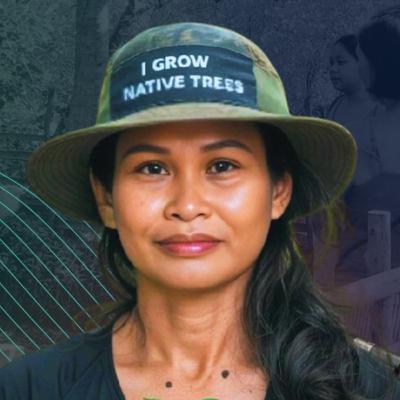
Can restoring a coastline also restore livelihoods, educate students, and protect communities all at once? Thessa Ramos proved it's possible by weaving solutions together instead of solving problems in isolation. In this episode, she shares how a mangrove nursery became a movement across 15 municipalities, why nature-based solutions need strategic thinking, and what it takes to build a truly regenerative Philippines from the ground up. Tune in as we explore the art of connecting the dots between environment, livelihood, and resilience.Secure your tickets for AlterCOP 30 Philippines happening on the 26th through 28th of November now! Visit www.altercop.com/philippines to know more.
Climate data tells you where flooding happens, but it doesn't tell you how staff and workers help people and the environment adapt to risks. The people navigating these realities every day have already mapped the patterns, identified the vulnerabilities, and often designed their own solutions. In this second episode of the AlterCOP 30 Philippines miniseries, three catalysts reveal what happens when communities stop being consulted and start leading—turning lived experience into real plans and solutions.This is a conversation about what becomes possible when we start asking including communities in finding answers. The future isn't regenerative when communities are consulted—it's regenerative when they become the catalysts
This is a pilot episode of the AlterCOP 30 Philippines' miniseries where we feature the stories of humans behind the program.When 26 million students lose school to typhoons and farmers earn a mere fraction from their produce, two young Filipinos decided they couldn't just watch anymore.One taught themselves to build education boxes for disaster-displaced kids. The other coded a platform from YouTube tutorials to fix a broken food system with nine layers of middlemen.They're proving you don't need a business degree or perfect solutions—just the courage to start and the willingness to learn as you go.
Walkable cities. Comprehensive transport system. Dignified housing. Multi-purpose facilities. Less pollution. Iilan lang ‘yan sa mga aspeto na bumubuo sa isang sustainable and healthy city.
Gayunpaman, paano natin makakamit ang mga ito para sa Metro Manila at pati na rin sa mga malalaking mga lungsod tulad ng Cebu at Davao?
Find our social media pages, community group, and other content here: linktr.ee/sustainarumble
With the continuous growth of all the big cities in Asia, it is no doubt that Metro Manila is considered in this discussion as being the only commercial hub in the Philippines.
As this phenomenon continues to worsen, what now happens to Filipinos that kept on flocking to the Philippines’ capital region hoping for better opportunities for themselves and their families?
Find our social media pages, community group, and other content here: linktr.ee/sustainarumble
Climathon is a nonprofit based in the UK whose goal is to localize climate solutions for specific climate action kahit saan man sa mundo. Chances are, you might have at least seen Climathon Philippines on your social media feed, or maybe went the extra mile by joining in one of their events before.
Pero, alam mo ba paano sila nag-umpisa sa Pilipinas? Alamin dito kasama si Carla Mumar!
——
Interesado ka bang dalhin ang Climathon sa iyong locality, free of charge? Message Scale here! You may also checkout Climathon Philippines' Facebook page or YouTube channel to discover ano-ano ang mga kaganapan!
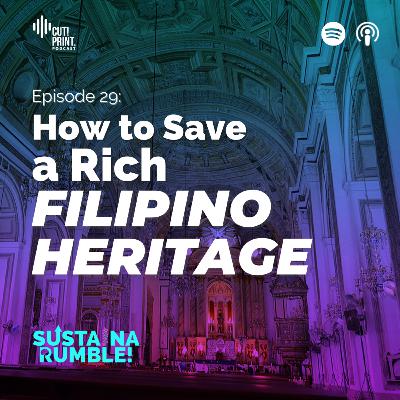
Ang culture at heritage ay napakahalaga hindi lang sa pagrerepresenta ng ating napakayamang kasaysayan pero pati na rin sa paniniguro na naiintindihan natin ang ating kasarinlan upang makamit ang totoong progress.
If we keep destroying historic buildings and natural environments, when will we finally stop and realize their importance to the sustainability of our nation? Kapag lahat ay giniba na? How can we then save a dwindling Filipino heritage?
Community: The Pit by SUSTAINARUMBLE!
Facebook: Sustainarumble
Instagram: @sustainarumble
LinkedIn: SUSTAINARUMBLE!
Blog: SUSTAINARUMBLE! on Medium
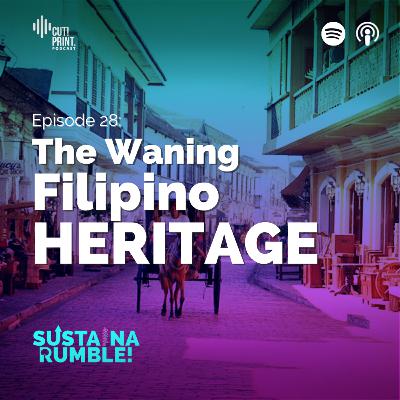
Napakabilis ng paglago ng ekonomiya sa panahon ngayon, lalung-lalo na dahil sa teknolohiya na nagpapadali at nagpapaganda ng buhay para sa lahat.
However, the very things that made modernization abundant are also the same reasons why we are slowly neglecting the very foundation of our souls — our culture and heritage.
Nagmistulan nang lifeless ang mga lungsod at malimit nang makilala ang ating kasarinlan sa mga nagsisilakihang mga gusali.
Community: The Pit by SUSTAINARUMBLE!
Facebook: Sustainarumble
Instagram: @sustainarumble
Blogs: SUSTAINARUMBLE! on Medium
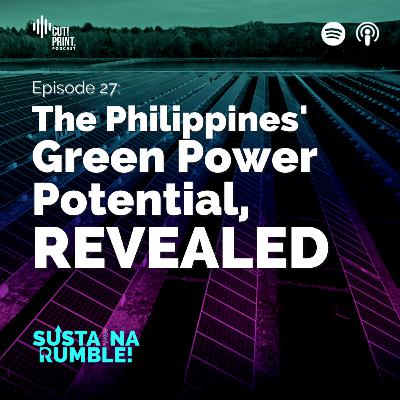
Because of the Republic Act of 2008, Filipinos have the capability to make the choice of shifting to renewable energy as their power source. The Filipino society is potent in making energy production and usage sustainable.
Ano ba ang mga options? How can Filipinos unleash the green power potential?
Community: The Pit by SUSTAINARUMBLE!
Facebook: Sustainarumble
Instagram: @sustainarumble
Blogs: SUSTAINARUMBLE! on Medium
When you are clean and everyone wants you... pero hindi ganoon ka-simple magpalit para sa'yo.
The trend is real: the world is shifting to renewable energy that is very environmentally friendly and will still keep our lights on at the same time. Solar panels are becoming cheaper and cheaper by the day. Wind is free. 0 emissions for the same services that conventional energy offers.
Pero bakit hindi basta basta magawa sa Pilipinas?
Community: The Pit by SUSTAINARUMBLE!
Facebook: Sustainarumble
Instagram: @sustainarumble
Blogs: SUSTAINARUMBLE! on Medium

Comments

Download from Google Play

Download from App Store
 United States