


 Claim Ownership
Middle Market Mergers and Acquisitions by Colonnade Advisors
Subscribed: 19Played: 152
Subscribe

© All rights reserved
Description
Get the insiders' take on mergers and acquisitions. M&A investment bankers Gina Cocking and Jeff Guylay of Colonnade Advisors discuss the technical aspects of and tactics used in middle market deals. This podcast offers actionable advice and strategies for selling your company and is aimed at owners of middle market companies in the financial services and business services sectors. Middle market companies are generally valued between $20 million and $500 million.
30 Episodes
Reverse
In this episode, host Jeff Guylay is joined by guest Mark Achler, co-author of Exit Right, to explore the critical decision of whether—and when—to hire advisors during the M&A process. Drawing on lessons from the book and real-world experience, Jeff and Mark outline how CEOs can maximize value by assembling the right team of experts, while still retaining control over strategy, relationships, and execution. From bankers and attorneys to financial planners and tax professionals, this episode offers actionable insights on selecting advisors who align with your values and contribute meaningfully to successful outcomes. What You'll Learn in This Episode: The spectrum of advisors involved in a typical M&A transaction Why hiring early—especially pre-LOI—creates leverage and unlocks value How to avoid becoming overly dependent on advisors The CEO's role in maintaining judgment, relationships, and deal momentum Why trust between parties is the foundation of successful dealmaking How detailed LOIs and clear integration planning drive better outcomes Real-world case studies showing how applying these principles boosted valuations Key Discussion Points & Notable Quotes: The Spectrum of Advisors in a Deal (00:43) Mark and Jeff review the key players involved in M&A: attorneys, bankers, tax advisors, financial planners. Timing matters—especially when it comes to financial planning and structuring decisions. "You want the best experts early—not just after the deal is done." – Mark The CEO's Non-Negotiable Responsibilities (03:48) Even with great advisors, CEOs must lead on strategy, decisions, and relationships. "There are some things you just can't outsource. You can't outsource judgment or trust." – Mark The Importance of Trust in Getting Deals Done (05:46) Advisors can facilitate—but it's the trust between principals that often moves a deal forward. "Trust is the lubrication that gets deals across the finish line." – Mark The Role of the Banker and the Importance of Timing (06:17) A good banker understands the full arc of a transaction and helps prioritize forward-looking rationale over backward-looking valuation. "We're not just selling the past EBITDA—we're building the case for future synergy." – Jeff When to Step in as a CEO (08:13) The back-and-forth between attorneys can derail progress. CEOs must often step in to resolve what really matters. "There's always a point in a deal when someone has to say, 'Enough—we need to solve this as principals.'" – Jeff Detailed LOIs Preserve the Deal's Integrity (10:41) Without a clearly written LOI, sellers lose leverage and risk misinterpretation later. "The minute you sign the LOI, you lose 90% of your negotiating leverage." – Mark "Our role as advisors is to make sure the LOI is translated accurately into legal documents." – Jeff The Case for the Right Advisor (13:18) Not all advisors add value—some derail deals. Founders must choose those aligned with their values and goals. "This is your baby. Choose someone who gets it, who gets you." – Mark "You're essentially choosing a best friend for a very intense experience." – Jeff Real-World Success: A Valuation Doubled (18:54) Mark shares a powerful case study of a founder who used the rationale framework to double their offer—by helping the buyer see the long-term potential. "They shrugged and said, 'We're not paying you enough.' That's the Jedi mind trick." – Mark What Makes an M&A Outcome Truly Successful (23:31) Success isn't just the highest purchase price. It's achieving the intent of the transaction—alignment, culture, growth, and impact. "Think beyond the number. Think about the next chapter." – Mark Final Thoughts: Hiring the right advisor can unlock enormous value—but only when paired with clear leadership from the CEO. This episode offers a roadmap for founders preparing to sell, highlighting how to build an aligned, expert team while maintaining ownership of the process. Deals aren't just financial—they're personal, strategic, and long-term. The right partner makes all the difference.
In this episode, we discuss the key questions sellers should ask potential buyers when considering a sale. Understanding a buyer's strategic goals, cultural alignment, and team integration plans is crucial for ensuring a smooth transaction and long-term success. Hosts Gina and Jeff dive deep into the due diligence process and provide sellers with a roadmap to evaluate fit beyond just price and terms. What You'll Learn in This Episode: How to assess potential buyers during management meetings The three critical categories of questions sellers must ask: Strategy: What are the buyer's long-term goals? Team & Integration: What happens to the management and employees post-sale? Culture: How well does the buyer's corporate environment align with the seller's? How to prepare for buyer meetings and identify red flags early The importance of understanding a buyer's track record with past acquisitions Why employment agreements and compensation plans should be negotiated early Key Discussion Points & Notable Quotes: Developing the Buyer List (1:00) Colonnade Advisors carefully curates a list of potential buyers, focusing on strategic fit and long-term plans. As Gina explains: "We are spending a lot of time at Colonnade—an awful lot of time—thinking about which companies out there could be the best fit for this seller… A good fit from size, product set, and strategy." She further explains why breaking buyers into categories (strategics, private equity-backed strategics, and institutional investors) helps sellers make better long-term decisions. Understanding Buyer Motivations & Fit (4:00) Sellers need to look beyond just financial offers. Jeff highlights the importance of knowing who you're dealing with: "We have transaction execution experience with many of these buyers… we know who follows through on commitments and who is just going to throw out a high number to get in the mix but won't close." Management Meetings & Key Questions for Buyers (7:15) During management meetings, sellers should evaluate buyers as much as buyers evaluate them. According to Gina: "It's really important that it's a two-way street. The management team has the opportunity to evaluate the people across the table from them… Sometimes a management meeting goes poorly because somebody was rude. It's important that comes out because this is a low-stress situation for buyers—they should be on their best behavior." The Role of Private Equity vs. Strategic Buyers (9:45) Not all buyers have the same investment horizon. Gina explains: "If you are being acquired by a strategic that's owned by a private equity firm, there's going to be another exit event at some point in the future… That private equity firm bought that platform with an investment horizon of three to seven years, typically five years, so you'll be going through this again." Employment Agreements & Negotiation Tactics (16:50) Some buyers delay employment agreement negotiations until the last minute, putting sellers in a tough spot. Gina warns: "I've seen a strategy used by some buyers that absolutely infuriates me… they refuse to negotiate employment agreements for senior leadership until two weeks before close because they know they have the sellers over a barrel." Evaluating Cultural Fit (22:59) Culture can make or break a deal. As Jeff notes: "The first date here is the management meeting, and we want to prepare our clients to be ready—ask great questions and get the most information they can out of these meetings." Gina also suggests asking buyers tough questions to see how they respond: "One of my go-to questions at dinner—usually after the first glass of wine—is, 'Tell me about the worst deal you've been involved in. What happened?' You'll learn a lot from their answer." Final Thoughts: Selecting the right buyer is about more than just the highest offer—it's about finding a partner that aligns with the seller's vision, values, and long-term growth strategy. This episode provides actionable insights to help sellers navigate this crucial decision-making process.
In this episode, we discuss strategic steps for Equipment Leasing and Finance companies as they grow and evolve. The leadership of some of these businesses may decide to remain a certain size and complexity and be " lifestyle businesses", providing healthy cash flow to the owner(s) while they continue to run the business. However, other options exist, and exiting the business for a favorable multiple to a bank or other buyer can be an excellent strategy, the dream plan for many entrepreneurs. In this interview, we interview Bob Rinaldi and discuss the potential to grow and leverage a business to realize a win-win exit strategy. This episode is a great follow-up to our previous show, Start Early & Exit Right, as we dive deep into many of the concepts of M&A rationale. What's unique about this episode is that it is geared toward a specific target audience, our friends in the Equipment Leasing and Finance (ELF) industry. In this episode we cover: How partners such as Rinaldi Advisory Services (RAS) and Colonnade work with Equipment Leasing & Finance (ELF) companies to prepare for a successful sale (1:00) What are the biggest challenges for the independents as they look to be "bank ready" for an acquisition? (4:00) What are some of the biggest challenges for banks pursuing an acquisition of an equipment leasing company? (9:30) What determines the level of a premium in the sale price that an ELF company can expect? (20:00) What has M&A activity looked like in recent years and what are the prospects? (23:00) What about Private Equity buyers in this space? (26:30) How partners such as Rinaldi Advisory Services (RAS) and Colonnade work with Equipment Leasing & Finance (ELF) companies to prepare for a successful sale (1:00) Bob: My practice has evolved around three target audiences in the equipment leasing space. About 60% of my clients are independent leasing (ELF) companies that I work with through the Confidential CEO Resource℠ model. This is multi-year exit strategy planning. Whether the company exits or not is not important. The idea is to get them from point A to point B so they're prepared if that time comes. The second part of my practice is working with banks, predominantly community banks who are looking to get into the ELF space. Third, I work with a handful of service providers in the industry, as well. Rinaldi Advisory Services (RAS) offers the Confidential CEO Resource℠ (CCR) as a robust, full-scope advisory service that provides clients with a broad base of support for long-term strategic management. RAS works with CEOs and Principals to provide meaningful analysis and actionable insights. The aim is to help ELF senior management arrive at strategic and tactical decisions geared toward managing growth as well as operational and financial efficiencies. Colonnade has deep experience in the ELF industry. Colonnade is a leading investment banking firm that has completed over $9 billion in M&A transactions for clients in the business and financial services industries. Colonnade has advised many companies in the EFL sector on strategic transactions. Please see our Quarterly Updates on the ELF industry here. What are the biggest challenges for the independents as they look to be "bank ready" for an acquisition? (4:00) Bob: The biggest challenge is predominantly that these founders/owners are very much entrepreneurs. They started the business. They're very much involved in the everyday transactional nature of their business. They don't have the time to gain the perspective to look at their company objectively and determine what needs to happen to be a better company from a non-transactional standpoint or to be a better company for the purpose of acquisition. Jeff: Let's drill down a little bit on some of the biggest challenges for the independents. There's size and scale, where are you today and where are you going? Banks are the natural resting home for specialty finance companies, and ELF companies are such a great asset class for banks in particular. Obviously, they're a number of large independents, but from the bank's perspective, what are the other things you see where companies need to focus? Is it finance and accounting? Is it operations? Is it servicing? Bob: Yes. Yes. And yes. It's really all those things. But even before you get to that, let's look at the business and find components within the business that definitely will never, ever fit in a bank. I'm able to identify those things. You then have to decide what to do with those things. Do I jettison those things completely? Do I sell those off? Do I break it outside of the company and put it in a separate entity so that what is left is sellable and simple to understand? Compare that to a buyer looking at the company and thinking, "I like this, I like this. I hate that. Therefore, I'm not doing it [the acquisition]." For example, say that there is a heavy services component of the (ELF) business; services component being something that has morphed, be it operational leases or servicing equipment that is leased. A bank can't be in that business. If that is an absolute key critical component to your leasing business, then a bank buyer is probably never going to be the buyer, which is going to leave you looking at non-financial institutional-type buyers, and they're fairly limited, so that's a problem. That is when you look at it and go: "If that's what we're always going to do, then this maybe is just going to be a lifestyle business. Let's just find ways to improve the income generation, the profitability, and keep it as a lifestyle business." What are some of the biggest challenges for banks pursuing an acquisition of an equipment leasing company? (9:30) 1) The banks must use experienced advisors who understand the appropriate valuation models. Bob: If the bank has not been in the business before and their only experience with acquisitions has predominantly been buying other smaller banks, the first challenge is the valuation models. Banks are used to paying a multiple of book value. Leasing companies are not valued that way; their valuation is based on a multiple of earnings or pretax adjusted net income. In a typical leasing company, most of the leases are on a fixed term, fully amortizing type of a structure; therefore they just generate income. But the assets don't stay on the balance sheet that long, they continually roll-off at a rapid rate, so you've got to keep putting on more. It's really not an asset play as much as it is a net income play. Jeff: When we talk to banks as acquirers of these businesses, from either the buy-side or the sell-side, you're absolutely right. It's all about the income-generating opportunity. Yes, there are assets associated with it, but much more importantly, it's "What's the potential earning stream for this business within the bank?" (See: Discover the Rationale for a Synergistic Business Merger). Bob: That really comes down to the financial institution's advisor, a buy-side advisor. If they've not had much experience in the equipment leasing space, especially current experience like Colonnade has, they're already at a very big disadvantage because now you've got two entities that are blind and stating the same thing and focused on book value, so they're getting bad advice along with their own preconceived ideas. That's like a double whammy right out the gate. It's common when you find that a bank or their board, for whatever reason, have just got very comfortable with a buy-side advisor, who has never had that much experience at it but they've just gotten very comfortable with them and they wouldn't even conceive of going outside. A lot of this gets really back down to, "Is the bank nimble? Is the bank flexible? Does the bank have a CEO that has cut a bigger vision?" The same thing with the board, the death of any kind of an institution is just getting so stuck in your way that you just can't get out of it. 2) The CEO of the bank must have a visionary leadership style that allows the acquired company to thrive. Bob: It all still goes back to the CEO of the bank and how progressive they are, how aggressive they are. And aggressive does not mean they're careless. Jeff: The folks that we generally work with on the banking side have made that decision. They said, "Okay, we're going to get into specialty finance. We want to do it in X, Y or Z asset class, and we have the headset to bid accordingly, and that these businesses are valued differently than bank deals. The multiples are different, the metrics are different. We're committed, we've got board approval, we've got senior leadership approval and we're going to go ahead with it." Bob: You and I know one of the smartest, most aggressive community bankers: Chuck Sulerzyski of Peoples Bank of Marietta, Ohio. Peoples Bank is located in the Southeast corner of Ohio, squarely in Appalachia country. How does a bank that size, originally ~$1 billion in assets when he took it over and roughly $7 billion today, make such successful leasing company acquisitions? One located in Vermont and one located in Minnesota? If you take a look at the numbers, the ROA and ROE of the bank have improved dramatically. Their yields and spreads have increased dramatically. Their asset growth has increased significantly in the commercial real estate (CRE) and in the commercial and industrial (C&I) sectors. His shareholders are being rewarded handsomely and will continue to be. Jeff: Chuck sets a great example. He has been aggressive in good ways. Peoples Bank also acquired an insurance premium finance company, and they're diversifying. Chuck has the right headset in that he looks to acquire businesses to expand and diversify their geographical footprint. That's a real success story, in my view. Bob: If you're going to acquire a leasing company that's growing, that's used to growing assets, the last thing you want to do is turn them into a bank. That's the whole premise for why y
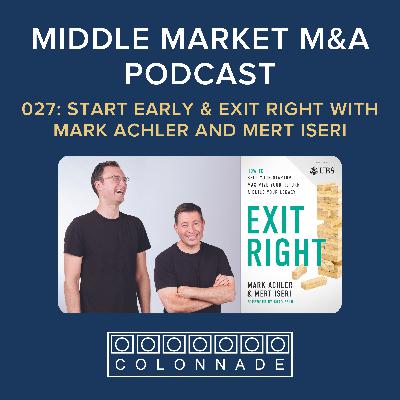
Before you sell your company, even the odds. This episode features guests Mark Achler and Mert Iseri, authors of the recent book, Exit Right: How to Sell Your Startup, Maximize Your Return and Build Your Legacy. Exit Right demystifies how to conclude the startup journey, a perfect complement to our podcast, which focuses more on the exits of larger middle-market companies. As Brad Feld states in the Foreword, "Mert and Mark set the roadmap for how entrepreneurs and business owners can proactively manage the process of getting to a successful exit along the way". As Jeff says at the start of the interview: Mark and Mert cover so many great informative topics in the book. There is a wealth of tips to guide business owners through what can be a tumultuous process, getting through the exit. There are also so many topics we align with: relationships matter most, planning for wealth, time kills all deals, and the importance of following a best-practice process. In this podcast episode, we focus on three topics with a lot of meat to each: FAIR, Mert and Mark's framework for a successful exit, (3:00) The"Exit Talk" and how we suggest that all companies adopt this practice with their board (15:00), and Who is involved in the Exit Talk and why? (28:00) What is FAIR? Why does it lead to the best transactions? (3:00) Mert: What we realized as we started to gather stories and experiences from M&A bankers, lawyers, serial entrepreneurs, etc is that the real question isn't, "Let's find out who's going to pay the most." The real question is, "What's the right home for this business? What's the right home for my people? What's the right home for the vision? Who is going to serve our customers the best?" Our view of an exit went from being a short-term transaction to a long-term partnership. The term "exit" is a poor word choice. You're not really exiting anything. If anything, it's the beginning of a brand new relationship. So when we ask ourselves, "What makes a great home for a startup?" we focus on these four elements that make exits great. FAIR. Fit, Alignment, Integration, and Rationale. If you have all four of those, it just so happens that you've also found the person who's willing to pay the most for your business, because they will realize the long-term value and they'll price the deal accordingly. Fit is the cultural fit between the two companies. Amazon and Zappos are a great fit. Time Warner and AOL, are probably not a great fit. It's easily described. Can you sit next to this person for four hours and not want to kill them by the end of the meeting? Can you actually make decisions without written rules? Are cultural values aligned? Are the DNAs sort of similar, cousins to each other between those two companies? Alignment is about being aligned with your co-founders, board, and shareholders in terms of the direction of where you want to go. The acquiring company also must be aligned. We almost always dismiss the alignment that we need from all sides of the table. This isn't two sides looking at each other. This is two sides looking in the same direction. Integration has to do with the plan for how these two companies will come together. We've seen so many examples of this plan of integration being done as an afterthought. It's not just product and sales integration but people integration, finance integration; many, many layers. And all of these stakeholders have different agendas that need to be individually managed. Rationale. Can you explain to your grandmother why this acquisition makes sense? How are we going to deliver more value to our customers as a result of this partnership? How is two plus two equal to 100 in this context? Mark: There are profound financial implications to the FAIR framework. Let's take Integration. Integration is the ugly stepchild. People always say, "Oh yeah, we'll deal with integration afterward." Turns out that in many transactions, it's not always 100% cash. Sometimes there's an earn-out for future performance. If you're not integrated well (you don't have the resources you need to execute your plan), there are some significant financial implications to the earn-out. Then there are the financial implications to Rationale. Transactions are typically based on looking backward using a multiple. When you create a rationale that says one plus one equals a hundred, if it's a strategic investment, you take your product and we plug it into the larger company's sales force or the larger company's customer base. What could we do inside the larger company? What's the impact of your product on the larger company? The way to maximize value is not looking backward as a multiple, but looking forward using the rationale. Strategically, why is the combination so valuable? If you can get everybody aligned around the rationale and the financial implications of that rationale, that's how you're going to drive a better price for an exit. Mert: No one's going to just sit down and tell you, "This is our rationale." You uncover it. You unearth it over years. That's why we urge entrepreneurs to put their party dresses on. Talk to many competitors. Talk to strategics. Get out the door. You need to build this trusted relationship over time with fundamental questions. How can I help? How can I help you push your agenda forward? How can I help my customers? This is what great partnerships really look like. We're not saying go share your financials with your competitors or give away all your IP to a larger strategy, but you need to be that trusted partner that advances the mission on all sides and creates a situation where everybody wins. Mark: We wrote the book about exits, but it turns out that the decisions that entrepreneurs make at the beginning of their journey have an outsized impact at the end of the journey. Even though this book is really about the exit, there is really good advice there about the beginning of the journey as well. Jeff: That's exactly right. This book is really about the journey. All of the steps on the journey influence the end. There's so much wisdom in the book and insights about all the things that you can do to proactively get to the right end. Management meetings are oftentimes the first time that business owners meet their potential acquirers, whether they're competitors or strategics, or investors. But the longer that relationship can be developed, the more that you can uncover in terms of the shared common goal of what can we do together. And the best valuation and the best terms will just naturally evolve. What is an "Exit Talk"? How can founders use it to reach alignment in their boardrooms? (15:00) Jeff: The Exit Talk really struck a chord with me. Let's encourage clients and future clients to have these discussions and this thought process through the FAIR framework to really think ahead. Sometimes we as investment bankers get brought in late in the game. But most of our transactions and our best relationships really span years. We get to know the business, the goals, and importantly the people involved, the operators, the owners, the founders, and the investors. Some of these relationships for us span a decade or more. We give them advice on how to grow their companies. This concept of an exit talk is missing from my perspective. Exit discussions are often secretive or clouded in secrecy. It is a very small universe of folks within a company that knows that a transaction is imminent. It's rarely discussed openly among the senior leadership team until late in the game. What you guys propose is proactive. Through your work and sharing your work with my future clients, I'd like them to embrace this philosophy. I love this quote that you said, "Instead of fueling the awkwardness of the exit topic by staying silent, we are putting forward a new norm that we believe the entire industry should adopt, which is the Exit Talk." Mark: This is one of our favorite topics. But before we dive into the Exit Talk: We are such big believers in trust. Every deal has its ups and downs. It has its emotional turbulence, it's the journey. Trust is the lubrication that gets deals done through to the conclusion. I just wanted to put a fine point on that topic of trust because it permeates everything we do. The Exit Talk. It turns out that there's a stigma to talking about exits. CEOs are afraid. They're afraid that if they bring up the topic of an exit that their board and their investors are going to think their heart's not in it. They've lost hope. They've lost faith. In the Venture Capital or Private Equity world, we have a time horizon. When you take our capital, you take our agenda, and you take our time horizon. We're looking for X return over Y timeframe. And if you're in year one of a fund, we've got plenty of time. Let's go build and grow. If you're in year 10 of a fund, we've got to start returning capital back to our LPs. With the Exit Talk, what we're proposing is that once a year, maybe your first board meeting of the year, you have a regularly scheduled annual talk where the CEO, without fear of being perceived as their heart's not in it, can talk about the exit. The reason it's so incredibly helpful is that you have the luxury of time. If you had 18 months or two years, you have the luxury of saying, "Who's going to be the most likely acquirer? Is it going to be a strategic acquirer? And why? Who is it and why would they want to acquire us? Or is it going to be a financial buyer and what are they looking for? Are they looking for top-line revenue?" If we're going to sell to somebody who really cares about growth, we may invest a little bit more heavily in sales and marketing. If it's somebody who is more financially oriented and really cares about EBITDA, we might tighten the ship and focus on profitability. It gives you the luxury of time to get your intellectual property in order, make sure that every single employee has a signed agreement, and m
This episode continues with our "industry spotlight series" where we focus on specific trends and opportunities in middle-market M&A transactions. Our previous episodes have covered four industries in which Colonnade has played a significant role as an M&A advisor to both buy-side and sell-side clients. We add F&I Agencies & Payment Plan Providers as industries where we deeply know the dynamics and players so as to provide exceptional service to clients who hire us to assist them in a transaction. Colonnade has studied the F&I Agencies and Payment Plan Provider markets for the last 20+ years. We have worked on nearly 30 M&A transactions on the buy-side and the sell-side. We have gotten to know the industry players and the buyers. We've identified some high-opportunity M&A plays that could help to drive even more value, scale, and customer satisfaction in the industry. Spotlight on F&I Agencies (1:00) In this first part of our episode, we answer the following questions: Where do F&I agencies sit in the F&I ecosystem? (1:00) What does a typical F&I agency look like? (7:00) What is going on in terms of M&A and what are the value drivers in the industry? (9:00) What is driving M&A transactions right now and what are some potential M&A plays? (12:00) Where do F&I agencies sit in the F&I ecosystem and what value do they provide? (1:00) Gina: Between the F&I administrators and the F&I office and the dealership, there are F&I agencies. They are independent agencies with independent agents. They are like insurance agents. They bring together the product administrators and the dealers. Gina: The agents have deep knowledge about the products they represent. They can train the F&I office on those products and how to sell the products. They also act as the middle man or the interface with the administrator. They are one distribution arm for the administrators, which makes them critical in the ecosystem. They are a valuable component of the overall F&I ecosystem. Jeff: The F&I agency is a particular point in the value chain. It's a differentiator. Some administrators sell to dealers through a direct sales force, others use F&I agents. Gina: There are administrators who go direct to dealers, but most administrators also use independent agents. They may have a direct sales force, but they have independent agents also. The only sector where that seems to not always be the case is selling into independent dealerships. You tend to see more direct agents that are employed by the administrators selling into the independent dealerships. Gina: An important component of what the agents do is help the dealership with reinsurance. Reinsurance is an important component of a dealership owner's profits. For every contract, every F&I product that is sold, there is a reserve set aside for future claims. F&I agents are usually very fluid and educated in talking about reinsurance and making sure that the dealership has the right reinsurance programs. So they deal with reinsurance, they do training on products, they do training on how to sell products. They sometimes help with staffing in the F&I office, and they'll help with some of the technology that is between the F&I office and the administrator. Gina: F&I represents a third of a dealership's profits. Everybody within the organization and affiliated with the organization is going to make sure that F&I runs smoothly. What does a typical F&I agency look like? (7:00) Gina: There are well over 100 independent agencies, and approximately 75%-80% of F&I agencies are less than 10 employees. There are very few large agencies. There are a few that are scaling, but there really aren't many. There is only one national agency that comes to mind and that's Vanguard (owned by Spectrum Automotive). Vanguard has been very acquisitive in building out its agent network. We also see Brown & Brown, which is a P&C insurance brokerage. They've been acquiring F&I agencies over the last few years. I don't know if they have a national footprint yet, but they're probably getting pretty close. And then you have acquired a lot of small agencies. Jeff: The Brown & Brown example is an interesting one that we've watched over the last five to six years as they've entered the industry. We've always thought their participation in the F&I agency world makes a lot of sense, given the parallels to the P&C distribution market. What is going on in terms of M&A and what are the value drivers in the industry? (9:00) Gina: We think that the M&A market for F&I agencies will continue to be hot in 2022. (See Gina's cover article in Agent Entrepreneur, 2022 M&A Predictions for F&I Agents) Agent value is driven by a couple of different factors. One is diversification. One of the challenges for these small agencies, just like any small company, is having all of their eggs in one basket. An F&I agency may have one dealership group that represents 40% of sales. That is a gating factor to trading and getting the highest possible value. Agencies that have significant concentration, which I call greater than 15%, trade at a lower multiple than agencies that have little concentration. Another value driver is size. We look at the number of W-2 employees (as well as financials). Jeff: Important when you go to sell these companies: Who owns the dealer relationships? And what's the risk of attrition in a transaction? Gina: A lot of diligence needs to be done in these transactions to really understand the nitty-gritty of who, not just on paper but in practice, owns the relationships. What is driving the M&A transactions right now and what are some potential M&A plays? (12:00) Jeff: It sounds like an industry that could be rolled up further. Following the playbook of the P&C insurance distribution market, you got a lot of mom and pops out there and a few large players. Gina: Both Brown & Brown and Vanguard Dealer Services (Spectrum Automotive) are rolling up agencies. The rest of M&A activity we see is not a roll up, but administrators buying agencies. National Autocare and Portfolio Group have been very inquisitive. There are many other administrators who bought one, two, three agencies, as they attempt to lock in their distribution channels. Gina: There should be another roll up of F&I agencies. There should be a private equity firm that's coming in here saying, "I'm going to put a hundred, $150 million to work and we're going to leverage it. And we're going to buy up 20 F&I agencies. We're going to make a super-agency with national coverage." That could be uber-successful for everybody involved. It just hasn't happened yet. Jeff: The folks that are acquiring are paying pretty high multiples, and that's a challenge. Any new entrant would have to go in and go big pretty quickly. They'd have to find a platform that they can scale and put a lot of capital to work while holding their nose as they pay big prices upfront. Gina: A lot of the M&A activity we have seen is with an older generation that is retiring. There's also some leakage happening where the younger, talented, hungrier F&I agents are like, "I get it, I can do this." They leave and go start their own agency. I think we'll see that next-generation starting to trade in about a year or two. Gina: I have one last point I want to cover about F&I agency M&A: what's driving the activity. First of all, there's a lot of money looking for deals. There are private equity firms backing administrators that need to grow inorganically. But we also see a lot of M&A activity at the dealership level. They're getting bigger. Big dealership groups are buying up other dealers, independent shops, and dealership groups. Every time one of those transactions happens, the agent that represents the target dealership is at risk of losing that client. Dealership M&A is driving F&I agency M&A. I think that this is the question that keeps a lot of agents up at night: Are they one or several M&A transactions away from losing a significant portion of their relationships and their livelihood? Spotlight on Payment Plan Providers (18:00) In this second part of our episode, we answer the following questions: How do payment plan providers add value to the auto F&I sector? (18:00) How big is the industry and who are the biggest players? (23:00) Why are payment plan providers a favorite industry of Colonnade? (25:00) What is going on in terms of M&A and what are the value drivers in the industry? (29:00) How do payment plan providers add value to the auto F&I sector? (18:00) Jeff: Payment plan companies came out of the ground around 20 years ago. They started as an offshoot of the insurance premium finance market, which we've talked about in a previous podcast. Fundamentally, this market is designed to help consumers purchase F&I products cost-effectively. Whether you're in a dealership (point of sale) and the F&I person says, "This VSC is going to cost you $3,000" or whether you get a piece of mail about an extended auto warranty (aftermarket), once you get sold on buying the coverage, the questions is always: Do you want to write a check for three grand or do you want to finance it over two or three years? In most cases, the VSC/extended auto warranty gets financed. That's where these payment plan companies come in. Jeff: At the dealership (point of sale), the payment for an F&I product typically gets rolled into the auto loan. It's just one of the line items in the auto loan, and you (as the consumer) pay it off as you go. There are some payment plan providers that focus on point of sale at the dealership, allowing a consumer to finance the product outside the auto loan. In the aftermarket, which is really where we see these payment plans flourish, it's a different dynamic. If you're on the phone with a direct marketer and you agree to buy the coverage, you can put 10% down and pay over 18 or 36 months, depending on the payment plan. Interestingly, they're interest-free and cancelable at any ti
In this episode, Gina Cocking and Jeff Guylay pick up their discussion around the due diligence process related to the sale of a company. This episode is a great add-on to the previously released four-episode series exploring the due diligence process: EP003: Business aspects of due diligence EP004: Legal aspects of due diligence EP005: Accounting aspects of due diligence EP006: Technology aspects of due diligence As we explore the organizational aspects of a due diligence data room, you'll hear the reminiscing of both Gina and Jeff as they remember their days on Wall Street physically managing the data rooms of decades past when there were literally rooms full of documents that buyers would make appointments to review while the analysts on the deal watched. You'll hear how much data rooms have transformed in recent years with the birth of the electronic data room. Get ready for a call-to-action, which Gina describes as a "resolution" that you can make any time, to get your company's documents located, organized, and filed in a neat system to be ready for a transaction. Thus our title for the episode: Get your Ducks in a Row. We answer the following questions in this podcast episode: What are data rooms, and why are they so important in the due diligence process? (2:00) What were data rooms like in decades past? (2:30) What are data rooms like today? (4:30) What is contained in an electronic data room? (6:20) Are data rooms static or do they change over time? (10:00) How is confidentiality protected in a data room? (16:00) What can a company do to prepare for a transaction? (20:00) What do you suggest companies do immediately after listening to this episode in regards to data rooms? (27:00) What are data rooms, and why are they so important in the due diligence process? (2:00) Jeff: Big picture, data rooms are the electronic location of all the materials that we help our clients collect and collate during our process of selling the company. They contain all the information that buyers and investors will need to complete a transaction. So it's everything from articles of incorporations, to financial models, to contracts, etc. Gina: The data room is critical in any buyside or sellside process. The data room is where all the documents are kept that the buyers have access to when reviewing the business. We also give access to the buyers' accountants, attorneys, HR consultants, marketing consultants, etc. Datarooms are all electronic (online) nowadays, but it has not always been that way. What were data rooms like in decades past? (2:30) Jeff: As an analyst in investment banking in the '90s, I would sit in a physical data room on Wall Street. We would have buyers come through, and they would have to sign into the data room and show ID. It was a room full of documents where buyers could spend several days going through documents. They were not able to take any documents out of the data room. They could ask to selectively photocopy certain documents, and we analysts would photocopy them. The business folks, the attorneys, the accountants would come in in-person and spend days digging through the documents. Gina: I remember being stuck in Bethlehem, Pennsylvania in a basement of a chemicals manufacturing facility for about two weeks. One of the challenges in a physical data room is you couldn't have multiple buyers come in at the same time. You also had to double-check all the files when everyone left to make sure nobody took a document. What are data rooms like today? (4:30) Jeff: The efficiency with electronic data rooms has been a game-changer. You can have 30 professionals across various functions looking at documents at the same time and really increase the cycle time of the transaction. Everybody has a unique password, they sign in (online). We can see what documents they've downloaded, which ones they've reviewed, and which ones they haven't looked at. You can see who is really being active. It's a great tool for us as advisors to see who is most interested in a transaction. What is contained in an electronic data room? (6:20) Gina: In the data room, you will have various workstreams based on who will be asking for documents. You'll have workstreams for business, accounting, tax, legal, technology consultants, marketing, HR, and insurance professionals. From a business perspective, it will include all monthly reporting packages, KPIs (Key Performance Indicators), MD&As (Management Discussion and Analysis of the financial results); whatever a business is using to manage the business on a day-to-day basis. Business information will also include company presentations made to outside shareholders and banks, internal presentations, presentations made to clients, information on past employees, current employees, payroll data, insurance information, claims history, insurance applications. Jeff: The data room acts as a central repository of all the information that describes the company, its operations, history, and future. We start building this data room on day one of our engagement. Colonnade is always thinking ahead about ways that we can help our clients manage the process as efficiently and effectively as possible. Download Colonnade's sample due diligence list here. Are data rooms static or do they change over time? (10:00) Jeff: Our data rooms are living data rooms. Documents continue to be populated throughout the process. On day one, we start asking for documents. These documents include items that we need to produce the financial model and create the Confidential Information Memorandum. Later, we assess what information we need for second-round bids and ultimately confirmatory diligence. Gina: Everything that we ask for is to help us to understand our client's story and to position us to be able to answer questions as if we were a company insider. I would say our typical list is 250 to 300 documents that we're requesting. How is confidentiality protected in a data room? (16:00) Gina: All of our clients worry about what goes into the data room, who's going to see it, and how we protect the secret sauce of the business. We work carefully with our clients from the start to determine what documents they are comfortable sharing at which stages of the process. Jeff: If we contact 50 buyers, and 20 folks are interested enough to take a book (Confidential Information Memorandum), we might have an initial data room that would be a prelude to initial Indications of Interest. (See our podcast episode, Narrowing the Field – Indications of Interest and Letters of Intent). Moving to the next phase you might have six interested buyers, and you can phase in the documents that folks are able to see. We control access electronically. Gina: I am a big proponent of putting a lot of information in the data room before LOIs are due because then you get better LOIs. They are more well thought out, a lot of the diligence has been done, and when they say, "We are going to pay X," there's really not much else that they are going to discover at that point that can change that price. We do a lot of redacting. Instead of putting a customer's name in, it's company one, company two, company three. We take out employee names. We black out contract terms. We black out the name of vendors. We can do that also in the financial information. Jeff: We as advisors do a lot of the heavy lifting to first identify the sensitive topics and then manage methods of disclosure. Sometimes we have multiple versions of the data room. We might have a strategic (competitor) data room that is different from the financial sponsor data room. What can a company do to prepare for a transaction? (20:00) Gina: First and foremost, digitize everything. We're in 2022. There should be nothing that is still on paper. You should have a central repository, a server, Dropbox – some solution for all of your documents in one place. Create a document tracker. It can be an Excel list of key documents in your organization including business licenses, lawsuits, complaints, vendor contracts, client contracts, etc. The list should have the title, the date, the expiration date, key contract terms, etc. Do it now. Pay a temp $20 an hour to get that all into a diligence tracker for you. This will avoid paying lawyers $300 to $500 an hour later. Jeff: Being organized upfront is exactly the right strategy. The more that you can front-load, the smoother the process will go, and your legal costs will ultimately be lower if you're more organized. Gina (23:41): Data hygiene is critical to any process, and the time to start is now. Jeff: Doing this heavy lifting upfront in the process is really key to driving efficiency. Speed is key in any transaction and making sure that we can streamline the process from the day that we pick up the phone and start talking to folks through the closing date is really key. The data room is the place where it happens. What do you suggest companies do immediately after listening to this episode in regards to data rooms? (27:00) Gina: A great resolution for a company is to get your documents organized. It is easier to stay on top of your contracts and your licenses if you're organized. If you have a tracker, you know where everything is. You won't wake up in the middle of the night wondering where things are. You will also realize what you don't have, what is not documented, what has expired. Keeping everything in one place instead of in the control of various employees of the business will put you in a position to run your business better and go through a sale process better. From 10:45 (earlier in the podcast). Gina: The other thing to remember is that speed is key to any process. Once you get into that exclusivity phase, we want to get through that to signing and funding as quickly as possible. Jeff: Getting these documents in advance is key. It takes time to find, organize, and scrub all the documents for confidentiality. It's c
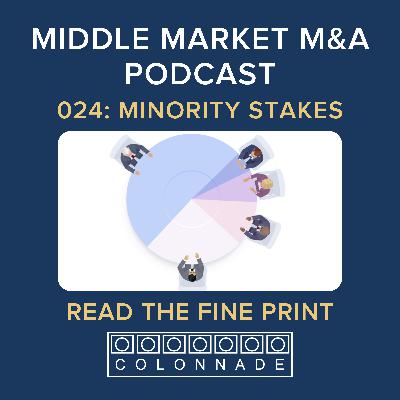
This episode is an excellent continuation of our discussion in E023 about the pros and cons of partnering with a financial sponsor. When a company is considering an M&A transaction, there's a range of alternatives. On one side of the spectrum, there's selling 100% of the company and exiting. On the other side of the spectrum is no transaction at all ("stay the course"). In the middle are the options to sell various amounts of a company's equity. When considering raising capital, more often, we see our clients sell a majority stake, in which an investor buys more than 50% of the equity in the company. In some cases, we see a minority stake investment, which is less than 50% of the economics. Today's episode dives in deep on minority investments, and Colonnade Advisor's Managing Directors Gina Cocking and Jeff Guylay explore: Reasons companies take on minority investments Different types of minority investors and what they are seeking How minority investments are valued What rights come with minority investments The biggest challenges associated with a minority stakes investment Advice for companies exploring minority stake investments Reasons companies take on minority investments (1:56) Gina: The most common reason we see is to buy out a minority partner. Another reason is to increase the equity capital in the business so it can raise debt and finance growth. Often, there's a thin layer of equity in founder-owned companies because they've been distributing their own capital. They now want to make an acquisition, for instance. To make that acquisition, they will need more capital in the business. They need equity to then raise debt. We hear business owners say, "I want to diversify my investments. Or, I would like to fund my kids' education, weddings, etc." Minority investments can be raised to give owners of businesses some liquidity. Jeff: In our last podcast (E023), we talked about the value that financial sponsors bring to a founder-owned or an entrepreneurial-run company in terms of strategic benefits to the growth of the business. Sometimes we hear our clients say: "I don't need a lot of growth capital" or "I don't need a lot of liquidity" or "I don't need to buy anybody out. But this might be the right time, given what's going on in my industry, at this particular point in time, to bring on somebody who can help me out. I might need help in the capital markets. I might need help with a growth plan. I might need help with acquisitions." These strategic issues are important and sometimes supersede the economics of the transaction. Different types of minority investors and what they are seeking (4:58) Gina: I tend to put the investors into three buckets: venture capital firms, strategic investors, and private equity firms and family offices. Venture capital funds frequently make minority investments in companies. VCs are more focused on companies that are pre-profit and in the early stages with a lot of growth ahead. When you take an investment from a venture capital firm, you're not getting liquidity. Dollars are not going into your pocket. Jeff: Venture capitalists are focused on putting capital into the business to help you grow. A strategic investor is interested in investing in a company to lock in a long-term relationship. If one of your vendors has an investment in you, you're probably not going to move away from that vendor. So that's where you can get strategic money. Strategic investors will also invest in companies to watch new technologies as they grow. They are then at the forefront and in a position to make an acquisition later of that company. Jeff: Strategic partners bring not just capital but relationships. They're investing in you because there's a good business case, and they're going to help you grow. Gina: The third bucket is private equity firms and family offices. Some PE firms will make minority investments. We often see private equity firms making minority investments because they really like the company and they want to get their foot in the door. The company's not ready to sell yet, and the investor wants to be the first capital there. They partner with the company, sit at the board level, and help with strategic decisions. When the company's ready to sell, they're a trusted partner and the first one in line. How minority investments are valued (10:03) Gina: There is typically a minority discount. A minority position is less liquid. A minority shareholder will have different rights than a majority shareholder. We see valuations of minority investments typically at a 10% to 15% discount to a complete sale. For example: A $100 million company, no debt, so $100 million equity value. If a minority investor wants to come in and buy 40% of the company, they may do so for $30 million. So they're buying at a discount. Jeff: Conversely, when an investor or buyer is looking to buy a significant majority stake, or 100% of the company, they're going to pay a premium to the valuation. They're going to pay a 10%, 20%, or 30% premium for control of the business. Gina: When we work with private companies, they often assume a minority investor invests in common stock. When we talk to the investors, it's more often as preferred stock or even debt with warrants. If the capital stack can accommodate the debt, they'll do debt with warrants. That way, they're de-risking their investment, because they're higher in the liquidity preference. Debt will be paid back before equity if a company goes into bankruptcy. We sometimes see it as a bait and switch. We'll see companies that are talking to minority investors. They think they're talking about common stock. And then, all of a sudden, they get a term sheet that is debt with warrants. The term that we use in finance is pari passu (equal footing). Are the securities that the investors are coming in with pari passu with the owner's securities? Are they the same security? When raising capital, the ideal situation for taking on a minority investment is that the equity coming in is pari passu with what the founder/owners of the business have. Jeff: Pari passu is an important concept. We always try to get our clients to have new money come in pari passu with the existing shareholder's ownership and investment. With a majority sale or majority investment, that's more common. With a minority investment, the investor is looking to get additional rights, controls, and protections in any way they can. What rights come with minority investments (14:21) Gina: What's key in minority investing is not just the money. What's key is all the other terms. What do the minority shareholders want for the money that they're investing? They want to vote. They're going to want a board seat. Minority shareholders always get the right to inspect company records. The company will need to prepare financial statements and present them to minority shareholders. Along those lines, minority shareholders may sometimes require that audits be done. Jeff: Minority investors will also want anti-dilution protection. The valuations of earlier stage companies are less concrete. As investors look to the next round of financing, an important question they ask is, "What's going to happen to me as the investor when the next round of money comes in?" Another area that we will see in minority term sheets is in regard to dividends. The minority shareholders will expect to have pro-rata dividends. Everybody who owns a security gets a dividend when dividends are paid. What is sometimes unexpected are dividends that are basically tax distributions. The business might be making $10 million a year pre-tax. All of the members of that LLC or an S Corp. have to pay taxes on those earnings. If those earnings are not distributed to the individuals, or the equity holders, it's called phantom income. For tax purposes, they've received income, but they actually never received the cash. Oftentimes, term sheets will have specific criteria around tax distributions. Gina: Term sheets may also give minority investors approval rights, a supermajority approval right. We see term sheets where the minority investor must approve any merger, acquisition, consolidation, or reorganization of the company. The investor could also have approval rights in order for the business owner to get a new line of credit or make any material changes in management. For a business owner, that can be pretty difficult to swallow. Jeff: These potential controls can affect profit sharing plans and equity incentive grants. Gina: Entering into new lines of business can be restricted for the business owners. The company cannot make a capital expenditure over a certain amount without approval. The company has to prepare a year-end budget. The budget gets approved by the minority investor and then continually measured. Jeff: Controlling the exit is the most important element that a financial sponsor seeks. They want to know when the company's going to be sold, who it's going to be sold to, what the valuation is, and what the terms will look like. For an entrepreneur who has been running this business successfully for years, having somebody have a hammer over them, with respect to the exit, can be a real problem. The biggest challenges associated with a minority stakes investment (25:00) Jeff: The biggest challenge that we see in minority investments is this balance of ownership versus control. A minority investor comes in, puts some money in the company, perhaps puts some money in the existing investors' pockets, and ends up owning less than 50% of the company. The challenge for this minority institutional investor is they've got limited partners that they report to. They need to be very comfortable that they have sufficient control elements in the deal structurally. They want to have significant influence on all these topics we talked about, particularly the exit. Voting, dividends, changes of the business line, etc; thes

This episode continues our series of "industry spotlights," in which we focus on specific trends and opportunities in middle market M&A transactions.
This episode continues our series of "industry spotlights," in which we focus on specific trends and opportunities in middle market M&A transactions. This episode focuses on the automotive reconditioning industry, a $5.4 billion industry that is highly fragmented and ripe for consolidation. Colonnade has extensive transaction experience in the automotive services industry and has been the sell side or buy side M&A advisor on many of the automotive services industry transactions that have taken place over the last decade. Colonnade has insider-level mastery of the drivers of valuation, competitive positioning, business trends, relevant metrics, and the right buyer universe, enabling us to provide superior deal execution to our clients. Colonnade recently published a white paper on the automotive reconditioning industry. The white paper is available here. In this episode, we answer the following questions: What is automotive reconditioning? Why do automotive dealerships outsource reconditioning? What is the industry size, and who are the largest participants in the industry? What are the value drivers for automotive reconditioning companies? What are the M&A trends in the automotive reconditioning industry? What is automotive reconditioning? (02:10) Gina: Automotive reconditioning is the process of making a newly acquired vehicle retail-ready. Dealerships get cars in a couple of ways. On the new side, they get it directly from the OEMs, and on the used side, they may be buying it from auctions or taking vehicles as a trade-in. Used vehicles need to be reconditioned to be car lot ready. Do dealerships have an in-house reconditioning department? (04:17) Gina: The majority of dealerships outsource reconditioning. What is the size of the automotive reconditioning industry, and who are the industry participants? (05:01) Gina: We estimate that the automotive reconditioning industry is a $5.4 billion market. It is comprised of mainly single technician entrepreneurs, a technician who is skilled in a specific trade. When a dealership outsources reconditioning, they are probably outsourcing it to three to five reconditioning technicians that are independent contractors. What types of dealerships typically outsource automotive reconditioning versus having it in-house? (06:25) Gina: The largest dealerships are the most likely to outsource because they realize how inefficient it is to have highly paid employees reconditioning cars. They could use that time doing much more valuable service lane work. Independent dealerships and smaller dealerships tend to have automotive reconditioning done in-house. How many companies are in the automotive reconditioning industry? (07:50) Gina: We don't really see many companies of scale. Based on the number of dealerships out there, we estimated as many as 40,000 independent technicians nationwide doing this type of work. Why do dealerships outsource automotive reconditioning? (09:57) Gina: Skilled technicians are expensive and in high demand at dealerships. Outsourcing automotive reconditioning helps to keep up the profitability of the dealership. Why do dealerships need to make vehicles retail ready as quickly as possible? (10:30) Gina: New and used vehicle supplies are low, and demand is high. Low supply and high demand are driving prices of cars to an all-time high, so dealerships need to get vehicles retail ready as quickly as possible. How do dealerships manage relationships with multiple outsourced automotive reconditioning vendors? (13:02) Gina: It is a lot of process management, and there is some software to manage the process, but still, managing five different vendors is inefficient, especially if the dealers do not control their daily activity because they are independent. Who are the largest participants in the automotive reconditioning industry? (14:05) Gina: The largest in the industry is Dent Wizard. Some companies, such as Streamline Recon, are located in large metropolitan markets, and they may have some scale. But, aside from these companies, there are not many companies of scale. This industry is very fragmented. What systems or processes do automotive reconditioning companies need to scale up? (16:16) Gina: There are a couple of reconditioning workflow management software available, which seem to be critical to any dealership technician relationships that they want to run efficiently. There is room for the adoption of robust workflow management software in the reconditioning process. Does automotive reconditioning include fixing a vehicle's mechanical issues? (18:00) Gina: The mechanical part, making sure the car runs without banging noises and that it starts and stops, is all done before it gets to the reconditioning center. Automotive reconditioning is all about appearance. How does the collision center industry compare with the automotive reconditioning sector? (19:10) Gina: The collision industry is a very different market. The work is largely being paid for by insurance companies in the collision industry and has nothing to do with dealerships. So, you do not see collision centers doing reconditioning work very often. They are very separate businesses. What are the value drivers for automotive reconditioning companies? (20:38) Gina: Value drivers include size, number of employees, scale, and diversification of revenue. Also, process management is an important component. What are the M&A trends in the automotive reconditioning industry? (22:34) Gina: We will see quite a bit of M&A activity in this space over the next decade. It is a profitable industry that is important to dealerships. Dealerships outsource automotive reconditioning to several vendors, which is inefficient in terms of process management. Automotive reconditioning companies that can do it all for dealerships will be the winners. Host Information Gina Cocking Gina Cocking serves as the Chief Executive Officer of Colonnade Advisors. She returned to Colonnade as a Managing Director in 2014. Gina began her career in investment banking at Kidder Peabody, was an analyst at Madison Dearborn Partners, and an associate at J.P. Morgan & Co. She was a Vice President at Colonnade Advisors from 1999 to 2003. She left Colonnade to gain operating experience as the Chief Financial Officer of Cobalt Finance, a specialty finance company. She went on to become the Chief Financial Officer of Healthcare Laundry Systems, a private equity-backed company for which she oversaw the successful sale to a strategic acquirer. Gina served as the Line of Business CFO – Consumer Banking and Lending at Discover Financial Services. Gina serves on the Board of Directors of CIB Marine Bancshares, Inc., a bank holding company based in Brookfield, Wisconsin, that operates banking offices in Illinois, Indiana, and Wisconsin. Gina received her BA in Economics and an MBA from the University of Chicago. Additionally, Gina holds the Series 24, 28, 79, and 99 securities licenses. Jeff Guylay Jeff Guylay is a Managing Director of Colonnade Advisors. Prior to joining Colonnade in 2000, Jeff was an investment banker at J.P. Morgan in the firm's Mergers & Acquisitions and Fixed Income Capital Markets groups in New York. He also spent several years in J.P. Morgan's Chicago office. Jeff has over 20 years of M&A and investment banking experience and has served as lead execution partner on over 25 M&A and financing transactions at Colonnade. Jeff received an MBA from Northwestern University's Kellogg Graduate School of Management and a Master of Engineering Management from the University's McCormick School of Engineering. Jeff received a BA from Dartmouth College and a BE from Dartmouth's Thayer School of Engineering. Jeff holds the Series 7, 24, 63, and 79 securities licenses. Jeff serves as a director of the non-profit Nurture, an organization dedicated to enhancing the nutrition and wellness of children and families. About the Middle Market Mergers & Acquisitions Podcast Get the insiders' take on mergers and acquisitions. M&A investment bankers Gina Cocking and Jeff Guylay of Colonnade Advisors discuss the technical aspects of and tactics used in middle market deals. This podcast offers actionable advice and strategies for selling your company and is aimed at owners of middle market companies in the financial services and business services sectors. Middle market companies are generally valued between $20 million and $500 million.
In previous episodes, Colonnade Advisors has outlined our unique 16-week sales process timeline in four phases: pre-marketing, go to market, management presentations/buyer due diligence, and exclusivity/documentation. In this episode, we will be doing a deep dive on indications of interest ("IOI"), which take place at the end of the go to market phase, and letters of intent ("LOI"), which take place at the end of the management presentations/buyer due diligence phase.
This episode continues our series of "industry spotlights," in which we focus on specific trends and opportunities in middle market M&A transactions. This episode kicks off several episodes around the finance and insurance ("F&I") products industry, estimated at $80+ billion in size at the retail level. Specifically, this episode is all about vehicle service contract ("VSC") administrators. Colonnade has extensive transaction experience in the automotive F&I products industry and has been on the sell side or buy side M&A advisor on many of the significant F&I products transactions that have taken place over the last decade. These transactions are complex and require an investment banking team with deep industry knowledge. Colonnade has insider-level mastery of the drivers of valuation, competitive positioning, business trends, relevant metrics, and the right buyer universe, enabling us to provide superior deal execution to our clients. In this episode, we answer the following questions: What is a VSC? What types of car problems are covered under a VSC, and how does it differ from car insurance coverage? What is the F&I products ecosystem? What are the economics of a VSC? What is the value of VSCs to consumers? Who are the major players in the VSC administrator industry? What are the consolidation trends in the VSC administrator industry? How are VSC administrator companies valued? What is a VSC? (02:30) Gina Cocking: A VSC is like a warranty but cannot be legally called a warranty. OEMs can only offer warranties. Essentially, a VSC is covering any mechanical failures on a vehicle, which can range from problems with the engine, electronics, windows, and others. What types of car problems are covered by VSCs? (02:38) Gina Cocking: Different VSCs cover different car problems. Some have full coverage, and others are more limited. Car buyers may also buy a tire and wheel contract, a key fob contract, or an appearance protection contract. There is a whole slew of products that can cover mechanical failures, which are noninsurance-related problems. What is covered by car insurance versus a VSC? (03:00) Gina Cocking: Collusion damages, such as if a driver gets hit by another car or runs into a stop sign, are covered by insurance. VSC covers all mechanical failures. How often are VSCs purchased with cars? (3:40) Gina Cocking: About 51% of cars sold in the United States through franchise dealerships are sold with a VSC attached to that car. What is the F&I products ecosystem? (03:46) Gina Cocking: Dealerships are the primary distribution channel as they are selling the F&I product to consumers. Third party marketers also sell VSCs. The VSC administrators adjudicate the claims. For example, when a consumer has a mechanical failure, they will contact the VSC administrator, who will work with the repair facility to ensure that the repair facility is paid for any claims. If it is an administrator obligor, they are responsible for the payments for the claims. F&I agents are the intermediary between the administrator and the dealership. What are the economics of a VSC? (05:16) Gina Cocking: VSCs are profitable products for dealerships and other sellers. For example, if a dealership sold a VSC to a consumer for $3,000 (VSC usually costs $2,800 to $3,500), the administrator probably sold it to the dealer for $1,000, and $500 was paid to an F&I agent. Therefore, the dealership is going to make a $1,000 profit on the sale of the VSC. Part of the $1,000 paid to the administrator covers administration costs, and part of it goes into the trust to pay for future claims. VSCs are typically a five-year contract. The funds held at the trust will earn out over five years and will be used to pay future claims. Any excess funds in the trust are remitted back as profits to the dealership or whoever owns the trust. What is the typical F&I product penetration rate on vehicles sold? (08:04) Gina Cocking: Public dealerships have shown F&I product penetration rate greater than 100% on average per vehicle sold last year, which means they are selling more than one product. Penetration rate continues to increase primarily driven by returning customers who have had good experiences with these products and dealerships' increased marketing efforts around these products. What is the value of VSCs to consumers? (10:53) Gina Cocking: There is a correlation between the increase in sales of VSCs and other vehicle warranty products and the rise in consumer electronics. If consumers have a service contract on their phone, they should also have a service contract on their car, a valuable asset. The peace of mind component of service contracts, particularly VSCs, is why consumers are adopting these products. It is an excellent financial management product, but it is not necessarily a product for everyone. For example, some people do not need a VSC because they essentially can self-insure (i.e., have the funds to pay for repairs). However, 40% to 50% of Americans do not have $400 of assessable cash at any given time to pay for an unexpected repair, so these products are a necessary financial planning product to protect one of the most valuable assets, a car. In the past, VSCs have had a bad reputation due to claims being denied. What are some of the top reasons claims are denied? (13:42) Gina Cocking: Generally, what I see are when claims are denied is that they are usually made during the blackout window. Most VSCs will have a 30-day window post-purchase where you can not make a claim for anything that happens in the first 30 days. The reason for that is adverse selection. The other reason is that it might not be covered by the VSC, which is usually pretty clear in these contracts. Who are the major players in the VSC administrator industry? (16:52) Gina Cocking: The two largest VSC administrators that are non-OEM are JM&A and Safeguard. Other administrators include RoadVantage, IAS, and APCO. In addition, there are insurance companies that own administrators. For example, Fortegra owns Smart AutoCare as its warranty administrator, Assurant owns the Warranty Group, and AmTrust owns AAGI. What have been the consolidation trends in the VSC administrator industry? Why are companies integrating, and what are the benefits? (18:35) Gina Cocking: Vertical integration brings synergies and distribution. Administrators are locking up distribution channels by buying F&I agencies and buying other administrators. When administrators acquire another administrator, it could increase the geographic footprint and bring in a new market. Insurance companies are buying administrators because there is some vertical integration by taking out part of the cost structure. Part of the cost structure is called Contractual Liability Insurance Policy ("CLIP"). An insurance carrier provides the CLIP, which is essentially a backstop to the funds put in the trust to pay for future claims. If there are not enough funds in the trust to pay for claims, the CLIP will ensure that the insurance carrier will provide the funds to pay for the claim. There is an expense associated with purchasing a CLIP, so an administrator that vertically integrates with an insurance company will take out some of the expense in the cost structure and recognize some synergies. The number one driver of M&A activity in the industry is private equity firms, which have been investing in the F&I products sector for over ten years because of the dynamics of the industry. Favorable industry dynamics include large industry size, industry growth, high margins, and high cash flow. Private equity firms often acquire an administrator then make add-on acquisitions to increase distribution and recognize synergies in the expense chain by taking out a layer of the cost structure. How are VSC administrator companies valued? (24:51) Gina Cocking: Administrators are valued, typically not on GAAP, but modified cash accounting basis. GAAP accounting matches expenses and revenues with the life cycle of the product. Under modified cash accounting, revenues are recognized at the time of sale because these products are rolled into an auto loan, and the administrator gets payment upfront. The expense associated with reserve for future claims and the CLIP, all the contract-related expenses, are recognized at the time of sale. For a growing business under modified cash, earnings will be higher than under GAAP accounting. There is real value to the insurance funds in the trust to pay for future claims for an administrator obligor. The products are structured to a certain loss ratio, which is claims divided by the premiums remitted to the trust. Income from the trust should be included in the value of the company. Other drivers of value in this industry include geographic reach, concentration with dealership groups, and size. Client concentration is important because most private equity firms will not invest in a company if greater than 15% or 20% of its revenues come from a single source. Size matters because bigger companies are worth more than smaller companies. Host Information Gina Cocking Gina Cocking serves as the Chief Executive Officer of Colonnade Advisors. She returned to Colonnade as a Managing Director in 2014. Gina began her career in investment banking at Kidder Peabody, was an analyst at Madison Dearborn Partners, and an associate at J.P. Morgan & Co. She was a Vice President at Colonnade Advisors from 1999 to 2003. She left Colonnade to gain operating experience as the Chief Financial Officer of Cobalt Finance, a specialty finance company. She went on to become the Chief Financial Officer of Healthcare Laundry Systems, a private equity-backed company for which she oversaw the successful sale to a strategic acquirer. Gina served as the Line of Business CFO – Consumer Banking and Lending at Discover Financial Services. Gina serves on the Board of Directo
This episode kicks off a series of "industry spotlights" in which we focus on specific trends and opportunities in middle market M&A transactions. Our first episode in this series is all about an exciting niche industry ($35 billion) that Colonnade has dominated in the role of advisor to both buy-side and sell-side clients. This industry focus has allowed us to deeply know the industry players and provide exceptional service to clients who hire us to assist them in a transaction.
We are excited to focus today's episode on the final phase of our unique 16-week sales process. Today we are focused on phase four: exclusivity/documentation. We invite you to listen to episode 001 for more information about phase one (pre-marketing), episode 002 for more information about phase two (go to market), and episode 0016 for more information about management meetings: https://www.coladv.com/podcasts/002/ Other episodes dive deep into technical aspects and tactics used in middle market and mergers and acquisitions. We also invite you to download our 16-week sales process timeline for more information on how Colonnade Advisors typically approaches the process of selling a company: https://coladv.com/wp-content/uploads/Four-Phases-with-graphic.pdf In our deep-dive discussion on exclusivity/documentation, the word "scary" comes up quite a few times. Rather than being scary from a horror film or haunted house, this scary is more like cold feet before a wedding. That's because exclusivity/documentation is when you pick your partner and take a leap of faith with a single buyer. You'll learn that in this phase of the sales process, we are not yet on the homestretch. In fact, our discussion unveils the many challenges of this phase of the sales process that must be simultaneously and actively managed. You'll hear that this phase of the sales process almost feels like a crescendo. Our job at Colonnade is to manage this increasing set of workstreams and pull off a successfully closed deal. Then, as you'll hear in the podcast episode, it's time to celebrate. Key topics covered in this episode: • Preparing for the shift of power from seller to buyer • The importance of the letter of intent ("LOI") negotiations • How to select the winner (while keeping others warm in the background) • Who's involved during the exclusivity/documentation phase • How long the process takes, and how much it costs • Pitfalls that we have encountered during this phase and how Colonnade mitigates these risks with our clients What is the exclusivity and documentation phase, and how do you get up to this point? (01:07) Gina: "This phase occurs when a seller is exclusive with a single buyer—we have received several bids and determined the winner. Both parties sign an LOI at this phase, and the seller agrees not to provide information or engage with any other potential buyers. The seller is essentially going off the market, which can be a bit scary because if the deal does not move forward with the exclusive buyer for some reason, then we will have to go back to the other bidders." What tasks need to be completed during the exclusivity and documentation phase? (02:11) Gina: "During exclusivity and documentation phase, we work through the confirmatory due diligence, which often involves a buy-side quality of earnings report. Also, during this period, we negotiate, finalize and execute the definitive purchase agreements and work through any related regulatory tasks to close." Is it possible for sellers to go through the exclusivity and documentation phase with multiple potential buyers? (03:18) Jeff: "In large transactions, it is possible to run multiple parties through this phase, but it typically does not happen in middle market deals." What is the importance of the letter of intent (LOI) negotiations? (04:13) Jeff: "LOI negotiation is critical because we want to nail down all the topics that we think are going to be critical in negotiation and final documentation before we commit to one party. Hammering out these key topics ahead of time also expedites the process." Is the highest price generally selected as the winner? (05:05) Jeff: "Business owners do not always pick the highest price. It is also about picking the best terms." Listen to Colonnade's podcast episode 007: Striking a Deal: Price & Terms: https://www.coladv.com/podcasts/007/ Once a seller is exclusive with a buyer, is there a backup plan if the deal falls apart? (05:15) Jeff: "We keep the non-winning bidders warm and engaged in a limited fashion to make sure that we have backups if the deal falls apart." How do you assess the certainty to close a deal? (06:30) Jeff: "Assessing the certainty to close comes from years of experience working with buyers and thinking through key items such as where is the capital coming from, what their acquisition history is and how likely they are to close on the terms that we have outlined." Are there particular buyer types that are more problematic in terms of the certainty to close? (06:35) Gina: "One group that has caused us problems with the certainty of close in the past is search funds or unfunded sponsors, which are private equity investors that do not have a dedicated fund. These funds tend to bid the highest prices, which is appealing, but they will still need to raise the capital once in exclusivity from institutional investors. Those institutional investors will want to do their diligence, almost restarting the deal process, which creates more risk of the deal not getting done." Jeff: "About ten years ago, family offices were also in this category to some degree. Family offices had smaller dedicated investment teams, so the certainty of closing was considerably lower than traditional private equity firms or a strategic buyer. But that has changed over the last decade where family offices have shifted to become credible buyers." How long does it take to get from signing the LOI to closing? (08:45) Gina: "We generally put 30 to 45 days in the LOI with a provision that both parties can extend the period of exclusivity by mutual written consent based on putting forth best efforts. The time to close depends on the industry. For example, some industries may need regulatory approval or use complex accounting methodologies, which would require more time." What are the components of confirmatory diligence, and how are these workstreams sequenced? (10:06) Jeff: "There is HR, accounting tax compliance, regulatory, legal, IT, and others. Running these workstreams in parallel is key because it is the easiest way to minimize time to close, but you cannot get to the legal documentation until all these other workstreams are completed." At what point do you expect the first turn of the purchase agreement from the buyer? (12:30) Gina: "Pushing to get that first turn of the purchase agreement is very important. We frequently put the purchase agreement in the data room before the LOI, and we expect a markup of it along with the LOI or an issues list, which will help expedite the process." Who pays for the costs associated with confirmatory diligence and documentation? (13:38) Gina: "The seller pays for the seller's costs, and the buyers pay for the buyer's cost." Jeff: "In the context of a rollover deal, where the company is getting bought by a sponsor, the surviving entity ends up absorbing costs from both sides." What are the typical costs incurred during this phase for sellers and buyers? (14:31) Gina: "The seller can expect to pay for tax counsel or tax accountants if there is tax work to be done, an attorney to assist with negotiating terms, a tax lawyer, and other types of counsels. Buyers can expect to encounter legal fees, accounting fees, consulting fees, IT, technology consulting, and HR consulting." How much does this phase cost for both the sellers and buyers? (14:31) Gina: "Ballpark is anywhere from $75,000 to a couple hundred thousand for a seller. On the buyer's side, a couple hundred thousand easily on diligence for a middle market transaction that's valued $75 to $125 million." From the seller's side, who is typically involved during the confirmatory diligence phase? (15:55) Gina: "Confirmatory diligence is a big undertaking, and sometimes the knowledge level about the company needs to go beyond the deal team that has been involved to date. At this stage, other people in the company may need to be made aware of the transaction (e.g. sales management, IT, HR, etc.), which can be tricky." What types of issues generally come up in employment contract discussions? (18:57) Gina: "One issue that comes up is pay, which we manage by building out expected compensation levels in the financial model. The second issue is the bonus structure, and the third is vacation. The most important issue that comes up is non-compete, who gets one and what the terms are." Which employees will generally be subject to non-competes? (19:25) Jeff: "There is usually a non-compete for selling shareholders that will be getting proceeds from the deal and non-equity participants that are key to the ongoing entity." What are the risks associated with employment agreements and non-competes, and how do you mitigate these risks? (20:52) Jeff: "The risk with non-equity participants that are key to the business is that they could choose not to go with the new buyer for whatever reason. This can result in a domino effect from a price change to the deal not happening at all. One tactic that we use is to encourage our seller clients to put in place some type of transaction and retention bonus." Gina: "When Colonnade is working on a transaction, we ask a lot of questions upfront. We will often ask who has employment agreements and what are the terms of those agreements. For business owners that are thinking about selling in a few years, they should be thinking about who their key employees are and how to get them under employment agreements now." What are the different types of employee bonus plans associated with a sale? (23:17) Jeff: "One is transaction bonuses which are for employees who are essentially doing two jobs during the deal process. The second is the retention bonuses that ensure employees are not going to leave when the deal closes." What is Hart Scott Rodino ("HSR"), and how does it impact the transaction? (23:59) Gina: "HSR is one type of regulatory approval that might be needed to close a deal. HSR applies to companies of a certain size, which will need to be ap
In previous episodes, Colonnade Advisors has outlined our unique 16-week sales process timeline in four phases: pre-marketing, go to market, management presentations/buyer due diligence, and exclusivity/documentation. Today's episode focuses on phase three: management presentations/ buyer due diligence. We invite you to listen to episode 001 for more information about phase one (pre-marketing) and episode 002 for more information about phase two (go to market). Other episodes dive deep into technical aspects and tactics used in middle market and mergers and acquisitions. We also invite you to download our 16-week sales process timeline for more information on how Colonnade Advisors typically approaches the process of selling a company. In this episode, we focus on the management meetings, where we introduce our seller clients to a limited set of qualified buyers that have put forth strong offers to buy the company. Management meetings fall on the heels of all the work Colonnade Advisors does with our clients to prepare for this stage of the sales process. At this point in the game, we've worked through the list of potential buyers and have narrowed the field to the most qualified. Management meetings are the first time the seller's management team will interact with this limited set of buyers. Thus the title for our episode: Seller and Buyer's First Date. Key questions explored in this episode are: What purpose does a management meeting serve? What topics are covered during management meetings? Who is invited? What's the format for a successful management meeting? How has COVID19 changed how management meetings take place? How do we best prepare our clients? What purpose does a management meeting serve? (02:15) Gina: "Management meetings are a continuation of the storytelling of the company. It is the opportunity for the management team to tell their story in their own words. Management meetings are different from diligence meetings—it is not a meeting for potential buyers to ask detailed questions. Management meetings are the showcase for the management to tell the origin story, to explain in their own words what the business does. And then, very importantly, talk about the growth opportunities." What topics are covered during management meetings? (04:35) Gina: "Management presentations involve much of the confidential information memorandum but told from management's voice. Additionally, financial numbers are updated from when the confidential information memorandum was released. Sometimes, pages are added to the management presentation specific to the buyers we're meeting with. Jeff: "When we go to market and have one-on-one conversations with buyers and investors, different themes emerge. Some of them are new and intriguing and bring us down different paths and highlight new growth opportunities. We benefit from the collective insights and questions of up to 100 or more different investors that are looking at the acquisition from their perspective. Once we collect all these thoughts, questions, and comments that buyers ask of us, we weave those themes into the management presentation. It is a collection of ideas that we've been able to cultivate from the market." Who is invited to the management meetings? (08:12) Gina: "From the seller's side, you'll have the CEO, President, the Chief Marketing Officer, the Chief Sales Officer, and the CFO. Management team members that are leaving post-transaction should not attend the management meeting. (From the buyers' side) if the buyer is a private equity firm, it will typically include Principals, VPs, and maybe some analysts. If the private equity firm has an investment banking advisor, their banking team will typically attend. If it is a strategic acquirer, the group may be larger. There may be an internal M& team and/or an investment banking advisory team. If the buyer is a private equity-backed company, it will usually be the investment banking advisory team, the strategic core team, M&A team, and some of the private equity firm representatives." What's the format for a successful management meeting? (12:15) Gina: "Meetings typically take place at the seller's location, either their office or offsite location. Some people will dial into the meeting." Jeff: "Typically, after the management meeting, the group goes out for dinner. Historically, these dinners have been significant in building relationships and deciding who our clients like and who they don't. A lot comes out in these dinners. From the buyers' side, who attends, their seniority, and how prepared they are, are an important reflection of their interest level. The best meetings are interactive, going back and forth, and the attendees don't even touch the (presentation) books." How has COVID19 changed how management meetings take place? (12:47) Gina: "Historically, there are typically four to eight people attending meetings in person. During the COVID pandemic, things have changed. We've had Zoom management meetings, and because people don't have to travel, the meetings have gotten larger." Jeff: "The management meetings being virtual versus the (traditional) in-person meetings can be challenging. One of the major purposes of these management meetings is to build a relationship between the buyer and seller. An important role we play is working with our clients to manage this relationship-building inside of the virtual culture that we're living in right now." How does Colonnade best prepare clients for management meetings? (17:41) Gina: "At Colonnade, we will do a profile of each attendee and the firm, a list of questions that they have asked, documents that they have requested, and where we think their interest lies. We also do dry runs with the management team." Jeff: "In preparing our clients on what to present, we will draft the management presentation and then have the management team review it. We spend a lot of time talking through how it might go, particularly with the list of potential questions that we pull together." Gina: "We prepare our clients for questions that are likely to come up. One question almost every management team gets is, 'why are you selling now, or why are you raising capital now?' Another common question is 'what keeps you up at night?' We also prepare our clients for questions to ask of the buyer. One question we encourage everybody to ask is, 'what is your experience in this industry, and what trends do you see in this industry that I should be paying attention to?' Other great questions are: 'describe an ideal partnership for our firms', and 'tell me about some of your other deals that were successful?' Jeff: "It is also good for the financial sponsors to talk about some of the deals that didn't go well. If you can get somebody to open up about some challenging situations/investments they've had, that can be insightful."My favorite question is: 'beyond the capital, why should we pick you? Why are you the best partner for us?' At Colonnade, we do our best to prepare our clients and get them ready and through the process as fast as we can." Host Information Gina Cocking Gina Cocking serves as the Chief Executive Officer of Colonnade Advisors. She returned to Colonnade as a Managing Director in 2014. Gina began her career in investment banking at Kidder Peabody, was an analyst at Madison Dearborn Partners, and an associate at J.P. Morgan & Co. She was a Vice President at Colonnade Advisors from 1999 to 2003. She left Colonnade to gain operating experience as the Chief Financial Officer of Cobalt Finance, a specialty finance company. She went on to become the Chief Financial Officer of Healthcare Laundry Systems, a private equity-backed company for which she oversaw the successful sale to a strategic acquirer. Gina served as the Line of Business CFO – Consumer Banking and Lending at Discover Financial Services. Gina serves on the Board of Directors of CIB Marine Bancshares, Inc., a bank holding company based in Brookfield, Wisconsin, that operates banking offices in Illinois, Indiana, and Wisconsin. Gina received her BA in Economics and an MBA from the University of Chicago. Additionally, Gina holds the Series 24, 28, 79, and 99 securities licenses. Jeff Guylay Jeff Guylay is a Managing Director of Colonnade Advisors. Prior to joining Colonnade in 2000, Jeff was an investment banker at J.P. Morgan in the firm's Mergers & Acquisitions and Fixed Income Capital Markets groups in New York. He also spent several years in J.P. Morgan's Chicago office. Jeff has over 20 years of M&A and investment banking experience and has served as lead execution partner on over 25 M&A and financing transactions at Colonnade. Jeff received an MBA from Northwestern University's Kellogg Graduate School of Management and a Master of Engineering Management from the University's McCormick School of Engineering. Jeff received a BA from Dartmouth College and a BE from Dartmouth's Thayer School of Engineering. Jeff holds the Series 7, 24, 63, and 79 securities licenses. Jeff serves as a director of the non-profit Nurture, an organization dedicated to enhancing the nutrition and wellness of children and families. About the Middle Market Mergers & Acquisitions Podcast Get the insiders' take on mergers and acquisitions. M&A investment bankers Gina Cocking and Jeff Guylay of Colonnade Advisors discuss the technical aspects of and tactics used in middle market deals. This podcast offers actionable advice and strategies for selling your company and is aimed at owners of middle market companies in the financial services and business services sectors. Middle market companies are generally valued between $20 million and $500 million.

In this episode, Jeff Guylay focuses on the best practices to maximize after-tax proceeds from a transaction. Jeff is joined by featured guest Raj Rathi, co-founder of Rathi Singh Private Wealth Management, to share his insights from helping his clients understand the nuances of how best to manage their wealth. Jeff and Raj discuss the importance of diligently working to articulate one's long-term personal and financial goals and utilize the wealth created in a transaction to achieve those goals. Key takeaways from this episode are: • Planning matters; and the sooner business owners start thinking about these important topics, the better • Assembling a complete team, spearheaded by a trusted private wealth advisor, can materially improve the odds of achieving business owners' lifelong goals post-transaction through wealth preservation In this episode, Colonnade Advisors addresses the following questions as related to maximizing wealth created in a transaction: Why and how did Raj make the transition from working with corporate clients to wealth management? (02:24) Raj: "My corporate life tended to be transactional, where I would have wonderful client relationships, but sometimes those relationships tend to fade after the transaction has transpired. I realized that I liked to keep those relationships, and I liked to have those flourish a little longer. Also, there is an incredible opportunity for my personal clients to get the value-added services from somebody that can look at their situation from a much broader perspective." "Corporate clients have the benefit of an M&A advisor giving them expert advice on how to navigate every nuance of a transaction. Private clients don't get that same type of benefit. They tend to do things by themselves. There is a tremendous amount of inefficiency that exists in the way private clients manage their assets." "Part of the reason for my transition was the opportunity to work with corporate clients on an individual basis and help them, as a trusted advisor, on the private side. To help them figure out the most efficient structure regarding what happens with their wealth after they sell their business." When should business owners start thinking about post-transaction wealth management structures? (08:35) Raj: The best structures tend to be implemented before a transaction takes place. Colonnade, as a sell-side advisor, is incredibly value-added. You focus on maximizing your clients' pretax return on a sale and also try to highlight that there is a maximization that happens after the sale with the estate taxes and structure." "No client has a crystal ball on exactly when they may sell a business. The best advice is pre-planning never hurts because you don't know when exactly the sale is going to occur." Can business owners work in parallel with an M&A advisor on a sale transaction and a private wealth advisor on post-transaction wealth management? (10:50) Raj: Yes, it can run on a parallel path, but it takes a little bit of work. Business owners will need a good banking team to assist on the actual M&A execution and have a good private banking team that can work with the estate attorney or other key advisors. The critical component here is the more time you have, the better, and if you don't have a lot of time, there are still things that can be done that are quite valuable." Why is it important to consider post-transaction wealth management before a transaction takes place? (12:18) Raj: "Knowing how much of the transaction proceeds you will need for your lifespan, how much of the proceeds you want to give to your children, and to charity, in advance, will allow private wealth advisors more time to research the best approach." "Protecting your kids from creditors or predators can be done pre-transaction, harder to do post-transaction, not impossible but a little bit harder." "With the right structure, the estate tax bill can be alleviated into perpetuity. These are the kinds of things that are better addressed ahead of a transaction." Who is typically involved in the private wealth management team? (14:41) Raj: "Private wealth advisor, accountant, estate planning attorney, and tax advisor." Are there structures to minimize capital gains tax on the transaction proceeds? (18:04) Raj: "Sellers should plan on how much they need in their lifespan. Then plan the amount for gifting to children, grandchildren, or charity. We can use gift structures that are right down the middle of the fairway with what is permissible by the IRS, etc. Sellers would need to check with their tax advisor and the estate planning attorneys, but there are many proven structures." "Marrying what we do on an after-tax basis with what M&A advisors do on a pretax basis can be a home run. With proper structuring, the assets are protected from creditors and predators and can be passed down from generation to generation with minimal tax consequences. What are the three main questions that business owners should be thinking about regarding post-transaction wealth management? (21:40) Jeff: "What are your lifestyle needs? What do you want to give to your kids and grandkids or future generations? And then philanthropically, what do you want to accomplish?" Are business owners generally prepared to answer those three main questions? (25:32) Raj: "Those questions should be asked year in, year out for generations or decades. Many business owners will stress about the transaction side, as they should, but they do not marry it with stressing about the after-tax side, which does matter a fair amount." As a wealth management advisor, what are key factors to consider to advise your clients successfully? (25:50) Raj: "Understanding the risk appetite of the client, which entails hardcore planning and analytics on the client and the family and what they need. We have structural conversations with the client to understand the constraints and navigate that on a real-time basis over many years. Also, building in the flexibility structurally so that clients can adapt over time." Can you give an example of one of your private wealth clients? (26:18) Raj: "One of my clients was a Fortune 500 company CEO who just retired. Over the past ten years, he brought down his estate tax from $30 million to $4 million. The wealth transferred successfully on a multi-generational basis, with charity benefits and tax efficiency throughout the portfolio. That doesn't happen by accident. It happened by continued conversations and being smart about pre-planning and post-planning." Ideally, when is the optimal time for business owners to meet with private wealth management advisors? (31:16) Raj: "A year or two before a transaction would be wonderful, but the reality is most people do not do so for various reasons. When business owners decide to hire an advisor to sell the business, that is a good breakpoint to engage an estate planning person and have a team on a parallel path. Another good breakpoint is when the seller is in the letter of intent phase in a transaction." "Even if business owners engage a private wealth advisor post transaction, there is still a lot of good work that can be done, but it just takes a lot longer." Featured guest bio and contact information: Raj Rathi Email: rajeev.rathi@ml.com Raj Rathi is a graduate of The University of Chicago and Dartmouth's Tuck School of Business. Early in his professional life, Raj was an investment banker with JP Morgan and Lehman Brothers, eventually serving as a co-leader in the investment bank's industrial practice. After working in banking for over 15 years, Raj shifted his business activities to private clients from corporations and co-founded The Rathi Singh Private Wealth Management practice. For the past 15 years, Raj & his team have focused on providing a coordinated approach to wealth management that overlays risk, estate, tax, and portfolio considerations to maximize outcomes for clients. Raj's clientele includes Fortune 500 CEOs, business owners, and individuals with generational wealth. Ultimately he views his role as helping clients understand the nuances of how best to manage their wealth with a purpose and how best to define that strategy based on their goals. Please note that neither Merrill Lynch nor Colonnade Advisors provides legal or tax advice. Please consult with your advisors as appropriate. Host Information Gina Cocking Gina Cocking serves as the Chief Executive Officer of Colonnade Advisors. She returned to Colonnade as a Managing Director in 2014. Gina began her career in investment banking at Kidder Peabody, was an analyst at Madison Dearborn Partners, and an associate at J.P. Morgan & Co. She was a Vice President at Colonnade Advisors from 1999 to 2003. She left Colonnade to gain operating experience as the Chief Financial Officer of Cobalt Finance, a specialty finance company. She went on to become the Chief Financial Officer of Healthcare Laundry Systems, a private equity-backed company for which she oversaw the successful sale to a strategic acquirer. Gina served as the Line of Business CFO – Consumer Banking and Lending at Discover Financial Services. Gina serves on the Board of Directors of CIB Marine Bancshares, Inc., a bank holding company based in Brookfield, Wisconsin, that operates banking offices in Illinois, Indiana, and Wisconsin. Gina received her BA in Economics and an MBA from the University of Chicago. Additionally, Gina holds the Series 24, 28, 79, and 99 securities licenses. Jeff Guylay Jeff Guylay is a Managing Director of Colonnade Advisors. Prior to joining Colonnade in 2000, Jeff was an investment banker at J.P. Morgan in the firm's Mergers & Acquisitions and Fixed Income Capital Markets groups in New York. He also spent several years in J.P. Morgan's Chicago office. Jeff has over 20 years of M&A and investment banking experience and has served as lead execution partner on over 25 M&A and financing transactions at Colonnade. Jeff received an MB
In this episode, Gina Cocking and Jeff Guylay discuss the different types of auction processes we use in a sale transaction, including a negotiated deal, a small process, a targeted auction, and a broad auction. Gina and Jeff talk about each approach's pros and cons and why Colonnade advises clients on selecting one versus the other, recognizing that each situation is unique and calls for a customized approach to the market. This episode concludes with a case study of a negotiated process, a broad auction, and a hybrid between a small and targeted auction. In this episode, Colonnade Advisors addresses the following questions as related to the different types of auction processes: What are the four primary types of auction processes that Colonnade ues when helping clients sell their business? (01:52) Gina: "There are four general categories, ranging from the smallest audience to the largest. A negotiated deal involves one bidder. A small auction process generally involves two to five bidders. A targeted auction involves the most likely universe of buyers, ranging from six to 20. Lastly, a broad auction involves contacting a large universe of potential buyers, over 20 parties. There are pros and cons to each of these types of auctions." What are the advantages of a broad auction? (03:42) Jeff: "Broad auction is all about market discovery. All four types of auctions involve competition and market discovery, but a broad auction involves unturning every stone, looking under every nook and cranny, and finding that needle in a haystack that you wouldn't have thought about otherwise." How do we get to the highest value and best outcome with a negotiated auction? (05:14) Gina: "With a negotiated auction, there is one buyer, so there is the risk of no competition. The buyer could decide to change the price or walk away at any time. One tactic that we use is creating a credible threat. As the seller's advisor, we work in the background on creating materials to go to broader auction, if necessary. That is the credible threat: if the deal has a misstep at any point, the buyer knows that we can immediately go to market and get full market discovery." Jeff: "Some sellers do not want to go through a broad auction, so they are willing to get a slightly lower price for the benefit of only dealing with one buyer. In addition to pricing, deal momentum and getting a deal done are also critical. " What are the benefits of running a small process? (08:01) Gina: "A small process has a lot of the same dynamics as a negotiated auction. One additional advantage with a small process is actual competition, so you can compare bids and push bids up to the highest possible bid of that group. A second advantage is that the seller will have a fallback buyer if the first choice drops out for some reason. Another advantage to a small process is confidentiality. Selling a company is a very revealing exercise because the seller has to tell buyers everything about the company. A negotiated deal and small process limit the risk of who is getting the seller's confidential information." What types of buyers are generally in a small process and targeted auction? (10:46) Gina: "In a small process, it tends to be strategics. When there is a smaller universe of potential buyers, it tends to be the ones who really understand the business and are already interested, which are likely to be strategics. Jeff: "A small process is almost always largely comprised of strategics. There is probably a mix of strategics in a targeted auction, maybe have half a dozen strategics and ten private equity firms. That sort of universe can generate meaningful competition." What are the trade-offs between a small process and a targeted auction? (11:27) Jeff: "The workload for a small process and a targeted auction is probably the same, but the seller does lose a little bit of a grip on confidentiality because they are talking to 20 parties instead of two." What is one of the drawbacks of starting with a small group of buyers? (12:17) Jeff: "One of the drawbacks of starting with a small group of buyers in a negotiated deal, small process, or the targeted auction is that it is sometimes challenging, depending on how far along you are in the process, to switch to a broader auction. Sellers have to carefully select the appropriate process upfront." What are the considerations for doing a broad auction? (14:04) Gina: "The most important reason to do a broad auction is full market price discovery." What is Colonnade's approach to assessing the buyer universe? (14:30) Gina: "Colonnade focuses on specific industries in business services and financial services and the intersection between those two, so we know the private equity universe and strategic buyers in these industries." Does a broad auction require more work for the seller? (15:30) Jeff: "A broad auction does not mean that our clients have to do more work than in a targeted auction. All the materials that we put together are the same. We still have to go through rigorous due diligence, putting the book together, building the financial model, and making sure that the story ties out." What is Colonnade's typical broad auction process? (16:00) Jeff: "We create a curated list of buyers, which is approved by our seller clients, and we approach this broad group with a no-name teaser. We contact this broad group and find out the conversations they are having internally and determine whether there is a fit. Sometimes the most obvious top five names are not interested, so it is good that we went to a broader universe. Our team goes through the list on a no-name basis, then under a non-disclosure agreement with specifics. We work the funnel down through indications of interest, management meetings, final bids, and down to the winner." Is there confidentiality risk in a broad auction when reaching out to 100 or more potential buyers? (17:25) Gina: "The 100 or more potential buyers do not all get the information. In the funnel, the 100 or more get the teaser and NDA on a no-names basis. Then at the next stage in the funnel, after the execution of an NDA, some subset will get the confidential information memorandum, which has a lot of information, but it still is limited. The next subset gives us an indication of interest letter, and we will invite them into the next stage, in which they then have access to a limited data room and perhaps a management meeting. Only that final buyer in exclusivity has access to what can be considered the company's trade secrets and have access to the contracts, etc." Jeff: "The buyer list is highly curated. " Can you give an example of a negotiated process? (19:02) Jeff: "TD Bank was selling a national commercial finance business to Wells Fargo. TD Bank hired Colonnade after they started talking about price. Colonnade's role was negotiating the deal and giving TD confidence that they were getting a fair price and what valuation should be in a broader process—creating a credible threat. We worked diligently to negotiate the deal with Wells Fargo and put a book together so that we were ready to go to market if needed. We had the 40 logical names ready to be contacted at any minute if the deal with Wells Fargo failed, and Wells Fargo knew it too. To Well Fargo's credit, they came through and offered a fair price and came through on the timing and offered a great platform for the team." Can you give an example of a broad auction? (20:54) Gina: "Last year, Colonnade advised Smart AutoCare on its sale to Fortegra, a Tiptree subsidiary. We started with over 100 potential buyers in a broad auction. We received eleven indications of interest, so it was a very robust auction, and we had great price discovery. At the time, we did not go to Tiptree because Fortegra was a supplier to the company. We had three or four LOIs, and we went forward with the winning bidder, and it was a great price. We ended up pivoting away from that buyer because the business owner felt that the private equity firm did not understand his business, so we went to Tiptree. We were able to negotiate a transaction with Tiptree and successfully close. It was a fantastic result." Can you give an example of a hybrid between a small process and a targeted auction? (22:37) Jeff: "A few years ago, we advised ADG on its sale to APCO. APCO had approached ADG and its private equity owner and made an offer. ADG hired Colonnade to run a small process or a targeted auction to the obvious buyers. There were many potential buyers, but we narrowed it to a list of 15 and worked that list to generate competition and drive up the price and terms. APCO, who had essentially triggered the auction, was ultimately the winner, and they paid market price and terms. It was a great outcome for the team." How do sellers determine which auction process is the best option for selling their businesses? (24:16) Jeff: "Each situation is unique, and it depends on lots of different circumstances. It is all part of the pre-planning process that we work with our clients to think about what's going to get the best outcome based on their objectives." Host Information Gina Cocking Gina Cocking serves as the Chief Executive Officer of Colonnade Advisors. She returned to Colonnade as a Managing Director in 2014. Gina began her career in investment banking at Kidder Peabody, was an analyst at Madison Dearborn Partners, and an associate at J.P. Morgan & Co. She was a Vice President at Colonnade Advisors from 1999 to 2003. She left Colonnade to gain operating experience as the Chief Financial Officer of Cobalt Finance, a specialty finance company. She went on to become the Chief Financial Officer of Healthcare Laundry Systems, a private equity-backed company for which she oversaw the successful sale to a strategic acquirer. Gina served as the Line of Business CFO – Consumer Banking and Lending at Discover Financial Services. Gina serves on the Board of Directors of CIB Marine Bancshares,
This is a special episode discussing how to build successful business relationships. In this episode, Gina Cocking, is joined by featured guest Willard Bunn, a managing director at Colonnade Advisors. Willard has previously served as chairman, chief executive, and director of several commercial banks. He has held numerous board positions and has extensive experience as an investment banker. Willard has the ability to build deep relationships with potential clients and industry professionals, resulting in seemingly effortless marketing. One of the key takeaways from this episode is that trust is a critical factor in building a successful business relationship. In this episode, Willard addresses the following questions as related to building business relationships: Before you meet somebody for the first time, do you do any special preparation beforehand? (02:02) Willard: "Yes, there is so much information available on LinkedIn and other sources. When I meet people for the first time, I will search for them and extract what I can. It's helpful when you show up at a luncheon table to know who exactly you're talking to." How do you prepare when you don't know you're going to meet a person? For example, when attending conferences with hundreds of people in a room. (03:11) Willard: "I have found the best icebreaker has always been to ask. 'What is your business? What do you do?' Because there is nobody on the planet who doesn't want to talk about his or her business. Once you get that laid out, then you know where to go with the next question." Once you have met a person and chatted for a few minutes, how do you continue with that relationship? What type of follow-ups do you do? (03:57) Willard: "Normally, the follow-up would be an email of some sort. In the email, try to grab onto something in the conversation because that person has met a lot of people that evening, too." How soon do you generally follow-up with someone that you have met? (04:53) Willard: "I try to follow up quickly with an email, so the image is still in their mind. I also think it's helpful to attach something to the email. For example, for Colonnade's marketing, attaching a podcast episode or white paper would be helpful because it gives them an idea of who you are and the company." Do you have any strategies for cold calling or emailing people? (04:53) Willard: "If you are reaching out to someone for the first time, it is a good idea to attach a piece of work that you have done. For people that you're in touch with regularly, it is a good idea to attach a current update to the piece of work. This kind of process can stretch over the years. Building these relationships take time." When you do outreach and do not get a response, how long do you wait before you reach out to somebody again? What strategy is there without making the person feel guilty but reminding them that you're there? (08:19) Willard: "These are situational. I think once a quarter is probably sufficient time to give some downtime, but not to let it lapse either." What are other successful maintaining relationship strategies have you encountered? (09:21) Willard: "When I was running a bank, I was the target for investment bankers, and one of the bankers would send a non-business book every Christmas. I always thought that was a good way to keep in touch via a non-aggressive Christmas present." How do you prioritize maintaining relationships with people? (11:35) Willard: "One of the things that I noticed in the investment banking business was the bifurcation of time. When you get busy with current active deals, how do you simultaneously keep in touch with prospects? It's like everything else in life, you have the work you have to do right now in front of you, but you also have a list on the side of prospects. Communication now is much easier than ten years ago, which makes reaching out to prospects to keep in touch much easier." How do you reach out to people that you have not interacted with much? (13:26) Willard: "During non-COVID times, Chicago offered various events that allow people to meet. One medium that I have used in the past was the speaker dinners at the Economic Club. It gives you an informal, non-threatening environment to try to further a relationship." How do you build trust in a relationship? (15:18) Willard: "That is an important concept. People hire you because they trust you and feel you understand their business. It is hard to know what triggers trust. In my particular case, on the investment banking side, the people we represented, I knew well over several years. When you see how people behave in restaurants with waiters, how they behave on the golf course, and all that kind of stuff, that adds up to form a standpoint that I know this person and trust them, particularly, I can trust them to tell me the truth." Gina: "We also talked about how follow-ups after meeting a person can build trust. It's a good way to start building trust." What is one way to distinguish yourself when following up with business prospects? (18:39) Willard: "You distinguish yourself by actually doing something you said you were going to do. It is super simple, but not everybody does that." How often do you use handwritten notes, and when and why do you do that? (19:45) Willard: "In meaningful situations, I think a handwritten note is a very nice idea. It shows a little extra effort." Gina: "When I left Discover Financial Services, I wrote some of my colleagues handwritten notes a few days before I left. Then, I noticed several people had my note in their cubicles. I think because it was an unusual thing. People kept it and remembered it." What are your thoughts on postcards? (21:26) Willard: "Postcards are a very nice thing to send to people because it lets them know you're thinking of them in out of the way places." We all have limited hours in a day; how do you politely decline someone who reaches out to you, but you may not be in the best position to have a conversation with them? (23:00) Willard: "If someone wants your opinion about something, that is a nice compliment, so you don't want to seem ungrateful. If time is limited, tell the truth that it isn't anything you want to get involved with right now." Do you have any advice for people who are starting their careers and starting to build professional relationships? (25:31) Willard: "I'll give a piece of advice that I got from my father-in-law. When I was working in New York in the 70s, he advised me that I should get out every day and have lunch with somebody, and I did. Some of those lunches have led to great business ideas. My main point is to make sure you are out there seeing people, and lunch is a good time to do it." Featured guest bio and contact information: Willard Bunn III Email: wbunn@coladv.com Willard Bunn III joined Colonnade Advisors as a Managing Director in 2012. Willard has served as chairman, chief executive, and/or director of several commercial banks in the course of his 40-year career. Willard's long career in the banking industry began at Chemical Bank in New York before returning to Springfield in 1978 to serve as Executive Vice President and eventually Chairman and Chief Executive Officer of Marine Corporation, a multibank holding company with $1.2 billion of assets. Following Marine's merger with Banc One, Willard was appointed Chairman and Chief Executive Officer of Banc One Illinois Corporation, which he held until 1994. Willard went on to serve in various management positions with two investment banking firms. Willard served as a Director of Baytree Bank of Lake Forest, Illinois, from its founding in 2000 and as Chairman of the Bank from April 2010 to August 2012. Willard serves on the Board of Directors of CIB Marine Bancshares, Inc., a bank holding company based in Waukesha, Wisconsin, that operates banking offices in Illinois, Indiana, and Wisconsin. He also serves on the Boards of Midland National Life Insurance Company and North American Company for Life and Health Insurance, insurance subsidiaries of the Sammons Financial Group. In addition, Willard is Chairman of the Board for the Poetry Foundation, a literary organization, and a Poetry magazine publisher. He serves as an advisory director of Chicago-based Campus2Career Transition Services and a member of The Banc Funds Company's valuation committee. Willard holds a BA from Princeton University and an MBA from the University of Virginia. In addition, he has the Series 79 securities license. Host Information Gina Cocking Gina Cocking serves as the Chief Executive Officer of Colonnade Advisors. She returned to Colonnade as a Managing Director in 2014. Gina began her career in investment banking at Kidder Peabody, was an analyst at Madison Dearborn Partners, and an associate at J.P. Morgan & Co. She was a Vice President at Colonnade Advisors from 1999 to 2003. She left Colonnade to gain operating experience as the Chief Financial Officer of Cobalt Finance, a specialty finance company. She went on to become the Chief Financial Officer of Healthcare Laundry Systems, a private equity-backed company for which she oversaw the successful sale to a strategic acquirer. Gina served as the Line of Business CFO – Consumer Banking and Lending at Discover Financial Services. Gina serves on the Board of Directors of CIB Marine Bancshares, Inc., a bank holding company based in Brookfield, Wisconsin, that operates banking offices in Illinois, Indiana, and Wisconsin. Gina received her BA in Economics and an MBA from the University of Chicago. Additionally, Gina holds the Series 24, 28, 79, and 99 securities licenses. Jeff Guylay Jeff Guylay is a Managing Director of Colonnade Advisors. Prior to joining Colonnade in 2000, Jeff was an investment banker at J.P. Morgan in the firm's Mergers & Acquisitions and Fixed Income Capital Markets groups in New York. He also spent several years in J.P. Morgan's Chicago office. Jeff has over 20 years of M&A and investment ban
In this episode, Gina Cocking and Jeff Guylay focus on valuation - determining what your company is worth. Key takeaways from this episode are: The right valuation methodology depends on the industry and the company Valuation should not be overly focused on the multiple. It also depends on what you to apply the multiple to Market price discovery through a competitive process will drive the highest valuation In this episode, Colonnade Advisors addresses the following questions as related to valuation: What are the different valuation methodologies used? (00:48) Gina: "There are comparable company trading, comparable transaction, and the more complex discounted cash flow valuations. There are also other types of valuation methods that are not relevant to what we do on a day-to-day, so we will focus on the three main ones." At what point in the process is valuation analysis generally performed? (01:12) Jeff: "It is often performed ahead of going to market. Many times, it is ahead of us doing due diligence. We might update these valuation analyses for our clients at various points throughout the process, and we do a gut check on whether we are ready to go to market." What is the value of hiring a sell-side financial advisor in determining the transaction price? (01:12) Jeff: "Ultimately, it is the market that sets the transaction price. The real value of hiring a financial advisor to help sell a business is to get the best price and terms, which is generally achieved through an auction process." What is a comparable transaction valuation? (02:43) Jeff: "It is what the market has offered up to companies that are comparable to the company being evaluated. For example, if a company sold at eight times EBITDA, it's logical to assume that another company that is very similar, or comparable, would trade at eight times EBITDA." What attributes of a target company will impact the comparable transaction multiple? (03:37) Jeff: "The multiple will depend on all sorts of attributes of the specific target company, whether it is growing faster or slower, whether the management team is better or worse, client concentration, or geographic concentration. All sorts of things influence the multiple that a buyer is willing to pay." What is comparable trading valuation, and how does it apply to middle market transactions? (04:17) Jeff: "This involves looking at where the comparable public companies are trading in the public markets. The comparable trading valuation metrics are a little more theoretical for the middle market transactions. It is a helpful metric and something used in negotiations with buyers, but there are all sorts of factors that drive the multiple relative to what you might expect to achieve in the private market." Gina: "Volatility in the public market will impact the valuation of public companies. You do not see the same day to day volatility in a private transaction. For a middle market company, comparable trading valuation is less relevant because of the size differential." What is discounted cash flow valuation? (06:35) Jeff: "The discounted cash flow valuation is an analysis of the businesses' free cash flows. Then discount the cash flows at a certain discount rate to arrive at the net present value of all those cash flows. The biggest drivers of this analysis include the discount rate, which could be derived using the CAPM model, and a variety of other factors." What industries use revenue multiples? (09:37) Gina: "Pre-profitability companies use revenue multiples. It is often used in high growth type businesses such as software and biotech companies and recurring revenue companies. The revenue multiples can range depending on the industry." What is the rationale for using EBITDA multiples? (10:29) Gina: "EBITDA is a proxy for cash flow and normalizes income between various companies." How do you determine which multiple metrics to use? (11:58) Jeff: "There are many different metrics that buyers and sellers can focus on, and it is generally industry-specific. It is important for the seller and their advisor to focus on what are the right metrics for the seller's business." What are the multiple metrics applied to? (12:34) Gina: "There are a lot of different ways to look at what the metric is. Different methods are used in different industries. Some industries use GAAP accounting, and some industries use some special purpose accounting. There are also add-backs to EBITDA so that anything unusual and extraordinary can be added back to increase EBITDA and valuation." What is the significance of add-backs? (14:18) Jeff: "Add-backs help demonstrate what the company's earnings stream looks like going forward. It gives a sense of the pure earnings of the business." What are pro forma adjustments to EBITDA? (14:58) Gina: "It involves adjusting historical EBITDA for known future or recent arrangements, such as a decrease in expense or increase in operating efficiency. The adjusted EBITDA demonstrates how the business is going to operate going forward." What is synergy in an M&A transaction, and can the seller benefit? (17:13) Gina: "Synergy is when two companies combine, and instead of being one plus one equals two, one plus one equals three. That could be because of expense reductions or revenue enhancements. Buyers will benefit from synergies in the future. A competitive process will increase the likelihood that a seller will get paid for at least a portion of the synergies a buyer may achieve." How does customer concentration impact valuation? (19:26) Gina: "Customer concentration or any distribution channel concentration will typically reduce valuation. Customer concentration involves anything greater than 15%." How does the transaction process impact the price and term? (20:49) Jeff: "There are various factors that could lead to a potential buyer dropping out. Therefore, finding the greatest number of highly qualified buyers and working diligently through the process delivers the best price and term for sellers." What is the difference between enterprise value versus equity value? (21:47) Gina: "If a company has debt on the books, then the debt is subtracted from the enterprise value to get to the equity value." What is the ultimate answer to "What is my company worth?" (23:30) Gina: "Your company is worth whatever someone is willing to pay for it. Our job is to create a competitive environment to yield the highest price and the best terms." Host Information Gina Cocking Gina Cocking serves as the Chief Executive Officer of Colonnade Advisors. She returned to Colonnade as a Managing Director in 2014. Gina began her career in investment banking at Kidder Peabody, was an analyst at Madison Dearborn Partners, and an associate at J.P. Morgan & Co. She was a Vice President at Colonnade Advisors from 1999 to 2003. She left Colonnade to gain operating experience as the Chief Financial Officer of Cobalt Finance, a specialty finance company. She went on to become the Chief Financial Officer of Healthcare Laundry Systems, a private equity-backed company for which she oversaw the successful sale to a strategic acquirer. Gina served as the Line of Business CFO – Consumer Banking and Lending at Discover Financial Services. Gina serves on the Board of Directors of CIB Marine Bancshares, Inc., a bank holding company based in Brookfield, Wisconsin, that operates banking offices in Illinois, Indiana, and Wisconsin. Gina received her BA in Economics and an MBA from the University of Chicago. Additionally, Gina holds the Series 24, 28, 79, and 99 securities licenses. Jeff Guylay Jeff Guylay is a Managing Director of Colonnade Advisors. Prior to joining Colonnade in 2000, Jeff was an investment banker at J.P. Morgan in the firm's Mergers & Acquisitions and Fixed Income Capital Markets groups in New York. He also spent several years in J.P. Morgan's Chicago office. Jeff has over 20 years of M&A and investment banking experience and has served as lead execution partner on over 25 M&A and financing transactions at Colonnade. Jeff received an MBA from Northwestern University's Kellogg Graduate School of Management and a Master of Engineering Management from the University's McCormick School of Engineering. Jeff received a BA from Dartmouth College and a BE from Dartmouth's Thayer School of Engineering. Jeff holds the Series 7, 24, 63, and 79 securities licenses. Jeff serves as a director of the non-profit Nurture, an organization dedicated to enhancing the nutrition and wellness of children and families. About the Middle Market Mergers & Acquisitions Podcast Get the insiders' take on mergers and acquisitions. M&A investment bankers Gina Cocking and Jeff Guylay of Colonnade Advisors discuss the technical aspects of and tactics used in middle market deals. This podcast offers actionable advice and strategies for selling your company and is aimed at owners of middle market companies in the financial services and business services sectors. Middle market companies are generally valued between $20 million and $500 million.
In this episode, Gina Cocking and Jeff Guylay continue their discussion on deal structuring. Today, the focus is on roll-ups. Key takeaways from this episode are: • Highly fragmented industries are ripe for roll-ups • A roll-up is an attractive exit alternative for companies that are subscale or have an incomplete management organization • Transparency from both the buyer and the seller leads to the most successful outcomes Other episodes in our series about deal structuring include price and terms, earn outs, rollover equity, and reps and warranty insurance. Later in this episode, Gina is joined by our guest Rob Humble, Chief Revenue Officer at Innovative Aftermarket Systems ("IAS"), to share his insights from executing a roll-up strategy for IAS as the Senior Vice President of Strategy and Corporate Development. In this episode, Colonnade Advisors addresses the following questions as related to roll-ups: What is a roll-up? (01:02) Gina: "A roll-up is when an owner, which could be a private equity owner or a strategic, starts with a platform company. The roll-up adds other companies in the same industry, and they're typically smaller companies than the platform. The add-on companies are rolled into the platform." What is the purpose of implementing a roll-up strategy? (01:34) Gina: "It's a way for a company to increase in size inorganically, quickly, and while doing so, they are recognizing both expense synergies and perhaps revenue synergies." Jeff: "It plays on the themes that we've talked about in other episodes, which is bigger is better, in many respects. Generally, bigger companies are more attractive to a wider audience of investors or buyers." What industries typically do roll-ups? (02:42) Gina: "One industry that comes to mind is the insurance agency industry. We have seen this time and time again, where a private equity firm buys an insurance agency, a large insurance agency, and then they start making smaller acquisitions." Jeff: "The insurance distribution sector is perfect for the roll-up strategy. It's low capital intensity, recurring revenue, and highly fragmented market." What type of companies implement roll-up strategies? (04:29) Jeff: "This strategy works for large public companies, private equity firms, and independent companies." What is the rationale for roll-ups? (05:34) Gina: "One is geographic. Number two, it might be because of specific product knowledge. Number three, it can be to get a specific customer. What is the financial benefit of roll-ups? (06:49) Jeff: "A large platform company is going to trade at a higher multiple than a smaller company. There's arbitrage if a large platform company acquires smaller add-on acquisitions and integrates successfully." Why is integration important? (07:56) Gina: "Sometimes, acquisitions fail because they fail to integrate properly. That is not just making sure everybody is on the same technology system, but integrating cultures, integrating client relationships, and integrating product sets. That is the real challenge in an acquisition." Jeff: "The integration is key to a lot of things, certainly to value maximization over time." How do add-on companies benefit from roll-ups? (10:23) Jeff: "The add-on companies benefit from the resources of the parent company, the larger enterprise. Add-on companies can grow their business, which probably will have some contingent consideration involved in the transaction, and be a part of the success." Gina: "The smaller company, ideally, will have some rollover equity or earn outs that are structured on growth in the company, so you get to participate in the upside." When Colonnade represents a seller into a roll-up, what diligence is done on the buyer? (12:10) Jeff: "We do diligence on the parent company and the financial sponsor. We talk about their track record and history in doing roll-ups. We do diligence on the acquisitions they have done already and the outlook of the combined entity. Part of the consideration to our client is likely going to be equity in this new entity, so we will think about how much to rollover, what's it worth, what are all the conditions around it, and who is in control." What is one of the challenges for sellers in a roll-up? And what are the trade-offs? (13:23) Gina: "One of the challenges for entrepreneurs when they go through a sale process is the sudden realization that they're going to have a boss. Entrepreneurs are entrepreneurs for a reason. They like running the show. It can be a challenge to be part of a larger organization and not be in charge." Jeff: "There are the trade outs with control. Being part of a larger organization, the add-on company benefits from the growth of the larger organization, increased size, and resources for future acquisitions." What is the potential upside for sellers that rolled over equity into the new entity from a financial perspective? (15:63) Gina: "The upside can be enormous. The next exit with the platform could be worth just as much if not more than when the seller went in and did the first transaction." What is your outlook on roll-ups used in transactions? (17:45) Gina: "Roll-ups are used all the time. Going into the next decade, I do not see a slow down in roll-ups as a strategy being deployed by private equity firms." Gina invites Rob Humble, Chief Revenue Officer at IAS, to share his insights from executing a roll-up strategy for IAS as the Senior Vice President of Strategy and Corporate Development. What is the most effective structure for proceeds to the seller for a roll-up? (18:40) • An acquisition under private equity ownership generally comes with an equity component • For sellers that are not looking to be a long-term part of a bigger organization, they are likely maximizing value at closing, which means they are going to value cash and as little earn out as possible • IAS was private equity-owned and was buying companies that bought into the private equity model, which is to invest the executive's energy, and together produce greater value and then share in that value How do you guide sellers that shy away from roll-ups because they want to protect their employees? (21:13) • As the buyer, be honest and transparent as much as possible throughout the process • Sellers can build a deep trust with the buyer and can trust that the deal that they entered into together is going to work out for not only what the buyers' strategic intent is, but sellers' as well • It is best if the buyer can collaborate with the sellers on what are the ways that they can be more efficient together How do you get business owners comfortable with working for someone post the transaction? (23:33) • It comes back to honesty, transparency, and as much diligence both ways as possible. What would you tell a business owner that is getting ready to sell into a roll-up strategy? (23:51) • Get prepared and get organized. Perform diligence on your own company before you let somebody else look at your company • Sellers should understand why they want to sell then find a buyer that they believe meets that criteria Featured guest bio and contact information: Rob Humble Email: rhumble@iasdirect.com Rob Humble is the Chief Revenue Officer at Innovative Aftermarket Systems. Before coming to IAS Rob held strategy and corporate development leadership roles with financial services firms NetSpend and Rent-A-Center. Prior to his time in financial services, Rob held strategy, finance, and operations roles at Fortune 500 companies spanning the automotive, defense & aerospace, and chemical industries. Rob earned his bachelor's degree in mechanical engineering from Washington University in St. Louis, graduating magna cum laude. He also holds an MBA from Harvard Business School. Rob lives in Austin, TX with his wife and two young kids. He enjoys hanging out with his family, distance running, binge-watching the hottest TV shows, watching Oklahoma Sooners football and indulging in random interests including knitting, furniture building, and home improvement. Host Information: Gina Cocking Gina Cocking serves as the Chief Executive Officer of Colonnade Advisors. She returned to Colonnade as a Managing Director in 2014. Gina began her career in investment banking at Kidder Peabody, was an analyst at Madison Dearborn Partners, and an associate at J.P. Morgan & Co. She was a Vice President at Colonnade Advisors from 1999 to 2003. She left Colonnade to gain operating experience as the Chief Financial Officer of Cobalt Finance, a specialty finance company. She went on to become the Chief Financial Officer of Healthcare Laundry Systems, a private equity-backed company for which she oversaw the successful sale to a strategic acquirer. Gina served as the Line of Business CFO – Consumer Banking and Lending at Discover Financial Services. Gina serves on the Board of Directors of CIB Marine Bancshares, Inc., a bank holding company based in Brookfield, Wisconsin, that operates banking offices in Illinois, Indiana, and Wisconsin. Gina received her BA in Economics and an MBA from the University of Chicago. Additionally, Gina holds the Series 24, 28, 79, and 99 securities licenses. Jeff Guylay Jeff Guylay is a Managing Director of Colonnade Advisors. Prior to joining Colonnade in 2000, Jeff was an investment banker at J.P. Morgan in the firm's Mergers & Acquisitions and Fixed Income Capital Markets groups in New York. He also spent several years in J.P. Morgan's Chicago office. Jeff has over 20 years of M&A and investment banking experience and has served as lead execution partner on over 25 M&A and financing transactions at Colonnade. Jeff received an MBA from Northwestern University's Kellogg Graduate School of Management and a Master of Engineering Management from the University's McCormick School of Engineering. Jeff received a BA from Dartmouth College and a BE from Dartmouth's Thayer School of Engineering. Jeff holds the Series 7, 24, 63, and 79 securities licenses. Jeff serves as a

Comments

Download from Google Play

Download from App Store
 United States