


 Claim Ownership
EU-Startups Podcast
Subscribed: 31Played: 1,174
Subscribe

© Menlo Media S.L.
Description
The official Podcast of EU-Startups.com - the leading online magazine about startups in Europe.
164 Episodes
Reverse

In this episode, Rupa Popat, founder of Arāya Ventures, shares her vision for redefining early-stage venture capital. Rupa discusses the persistent under-allocation of capital to diverse founders, highlighting that female-led teams in the UK still receive less than 1% of VC funding - even though data shows diverse teams consistently outperform.
Rupa also dives into the world of AI investing, focusing on workflow-native, human-centred AI rather than headline models. She shares her perspective on the UK’s positioning as a European AI hub, the growing opportunities in Health x AI, and how early-stage founders can prepare for fundraises that go beyond technical spectacle to execution-led, scalable businesses.
Throughout the conversation, Rupa explores what it means to be a value-add VC today, the importance of domain expertise in building defensible startups, and the systemic challenges in the venture ecosystem. She highlights emerging sectors, including preventative healthcare, precision medicine, and FemTech, while providing actionable insights for founders, investors, and policymakers.
Key points covered in this interview:
- The persistent funding gap for female founders and why inclusivity drives performance, not just values.
- What makes a founder or founding team stand out at pre-Seed stage: lived experience, resilience, and clarity of vision.
- Emerging opportunities at the intersection of Health x AI, including preventative care, precision medicine, and FemTech.
- How Arāya Ventures trains investors through its Investment Academy to broaden who writes cheques and build a more inclusive ecosystem.
In this interview, Jan Oberhauser, Founder and CEO of n8n, talks about how a personal frustration with repetitive coding led him to build one of Europe’s best-known workflow automation platforms. From the early pain point of constantly rewriting the same code to creating a fair-code automation tool used by developers and enterprises worldwide, Jan shares the thinking behind n8n and the principles that shaped it from day one.
Jan explains the meaning behind the company’s unusual name, why openness and community-driven technology matter, and how flexibility, self-hosting, and control over data have become major priorities for businesses, especially in Europe. He also discusses why companies want to avoid being locked into a single model, provider, or ecosystem as AI adoption accelerates.
The interview also looks at the broader AI landscape, including Europe’s position compared to the US and China, the areas where the region still needs to improve, and what may separate long-term winners from the flood of startups building “just another AI tool”.
Beyond company building, Jan also reflects on surprising use cases of n8n, how users have stretched the platform in unexpected directions, and what he looks for when backing founders as an angel investor.
Key Points
- How Jan’s frustration with repetitive coding became the starting point for n8n
- The story behind the name n8n and the company’s fair-code, community-driven philosophy
- Why data ownership, self-hosting, and flexibility matter more than ever for European businesses
- Europe’s strengths and weaknesses in AI compared with the US and China
- Jan’s thoughts on the AI bubble, unexpected n8n use cases, and the founder traits he values as an investor

This episode features Ana Maiques, CEO and co-founder of Neuroelectrics, a Barcelona-based neurotechnology company pioneering non-invasive brain stimulation for neurological and psychiatric conditions. Founded in 2011 as a spin-off from Starlab, Neuroelectrics has grown into a global digital brain health company operating in over 74 countries, with a presence in both Barcelona and Boston since 2014.
Their tech enables clinicians to both read and influence brain activity in real time, offering applications in epilepsy, depression, Alzheimer’s disease, Parkinson’s disease, and anxiety disorders.
The conversation explores how the neurotechnology landscape has evolved over the past decade - from a niche research field into a rapidly growing sector attracting significant investment. Maiques also discusses Neuroelectrics’ collaboration with NASA, where its technology has been used to measure cognitive fatigue in pilots.
The interview examines the structural challenges of scaling DeepTech companies in Europe versus the US, including access to capital, talent, and regulatory pathways. Maiques shares insights from her role as President of EsTech, an organisation representing leading Spanish scale-ups.
Key Points:
- Why Neuroelectrics was founded to address the lack of personalised, effective brain disorder treatments
- How non-invasive brain stimulation works and why it offers advantages over surgical approaches
- How COVID-19 accelerated adoption of remote brain treatment and telemedicine solutions
- Challenges of scaling DeepTech companies in Europe and the funding gap compared to the US
- The current state of gender diversity in STEM and where progress is still needed
Timestamps
0:00 - Intro
1:30 - Sponsor
2:43 - Interview
In this interview, we speak with Philipp Heltewig, Refurbed founder Kilian Kaminski. The Austrian scale-up is turning e-waste into Millions.

In this interview, we speak with Philipp Heltewig, Chief AI Officer at NiCE and General Manager of NiCE Cognigy, about the journey of building Cognigy from a startup in 2016 to a $1 billion acquisition by NiCE Ltd. in 2025.
Philipp reflects on the early frustrations that inspired the company, the rapid evolution of enterprise AI adoption, and how customer service is shifting from chatbots to agentic AI systems capable of acting autonomously within enterprise workflows.
Cognigy was founded in 2016 by Philipp Heltewig, Sascha Poggemann, and Benjamin Mayr with the goal of transforming how enterprises engage with customers.
In the conversation, Philipp looks back at Cognigy’s early years and the key milestones along the way, including the ~€36 million Series B in 2021, the €93 million Series C in 2024, and the strategic acquisition by NiCE in 2025.
A major theme of the discussion is the rise of agentic AI — systems that can understand intent, take actions across enterprise systems, and orchestrate complex customer interactions. Philipp breaks down how these AI agents differ from traditional chatbots and why enterprises are increasingly adopting them to automate routine tasks while allowing human agents to focus on higher-value interactions.
The conversation also explores the limits of current AI systems and the situations where human support is still essential, particularly when empathy, complex judgement, or sensitive decision-making is required.
Key Points
- Cognigy was founded in 2016 and acquired by NiCE Ltd. for $1 billion in September 2025.
- Philipp explains the shift from basic chatbots to agentic AI, capable of acting autonomously within enterprise systems.
- Enterprises increasingly use AI to augment human agents, handling routine interactions while humans focus on complex cases.
- The interview explores how the founder role evolves after a major acquisition, and how AI strategy is shaped within a larger global company.
Chapters
00:00 - Intro
01:26 - Sponsor
02:39 - Interview
In this interview, Enrico Giacomelli, Founder and Chairman of Namirial, reflects on building one of Europe’s leading Digital Transaction Management and Qualified Trust Service Provider (QTSP) groups - from a small Italian software house founded in 1991 to a pan-European digital trust leader valued at approximately €1.1 billion.
Founded in 2000 in Senigallia, Namirial now operates in 90+ countries, employs over 1,300 people, and serves enterprises, SMEs and public administrations across Europe, Latin America and Asia.
In 2020, Ambienta acquired a majority stake, accelerating international expansion. In July 2025, Bain Capital acquired a majority stake. Later that year, Namirial merged with Signaturit (backed by PSG Equity), creating a leading pan-European QTSP with strong positions in Italy, Spain, France and Germany.
We discuss regulation as both constraint and catalyst, what “AI-first” means in a highly regulated environment, scaling through M&A, and the future of European digital identity.
Key Points:
- How Enrico identified the original problem in 1991 - and why it still matters
- Building a global tech leader from outside Europe’s main startup hubs
- Regulation as both constraint and competitive advantage
- What “AI-first” means in a trust-heavy, compliance-driven sector
- Practical advice for founders making their first steps
- Avoiding the AI hype cycle while building long-term value

In this episode, we speak with Davide Dattoli, Founder and Executive Chairman of Talent Garden, about building one of Europe’s largest digital skills and EdTech platforms — from its launch in 2011 as a coworking experiment in Italy to a pan-European education group operating across 12 markets in Europe, Brazil, and Singapore.
Today, Talent Garden trains 25,000 professionals and students annually, connects 4,500 startups and tech professionals, and attracts more than 500,000 campus visitors each year.
We also discuss Davide’s role as Venture Founder at Italian Founders Fund, Italy’s founder-backed VC supporting pre-seed and seed startups, as well as his broader involvement in the European tech ecosystem.
The conversation explores how the EdTech sector is evolving amid growing AI-driven learning investment (with roughly €52.7 million disclosed in European digital-skills funding rounds in 2025–2026), why physical learning communities still matter, and what “future-proof” skills really mean beyond the buzzwords.

In this episode, we sit down with Fridtjof Berge, co-founder and Chief Business Officer at Antler, one of the world’s most active early-stage venture capital firms. Since launching in 2017, Antler has backed more than 1,650 startups globally and, according to recent data, has now made over 1,800 investments across six continents, supporting founders from day zero.
Fridtjof shares his journey from McKinsey and Harvard Business School to building a global VC platform operating in 27 cities, from San Francisco and New York to Berlin, Singapore, Tokyo and Sydney. We explore how Antler scaled from deploying €5.4 million across 44 startups in 2019 to launching a €30 million Nordic fund in 2021 and a €150 million Nordic fund in 2023.
We also dive into Antler’s latest report, “The Anatomy of Greatness”, analysing a decade of unicorn creation from 2014 to 2024. The data reveals a dramatic acceleration in billion-dollar company formation, the rise of AI, shifting founder demographics, and the globalisation of innovation far beyond Silicon Valley.
From backing breakout companies like Airalo and Lovable, to shaping one of the most distributed early-stage investment models in the world, Fridtjof offers his view on what truly sets exceptional founders apart today.
Key Points:
- Antler has made over 1,800 global investments and backed more than 1,650 companies since 2018, operating in 27 cities worldwide
- Unicorn creation has surged from around 4 per year a decade ago to 148 per year, driven largely by AI
AI startups now reach unicorn status in just 4.7 years on average, faster than any other sector
- The average AI-unicorn founder age has fallen to 29 in 2024, even as overall founder age trends slightly upward
- Unicorns have expanded from 30 cities in 8 countries to 300+ cities across 45 countries, reflecting a globalisation of tech entrepreneurship

In this interview, we sit down with Tessa Clarke, co-founder and CEO of Olio, a community-powered platform built to redistribute surplus food and household items at scale.
Growing up on a dairy farm in Yorkshire, Tessa developed an early understanding of the effort behind food production and a deep aversion to waste. That mindset later collided with a very common problem: moving house with a fridge full of perfectly good food. Knocking on neighbours’ doors with a newborn and toddler in tow, she realised there had to be a better way to share surplus – and Olio was born.
Since launching in 2015, Olio has grown from a 12-person WhatsApp experiment into a global platform with over 9 million users, 135 million meals redistributed, 15 million household items rehomed, and around 300,000 tonnes of CO₂e prevented. To date, Olio has raised around €45 million in funding.
Alongside neighbour-to-neighbour sharing, Olio now works with major partners including Tesco, Sainsbury’s, Pret and Compass Group to safely redistribute surplus food at scale.
In the conversation, Tessa reflects on moving from senior corporate roles at Dyson and Wonga to building a purpose-led startup, the power of volunteer-driven models, and why household food waste – which accounts for around half of global waste – remains one of the hardest challenges to solve.
Key Points
- How growing up on a dairy farm shaped Tessa Clarke’s views on food, work and waste
- The moment that sparked Olio – and how a few sweet potatoes led to a global platform
- Lessons from scaling a purpose-led startup from a WhatsApp group to millions of users
- Why household food waste is harder to tackle than supply-chain waste
- The role of community, volunteers and trust in making circular models work at scale
- Where Olio’s peer-to-peer model fits within the wider European FoodTech ecosystem

In this episode, we sit down with Hanno Renner, co-founder and CEO of Personio, Europe’s leading all-in-one HR software platform, to reflect on a decade-long journey from near-bankruptcy to building one of Europe’s most influential SaaS companies.
Hanno looks back on Personio’s earliest days, including the moment when the company had just a few hundred euros left in the bank. We explore what truly changes when a startup moves from survival mode into scale-up mode, what doesn’t scale as expected, and how founder alignment evolves as roles diverge in a company of more than 1,800 people serving over a million employees.
A central and timely part of the discussion focuses on EU Inc and the proposed 28th regime. Hanno makes a strong case for deeper European integration. His pro-European stance highlights why regulatory harmonisation, capital mobility, and a truly unified market are not abstract policy debates, but goals for Europe’s next generation of scaleups.
Beyond business, Hanno reflects on leadership lessons from his time as a yacht skipper, how those experiences shaped his approach to responsibility and decision-making, and how he thinks about long-term societal impact through the Personio Foundation, which has committed 1% of the company’s equity to climate action and education.
Key Points
- From near-zero cash to multi-billion valuation: the least visible but hardest phases of Personio’s growth
- What breaks - and what surprisingly holds - when scaling from startup to European scaleup
- Personio’s evolving role at the centre of Europe’s HRTech ecosystem
- Why EU Inc and the 28th regime are critical for Europe’s ability to build global tech champions
In this episode of the EU-Startups Podcast, recorded during Leonard’s 2026 Launch Day in Paris, we speak with Dag Wirdenius, CEO & Founder of SiteAssist, one of the startups supported by Leonard, the innovation and foresight platform of the VINCI Group.
Together with Leonard, we spotlighted selected startups from its incubation and acceleration programmes, showcasing solutions tackling real-world challenges in construction, infrastructure, energy, and mobility.
In this conversation, Dag explains how Site Assist improves day-to-day support on construction sites, focusing on efficiency, safety, and practical operational needs. We discuss the realities of innovating in complex on-site environments.
This interview is part of a five-episode Leonard series, recorded live during Launch Day, with new episodes released weekly.
Key topics discussed in this episode:
- The challenge Site Assist is addressing on construction sites
- How the platform supports on-site teams and operations
- Why construction remains a difficult sector to innovate in
- Lessons from deploying solutions in real construction environments

In this special episode of the EU-Startups Podcast, we continue our five-part interview series in partnership with Leonard, the innovation and foresight platform of the VINCI Group, recorded during their Launch Day in Paris
Leonard supports startups and internal projects shaping the future of construction, infrastructure, energy, and mobility, and during Launch Day we sat down with five companies from its 2026 cohort for in-depth conversations.
This episode features Julien Bec, CEO of Cold Pad, an engineering company delivering patented, cold-installed composite bonding and fastening solutions. Cold Pad enables structural repairs and reinforcements without drilling, welding, or hot works, even during live operations. Its technology improves safety, reduces downtime, and allows maintenance to be integrated directly into an asset’s normal operation - particularly in harsh or high-risk environments.
We discuss why maintenance and repair are often overlooked compared to new builds, the hidden safety trade-offs of traditional repair methods, and how cold-installed solutions can extend asset life while minimising operational disruption.
This episode is part of our Leonard Launch Day series, with one interview released each day this week (Monday to Friday).
Key points in this episode:
- Why “no drilling, no welding, no hot works” matters in live environments
- How cold-installed composite repairs improve safety and reduce downtime
- Real-world use cases where shutting down infrastructure is not an option
- The role of maintenance in extending asset lifespan and sustainability
- Why deep engineering solutions still matter in a software-heavy ConTech market
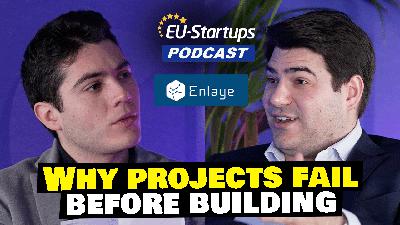
In this special episode of the EU-Startups Podcast, we continue our five-part interview series recorded during Leonard Launch Day in Paris, in partnership with Leonard, the innovation and foresight platform of the VINCI Group.
Leonard supports startups and internal projects shaping the future of construction, infrastructure, energy, and mobility, and during Launch Day we sat down with five companies from its 2026 cohort for in-depth conversations.
This episode features Philippe Rival, CEO of Enlaye, a ConTech company building an AI-native Risk Lifecycle Management platform. Enlaye helps builders, developers, and infrastructure owners identify, compare, and manage risks across the entire project lifecycle - from bid to delivery - reducing cost overruns, claims, and delays.
We discuss how risk is often underestimated or ignored in early project stages, where AI can surface hidden liabilities humans miss, and why better risk management can change how teams collaborate when things go wrong.
This episode is part of our Leonard Launch Day series, with one interview released each day this week (Monday to Friday).
Key points in this episode:
- What “Risk Lifecycle Management” means in practice
- How AI helps surface construction risks earlier and more accurately
- Why risks are often visible long before projects break down
- The challenge of managing risk across multiple stakeholders
- How better risk data changes accountability and decision-making

In this special episode of the EU-Startups Podcast, we kick off a five-part interview series recorded during Leonard Launch Day in Paris, in partnership with Leonard, the innovation and foresight platform of the VINCI Group.
Leonard supports startups and internal projects shaping the future of construction, infrastructure, energy, and mobility, and during their Launch Day we sat down with five companies from its 2026 cohort for in-depth conversations.
The first interview in the series features Ryan Luke Johns, CEO of Gravis Robotics, a Swiss ConTech company enabling autonomy in heavy machinery. Gravis retrofits existing excavators and loaders with advanced robotics and software, transforming them into remote-controlled, semi-autonomous, or fully autonomous machines.
We discuss why autonomy is becoming critical in construction, the challenges of deploying robotics in unpredictable environments, and why retrofitting existing equipment is key to real-world adoption.
This is episode one of five, with one interview released each day this week (Monday to Friday).
Key points in this episode:
- Why autonomy in heavy machinery is becoming a necessity, not a luxury
- The safety benefits of removing humans from high-risk machine operations
- Retrofitting existing equipment versus building autonomous machines from scratch
- The realities of deploying robotics on live construction sites
- How human operators’ roles are evolving alongside autonomous systems

In this episode of the EU-Startups Podcast, host David Cendon Garcia sits down with Friedrich Schwandt - founder of Statista and CEO of ECDB - to unpack nearly two decades of building one of the world’s most trusted data platforms, and why he decided to step back as CEO to start again.
Friedrich founded Statista in Hamburg in 2007 with a simple idea: make reliable data accessible. Seventeen years later, it had become a global data and business intelligence platform with over 1,400 employees, millions of users, and customers ranging from media giants to global enterprises. In 2024, he moved into a chairman role and turned his focus to ECDB, a company built to bring clarity to the fast-moving world of eCommerce data.
We talk about:
• The early problem Statista was really trying to solve
• The hardest moments of scaling that never make it into success stories
• What corporate life at Deutsche Telekom and BCG prepared him for - and what it didn’t
• Letting go of control as a founder, and knowing when it’s time
• What young SaaS and data founders get wrong
• How AI is changing the way data companies are built
• And our shared connection to Ireland (and his fondness of card games)
This episode is about data, yes - but also about leadership, timing, and the long game of building something that lasts.

After 100+ episodes over two years, this is Marcin Lewandowski’s final episode as host of the EU-Startups Podcast.
We flipped the script: this time Marcin is interviewed by David Cendon Garcia (News Editor at EU-Startups) — who will be taking over the podcast going forward.
We recorded it live on a padel court, in one take, while playing.
It’s a fun behind-the-scenes look at:
→ Marcin's story and how it all started
→ the conversations that made the biggest impact
→ the toughest moments
→ favorite guests + lessons learned
→ and what’s next
Thank you, Marcin. David — welcome to the mic.
If you haven't already.... Subscribe to the EU-Startups Podcast on YouTube!
Or follow along on your other favorite podcast platforms... Spotify - https://open.spotify.com/show/4QU85dN... / Apple Podcasts - https://podcasts.apple.com/ee/podcast...
Follow EU-Startups on LinkedIn:
https://www.linkedin.com/company/eu-startups-menlo-media/
Visit our Website:
https://www.eu-startups.com/
Subscribe to our Newsletter:
https://www.eu-startups.com/newsletter/
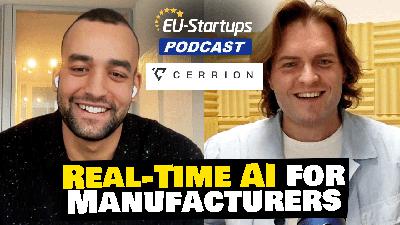
Most people talk about AI in the cloud. Karim Saleh is putting it on the factory floor.
This week on the EU-Startups Podcast, Marcin Lewandowski sits down with Karim Saleh — Co-Founder & CEO of Cerrion, the company building agentic AI that watches factory lines 24/7 and intervenes in real time to prevent safety incidents, scrap, and costly downtime.
Cerrion plugs into standard cameras, understands production flows like an expert operator, and can instantly take action — slowing conveyors, shutting down machines, or triggering alarms. Factories using Cerrion resolve issues 50% faster, cut downtime and scrap in half, and run operations with far less stress.
Karim’s journey is unreal:
→ Grew up in a manufacturing family in Egypt
→ Professional athlete & captain of Egypt’s national water polo team
→ Electrical engineering at ETH Zurich
→ Founder building AI across 15 countries and 3 continents
→ Just raised an $18M Series A from Creandum, Hanel, YC, 10x Founders, Robin Chan, Justin Kan, Harry Stebbings and others
We cover:
• The moment on a factory floor that shaped the mission behind Cerrion
• Why frontline teams everywhere face the same structural problems
• How agentic AI can safely intervene during production
• Real stories where Cerrion caught what humans couldn’t see in time
• The surprising similarity between factories in 15 different countries
• What elite sport teaches you about building a hypergrowth startup
• What the factory of the future feels like for a shift leader in 2030
• And the “one myth about factories” Karim wants the world to forget
This is one of the most grounded, mission-driven, high-clarity deep-tech conversations we’ve had.
Takeaways:
1. Frontline teams are overwhelmed; AI reduces stress, not jobs.
2. Agentic AI is shifting factories from firefighting to foresight.
3. Real-time AI intervention works when humans stay in the loop, not out of it.
4. Elite sports taught Karim the founder superpower: discipline beats adrenaline.
5. The factory of the future is calm, predictable, and safe — not chaotic.
Chapters:
00:00 – Introduction: Karim’s story & Cerrion’s mission
02:13 – Growing up in manufacturing & seeing frontline pain
06:59 – What’s broken in factories today
10:39 – How Cerrion’s AI agents work in real time
12:34 – Human–AI partnership on the shop floor
15:40 – Success stories from 15 countries
18:22 – Athlete mindset → founder mindset
21:29 – Hypergrowth: what broke first
24:50 – The factory of the future
26:42 – Rapid Fire with Karim Saleh
If you haven't already.... Subscribe to the EU-Startups Podcast on YouTube!
Or follow along on your other favorite podcast platforms... Spotify - https://open.spotify.com/show/4QU85dN... / Apple Podcasts - https://podcasts.apple.com/ee/podcast...
Follow EU-Startups on LinkedIn:
https://www.linkedin.com/company/eu-startups-menlo-media/
Visit our Website:
https://www.eu-startups.com/
Subscribe to our Newsletter:
https://www.eu-startups.com/newsletter/

Is Europe really at an AI crossroads — or are we already picking a lane?
This week on the EU-Startups Podcast, Marcin Lewandowski sits down with Emmet King, Founding Partner at J12, VC with presence in Stockholm, London, and Paris, backing founders early at the frontier of AI,
to unpack what the AI moment actually looks like on the ground for European founders.
Emmet argues that Europe has world-class AI talent, but faces real constraints in capital deployment, energy capacity, and regulatory timing. The question isn’t “can Europe build iconic AI companies?” — it’s whether we’ll move fast enough on energy, compute, and policy to let them scale here.
Together, we dig into:
• What “Europe at an AI crossroads” means in practical terms for founders today
• Where talent density is an advantage — and where capital, energy, and regulation still bite
• Why calling AI a “bubble” is lazy, and where the froth really is (application layer)
• Where the real compounding value lies: infra (DataCrunch, etc.) vs applied AI (Dropcode, Kovant, Pistachio, Dema…)
• Energy reality: China’s lead, US flexibility, and how Europe can close the gap
• The non-negotiables for building an AI startup in Europe in 2026
• What kind of regulation timing helps, instead of smothering, AI scaleups
• Signals that the tide is turning: talent flows, new strategies, infra investment
• A concrete “order of operations” for Europe: capital, energy, compute, data, visas
We also run through a quick rapid-fire round:
• Europe’s AI superpower — and kryptonite
• One regulation to keep, one to rewrite
• How to spot the copilot mirage (shiny but 0.2% impact)
• What proves an infra startup can actually compound
• And Emmet’s finish to: “AI isn’t a bubble if we…”
Takeaways
• Europe has the AI talent to build global leaders — but still underpowers them with capital, energy, and policy.
• The AI “bubble” narrative is lazy; froth is in shallow apps, while infra quietly compounds.
• Energy capacity and compute access are now strategic levers, not back-office concerns.
• Winning AI startups in Europe will be trust-first, productivity-proven, and talent-dense.
• Europe’s path is clear: align capital, energy, compute, data, and visas around its best teams.
Chapters
00:00 – Introduction to AI in Europe
03:10 – Europe at an AI Crossroads
08:16 – Energy Infrastructure and AI
10:41 – The AI Bubble Debate
18:01 – Non-Negotiables for AI Startups
22:55 – J12’s Investment Lens & Thesis
26:22 – If Europe Led for a Day: What to Fix First
31:16 – Contrarian Bets, Safe Bets & Myths
35:14 – Rapid Fire with Emmet King
If you’re building AI in Europe — or thinking about where to found your next company — this conversation is a roadmap, not a hot take.
If you haven't already.... Subscribe to the EU-Startups Podcast on YouTube!
Or follow along on your other favorite podcast platforms... Spotify - https://open.spotify.com/show/4QU85dN... / Apple Podcasts - https://podcasts.apple.com/ee/podcast...
Follow EU-Startups on LinkedIn:
https://www.linkedin.com/company/eu-startups-menlo-media/
Visit our Website:
https://www.eu-startups.com/
Subscribe to our Newsletter:
https://www.eu-startups.com/newsletter/
#ai #technology #startup #investing #business
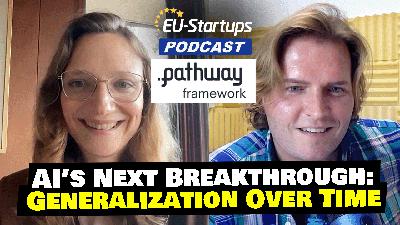
This week on the EU-Startups Podcast, Marcin Lewandowski sits down with Zuzanna Stamirowska, CEO & Co-Founder of Pathway — the company building the world’s first post-transformer AI model.
Transformers took us far, but they’re showing real limits: they recite instead of reason, freeze instead of adapt, and break under real-time complexity.
Zuzanna’s team is rewriting the foundations. Pathway introduces a new architecture with native memory, temporal awareness, and glass-box visibility, enabling models to adapt on the fly—more like humans, less like static prediction engines.
Backed by the minds behind Transformers and GPT o1, and trusted by organizations like NATO, La Poste, and Formula 1 teams, Pathway might be the most important AI company you haven’t heard of yet.
In this conversation, we dive into:
• Why AI’s next leap requires new foundations—not bigger transformers
• How Pathway updates reasoning mid-stream as new evidence arrives
• Visibility as a feature: what “glass-box AI” actually looks like
• How long-range context can survive without latency or cost exploding
• Why post-transformer models need far less data to specialize
• The operational patterns across NATO, La Poste & F1 that justify a new paradigm
• What Pathway’s #1 ranking on Hugging Face opened up
• The next 12 months: the capability Zuzanna is most excited to ship
If you care about where AI is really going — not incremental tweaks but a genuine architectural shift — this is the episode.
Takeaways:
• AI’s next leap is architectural, not incremental.
• Memory + time unlock adaptation transformers can’t touch.
• Context beats parameter count.
• Glass-box visibility will become an enterprise requirement.
• Less data, more reasoning — the future is efficiency over scale.
Chapters:
00:00 – Meet Zuzanna & Pathway
02:57 – Why AI Needs New Foundations
05:58 – Memory & Time: The Missing Ingredients
09:09 – Adaptive Reasoning in Real Time
11:57 – Less Training, More Understanding
15:06 – NATO, La Poste, F1: Field Proof
18:01 – Building Teams at the Frontier
21:09 – Hugging Face #1: The Ripple Effect
23:58 – What Comes Next
If you haven't already.... Subscribe to the EU-Startups Podcast on YouTube!
Or follow along on your other favorite podcast platforms... Spotify - https://open.spotify.com/show/4QU85dN... / Apple Podcasts - https://podcasts.apple.com/ee/podcast...
Follow EU-Startups on LinkedIn:
https://www.linkedin.com/company/eu-startups-menlo-media/
Visit our Website:
https://www.eu-startups.com/
Subscribe to our Newsletter:
https://www.eu-startups.com/newsletter/
#ai #technology #startup

Most healthcare only really starts when something goes wrong.
Even is trying to flip that.
Recorded live during Italian Tech Week in Turin, this episode of the EU-Startups Podcast features Matilde Giglio, Co-Founder of Even, India’s leading healthcare startup redesigning access to affordable, high-quality care for over 1.3 billion people.
Backed by Khosla Ventures, Founders Fund, Lachy Groom, Alpha Wave and others, Even has raised over $60M since launching in 2021, grown to a 400+ person team, and built a unique membership that gives Indians unlimited, cashless access to primary care, diagnostics, specialists, and hospital cover – all wrapped around a strong preventive model.
We talk about:
– Why Matilde chose India and what she saw in the system
– Why most “prevention” models fail – and how Even makes it work at scale
– How they redesigned incentives so doctors, patients and Even are aligned
– What it means to build hospitals that feel like part of life, not a last resort
– Where AI is genuinely useful today – and what stays deeply human
– The hardest founder moments building in a complex, regulated system
– And the headline Matilde wants Even to make five years from now
Takeaways:
– Even blends care + cover in one model, not two separate worlds.
– The core bet is prevention first, not “wait for sickness then pay big.”
– Incentives are redesigned so patients, doctors and Even win on better outcomes, not more procedures.
– AI augments care, handling workflows and insight – but trust and empathy stay human.
– Success is measured in health outcomes and satisfaction, not just ARR or procedure volume.
Chapters:
00:00 Understanding Even Healthcare's Model
02:21 The Decision to Operate in India
05:05 Innovative Healthcare Solutions and Prevention
06:19 Redesigning the Hospital Experience
09:17 The Role of AI in Healthcare
12:40 Challenges Faced by Founders
16:21 Future Aspirations for Even Healthcare
19:07 Rapid Fire Questions and Closing Thoughts
If you haven't already.... Subscribe to the EU-Startups Podcast on YouTube!
Or follow along on your other favorite podcast platforms... Spotify - https://open.spotify.com/show/4QU85dN... / Apple Podcasts - https://podcasts.apple.com/ee/podcast...
Follow EU-Startups on LinkedIn:
https://www.linkedin.com/company/eu-startups-menlo-media/
Visit our Website:
https://www.eu-startups.com/
Subscribe to our Newsletter:
https://www.eu-startups.com/newsletter/
#startup #health #healthcare

Comments

Download from Google Play

Download from App Store
 United States