


 Claim Ownership
Circularity.fm
Subscribed: 6Played: 104
Subscribe

© Circularity.fm
Description
Circularity.fm is the podcast about understanding, building and managing circular business models.
Most episode showcase one specific organisation that runs a circular business model or a business model in the circular economy. This can be a startup, an established SME or a business field of a corporate. Hence, interviews are both about founding and funding a circular business as well as transforming an existing linear business to a circular one, be it in Europe, North America, South America, Asia, Africa or Australia. The podcast focuses on experiences made in this build-up and transformation phase.
Most episode showcase one specific organisation that runs a circular business model or a business model in the circular economy. This can be a startup, an established SME or a business field of a corporate. Hence, interviews are both about founding and funding a circular business as well as transforming an existing linear business to a circular one, be it in Europe, North America, South America, Asia, Africa or Australia. The podcast focuses on experiences made in this build-up and transformation phase.
93 Episodes
Reverse
How does climate risk exposure connect to supply chain decisions, and where does circularity come in?
Michael Bruch, Global Head of Risk Consulting Advisory Services, and Lena Fuldauer, Head of Resilience & Business Development at Allianz Risk Consulting, talk about how companies can assess climate risk across their locations and supply chains, and what role circular strategies play in strengthening supply chain resilience.
What you'll hear in this episode:
• How companies use location-level climate risk data to spot vulnerabilities within the supply chain and compare potential investment sites.
• Why the most productive conversations happen when risk managers and sustainability teams work together.
• How circular approaches like battery recycling reduce dependence on geopolitically concentrated raw materials.
This episode opens the series Enabling Circularity Through Insurance. The series looks at the concrete levers insurance companies hold, from risk assessment and advisory services to product design and claims policies, and how these can enable circularity.
How can a reuse marketplace for unused industrial assets reduce costs and waste at scale?
In this episode, Nathalie Clement, Amanda Fiorillo, and Bernd Schmid from Airbus Defence and Space explain how Airbus built SecondLife, a digital platform where employees trade unused equipment. In three years, 160 tons of waste were avoided and 1,600 tons of CO₂ were saved.
What you'll hear in this episode:
• How Airbus structured a three-step reuse strategy: internal marketplace, external resale and supplier buyback, and donation as a last resort
• Why the financial case is central: a 150% ROI over three years and €1.5 billion in asset value exchanged internally
• How KPIs turned a pilot into a scalable system across the company
Featured in this episode is also Heiko Tullney from Indeed Innovation as co-host. This is the final episode of the Irresistible Circular Business series, produced in partnership with Indeed Innovation, the global design and innovation firm pioneering the circular economy.
Can the value of a product increase over time instead of declining?
In this episode, Aurelia Figueroa, Chief Sustainability Officer, and Gianfranco Gentile, Global Head of Heritage at Breitling, discuss how heritage, repair, and brand identity interact to create a circular model where product value appreciates over decades. The episode is co-hosted by Karel J. Golta, Executive Director at Indeed Innovation.
What you'll hear in this episode:
-How Breitling's Rewind program sources, restores, certifies, and resells vintage watches, and why the company treats it as a cultural mechanism that reinforces demand for current production
-How Breitling frames circularity as a driver of value creation
-How valuing heritage and product longevity can become business assets
This is the fifth episode in the series Irresistible Circular Business, sponsored by [Indeed Innovation](https://www.indeed-innovation.com/), the global design and innovation firm pioneering the circular economy. The series showcases business practices that deliver irresistible commercial and circular results, with examples from different industries across different R-strategies.
How can a 100+ year old linear company transform its processes to make circularity commercially irresistible?
In this episode, Patrick Lerou, Global Lead for Circularity, and co-host Florian Witt, Director of Technology at INDEED Innovation, discuss how Philips built a circular system for high-value medical equipment that turns trade-ins into revenue, parts harvesting into supply chain resilience, and refurbishment into a competitive advantage.
What you'll hear in this episode:
• How Philips uses a three-tier triage system to maximize value from returned equipment through resale, parts harvesting, or certified recycling.
• Why "seeing is believing" works as a sales strategy, with factory tours convincing procurement directors and even governments of refurbishment quality.
• How the Suez Canal crisis revealed circularity's hidden benefit: supply chain resilience through self-sourced components.
This episode covers the operational mechanics and commercial logic behind enterprise-scale circularity, including how to navigate fragmented global regulations and connect data points.
This is the fourth episode in the series Irresistible Circular Business, sponsored by INDEED Innovation, the global design and innovation firm pioneering the Circular Economy. The series showcases business practices that deliver irresistible commercial and circular results, with examples from different industries across different R-strategies.
How do you build a successful certified refurb program for major appliances?
In this episode, Samantha Truesdell, Enterprise Circularity and Climate Strategy Manager, and Caio Doranti, Global Sustainability Senior Manager at Whirlpool Corporation, explain how Whirlpool launched a certified refurbishment program for large home appliances, selling returned units direct to consumer through brand websites. The episode is co-hosted by Karel J. Golta, Executive Director at INDEED Innovation.
The conversation looks at how Whirlpool evaluated circular business model opportunities and why certified refurb was selected as one of the first to execute.
What you'll hear in this episode:
• Whirlpool's enterprise circularity framework and the criteria used to evaluate and prioritize circular business models
• How the certified refurb program works, from returned unit inspection and grading to resale through direct-to-consumer channels
• The revenue case for certified refurb and how the direct-to-consumer model affects margin
The episode also covers internal stakeholder alignment, pilot-phase KPIs, and what Whirlpool expects to learn as geographic coverage expands in phase two.
This is the third episode in the series Irresistible Circular Business, sponsored by INDEED Innovation, the Global Design and Innovation Firm pioneering the Circular Economy. The series showcases business practices that deliver irresistible commercial and circular results, with examples from different industries across different R-strategies.
How can take-back programs move beyond compliance to become a primary sales driver and scaling mechanism?
In this episode, Daniel Unger, Environmental Sustainability Manager at Johnson & Johnson MedTech Germany, and Michael Leitl, Executive Director at Indeed Innovation, discuss how J&J’s collection system solves a core operational problem for its customers: the waste management costs for hospitals.
The conversation explores how their take-back program functions as a crucial sales and commercial lever.
What you’ll hear in this episode:
• The function of the take-back program as a Unique Selling Proposition that secures sales and influences procurement.
• The major regulatory barriers that block cross-border logistics and the strategic decisions that facilitate rapid market scaling and partner adoption.
• The long-term business case and vision for industry-wide collaboration
This episode covers the practical trade-offs and operational shifts required to build a financially and environmentally viable take-back business model, despite regulatory and cost constraints.
This is the second episode in the series Irresistible Circular Business, sponsored by Indeed Innovation, the global design and innovation firm pioneering the Circular Economy. The series showcases business practices that deliver irresistible commercial and circular results, with examples from different industries across different R-strategies.
How do you scale refurbishment through existing dealer networks?
In this episode, Rolf Keller, Head of Circularity, explains how Vitra built its circular model around buying back, refurbishing, and reselling furniture through its dealers, saving 60 to 90% CO2 compared to new products.
Co-hosted by Heiko Tullney, Executive Director at Indeed Innovation, this conversation focuses on:
• The role of modular design and why backward compatibility across product generations matters
• How Vitra structured dealer access to circular stock, including list pricing, visibility into inventory, and revenue sharing
• The criteria behind Vitra's buyback decisions, from product age and condition to logistics and location
The episode also covers how replacing seat covers solves stock mismatches in contract orders and how Vitra embeds circularity requirements into new product development.
This is the first episode in the series Irresistible Circular Businesses, sponsored by Indeed Innovation, the global design and innovation firm pioneering the circular economy. The series showcases business practices that deliver irresistible commercial and circular results, with examples from different industries across different R-strategies.
How do you design circular systems, not just circular products?
In this episode, Anne Farken from Designworks, a BMW Group Company, talks about why circular design is not only about the product itself, but about the ecosystem around it. The conversation looks at the gap between saying design should be integrated from the beginning and actually thinking product and business model together from day one.
What you'll hear in this episode:
• How to design the product ecosystem and integrate product development, business model, and value creation from day one
• The role of designers in translating business model insights into product requirements and facilitating integration across teams
• Why the more you rethink a product, the more you need tolerance for ambiguity and alignment across teams
The episode also touches on why constraints and tradeoffs should be seen as creative opportunities.
This is the final episode in the series Implementing Circular Design Principles, produced in collaboration with the German Design Council.
The series explored how design decisions shape circular outcomes at the material, product, and system level, following the principles of Rethink, Reduce, Reuse, and Recycle.
How can rethinking product design drive innovation, circularity and reduce costs?
In this episode, Nicola Stattmann, Co-founder and CEO of OMC°C, explains why circular product development, when integrated from the start, leads to less investment needed.
The conversation looks at how rethinking material and component choices enable innovation and simplify manufacturing, using the Nike Flyknit's reduction from 50 components to 5 as an example.
What you'll hear in this episode:
• Why less materials, components, and process steps translates to reduced costs
• The role of curiosity and enthusiasm in rethinking how products are made
• Why designers need to make their processes transparent to gain alignment across departments
The episode also explores how Stattmann applied these principles at OMC°C, building an interdisciplinary team of top experts to develop a modular urban greening system.
This episode was recorded in German. English subtitles are available on all our platforms.
This is the second episode in the series Implementing Circular Design Principles, produced in collaboration with the German Design Council.
The series explores how design decisions shape circular outcomes at the material, product, and system level, following the principles of Rethink, Reduce, Reuse, and Recycle.
What should designers know about materials before product development?
In this episode, Andreas Maegerlein, Head of the Creation Center Europe at BASF, talks about circular design from a material perspective, focusing on how material choices enable or limit circularity.
The conversation looks at how product design is affected when materials are developed to last for decades, while products are often designed to be disposable or short-lived.
What you’ll hear in this episode:
• The importance of aligning material choice with product lifetime and use cycles
•Why material selection need to be informed by recycling infrastructure, recycling technologies, and energy-usage
• How the role of designers is evolving from showcasing quality alone toward also conveying sustainability
This episode opens the series Implementing Circular Design Principles, produced in collaboration with the German Design Council.
The series explores how design decisions shape circular outcomes at the material, product, and system level, following the principles of Rethink, Reduce, Reuse, and Recycle.
How do you identify and act on the biggest levers in your environmental footprint?
In this episode, Marcel Niederberger, Head of Sustainability, and Marc Vetterli, Sustainability Expert in Engineering, explain how V-ZUG used life cycle assessment to discover that material intensity (and not just energy efficiency) drives environmental impact in home appliances.
What you'll hear in this episode:
• Why it is essential to carry on life-cycle assessments of all products.
• The development process behind high-quality recycled ABS for visible white panels in washing machines and dryers, and its scalability.
• V-ZUG's self-imposed CO2 penalty that funds fundamental research and early-stage circular projects.
The episode also explores practical implementation topics, including closing material loops with suppliers, designing for reuse across product generations, and building competitive advantage.
This episode concludes the "Recycled Plastics for Premium Brands" series, sponsored by HolyPoly.
The series focused on the practicalities of using technical recyclates in long-lasting, high quality products.
Can recycled technical plastics meet quality, performance, and price requirements at the same time?
In this episode, Isabelle Gola from Bosch Power Tools explains how Bosch developed a closed-loop pilot for power tools using recycled technical plastics while maintaining the same quality and performance standards, at the same price point for the end consumer.
What you’ll hear in this episode:
• How recycled technical plastics were tested against existing quality and performance specifications.
• How communication, certification, and transparency shaped internal alignment and customer response.
• How Bosch defined success in the pilot, with feedback, learning, and data as central KPIs.
The episode also looks at practical challenges behind the closed-loop approach, including reverse logistics considerations, sourcing sufficient volumes, and using disassembly data to inform eco-design and future product development.
This episode is part of the “Recycled Plastics form Premium Brands” series, sponsored by HolyPoly.
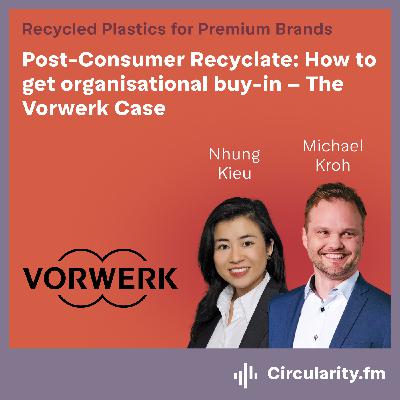
How do you get organisational buy-in for sustainable initiatives?
In this episode, Nhung Kieu, Head of Sustainability at Vorwerk Group, and Michael Kroh, Fellow Materials Engineering and Sustainability Officer at Vorwerk Engineering, share how Vorwerk increased the use of recycled plastics in products such as Thermomix and Kobold vacuum cleaners.
Based on Vorwerk’s experience, we discuss how organisational support was built across engineering, procurement, and management.
What you’ll hear in this episode:
• What drove Vorwerk to increase recycled content and position sustainability as part of the business strategy.
• Which barriers had to be addressed, including quality perceptions, pricing constraints, and internal skepticism.
• Which factors help to create both sustainability impact and economic value.
Listen now to get a practical perspective on how circular initiatives gain traction inside organisations by aligning technical feasibility with business and organisational realities.
This episode is part of the “Recycled Plastics form Premium Brands” series, sponsored by HolyPoly.
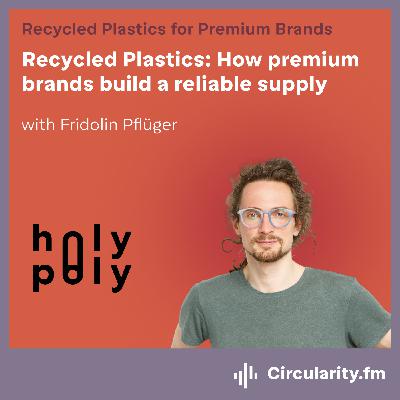
Mandatory recycled-content targets are expanding, while recycling capacity is not.
In this episode, Fridolin Pflüger, co-founder and CEO of HolyPoly, looks ahead to how regulatory recycled-content requirements and carbon pricing are likely to reshape plastics supply chains over the next decade.
This conversation explores the future of plastics recycling, highlighting the challenges and opportunities within the industry. It discusses the impact of regulatory changes, the dynamics of supply and demand, and the differences between mechanical and chemical recycling.
This episode is the first in our “Recycled Plastics for Premium Brands” series, sponsored by HolyPoly.
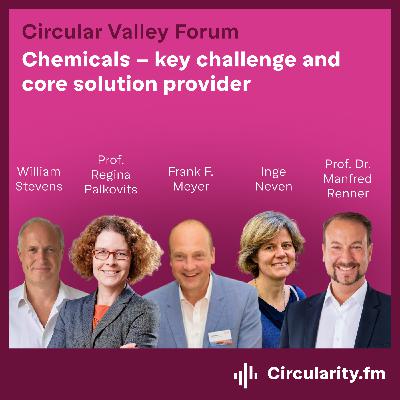
95% of all products contain chemicals, which makes chemistry central to every industrial value chain. But what would it take to make this foundation of European production more circular?
In this episode, Frank F. Meyer from Henkel Consumer Brands, Inge Neven from VITO, Prof. Regina Palkovits from RWTH Aachen and the CATALAIX program, Prof. Manfred Renner from Fraunhofer UMSICHT and Fraunhofer CCPE, and William Stevens from Tech Tour join moderator Carsten Gerhardt to discuss the future of circular chemistry.
Together they explore three core questions:
What is on their horizon in terms of chemical innovation?
What does it take to scale these technologies across industrial settings?
And what does it take to bring something successful in the lab to the market?
This episode concludes our series in collaboration with Circular Valley, which aims to advance Europe’s transition toward a circular economy across the cross border region of North Rhine Westphalia, Flanders and the Netherlands. The panel was recorded at the Circular Valley Forum 2025.
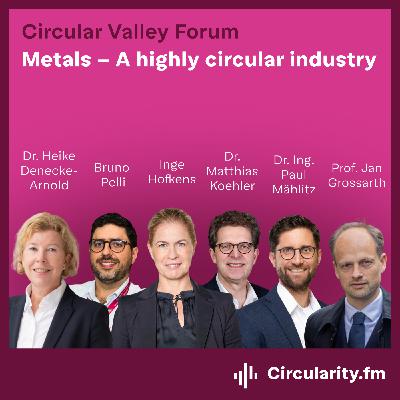
How can the metals sector advance circularity while navigating rising demand, resource scarcity and geopolitical pressure?
In this panel from the Circular Valley Forum 2025, industry and policy leaders discuss the opportunities and constraints of creating a more circular metals system. The speakers include Inge Hofkens, COO at Aurubis, Dr. Heike Denecke-Arnold, CEO of Salzgitter Flachstahl, Bruno Pelli from Vale in Brazil, Dr. Ing. Paul Mählitz from the German Mineral Resources Agency (DERA) and Dr. Matthias Koehler, Deputy Director General for Raw Material Policy, Circular Economy and Resource Protection at the German Federal Ministry for Economic Affairs and Climate Action.
The panel explores recycling limits, alloying element recovery, the role of scrap in decarbonisation, and how global market dynamics shape European resource strategies.
This episode is part of our series in collaboration with Circular Valley and features sessions recorded at the Circular Valley Forum 2025.
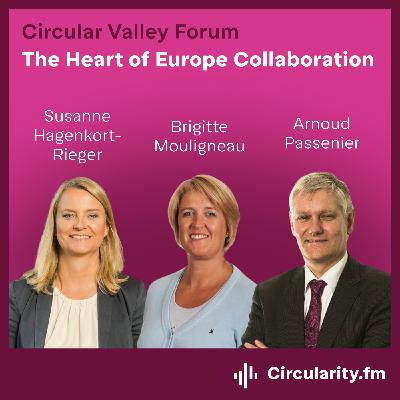
How can cross-border cooperation accelerate the transition to a circular economy in Europe’s industrial heartland?
This panel from the Circular Valley Forum 2025 brings together three senior public-sector leaders: Susanne Hagenkort-Rieger, Director General of the Economic Policy Department at the Ministry of Economy in North Rhine-Westphalia; Brigitte Mouligneau, Transition Manager at OVAM and Circular Flanders; and Arnoud Passenier, Circular Economy Advisor to the Government of the Netherlands. They discuss how their regions structure circular economy policy, where joint priorities lie, and why trilateral collaboration is essential for scaling circular value chains across chemicals, construction and battery materials.
The conversation highlights the need for shared infrastructures, coordinated industry support and policy alignment to make circular business models viable at European scale.
This episode is part of our series in collaboration with Circular Valley. The series features recorded sessions from the Circular Valley Forum 2025.
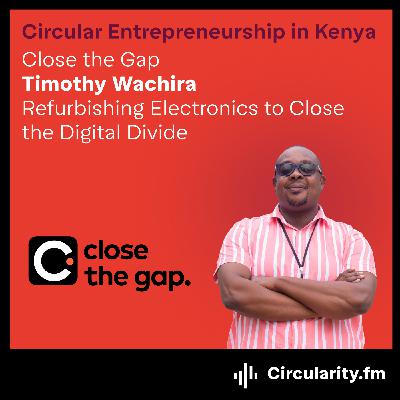
How to create a successful circular hub for electronics that holistically integrates social and commercial aspects into the model?
In this episode, we speak with Timothy Washira, Operations Manager at Close the Gap's Circular Economy Hub in Mombasa, Kenya.
Close the Gap first started in Belgium in 2003 with the mission to provide high-quality pre-owned computers and bridge the digital divide. The organization started its first operations in Kenya in 2019 in Nairobi, before moving the Circular Economy Hub to a bigger, state-of-the-art facility in Mombasa in 2020.
The Circular Economy Hub is the logistics backbone for Close the Gap in Kenya. Its focus is on IT Asset Disposition which involves collecting used IT devices from corporate partners in Kenya, conducting data wipe processes; refurbishing or recycling the devices, and deploying the pre-owned high quality devices to impact projects.
Timothy talks about how Close the Gap is driving socio-economic transformation through for example, its incubator space and the BOOST program.
Listen to hear how Close the Gap integrates commercial success with social impact, creating jobs, promoting the circular economy, and empowering over 6 million people with access to technology and skills.
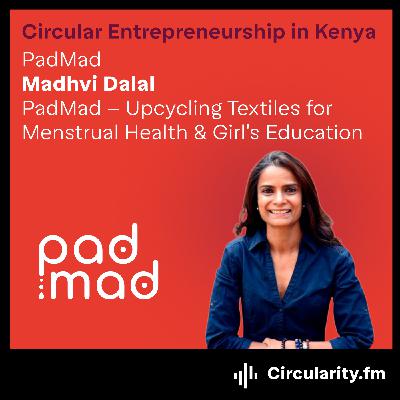
How can a reusable pad company address education, employment, and environmental waste simultaneously?
In this episode, Madhvi Dalal, founder of PadMad, talks about why and how she built a social enterprise to tackle period poverty in Kenya, a country where 65% of women and girls cannot afford menstrual products. This crisis leads to girls missing school and exams, forces them to improvise pads with unhygienic materials, and leaves them exposed to be taken advantage of.
Madhvi walks us through PadMad's three-pillar focus: education, running workshops in schools and workplaces to break stigma and provide information. Empowerment, employing marginalised women to manufacture the pads. And environment, creating reusable pads from textile waste to reduce plastic pollution.
You'll also hear how this model has scaled to impact over 150,000 people and prevented millions of disposable pads from polluting Kenya's environment.
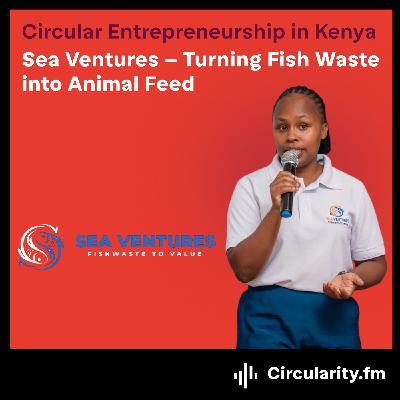
How can fish waste solve a national animal feed crisis and empower local communities?
In this episode, Faith Mwende from Sea Ventures explains how her startup tackles the massive post-harvest losses in Kenya's fishing industry, where 60-70% of the catch becomes waste.
You'll hear how Sea Ventures creates a circular economy model by collecting this fish waste and processing it into high-quality animal feed, directly addressing Kenya's scarcity of animal feed. Faith also talks about the company's social impact, which includes creating jobs, providing training in sustainable farming, and empowering women in both the fishing and agricultural sectors.
Recorded in Mombasa, Kenya, this episode showcases a local solution that integrates environmental action with economic and community development.

Comments

Download from Google Play

Download from App Store
 United States