


 Claim Ownership
Field Notes on Music Teaching & Learning
Subscribed: 24Played: 424
Subscribe

© Copyright 2020-2026, Ashley Danyew. All rights reserved.
Description
This podcast is a collection of creative ideas, practical strategies, and thoughtful observations from the field of music teaching and learning. Music educator Ashley Danyew will dive into topics like how we learn, developing musicianship, time management, teaching sequences, planning tools and strategies, the art of teaching, practicing, and the creative process, and share personal stories from her own experiences and observations. You’ll find creative and pedagogically-sound teaching tips; fresh, new approaches you can use in your teaching; and insight into a few tried-and-true systems and creative processes designed to help you do your best work.
105 Episodes
Reverse
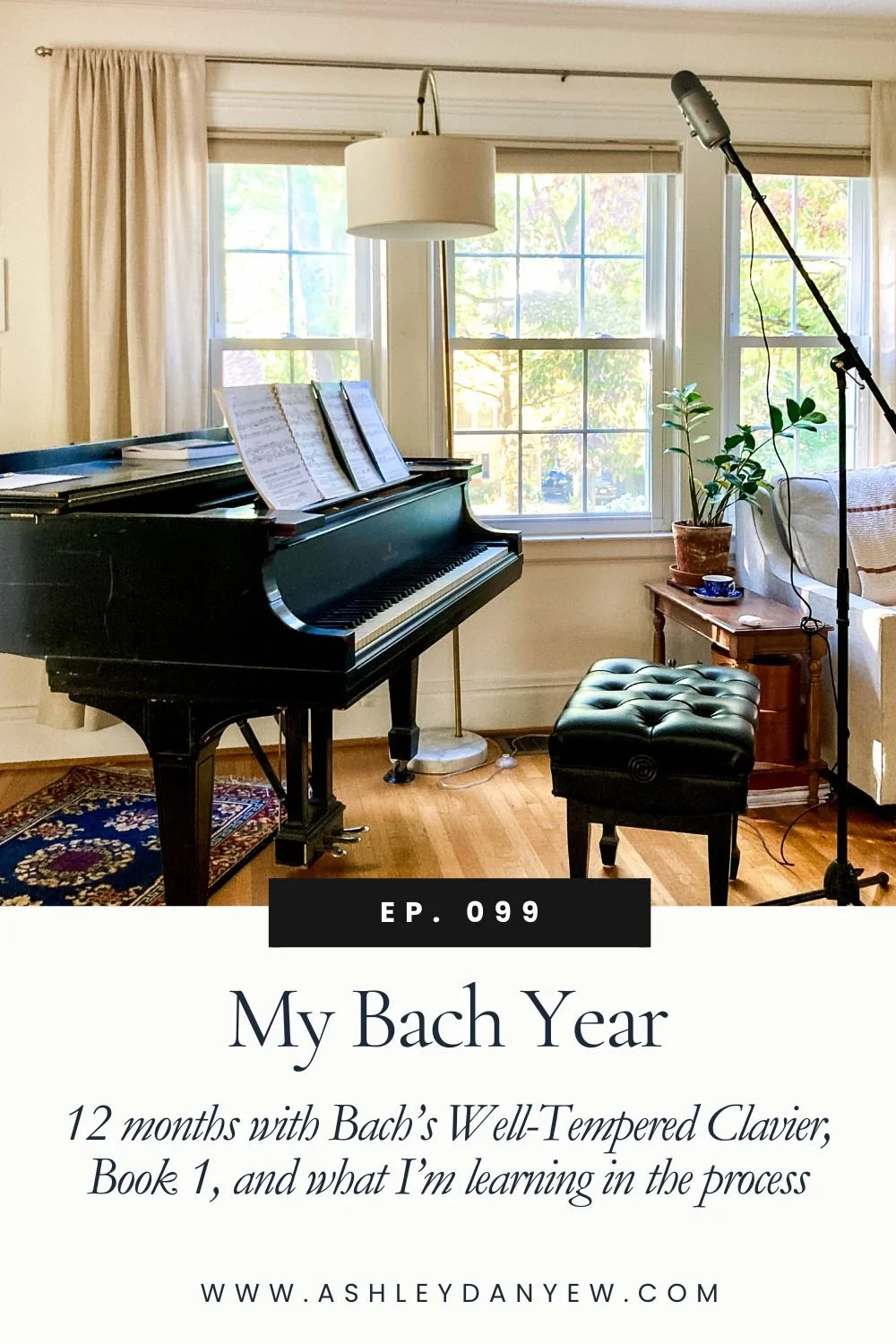
It started with an aspiration: “I want to get back into regular practicing,” I said to Steve one day. “But without a performance commitment, it’s hard to justify the time. What’s the point?” “There doesn’t need to be a point,” he said simply. “Do it for you. I think you’d enjoy it.”In that moment, I gave myself permission to start: A recommitment, a new routine, an artistic practice.But what would I play? Almost immediately, I thought of Bach’s Well-Tempered Clavier. I played a few of the preludes and fugues from Book 1 in high school and maybe the beginning of college, but there were many I’d never learned. Some of the fugues were intimidating as I flipped through my score (the Willard Palmer edition)—certainly not something I could sit down and sight-read my way through. I decided to challenge myself to learn one prelude and fugue each month, in order. I also decided to record them at the end of the month; not to post or share, necessarily, but as a way of documenting the project.I’m sharing all this because I think it’s important to talk about the process of learning and to make it more visible. That’s what this podcast is all about—sharing field notes, reflections, and observations about the questions I’m asking, things I’m learning, teaching strategies I’m trying, and things I’m curious about.Consider this episode my field notes on my year-long Bach experiment.For show notes + a full transcript, click here.Resources Mentioned*Disclosure: some of the links in this episode are affiliate links, which means if you decide to purchase through any of them, I will earn a small commission. This helps support the podcast and allows me to continue creating free content. Thank you for your support!Well-Tempered Clavier, Book 1 (J.S. Bach)A Quick Warm-Up Routine for Piano Teachers and AccompanistsTiny Experiments: How to Live Freely in a Goal-Obsessed World (Anne-Laure Le Cunff)The Art of Practicing (Madeline Bruser)Learn Faster, Perform Better (Molly Gebrian)Essay: Holding On and Letting Go (Fugue No. 4)Essay: When Two Things Are True At Once (Prelude No. 8)Bach’s Musical Universe: The Composer and His Work (Christoph Wolff)If you enjoyed this episode, please leave a review in Apple Podcasts >>Find me on Instagram: @ashleydanyewWhenever you’re ready, here are three ways we can work together:1️⃣ Need fresh teaching ideas? In this quick 25-min. call, you’ll get focused answers, creative ideas, and personalized advice for one teaching or business topic of your choice. Bring your questions for an ask-me-anything style session, and let’s brainstorm strategies together.2️⃣ Have questions about teaching, running your studio, or managing your music career? In this 60-min call, you’ll get personalized advice, creative ideas, and step-by-step strategies on up to 3-4 teaching/business topics of your choice. This session gives you the space to talk through your goals, ask questions, and get expert guidance.3️⃣ Develop the skills and strategies you need to plan the year, refine your teaching methods, and manage your time more effectively with a suite of online courses for music educators.

Earlier this year, I reread Cal Newport's Slow Productivity: The Lost Art of Accomplishment Without Burnout for the Musician & Co. Book Club.One of the things I really enjoy about Cal's books is how well-researched they are. The three principles he outlines in this book are informed and enriched by writings, studies, and historical insights.Cal addresses two main questions in this book: 1) How do we accomplish meaningful work without burnout? and 2) Can we take a slow approach to productivity?I’ve spent some time thinking about what this looks like in self-employment, but recently, I’ve been thinking about what this looks like in my studio. How can I apply the principles of slow productivity to my teaching practice?In this episode, I’ll share five ways I’m adapting Cal’s framework to my studio, from evaluating my time and capacity to repertoire selection and lesson planning to practicing expectations.For show notes + a full transcript, click here.Resources Mentioned*Disclosure: some of the links in this episode are affiliate links, which means if you decide to purchase through any of them, I will earn a small commission. This helps support the podcast and allows me to continue creating free content. Thank you for your support!Slow Productivity (Cal Newport)Join the Musician & Co. Book Club (it’s free!)A Review of “Slow Productivity” by Cal Newport (Musician & Co.)Ep. 064 - How I Plan a Year of Student RepertoireLearn Faster, Perform Better (Molly Gebrian) How to Learn Faster and Perform Better: A Review of Molly Gebrian’s Book (Musician & Co.) Ep. 047 - An Inside Look at My Lesson-Planning ProcessIf you enjoyed this episode, please leave a review in Apple Podcasts >>Find me on Instagram: @ashleydanyewWhenever you’re ready, here are three ways we can work together:1️⃣ Need fresh teaching ideas? In this quick 25-min. call, you’ll get focused answers, creative ideas, and personalized advice for one teaching or business topic of your choice. Bring your questions for an ask-me-anything style session, and let’s brainstorm strategies together.2️⃣ Have questions about teaching, running your studio, or managing your music career? In this 60-min call, you’ll get personalized advice, creative ideas, and step-by-step strategies on up to 3-4 teaching/business topics of your choice. This session gives you the space to talk through your goals, ask questions, and get expert guidance.3️⃣ Develop the skills and strategies you need to plan the year, refine your teaching methods, and manage your time more effectively with a suite of online courses for music educators.

I started using Piano Safari in my studio five years ago. There are a lot of things I like about the curriculum and pedagogical approach, but one of my favorite resources is their correlated sight-reading cards.Piano Safari has three levels of sight-reading cards available, corresponding with the three levels of their method book series. Each pack includes 80-98 unique cards (depending on the level), divided into color-coded units for easy organization. Each card includes 1-2 sight-reading examples and a rhythmic-reading example.Level 1 starts with off-staff notation, moving to staff notation beginning on Treble G and Bass C. Exercises include unisons, 2nds, and 3rds.Level 2 introduces 4ths and 5ths, sharps and flats, and dotted quarter note rhythms.Level 3 includes exercises in C major, A minor, G major, E minor, F major, and D minor. Meters include 4/4, 3/4, 2/4, and 6/8, and rhythms include eighth rests and sixteenth notes.The cards can be used as a supplement with any standard reading method, with children or adults, in private or group settings.In this episode, I’ll share my 7-step teaching process for using these cards in lessons with elementary and early-intermediate students, and 24 creative ways to incorporate them into your teaching.For show notes + a full transcript, click here.Resources MentionedPiano Safari Sight-Reading Cards, Level 1Piano Safari Sight-Reading Cards, Level 2Piano Safari Sight-Reading Cards, Level 3Piano Safari Sight-Reading Card Pack (Levels 1-3)If you enjoyed this episode, please leave a review in Apple Podcasts >>Find me on Instagram: @ashleydanyewWhenever you’re ready, here are three ways we can work together:1️⃣ Need fresh teaching ideas? In this quick 25-min. call, you’ll get focused answers, creative ideas, and personalized advice for one teaching or business topic of your choice. Bring your questions for an ask-me-anything style session, and let’s brainstorm strategies together.2️⃣ Have questions about teaching, running your studio, or managing your music career? In this 60-min call, you’ll get personalized advice, creative ideas, and step-by-step strategies on up to 3-4 teaching/business topics of your choice. This session gives you the space to talk through your goals, ask questions, and get expert guidance.3️⃣ Develop the skills and strategies you need to plan the year, refine your teaching methods, and manage your time more effectively with a suite of online courses for music educators.

Assessment is a process of measuring, evaluating, and documenting learning.Measuring a student’s progress in the studio provides an opportunity for reflection, evaluation, and deeper understanding as we consider with our students what they know and can explain or demonstrate.This informs our teaching, curriculum planning, and repertoire choices. In turn, it also helps students develop a diverse set of musicianship skills, including technique, performance, aural skills, sight-reading, and musical creativity.In this episode, we’ll talk about how to plan an assessment for your studio, including defining assessment criteria and choosing measurement tools, and how to use this data to motivate your students and inform your teaching.For show notes + a full transcript, click here.Resources MentionedRCM Piano SyllabusIf you enjoyed this episode, please leave a review in Apple Podcasts >>Find me on Instagram: @ashleydanyewWhenever you’re ready, here are three ways we can work together:1️⃣ Need fresh teaching ideas? In this quick 25-min. call, you’ll get focused answers, creative ideas, and personalized advice for one teaching or business topic of your choice. Bring your questions for an ask-me-anything style session, and let’s brainstorm strategies together.2️⃣ Have questions about teaching, running your studio, or managing your music career? In this 60-min call, you’ll get personalized advice, creative ideas, and step-by-step strategies on up to 3-4 teaching/business topics of your choice. This session gives you the space to talk through your goals, ask questions, and get expert guidance.3️⃣ Develop the skills and strategies you need to plan the year, refine your teaching methods, and manage your time more effectively with a suite of online courses for music educators.
In a recent class with three intermediate students (8th-11th grade), we compared the music of Franz Schubert and Max Richter. Schubert was a prolific Austrian composer, writing at the end of the Classical period and the beginning of the Romantic period. During his brief life, he wrote over 1,500 works. He was known for his storytelling abilities: long, singing lines, dramatic mood swings, an improvisatory style that seems to wander at times, and emotional intensity.Max Richter is a contemporary German-born pianist and composer known for blending classical techniques with electronic, ambient, and minimalist styles. He names J.S. Bach as a key influence, and has championed the works of minimalists such as Arvo Pärt and John Cage. He drew inspiration from Schubert’s Winterreise when creating his 2010 album Infra.In this episode, I’m taking you behind the scenes of this studio class, sharing the repertoire I introduced to my students, the discussion questions that guided our conversation, and a composition activity that students didn’t want to end.For show notes + a full transcript, click here.Resources Mentioned*Disclosure: Some of the links in this episode are affiliate links, which means if you decide to purchase through any of them, I will earn a small commission. This helps support the podcast and allows me to continue creating free content. Thank you for your support!Ep. 083 - Bernstein & Bill Evans: Inside My Recent Intermediate Studio ClassEp. 077 - A New Approach to Teaching Group ClassesSchubert Piano Sonata No. 20 in A Major, D. 959: II. Andantino (Mitsuko Uchida)Richter “Andante” from In a Landscape (Max Richter)Schubert Impromptu No. 3 and Richter Infra 3 (Coversart)Songs Without Words(Felix Mendelssohn)Schubert Moments Musicaux No. 6 in A-flat Major (Alfred Brendel)Vladimir’s Blues (Max Richter)Max Richter Piano Works(Max Richter)If you enjoyed this episode, please leave a review in Apple Podcasts >>Find me on Instagram: @ashleydanyewWhenever you’re ready, here are three ways we can work together:1️⃣ Need fresh teaching ideas? In this quick 25-min. call, you’ll get focused answers, creative ideas, and personalized advice for one teaching or business topic of your choice. Bring your questions for an ask-me-anything style session, and let’s brainstorm strategies together.2️⃣ Have questions about teaching, running your studio, or managing your music career? In this 60-min call, you’ll get personalized advice, creative ideas, and step-by-step strategies on up to 3-4 teaching/business topics of your choice. This session gives you the space to talk through your goals, ask questions, and get expert guidance.3️⃣ Develop the skills and strategies you need to plan the year, refine your teaching methods, and manage your time more effectively with a suite of online courses for music educators.

Comments

Download from Google Play

Download from App Store
 United States