


 Claim Ownership
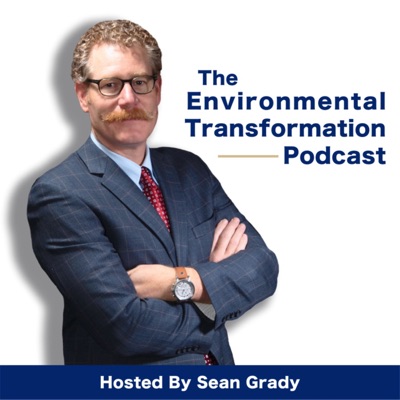
The Environmental Transformation Podcast with Sean Grady
Subscribed: 19Played: 165
Subscribe

© Sean Grady
Description
The Environmental Transformation Podcast explores the future of Sustainability, EHS, the Circular Economy, and Environmental Innovation. Host Sean Grady interviews industry leaders and changemakers about emerging technologies, digital transformation, and the trends reshaping the environmental sector. Stay informed, lead the change, and join the ET Nation on every major platform as we dive into the conversations driving real environmental impact.
138 Episodes
Reverse

PFAS litigation produced New Jersey settlements with DuPont and 3M valued at $2.5 billion. Water utilities and ratepayers still face treatment costs.Environmental attorney Bill Jackson of Kelley Drye & Warren talks with Environmental Transformation podcast host Sean Grady about representing 15 states in contamination cases. He explains how natural resource damages differ from remediation costs, why states can bring claims outside CERCLA, and how public claims based on risk differ from an individual's effort to prove that exposure caused cancer.Jackson also addresses a difficult distinction: holding a chemical manufacturer responsible is not the same as pursuing the companies that used its products. He describes how the PFOA and PFOS hazardous substance designations affect property owners and firefighting foam users, and why enforcement discretion does not necessarily protect passive receivers from private lawsuits.For utilities and industrial operators, the discussion covers upstream discharge testing, internal PFAS audits, historical insurance policies and the cost of contamination in biosolids applied to farmland. Jackson explains New Jersey's approach to helping private well owners and protecting public systems from contribution claims.He closes with North Carolina's nearly $600 million settlement tied to the Fayetteville Works site and Cape Fear River contamination, describing the funding needed for water treatment and natural resource damages.Follow the Environmental Transformation podcast and sign up for the newsletter at seankgrady.com.#PFAS #WaterQuality #EnvironmentalLawCHAPTERS:0:00 Bill Jackson on PFAS Accountability4:00 Protecting Taxpayers From Cleanup Costs6:00 Why PFAS Is Not Natural Background9:00 Cleanup vs. Natural Resource Damages12:00 State Claims Beyond CERCLA15:00 Proving PFAS Risk in Court19:00 Explaining Toxicity Science to Judges22:00 Sponsor Messages25:00 CERCLA and Joint and Several Liability29:00 Chemical Makers vs. Product Users31:00 Firefighting Foam and Airport Liability33:00 Drinking Water Standards and Ratepayers36:00 Water Settlements and Private Wells39:00 Tracking Upstream PFAS Discharges43:00 Internal PFAS Audits46:00 Historical Insurance and Cleanup Costs49:00 Passive Receivers and Contribution Risk52:00 Biosolids and Contaminated Farmland56:00 Source Control at Contaminated Farms58:00 North Carolina's PFAS Settlement

Indiana's circular economy starts before the recycling bin, with buildings designed for deconstruction and manufacturers recovering their materials.Circular Indiana board president Pam Francis, vice president of Schott Design, and board member Ken Miller talk with The Environmental Transformation podcast host Sean Grady about keeping products and materials in use longer. They explain the organization's shift from the Indiana Recycling Coalition, the upfront costs of changing business practices and the challenge of keeping recovered materials close to Indiana manufacturers.The conversation covers AI-powered waste sorting, digital product passports and extended producer responsibility, or EPR. Francis and Miller discuss their focus on batteries, the fire risks that shape that work and the questions surrounding producer-funded collection, consumer costs and convenient drop-off locations.Francis describes practical changes in commercial interiors, including carpet recycling, furniture reuse and designing spaces that can adapt without sending usable materials to a landfill. Examples include Shaw Industries' carpet take-back model and Sortera's use of AI to separate aluminum alloys, along with discarded tires turned into road barriers and unsold food recovered for animal feed.The guests also preview the 2026 Circular by Design: Innovation Meets Action conference, scheduled for Oct. 5 at The Heritage Group's Indianapolis venue, The Center, with speakers including Heidi Sanborn and Kent Holm.Conference registration and membership: circularin.orgPodcast, newsletter and updates: seankgrady.com#CircularEconomy #BatteryRecycling #SustainableDesignCHAPTERS:0:00 Welcome and Guest Introductions2:00 Moving Beyond Traditional Recycling6:00 Measuring Circular Economy Progress8:00 Circular by Design Conference Preview11:00 The Business Barriers to Circularity14:00 AI Sorting and Recycling Infrastructure17:00 Recovering Recyclables From Mixed Waste20:00 Circular Indiana's Battery EPR Plan23:00 Building an EPR Stakeholder Coalition25:00 Battery Fires and Recycling Safety27:00 Sponsor Break30:00 Indiana's Manufacturing Supply Chains34:00 Tires and Food Waste as Raw Materials36:00 Heidi Sanborn and EPR Experience39:00 Kent Holm and Battery Collection Models43:00 Oil Containers and Hazardous Waste45:00 Designing Out Construction Waste49:00 Reusing Carpet, Furniture and Doors51:00 Shaw's Carpet Take-Back Model53:00 Building Deconstruction in Boulder56:00 Waste Industry Partnerships58:00 Sortera and AI Aluminum Sorting1:01:00 Battery EPR and Long-Term Goals1:04:00 Keeping Resources in Use1:07:00 Closing and Conference Reminder

Greenwashing can start when a communications team turns solid sustainability data into an overstated claim, says Helen Neal. The founder of HN Communications, a certified B Corp sustainability communications consultancy, talks with the Environmental Transformation Podcast host Sean Grady about the gap between corporate progress and public credibility. She explains how companies can speak about climate action without exaggerating results or going silent out of fear of scrutiny.Neal details her IMPACT framework: integrity, meaning, proof, action, consistency and transparency. She also explains how Zena, the artificial intelligence platform she developed, reviews websites, press releases and sustainability reports for potential regulatory risks. Rather than rewriting copy, the tool coaches users to identify missing evidence, clarify claims and explain how results were achieved. Neal says it still requires human review and is not a substitute for legal advice.The conversation also covers the pressure on 2030 commitments, why sustainability needs support from the chief executive and how tying bonuses to measurable goals can spread responsibility across a business. Neal makes the case for treating secure supplies, reliable energy and ethical procurement as long-term business priorities rather than simply the right thing to do.She traces her move from corporate work to building a flexible, remote consultancy and explains why she created the Climate Leaders Community for women in sustainability. Her message to boardrooms: use technology to understand the data, but keep telling the human stories behind the work.Contact Helen Neal: [email protected] Helen Neal and HN Communications on LinkedIn.#Greenwashing #SustainabilityCommunications #ClimateLeadershipThanks to our Sponsors: Cascade Environmental, E-Tank, WASTELINQTAGS:Helen Neale, Xena AI, Zena review, HN Comms, green hushing, ESG reporting, environmental advertising, green claims review, corporate accountability, climate risk communication, supply chain resilience, Scope 3 emissions, sustainability governance, responsible marketing, circular economy, climate commitments, sustainable procurement, brand trust, climate tech, environmental podcast

Indiana sustainability strategy is shifting from pollution prevention alone to resource efficiency, circular economy, water reuse and supply chain resilience. Paul Melillo, director of business development and principal at Metric Environmental, explains how the Indiana Partners for Sustainability is making that transition as it prepares for its 29th annual conference Sept. 10 in Indianapolis.Melillo describes the voluntary Partners Pledge, which asks member companies to identify sustainability improvements, attend events and report annual metrics on materials, landfill disposal, recycling and energy use. He makes the economic case in simple terms: businesses pay for waste when they buy materials and again when they dispose of them. Reducing waste can cut costs while improving environmental performance.The discussion also previews the conference program, including keynote speaker Bruno Pigott, executive director of the WateReuse Association, the Governor's Award for Excellence, and concurrent afternoon tracks focused on sustainability success stories and water. Melillo says water demand tied to data centers and major manufacturing developments is likely to be part of the conversation, alongside PFAS and infrastructure planning.Looking beyond the conference, Melillo argues that Indiana businesses need to prepare for more supply chain transparency, product life cycle scrutiny, carbon footprint reporting, water-use disclosure and recycling expectations. The organization supports members through quarterly facility meetings, peer sharing, consulting partners and a recorded library of more than 200 presentations.Learn more at inpartnersforsustainability.org.

Automotive plastic recycling is moving outside the curbside bin as EPR laws push petroleum brands to fund collection systems for used oil and antifreeze containers.David Lawes, CEO of Interchange 360, explains why petroleum packaging needs a separate recovery system and how the organization is building one across the United States. The effort grew from a Canadian model and brings major petroleum producers under a shared compliance structure for petroleum and automotive packaging.Lawes describes a funding model based largely on product volume, with fees collected upstream and incentives paid to existing trucking, collection and recycling businesses rather than a network of Interchange-owned trucks or facilities. He also explains how auto retailers, household hazardous waste sites and other return locations can serve as convenient alternatives to curbside recycling, where residual oil can contaminate broader material streams.The conversation follows the material after collection. Motor oil containers can be shredded, warmed and processed through a centrifuge to remove residual oil, which can be recycled, while the plastic can move into post-consumer markets and potentially back into new motor oil packaging. Lawes says the long-term goal is a tighter circular system, but processing capacity remains a major constraint, especially in states such as Colorado where the program is building infrastructure from a near-zero starting point.Lawes also discusses why consumer behavior often comes down to two factors: clear communication and convenient drop-off options. He points to British Columbia, where the Canadian program has achieved collection and recycling rates above 90%, as evidence that specialized systems can scale when the network is easy to use.Learn more about the Environmental Transformation Podcast at www.seankgrady.com.#PlasticRecycling #ExtendedProducerResponsibility #CircularEconomyCHAPTERS:0:00 Recycling Challenge and Introduction2:00 Five Oil Brands Build a Shared EPR Model4:00 Why the Canadian Model Was Chosen6:00 Canada and U.S. Program Differences9:00 How Volume Based EPR Funding Works12:00 Incentivizing Existing Recycling Companies15:00 Alternatives to Curbside Collection18:00 Sponsor Break20:00 State by State EPR Compliance24:00 Circularity and Post Consumer Content27:00 Building Processing Capacity From Zero30:00 Cleaning Oil Contaminated HDPE33:00 Other Materials That Need Separate Systems36:00 Convenience Drives Recycling Behavior40:00 Collection Equipment and Retail Incentives42:00 Colorado Targets and Producer Compliance45:00 Developing Colorado Processing Capacity49:00 Building the System for the Long TermTAGS:David Laws recycling, Lawes lubricant recycling, Interchange360 recycling, lubricant container recovery, used oil bottle recycling, petroleum packaging stewardship, alternative collection program, motor oil jug recovery, antifreeze jug disposal, producer responsibility group, Colorado packaging compliance, Washington EPR policy, post consumer resin, HDPE oil bottle processing, circular packaging systems, automotive waste diversion, hazardous waste drop off, recycling incentive model

Comments

Download from Google Play

Download from App Store
 United States