


 Claim Ownership
Haptic & Hue
Subscribed: 516Played: 13,806
Subscribe

© Jo Andrews 2026
Description
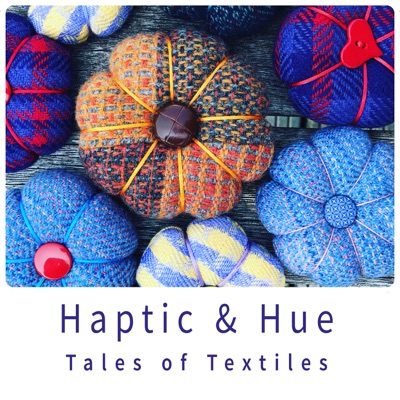
Haptic & Hue's Tales of Textiles explores the way in which cloth speaks to us and the impact it has on our lives. It looks at the different light textiles cast on the story of humanity. It thinks about the skills that go into constructing it and what it means to the people who use it.
76 Episodes
Reverse
This month, we celebrate a woman who devoted her life to preserving her homeland's identity through stitch. Lubow Wolynetz, who has died aged 87, was born in Ukraine's Carpathian Mountains in 1938. After surviving occupation, war and a displaced persons camp, she spent more than fifty years in America as a museum curator and teacher, passing Ukraine's intricate expressions of identity on to hundreds of people. There is something universal in Lubow's story which shows that however much a people's homes and buildings may be destroyed, their stitched culture, passed from mind to mind and hand to hand, is almost impossible to erase. It's a truth shared by the tatreez of Palestine, the arpilleras of Chile under Pinochet and the Highland tartans banned after 1746 in Scotland, and it makes Lubow's story one to treasure.
The first group of people in the world to be called refugees were deeply tied up with the production of luxury cloth. In the 17th and 18th century a small corner of east London became a byword for some of the best woven silk in the world. Spitalfields silk was worn by some of history's most famous people. George Washington, despite fighting a war against the British, had a waistcoat made from it, and his wife, Martha, had an entire dress made from the silk designed in London and woven by hand on the draw looms of Spitalfields. Queen Victoria wore it on her wedding day, and Queen Charlotte, wife of George III, wore it deliberately, to champion British industry. There are estimated to be over 40 million refugees in the world today and they are often seen as a drain on the societies that shelter them and are subjected to hatred and harassment. But this episode looks at what the first group of people to be known as refugees – the Huguenots of France – contributed to the country that gave them shelter and how they made British silk textiles famous. For more information about this episode and pictures of the people and places mentioned in this episode please go to https://hapticandhue.com/tales-of-textiles-series-8/ And if you would like to find out more about Friends of Haptic & Hue with an extra podcast every month hosted by Jo Andrews and Bill Taylor – here's the link: https://hapticandhue.com/join/
In a few day's time the Bayeux Tapestry goes on show at the British Museum in London. The famous embroidery that depicts the Norman conquest of England has returned to the country where it was stitched for the first since it was made almost a thousand years ago. It was created by defeated Anglo-Saxon women, commissioned by their Norman conquerors, and they stitched it to serve a very particular political purpose. We will never know their names but they made one of the most extraordinary works of art to survive from early medieval Europe. Down the centuries it has exerted a powerful hold over many imaginations: it was taken to Paris by Napoleon to rally his troops as he planned to invade Britain, and later eyed by Hitler for the same reason. But the Tapestry is much more than a beautiful object. It is a brilliant piece of communication and in this episode, with the help of Michael Lewis, Curator of the Bayeux Tapestry at the British Museum, we look at the labour behind it and the story it was designed to tell. For more information about this episode and pictures of the people and places mentioned in this episode please go to https://hapticandhue.com/tales-of-textiles-series-8/ And if you would like to find out about Friends of Haptic & Hue with an extra podcast every month hosted by Jo Andrews and Bill Taylor – here's the link: https://hapticandhue.com/join/
A number of very special quilts have been arriving in North America over the past few weeks. A collection of more than 40 are being returned to Canada, 85 years after they were made in communities all over the country. Most of them are tattered and deeply worn but they have an extraordinary story to tell. They are the last evidence we have of an astonishing operation that saw Canadian women and children make over 400,000 quilts during the Second World War. These were sent, largely, to Britain to comfort children orphaned in the conflict, families bombed out of their houses, soldiers convalescing, land girls in hostels far from home and a myriad of other uses. In Britain, the Canadian wartime quilts were often loved and cherished. But gradually, as the years passed they faded from memory. A few hundred have survived and many museums in the UK hold them. In Canada they were completely forgotten. Now it is hoped that with the return of this major collection a new generation will come to understand the work of their grandmothers and great grandmothers. The aim is that there will be a permanent exhibit of the entire collection to stand as a memorial, not just to the women of Canada, but to all those around the world who use their textile skills in times of conflict to bring comfort, compassion and care. If you would liket o see pictures of the quilts of read a transcript of this podcast then please follow the link to https://hapticandhue.com/tales-of-textiles-series-8/
This month's episode is a little different: as many of you know we run a second podcast for Friends of Haptic & Hue called Travels with Textiles, in which we explore all kinds of textile topics that crop up in the news or that we come across in our travels and that we don't get the chance to talk about in the main podcast. Once a year we give you a special taste of what Friends of Haptic & Hue sounds like and invite you to join us. This time we are giving you a listen to an episode of Friends that went out earlier this year. We know that knitting is one of the most popular textile crafts today, it's estimated that there are well over a hundred million active knitters globally. But where does it come from? When did knitting first appear and what do we know about how it spread around the world? This episode of is devoted to knitting and its history. We explore the origins of knitting and what we know about some of the earliest surviving knitted pieces we have from North Africa. We travel to a small island in the North Atlantic that is home to some of the world's most iconic knitting and we hear about knitting traditions that grew up in America's Appalachia region with waves of different migrants arriving in the area. For more information about this episode and pictures of the people and places mentioned in this episode please go to https://hapticandhue.com/tales-of-textiles-series-8/ And if you would like to find out about Friends of Haptic & Hue with an extra podcast every month hosted by Jo Andrews and Bill Taylor – here's the link: https://hapticandhue.com/join/

Comments

Download from Google Play

Download from App Store
 United States