


 Claim Ownership
Shadow Warrior by Rajeev Srinivasan
Subscribed: 2Played: 31
Subscribe

© Prof. Rajeev Srinivasan
Description
An Indian/Hindu nationalist perspective on world affairs; as well as on technology and innovation; conversations with experts and with people just like you and me.
rajeevsrinivasan.substack.com
rajeevsrinivasan.substack.com
159 Episodes
Reverse
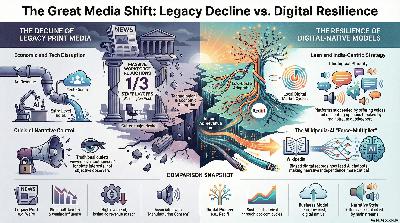
Just around the same time as the axe fell on Washington Post’s global staff, accompanied by much wailing and gnashing of teeth, I got a message from my Rediff.com editor, Nikhil Lakshman, mentioning it was the 30th anniversary of its founding. An interesting contrast indeed: the old Western flagbearer waning, while the Indian pioneer holds on, despite a plethora of competitors and copycats, including many pushing specific agendas.That also made me think of why there was a bloodbath at the Washington Post, where they gutted the foreign desks, sports, books, and some leading podcasts, and laid off a third of its staff. I suspect there are two reasons: one is the increasing insularity of the US, a retreat into Fortress America, and paradoxically a turning away from the rest of the world at the very moment the rest of the world should be looming more prominently in the rear-view mirror.And two, the economics and the technology of the narrative business have turned. On the one hand, print media have been retreating and losing ad revenue for years, and on the other hand, the rise of generativeAI has made it possible to eliminate entire layers of (at least) entry-level journalists, just as it is decimating paralegals, code-jockeys, and apprentice accountants. Only junior doctors seem immune so far, but we shall see how that goes. I must confess that there was a time when I consumed the Western narrative with gusto: reading Time, Newsweek, and so on, and listening to the BBC. In fact, I actually subscribed to the New York Times for years (ok, in my defense I was living in the New York area), and later The Economist for at least a dozen years. I still listen to some podcasts from the latter, but with considerable caution, as I am far more aware of their biases and proclivities.That’s where my concern about big-name Western media comes from. They are all somehow associated with the Deep State, that amorphous entity, the hidden puppet-master behind pretty much everything that goes on in foreign and domestic policy. For instance, an outlet that I considered the voice of NATO, turns out to be the voice of Whitehall, Britain’s bureaucracy.There has long been a truism that the Washington Post is the mouthpiece of Foggy Bottom, i.e. the US State Department, and the New York Times that of Langley, i.e. the Central Intelligence Agency (CIA). Noam Chomsky long ago made the insightful observation that they are both in the business of “manufacturing consent”, i.e. narrative-peddling to suit vested interests, specifically the Military-Industrial Complex, which likes, or needs, constant wars.The eclipse of the WaPo is not only a statement about the decreasing influence of the State Department on foreign affairs (in the wake of the decline of the “liberal, rules-based international order”). But it is also because the print media business is no longer lucrative, as the bulk of advertising revenue has now moved online, to the likes of Alphabet, Meta, Amazon et al. Large numbers of smaller US newspapers have closed down over the past few decades.I suspect also that gaslighting at scale is much easier now with the advent of outlets such as Wikipedia. Ashley Rindsberg, author of The Grey Lady Winked (an expose of the NYT), has been chronicling on Twitter how Wikipedia has become a handmaiden of the usual suspects. Editors are often paid agents provocateurs, and stories that do not serve their purpose are simply trashed. There is much that is subjective/motivated about the content.However, since Wikipedia has become the encyclopaedia of record, and generativeAI uses it unabashedly as a genuine source, the level of force-multiplication is immense. Every AI chatbot uses it, and of course all of us are using these chatbots. If it’s not in Wikipedia, it ceases to exist, and I fear this is happening to India’s Traditional Knowledge Systems.This level of groupthink, alas, is not unusual. That is where I applaud Rediff. When it appeared in the 1990s, the discourse in India was tremendously skewed to the Left. What was considered “Centrist” in India was, objectively speaking, “Left”, and what was considered “Left” was, in reality, “Lunatic-Fringe Left”. It was simply impossible to get a dissenting opinion published, especially because nobody would hire you if your views didn’t pass a test of fealty.But Rediff offered that possibility. Nikhil Lakshman, the editor, and Ajit Balakrishnan, the publisher, were willing to take risks with other voices, and I personally am grateful. Here I was, a non-specialist, a technologist and product manager in Silicon Valley, and also an unapologetic Hindu nationalist, which would have made me “Lunatic-Fringe Right” in the scheme of things.Rediff gave me a voice. Before me, it also gave a voice to my dear and late friend, Varsha Bhosle. We wrote stuff as we saw it, without self-censoring, and it turned out it resonated with a lot of people, especially in the diaspora, who at that time had much more Internet access than in India. I used to get hundreds of e-mails in response to my columns. Varsha got even more.We had the great advantage that, as non-professionals, we didn’t care about employment or income from journalism. Sun Microsystems paid my way; Varsha was the daughter of the celebrated Asha Bhosle.Conversely, that is a problem today for those JNU products who were planning to enter the field: USAID and Soros funds are down, and their proteges in the Indian online world (you know who they are) aren’t doing all that well. I have an old classmate, a journalist, whom I consider deranged and terminally anti-India, who makes a nice living off, I gather, funds from several countries inimical to India, but the outlook for his tribe is a little dim these days.Rediff was the only game in town in 1996, and it thrived. It was India’s pioneering internet portal with web news, email, shopping, entertainment, and it rode the first dot-com wave and survived multiple cycles (including the 2000 crash). It adapted from a pure portal to an aggregated and news-focused site, outlasting many peers by staying lean, India-centric, unbiased, and low-cost.Rediff represents a digital-native model that persisted through adaptation without the massive overhead of legacy print giants. More power to it! Thank you again, and best wishes!PostscriptThose tests of fealty to the ‘cause’ continue. I personally have been ejected from two op-ed columns because my thoughts were apparently impure. One, a few years ago, was at a prominent national daily. After writing occasionally for some time on invitation, my contact ruefully told me that I was persona non grata, in his words, not because my stuff was not good, but because the opinion editor did not agree with my perspectives.More recently, I had a regular monthly column in a well-known regional daily. After having my words over-edited repeatedly, I realized that their opinion editor, who had invited me on board, simply did not like my pro-Hindu stance. So I quit.The remarkable thing is all of the dramatis personae, including me, these two opinion editors, and the Rediff folks, are originally from Kerala. I wonder if this reflects some deep psychosis in the make-believe world in this last bastion of extreme Leftism. Tellingly, the ‘all-India strike’ called by left trade unions on the 12th of February was ignored everywhere except Kerala, where it was total.1075 words, 10 Feb 2026 updated 13 Feb 2026 This is a public episode. If you'd like to discuss this with other subscribers or get access to bonus episodes, visit rajeevsrinivasan.substack.com/subscribe
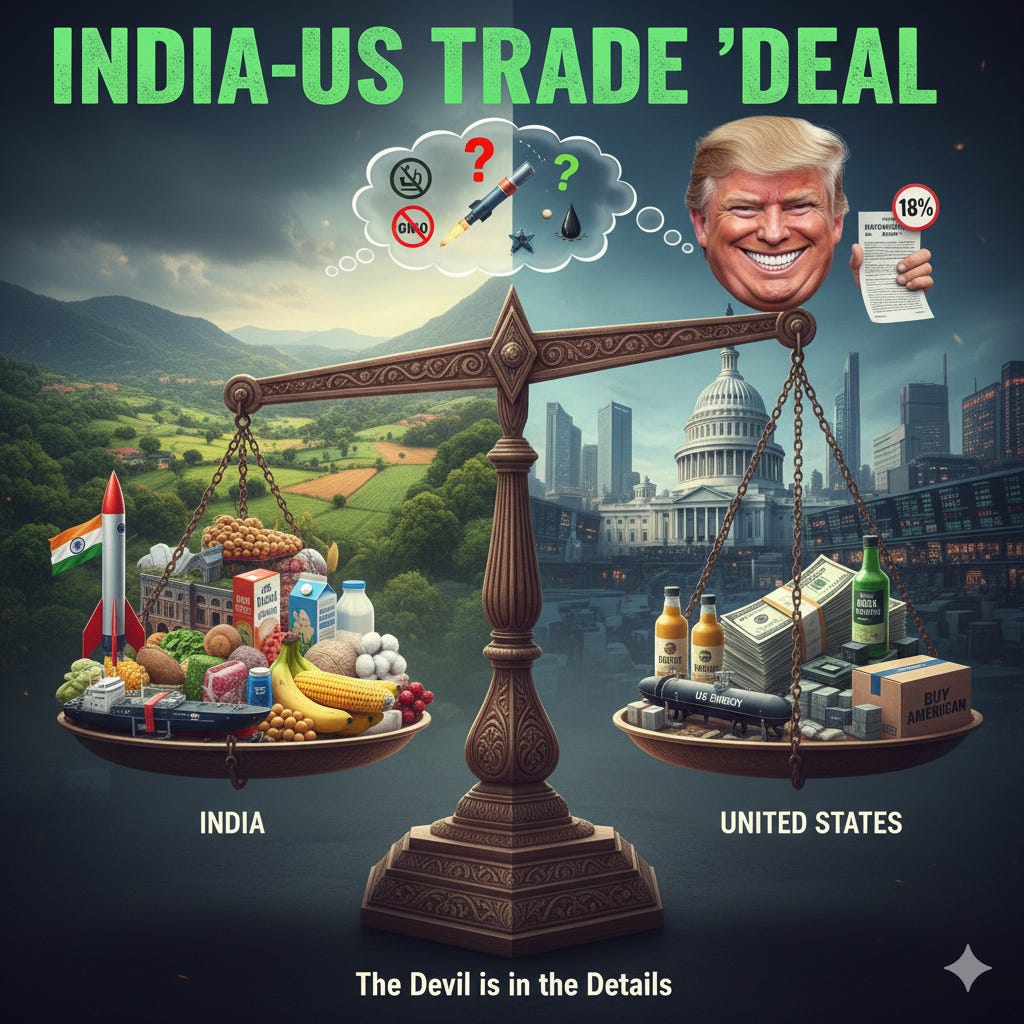
A version of this essay was published by firstpost.com at https://www.firstpost.com/opinion/india-us-trade-deal-trump-skepticism-13977047.htmlI am beginning to feel quite like ‘The Boy Who Cried Wolf’, who was destined to be ignored. Or maybe I am the boy who cried ‘The Emperor Has No Clothes’. For, I was skeptical last week about the India-EU FTA, which I called a triumph of hope over experience. Now I am equally skeptical about the so-called India-US trade ‘deal’, which in fact is not a deal at all, but a sort-of statement of direction about the way to an actual deal.The AI-generated video about this essay Google NotebookLM: I expressed my caution on a Malayalam TV program where the host was a retired Ambassador. He was less skeptical than me, but he understood where I was coming from: after all, a diplomat’s job is to put the best spin on the news (good or bad) from his country’s perspective. And I spent much of my professional career in marketing: I can tell spin when I see it. Reason No. 1: Trump is famous for exaggeration and U-turns.The very first reason for the scepticism about the Indo-US lovefest is that it was announced by President Trump, who, in the past six months, has, in his whimsical way, executed any number of U-turns, as well as Z-turns, and various other pretzel-logic twists, so much so that anything he says, and its opposite, can be equally true, in a quantum Schrodinger’s Cat sort of way. It is prudent not to take him at face value when he swears eternal allegiance to India. Again.Quoth he: “It was an Honor to speak with Prime Minister Modi, of India, this morning. He is one of my greatest friends, and a Powerful and Respected Leader of his Country. We spoke about many things, including Trade, and ending the War with Russia and Ukraine. He agreed to stop buying Russian Oil, and to buy much more from the United States and, potentially, Venezuela. This will help END THE WAR in Ukraine, which is taking place right now, with thousands of people dying each and every week! Out of friendship and respect for Prime Minister Modi and, as per his request, effective immediately, we agreed to a Trade Deal between the United States and India, whereby the United States will charge a reduced Reciprocal Tariff, lowering it from 25% to 18%. They will likewise move forward to reduce their Tariffs and Non Tariff Barriers against the United States, to ZERO. The Prime Minister also committed to “BUY AMERICAN,” at a much higher level, in addition to over $500 BILLION DOLLARS of U.S. Energy, Technology, Agricultural, Coal, and many other products. Our amazing relationship with India will be even stronger going forward. Prime Minister Modi and I are two people that GET THINGS DONE, something that cannot be said for most. Thank you for your attention to this matter!”Okay. Very interesting. There has been no Indian readout corroborating a number of these claims, especially on agriculture, which I imagine is a redline, a no-go, for India.Besides, these are supposed to be ‘reciprocal’ tariffs. If Indian tariffs go to zero on US products, why is the US imposing 18% on Indian products?Reason No. 2: Desperation of ‘jilted lovers’The ‘shotgun wedding’ vibe was present in the India-EU FTA as well: a sort of desperation. There is not much choice: you simply have to do this. I am not the only one saying this. Here is a tweet from a senior EU leader, former PM of Sweden and co-chair of the EU Council for foreign relations. Of course you could say that he would say this, wouldn’t he? But it happens to be true. The number of suitors is declining rapidly, so you compromise. But that is not a recipe for the longevity of the relationship, nor for faithfulness. You can expect er… adultery (early and often). The roving eye roveth.Reason No. 3: Agriculture and dairy red-linesWe really don’t know much about the fine print. I am aware that sales and marketing people tend to promise anything (even things they are completely aware are impossible) just to get the sale. Thus, when India diversifies away from the US market, and its Q3 numbers are not badly affected by the Trump tariffs, it is incumbent upon Trump and Navarro, Bessent, Lutnick et al to reverse their previous abuse, and be all milk and honey.The problem here, as always, is the agriculture and dairy product front. It is an absolute red line for India: no government can afford to piss off its farmers, nor to open up the country, home of much of the world’s genetic diversity, to Genetically Modified Organisms (GMO) including Terminator Seeds (that would forever put farmers at the mercy of Cargill and friends).Not only that, non-veg milk (that is, milk from cows that have been fed, among other things, ground-up animal bodies) is abhorrent to a large number of Indians. Not to mention the risk of things like Creuzfeldt-Jakob Disease or mad-cow disease (transmitted via feed that includes the ground-up brains of diseased cattle: see also the fatal brain disease Kuru, transmitted between cannibals in Papua New Guinea).The US rather urgently needs to get rid of its soybean and corn mountains and milk lakes (in contrast with the EU’s butter mountain and wine lakes) and in both, exporters salivate at the prospect of the proverbial billion-customer market. (The Chinese expertly used this rather illusory meme to attract foreign makers of consumer goods. That didn’t end well).In the case of India, there is no demand for soybeans, and the one place where I can see demand for corn is in ethanol, especially for blending into petrol. That would be a win-win, because it would reduce the need for India to grow highly thirsty sugarcane, thus drawing down the already alarmingly depleted water-table.Reason No. 4: Russian oil and energy in generalThe unseemly pressure over Russian oil raises hackles on the Indian side. After all, this is not the only time India has been pushed to the wall by American sanctions: there was the post-’Buddha is smiling’ period, and the prevention of the sale of ex-Soviet cryogenic rocket technology, as immortalized in Nambi Narayanan’s story in “Rocketry: The Nambi Effect”. Earlier, there was the embargo on supercomputers.In each of these cases, India rode out the sanctions and denials. But the question arises: why should India not use Russian oil if it makes commercial sense to India? Just because there is a conflict between Russia and Ukraine? That is really not India’s problem: India does not have a dog in that fight.Now there is the allegedly impending US attack on Iran. India has been denied Iranian oil for some time, and now under US pressure, it is being forced to ramp down its involvement in Chabahar Port in Iran that India built, and views as a gateway to Central Asia. Notably, China continues to import Iranian crude. Is India getting some relief there?It is not realistic to imagine that large amounts of Venezuelan crude will now flow to India if it abjures the Russian stuff. For one, even though Reliance’s Jamnagar refiner can process the heavy, sour Venezuelan oil, it is said that Venezuela will take some time and a lot of money to ramp up its output because of years of neglect, lack of naphtha to dilute and pump out the crude, and so on.Reason No. 5: Non-tariff barriers and subsidies.The US claims that India will drop all its non-tariff barriers, but what is the guarantee that the US will not raise an impenetrable wall on their side? It is a simple matter to impose difficult-to-comply-with rules that basically say “Your products are not welcome”. These may include environmental, carbon tax, quality, and various other demands.For example, there is the Merchant Marine Act of 1920 that insists that only American owned/built/crewed ships can transport goods between US ports. Then there are Buy American Act procurement restrictions that handicap foreign-origin products. Furthermore, quality standards e.g. on hormone-treated meat products, and on certification that seafood is tuna-safe have been used to keep out imported products.The US Farm Bill provides gigantic subsidies for five major crops – corn, soy, wheat, rice and cotton – amounting to $9.3 billion in 2024. Reports suggest that crop insurance and new benefits from the ‘bridge payments’ announced in 2025 may add another $10 billion+ to this sum. That is an enormous subsidy, pricing competitors out of the market.Reason No. 6: Loss of trustFinally, there is a sixth and critical reason: the loss of trust. For the longest time, India had convinced itself that it was an essential strategic partner to the US, if for nothing else to contain China. But that illusion is now gone, quite possibly because the US has decided to create a G2 condominium with China and retreat into Fortress America. The US administration now considers India, at best, a transactional vassal, and at worst, a potential rival to apply the Thucydides Trap to: and what better than to do war by economic means? India has to adjust.On the other hand, there are indeed positives. In the interest of fairness, here are the immediate views of Citibank and Bank of America, who both considered it a net positive for India.If you accept the tariff reductions by the US at face value, then India at 18% is doing marginally better than several other nations, including Vietnam, Thailand and Bangladesh. Ironically, Trump’s recent best-friend-forever Pakistan is hit with 19%. There was a video circulating showing Raghuram Rajan, the economist who wants to be to Rahul Gandhi who Manmohan Singh was to his mother, gloating earlier that India was suffering from 50% tariffs compared to Pakistan’s 19%.That brings up one more observation: the Opposition in India is screaming bloody murder about this supposed India-US ‘deal’ not because they claim India is getting a bad deal, but apparently because they think India is getting a good deal. They should see Trump’s latest triumph.Opposition, fear not: Trump is making even more entertaining claims about his ‘deal’ with Xi.

A version of this essay was published by firstpost.com at https://www.firstpost.com/opinion/shadow-warrior-the-epstein-files-expose-elite-depravity-13975791.htmlHere is the AI-generated video version of this podcast. I am not going to get into the political aspects of the infamous Epstein Files, nor so much into the morality thereof, but what amazes me is the fact that everyone seems shocked at the kinds of things that apparently went on in Epstein Island and elsewhere in his empire.I have long thought of the Epstein Files (and earlier Watergate, Wikileaks, Cablegate, even the silly Steele Dossier) as a mere sideshow, entertaining but hardly earth-shattering. To be candid, what they reveal is what we already knew: politicians and the rich are different from you and me, as Jay Gatsby might say. Yes, they can be vile monsters and get away with it.F. Scott Fitzgerald describes how extreme wealth fosters a sense of superiority, cynicism, carelessness with consequences, and emotional insulation: all qualities that make the rich operate by different rules, often viewing themselves as exempt from ordinary accountability. Extreme wealth provides insurance, or insulation, against consequences.We were warned with graphic images in cinema: “Eyes Wide Shut” by Stanley Kubrick was a revelation. It fits strikingly into the context of Fitzgerald’s “the rich are different” and the Epstein files, a cinematic bridge between literary critique and real-world revelations of predatory privilege.In Kubrick’s world of orgies where masked super-elites play, the victims are from lower strata (they are treated as disposable), while the elite retreat into impunity. The film was prescient about how money, secrecy, and impunity create inevitable nexuses of abuse. There was a dramatic and possibly relevant video of a young Mexican model, distraught, screaming, “They are eating babies!”, after attending one of the Epstein parties. She was, it is said, arrested, and ‘disappeared’, and was never seen again.Yet, it is “Salo: The 120 Days of Sodom” that I am most reminded of. This is quite possibly the most disturbing film ever made, at least among those that I have seen. Only “In the Realm of the Senses”, by Nagisa Oshima, a staggering tale of sexual obsession, comes close in shock value. A couple are caught up in a vortex or vicious cycle of increasingly dangerous sexual behavior. The unsimulated, explicit sex scenes in fact produce not prurience, but horror in the viewer.The film’s intensity peaks with its violent conclusion, where the female protagonist strangles her lover to death during erotic asphyxiation and then castrates his corpse, carrying the severed penis with her, blending extreme eroticism with graphic mutilation and murder in a way that challenged societal taboos on sex, obsession, and violence. Tellingly, it is based on a real-life story, but then it is a private tale, not one that involved powerful, public, men.“Salo”, by Pier Paolo Pasolini, is a loose adaptation of the Marquis de Sade’s 1785 novel “The 120 Days of Sodom”, relocated to the final days of Mussolini’s fascist Republic of Salo (1943–1945) in northern Italy. Four powerful libertines: a Duke (nobility), Bishop (church), Magistrate (law/state), and President (finance/capital) are the protagonists.They kidnap 18 young victims (mostly teenagers) and subject them to escalating cycles of sexual torture, degradation, humiliation, and murder in a remote villa. I remember the horrifying close-up of a young man’s eye being plucked out.This isn’t mere shock exploitation; Pasolini uses de Sade’s framework as a scorching allegory for:* Absolute power corrupting absolutely, where the elite treat bodies (especially vulnerable young ones) as disposable objects for consumption and control.* Fascism as the ultimate expression of capitalist/consumerist nihilism. The libertines embody the “anarchy of power” in a permissive, totalitarian system where rules exist only to protect the perpetrators.* Moral detachment and cynicism: the rich aren’t just wealthier; they’re philosophically and emotionally severed from humanity, viewing others as means to gratification without consequence.Is this how powerful men are? Is this how those with absolute power, especially men, have always acted? Or is it culture-specific? That’s a good question. But are elites generally debauched, depraved, and dissolute?There are several unconfirmed rumors that many of the rich and famous were associated with Epstein. But a certain royal was drummed out of the family and lost all his privileges for his (confirmed) participation in Epstein orgies. Others include captains of industry and political bigwigs, including US Presidents, a major leftist ideologue, and a film director.So it was apparently the in-thing in the US, sort of like the most sought-after restaurant in New York City, where the hoi-polloi were strictly excluded. This, in a country that allegedly finds its moral compass in the Puritans, people who were so religious that even Britain couldn’t stand them. And has been accused of being into moralization, not into morals.As of now, if you ignore the extreme claims (cannibalism) it is clear that the following happened:* Recruitment and grooming of underage girls* Sexual assault on minors* Distribution of Child Sexual Abuse Material* Trafficking across State and International BordersFrankly, this is probably just business as usual in many elite circles. If you have immunity, you tend to be very naughty. I expect this, too, will blow over, and public attention will move on. The apparent fact that many in political power in the US are part of the Epstein network is neither here nor there. This may be the way all powerful men work. Sad, but true.895 words, Feb 2, 2026 This is a public episode. If you'd like to discuss this with other subscribers or get access to bonus episodes, visit rajeevsrinivasan.substack.com/subscribe
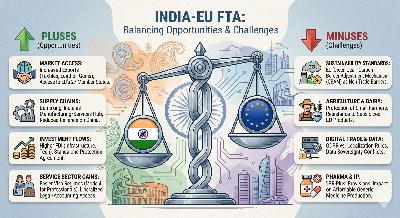
This is a free preview of a paid episode. To hear more, visit rajeevsrinivasan.substack.comI’m sorry to be so cynical so early, on the very day it was signed, but let me be honest: the much-ballyhooed (“mother of all trade deals”, quoth Ursula von der Leyen, boss of the EU) signing of the Free Trade Agreement between India and the European Union leaves me cold. Or maybe just underwhelmed. Because the words that come to mind are “desperation”, “buyer power”, and maybe “shotgun wedding”, or perhaps, as Hari, a friend, said, “rebound chicks”.Ok, so I am bad, but somehow, “revenge porn” also seems oddly appropriate. Are the Europeans now going to spill the beans about all their ahem… rendezvous with their erstwhile boyfriends?Bottom line, since I am a pessimist, I think this isn’t going to end well. If I were an optimist, perhaps I’d have said the inflated expectations will come to nought.The first clue is that India and the EU have been negotiating this trade deal for twenty, yes twenty, years. And now it’s a done deal in weeks. Did someone say, “shotgun wedding”?The second is that the EU has huge agricultural surpluses from coddling their farmers, referred to memorably by my favorite Whitehall simps, The Economist magazine, as the “butter mountain” and “wine lakes”. I really don’t think Euro-farmers are going to grin and bear it when India refuses their stuff, and worse, Indian agri-products start showing up there.The third is that it seems like it was only yesterday that the Europeans were, in their usual supercilious manner, scolding India for not following their edicts about cutting off all trade with, and in effect un-personing (or whatever the equivalent is for a country) Russia.The fourth is that their media, especially Deutsche Welle, has kept up a steady stream of invective against India, allegedly the epicenter of colossal Hindutva crimes against sundry cuddly minorities such as Kashmiri separatists, Khalistani splittists, Rohingya illegal aliens, und so weiter. (Of course the BBC, The Economist, The Guardian et al are in a different, exalted league altogether, but I guess after Brexit, I can’t blame the EU for their sins).I can sure I can think of several other reasons, which you, gentle reader, may or may not resonate with, but you get the drift.The good reasons, of course, are there:* Trump has basically abandoned the EU and hinted at winding down NATO. No more free lunch on defense. No more preferential treatment as good white countries.* The Chinese market has essentially slammed shut for Europeans. The perigee of this is the fact that Volkswagen is now planning to sell what in effect are white-labelled Chinese-designed and -built cars in China. To me that spells total surrender especially because Chinese EVs produced cheaply, at scale, are now eating them for breakfast everywhere. So now they need a new market. Why, India has 1.4 billion people! Bring on the BMWs! Because otherwise the crown jewels of German engineering, both the entire automotive industry and the famed mittelstand, are going to bite the dust. Hint to India’s 180 IQ mandarins: bone up on “buyer power”.* Europe needs a supply chain that is independent of both the US and China to the extent possible. India may well provide a good part of it. For instance, in computing, it needs to stop being so cruelly dependent on US Big Tech, as argued by a Lund University professor in Europe wants to end its dangerous reliance on US internet technology (https://theconversation.com/europe-wants-to-end-its-dangerous-reliance-on-us-internet-technology-274042). Amen, brother. Ditto India, and maybe a few EU GCCs in India will do the trick. Or maybe they could just phone Sridhar Vembu.* Europe is falling off a demographic cliff at warp speed. They simply will not have the manpower, especially as any growth there will be primarily from immigrants. India will not reach zero population growth for some time, and therefore skilled Indian migrants on short term work visas will be positiveAll of these are good for the EU, but what’s in it for India? As my friend Bapa asked, “So what is India getting? Are Europeans going to buy Indian shrimp?”
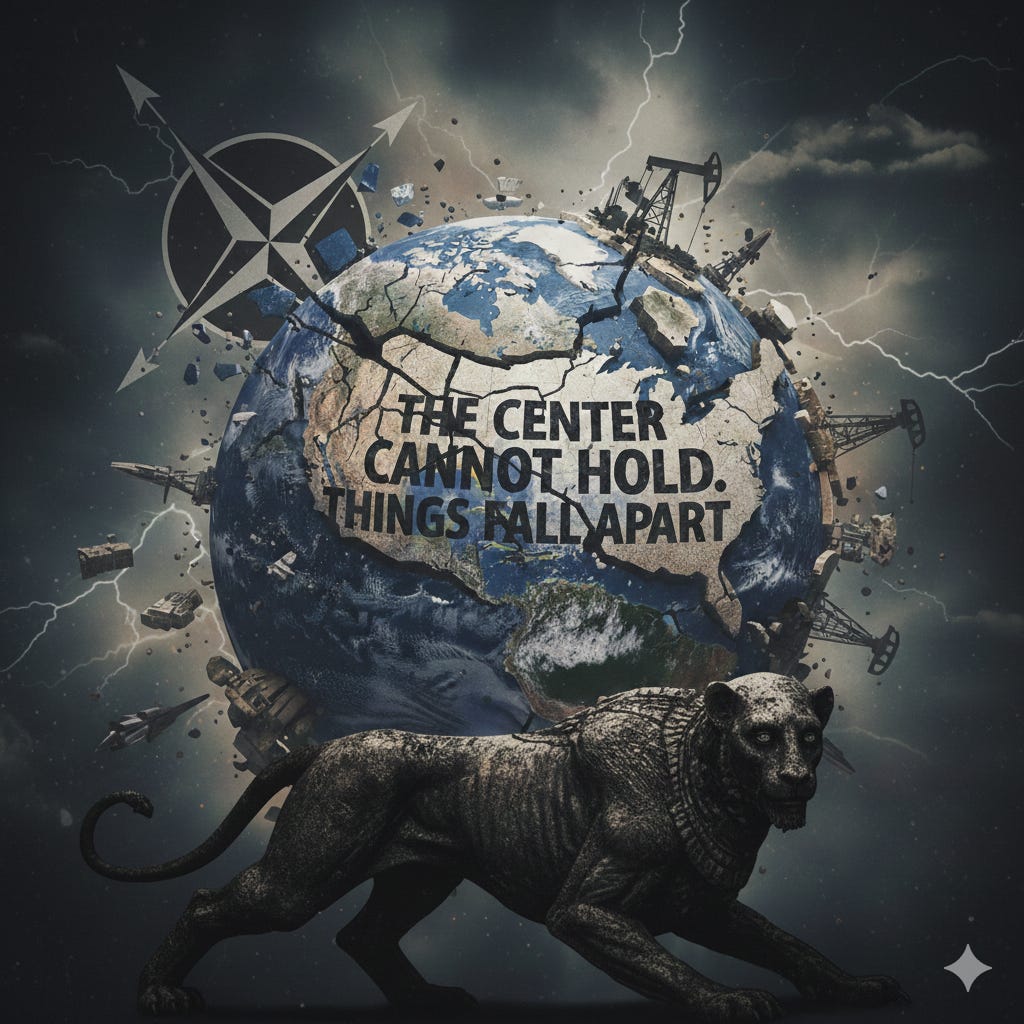
A version of this essay has been published by firstpost.com at https://www.firstpost.com/opinion/shadow-warrior-donald-trump-and-global-disorder-the-unravelling-of-the-old-world-order-has-begun-13970884.htmlThere is a general air of uncertainty in international relations right now, and there is the distinct feeling that the old order changeth. The upheaval is likely to bring difficult times to all of us. The long-predicted end of the “liberal, rules-based international order” seems to be upon us, with a definite fin-de-siecle feeling. The certainties that we have long held on to are no longer reliable.Foremost, of course, is the role of the United States, which bestrode the world like a colossus in the aftermath of the Second World War, and again after the end of the Cold War. Those of us born in the post-war years looked up to America, the “City on the Hill”, the beacon, celebrated in song and film, a cultural anchor in addition to a military and economic superpower.I remember the day my dad walked into the dining room with his newspaper and told us, “Marilyn Monroe is dead”. I was a small boy, and I had no idea who Marilyn Monroe was, but I remember that moment. I vaguely remember the Kennedy assassination. And every month, SPAN magazine brought images of the good life. My father did his PhD on John Steinbeck.Thus, for me and for those of my generation, it was only natural to look up to the US as an exemplar. In college, we used to refer to it, only half-jokingly, as ‘God’s own country’. (This was before Amitabh Kant applied this moniker to Kerala, and it stuck). I remember us reading Time and Newsweek in the IIT Madras hostel common room. We read them cover to cover.So it was but natural for us to write the GRE and apply to US universities; and many of us got in, with good scores and good grades. It was relatively easy in the late 1970s. And it was a revelation for us to go to a country that pretty much worked well; the standard of living was quite a bit higher than back at home, where you had to wait 6 years for a phone or a scooter.But fifty years later, things are not the same. The gap in the standard of living between India and the US had narrowed considerably, although the rule of law, clean air and public spaces, and the lack of petty corruption, plus the tendency to stick to the letter of agreements (ok, I grant that Trump may be an exception) are all still much more prevalent in the US.What has happened, though, is the relative decline of the US in almost every way. Take research. Or manufacturing. Or popular culture. Others are narrowing the gap steadily. Or take the streets of, say, San Francisco. The pristine, well kept streets I encountered when I first moved there are now in shambles, sometimes covered in human feces, with homeless people and needles all over the place.The US, and it hurts me to say this, as I am an unabashed Americophile (if that’s a word), over-extended itself through unnecessary wars and unwise crusades which the Deep State promoted for self-preservation, but which in fact turned out to be counterproductive.As I wrote recently in relation the Venezuela gamble, the US may well be following in the footsteps of other countries that once held the reserve currency, but fell into a trifecta of excessive debt, reduced core competence, complacency and overextension.The resulting retreat into “Fortress America” as outlined in the National Security Strategy, as well as the unabashed pursuit of American interests at the expense of allies and friends, is causing everything to fall apart, as in W B Yeats’ warning.The reaction of the US’s closest allies to various Trump diktats has been instructive. Europeans and the British applauded when Trump chose to peremptorily remove President Maduro from Venezuela and make a play for that nation’s massive oil reserves. But when he began in earnest to pursue Greenland, there were loud protests from some parts of NATO.That alliance appears to be crumbling as Trump, not unreasonably, suggests that Europeans need to pay for their own security, instead of expecting the US to finance it forever. Also, despite the appearance of a land-grab, Greenland has a trade and security rationale: as the Arctic Sea becomes more ice-free due to climate change, the fabled Northwest Passage and other trade routes open up, China is already ready for its own land-grab with its “Polar Silk Road”.Here’s a tweet from Ken Noriyasu of the Nikkei, highlighting future trade routes:But the threat to Denmark’s territorial integrity, in case Greenland opts to join the US, has rattled NATO members. Threats of escalating tariffs (10–25%) on Denmark and other NATO allies have sparked outrage. Joint Nordic/European statements reaffirm sovereignty; U.S. rhetoric treats it as a strategic necessity (Arctic resources, China/Russia competition). This treats allies as transactional subordinates, eroding NATO cohesion.The end of NATO would be a seismic shift, but I have long argued that Western Europe should bury its hatchet with Russia, because their real long-term foe is China, which has its eye on Siberia on the one hand, and Europe’s entire industrial might on the other.There is more: Ongoing wars (Ukraine, Middle East), tariff wars, alliance strains, and rising “spheres of influence” logic. Davos 2026 panels describe it as the “last-chance saloon” for the old order. UN Secretary-General Guterres warns leaders are “running roughshod over international law.” Think tanks (Brookings, Stimson) call it an interregnum: the liberal order is dying, no coherent replacement has emerged, and “monsters” fill the vacuum. Is “some rough beast” slouching towards Bethlehem to be born, as in the apocalyptic prophecy?What will rise from the ruins of the old world order? We can only wonder, as there are several possible answers:* Transactionalist multipolarity. Great powers (U.S., China, India, EU/Russia bloc) negotiate deals based on leverage, not universal rules. Might means right, backed by economic coercion or force.* Fragmented regional orders. Spheres where dominant powers set norms (U.S. in Americas/Arctic, China in Indo-Pacific, Russia near its borders, if there is a rapprochement with the EU). I have long predicted spheres of influence in the wake of what I see as a G2 condominium between the US and China.* No-rules world (worst case). Rising impunity, more unilateral interventions, eroded deterrence, potential for cascading crises. We are already beginning to see this with China’s unilateral land- and sea-grabs (e.g. the “nine-dash” line).2025 was an annus horribilis. 2026 is shaping up to be worse. None of the above scenarios is good for India, especially as it is beginning to get its manufacturing in order, at what appears to be exactly the wrong time, as tariff wars abound.By the looks of it, 2026 will be worse for all concerned. Centrifugal forces are going to tear up globalism, and a narrow nationalism may not bode well for anybody.The AI-generated podcast from notebookLM.google.com is at:1650 words, 19th Jan 2026 This is a public episode. If you'd like to discuss this with other subscribers or get access to bonus episodes, visit rajeevsrinivasan.substack.com/subscribe
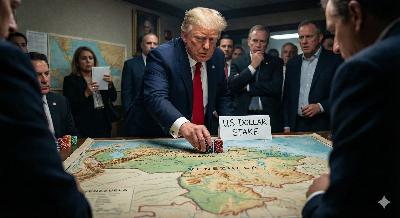
Part 1 of this essay was published by rediff.com at https://www.rediff.com/news/column/rajeev-srinivasan-trumps-huge-venezuela-gamble/20260114.htmPart 2 of this essay was published by rediff.com at https://www.rediff.com/news/column/rajeev-srinivasan-was-maduros-capture-a-warning-shot-to-china/20260124.htmIt is hard to judge whether the US regime-change operation in Venezuela is a stroke of genius or an act of pure recklessness. This is completely orthogonal to the questions of morality and legality involved in such, well, coups, to put it bluntly. The real issue at hand is twofold: why did they do it? And what is the long-term fallout from it?I consider several perspectives below: the moral/legal angle, the alleged oil bonanza, the alleged drug trafficking, geo-politics and geo-economics. In sum, I am inclined to believe that the Venezuela adventure may not be an indication of American strength, alas, but rather of American weakness. To someone like me who is deeply supportive of the US (especially in opposition to China, the G2 condominium notwithstanding), this is a disheartening conclusion.The morality and legality angleLet us summarily dispose of the entire morality-legality question. At the end of the day, international relations, despite flowery marketing language, is essentially Chanakyan matsya-nyaya, i.e. the big fish eat the little fish, the law of the jungle. Might is right, and that’s just the way realpolitik is, let us accept that and move on. The United Nations and the so-called ‘liberal rules-based international order’ are syntactic sugar hiding this bitter fact of life. There are a few implications for the little or medium-sized fish: deter the big fish. 1. Bulk up, build up your military and economic strength, including your ability to produce lots of military hardware, 2. Build your economic leverage, so that you are an indispensable trading partner nobody can afford to alienate, 3. Build a nuclear arsenal.This last is significant. Let us consider all the recent (and near-future) invasions by big fish. Iraq. Libya. Iran. Panama. Vietnam. Afghanistan. Ukraine. And soon, alas, Taiwan. Ok, I may have missed some here, but none of them have nukes. If you have working nuclear weapons, and the means to deliver them (such as nuclear-capable missiles, submarines lurking in the ocean depths with nuclear warheads), then it is risky for the invading big fish. No big fish likes body bags, and they certainly don’t like mushroom clouds over their cities.In addition, there was the stunning silence from the European Union and Britain, which have been moralizing to everybody about how wicked it was for Russia to invade Ukraine. No clutching pearls this time, eh, Eurocrats in Brussels? In fact, EU leaders were positively ecstatic about Trump’s intervention in Venezuela. It is indeed the end of the European century.Ditto with the United Nations, which, by the way, is pretty much on its last legs so far as I can tell: on 7th January President Trump exited 31 UN agencies and a grand total of 66 multilateral entities.This of course hurts the UN’s budget, not to mention its relevance.In January the US will formally exit the Paris Climate Agreement and the WHO, and it has already exited the UNHRC, UNESCO, and UNRWA. The newly announced exits include the UN Framework Convention on Climate Change, the Intergovernmental Panel on Climate Change, the UN Women’s Fund, the UN Population Fund, the International Solar Alliance, the International Renewable Energy Alliance, and so on.All this fits in with the ‘Fortress America’ part of the National Security Strategy, which I wrote about at some length recently. In my opinion, it is not in the US’ long-term interests. The post-WW II “liberal, rules-based international order” with America as its center was good for the US, and its precipitous end will erode pre-eminence, Manifest Destiny notwithstanding. The problem is that the dollar, sanctions, SWIFT and US Treasury debt are losing their clout. Pax Americana too.Summary: Nobody is bothered about morality or legality.The oil colony: is it for real?It could be argued that the unabashed Trump statements about Venezuela’s oil are exactly like the British and other European colonization of many lands in the 19th century. It can be summarized as: “we have the guns, we’re going to take your butter”. That may well be true, although it is not discussed in genteel circles, where they pretend the Euros were on an, um… civilizing mission.Trump, to his credit, makes no bones about it: he says in so many words that he will henceforth consider Venezuela’s oil to be his, and that it will be used for the benefit of both Venezuelans and Americans. To be honest, there is some rationale behind this: the infamous Resource Curse, where resource-rich countries end up with the riches being grabbed by both foreigners and kleptocratic local elites, and miserable citizens get virtually nothing.I am not quite sure how Arab OPEC countries managed to keep their money, and spend it on their own nationals: possibly because their populations were low, and they were used to authoritarian rulers anyway. The same with Norway. But the Resource Curse is a fairly universal phenomenon. I bet the global money managers are laughing all the way to the bank.When I first went to the US in the late 1970s, I had a graduate student friend, a woman from Venezuela. She was there on a generous scholarship funded by oil revenues, just like the Iranians who had studied with me in India. At least some of the money was going to actual citizens, and wasn’t disappearing into tax havens. I guess socialism did Venezuela in over decades, as we have seen in West Bengal and Kerala.The country’s finances are an absolute mess, through years of economic collapse, US sanctions, and a sovereign default in 2017. There are enormous debts owed by Venezuela to foreign investors, add up to more than $150 billion, or twice GDP; this includes interest, penalties for default, and arbitration awards for the expropriation (nationalization) of oil infrastructure. Venezuelan assets abroad (e.g. the CITGO oil retailer) are at risk.So far as I can tell, the country owes the following:* Bond default in 2017 (sovereign and state oil company PDVSA bonds): face value $60 billion, now up to $100 billion with accrued interest and penalties. Owed mostly to international asset managers such as Fidelity, Greylock, T Rowe Price (often US based)* Oil-backed loans of about $15 billion, to be paid off in oil shipments (China and Russia)* Arbitration awards often based on nationalization/expropriation of (especially oil-related) assets: around $30 billion (US and Canada based creditors such as ConocoPhillips and Crystallex owed around $8-10 billion)This means there’s a lot of issues that needs to be settled before Venezuela becomes a normal and substantial player in the world oil market. Besides, despite the exertions of Chevron, an American oil major that still has operations in Venezuela, I don’t think it will be easy to ramp up production there, which has collapsed due to a variety of factors, including the non-availability of naphtha to make the very viscous, heavy crude from the Orinoco Belt more easily transportable.It is said, however, that a number of US refineries can indeed handle this heavy crude (incidentally Indian refineries such as Reliance’s Jamnagar can as well) and so, over time, the oil will begin to flow, although it is going to cost quite a bit to get there. Their production was of the order of 3.5 million barrels per day in the 2010s, but it has fallen to about 1.1 million barrels now, as the result of infrastructure decay, mismanagement, corruption, and US sanctions.I have read estimates that it might take as much as $180 billion in investments over the next 10-15 years to bring Venezuela back online at scale. This means that any dreams of the US tapping Venezuela’s vast oil reserves any time soon are unrealistic. Besides, that could lead to an oil glut, depressing global prices even below the current $50-60 levels, which has the side effect of making America’s own shale-based oil production unviable.There is one good outcome, though: for neighboring Guyana. Venezuela had been threatening to go to war over Guyana’s oil fields. Given that Guyana has a large Indian origin population, I am glad that at least some diaspora people are becoming oil rich. But then again, Trump may feel free to claim their oil too, who knows?All this suggests that, despite all the talk of seizing the largest oil reserves in the world, this is not the real reason behind the regime change.Summary: The oil issue is overblown, and nothing dramatic will happen short-term.What about the drug-running?There was a lot of noise about how Venezuelan gangs pushing drugs in the US was a major threat, and how that needs to be taken care of. However, on closer scrutiny, Venezuela is not a major producer of cocaine (production is almost entirely in Colombia, with smaller amounts from Peru and Bolivia). It serves as a minor transit country for some cocaine, mostly headed to Europe or the Caribbean rather than directly to the streets of America.Data from the UNODC (UN Office on Drugs and Crime) and the US DEA (Drug Enforcement Agency) show no significant direct sea routes from Venezuela to the US; the only known direct route is limited air trafficking.DEA reports (including the 2025 National Drug Threat Assessment) and UNODC (World Drug Report 2025) consistently show Colombia as the overwhelming source of cocaine entering the US (around 84%+ of samples). Venezuela ranks low in direct contributions, with most US-bound cocaine transiting through Mexico/Central America via Pacific routes.Fentanyl trafficking into the United States follows a distinct supply chain, very different from plant-based drugs like cocaine. The overwhelming consensus from US authorities is that Mexico is the primary source of finished illicit fentanyl reaching the
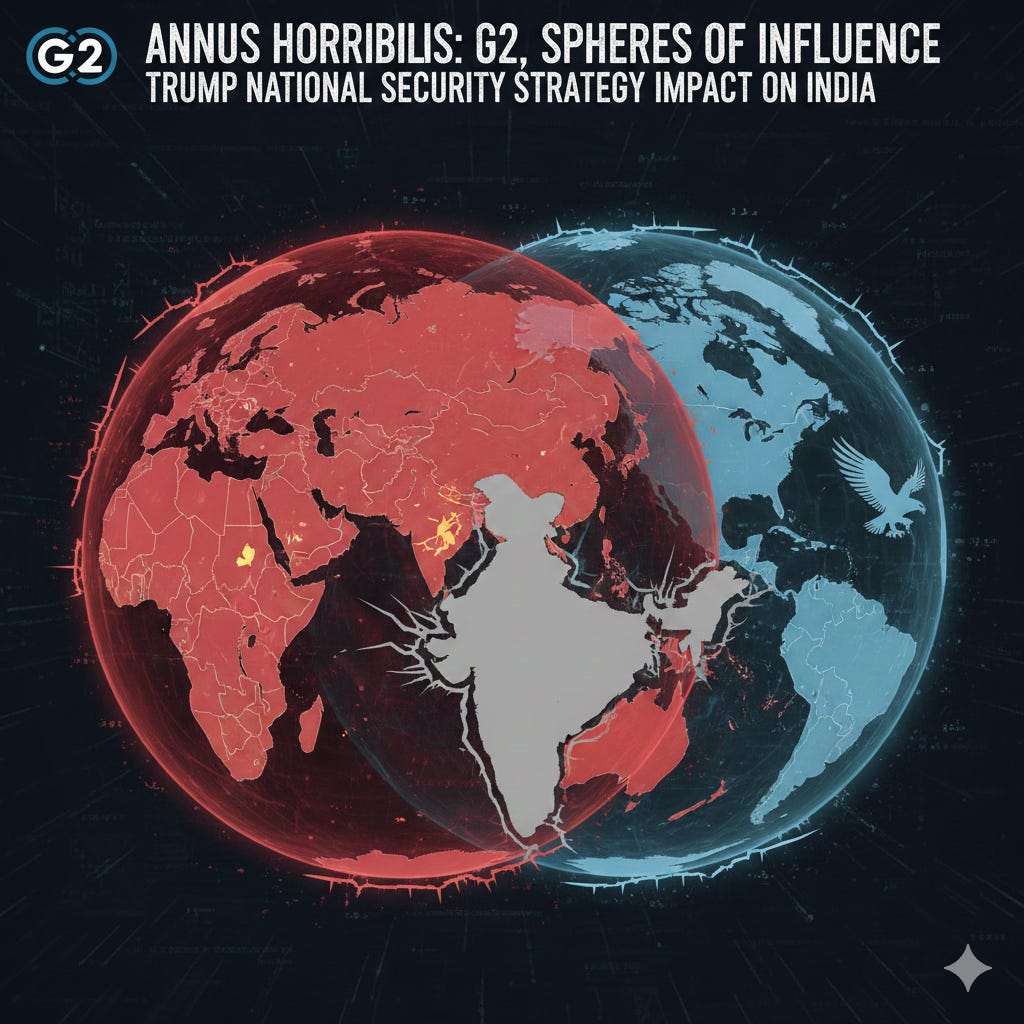
A version of this essay has been published by rediff.com at https://www.rediff.com/news/column/is-india-standing-alone-in-2025/20251222.htm2025 has been a disastrous year for the US, surely in foreign affairs and economics. The trade war, far from strengthening the economy, has shown the limits of American power: the capitulation to Chinese supplier power on rare earths, and a strategic retreat in the face of Chinese buyer power on soybeans, for example.The dramatic rise of Chinese generativeAI, which will undercut US Big Tech, is another problem. The US cannot afford to be the globocop any more, and the new National Security Strategy seeks a US withdrawal into ‘Fortress America’. It may mark the end of the vaunted ‘American exceptionalism’ as well as the ‘liberal rules-based international order’.In an earlier time, this would have led to the famous Thucydides Trap, but in effect the US has gone into an ‘anti-Thucydides Trap’ because it unthinkingly paved the way for China’s rise, seduced by the short-term benefit of low-cost Chinese goods while ignoring the long-term strategic disaster. In the 20th century, Britain collapsed suddenly, but it is merely a tiny island off Eurasia. I never expected continent-sized America to follow suit in the 21st century.Meanwhile, in a fine example of “manufacturing consent”, the discourse in the US is not focusing on the global problems facing the country, but on MAGA bullying of H1-B Indians and on the Epstein files, which, on the face of it, is a silly exercise in moralization. I believe it was Hermann Hesse who said something to the effect that Americans are not interested in morals, being content with moralization.But the entire kowtowing to China has serious implications for India. One of the pillars of Indian foreign policy for decades has been the idea that it is a strategic counterweight to China in the US’s calculations. But if the US has really ceded Asia to China (I recall President Obama saying as long ago as 2009 that the US and China would “work together to promote peace, stability, and development in South Asia”) then the famous ‘pivot to Asia’ is null and void.A couple of years ago, I wrote that the most obvious thing for the US’s Deep State to do would be to form a G2 condominium with China, divide up the world amongst themselves, and set up respective spheres of influence. This was predicated on America’s relative decline, and China’s economic and military rise to be, for all intents and purposes, a peer. I thought this would take a decade or more, but, lo and behold, the US is caving in furiously to China right now.In addition, I wrote about the surprisingly large and malign influence exerted by Britain, whereby it plays a ‘master-blaster’ role, leading the US by the nose, usually to America’s detriment. Britain’s ‘imperial fortress’ Pakistan seems to be involved in every terror incident, yet President Trump’s new-found camaraderie with them (“here, some more F-16 goodies for you”) is yet another indictment of their twisted priorities.And Britain seems to be “winning”, too: on the one hand, they have finally defeated Germany, which they couldn’t do via two World Wars: the latter’s economy, its electricity grid, and its vaunted mittelstand and its automobile industry are in shambles. On the other hand, Britain is the one major European power that has not been defeated by Russia, so they think they can, conversely, defeat them. France (Napoleon) and Germany (Hitler) learnt otherwise.The pointless Ukraine War is bankrupting Europe; I wrote about how this is hastening the end of the European century and how ‘Europe’ is reverting to what it was through most of history: unimportant ‘Northwest Asia’. This could well also be Britain’s revenge against Europe, which it exited in a huff via Brexit: British elites have looked down upon Europeans all along.I mention all these not to show that I was somehow prescient, but that things we have been observing for some time are coming to a head: the US National Security Strategy is the capstone of the New World Order. And it seems to codify these trends: hegemony to China with Asia as its sphere of influence, the abandonment of Europe to its own devices, a focus on the Americas in a new ‘Donroe Doctrine’ (so to speak).In the background are continuing terror attacks such as the one in Sydney, murderous attacks on Alawites in Syria, the car bomb in Delhi, and the lynching and burning alive of a minority Hindu youth, Dipu Chandra Das, in Bangladesh by a frenzied mob. The world is not a safe place.There was also a defining moment: the US seizure of a Venezuelan oil tanker. Far from being a show of strength, this may well be an admission of weakness: Venezuela is no competitor, and this is like the US invasion of defenseless Panama some years ago. It is, however, a declaration that the Americas belong to the US sphere of influence (the ‘Donroe’ Doctrine).Sadly, China may demur: it views the Americas are adjacent to them (just across the Pacific) and have made inroads into many countries, including Panama, and ironically are funding a proposed alternative to the Panama Canal through Nicaragua, as well as a major Brazil-Peru railroad project (all the better to ship in raw materials from both the Atlantic and Pacific coasts and to ship out “rubber dogshit from HongKong” back to them). Their $3 billion Chancay deepwater port in Peru has already been inaugurated.China is now a $500 billion trading partner for South America, overtaking the US, yes, overtaking the US. To top it all, the ports on both sides of the Panama Canal, i.e Cristobal (Atlantic side) and Balboa (Pacific side) are run by Hong Kong companies, which of course means the CCP does. In fact, it is blocking US firm Blackrock’s acquisition of these ports.China therefore has serious assets in the Americas, and large commercial interests. The US can pretend it is supreme in the Americas, but the reality may be a little different.Meanwhile, the US has more or less abandoned its Quad partners in Asia and acknowledged Chinese hegemony there: in other words, that half of the condominium is done. When the new Japanese Prime Minister Sanae Takaichi said something that was obvious and perfectly within her rights to worry about Japan’s security, the Chinese came down on her like a ton of bricks, wolf-warrior style. The normally voluble Trump said nothing at all in support of Japan.Regarding India, there has been a persistent tilt towards Pakistan during and after Operation Sindoor; and the imposition of harsh tariffs. The increasingly volatile situation in Bangladesh which is the result of a likely US-backed ‘regime-change’ operation is a significant security threat to India because of the collusion of jihadi, Pakistani and Chinese-proxy elements there and the very real concern about the cutoff of India’s Northeast from the mainland, apart from the ongoing murders and ethnic cleansing of Hindus and Buddhists there.Now comes the New York Times, which I generally despise as a propaganda arm of the Deep State. But they show some self-awareness in their editorial “America cannot win alone”. No man is an island, as John Donne wrote some years ago. And America is not a singular colossus any more either, and it needs alliances. It hurts me (as an Americophile) how rapidly the US is declining in relative terms, and perhaps even absolute terms.The best indicator of this decline is in the crown jewels of the US: its technology sector. On the one hand, the entire US stock market has been propped up by the Magnificent Seven and the alleged promise of the generativeAI boom. On the other hand, China’s patented “over-invest, scale up, get to be lowest-cost producer, drive competitors out of business” is repeating in industry after industry: the latest is automobiles, where the famous German marques are history.Trump’s surrender on Nvidia’s H200 chips is an indication that China is playing the trade-war game much better than the U.S. China has amassed a $1 trillion trade surplus in the first 11 months of 2025, an unprecedented feat that shows its trade power. Not only is this because of supply-chain dominance, but an analyst suggests it’s also because China is now on the verge of delivering a knockout blow to US/Western tech.There are news reports that China has almost managed to replicate EUV (Extreme Ultra Violet) lithography from ASML, one of the key areas in chipmaking that was beyond China’s reach. They used former ASML employees of Chinese descent, as well as less advanced technologies from ASML itself, Canon and Nikon.This is the context in which one has to critique Trump’s 2025 US National Security Strategy. In summary, it shows a narrowing of America’s expansive self-image, the beginnings of a ‘Fortress America’ mindset and an ‘America First’ doctrine. The ‘promotion of democracy’ is downplayed (aka ‘regime change’, as we have seen in Bangladesh. Thank goodness!) and fighting other people’s wars (think Ukraine) has been de-emphasized.It fits in very well with the G2 condominium idea, as it focuses on national interests and explicitly rejects globalism, elevates economic matters while suggesting the use of military might as an element of dealmaking, and asks ‘allies’ to shoulder more responsibility.Europe is downgraded, China is the prime focus with an emphasis on deterrence (e.g., Taiwan), supply-chain resilience and balanced trade, the Indo-Pacific gets short shrift, and the emphasis is on the Americas as, so to speak, the US’s private playpen, harking back to the 19th century.India gets almost no attention: it is mentioned four times as compared to 21 times for China, with the tone shifting from ‘strategic partner’ or ‘leading global power’ to a more transactional expectation of burden-sharing and reciprocity. The Quad is downplayed too. India will need to maintain multi-alignment (e.g., with Russia via RELOS agreements), diversify dependencies, and accelerate self-reliance. India is on
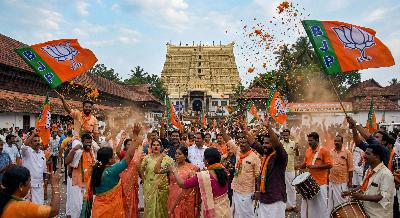
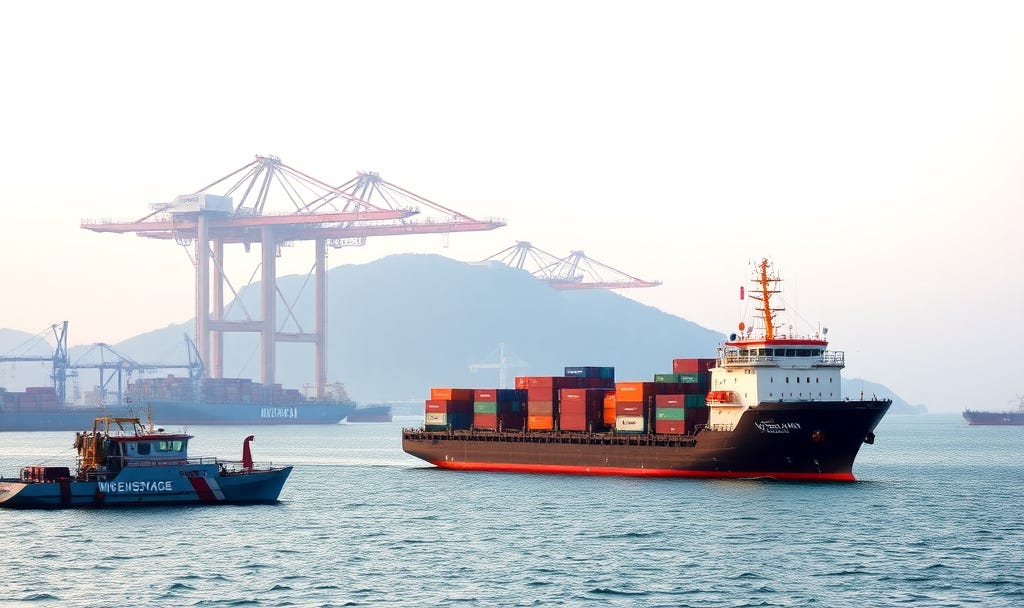
A version of this essay was published by news18.com at https://www.news18.com/opinion/opinion-what-the-bjp-win-in-thiruvananthapuram-may-mean-or-may-not-9774658.htmlAs a native son, I believe the BJP’s 50/101 seats in the Trivandrum Corporation in the recently concluded local body elections is an interesting outcome. But it must not be taken in isolation, and one must accept that this is neither a breakthrough for the BJP in the deep south, nor a mere footnote in the CPI(M)-Congress duopoly that has been the hallmark of Kerala politics. There are a lot of local factors, but yes, perhaps there is an underlying, nascent realignment.There is anti-incumbency: there used to be, like clockwork, one term for the UDF, one term for the LDF. But now, the CPI-M has been ruling for ten years in a row, and the voters may be fed up with them. In Trivandrum, for instance, the outgoing mayor, Arya Rajendran, who is in her 20s, has a well-deserved reputation for arrogance. Tellingly, she did not campaign in 2025.But there is more.There are at least four extraordinary factors at play here: One is the vanity that Kerala politics is somehow superior to politics elsewhere in (southern) India, because, you know, it is the 100% literate state. This is far from the truth. Mere literacy, that is, knowing the syntax of written language, does not guarantee you understand the semantics, that is, the ability to think critically rather than be gaslighted. The average Kerala voter is as easily manipulated as any other.Second, regional tensions. Kerala consists of three distinct regions: northern Malabar, which was under British rule, which meant it was plundered and underdeveloped. It also is Muslim-dominated. Central Kochi, which was a moderately dynamic dynasty, and is Christian-dominated. Southern Travancore, which was under a strong dynasty (but came under the sway of the British), and is Hindu majority.Third, the erstwhile consensus around ‘secularism’ is fraying: it is now increasingly seen as merely a shibboleth meant to hypnotize the Hindu community into caste-based internecine conflict and keep it a permanent underclass, with fewer rights than those of other religions. Hindus are still fighting 19th century battles in the 21st century. The shocking neglect, occasional desecration of, and outright large-scale theft from, major temples such as Sabarimala may now be turning into a bit of an issue for the lay Hindu.Fourth, after half a century of left-wing politics, it is becoming increasingly clear to the average Keralite that it is being left behind in development and prosperity. At independence, Travancore in particular was far ahead of the rest of India in key metrics like infant mortality, female literacy, and infrastructure. But anti-business socialism has led to de-industrialization, forced migration of Keralites in search of jobs, and high inflation, while other states are passing Kerala by.On top of all this, there is the rampant politicization of everything (for example, government jobs do not go to those who have high ranks in the State Public Service Commission selection exams, but to party cadres). There is a truly bizarre situation where two parties, both in the INDI Alliance all over the country (CPI-M and Congress), pretend to be rivals in Kerala, and do charades and shadow-boxing, although they do tactical voting to prevent the BJP from winning.It startles me to hear that there is a Left (CPI-M) and a Right (Congress) in Kerala, according to pundits. In reality, they are an Extreme-Left party and a Far-Left party, respectively. Indeed, even the BJP, which is spoken of as Far-Right is a Center-Left party, so severely distorted is the discourse – the median is Far-Left.To an impartial observer, the only way the Congress in Kerala can be termed a Right-wing party is that it appeases its vote-bank, the Christians, although the FC Nairs also traditionally vote for them. The Communists, whose rank and file are mostly made up of the OBC Ezhavas, increasingly are dominated by the needs of their Malabar Muslim vote-bank. So in a twisted sort of way, both these Left parties pander to the Conservative sentiments of these religious groups.This has real-life consequences, which Travancore voters are seeing increasingly clearly. The last major investment in Trivandrum was the ISRO’s Vikram Sarabhai Space Center, which was required to be on the magnetic equator. After that, the National Institute of Technology went to Kozhikode (in Malabar). The Indian Institute of Management went to Kozhikode (in Malabar). The Indian Institute of Technology went to Palakkad (in Malabar). The AIIMS is also likely to go to Malabar or Kochi.A metro system was given to Kochi, even though Trivandrum has an equal or better claim in terms of population size and other metrics. Successive UDF and LDF governments have sat on the proposal for Trivandrum’s metro (incidentally Kozhikode is also in the same boat). Trivandrum airport saw zero development for 40 years from 1960.Staggeringly, the Trivandrum port (Vizhinjam) was also delayed for 40 years, even though the deepwater container transhipment port there is now on track to handle a lot of India’s container cargo, which now goes to Colombo. Instead, 4400 crores were spent on a container port at Kochi, which has only 8 meters draft and cannot compete with Colombo.Trivandrum/Vizhinjam has 24 meters in depth, which means literally the largest container ship in the world, MSC Irina, with 24,000 containers on board, can and in fact has called at this port.The LDF government twisted Adani Ports’ arm and moved their logistics park for Vizhinjam, which Adani runs on contract, 200 km away to Kochi! In addition, the road and rail approaches to the port, which are necessary for ‘gateway’ or upcountry containers from/to say Bangalore or Hyderabad, have been delayed for a long time over trivial land acquisition issues.These lapses are glaring, and add up to step-motherly treatment for Trivandrum. There must be a lot of resentment among the voters here about this, because their real estate values would go up quite a lot if Vizhinjam’s business improves, and there will be jobs related to logistics, bunkering, cruise lines, and so on. Under the Sagarmala initiative, this is something that Trivandrum voters hope the Union Government will push forward, along with a proposed Tri-Services Maritime Command: thus both military and civil infrastructure may bring benefits.Finally, the excesses against Hindu temples, which are ruled by the Devaswom Board, packed with party cadres who may well be hostile atheists, are getting exposed broadly. There is a tradition prohibiting the entry of women between 10 and 60 years of age (ie. of childbearing age) into the shrine, which the women devotees in Kerala are broadly okay with, and don’t feel particularly discriminated against. The Kerala government made a huge fuss over it, and attempted to smuggle in both non-believing women and non-Hindu women into the temple.This has troubled some of the CPI-M’s traditional voters, for example the hitherto blase Ezhavas. As the attacks on Hindus continue, there is a bit of a counter-consolidation as well.There is no end: there is the huge current scandal of the theft of gold from the temple doors and dwarapalaka statues in Sabarimala (along with similar desecration in Guruvayur). There is an ongoing investigation, which ought to, if pursued properly, implicate highly connected political players. But recently, there have been instances of prosecutorial misconduct that mean likely criminals get away with, er, murder.Sowmya’s alleged murderer Charlie Thomas aka Govindachamy was let off death row, because the prosecutor did not make a good enough case. An actor, Dileep, who allegedly took out a contract for a thug to rape an actress in a moving car, was let off. You guessed it, the prosecution did not make a good enough case.Incidentally, Christian churches with vast landholdings (a good bit of which was 99-year leases given during British days which has now, magically, turned into freehold), or Muslim mosques and other Waqf claimants rarely face the wrath of the State. Yes, there is a case wending its way through the courts about the peninsula of Munambam which is home to 600 families, mostly Christian fisherman, but is claimed in its entirety as a Waqf property.A net reflection of all this is that urban Hindus have begun to rethink their political views. There is a strong urban-rural divide as seen in the just-conducted local body polls. The urban, so to speak, constituencies have seen the vice-like grip of the LDF diminish a bit, but they remain strong in the rural areas. This is borne out by conversations with the rural poor, who talk about kshema pensions, NREGA, and so on as benefits they get from the State government.What this suggests is that anti-incumbency is playing its part; but the likely outcome is a return to the Tweedledum-Tweedledee “throw the rascals out every five years” syndrome of years past. The BJP is unlikely to make any quick inroads into this; they may not get many Assembly seats in 2026, and they are unlikely to get more than a couple of Lok Sabha seats in 2029.Yet, as for obvious reasons there is a Right-ward lurch in Europe, with the rise of AfD in Germany, Marine Le Pen’s National Rally in France, and Nigel Farrage’s Reform UK, and these parties are no longer easily put behind a cordon sanitaire, the BJP in Kerala is not any longer completely unelectable. The voters are beginning to see that it is not completely er… untouchable.It will be a long, painful journey, but maybe in a decade or two, the BJP can become a realistic opposition party in Kerala. To do this in the extreme South, in the very bastion of the Communists, as well as in a State with very large non-Hindu populations, would be quite an achievement for them. We shall have to wait and see if they have the stamina and the staying power for this grueling odyssey.Mal
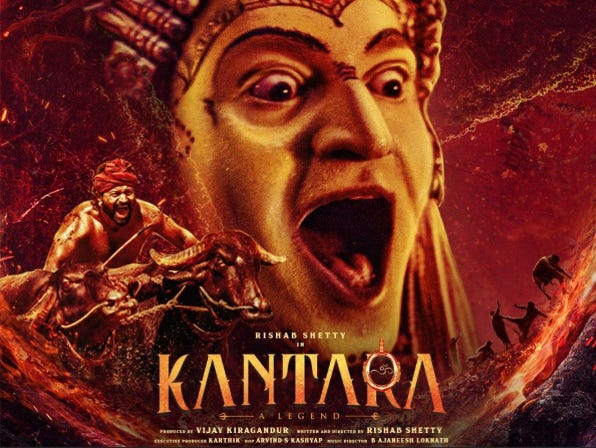
Let me admit up front that I like Rishab Shetty. A lot. I’d probably go see anything he makes, and I wish him well, because he is an actor with terrific presence. To be honest, I was blown away by his performance in Kantara, both as protagonist and director/writer. I had no idea about the bhoota-kola of Tulunadu, although I have seen the similar theyyam of nearby Malabar, and was suitably impressed.Therefore I was disappointed and underwhelmed by the prequel Kantara Chapter 1, for a variety of reasons. I understand this is not the universal reaction to the prequel: in particular, young people I spoke with liked the esthetics, the special effects, the big budget production, and the expansive canvas of the spice trade, a large kingdom, and good cast including veteran Jayaram as the weary king, and Rukmini Vasanth as a suitably gorgeous but sinister princess.But to me it came across as an untidy mishmash of various genres, with the principal purpose of creating a franchise: surely we can expect Chapter 2, Chapter 3 and so on. I don’t begrudge Rishab Shetty and his producer their success, especially as the original Kantara was a sleeper success on a tiny budget.Warning: spoilers ahead.My problems were manifold. The first was that the original Kantara hit me with the force of a hurricane, when the coming-of-age tale of the wild-boar-hunting-and-carousing Shiva takes a sudden and unexpected turn and he becomes, reluctantly, the bhoota-kola oracle, taking on the role of his father who disappeared, and his cousin who was murdered.It was a revelation: a moment when a man turns into the Divine, in a wholly believable and entirely autochthonous, Dharmic tradition, a celebration of the presence of benign powers all around, a manifestation of a pantheistic world-view. It was one of the few recent films that powerfully put across a wholly Hindu perspective, which unfortunately is unusual in India.As a child, I remember devotional and patriotic films in Malayalam, which engendered a certain affection for the traditions of one’s forefathers. And often the story-lines, from well-known literary works, were rooted in the local milieu. Over time, this has been dissipated, and replaced by unremarkable films that are technically quite good, but for lack of a better word, lack ‘soul’.In general, this has been true of the dominant Hindi/Urdu language films as well: the narrative is some kind of a global, ‘liberal’, westernized, ‘modernized’ and deracinated tale, where in particular Hindus get short shrift. For example, a recent, highly-rated Malayalam film mined Kottarathil Sankunny’s Aithihya-mala, but turned the protagonists into people of other religions. There was another named 19th Century in which the recently-invented (in the 2010s) fiction of a ‘breast-tax’ on lower-caste women was turned into ‘fact’.This sort of digestion of, and worse, denigration of, native tradition has been true of Hindi/Urdu films for a long time as has been amply and devastatingly recorded by the efforts of ‘Gems of Bollywood’ on twitter. Therefore it is refreshing when a few films offer a Hindu point of view, eg. Kantara, Bahubali, or the shatteringly powerful Baramulla. This is one reason I am loath to criticize Rishab Shetty too much, but I do have my own complaints.One is that the Kantara Chapter 1 seems like a mish-mash of various ideas, borrowed from various sources. The origin myth of the hero Berme, where he appears as an abandoned child on a bed of leaves (and the presence of the computer-generated white tiger) may be a nod to the Sabarimala legend: Lord Ayyappa is a foundling, and he is sent on an errand to fetch tiger’s milk by the evil queen who hopes that he will die in that quest.Then there is the battle of the good vs bad, which reminded me of the battle scenes from Bahubali, and indeed the dark-skinned barbarians from that film got a reprise here with the black-cowled evil sorcerer Kadapa tribe. And I wondered in passing if the very name ‘Kadapa’ was a reference to the Telugu stronghold of the proselytizing Christian Reddys.Then there is the untidy story of the port city that the Kantara folks want access to, so they can sell spices to white people with no middleman. They also dragged in a superfluous white trader. Yes, the West Coast has been trading with the Middle East and points west for millennia via the Spice Route, but that seems irrelevant to the deep-forest-dwelling Kantara villagers.In addition, there were cliched memes about slavery (of tribals) and exploitation by the rich and powerful. These came across as nods to the prevailing dogma of woke victim narratives. The remarkable thing is that slavery was virtually unknown among Hindus: the first textual and/or epigraphic examples of slavery in India were by a Christian church in Kerala (the Tarisapalli copperplate, 849CE) and during the Muslim invasions.The characters were also hit and miss. There were the picaresque companions from the original film, including a vidushaka type who was silly in the original, but annoying here; so was the prince’s kinkara. Neither of them added much to the film, and could easily have been written out. The prince was so typecast from the moment you laid eyes on him – clearly a dissolute, useless fellow – that you knew he was going to be dispatched summarily.I did like the princess. She was apparently born with paralysis in her hands and legs, and she was handed over to the sorcerer Kadapas, who cured her, but also (it is implied) turned her into a wily seductress, whose efforts to distract the hero (Berme) from his quest were, fortunately, futile. The old king was rather good, too. Rishab Shetty impresses as always with his physical presence, as well as his signature primal roar.I missed the glowing varaha and the superb Varaha-roopam song which was so electric in the original Kantara. (I hear there were some copyright claims from a band in Kerala, but it baffles me that an old traditional song or tune could be copyrighted by some upstart.) There was a little piglet in one scene, but that was not enough. The VFX of the Brahma-rakshas was unsatisfying, and should have been left to the viewer’s imagination.All in all, the prequel was a disappointment after the original Kantara, which was refreshingly unpretentious: it did not preach, nor did it explain – it just was, and it forced you to accept the reality of the demigods Panjurli and Guliga. In effect, you went into an alternate reality, along with the bhoota-kola dancer. There was no such staggering insight in the prequel Kantara Chapter 1. If you were expecting a spiritual high, as I was, you’d be disappointed.If on the other hand, you were looking for light entertainment on a big canvas, you’d be just fine.Thus my dilemma about the prequel: yes, it does tell a Hindu tale, and I once again wish Rishabh Shetty the best, but I wish it had left me feeling spiritually moved as the original did.1200 words, 16 Nov 2025The AI-based Malayalam podcast on this by notebookLM from Google. This is a public episode. If you'd like to discuss this with other subscribers or get access to bonus episodes, visit rajeevsrinivasan.substack.com/subscribe
A version of this essay was published by the Deccan Herald at https://www.deccanherald.com/opinion/adani-s-under-fire-we-ve-seen-this-before-3783432The repeated, withering attacks on the Adani group are getting to be tiresome, partly because they usually have no merit per se; and partly because the Western habit of weaponizing the narrative is now so evident. It is basically propaganda, with the pliant media manufacturing consent to support foreign policy.In a recent column in the Financial Times, Janan Ganesh wrote: “Politics, not tech, makes the world go around”. He may have a point, but at the moment, it is the opposite: the breakneck generativeAI race, and China’s near-monopoly in rare earths, are fueling both trade wars and capitulation: for example, Trump said before meeting Xi that “the G2 will be convening shortly”. TACO, anyone?I said during Biden’s days in “A US-China condominium dividing up the world between themselves”, that for the Deep State, a G2 would be a convenient (short-term) thing to do. Trump apparently has accepted that a) Chinese leverage is insurmountable, b) a division into spheres of influence would work best. Sadly, it would be disastrous for the US (and the Quad) in the medium term to make China Asia’s hegemon.But it is happening. As BNP Paribas puts it in a research note quoted by the Financial Times, “[Washington]... is now dealing with a peer rival capable of imposing material economic harm on it — a relatively new position for the US and a development which, at least to us, confirms China’s ascendancy to global economic superpower status.”It would be entirely rational for a G2 to prevent a third great power from rising, and India is the only candidate: Brazil, Russia, South Africa, the EU are handicapped in one way or the other, e.g. geography, resources, demographics, politics. Therefore the G2 are imposing a Thucydides Trap on India: wage economic (if not kinetic) war, and balkanize it.Everybody has learned lessons from the recent past (“Confessions of an economic hit-man”, anyone?): how Japan was ruined via the Plaza Accord, how Britain lost its pre-eminence by debasing its currency, and how the US allowed itself to be systematically de-industrialized by China over the last 30 years. They are not going to let India grow, certainly not easily.Thus Adani is a proxy for India. Mark Mobius, a legendary investor, said, “Investing in Adani is like investing in India”. That is not an exaggeration, because Adani has demonstrated the capability to deliver in more than one domain, especially in ports and airports (Disclaimer: I have a small position in Adani Ports). They have operations in Colombo, Haifa (Israel) and Abbot Point (Australia), which makes them a potentially major player in global shipping, not to mention their container ports at Mundhra and Vizhinjam (Trivandrum).There have been several waves of attacks on the Adani group, the first in June 2021 alleging improprieties in investments by Mauritius-based funds; the second in January 2023 with the ‘bombshell’ Hindenburg (a short-seller) report alleging stock manipulation and accounting fraud; the third in November 2024, a US Dept of Justice allegation about bribery; the fourth in October 2025 by the Washington Post alleging the Indian government induced LIC to invest $3.9 billion in Adani firms.When the Hindenburg report was publicized as the “largest con in corporate history” by pliant media like Reuters, FT and WSJ, I wrote that “The Adani Group may not be derailed by Hindenburg”. I also did a video conversation with Professor Narayanan Komerath on the topic.In fact, in a “dog it was that died” outcome, it was Hindenburg that closed shop; Adani has recovered even after a second Hindenburg report accusing the SEBI chief as well.Adani has been successful in their ports and energy businesses; they are doing well in airports; their efforts in green energy and in data centers (the new Google AI data center in Vishakhapatnam) may yet prove to be winners. Thus Adani has shown it can compete well in difficult infrastructure sectors. It is true that these need to align with government policies.Which brings whispers of ‘crony capitalism’, which is rich coming from the US, where ‘robber barons’ like John D Rockefeller, Andrew Carnegie, J P Morgan and Cornelius Vanderbilt created enormous fortunes primarily through cronyism. Have you heard the dictum “What’s good for General Motors is good for America”? Boeing, the Koch Brothers, Goldman Sachs and Big Tech are current beneficiaries of State munificence.India has had its share of crony capitalists who provided citizens with shoddy goods at high prices. I don’t dare name them, but you know who they are. Every country supports its national champions: Japan’s zaibatsu, Korea’s chaebol, China’s State Owned Companies.And recently J P Morgan Chase announced it is investing $1.5 trillion in US industries such as critical minerals, pharma, semiconductors, energy, drones, cybersecurity, AI and so on. Surely this is after consultations with and a go-ahead from the US Government. Similarly, it is neither sinful nor unusual for the Indian State to support dominant, effective players. More power to Adani!800 words, 31 October 2025 This is a public episode. If you'd like to discuss this with other subscribers or get access to bonus episodes, visit rajeevsrinivasan.substack.com/subscribe
The third episode in the IITM Alumni Association Trivandrum’s live monthly Fireside Chats. Host Rajeev Srinivasan speaks with senior executive and academic Dr. Rajasree, the CEO of Trest Research Park, earlier VC of APJ Abdul Kalam Technological University and an IIT Madras alumna speaks on India’s semiconductor and electronics ecosystem, particularly addressing the India Semiconductor Mission and its goal of achieving self-reliance in the sector, spanning everything from design to manufacturing. Key topics explored include the nation’s strategy to focus on mature nodes (like 28nm chips) rather than cutting-edge technology, the Design Linked Incentive (DLI) program to support startups, and the potential for the growing electronics industry to offset job losses in the IT services sector due to factors like H1B visa fees and generative AI. Dr. Rajasree also shares insights into major investments by groups like the Tatas and projected timelines for the initial domestic chip production and packaging in India, expected around late 2025 to 2026.AI-generated podcast on this fireside chat from notebookLM.google.com: This is a public episode. If you'd like to discuss this with other subscribers or get access to bonus episodes, visit rajeevsrinivasan.substack.com/subscribe
A version of this essay has been published by firstpost.com at https://www.firstpost.com/opinion/hindu-americans-political-vulnerability-violence-h1b-bias-13936122.htmlChandra Mouli Nagamalliah, a 50-year old motel manager in Dallas, Texas, was brutally hacked to death and beheaded by a Cuban criminal illegal alien, in front of his wife and son. The murderer kicked Chandra’s head around in the parking lot, before picking it up and dropping it in a garbage bin. All this because of an argument about a washing machine.This extraordinary incident got no airplay in the US, partly because it coincided with the murder of a conservative broadcaster, Charlie Kirk. There have been other acts of extreme brutality in the US: Iryna Zarutska, a Ukrainian refugee, was stabbed to death by a psychotic killer in a train. In December, Debrina Kawam was burned alive in a New York subway.Violence is not unusual, but it hits home when a ‘model minority’ Hindu is killed in such a dramatic manner. There was also the unexplained death of Suchir Balaji, a whistleblower who used to work for OpenAI, who may have been silenced. 633 Indian students have died abroad in 5 years, including 172 in Canada and 108 in the US, according to India Today.I worry about what all this means for the 2-3 million Hindu-Americans. I specifically speak of Hindu-Americans for good reason. Non-Hindus from India have other networks: Muslims and Christians join existing mosque and church groups; some Sikhs project Khalistani memes, falsely alleging religious discrimination in India, seek asylum, and shun Indian connections. Zohran Mamdani, a PIO, has strong Islamist support in his run for NYC Mayor.Second, anti-Hindu noise in the US has gone up substantially, especially the allegation that Hindus practise caste-based discrimination. There was the California Bill SB 403, sponsored by Afghan-American State Senator Aisha Wahab, which the Governor vetoed. Now there is a new Bill SB 509 that also targets Hindus, and which has also passed the California Senate and Assembly. It was co-authored by State Assembly Member Jasmeet Bains.Then there are the lawsuits. There was the infamous suit against Cisco Systems alleging caste bias by two Hindu ‘upper-caste’ managers against a ‘lower-caste’ employee. After years of acrimonious hearings, the Federal Court penalized the California Civil Rights Department for faulty prosecution; CRD withdrew the case against the two managers; the case against Cisco continues in arbitration. But this has led to copy-cat suits and a malign narrative against Hindus.Another major lawsuit was against the BAPS Shri Swaminarayan Temple in Robbinsville, NJ, the largest Hindu temple in the Western Hemisphere, again with accusations of caste-based discrimination. After years of wrangling, and accusations that an immigration lawyer had coerced some complainants, the DOJ and the US Attorney’s Office for New Jersey closed the criminal case on September 19th, finding no violations of federal law or worker exploitation. The civil case continues; the narrative against Hindus has been strengthened.There are leftists with Hindu names aplenty who are actively campaigning against Hindus and supporting people like the academic Audrey Truschke, a known anti-Hindu activist. This is true even among some people in India: for instance, Annapurna Roy won Best Director at the Venice Film Festival, and dedicated her win to women and “the children of Gaza”, never mind the Hindu women, children and men being severely oppressed in Bangladesh right next door.There has been a massive spike in the anti-Hindu narrative online in the recent past; paradoxically because of their ‘model-minority’ nature: they work hard, obey the law, pay taxes, and get ahead in life. Hindu-Americans likely have the highest per-capita income of any ethno-religious group in the US (Indian-Americans at large do). This leads to envy, especially as the economy struggles and you need scapegoats.That is reflected in attacks on the H1-B visa program, of which Indians are the biggest beneficiaries. There is the sudden imposition of a $100,000 “tax” on H1-B visas by President Trump. The net result of this is going to be an exodus to India and third countries, an echo of Idi Amin expelling Indians from Uganda.On the one hand, a good bit of America’s competency in technology is supported by Indian engineers on H1-B visas (of course, there are Indian doctors and nurses and so on also on H1-B). On the other hand, US engineers don’t have much bargaining power (compared to, say, US doctors), so they have been complaining about foreign-born engineers for decades.In addition to being part of the Trump Administration’s pressure tactics on trade, the H1-B noise harks back to early 20th century anti-Hindu and anti-Indian prejudice, when racism and religious bigotry combined to oppress immigrants. A century later, same wine, different bottle. I wrote in January about the compelling cases of Bhagat Singh Thind and Vaishno Das Bagai. They were, like Chandra Nagamalliah, real human beings, not just some statistics. The murdered Charlie Kirk himself had explicitly called for reducing visas for “people from India”.But there is a bigger, more general problem: Hindus generally seek wealth, not political power, ie the old Guns vs. Butter debate. The problem is that if you don’t have guns, the folks with the guns will take your butter. Hindus focused historically on wealth creation, and then were left flabbergasted when wave after wave of invaders came over the Khyber Pass or across the oceans, and just took the wealth.It is the same in the US now: Hindus seek material advancement, not political power. Even the Hindu elected representatives said very little about Chandra’s tragic death. Vivek Ramaswamy, who had earlier emphasized his Hindu roots, was silent until prodded by online critics. Other prominent politicians were also quiet.But other immigrant groups have made substantial progress in capturing political power. As an example, the entire city council in Hamtramck, Michigan, is Muslim. In the UK, Pakistani-origin people are in positions of power. In Dearborn, Michigan, the Muslim mayor, on September 9th, told a Christian priest that he was an Islamophobe and effectively urged him to leave the city.Without political power, Hindus will be vulnerable. There will be sorry exoduses from various countries, and India should become the “nation of last resort” for PIOs. India should treat this as a version of the ‘1000 Talents’ program that China used to attract its diaspora, and create ways to utilize their skills to support economic growth. That needs a lot of planning and can be a win for the country, however traumatic it is for individuals.Here is the AI-generated Malayalam version of this podcast, from notebookLM.google.com:1000 words, 20 Sept 2025, updated 23 Sept 2025 This is a public episode. If you'd like to discuss this with other subscribers or get access to bonus episodes, visit rajeevsrinivasan.substack.com/subscribe
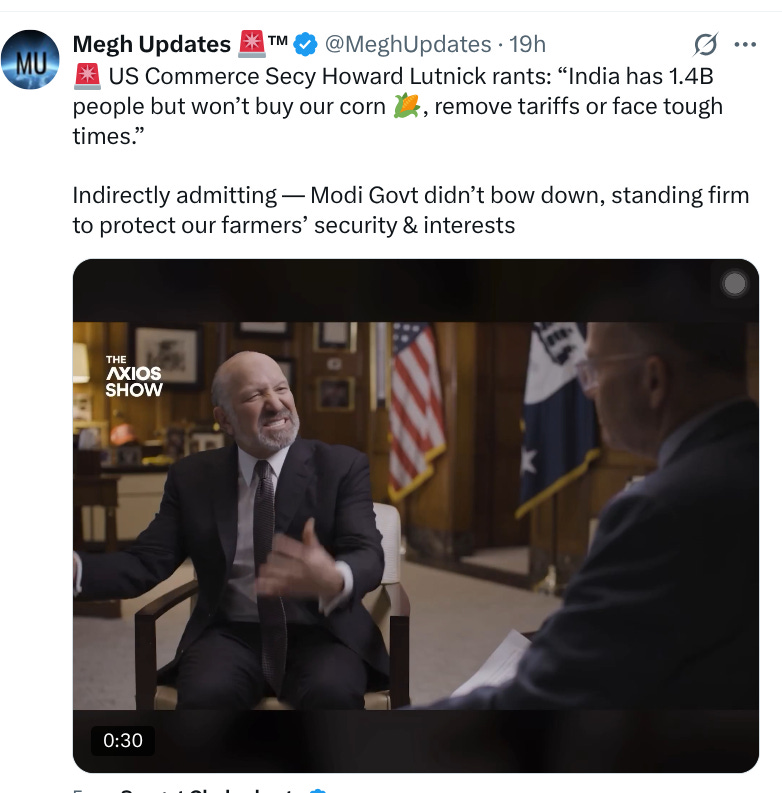
A version of this essay was published by rediff.com at https://www.rediff.com/news/column/rajeev-srinivasan-us-farm-distress-real-reason-for-trumps-tariff-tantrums/20250916.htmThere is breaking news that the trade talks between the US and India are on again. This means I was probably right that the harrumphing by President Trump and company was an opening gambit meant to soften India up for a deal that was beneficial to the US.The whole “India is funding Russia’s war effort by buying oil” meme sounded like a red herring right from the beginning, because of the very many reasons why it is not true. Now the real underlying reason behind the full-court press by Trump aides Navarro et al seems to have surfaced: it is to strong-arm India into rescuing the American farmer.It was an off-hand comment by an aide that gave away the farm (so to speak): US Commerce Secretary Lutnick’s assertion that India does not buy any corn from the US, in a September 14th interview to a US TV channel called Axios. Now this puts a whole new spin on things, because there is a crisis in US farming. No nation can afford to hurt its farmers, for both commercial, and perhaps more importantly, social and cultural reasons. We have seen how Japan subsidizes its uncompetitive rice farmers because rice is so central to its traditional culture. We have seen (at least in the days when I still used to read the magazine) the Economist commenting on “wine lakes” and “butter mountains”, that is, excessive production of agricultural products in Europe. Much the same in the US.If you over-produce, you need to find a buyer. That is the crux of the matter right now: the US used to sell 24 million metric tons of soyabeans, for example, to China every year, but after the tariff threats against it, China entirely switched its purchases to Brazil. So there’s a “soy mountain” in the US, and bankruptcies are mounting. This is serious. On the one hand, the US has lost its pre-eminence in industry to China through foolishly allowing the slipping away of its entire productive capacity to that country in the pursuit of the elusive “China price”. Now, it is on the brink of losing its pre-eminence in agriculture as well, and that can lead to the loss of food security, and a host of other, surprisingly large, side-effects. I summarized the whole problem in a tweet:It is indeed a systemic problem with many unintended consequences. On farm distress, there are several indicators: increased bankruptcies and farm liquidations/auctions, reduced farm loan repayment rates, and lower values for farmland, although farm profits have gone up temporarily because of US Department of Agriculture ad-hoc aid, not higher prices.There are several reasons for this collapse: but the biggest is buyer power. Because of over-production and global surpluses, prices have fallen for many crops; and as mentioned above, the wholesale move of Chinese demand away from the US has left overflowing silos with no prospect of sales in sight. Result: prices fall sharply.I have often felt that buyer power (one of Michael Porter’s famed “Five Forces”) is underestimated by many. Here it is in action. India seems to not understand that it is a big buyer of many commodities, and that gives it market power; so exercise it. On the contrary, India seems to view itself as a supplicant to big sellers. Not quite.What the US appears to be doing is to force India to be “the buyer of last resort”, on whom their products can be dumped: after all, I suspect the idea is, 1.4 billion people have to eat something, so why not eat American corn? There’s a certain perverse logic to this, especially if you remember the PL-480 days when American corn was indeed an emergency food supply to food-deficit India: cornflour is to this day called “American mav” in Kerala. But I am pretty sure Lutnick has no idea of all this.What is exercising the Trump lot is the fact that most of the farms are in solidly-Republican midwestern states (Illinois, Indiana, Kansas, Michigan, Minnesota, Missouri, Nebraska, North Dakota, Ohio, South Dakota, Wisconsin). I remember driving through many of them on a 4,000-mile Boston-San Francisco road trip: there’s nothing but cornfields for miles and miles. And they could be a disaster for Trump in the mid-term elections in 2026.Conversely, it does not occur to Trump aides that no Indian politician can afford to alienate his small farmers by bringing in American farm products, not to mention the cultural sensitivity to dairy products from er… non-veg cows. In an India that is largely self-sufficient in foodgrains these days, there is very little benefit in buying large quantities of foreign products. As an example, imports of oilseeds from ASEAN has decimated coconut farmers in Kerala.The Iowa governor has been in India twice, once in late 2024, and once just last weekend, trying to induce Indians to buy corn. Similarly, the governor of Nebraska was in Japan this month trying to sell them ethanol from corn. This is interesting: I wonder if the sudden enthusiasm in India for E20 ethanol blended petrol has something to do with US pressure.I am not a fan of ethanol blended petrol, because I think hybrid electric-petrol vehicles are a safer, better-tested alternative. But if the GoI is intent on E20, it may be better to buy corn ethanol from the US than to over-exploit water resources in India to grow sugarcane for the same. And maybe, just maybe, it will get Trump to back off from the shrill tariff cacophony.But to go back to my tweet above, there are a lot of other reasons for India to be wary of American farm products. The gigantic subsidies in the US Farm Bill (of the order of $20 billion a year) encourages farmers to over-produce (corn mountains for example). This ends up being converted to High-Fructose Corn Syrup, which is then added to virtually every food product: just read the labels in US supermarkets.I personally have seen the obesity epidemic in the US from the 1970s: people have become grossly fat, and diabetes levels, especially in inner-city ghettos of black and brown people, have gone through the roof as a result of all this sugar. #BigFood, that is all the packaged-food companies and fast-food companies, have engendered this transition, partly because of grossly manipulated "scientific" studies that blamed saturated fat and cholesterol.The culprit, it turns out, was always excessive sugar in the diet. But in the meantime #BigMedicine and #BigPharma took full advantage by selling statins as cholesterol-lowering drugs, and now the new panacea is Ozempic-class weight-loss drugs. However, objective studies show that despite the US spending enormous amounts on healthcare (about 20% of GDP), the health outcomes are mediocre, and often worse than other high-income countries.None of this makes it a good idea to import US farm products wholesale. What is worse, though, is the agricultural ecosystem which includes Genetically Modified Organisms. It depends on large-scale use of chemical fertilizers and pesticides. The Terminator Seed is terrifying: a Monsanto can turn off next year’s crop by refusing to sell new seeds, which is literally the “kill switch”. What you harvested this year will not germinate! Fiendishly clever, indeed!Given all this, and despite the critical importance of agri-products in both US politics and economics, it is a bad idea for India to be bullied into taking the stuff on board. India would be buying new problems, and its native intellectual property is what needs to be husbanded.There has already been tremendous erosion or digestion without recompense of these valuable IPs. A lot of traditional Indian rice variants have been spirited away to the International Rice Research Institute in the Philippines; similarly A2 zebu, humped Indian cattle, have been decimated in India by Amul and others importing A1 Jersey-type cattle. Ironically zebu breeds like Bramah are thriving in Texas, Brazil etc. No need to let IP loss happen again.It remains my belief that agricultural and dairy products are a red line for India that no Indian politician can cross. Sorry, Secretary Lutnick.Here is the AI-generated Malayalam podcast from notebookLM.google.com:1375 words, 15 Sept 2025 updated 16 Sept 2025 This is a public episode. If you'd like to discuss this with other subscribers or get access to bonus episodes, visit rajeevsrinivasan.substack.com/subscribe
A version of this essay was published by firstpost.com at https://www.firstpost.com/opinion/what-fuels-anti-india-hate-in-the-west-13932053.htmlI am personally very pro-America, yet I too have been baffled by the noises emanating from the Trump administration regarding India, particularly from one aide. Peter Navarro, apparently some trade muckity-muck, has had a field day accusing India of various sins. Apart from the entertainment value, this leads to a serious question: Why? And why now?There is reason to believe, by connecting the dots, that there is indeed a method behind this madness. It is not a pure random walk: there is a plan, and there are good reasons why the vicious attack on India has been launched at this time and in this manner. Of course, this is based on open source and circumstantial evidence: I have no inside information whatsoever.In this context, consider what is arguably the greatest political thriller of all time: "Z" (1969) by Costa-Gavras. It is based on a real-life political murder in Greece, where a popular left-leaning candidate for President was covertly assassinated by the ruling military junta.The way the plot unravels is when the investigating magistrate, masterfully played by Jean-Louis Trintignant, notices a curious phenomenon: the use of a single phrase "lithe and fierce like a tiger", used verbatim by several eye-witnesses. He realizes that there was a criminal conspiracy to get rid of the inconvenient candidate, with plausible deniability. Words and phrases have subtle meanings, and they reveal a great deal.Thus, let me bring to your notice the following tweets:* “India could end the Ukraine war tomorrow: Modi needs to pick a side” (August 5)* “Europeans love to whinge about Trump and to claim he is soft on Russia. But after 3 years it is Donald J Trump who has finally made India pay a price for enabling Putin’s butchery.” (August 6)* Speaker: “[the American taxpayer] gotta fund Modi’s war”. TV Anchor (confused): “You mean Putin’s war?”. Speaker: “No, I mean Modi’s war”. (August 28)Do you, gentle reader, notice a pattern?Now let me tell you who the authors of these posts are. The first quoted an article by an officer in the British Special Forces, which means their covert, cloak-and-dagger military people.The second was by Boris Johnson, former British Prime Minister. Johnson, incidentally, has been accused of single-handedly spiking ceasefire talks between Russia and Ukraine in 2022, when there was a possibility that the whole sorry spectacle of the war could have been settled/brought to a close.The third is by the aforementioned Peter Navarro on an American TV channel, Bloomberg Television.I don't know about you, but it seems to me that these three statements are lineal descendants of each other, one leading seamlessly to the next.This is how narratives are built, one brick in the wall after another. In reality, India has not contravened any sanctions in buying oil from Russia, and in fact has helped maintain a cap on oil prices, which were rising because of the Ukraine-Russia war. But then who needs truth if narrative will suffice?My hypothesis is that the anti-India narrative – as seen above – has been created by the British Deep State, otherwise known as Whitehall. First from the spooks, then from the former Prime Minister, and then virally transmitted to the American Deep State. It is my general belief that the British are behind much mischief (sort of the last gasp of Empire) and have been leading the Americans by the nose, master-blaster style.Britain has never tasted defeat at the hands of Russia; while France (Napoleon) and Germany (Hitler) have. Plus the US Military Industrial Complex makes a lot of money from war.A malignant British meme, intended to hurt Russia, is now turned on to India, which is, for all intents and purposes, an innocent bystander. Britain has had a thing about both Russia (“The Great Game”) and now India, and it was precisely why it created ‘imperial fortress’ Pakistan, with which to trouble, and if possible, hurt both.Then there was the second set of tweets that took things one step further. Navarro, all warmed up, blamed “Brahmins” for “profiteering by buying Russian oil at the cost of the Indian people” in a broadcast on September 1. Why he would be bothered about the “Indian people” is a good question. But what was far more interesting, indeed hilarious, was the near-simultaneous, and absurdly wrong, set of tweets by a whole group of INDI Alliance mavens.They ‘explained’, in almost identical words, that what Navarro meant was not “Brahmins”, but “Boston Brahmins”, a term coined in 1860 by Oliver Wendell Holmes, a doctor/essayist, to refer to traditional US East Coast elites, generally WASPs (White Anglo Saxon Protestants) who dominate the corridors of power in the US. Many claim to be descended from the original Pilgrims, Puritan extremists from Britain, who arrived in Plymouth on the Mayflower in 1620.They go to private (‘prep’) schools like Philips Exeter Academy, then Harvard or Yale, then Goldman Sachs, then Harvard Business School, and generally end up running the country as a hereditary, endogamous caste. It is very difficult for outsiders to marry into or enter this circle, although money helps. For example the Irish Catholic Kennedy clan is part of this caste because they made big bucks (partly by smuggling liquor during the Prohibition era), even though the Irish are generally looked down upon.I have long claimed that America is full of castes like this, which include the investment-banker caste, the lawyer caste, the doctor caste: all go to the same schools, the same colleges, marry each other, etc. In fact they do form the kind of exclusionary group that the western narrative imputes to India jati-varna. Anyway that’s a long story, and that’s not the point: it is the tweets by, for example, Karti Chidambaram, Sagarika Ghose, Saket Gokhale, et al.They were so ‘spontaneous’, so near-identical, and so outright idiotic that it is impossible that they came from anything other than a ‘toolkit’ supplied by the usual suspects: the regime-change specialists. And their claim was not even accurate: Navarro was indeed targeting Hindus and Brahmins, as is evident from the following tweet. There is no earthly reason for him to choose this image of Modi, other than that he was coached into doing so.So we go back to the original question: why? Who hates Hindus so much?There are a number of other incidents where Indians (in particular Hindus) have been targeted in various countries: Ireland recently; Australia some time ago and again now, see below an anti-immigration (particularly anti-Indian) rally on August 31st; Canada with its Khalistanis running amok (lest we forget, 40 years ago, they downed Air India Kanishka).Let us note the curious coincidence that these are all countries where the British have influence: Canada and Australia are in effect their vassals. Ireland is not, and I suspect the British are hated there, but somehow in the last few weeks, this British prejudice has spilled over with “Irish teenagers” physically attacking Indians (including women and children). I wonder if the “Irish teenagers” are really British agents provocateurs.So let’s put two and two together: who hates Indians, Hindus and Brahmins? Why, Pakistanis, of course. And they have been burned a little by Operation Sindoor. Pahalgam didn’t quite turn out the way they thought it would, considering it was scheduled during the India visit of J D Vance accompanied by his Indian/Hindu-origin wife, Usha Chilukuri Vance. That might explain why there’s a sudden explosion of social-media hatred by ISI and CCP bots against Indians.Pahalgam was Phase 2 of the regime-change operation. By so visibly targeting and murdering Hindus in Pahalgam, the Pakistanis calculated they could induce massive rioting by Hindus against Muslims, which would be an excuse for “the rules-based liberal international order” to step in, exile Modi, and um… restore order, as in Bangladesh. The usual playbook.Alas, “the best laid schemes o’ mice an’ men gang aft agley”, and Pakistan got a whipping instead, and some of their (US or China-supplied?) nuclear assets apparently went up in smoke. But make no mistake, the regime-change gang will redouble its efforts.Phase 1 had been the 2024 elections where there were surprising losses by the BJP. Phase 3 is the ‘vote-chori’ wailing by the INDI Alliance: odd, considering nobody knows which passport(s) Rahul Gandhi holds. Phase 4 is the ongoing ‘Project 37’ in which renegade BJP MPs are supposed to bring down the central government.Pakistan, and its various arms, including the Khalistan project, participate with great enthusiasm in these various phases. And for all intents and purposes, the UK has now become a Pakistani colony. Recursive master-blaster, as I conjectured: Pakistani-Britons control Whitehall, Whitehall controls the US Deep State. Here’s Britain’s new Home Secretary, Shabana Mahmood, in the words of a suddenly-awake Briton on September 6th.An Emirati strategist, Amjad Taha, asked a valid question: why is there more terrorism in the UK than in the Middle East?Wait, there’s more. Here’s a loudmouth Austrian who wants to dismantle India, long a Pakistani dream. And the map is by some Jafri, which sounds like a Pakistani surname. The Austrian also wants Rahul Gandhi to be the next Prime Minister.Pakistan is itself unraveling, as can be seen in Balochistan which is in open rebellion. Their Khalistani dream is new, but Kerala and the Northeast as Islamist entities were standard memes even from Chaudhury Rehmat Ali who dreamt up Pakistan in the first place in the 1930s.Pakistan just got a boost, however, with OSINT identifying a US C-17 (a giant military cargo plane) arriving to resupply Nur Khan Airbase. This raises the question again: were US personnel and assets decimated there by Indian missiles during Operation Sindoor? Is that why the US got
The second episode in the IITM Alumni Association Trivandrum's live monthly Fireside Chats. Senior executive Sri CMA, formerly VP at Alstom T&D France and Board Member, Alstom India and Areva India, has been in charge of setting up factories in several countries, and has first-hand knowledge of geo-economics and manufacturing. He is also actively involved in analyzing international relations and geo-politics. In this live conversation, he provides insights into the (unintended) consequences of President Trump's tariffs, and answers specific questions from the audience. He considers the repercussions on India both tactically and strategically, and how the nation might respond, with diversification of markets, case-by-case analysis of sectors, and creating leverage with its own core competencies.Here is the AI-generated podcast about this live chat: This is a public episode. If you'd like to discuss this with other subscribers or get access to bonus episodes, visit rajeevsrinivasan.substack.com/subscribe
An edited version of this essay was published by Deccan Herald at https://www.deccanherald.com/opinion/decoding-trump-s-tariff-tantrums-3694626, as the editor downplayed the ‘vote chori’ INDI alliance story and the atrocities by Tipu on Hindu Kerala. Last month, I wrote here about India’s splendid diplomatic isolation, but my prediction became fact sooner than I expected, with President Trump’s withering attacks on India. Biden drove Russia into China’s arms over Ukraine; Trump seems intent on driving India into China’s arms; and Ukraine isn’t even Asia’s problem, but a likely Chinese invasion of Taiwan would beThere are at least four different ways in which one could rationalize the Trump position:* A negotiating opening gambit to soften up India* Frustration from the lack of leverage against Presidents Putin and Xi* Part of a regime-change operation planned by the Deep State* A desire to force manufacturing and investment to move back to the USI hope it is a combination of 1 and 2, and that better sense will prevail before a mutually-beneficial Indo-US relationship is damaged beyond repair. However, there is a non-trivial chance that, with prompting by Britain’s Whitehall (which created Pakistan in the first place to keep India in check), the US Deep State has decided to target India.I wrote a couple of years ago that the Deep State, intimidated by China’s rise, might accept a condominium with it, giving each a sphere of influence. China gets Asia and the Indian Ocean; the US gets the Americas, Europe and the Atlantic; and they share the Pacific. India, Japan, Australia (i.e. the Quad), and ASEAN become Chinese vassals. So like the Vatican-brokered Treaty of Tordesillas in 1494 that divided the world between Spain and Portugal!There is also the anti-Thucydides Trap, wherein the incumbent power (the US), instead of resisting the rise of the challenger (China), helped it grow, deluding themselves that China would be benign. However, both are now employing all possible means against new challenger India’s rise, including trying to balkanize the latter.That is Scenario 3, the Deep State playbook of ‘color revolutions’ against governments they don’t like for whatever reason. The continuous INDI Alliance efforts to stir up linguistic or caste-based divisions in India, along with the recent ‘Vote Chori’ fuss to delegitimize India’s democracy, are part of the toolkit: declare a regime undesirable, then topple it. In 2024 they almost succeeded, but not quite. They will keep trying.Scenario 4 makes a strange sort of sense. Trump realizes the US erred badly in relinquishing manufacturing to China, and wants to pull it back; also he has no interest in India becoming a new manufacturing power. Similarly, the ‘deals’ forcing Japan, the EU, Korea et al to invest billions of dollars in the US (and Ukraine, which lives on charity, has promised to spend $100 billion in the US!) are extortionate: a sort of neo-imperialism.The effort to browbeat India into buying more US weapons is part of this: Trump aide Peter Navarro grumbled that India buys 36% of its armaments from Russia. He omitted to mention that this is down from 70+% a decade ago. Sadly, US armaments and aerospace products (e.g. the F-35 and Boeing 787s) are now seen as not so reliable.The moral posturing about India’s purchases of Russian oil leading to deaths of Ukrainians is downright bizarre. It’s just business, Trump aide Scott Bessent, why repeat INDI’s Ambani-Adani mantra? Remember your own ‘robber barons’ and “What’s good for General Motors is good for America”? There are many examples of profit above morals.One is the 1973 oil price crisis, when OPEC suddenly quadrupled crude oil prices, forcing a massive transfer of wealth from developing countries, quite likely causing starvation deaths. The US could have persuaded (or bullied) OPEC into preventing the price rise. But it didn’t. Why? Because those petro-dollars were recycled into buying American weapons. The Military Industrial Complex prospered. No morality there.There is an earlier parallel. Tipu Sultan invaded Kerala in the 1780s with a reign of terror, massacres, loot of Hindu temples, pillage, forced conversions and so on. The British did nothing, despite a treaty with Travancore. After Tipu had amassed all the looted treasure in one place, the British killed him, and stole all of it themselves. The British came out smelling of roses because they killed a tyrant, and they had the loot. Two birds, one stone. No morality there, either.Given all this, there’s one thing India needs to do urgently: gain leverage, a bargaining chip. China has rare earths, OPEC has oil. India should use the 100,000 H1-B folks who are likely to be forced out from the US to gain leverage through first-class software products.760 words, 20 Aug 2025, updated 21 Aug 2025 This is a public episode. If you'd like to discuss this with other subscribers or get access to bonus episodes, visit rajeevsrinivasan.substack.com/subscribe
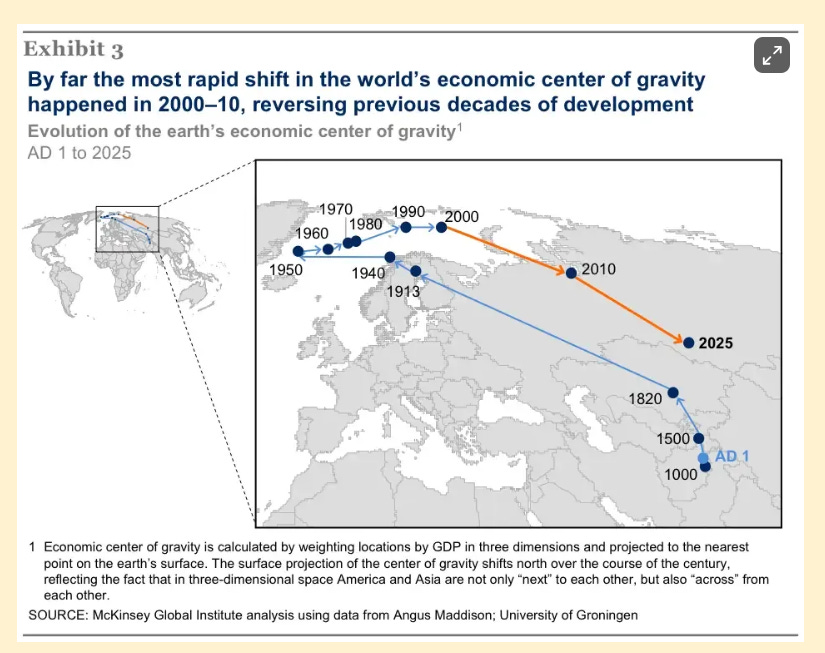
A version of this essay has been published by firstpost.com at https://www.firstpost.com/opinion/shadow-warrior-from-crisis-to-advantage-how-india-can-outplay-the-trump-tariff-gambit-13923031.htmlA simple summary of the recent brouhaha about President Trump’s imposition of 25% tariffs on India as well as his comment on India’s ‘dead economy’ is the following from Shakespeare’s Macbeth: “full of sound and fury, signifying nothing”. Trump further imposed punitive tariffs totalling 50% on August 6th allegedly for India funding Russia’s war machine via buying oil.As any negotiator knows, a good opening gambit is intended to set the stage for further parleys, so that you could arrive at a negotiated settlement that is acceptable to both parties. The opening gambit could well be a maximalist statement, or one’s ‘dream outcome’, the opposite of which is ‘the walkway point’ beyond which you are simply not willing to make concessions. The usual outcome is somewhere in between these two positions or postures.Trump is both a tough negotiator, and prone to making broad statements from which he has no problem retreating later. It’s down-and-dirty boardroom tactics that he’s bringing to international trade. Therefore I think Indians don’t need to get rattled. It’s not the end of the world, and there will be climbdowns and adjustments. Think hard about the long term.I was on a panel discussion on this topic on TV just hours after Trump made his initial 25% announcement, and I mentioned an interplay between geo-politics and geo-economics. Trump is annoyed that his Ukraine-Russia play is not making much headway, and also that BRICS is making progress towards de-dollarization. India is caught in this crossfire (‘collateral damage’) but the geo-economic facts on the ground are not favorable to Trump.I am in general agreement with Trump on his objectives of bringing manufacturing and investment back to the US, but I am not sure that he will succeed, and anyway his strong-arm tactics may backfire. I consider below what India should be prepared to do to turn adversity into opportunity.The anti-Thucydides Trap and the baleful influence of Whitehall on Deep StateWhat is remarkable, though, is that Trump 2.0 seems to be indistinguishable from the Deep State: I wondered last month if the Deep State had ‘turned’ Trump. The main reason many people supported Trump in the first place was the damage the Deep State was wreaking on the US under the Obama-Biden regime. But it appears that the resourceful Deep State has now co-opted Trump for its agenda, and I can only speculate how.The net result is that there is the anti-Thucydides Trap: here is the incumbent power, the US, actively supporting the insurgent power, China, instead of suppressing it, as Graham Allison suggested as the historical pattern. It, in all fairness, did not start with Trump, but with Nixon in China in 1971. In 1985, the US trade deficit with China was $6 million. In 1986, $1.78 billion. In 1995, $35 billion.But it ballooned after China entered the WTO in 2001. $202 billion in 2005; $386 billion in 2022.In 2025, after threatening China with 150% tariffs, Trump retreated by postponing them; besides he has caved in to Chinese demands for Nvidia chips and for exemptions from Iran oil sanctions if I am not mistaken.All this can be explained by one word: leverage. China lured the US with the siren-song of the cost-leader ‘China price’, tempting CEOs and Wall Street, who sleepwalked into surrender to the heft of the Chinese supply chain.Now China has cornered Trump via its monopoly over various things, the most obvious of which is rare earths. Trump really has no option but to give in to Chinese blackmail. That must make him furious: in addition to his inability to get Putin to listen to him, Xi is also ignoring him. Therefore, he will take out his frustrations on others, such as India, the EU, Japan, etc. Never mind that he’s burning bridges with them.There’s a Malayalam proverb that’s relevant here: “angadiyil thottathinu ammayodu”. Meaning, you were humiliated in the marketplace, so you come home and take it out on your mother. This is quite likely what Trump is doing, because he believes India et al will not retaliate. In fact Japan and the EU did not retaliate, but gave in, also promising to invest large sums in the US. India could consider a different path: not active conflict, but not giving in either, because its equations with the US are different from those of the EU or Japan.Even the normally docile Japanese are beginning to notice.Beyond that, I suggested a couple of years ago that Deep State has a plan to enter into a condominium agreement with China, so that China gets Asia, and the US gets the Americas and the Pacific/Atlantic. This is exactly like the Vatican-brokered medieval division of the world between Spain and Portugal, and it probably will be equally bad for everyone else. And incidentally it makes the Quad infructuous, and deepens distrust of American motives.The Chinese are sure that they have achieved the condominium, or rather forced the Americans into it. Here is a headline from the Financial Express about their reaction to the tariffs: they are delighted that the principal obstacle in their quest for hegemony, a US-India military and economic alliance, is being blown up by Trump, and they lose no opportunity to deride India as not quite up to the mark, whereas they and the US have achieved a G2 detente.Two birds with one stone: gloat about the breakdown in the US-India relationship, and exhibit their racist disdain for India yet again.They laugh, but I bet India can do an end-run around them. As noted above, the G2 is a lot like the division of the world into Spanish and Portuguese spheres of influence in 1494. Well, that didn’t end too well for either of them. They had their empires, which they looted for gold and slaves, but it made them fat, dumb and happy. The Dutch, English, and French capitalized on more dynamic economies, flexible colonial systems, and aggressive competition, overtaking the Iberian powers in global influence by the 17th century. This is a salutary historical parallel.I have long suspected that the US Deep State is being led by the nose by the malign Whitehall (the British Deep State): I call it the ‘master-blaster’ syndrome. On August 6th, there was indirect confirmation of this in ex-British PM Boris Johnson’s tweet about India. Let us remember he single-handedly ruined the chances of a peaceful resolution of the Ukraine War in 2022. Whitehall’s mischief and meddling all over, if you read between the lines.Did I mention the British Special Force’s views? Ah, Whitehall is getting a bit sloppy in its propaganda.Wait, so is India important (according to Whitehall) or unimportant (according to Trump)?Since I am very pro-American, I have a word of warning to Trump: you trust perfidious Albion at your peril. Their country is ruined, and they will not rest until they ruin yours too.I also wonder if there are British paw-prints in a recent and sudden spate of racist attacks on Indians in Ireland. A 6-year old girl was assaulted and kicked in the private parts. A nurse was gang-raped by a bunch of teenagers. Ireland has never been so racist against Indians (yes, I do remember the sad case of Savita Halappanavar, but that was religious bigotry more than racism). And I remember sudden spikes in anti-Indian attacks in Australia and Canada, both British vassals.There is no point in Indians whining about how the EU and America itself are buying more oil, palladium, rare earths, uranium etc. from Russia than India is. I am sorry to say this, but Western nations are known for hypocrisy. For example, exactly 80 years ago they dropped atomic bombs on Hiroshima and Nagasaki in Japan, but not on Germany or Italy. Why? The answer is uncomfortable. Lovely post-facto rationalization, isn’t it?Remember the late lamented British East India Company that raped and pillaged India?Applying the three winning strategies to geo-economicsAs a professor of business strategy and innovation, I emphasize to my students that there are three broad ways of gaining an advantage over others: 1. Be the cost leader, 2. Be the most customer-intimate player, 3. Innovate. The US as a nation is patently not playing the cost leader; it does have some customer intimacy, but it is shrinking; its strength is in innovation.If you look at comparative advantage, the US at one time had strengths in all three of the above. Because it had the scale of a large market (and its most obvious competitors in Europe were decimated by world wars) America did enjoy an ability to be cost-competitive, especially as the dollar is the global default reserve currency. It demonstrated this by pushing through the Plaza Accords, forcing the Japanese yen to appreciate, destroying their cost advantage.In terms of customer intimacy, the US is losing its edge. Take cars for example: Americans practically invented them, and dominated the business, but they are in headlong retreat now because they simply don’t make cars that people want outside the US: Japanese, Koreans, Germans and now Chinese do. Why were Ford and GM forced to leave the India market? Their “world cars” are no good in value-conscious India and other emerging markets.Innovation, yes, has been an American strength. Iconic Americans like Thomas Edison, Henry Ford, and Steve Jobs led the way in product and process innovation. US universities have produced idea after idea, and startups have ignited Silicon Valley. In fact Big Tech and aerospace/armaments are the biggest areas where the US leads these days.The armaments and aerospace tradeThat is pertinent because of two reasons: one is Trump’s peevishness at India’s purchase of weapons from Russia (even though that has come down from 70+% of imports to 36% according to SIPRI); two is the fact that there are significant services and intangible imports by India from the US, of for instance B
A version of this essay was published by Deccan Herald at https://www.deccanherald.com/opinion/the-abhimanyu-syndrome-india-and-its-isolation-3650402Recent events have made it increasingly clear that India is utterly alone. I call this the Abhimanyu Syndrome, in honor of the teenaged Abhimanyu, who only knew how to enter the impregnable Chakravyuha, and who was then murdered, alone, against all Dharmic principles, by several powerful Maharathis.India's possible rise as an economic and military power is being resisted tooth and nail by the incumbent major powers. This is natural: all 'insurgent' powers face this problem. India's rise will need some paradigm shifts, which may or may not happen.China's rise was helped by two things: an industrial policy and inadvertent help by the US's managers and Wall Street who were seduced by the short-term appeal of the lower-cost 'China price'.The ruthless industrial policy is a result of China's civil services being full of engineers who understand the near term. In the long run, it may or may not succeed because of second-order effects such as population implosion, environmental ruin and skewed investment decisions.The US is now facing decline (and the EU has already begun a steep decline) for a variety of reasons, including natural cycles and the loss of comparative advantage in weaponry.In this context, I wish I knew what paradigm shift, if any, will propel India to a G3 slot, but the general global churn, new technologies, etc might create an opportunity. In the meantime, India has to struggle alone, against a mass of hostile powers.I read an article in a Sri Lankan newspaper that painted India as a tyrant, but China as a benevolent friend dispensing largesse. Yes, the same China that has grabbed Hambantota! And it called for a new SAARC, one minus India. This is the kind of propaganda that China and Pakistan are rolling out in the Indian subcontinent.China has every reason to want to kneecap India, the only Asian power that can (and hopefully will) challenge its hegemonistic pretensions. Even the US doesn't: Obama anointed China as the guardian/manager, if not owner, of 'South Asia'. Spheres of influence, you see.The US, in general, has been a disappointment. Many Indians expected, after Biden's antics with Yunus in Bangladesh, that Trump would be more in tune with Indian interests, partly because the US and India both need to keep China in check, and Trump wants to move more manufacturing out of China.But that has clearly not happened. Instead, India has been in Trump's gunsights over trade (although India's surplus is small, and agricultural items that the US wants to sell are a serious no-no for India). Their embrace of Pakistan during and after Operation Sindoor has been inexplicable unless Trump has adopted pure Deepstate policy.India cannot be a Chinese vassal (although it is in BRICS) and it doesn't want to be an American vassal though it’s in the Quad (its ties with Russia and strategic autonomy are too important). Thus India is squeezed; for instance, the recent threat by some NATO muckity-muck to impose Russia-related sanctions was sinister.This could be both good and bad. Let’s face it, nobody likes a rising power (see Thucydides Trap). While the Sri Lankan paper glorifies China, let us remember that China has territorial disputes with literally every one of its neighbors, and most of ASEAN is deathly scared of them. That comes from hard power. If SAARC or G20 or somebody is worried about India, that is a good sign that home-grown military power is noticeable.Everyone complains that India is not loyal to them. BRICS boosters grumble that India is a Western ‘mole’ that is preventing them from toppling the dollar and making the US irrelevant. Conversely, the Anglosphere complains that India is not sufficiently committed to them, as in not toeing their Ukraine line. This is as it should be: multi-alignment means India is not beholden to anybody, but will pursue its selfish interests first and foremost.This is qualitatively different from the late lamented ‘non-alignment’ of Nehruvian days, which meant everybody disliked India for its moral posturing. Multi-alignment means India will engage with everybody, on its own terms. With the US, for technology and trade. With Russia, for weapons and oil. Even with China, despite China being India’s staunchest enemy, for electronic components. And even with perfidious Britain, as in the just-concluded FTA, which I personally consider pointless.Thus the splendid isolation is a back-handed compliment: the rest of the world is anticipating the rise of India as a superpower; and superpowers have no friends, only interests. And remember, Abhimanyu died, yes, but his side won overwhelmingly.780 words, 22 Jul 2025 updated 25 Jul 2025 This is a public episode. If you'd like to discuss this with other subscribers or get access to bonus episodes, visit rajeevsrinivasan.substack.com/subscribe
A version of this essay has been published by firstpost.com at https://www.firstpost.com/opinion/shadow-warrior-air-india-crash-how-to-spin-doctor-and-peddle-narratives-the-western-way-13912025.html There has been a virtual masterclass lately in the creation and dissemination of biased narratives. Not only in the case of the ill-fated Air India 171 (Boeing 787, June 12, 2025) that crashed, but also in some other, unrelated instances. The age-old practices of "truth by repeated assertion" and "dubious circular references" as well as "strategic silence" have all been deployed in full force.The bottom line with the Air India flight: there is reasonable doubt about whether there was mechanical/software failure and/or sabotage or possible pilot error. Any or all these caused both engines to turn off in flight. But the way the spin-doctors have spun it, it is now "official" that the commanding pilot was suicidal and turned off the fuel switch. Boeing, the plane maker, and General Electric, the engine maker, are blameless.This is, alas, not surprising. It is in the interests of western MNCs to limit reputational damage and monetary loss related to their products. They do massive marketing by unleashing their PR agencies. We also saw how they protect themselves in other instances. A leaked Pfizer contract for their Covid vaccine insisted that if anything happened, it was the user's problem, not Pfizer's: there was no indemnity.Incidentally, a report on July 19th said that the Pfizer COVID vaccine can lead to severe vision problems. Oh, sorry, no indemnity.What is deplorable in the Air India case is that the AAIB, the Indian entity investigating the disaster, chose to release a half-baked preliminary report with enough ambiguity that a case could be (and definitely was) built up against the poor dead pilots. Any marketing person could have read the report and told them that it would be used to blame the pilots and absolve the manufacturers.Besides, the AAIB report was released late night on a Friday India time, which meant that the western media had all of one working day to do the spin-doctoring, which they did with remarkable gusto. Meanwhile the Indian media slept. Whose decision was this? Clearly, Indian babus need a remedial course in public relations if this was mere incompetence. Of course, if it was intentional, that would be even worse.There is a pattern. In earlier air accidents, such as the Jeju Air crash involving a Boeing 737-800 in South Korea in December, the pilots were blamed. In accidents involving Lion Air (Boeing 737 Max 8, 2018), China Airlines (737 200, 1989), Flydubai (737 800, 2016), ditto. I am beginning to believe that a lot of Asian pilots are poorly trained and/or suicidal. Ditto with the F-35 that fell into the ocean off Japan.Truth by repeated assertion is a powerful force for gaslighting the gullibleI wonder what excuses we’ll hear about the Delta Airlines Boeing 767 whose engine caught fire in the air after take-off from LAX on July 20th. The pilots didn't die so they will speak up. Besides, they were westerners. I am eagerly awaiting the spin on this.I also noticed with grim amusement how the BBC, WSJ, Bloomberg and Reuters and so on were busy quoting each other to validate their assertions. This is a standard tactic that India's distorians (see Utpal Kumar's powerful book 'Eminent Distorians') have perfected: B will quote third-hand hearsay from A, then C will quote B, D will quote C, and before you know it, the hearsay has become The TRUTH. But if you wind it back from D to C to B to A it becomes, "I hear someone told someone that xyz happened". Out of thin air, then.There is also the lovely tactic of strategic silence. It has been used to un-person people who ask inconvenient questions. It has also been used to defenestrate inconvenient news. Just days ago, under the Deepstate-installed new regime in Syria, hundreds of minority Druze were brutally massacred. There was video on X of armed men in uniform forcing Druze men to jump off tall buildings, and desecrating their shrines.Similary, there is a brutal reign of terror, rape, murder and thuggery against Hindus, Buddhists and others under the Deepstate-blessed regime of Mohammed Yunus in Bangladesh: a clear genocide. Neither Syria nor Bangladesh gets any headlines. There are no loud human-rights protests as in the case of Gaza. This is not news. It is un-news."Manufacturing Consent" all the way.India is particularly vulnerable to this gaslighting because Indians consume a lot of English-language 'news'. Scholars have long noted how the US public has been maintained in a state of ignorance so they could be easily manipulated. The same is true of the Indian middle class. So there is yet another reason to do less in English. Fooling, say, the Chinese or Japanese public is a lot more difficult.The fact is that even though Indians may be literate in English, they do not understand the context and the subtext of what is fed to them by the likes of The Economist, NPR, The Financial Times, the New York Times, etc. The best way I can explain this is the 100+5 analogy in the Mahabharata: they may fight with each other on domestic matters, but Anglosphere and Deepstate are in cahoots when it comes to international matters.Things are both getting better and getting worse. On the one hand, social media and its imprint on generative AI mean that it is ever easier to propagate fake news (in addition to deepfake audio and video, of course). On the other hand, despite the problem of charlatans and paid agents provocateurs getting lots of eyeballs, the large number of Indians on social media may push back against the worst kinds of blood libel against India and Indians, of which there's plenty these days often created by bots from 'friendly' neighbors.This is a serious matter indeed. One solution is to do a version of the Great Chinese Firewall and ban wholesale the worst offenders. Indeed, a few of the vilest handles have been ejected from X. However, the pusillanimity with which notorious Pakistani handles were unbanned, then re-banned after outrage, shows there's something rotten in the Information Ministry. Almost exactly the same as the unbanning of Pakistani cricketers, then rebanning after outrage. Is there anybody in charge?Information warfare is insidious. Going back to the Air India case, I think the families of the maligned pilots should sue for gigantic sums for libel and defamation. The sad state of the Indian judiciary may mean that, unfortunately, this will not go far. However, there is precedent: Lee Kwan Yew in Singapore used to terrorize villainous western media by suing them in his courts. They learned to toe the line.If this tactic does not work, India should eject the hostile media. The Indian market is increasingly important to western media (not vice versa) because soon there will be more English-reading consumers in India than in the Five Eyes Anglosphere. I should say that in quotes because as I said above, most Indians are blissfully unaware of the hidden agendas, and naively believe them. But "Judeo-Christian" culture is very different from Dharmic.I keep getting emails from the New York Times with tempting offers to subscribe to them for something really cheap like Rs. 25 a month. They need Indian readers. I have been shouting from the rooftops for years that one of these charlatan media houses needs to be kicked out, harshly, with 24 hours notice to wind up and leave. As in the Asian proverb, "kill the chicken to scare the monkeys". The monkeys will notice, and behave. Otherwise the information warfare is just going to get worse.1290 words, Jul 22, 2025 This is a public episode. If you'd like to discuss this with other subscribers or get access to bonus episodes, visit rajeevsrinivasan.substack.com/subscribe
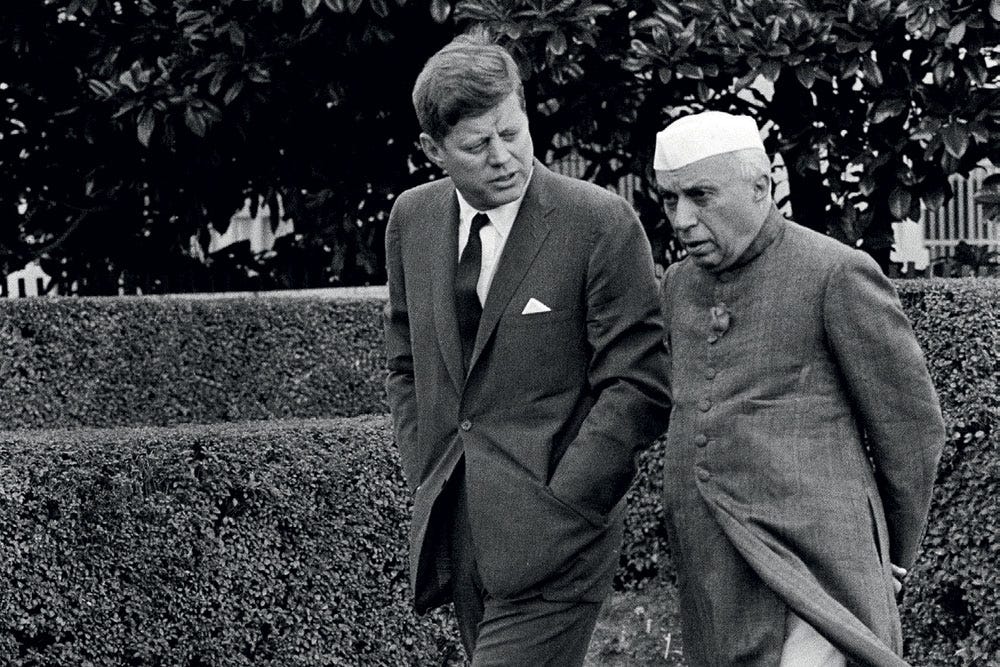
A version of this essay has been published by firstpost.com at https://www.firstpost.com/opinion/shadow-warrior-zohran-mamdani-and-the-coming-crisis-for-hindus-in-america-13908482.htmlI have long felt the Deep State works on a single playbook in its foreign policy: regime-change, or what is colloquially called ‘Color Revolutions’. It is a simple routine: in some remote country, declare the ruling dispensation to be mad dogs, and shoot them, metaphorically if not in reality. Anoint a ‘friend’ as the new chief. All hail to him/her! The pliant media goes along.There have been innumerable such plays all over the world, and most of the time, the results have been bad to disastrous for the country in question. Just look at Ukraine, Iraq, Libya, and Syria for recent examples. Iran, too, when Mossadegh was toppled because of, what else, oil: BP was annoyed at him for nationalizing Iranian oil.As an aside, I have wondered why Deep State did not orchestrate a color revolution against the Nehru Dynasty. On the face of it, there were plenty of reasons to do so: Jawaharlal’s embrace of the Soviet Union, Indira’s defiance regarding East Pakistan, and so on. So why didn’t they topple the Dynasty and install a puppet, as they did with Mohammed Yunus in Bangladesh?Maybe India was just too unimportant. Or maybe, just maybe, the Nehru Dynasty was in fact the Deep State puppet already in place. Was Jawaharlal hand-picked, and didn’t even know?So is Zohran Mamdani’s rise the first Color Revolution in the US? A friend claimed that it wasn’t, and that Barack Obama was the first. That is a debatable point, but one could argue that Obama 1 & 2, and Obama 3 (Biden’s term) were the worst presidencies in US history.While there have been many good opinion pieces written about Mamdani’s rise and rise, for instance by Jaggi and Avatans Kumar, I would like to focus on the broader implications of what Deep State might achieve by rolling out a Color Revolution in its own backyard. It’s one thing to mess up a far-off country, and entirely a different thing to screw up your own premier city. This is a high-risk (and presumably high-return) strategy for Deep State.Of course, the UK Deep State (aka Whitehall) may well be leading the US Deep State by the nose. I called it a “master-blaster” relationship, hat tip to Mad Max Beyond Thunderdome. This color revolution possibility is not something I invented out of thin air, I give due credit to, among others, San for noting this possibility, along with many other unusual things about the Mamdani campaign, including its connection to Soros, as well as the uncompromising religious bigotry and use of dog-whistles against, for instance, Jews and Hindus. So Zohran Mamdani is worth watching, and so is his father, Columbia Professor Mamdani, who wrote something alarming in his 2004 book Good Muslim, Bad Muslim: America, the Cold War, and the Roots of Terror: see an excerpt below that seems to justify suicide bombing as a tactic. Of course, he may just have been doing an academic analysis, and surely, what the father said cannot be attributed to the son, but we can wonder about early influences on Zohran.Beyond the personal proclivities of the man and family, there is a mixture of Islamist radicalism and extreme-left radicalism in Zohran Mamdani’s background. Some have called his rise a victory for the Red-Green Alliance, which is of significance to India, because here too we have often seen such a combination in play. Besides, it’s notable that Mamdani has never said a word about atrocities committed on Hindus in Pakistan/Bangladesh or even in India, though he’s quick to make up atrocity literature alleging “Gujarati Muslims have been wiped out” in India. About 10 million Gujarati Muslims may like to differ. Amazingly, the very people whom Mamdani is supposed to be emancipating, the underclass blacks and other low-income residents of NYC, did not vote for him. His victory in the Democratic primary came from young, well-off whites and “Asians” (the same Asians as in the UK?), and unions. That itself is telling. The bigger question, though, is how this relates to the eclipse of the West. I take the UK as Exhibit A. There was a recent article in the Economist magazine about how Britain is now a cheap country. In other words, the per capita income has fallen, and British assets are valued low, because there is a general perception of malaise, partly because manufacturing has collapsed.The headline is precious. It reminds me of the subtitle to Stanley Kubrik’s “Dr Strangelove: How I Learned to Stop Worrying and Love the Bomb”. Right on, cheers, tally-ho!It was hugely entertaining to also listen to an Economist podcast which suggested that a “services-led economy” would be the UK’s savior. Raghuram Rajan, take a bow. Necessity being the mother of invention, I suppose. There is not a single product of British manufacturing that anybody wants (with the possible exception of Rolls-Royce aircraft engines). They were able to dump their inferior goods on defenseless colonies (read: India) but those days are over.They are now apparently depending on services (e.g., their journalism, which, with its clipped accents, impresses Americans, but is available to the highest bidder. The word “Presstitutes” leaps to mind). In addition, IT services, it seems, given their convenient time zone. And cheap IT labor. Yes, direct threat to India. Wipro, Infosys, TCS, I am sure are paralyzed with fear. The UK is, in many ways, the canary in the coalmine. Its precipitous decline is related to the fact that it is a small island off northwest Asia, whereas of course the US is a continent-sized country with massive resources. But the other factors: the previous holder of the global reserve currency, the previous dominant superpower, etc., are relevant to the US.To be honest, I have no idea what the UK’s elites are thinking, because their current trajectory is going to end in disaster. As I have said before, they have fancied themselves as dealmakers extraordinaire, with Whitehall leading the world in mischief. But they were too clever by half: their homeland is collapsing. I don’t mind, it’s schadenfreude time, but I wonder what 3-d chess they are playing. I wonder if the US Deep State has a clue that the US could end up like the UK. The one thing that has sustained the UK in the last few decades is their financial services. But with the LIBOR scandal and Brexit, that game is also moving on: to Frankfurt, Singapore, Dubai (and eventually I guess GIFT City, India). The City of London, the name of the financial district, has been decimated. This is a warning to Wall Street in New York City.Another warning comes from California in general, and San Francisco in particular. Once the most appealing of American cities, it has been turned into a fetid, dangerous place full of yes, “street-shitters” and fentanyl addicts. The main culprit has been rule by left-wing extremists who put in place the ingredients for terminal decline: for instance, a moratorium on prosecuting any property crimes worth less than $950, which led to the hollowing out of retail downtown.I am not saying New York City is a pleasant place especially compared to what San Francisco was (I lived for a long time in the suburbs of both, so I have personal experience) but there is surely a lot that can go wrong with socialism of the Mamdani variety. Exhibits A, B, C: Venezuela, Cuba, etc. What is of more immediate concern to Hindus is that the US will become more dangerous for them. As it is, the amount of racial hatred and animosity towards brown Hindus has grown perceptibly, aided by social media ‘influencers’ who are likely paid by ISI/CCP/Deep State. There is also the element of envy, as Hindus have risen to high positions, mostly by way of hard work and smarts. In analogy with Jews, this envy can turn into poisonous bigotry. We have seen how Kristallnachts develop. And then Final Solutions. The UK has seen, along with the growth of its Muslim population (“demography is destiny”) a concomitant level of animosity and violence against Hindus: see Leicester; and the British establishment is so afraid of Muslims that they will not take any steps to curb their acts. This is leading to clear and present danger for Hindus. We have seen this movie before.In addition to the increasing animosity towards H1-B holding Indians, who are predominantly Hindus, a victory for Zohran Mamdani will basically make it clear to US Hindus that their days are numbered, and that the US may rapidly follow the UK into societal and economic collapse. It’s a sobering thought. Do we have a Plan B?1330 words, 15 Jul 2025 This is a public episode. If you'd like to discuss this with other subscribers or get access to bonus episodes, visit rajeevsrinivasan.substack.com/subscribe

Comments

Download from Google Play

Download from App Store
 United States