


 Claim Ownership
Owl Have You Know
Subscribed: 5Played: 184
Subscribe

© 2026 Rice Business
Description
Owl Have You Know is Rice Business’ podcast created to share the experiences of alumni, faculty, students and other members of our business community – real stories of belonging, failing, rebounding and, ultimately, succeeding. During meaningful conversations, we dive deep into how each guest has built success through troubles and triumphs before, during and after they set foot in McNair Hall.
The Owl Have You Know Podcast is a production of the business school at Rice University (Rice Business) and is produced by University FM.
The Owl Have You Know Podcast is a production of the business school at Rice University (Rice Business) and is produced by University FM.
132 Episodes
Reverse
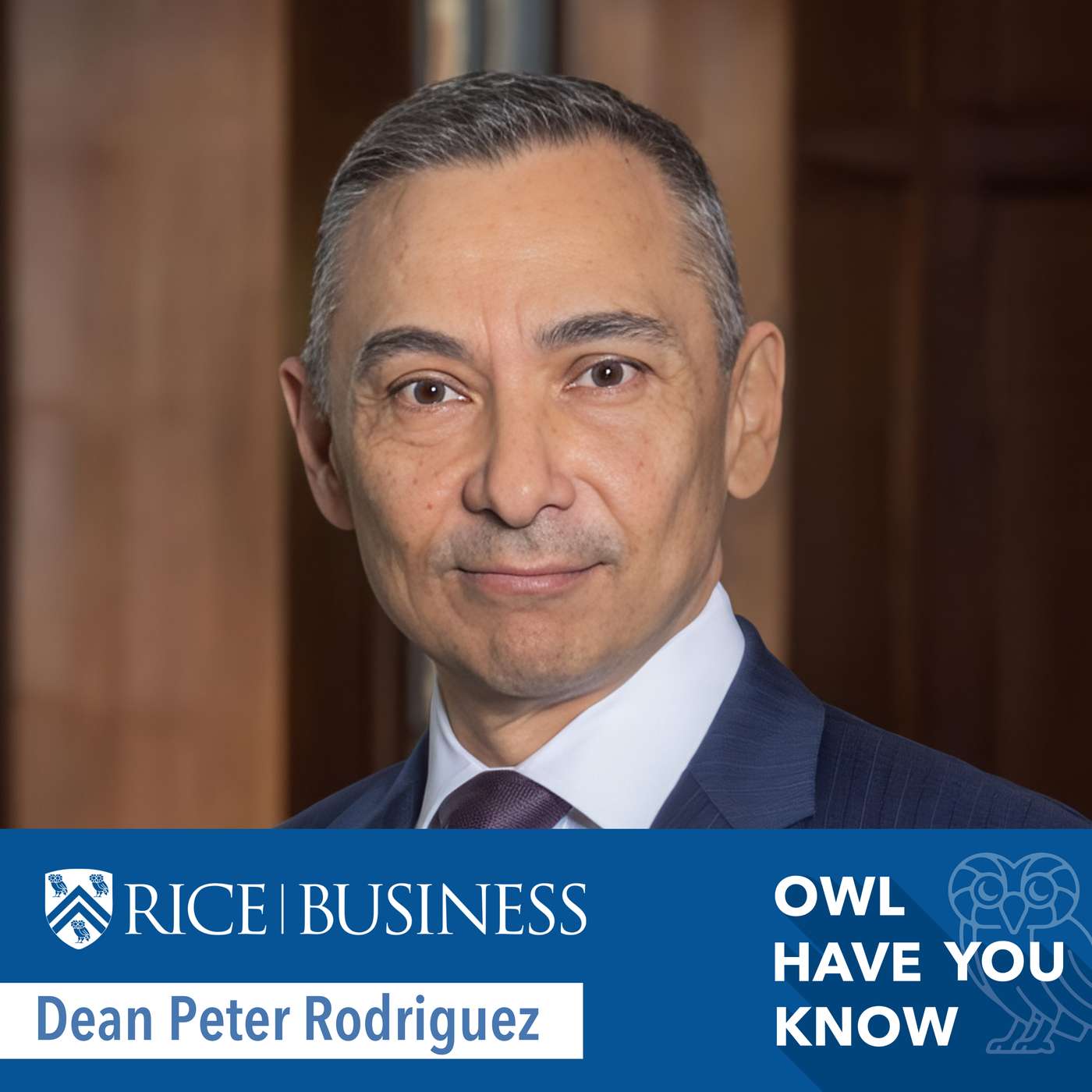
Over the past decade, Rice Business has scaled with intention.MBA enrollment has doubled. Faculty ranks have grown. New MBA formats have launched. The Virani Undergraduate School of Business was established. And a new building will open soon, designed to further fuel collaboration, research and innovation.In this conversation, Dean Peter Rodriguez reflects on the strategy behind that momentum — from championing the Online MBA to building one of the nation’s strongest entrepreneurship ecosystems in the heart of Houston. He discusses AI’s impact on business education, the evolving energy landscape, and the leadership lessons that come with guiding a school through rapid transformation, all while shaping the next chapter for Rice Business.Episode Guide:00:00 Meet Dean Peter Rodriguez01:20 Online MBA Origins and Vision for Growth07:50 Virtual Campus Advantage09:41 From Space Crunch to Expansion: Designing the New Building16:29 Launching the Virani Undergraduate School of Business21:51 AI and Business Education28:46 Dean Life and Daily Headwinds29:23 Why Rice Ranks High & Houston’s Entrepreneurship Advantage36:32 What Deans Learn on the Job43:37 Next 50 Years Vision48:25 ClosingThe Owl Have You Know Podcast is a production of Rice Business and is produced by University FM.Episode Quotes:On Rice MBA’s Growth over the decade01:37: If there was one overarching theme of the last decade, I think growth is it. The question is always like, well, why growth? Or growth for what? And of course, clearly want growth for the good outcomes, and that good outcomes all start with pursuing the mission.We have a mission to create and disseminate knowledge at the vanguard of business and the business disciplines. And so that is what we really do. And when I was really looking at the job almost exactly 10 years ago and thinking about where Rice was and where it needed to be, one of the first conclusions that was easy to draw was that it needed to be about twice as big as it was, at least, you know, and, and it is not that growth is all good, but why would I say that? And the thinking was, you know, in order to advance that mission, we needed more tenure track faculty. And there the foundation on which more or less everything else proceeds.How does the Rice Business navigate AI? 22:19: On the basic part of our mission, which is delivering an education, we have to do two things. We have to prepare people to think really critically and to be able to assess them as individuals without this incredible, unprecedented tool. That is to say, what can Peter do of his own accord? What does he know? And then I have to train him very aggressively to make sure that with the tool, he is also highly capable, far more capable to do some things, and as capable as anybody in any university in the country is using the tool. So there's sort of almost sounds like martial arts mastery. You know, you have to sort of, wax on, wax off, you know, learn these sort of things that are apart from the tool, and then you are sort of empowered. That's where we are, is trying to do that.Houston loves risk takers30:59: Houston loves risk takers. It is part of the environment, it is part of a Texas thing too, but, you know, it is going to space, drilling out in the Permian Basin or deep in the ocean, putting in an artificial heart, whatever it is. I think there is a real admiration for trying hard things and picking yourself up if you fail and not being discouraged because things did not go right the first time.Show Links: Rice Business New Building PlansTranscriptGuest Profile:Peter Rodriguez | Rice BusinessLinkedIn
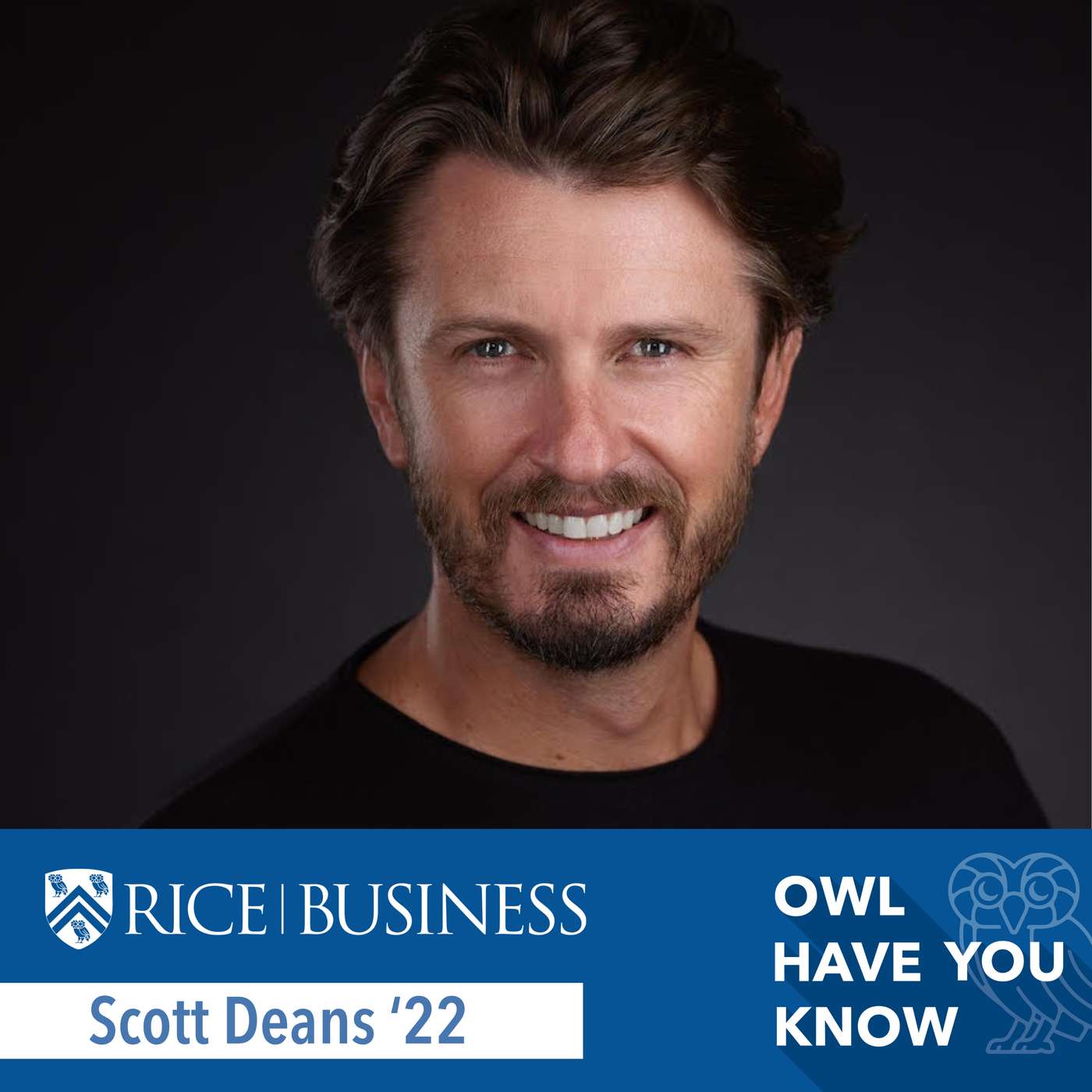
Leveling up your game just got so much easier, thanks to the new cutting-edge technology from BeONE Sports — a startup that uses mobile motion-capture and AI to enhance athletic performance, prevent injuries, and support coaches and athletes at every level.Co-founded by former Division I athlete Scott Deans ’22, the idea for BeONE started right here at Rice Business. Scott has loved sports since his days playing football, and through the EMBA program, he found a way to bring his passion and business acumen together.He joins co-host Brian Jackson ’21 to discuss his early career journey through architecture, the 12 years he spent at bp and what ultimately led him to Rice Business. They also dive deep into the exciting technology being used at BeONE and how the company’s partnership with Rice Athletics is helping student athletes optimize their performance and prevent injuries.Episode Guide:00:00 Introduction to Scott Deans and BeONE Sports01:02 Scott's Athletic Journey and Transition to Architecture05:55 From Architecture to Analytics at BP12:56 Pursuing an MBA at Rice University16:36 Founding BeONE Sports and Its Technology28:23 Partnerships and Applications of BeONE Sports37:44 Challenges and Advice for Entrepreneurs42:20 Conclusion and Final ThoughtsThe Owl Have You Know Podcast is a production of Rice Business and is produced by University FM.Episode Quotes:On building company your passionate about19:35: I sometimes imagine if I had chosen the other, one of the other companies, and I was like, there is no way I would be here after four years, grinding through the trenches, as they say, on something that did not matter to me. So, yeah, I think that is a huge, huge point in any entrepreneurial journey, that it has to matter to you; otherwise, you are not willing to compromise and go through all the pain in order to make it successful.How the Rice program helped Scott build his business28:30: So another big piece of the program at Rice was really focused on, like, building a team. And I have been a coach for a long time. I have been part of teams and built teams, so teams are, in my opinion, the linchpin, really the basis for product and a business and all those things. But part of that process is everybody's recognizing what they are good at and what they are not good at, and then where you have gaps. You need to find people who are strong in those areas. So, recognize really quickly the areas that I am not strong at and, Jason, basically from a business side and many other sides, filled those perfectly.The importance of asking better questions09:55: Always try to ask better questions, and this has been a mantra of mine since I was a little kid. I think. Because, you know, there are always going to be answers. You can always find a solution. But is the solution the right one? And is there a better question we could be asking to, you know, a lot of rework or pivoting and changing. And so it creates a mindset of constant flux, like you are in constant change. And that is not an easy mindset for many people.Show Links: BeONE Sports “Rice partners with BeONE Sports to transform athlete performance with AI technology” | Rice BusinessTranscriptGuest Profile:Scott Deans | LinkedIn
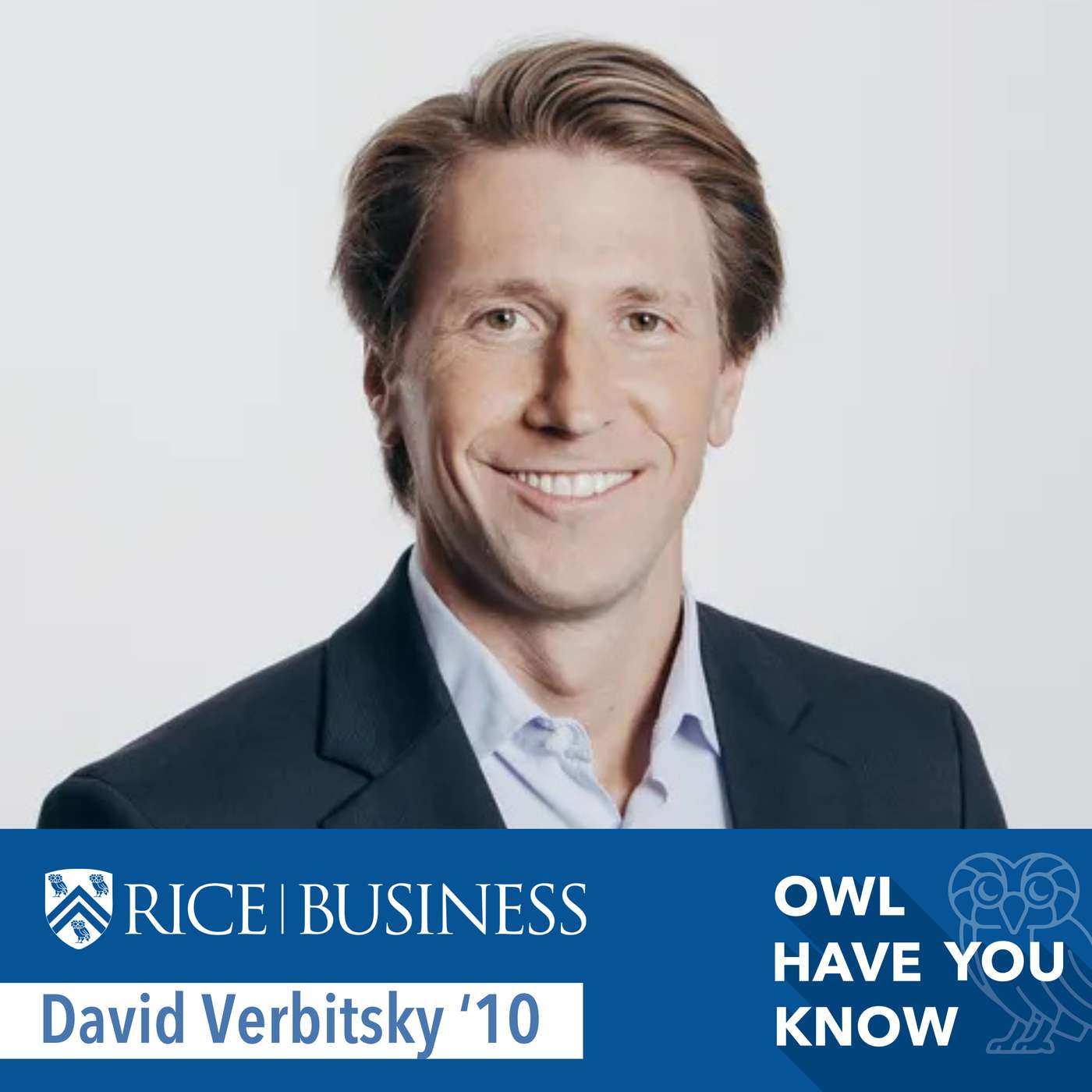
Not every job will feel like the perfect fit, but for David Verbitsky ’10, every new position is an important stepping stone in your career, and an opportunity to learn and grow. When David wanted to pivot his career from engineering to finance, the path led him straight to an MBA at Rice Business. His experience at Rice spring boarded him into a career in investment banking with a special focus on agriculture and food. Over the past 15 years, he’s worked as the global head of agriculture and nutrition investment banking at Goldman Sachs, as the global head of AgTech and sustainable food investment banking at Nomura Greentech, and as a member of the global chemicals and agriculture investment banking team at Barclays.Now, David is applying all of his industry expertise to his own investment banking firm, Verbitsky Capital. In this episode, he chats with co-host Maya Pomroy ’22 about how Rice Business prepared him for a successful career in finance, what he learned through every job change and where he thinks innovation in the agriculture sector is heading next.Episode Guide:00:00 Introduction and Guest Welcome00:59 David’s Early Career in Engineering03:06 Transition to Business School and Finance06:09 Investment Banking Journey08:59 Shift to Agriculture Sector18:20 Navigating the VC Fund Experience21:30 Exciting Deals in AgTech23:24 Challenges and Lessons Learned29:44 Building and Leading a Team with Verbitsky Capital31:37 Future of AgTech34:35 Career Advice and Final ThoughtsThe Owl Have You Know Podcast is a production of Rice Business and is produced by University FM.Episode Quotes:The importance of judgement in every leader31:19: [Maya Pomroy]: What do you look for in leaders?31:26: [David Verbitsky] I do not really know if you can quantify or measure it, but it is judgment. The only way you can really see that is seeing people in action, right? It is seeing, okay, when you are in a difficult situation, or maybe it is not even difficult, but when you have to make decisions. And take responsibility for things. And some of it is, could be very easy, like simple things who just, we are in the middle of a deal and you gotta just decide on what, how you move forward. Right. How do you take decisions? How do you move forward? How do you take accountability? How do you, in certain circumstances, decide not to do something? Which is probably more important in many different ways.On networking and constant learning36:16: [Maya Pomroy]:What would you say to someone that is sort of considering maybe an MBA to really pivot their own career.36:25: [David Verbitsky] So first and foremost, I would say it is all about relationships. And her ability to, to maintain them. Right. That, that is part networking, but it is also just part effort of just people you already do know. Maintaining those relationships. Do you think that is first and foremost is the most important thing? Do not burn any bridges. Right? Keep them, keep them all active and then building off of that just sees opportunities when they present themselves, be open to things. Because they might be the wrong choice, but. You should learn something from every new step you take.From missteps to momentum37:04: Going to Goldman Sachs and switching a hundred percent into agriculture was a big opportunity, which I was like, I do not know, but let us try it out. Right? Those things worked out incredibly well. And then I had a bunch of missteps of like trying, trying to go and do startup or VC fund that just was not the right fit, or go into a place that was good for a while, then was not, and then just, it leads you here. So like. Realize when an opportunity presents itself and do not be afraid to take it. Which is the right piece of advice. Just be aware and realize this is an opportunity. Maybe it is not the right one, but be, I think, very mindful.Show Links: TranscriptGuest Profile:David Verbitsky | LinkedInVerbitsky Capital
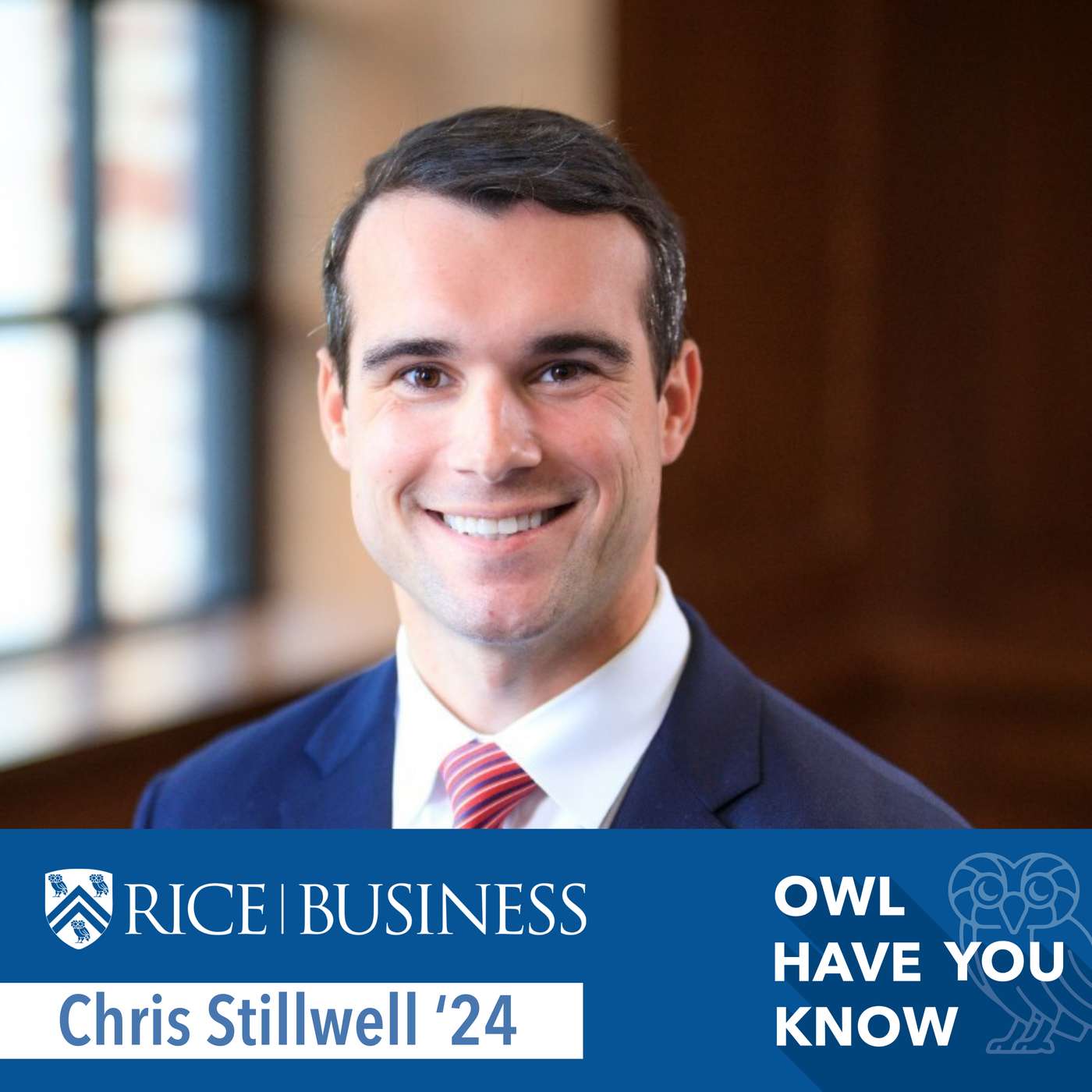
When it comes to working in military intelligence, strong leadership skills and the ability to make quick decisions under pressure are key. Just as important to a mission’s success is being a good team player.Those were the lessons and skills Chris Stillwell ’24 carried into his two career pivots after his time working as a military intelligence officer for the U.S. Army. His first pivot landed him a role at Kearney in Dubai focusing on M&A integration and strategy consulting. Chris then decided to pursue an MBA at Rice Business to sharpen his financial skills and pivot once again into the world of investment banking. Now an investment banking associate at Bank of America, Chris joins co-host Brian Jackson ’21 to discuss his military experience, why he chose Rice, how the program helped him make a major career transition, and his advice to those considering an MBA to pursue new career opportunities. Episode Guide:00:00 Introduction to Chris Stillwell01:03 Military Intelligence: Separating Fact From Fiction02:15 Roles and Responsibilities in the Army03:08 Leadership and Decision Making in High-Pressure Situations08:07 From Military to Consulting09:49 Living Abroad: Challenges and Cultural Insights15:02 Transitioning to an MBA at Rice University18:13 Involvement and Networking at Rice20:56 Entering Investment Banking: Preparation and Challenges25:37 Day-to-Day in Investment Banking28:46 Advice for Career Pivoters and VeteransThe Owl Have You Know Podcast is a production of Rice Business and is produced by University FM.Episode Quotes:The moment Chris realized that Rice gave him an edge over his peers[20:48] Brian: Going into investment banking, was there, like, now an elevated sense of confidence of, Okay, I've done this before; I'll do it again?[20:56] Chris: Maybe some blind confidence sometimes. Yeah, you could even ask my parents. I went home for like four days for the Christmas break the year I was recruiting. And I was studying flashcards with my mom of all the IB 400 questions. And I was like, “I'm not going to get a job. You know, like all these people around me are much smarter than me. There's a really—we've got a really talented pool of candidates that are recruiting this year.” But you know, I felt like at the end of the day, the Finance Association and Rice, just the classes I took, really prepared me to understand the basics of finance, the basics that are expected of the interview process. And then, going forward, I saw when I started as an intern at the bank, I went to New York for a week…We were training with all these people from all these different schools, going to all these different groups in the bank, and some people didn't even know what a DCF was or didn't know how to do it that well, I should say. We were doing some practice problems, and I was like, “Wow, we’re actually far ahead of a lot of these other schools and people.” So that was kind of good to see that Rice really put an effort into training us up. What Chris learned about leadership through three career pivots[30:15] There are certain people who can be leaders and are very good at being leaders. But being a good leader in the military might not translate to being a good leader at banking. And a lot of times you actually see that, or you see military officers leave the military and go into the corporate world and not be as successful. Because I really think you do need to tailor your leadership style to the one the industry you're working in, and two, the people you're working with, you know, different ways of operating motivate people differently. Like in the military, you could yell at somebody and hold them to a higher standard and maybe they'll do it. But if you yelled at somebody like, you know, a marketing job, they probably would shut down and that'd be the end of it. It really doesn't work the same. The leadership style is something that you have to adjust to the area you're working in.On how his military experience strengthened his teamwork skills[04:03] In the military, you are a leader, but you learn how to be a good follower as well. And I think what you do with that is that you are able to have great teamwork. You're able, like in my current job now, I have an analyst underneath me, but I have people like VPs and MDs above me and I can understand what their intent is and what we need to get accomplished in our day-to-day job, but also articulate to the people below me, Hey, this is the intent and this is how we do it. So it's kind of been very helpful in those soft skills.On how Rice gave him the academic foundation he needed[16:49] My reasons for going to Rice were great, but once I got there, I appreciated it a lot more. I really got exposed to, I mean, I was looking for some things like smaller classrooms for example. Like a lot of people we hire from Kearney were from Yale or HBS, and their class size was like a thousand people. And maybe you didn't have a lot of rigor in terms of academics. I think Rice, especially in the first term, really forces you to go to classes to do your homework, to learn the materials. And that was attractive to me as well, because I didn't come from a finance background at all. So I didn't even know what a DCF was before I came to Rice. So I was very grateful at that, you know, getting to Rice and realizing that it was such a good platform to be integrated into.Show Links: TranscriptGuest Profile:Chris Stillwell | LinkedIn
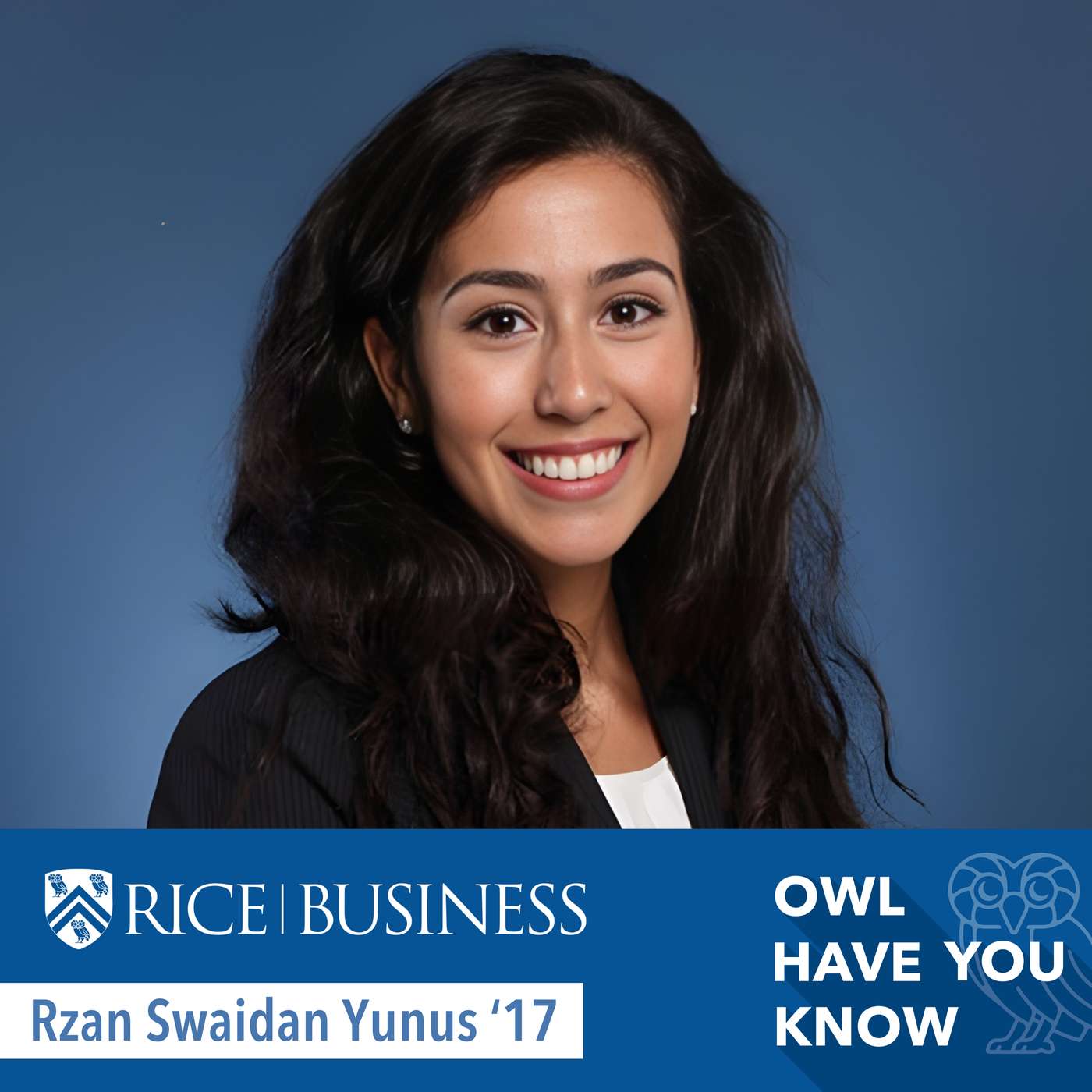
As a first-generation American from Saudi Arabia, Rzan Yunus ’17 learned from an early age what ambition and perseverance can lead to. She credits her immigrant father’s determination to build a successful career and life for his family in the U.S. as inspiration for her own strong work ethic and drive. It was that drive that led her first to a career in insurance at American International Group (AIG), and eventually all the way to Rice Business. Since pivoting from insurance into consulting, Rzan has put her Rice MBA to use as a senior director at Alvarez & Marsal, where she’s helping companies solve tough problems. Rzan chats with co-host Brian Jackson ’21 about how her father’s pursuit of the American dream inspired her, the critical skills she picked up at AIG, why she was drawn to the Professional MBA program and how her experience at Rice has left a mark on her forever. Episode Guide:00:00 Introduction to Rzan Yunus01:00 Early Life and Family Influence05:39 Career Beginnings at AIG09:40 Pursuing an MBA at Rice18:28 Transition to Consulting23:07 Current Role and Consulting Insights35:40 Balancing Career and Personal Life39:46 Conclusion and Final ThoughtsThe Owl Have You Know Podcast is a production of Rice Business and is produced by University FM.Episode Quotes:Finding community, support, and belonging at Rice[12:32] When you learn entrepreneurship, you learn to hustle. You learn to think like an owner, or take accountability to be resourceful, to drive results. I really appreciated Rice's pathways with other organizations and other companies, particularly consulting. I knew I wanted to explore that eventually and knew that they recruit based on certain programs. And then my favorite thing about Rice, and when I went and visited, is the team and peer atmosphere. You know, you spend so much time at work, but you also spend so much time in this program. And the people that I met and the camaraderie and the collaboration and the fact that you rarely ever achieve anything alone in life. I really wanted to be surrounded with people that were smart and hardworking and capable and collaborative and supportive. Very similar to the support system that I think everybody needs in life to be successful.Why the MBA program was an important investment in Rzan’s future.[16:17] My two years in the program, and I think I said this earlier, it really changed my life. I am becoming and am the person now that I never thought I could have been 10 years ago, 15 years ago. I mean, the program is hard. It's a top MBA program for a reason. Balancing school and your personal life is difficult. Working full-time while earning an MBA is not a casual commitment, but it's the most important step that you can take to invest in yourself. Surround yourself with people that reflect the ambition and the dedication that is contagious. Why she chose to pivot to consulting[19:11] I chose consulting because I loved the variety of work that they got to do, you know, in every year, and this was something that really attracted me to it when I was meeting with people from Alvarez & Marsal. You know, you work in different industries and different projects. One year you might be doing a transformation for a media company. The next, working on a financial services operational improvement. The following year on a manufacturing cost reduction. And I think that continuous learning really appealed to me.Show Links: TranscriptGuest Profile:Rzan Yunus | LinkedInRzan Yunus | Rice Business
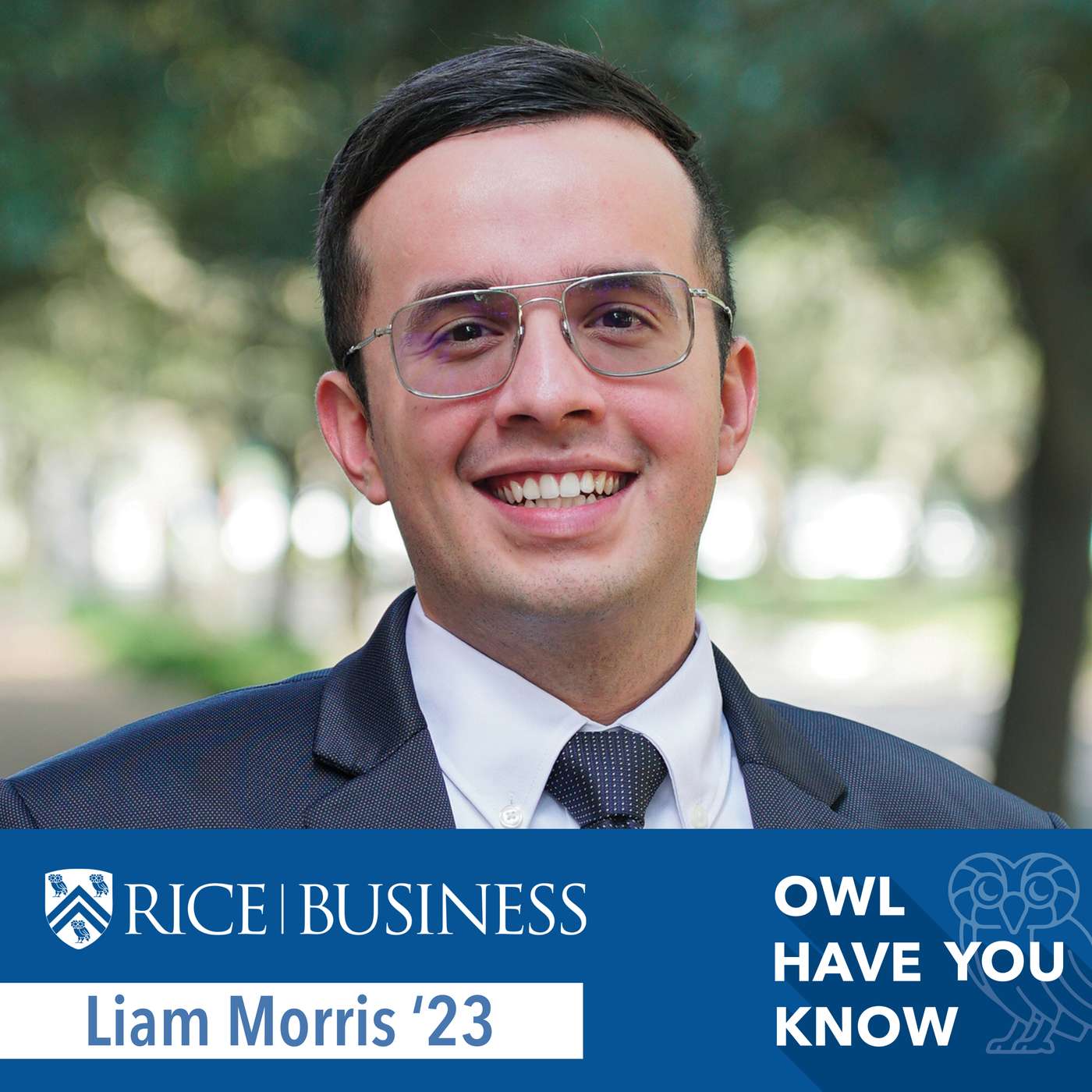
Liam Morris ’23 manages one of the most complex corners of United Airlines — airport operations quality control across more than 80 stations spanning Latin America, Central America and the Southwest U.S. In this conversation, he shares how early travel experiences opened the door to a career in aviation, the path that led him from loading bags in El Paso to overseeing global safety audits, and what it takes to lead with precision, clarity and calm under pressure.Liam also reflects on United’s customer-centric transformation, the moments that shaped his commitment to the industry, and how the Rice Online MBA gave him the flexibility and confidence to grow as a leader while navigating an ever-moving, always-on operational world.Episode Guide:00:00 Introduction to Aviation and Role at United Airlines00:29 Ensuring Safety and Compliance in Airport Operations02:56 Passion for Aviation and Early Influences06:08 Managing Multiple Stations and Time Zones08:00 Why United Airlines Stands Out12:16 Best Flight Experience and Customer Insights13:54 Decision to Pursue an MBA at Rice19:58 Mutual Learning and Decision Making22:27 Leadership Growth and Student Association26:47 Career Journey and Future Goals30:02 Travel Tips and Flying Etiquette37:19 Conclusion and FarewellThe Owl Have You Know Podcast is a production of Rice Business and is produced by University FM.Episode QuotesFrom cleaning planes to leading global operations25:34: I never, ever envisioned that I would be where I’m at now, and I can honestly say from when I was a business partner with United — cleaning aircraft and loading bags for another company, right — but working the United product, I never had a plan to get to where I was. My internship with United came up out of nowhere, and I moved to Jersey. Then, midsummer, I got a full-time offer to stay, and I transferred schools. You know, at the very last minute, I went up to Rutgers from UT El Paso. And then, you know, an opportunity came to transfer to Dallas, and there I ended up. You know, our CEO lives there. Ended up meeting him and a lot of executives all the time, and my name got out there really great. And then I came down to Houston to go to Rice as an assistant manager here in the airport. Then I finished my B.A. and went into the current role that I’m at, which is safety and regulatory. I can honestly say I never really had a plan to get where I was, but I’m thankful that I was always willing to walk through the door, because every single opportunity that I’ve had — both promotion and a lateral — was a great move, and it was such an instrumental, pivotal move.On being part of something bigger than yourself04:06: I wanted the ability to be in an industry where I am a part of something bigger, right? And being a part of an airline is really cool because even though, you know, my work now may not directly affect a flight leaving on time out of here, it does affect the customer experience some way. So I just wanted to be a part of a really, really big machine that gets people where they need to go.Show Links: TranscriptGuest Profile:Liam Morris | LinkedIn
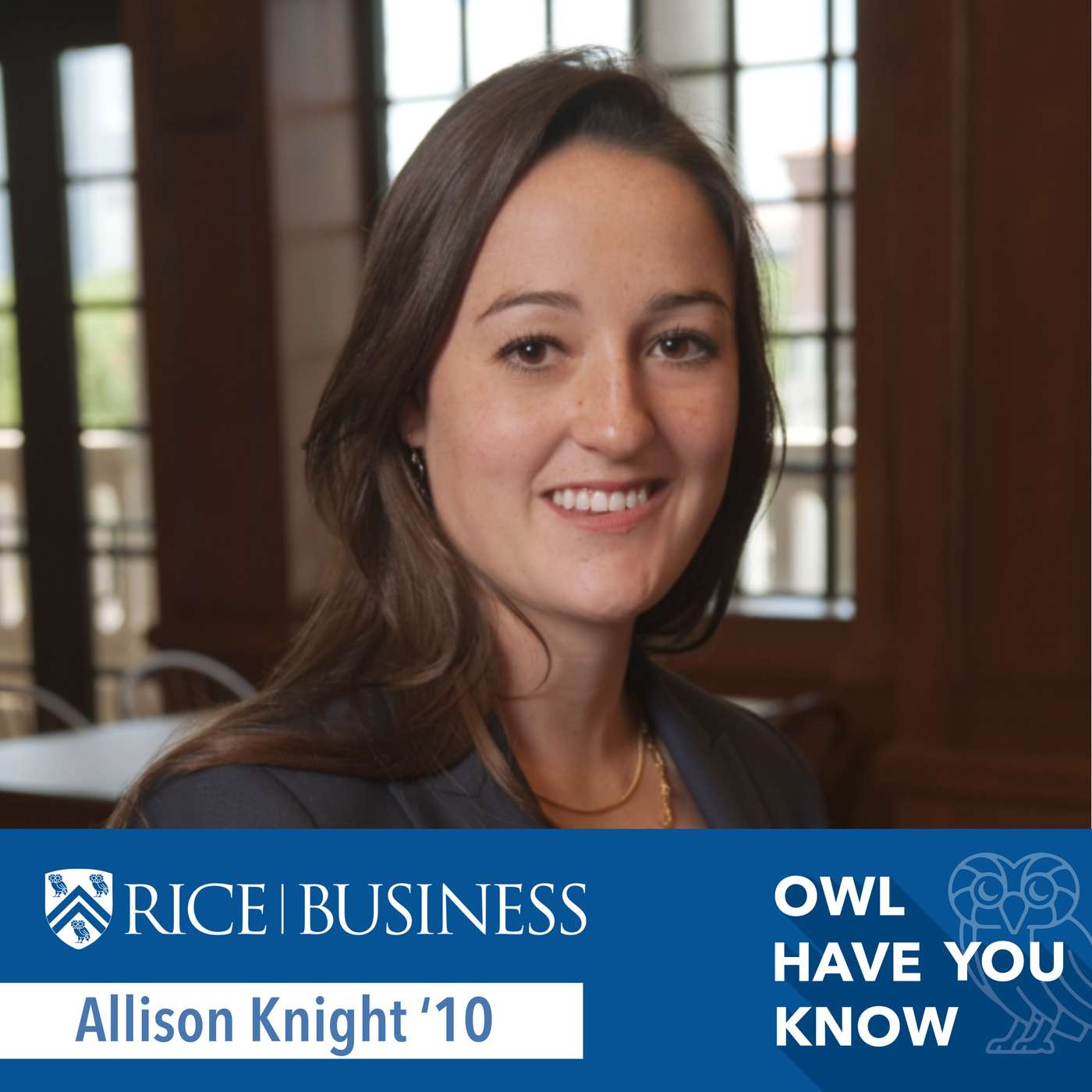
As the youngest founder in her Rice MBA cohort, Allison Knight ’10 knows a thing or two about blazing a trail. At just 24 years old, she co-founded Rebellion Photonics, which used cutting-edge technology to identify and quantify gas leaks on oil rigs, preventing catastrophic explosions. Knight went on to sell Rebellion Photonics to Honeywell in 2019, and is now codifying blue collar genius through Alaris AI. In this episode, Knight joins host Brian Jackson ’21 to discuss how Rebellion Photonics used early AI technology to improve hyperspectral imaging and revolutionize gas leak detection. She also opens up about her experience as a young woman founder in a predominantly male industry, her role as an adjunct professor at Rice Business and why she believes blue collar work is the next frontier for AI exploration. Episode Guide:00:00 Introduction to Allison Knight01:09 Founding Rebellion Photonics02:25 Challenges and Innovations in Gas Leak Detection03:48 The Role of AI in Rebellion Photonics04:26 Reflections on Being a Young Founder12:44 Lessons From Startup Life16:25 Introducing Alaris AI: AI for Blue Collar Workers23:35 Teaching AI at Rice Business27:52 The Future of AI in the Workforce32:44 Final Thoughts and ReflectionsThe Owl Have You Know Podcast is a production of Rice Business and is produced by University FM.Episode Quotes:On being a young entrepreneur12:17: I was 24. I was the youngest student in the Rice MBA program, and I had gotten a prestigious, semi-prestigious investment banking job that I had accepted. And then I did the thing you’re not supposed to do under any circumstances, which is renege on a job. They do not like that. But I am a physicist more than I am an MBA. Science and tech still make me the happiest. So, I ended up, even at Rice, just hanging out with Rice techies, like other applied physicists. Yeah. And it was just too tempting. I knew I should do the investment banking job, but I just could not do it. I had to go for this crazy methane emissions monitoring company. And I loved it.Allison’s first AI moment08:31: I think everyone will experience this, and I just happen to experience this 15, 16 years ago. It is your, like, AI moment—that first time where you run some code with AI. We had been trying to do real-time video detecting and imaging gas leaks in real time and kind of making do with it, and they were ugly. But then we brought in AI and started doing very, very, very, very basic machine learning, and it was just like magic, Brian. It was magic.On AI’s next frontier17:20: Pretty much across the board, AI really sucks for blue-collar work. With white-collar work, we can just boop, boop, boop—take the generic ChatGPT, and it works beautifully. And that’s because we, white-collar workers, have been typing for a long time. We’ve got all their documents in different folders, new ones, and so it’s all been trained on that for the most part. So it’s really trained on white-collar documentation and meant for it. Blue-collar documentation—basically, manuals and SOPs—has inherently always been stinky. But more importantly, none of the documentation has been done on what’s in their head, what’s in the foreman’s head, the supervisor’s head, or the individual’s head. And so, when you don’t have that data documented, structured, codified, the AI will be useless.Show Links: Alaris AITranscriptGuest Profile:Allison Knight | Rice BusinessLinkedIn Profile
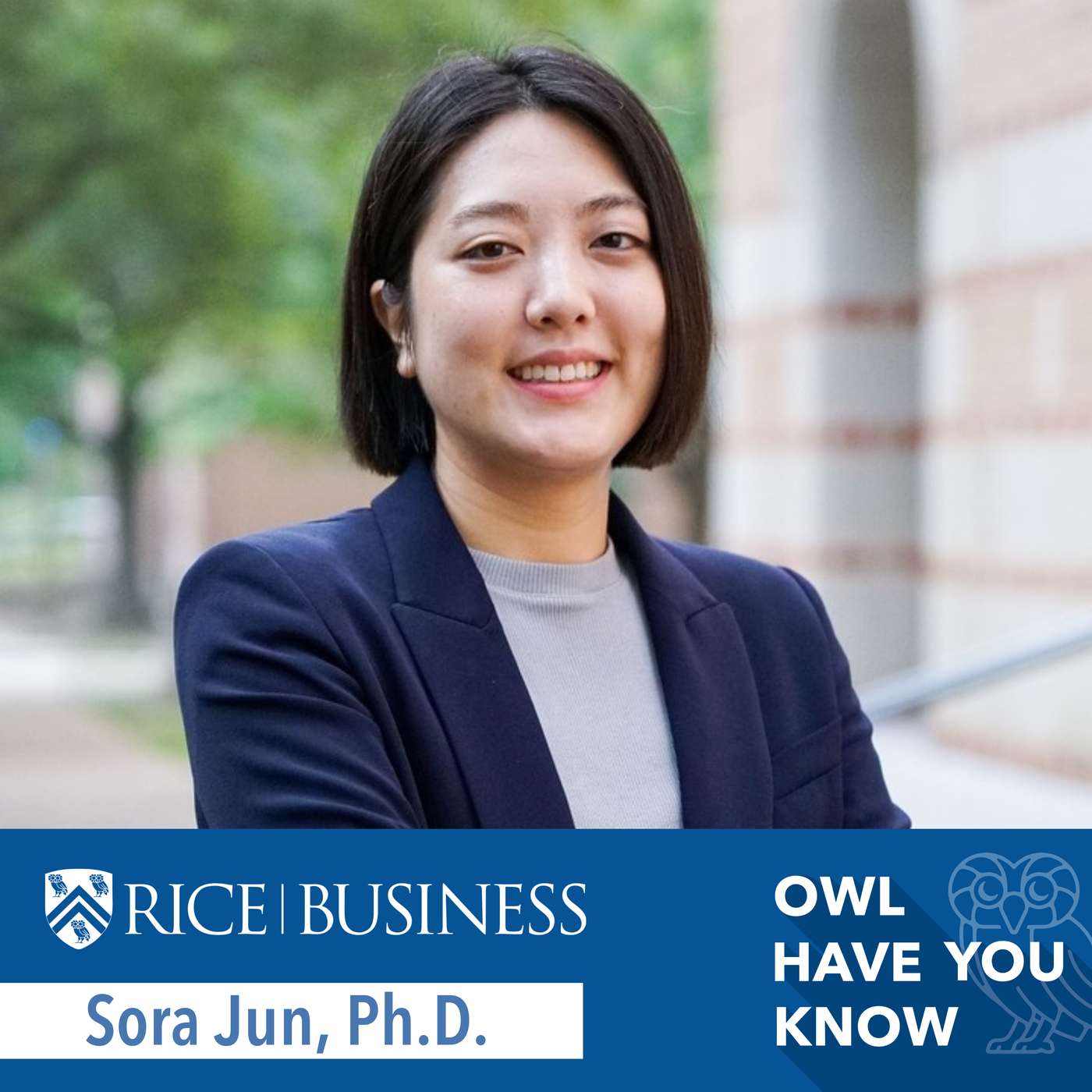
How does something as simple as a five-star rating system reveal subtle biases?When she’s not teaching MBA and undergraduate students at Rice Business, Sora Jun, Assistant Professor of Management – Organizational Behavior, studies the hidden forces that shape how we see and treat one another. Her work explores how our minds process inequality and how even small design choices, like switching from stars to thumbs-up icons, can make systems fairer. Host Brian Jackson ’21 sits down with Sora to discuss her research on the hidden bias of gig worker ratings, what she loves most about teaching at Rice, the findings of her latest paper and how her background has shaped her work. Episode Guide:00:00 Introduction to Sora Jun, Ph.D.00:58 Journey From Finance To Organizational Behavior02:20 Impact of Diverse Upbringing on Research05:05 Teaching Experience and Philosophy08:52 Research on Bias and Inequality17:50 Framing Inequality: Advantage vs. Disadvantage24:34 Exploring Anti-Asian Discrimination29:17 Future Research Directions30:56 Teaching Across Different Programs32:20 Final Thoughts and TakeawaysThe Owl Have You Know Podcast is a production of Rice Business and is produced by University FM.Episode Quotes:How embracing insecurity helped Dr. Sora on her research23:32: It actually took me a while to really feel like I had enough legitimacy in standing and studying this in some ways, because I felt like I did not really have the real, like, Asian American experience, given that I have been in so many different circles and I'm hearing so many different stories about what it means to be Asian for different people. But I think really embracing that insecurity almost was useful because I think it just made me dig in deeper and realize that might be part of that Asian experience—feeling like there are so many different kinds of Asian experiences. I'm sure this is similar for other groups as well, but I think I've just become more appreciative of just asking people, like, what's this been like for you? I started to do more qualitative-oriented work because of this, and I think that is helping me sort of reaffirm my own, I guess, standing and studying this topic.Why the way we talk about inequality matters14:52 [Brian Jackson]: Why does framing matter so much when talking about pay gaps or wealth disparities?16:08 [Sora Jun]: So, framing of inequality matters because even though what is being talked about is logically equivalent for an advantage or disadvantage frame, people understand it to be very different. And then they focus on different, I guess, objects.On balancing the fairness of the gains of a binary system with the loss of nuance13:36 [Sora Jun]: I think that's a really tricky part. I do think it is a challenge if we were to imagine changing all these numerical rating scales to dichotomy scales. We would lose a lot of the fine-grained information. So it probably depends a lot on the context. I think from our study, what we were finding was that the ratings using a five-point scale were already quite inflated, so there was not actually a ton of fine-grained information to be had from even the five-point scale information.Show Links: TranscriptGuest Profile:Sora Jun | Rice Business
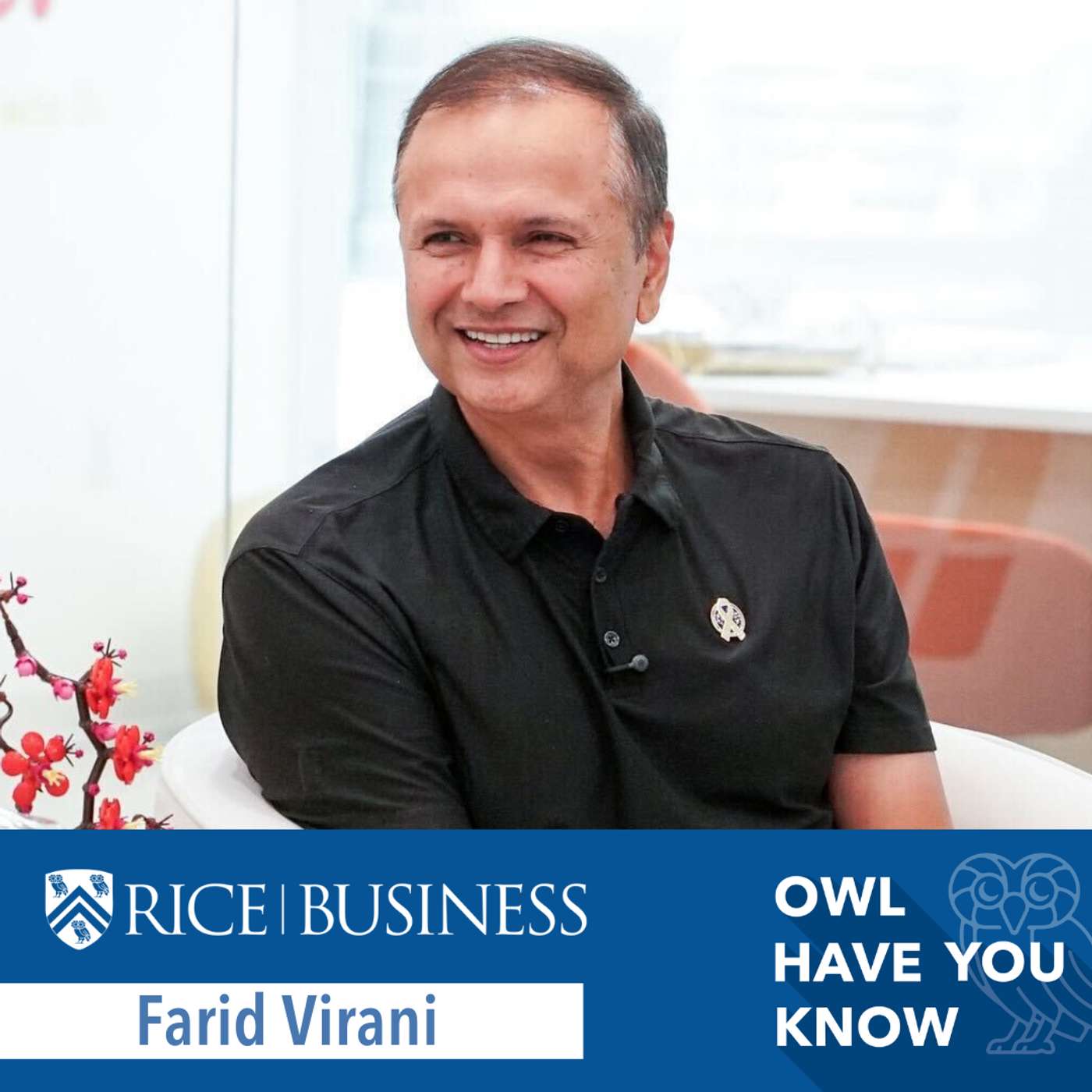
One year ago, the Virani family made a historic gift to Rice Business, establishing the Virani Undergraduate School of Business. To mark the occasion, Owl Have You Know welcomes Farid Virani — entrepreneur, philanthropist and proud Rice University parent.In 1999, Farid founded Prime Communications with a single storefront in Houston’s Baybrook Mall. Today, Prime Communications is the largest AT&T authorized retailer in North America, with more than 2,500 locations across the U.S., Canada, and Mexico. Along the way, Farid has relied on three guiding principles — "stay humble, hungry and scrappy" — which continue to shape his approach to business and life.He joins host Maya Pomroy ’22 to share his entrepreneurial journey, the Virani family’s commitment to education and community, and the vision behind the Virani Undergraduate School of Business — a school designed to empower the next generation of ethical, curious, and compassionate business leaders.Episode Guide:00:15 Meet Farid Virani: Entrepreneur and Philanthropist04:26 Building a Business Empire05:58 Philanthropy and Community Investment07:39 The Virani Undergraduate School of Business11:24 Leadership and Business Education17:32 The Faris Foundation: A Legacy of Giving20:25 Advice for Aspiring EntrepreneursThe Owl Have You Know Podcast is a production of Rice Business and is produced by University FM.Episode Quotes:How being agile can separate you from other business leaders14:13: So, everything is moving very fast. For the next generation of entrepreneurs, the business leaders not only have to build businesses and solve problems in society, but they have to be agile. They have to be fast. They have to embrace technology. That’s a lot of stuff that is coming their way. They have to find their own North Star as to what they’re going to do, and how you do it, I think, will depend on individuals—on their passion, on what they find exciting, what excites them. But more than that, to me, it will require a mixture of basic business fundamentals—doing the right things, building things, having great teams around—but embracing technology, not running away from it. Embracing change, not running away from it. I think that will separate successful entrepreneurs and businesses.What Farid hopes for the Virani School15:48: So, my hope is that the Virani School at Rice becomes a top 10 school in the country. Top 5. You said it. That is what we strive—I think Peter and the leadership will strive to do that. But more than that, for me, is that it becomes an institution—the Virani School—that develops the future leaders for the country. Now, whether they are in business, in entrepreneurship, whether it is in the political arena, or whether it is in any industry, so long as it develops leaders that give back to the community and give back to society, and give back to the country, then we will all benefit.Stay humble, hungry and scrappy21:02: Be curious, because you just do not know what life has in store for you. I mean, I think for me, being curious and asking questions about things has served me well, and obviously, be grateful that you are part of an amazing institution like Rice—even more special, the Virani School. But then, you know, stay humble, stay scrappy, and stay hungry, and that pretty much has served me well. And it is simple, you can remember it, and it is nothing fancy.Show Links: TranscriptThe Virani Undergraduate School of Business announcementGuest Profile:Farid Virani | Rice Business
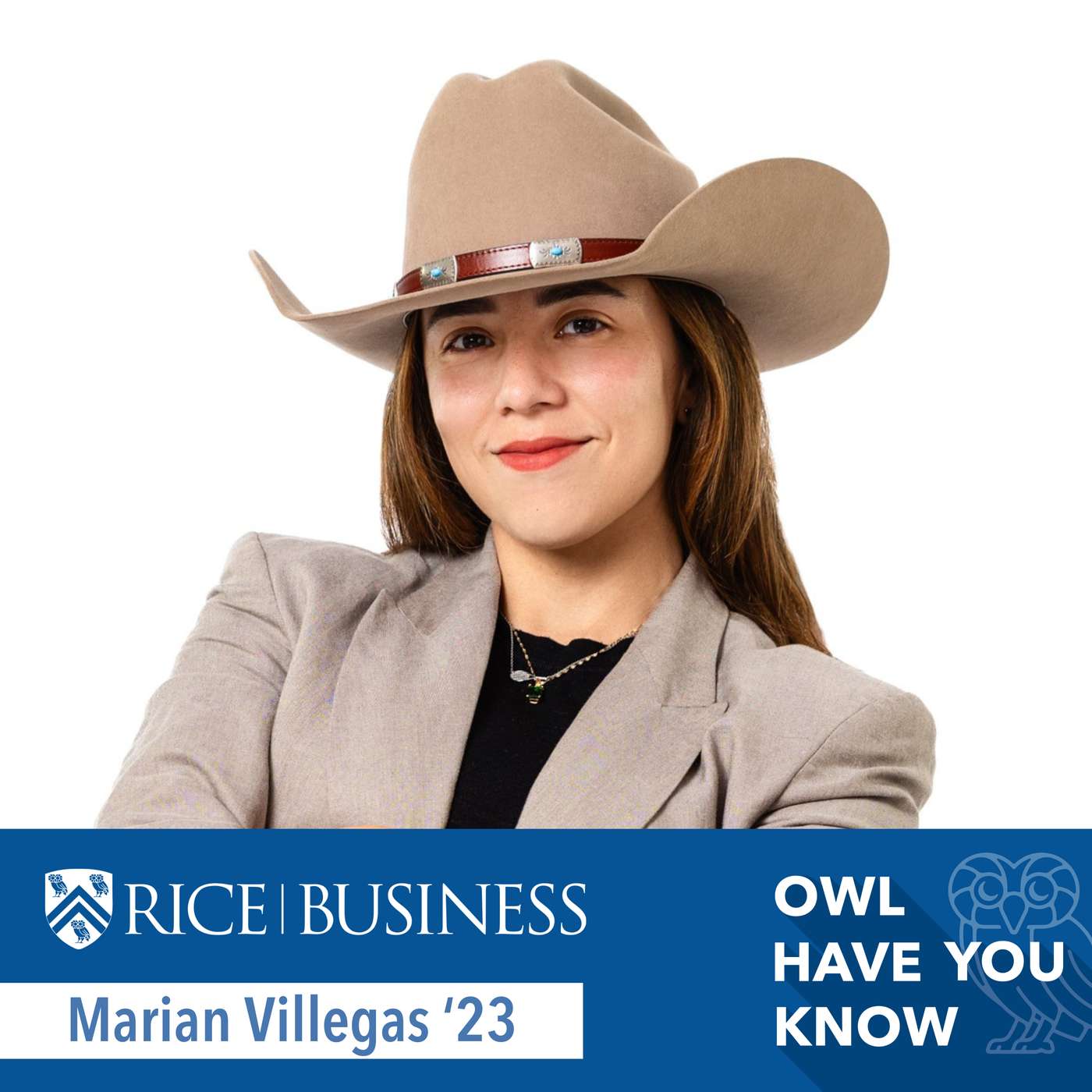
For Marian Villegas ’23, art can be found in everything — even petroleum engineering. Raised in Tabasco, Mexico, Marian grew up inspired by her father’s work in oil and gas and her own lifelong love of painting. That dual passion led her to a career in petroleum engineering — and eventually to Rice Business, where her MBA helped her grow in both her role as a senior asset manager at EDP Renewables North America and as the founder of her art studio, Mablueart.In this episode, Marian joins co-host Maya Pomroy ’22 to share how she’s built a career that bridges energy and art, the lessons she’s carried from Tabasco to Houston, and why creativity continues to guide everything she does.Episode Guide:01:38 Growing up in Tabasco04:37 Pursuing a Career in Petroleum Engineering09:51 Transition to the United States and Career Growth14:05 Discovering and Nurturing a Passion for Art18:57 Exploring Graduate School and MBA Programs23:43 Starting Mablueart26:15 Incorporating Unique Elements Into Art33:12 Future Goals and Teaching at RiceThe Owl Have You Know Podcast is a production of Rice Business and is produced by University FM.Episode Quotes:Seeing petroleum engineering as an art[6:13]: So I wanted to have a good understanding of that [petroleum engineering] from a guy who was leading an entire organization. So I went there. He was extremely nice. He saw me, he’s a very sharp guy. And then the minute he saw me, he was like, “Okay, Marian, I guess those are all your questions. I’m going to just talk about petroleum engineering. You don’t need to tell me questions. I will just tell you my story.” And after an hour and a half — not 15 minutes — an hour and a half, of this amazing story, I fell in love with that, the idea of being a petroleum engineer. He’d talk about, “This is art.” You know, the words, the way he was explaining that to me, like a story… for me that was a: Yes, I want something that I can feel that passionate about. For me, it’s also art in a way.From oil and gas roots to pursuing art[3:59]: I grew up in this beautiful town. It’s a very small town, Tabasco (Villahermosa), but it is all about oil and gas. Everybody, every single thing, is about oil and gas. So I always loved art in a way — always reading art, always painting. I have been painting my whole life in different aspects, but I never thought about that as another source of income, in a way, as a business.When art as therapy becomes a business[17:06]: Until today, it [creating art] used to be my therapy, in a way. I would work the entire week, and during the weekends I would paint full-time. And for me, that was my escape. Today it’s also business. I have deliverables, I have people waiting. And my biggest fear was that, at some point, I would just stop enjoying this part of the art world because I needed to deliver. So that’s why I guess it took me so long to decide to make it big, as I did not want to see this as another job. I wanted to keep painting and seeing this as my therapy, and art is always, for me, the answer. But, I didn't want that to take away that creativity from me.Show Links: Mablueart.comThe Art of Networking with Marian Villegas – Nov. 1, 2025 at Rice UniversityTranscriptGuest Profile:Marian Villegas | LinkedIn
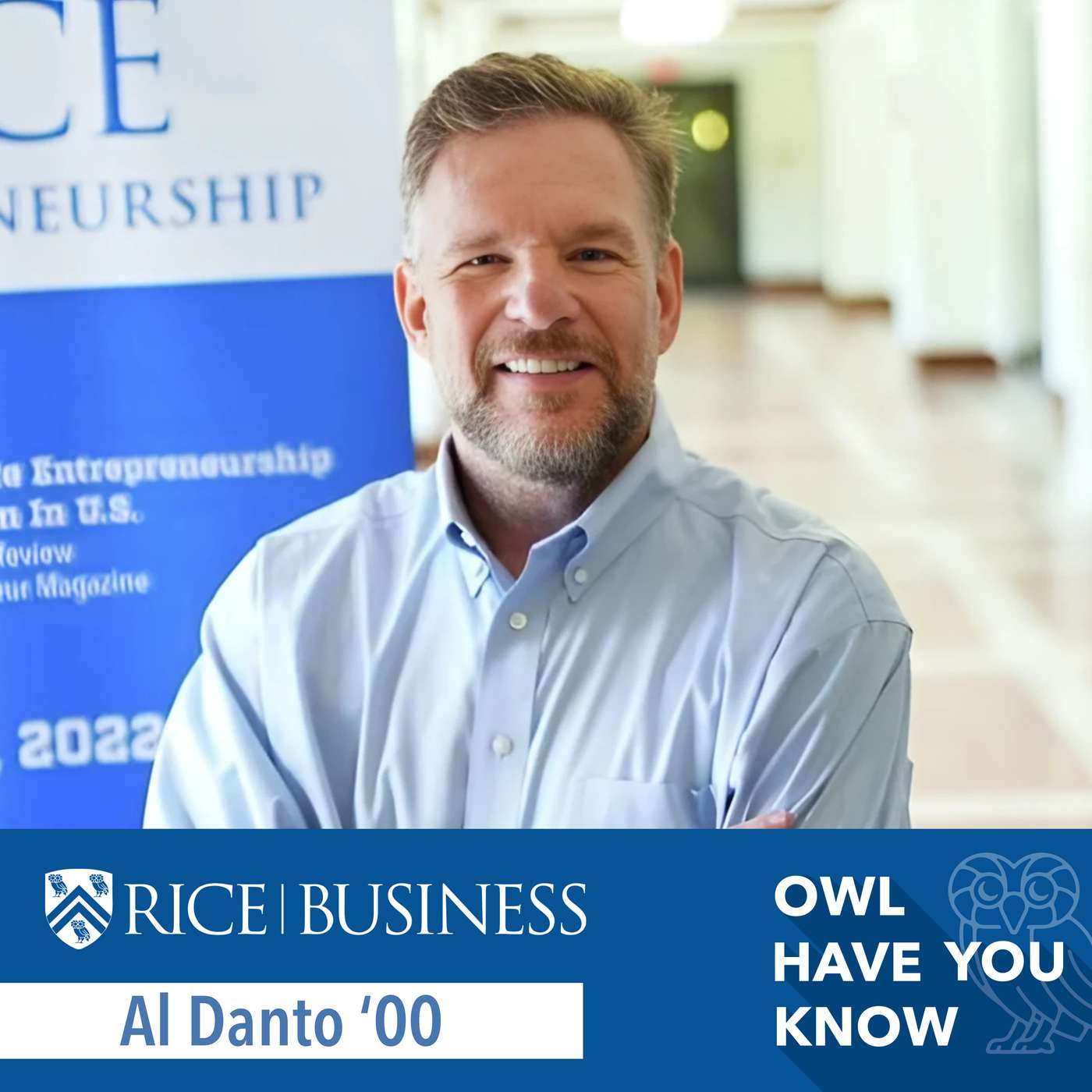
Al Danto, senior lecturer in entrepreneurship, has been a trusted mentor and beloved member of the Rice Business community for more than two decades. A serial entrepreneur, he launched his first company at the age of 23, growing it through multiple acquisitions before selling to a private equity-backed group. After earning his MBA at Rice Business, he returned to teach New Enterprise, Enterprise Acquisition and their corresponding E-labs – guiding students as they build and acquire businesses of their own. He is also a driving force behind the Veterans Business Battle. Beyond his professional success, Al has had a personal journey few could imagine. In May 2022, Al experienced two life-threatening medical crises and was placed on advanced life support. Sixty-five days later, he walked out of the hospital determined to return to the classroom, and by October, he was back. In this episode of Owl Have You Know, Al shares his extraordinary career journey, his story of recovery and why he urges everyone to “grab life” and make a difference. Episode Guide:00:22 Meet Al Danto: The Entrepreneurial Legend01:01 Al Danto’s Early Ventures and Successes07:56 Scaling the Business and Strategic Exits12:32 The Rice MBA Experience16:55 Launching Universal Worker20:31 Rice Alliance and the Rice Business Plan Competition25:52 Teaching and Mentoring at Rice29:22 Identifying the Secret Sauce of Successful Entrepreneurs33:42 Personal Health Challenges and Overcoming Adversity43:38 The Role of Mentorship and Support in Success49:00 The Veterans Business Battle: Supporting Veteran Entrepreneurs51:24 Vision for the Future of Rice UniversityOwl Have You Know is a production of Rice Business and is produced by University FM.Episode Quotes:On the tough realities of entrepreneurship and success[26:44] Maya Pomroy: For people to sign up to really take these risks, what do you think that it is that you bring? That people are so excited about.[26:53] Al Danto: First thing I try to do is talk you out of it. It’s not easy. I mean, it’s tough. You have — it’s really hard. I mean, you see a lot about the glamour, and you see all this stuff. You know, 80% of business startups — fail. I think at Rice, what we do is we have a fertile ground, right? To plant these seeds in. You have support. You have nurturing, and you have everything, but it’s a tough road. To me, a lot of it is you make the decisions. I personally think, for most cases, if you start a business, the success or failure comes to you. You know, 86% of plane crashes are pilot or human error. Which we talk about in class. And I think entrepreneurship is pretty similar.On making ideas real and sustaining Rice’s entrepreneurial legacy[28:50] The reality is you have to get out there and you have to do it, and you have to make these things real. And I think, you know, we’ve done that. It’s kind of in our DNA. And so now, five years, six years in a row now, the No. 1 Graduate Entrepreneurship Program — it’s not because of me, it’s because of what was started long ago, and it’s because of support. And now our alumni come back in, and they say what they’ve done — the good and the bad — that we bring back in.Believing in something bigger and rowing together at Rice[50:30] I think it’s important to have something that you believe in. I think if you can’t believe in, and anytime you see a military veteran, they put their life to go give us freedom. And a couple years ago, one of the veterans told me the best way that you can show our support is not to thank us, but to go out there and take advantage of the freedoms that we have. I think entrepreneurship is one of them as well. So it’s really been great, and every year these guys have not wanted to let the next person down, and they’ve stepped up and stepped into it. And I think that’s just not letting the next person down. And I think everyone that goes through Rice is going to experience that. It’s tough, but you’re in the rowboat mentality. We’re in this together, and we have to get through it, and y’all will. And that’s part of it.Show Links: TranscriptGuest Profiles:Al Danto | Rice Business
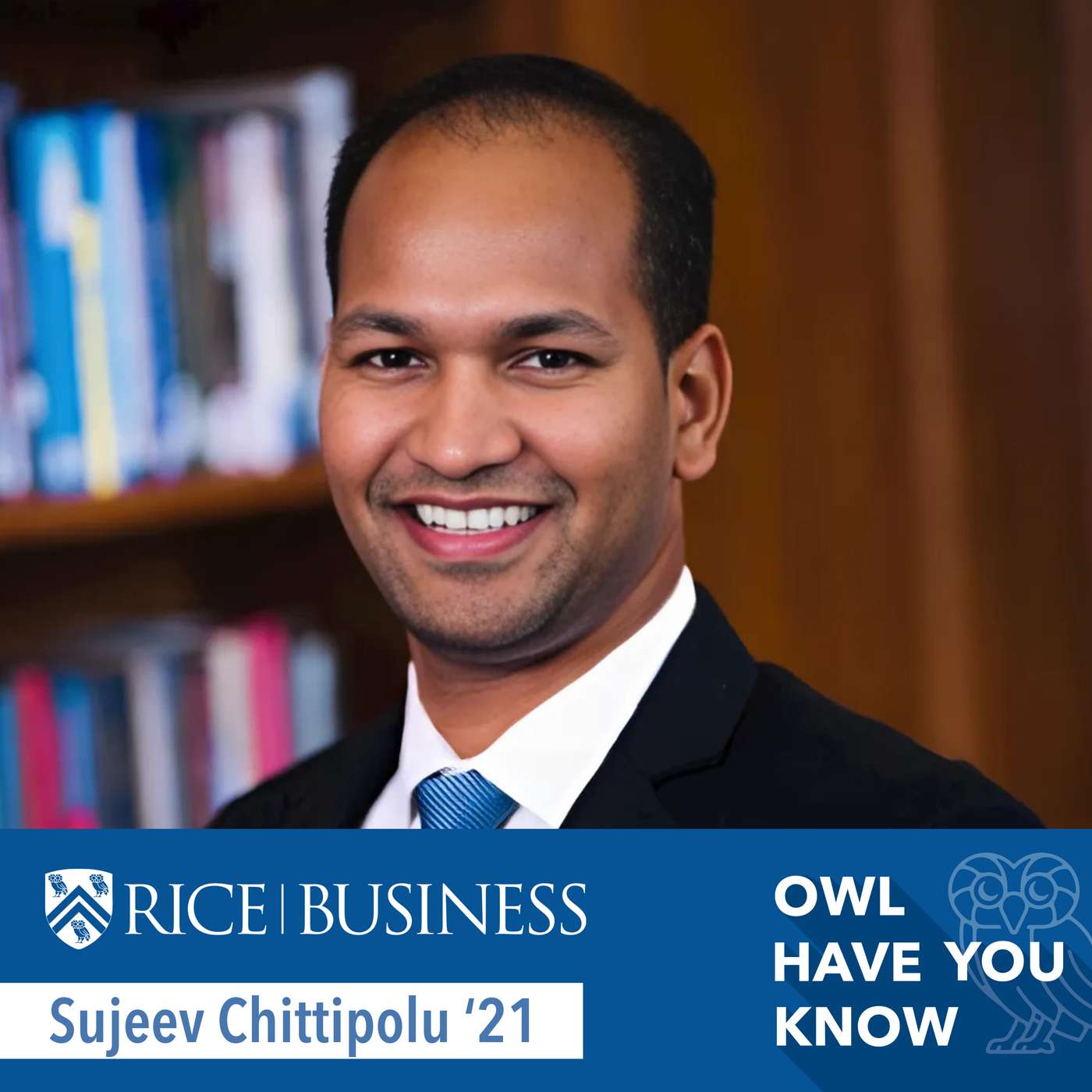
After many successful years as a mechanical engineer for Baker Hughes, Sujeev Chittipolu ’21 thought it was time to invest in his leadership potential. That led him to Rice Business. As part of Rice’s Professional MBA program, Sujeev formed invaluable connections through programs like CoachRICE and even joined the board of one of his classmate’s nonprofits — Amel Association Houston. Through Amel, Sujeev is taking what he learned at Rice Business and building leadership coaching programs for underserved youth in Houston, particularly in refugee communities. In this episode, Sujeev chats with co-host Maya Pomroy ’22 about his 16 years at Baker Hughes, how playing with machines in his father's small business shaped his interest in engineering, his work with Amel to give back to the community, and how the Rice MBA helped him put the final pieces together in his career. Episode Guide:01:30 Early Career and Education02:14 Journey at Baker Hughes05:37 Pursuing an MBA at Rice09:51 Giving Back Through AMEL15:19 Balancing Career and Personal Life16:00 Advice for Aspiring MBA Students16:43 Impact of Rice MBA on Career22:23 Staying Connected with Rice24:53 Future Aspirations and Final ThoughtsOwl Have You Know is a production of Rice Business and is produced by University FM.Episode Quotes:How coaching transforms a student’s confidence and future12:36: I would say one student named Musafa. He was initially not a student. He was active doing his things, but he was not very verbal in the class, right? [13:41] So as he worked with a coach, what we’ve seen was he could explore his inhibitions, he could set his goals, understand what were some of the drivers that were inhibiting his potential. And we’ve seen a clear change. He was about to quit high school. Yes, and working with the coach, it changed. He was over the process of a year, right? Two semesters, he became more verbal. He was confident in himself. He could understand what he wanted in life. He could realize, okay, I have a goal in career, and then okay, I can work towards it. So I think that one story kind of inspired more of us to come back and give. And it’s just like we’ve seen many of those, Maya, over the last three-plus years working with HISD.Shaping mindset and leadership through the Rice MBA16:19: [Maya]: So thinking back on before Rice and after Rice, what were some of the ways that your mindset has really changed because of the MBA that you worked for?16:32: [Sujeev Chittipolu]: So many ways. I think the way I look at problems and the way I look at challenges is very different now. I'm kind of more holistic in approach. I challenge myself much more based on the lessons I’ve learned during Rice, and even the leadership piece, right? Leadership not just at work, but I think leadership goes all the way — starts from home, through the community, at work. So you set an example for yourself. You set an example for your family members, so you’re learning always, trying to grow. So I think Rice has influenced me personally, professionally, and I think I keep continuing to reap rewards as I grow personally as well as professionally.On the hard work of growth and the rewards of giving back15:38: There is no easy way or there’s no shotguns in growth or in career. You have to differentiate yourself. You have to work hard to one, grow yourself and be able to give back. I think both of these. If you are passionate, if you want to grow, it’s not easy, but the journey might be tough, but the efforts are always rewarding, right? Giving back, you can see one story that is shared. It changes your perspective on life. It gives you things that show how grateful you are to be able to give back. So, take the leap forward. I think you always find time. There are weekends that you can stretch. There are days you know you need like one or two hours a day that you can stretch and always be able to give back. So yeah, I think take the leap forward, and it will be worthwhile.Show Links: TranscriptGuest Profiles:Sujeev Chittipolu | LinkedInBoard Profile | AMEL Association Houston
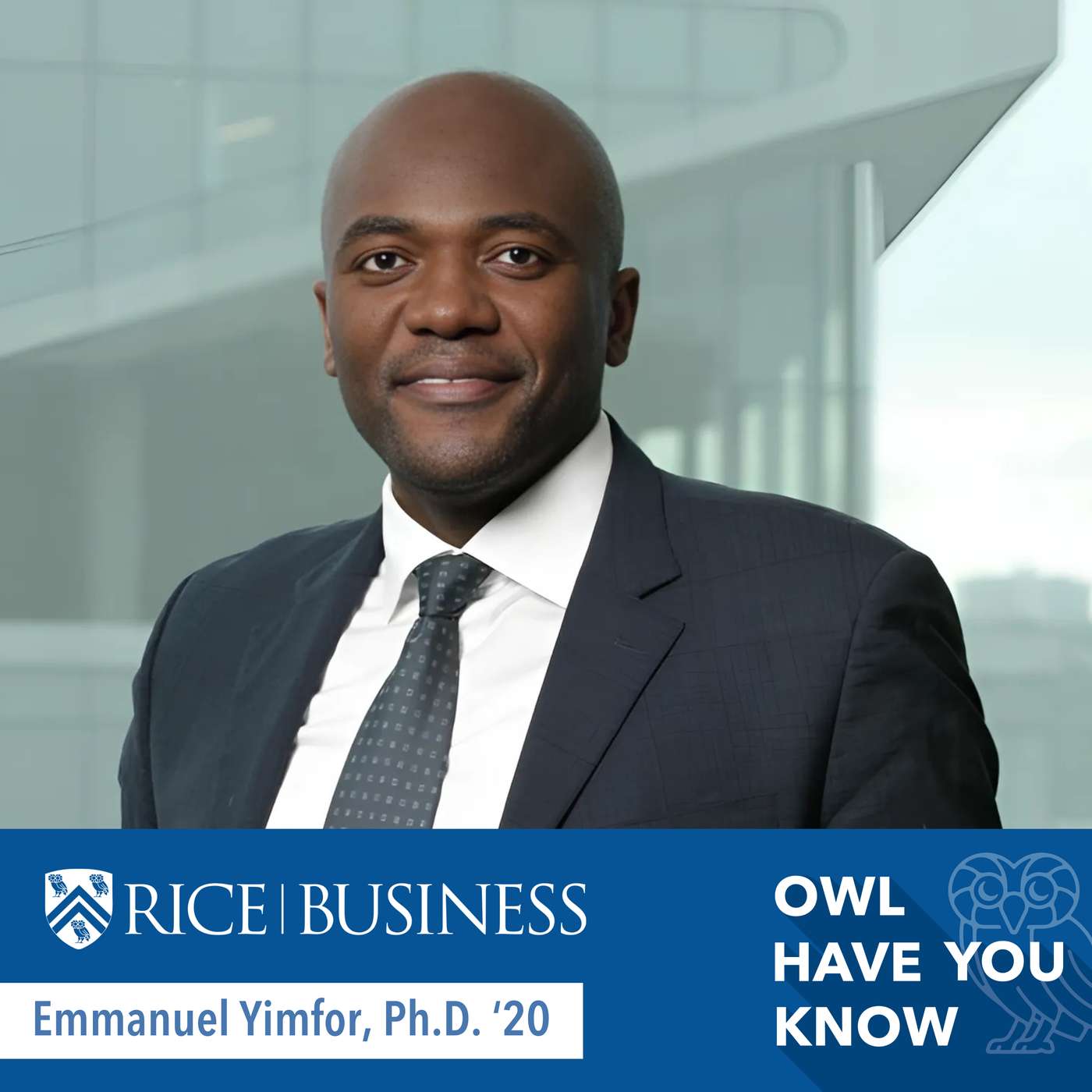
At a time when startups are primarily funded by private market investors, who you know has become a critical factor in gaining access to that venture capital. But how does the reliance on alumni and professional networks create barriers for startups from historically disadvantaged groups?Emmanuel Yimfor ’20 is a finance professor at Columbia Business School and holds a Ph.D. from Rice University. His research focuses on entrepreneurial finance, diversity and private capital markets, with insights into gender and racial disparities in venture capital funding, board representation and how resources could be more equitably allocated.Emmanuel joins co-host Maya Pomroy ’22 to discuss his career journey from working at a Cameroonian telecommunications company to teaching at some of the top U.S. business schools, as well as his research on the influence of alumni networks in venture capital funding, how AI tools can address biases in lending, and finally how he’s teaming up with his son to bring AI tools to young innovators and entrepreneurs in Cameroon. Episode Guide:01:00 Exploring Entrepreneurial Finance03:36 The Role of Networks in VC Funding08:10 Emmanuel's Journey From Cameroon to the U.S.12:34 The Rice University Experience15:43 Research on Alumni Networks and Funding21:49 Algorithmic Bias in Lending33:17 Empowering Future Innovators in Cameroon38:42 Final Thoughts and Future OutlookOwl Have You Know is a production of Rice Business and is produced by University FM.Episode Quotes:Rethinking who gets funded in venture capital31:07: What does good networks mean exactly? If you look at venture capital partners, for example, right? They have worked at McKinsey before they became venture capital partners. So they have worked at certain companies, they have done certain jobs that then led them to become VCs. And so to the extent that we have a lack of representation in this pipeline of jobs that is leading to VC, then the founders that do not come from these same backgrounds do not have as equal access to the partners. And so what that suggests is something very basic, which is like, just rethink the set of deals that you are considering. That might expand the pool of deals that you consider, because, you know, there might be a smart person out there that is maybe not the same race as you, but that has an idea that you really, really want to fund. And that is something that I think, like, everybody would agree with. You know, we want to allocate capital to its most productive uses.From hard data to meaningful change29:13: So I have a belief in America, at least based on my life journey, which is: if you work hard for long enough, somebody is going to recognize you and you will be rewarded for it. And so I really believe that America takes in data, thinks about that data for a while to think about whether the research is credible enough, and then, using that data, they are a good Bayesian, so they get a new posterior. They act in a new way that is consistent with what the new before and the new data. And so I think about my role as a researcher as just like, you know, providing that data. Here is the data, and here is what is consistent with what we are doing right now. Now, you know, what you do with that information now is like, you know, update what you are doing in a way that is most consistent with efficient capital allocation—is my hope.Why Emmanuel finds empirical work so exciting 21:34: Empirical work is so exciting to me because then you are like, "I am a little bit of a police detective." So you take a little bit of this thing that feels hard to measure, and then you can create hypotheses to link it to the eventual outcomes, to the extent that that thing that is hard to measure is something that is leading to efficient capital allocation. Then, on average, you know, this feeling that you get about founders that are from the same alma mater should lead to good things as opposed to leading to bad things. And so, you know, that is exactly the right spirit of how to think about the work.Show Links: TranscriptGuest Profiles:Emmanuel Yimfor | Columbia Business SchoolEmmanuel Yimfor | LinkedInEmmanuel’s Website
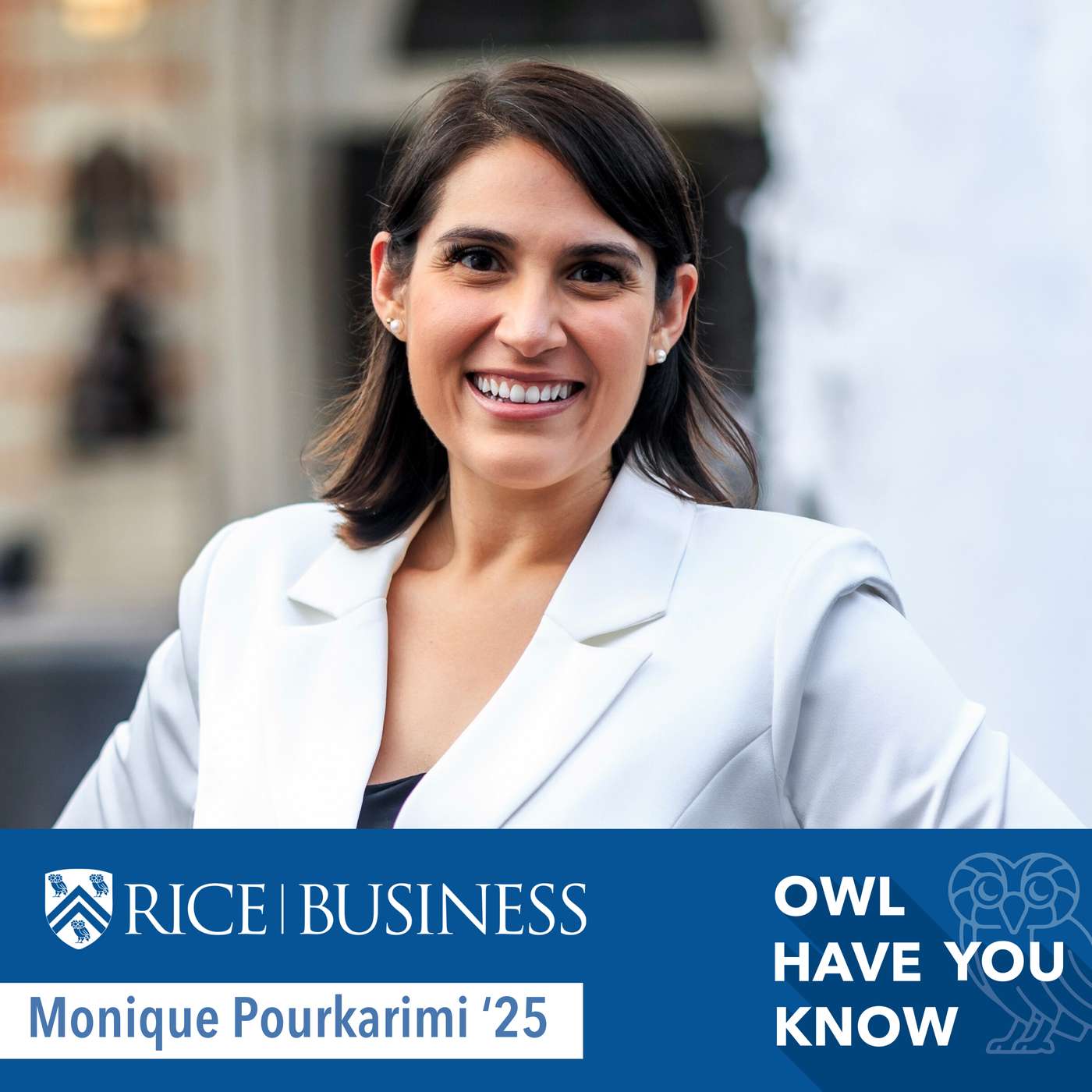
After navigating a challenging endometriosis diagnosis, multiple surgeries, and a complex healthcare system, Andria “Monique” Pourkarimi ’25 decided to tackle a gap she experienced firsthand. While pursuing an online MBA at Rice, an idea born in the classroom grew into Dr. Clara, LLC — a women’s health startup focused on closing the communication gap between patients and providers.Just a year earlier, Monique founded Pourkarimi & Associates, LLC, a financial consulting and independent insurance brokerage firm that helps clients navigate complex financial decisions and insurance needs. In this episode, Monique joins co-host Brian Jackson ’21 to share how her health journey inspires her work with Dr. Clara, why financial and insurance literacy are so important, and what led her career from the aisles of Costco to entrepreneurship and a Rice MBA.Episode Guide:00:00 Introduction to Monique Pourkarimi01:23 Balancing Business and MBA09:08 The Inspiration Behind Dr. Clara10:46 Challenges and Advocacy in Women's Health19:19 Future Plans and Reflections22:29 The Importance of Financial Education27:43 Pursuing Public Policy for Healthcare Reform30:51 Concluding ThoughtsOwl Have You Know is a production of Rice Business and is produced by University FM.Episode Quotes:Where did Monique get her entrepreneurship spirit?07:45: I think entrepreneurship runs in my blood. So my uncle has a logistics company that is here in the US and transports in Mexico as well. My grandmother, she works with him and his business, and, my mom has her own insurance brokerage as well, specializing in Medicare. So independent of my pursuits, my grandmother and my mom are the ones who raised me. So here it was three generations of strong Mexican women who were, you know, just under one roof. And I think that is kind of what shaped me in terms of the woman that I am today and that entrepreneurial spirit.Success is about impact, not numbers27:25: I think for me, success is counting how many people am I able to help at the end of the day, right? And it's not a number of just benchmarks of, oh, okay, I have a quota of helping 500,000 people. No, it's not about that at the end of the day. And do I confidently know that I have been able to help make a positive impact in this world? I do not want to leave it as I am starting these businesses because I am doing them for myself, or even with awards that I received through Rice. I think success is: what is my legacy? And if I were to die today, you know, what would people think about me? I think success is: what is my legacy? And if I were to die today, what would people think about me? Did I make a positive impact in people's life? That, to me, is success.The moment Monique said yes to Rice05:21: For me, I was thinking, wow, there is so much potential—especially with an MBA. There is so much potential I have in growing my businesses. And, as you said, Brian, being connected with the other students—I joke that Rice did all the background checks for us because I love my cohort. The people at Rice, the alumni—we are one big Happy Owl family. I had a lot of people who believed in me and were willing to help and point me in the right direction.Show Links: TranscriptGuest Profiles:2025 Best & Brightest Online MBA: Andria Monique Pourkarimi, Rice University (Jones) | Poets & QuantsAndria Monique Pourkarimi | LinkedIn
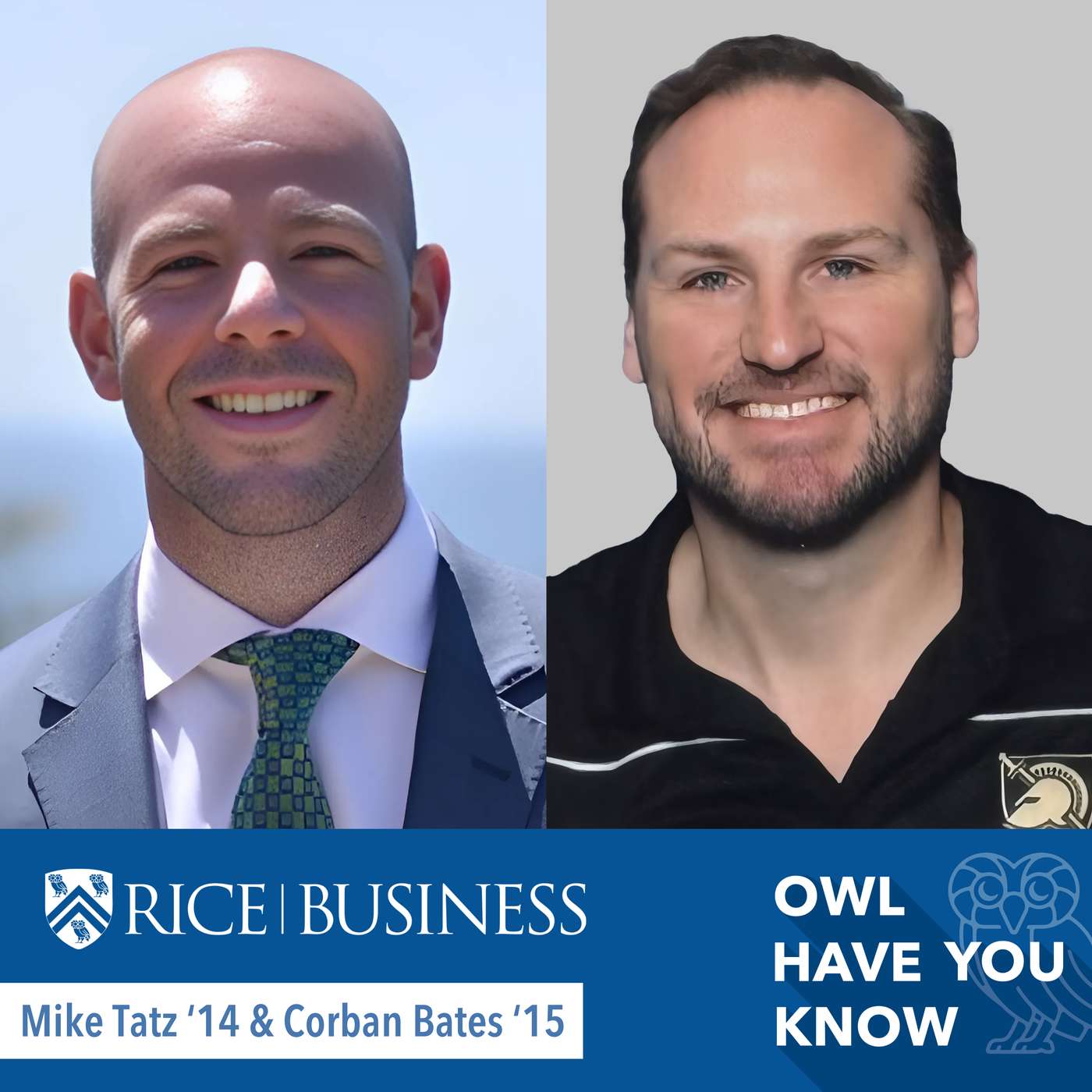
During their time at Rice Business, Mike Tatz ’14 and Corban Bates ’15 saw an opportunity to connect veterans with capital and the network needed to start a business. As veterans themselves, they understood how important it is to have the right connections and platform to pitch an idea. With that, the Veterans Business Battle was born. But Mike and Corban’s story starts long before Rice. The two first met as students at West Point and followed similar paths — from Division I athletics to Army service to financial services, and eventually entrepreneurship. After launching the Veterans Business Battle and earning their MBAs at Rice, Mike went on to found a CBD company for athletes, and Corban began overseeing direct investments into private companies — now serving as the chief financial officer for one of those investments. Mike and Corban join co-host Maya Pomroy ’22 to chat about how their time at West Point shaped them, what brought them to Rice Business and the impact the Veterans Business Battle has had over the past decade. Episode Guide:00:00 Meet Mike and Corban03:01 Life at West Point: Challenges and Lessons08:38 Transitioning From Military to Business School12:57 Creating the Veterans Business Battle20:18 The First Prize and Investor Opportunities22:15 The Journey and Impact of the Competition24:01 Career Transitions and Personal Growth25:29 Mike’s Venture Into the Sports Industry27:57 Corban's Path to Artisan Bakery33:43 Final Thoughts and Advice for Aspiring EntrepreneursOwl Have You Know is a production of Rice Business and is produced by University FM.Episode Quotes:The conversation that led Corban from Army to business school09:55: [Corban Bates] Mike’s been a huge blessing in my life, ’cause business school wasn’t really even on my radar. It’s just kind of going up and down the aisles of the career conference, and there were probably 20 schools there, but I didn’t talk to any of ’em. It wasn’t on my radar, and I talked to Mike. I just ran into him and it’s like, “Hey, how have you been?” Like, you know, all for Rice. He was there recruiting for Rice — Rice had a booth — and he starts telling me about it. And he was just about to start this internship at Goldman Sachs, and he had this amazing first year at Rice, and it just sets you up…[10:24] Yeah, I just ran towards it and was extremely fortunate to get in, and Mike completely changed the course of my career. If I hadn’t run into him, then things would be very different.On unapologetically pursuing what lights you up34:29: [Mike Tatz] I think a lot of people, even at business school, they get very pigeonholed into thinking that they have to be a consultant or an investment banker because they think about the financial support that it is going to give them or the safety net. There is a gazillion ways to make money out there. I think you have got to be happy. You have got to be happy. And you can be, but you have got to take that leap. You have got to have a plan. And then once you figure out what it is, you go, baby. You go as hard as you can, and you make everybody else think that you are crazy for how hard you are working at whatever you are doing. If you do that, I think good things are going to happen.Why veterans and business school are a perfect match17:09: [Corban Bates] Rice came up with this concept of really bringing on more veterans to their business school. I think it’s a great match of veterans being very far along in their leadership development and people management development by the time they’re in their late twenties, but being behind on the business concepts. And then you pair, you know, the rest of the civilians who are advanced in their business concepts but are probably lacking on the leadership front — probably haven’t led that much in their twenties. And so it’s this great pairing where both sides can learn from each other.The business network gap veterans face13:35: [Mike Tatz] I don’t think veterans need any special treatment, nor should they expect — or do we expect — any special treatment. But what I do think is the case is that, going back to that last example — let’s say I do want to start a business. I'm starting a business. There are a lot of steps to it, but one of those steps that is crucial is capital. And so my network, being in the military, is Army sergeants, Army majors, privates — whatever it may be, right? They're not the Goldman Sachs folks. They’re not the people looking to make investments into companies. They’re not the people with the means to not only provide financial capital, but mentorship capital and experience capital that you would need as somebody being in the military, coming out and trying — and wanting — to start your own business.Show Links: TranscriptGuest Profiles:Mike Tatz | LinkedInCorban Bates | LinkedInVeterans Business Battle
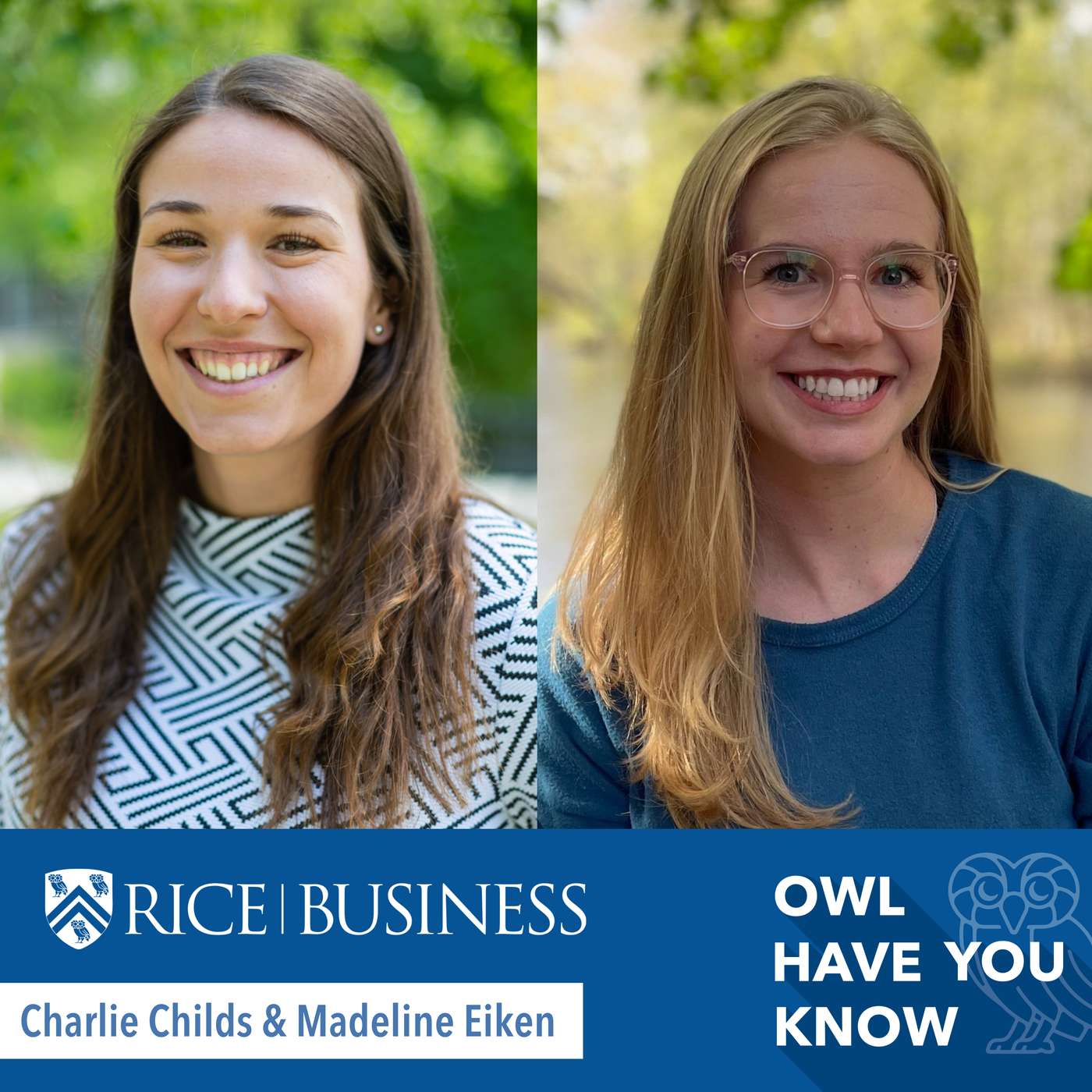
Like the discovery of penicillin, it started with an unexpected moment in the lab.Charlie Childs and Madeline Eiken didn’t set out to revolutionize drug testing — but a surprise breakthrough led them to create the world’s first lab-grown human intestine and win the 2025 Rice Business Plan Competition's grand prize. Their startup, Intero Biosystems, could dramatically reduce clinical trial costs, improve drug safety and advance personalized medicine.Host Maya Pomroy ’22 talks with Charlie and Madeline about the moment that sparked it all, their experience winning the 2025 Rice Business Plan Competition, and what’s next for their fast-growing startup. Episode Guide:00:59 Meet the Founders: Madeline and Charlie01:49 Their Groundbreaking Innovation of a Lab-Grown Human Intestine03:24 The Journey From Lab to Startup07:06 The Accidental Discovery11:49 Competing in the Rice Business Plan Competition15:52 The Pitch and the Competition Experience19:14 Support and Success at Rice23:37 Future Plans and Advice for Aspiring EntrepreneursOwl Have You Know is a production of Rice Business and is produced by University FM.Episode Quotes:Charlie on the lab-grown intestines breakthrough04:43 [Charlie Childs]: I think, every day, like, as we develop this model, we are just more and more amazed how amazing, like, nature is and how smart science is. So, what we can do is we take these stem cells, which, like you said, can turn to anything in the body, and then we simulate human development. So, every day we give them… we literally call it Gatorade. Like, the cells live in this red liquid, and it truly is Gatorade. It has, like, glucose and proteins and other things that the cells need to live just like our bodies do. And each day, we give them different proteins that leads them down human developmental time until they turn into the miniature intestines. So, it's actually a lot more simple than you would think. And our breakthrough figured out that a single protein that we switched in this process caused this beautiful thing to form. So, the cells, we joke about this every day, like, the cells just know what to do and we just need to, like, push them in the right direction and they will figure out what to do.From lab partners to startup co-founders 04:06 [Madeline Eiken]: We just know that we work really well together. We know that we have really complementary skill sets. So my background is in engineering, and, while Charlie is a biologist, and so the way that we approach problems is quite different from each other, but we have this, like, really shared interest in commercializing that technology.How does the Rice Business Plan competition stand out in comparison to some others?18:12 [Charlie Childs]: It was like a whole other beast, and people kept warning us, like, leading up to it. They were like, “This is fun, but wait till you get to Rice.” It was just like the breadth of not only the startups, but also the judges and all the people from Rice. It was the investors — like, we were just blown away at how much support and interest there was. And I mean, our first pitch was crazy. Like, people were audibly like gasping and cheering, and it was just such a fun group to pitch to. And we just made so many wonderful connections, and I truly, truly, like, this is like launching us into another realm that we didn’t even think we were gonna be able to be in. Both from, like, connections and investors, and just support — we're so thankful.What’s next for Intero Biosystems?24:05 [Madeline Eiken]: We're really excited to be really laser-focused on de-risking the company and meeting our milestones with this fundraise. We were really lucky to basically double what we were hoping to raise. So that was really awesome and exciting for us. And because of that extra cushion that we have, we think we can push a lot faster on some of our milestones that we had been thinking about for seed rounds and even Series A. So, right now we're really focusing on onlining our manufacturing and figuring out how we're gonna make the organoids really reproducibly so we can get them into the hands of customers as quickly as we can. So, now the fun part of running the company is what we get to do.Show Links: TranscriptGuest Profiles:Charlie Childs | LinkedInMadeline Eiken | LinkedInIntero Biosystems
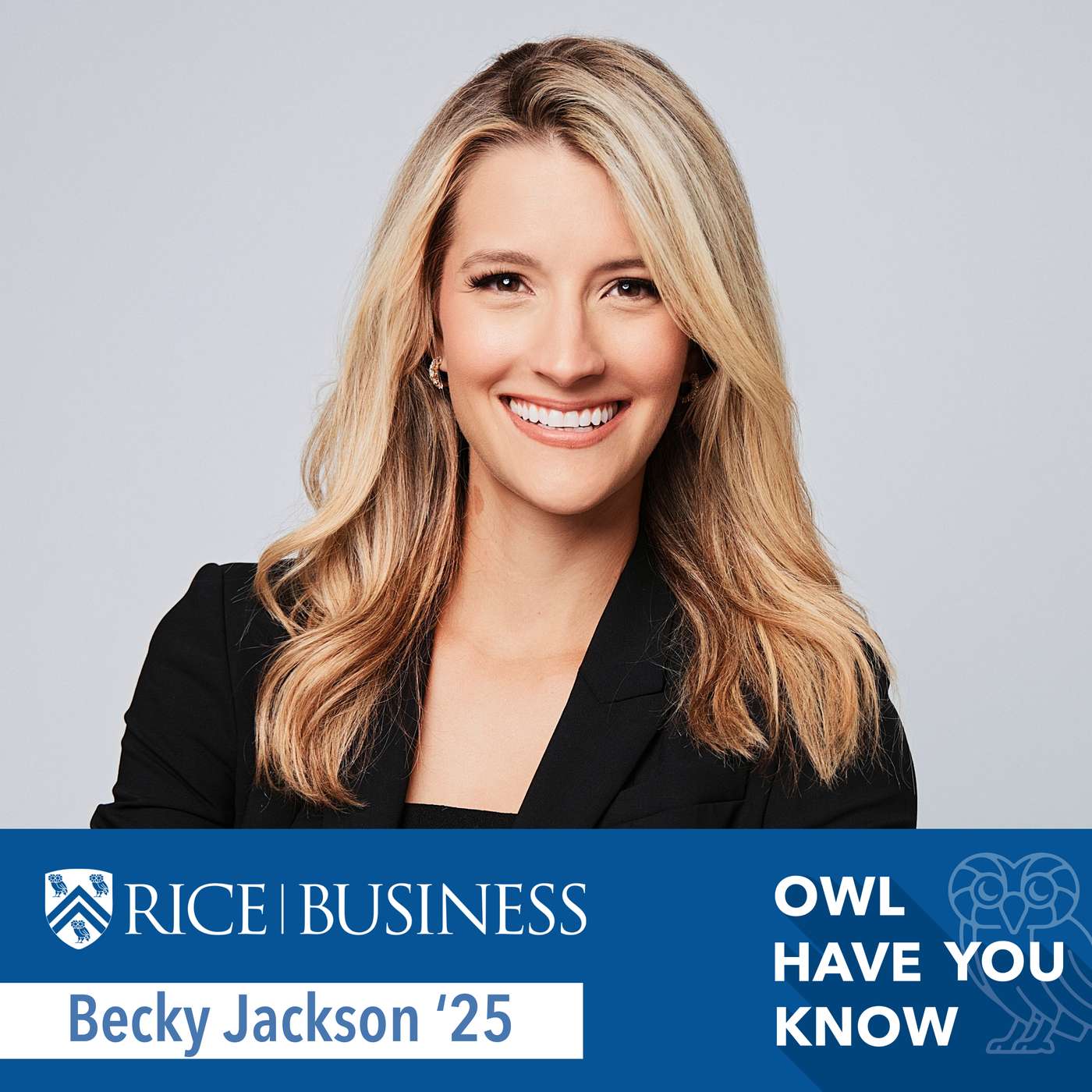
As the first figure skater to play Elsa in Disney On Ice’s Frozen and now a pioneer in the private security industry, Becky Jackson knows a thing or two about creating something from scratch. Before earning an MBA at Rice and becoming an entrepreneur, Becky had an illustrious figure skating career with Team USA and Disney. Now, she’s revolutionizing the way private security contractors reach clients with her company ONGUARD. Becky joins co-host Brian Jackson ’21 to chat about her journey — from discovering her passion for skating at age 7 and traveling the world with Disney on Ice to founding a business that works with local law enforcement and veterans to make private security more accessible. Episode Guide:00:00 Introduction to Becky Jackson02:05 Early Life and Figure Skating Journey04:03 Professional Career With Disney on Ice08:56 Transition to Business and Consulting11:57 Pursuing an MBA at Rice University14:07 Founding ONGUARD16:34 ONGUARD’s Mission and Future22:35 Connection With Veterans and Pitch Competitions23:54 Reflections on Entrepreneurship and Teamwork30:10 Advice for Aspiring EntrepreneursOwl Have You Know is a production of Rice Business and is produced by University FM.Episode Quotes:Lessons from being a solo founder24:49: Being a solo founder, I've learned the importance of a team, and how essential it is to have a really strong team with you. And so I think, in that respect, the experience with Disney always was—so incredibly grateful to be surrounded by artists and engineers who really love and, you know, are really committed to their work. And so that's been an important lesson for me: that you can't just go it alone. You can't just brute-force your way into starting a company. You really need to listen to experts. You need to know when to bring in the right people. And so, I think it's been a tougher journey for that, just kind of starting this off solo. But I quickly learned—and, you know, being at Rice helped me learn that too—is that, no, you need to learn to delegate, and you need to really tap into the network and the world around you.You’re never too old to go chase a dream27:32: You can really use the skills, but more importantly, the network to do anything that you, you know, really want to do. And something that I'm passionate about is that during my time at Rice, we had the slogan, “Rice Business, You Belong Here.” And that means, you know, can mean so much to everyone. It can mean something different. But for me, I always took the chance to think about it in terms of age, and that you're never too old to go chase a dream, or you're not too advanced in your career to start something new. And I think that's an important message that I always tell prospective students.How Becky found consulting after skating09:19: One thing I knew for sure is I wanted to work in some kind of, you know, dynamic environment. I had come from tour that was one city after the next, and it was traveling and meeting new people and new challenges every week. And so that's—that's where I landed in the world of consulting. I thought, oh, great—like traveling every week, new challenges, a lot of ambiguity. And so I thought that—that that's the thing for me.Show Links: TranscriptGuest Profiles:Becky Jackson | LinkedInONGUARD
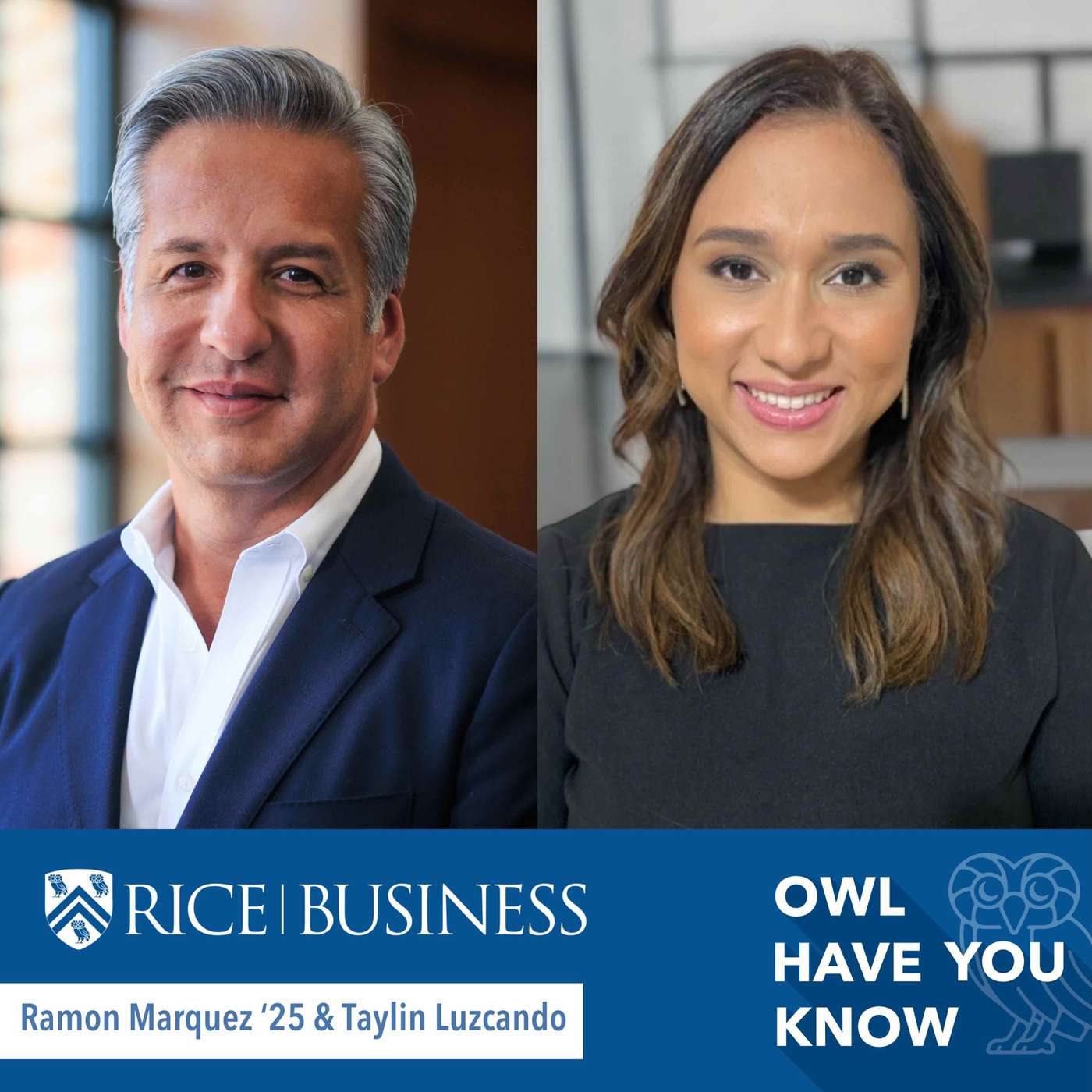
Retail executive Ramon Marquez can point to virtually every store in a shopping mall and explain how he helped that brand grow. With a passion for retail dating back to his childhood, he’s built a career as a leader in merchandising, product management and retail operations for major retailers like JCPenney, Abercrombie & Fitch, Old Navy, and is now shaping the future of Kmart and Sears. As a newly minted MBA graduate, Ramon gained not only a degree from Rice, but also a meaningful board appointment with Panama-based company, Effluz. After working with Effluz on his Global Field Experience, Ramon remained close with the company, which was founded by Taylin Luzcando and specializes in premature baby clothing and accessories. Ramon and Taylin join co-host Brian Jackson ’21 to chat about Ramon’s career journey from his grandfather’s general store in Mexico to the C-suite of some of the biggest global retailers, as well as why he decided to pursue an MBA at Rice and how he’s made an impact at Effluz. Founder Taylin also shares the personal origins of Effluz and why entrepreneurs should jump at the chance to partner with Rice’s Global Field Experience program. Episode Guide:01:41 Ramon's Early Career and Rise in Retail06:05 Leadership and Adaptability in Retail07:41 Pursuing an MBA at Rice Business10:52 Joining the Board of a Panamanian Startup13:34 Insights on Retail and Future Plans21:03 Personal Life and Community Involvement26:10 Meet Taylin Luzcando, founder of Effluz31:11 Taylin’s Experience with Rice’s Global Field Experience ProgramOwl Have You Know is a production of Rice Business and is produced by University FM.Episode Quotes:How one class changed Ramon’s path19:14: [Ramon Marquez] Towards the end of the MBA... and one of the very last classes I took was Life of Meaning. It’s an entrepreneurship lab. And what that class does is that it takes a look at where you want to be and how you fill the gap. And we did a lot of frameworks that helped me map out what is next. So, there were a lot of great things that came out of it. One was that I really didn’t have a plan in writing or a roadmap to where I want to land. In the class, part of the frameworks will get you back to, like, what are you passionate about? What is it that you wanted to do when you were a kid? What are the things that you don’t want to be left undone? And it helped me realize that, you know, there’s an entrepreneurial side of me that I have never explored.Why Ramon says passion for your job matter14:37: [Ramon Marquez] I encourage everyone, whatever you do, position yourself in a place where you love it, that you’re so intrigued and so inquisitive and so passionate. And a lot of people come to me and say, you know, “How do you get your job?” And I say, “Well, you have to be interested and passionate about retail. If you’re not, don’t get my job, because then it’s too much pressure. It’s too hectic. It’s too fast. It’s too vulnerable. It’s too difficult right now. Retail is really difficult.” But if you think about the fact that, you know, merchants have been around for thousands of years and commerce has existed from the beginning of time, retail’s not going to go away. It’s just the way that we will get to know what it’s like. And for that, I don’t have the answer, in case you were wondering.Show Links: TranscriptGuest Profiles:Ramon Marquez | LinkedInTaylin Luzcando | LinkedInEffluz
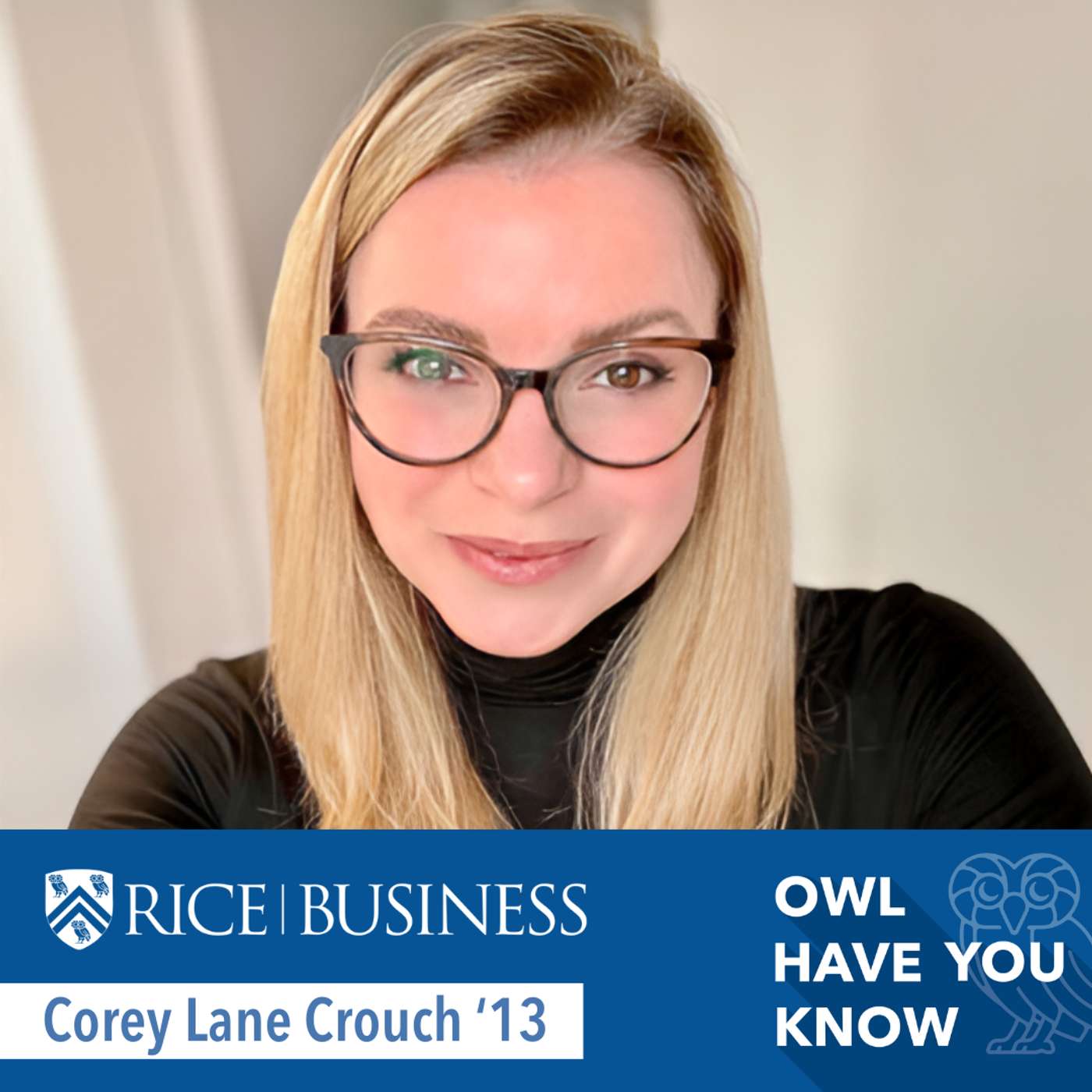
Despite entering college as a pre-med major, Corey Layne Crouch ’13 found her calling in the classroom after working as a teacher’s aide for a kindergarten class. Switching majors, she set out on a path to transform the education system from within. Corey’s entrepreneurial mindset in her work as a high school English teacher and school principal led her to Rice’s Professional MBA program. Now, she’s the chief program officer for AI for Education — an organization providing AI literacy training to educators and championing responsible use of AI in the education ecosystem. In this episode, Corey joins host Maya Pomroy ’22 to chat about her pivots from pre-med to English to her current role as an educational tech executive — as well as her time at Rice Business, the importance of supporting AI literacy and the innovative ways she’s influenced the education system. Episode Guide:00:00 Introduction to Corey Layne Crouch02:15 From Pre-Med to Kindergarten Teacher05:21 Teach for America and Moving to Houston08:23 Becoming a Principal and Pursuing an MBA17:04 Transition to EdTech and AI in Education25:07 Challenges and Misconceptions of AI in Schools30:26 Future of Education with AI38:22 Conclusion and Final ThoughtsOwl Have You Know is a production of Rice Business and is produced by University FM.Episode Quotes:On building AI literacy through tool-agnostic workshops[30:26] Maya Pomroy: So, tell me some of the work that you do — because AI for Education is really tackling one of the, I mean, this is one of the biggest shifts in modern learning.[31:41] Corey Layne Crouch: So we provide workshops and thing that we do, as well as that we're tool agnostic. We do have opinions about tools and where, you know, what's safe and what's fit for purpose, and what we think isn't quite yet, and how to integrate it in that way. ’Cause the technology is going to continue to evolve, but we really believe a foundation of which is rooted in durable skills, right, of critical thinking, and evaluation and understanding the best tool for a job and how to be community oriented. That is the work that we do. And, of course, we teach people how to use the tools and drive towards outcomes with them while we're laying that foundation as well.How Houston’s education scene inspired Corey's bold, equitable innovation07:16: Houston is such a great city, as you know, to be a young professional in and, and to start your career, let alone having the opportunity to be a part of the thriving, innovative education landscape there. I really think that it helped me think much bigger about what it meant to be an education and what was possible with innovation, and really moving the needle toward equity and supporting communities that historically, you know, weren't being serviced in the way that they deserved.Why entrepreneurship skills is essential for an AI-driven world32:46: I really believe that students need entrepreneurial skills, and not necessarily because every student is going to go off and start their own business per se, but at the root of it, entrepreneurial skills is about, you know, understanding what you're trying to drive to, or what's the job to be done, seeing what's the diagnosis, what are the challenges, or, you know, opportunities to do better, and then understanding the resources that you have, and moving forward with strategy, as if it's a puzzle piece and, you know, it's strategy, but it's also about just seeing that opportunity and having the confidence and the belief in your own critical thinking, your own resourcefulness, and your ability to collaborate and build relationship with others in order to solve a problem or drive something forward.Show Links: TranscriptGuest Profiles:Corey Layne Crouch | AI for EducationCorey on LinkedIn
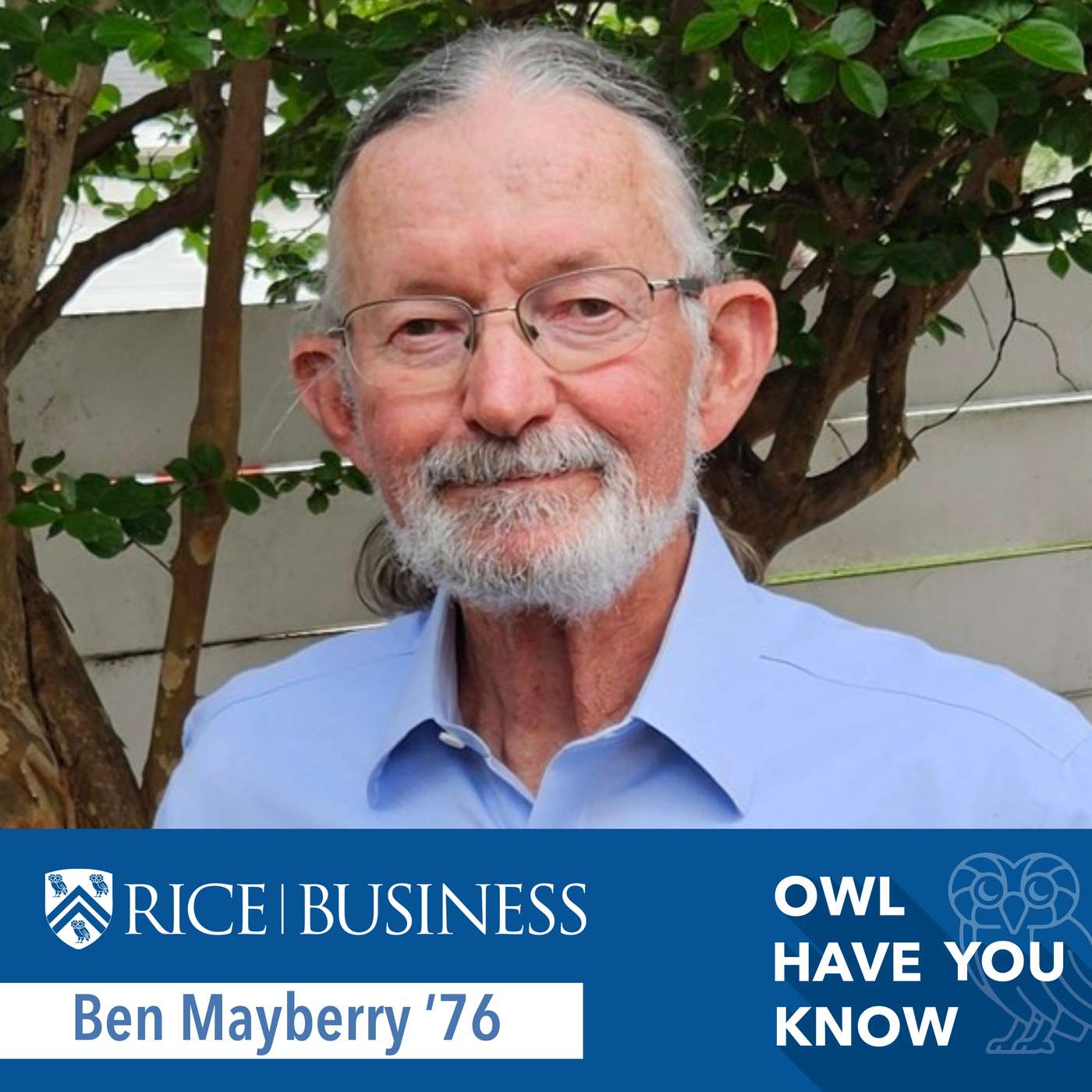
As a seasoned entrepreneur, investor and mentor, Ben Mayberry ’76 has seen a lot of change in the Houston business sector over the last 50 years.Beginning his career in the technology sector, Ben went on to co-found companies like BSG and Winston Sage, and has been deeply involved in the Rice Business community through mentorship and recruiting. Ben has also served as the president of the Rice Alumni Association and has been a judge in the Rice Business Plan Competition for two decades. Ben joins Owl Have You Know co-host Brian Jackson ‘21 to discuss his incredible career journey, commitment to Rice, involvement in the Houston Angel Network, approach to mentoring entrepreneurs, and the many lessons he’s learned over the course of his 50-year career. Episode Guide:00:00 Introduction to Ben Mayberry01:07 Early Career and Entrepreneurial Spirit02:42 Building and Managing Teams05:46 Mentorship and Advice07:36 Winston Sage Partners and Business Ethics09:43 Houston Angel Network14:33 Rice Business School Involvement22:32 Life Lessons and Final ThoughtsOwl Have You Know is a production of Rice Business and is produced by University FM.Episode Quotes:Why Ben thinks Houston is the easiest place to do business26:29: There's not one pivot point in my career I can point to, other than deciding to work for myself at some point. Then the decision points along the way that I've made. And, fortunately, I never made a decision that was so devastating that it, you know, shut me down. The most fun job I think I had of all was when we decided to open our other offices at BSG, and I was in charge of opening our remote offices. I just learned a lot about how you do business around the country. I learned how to negotiate with New Yorkers, people in Atlanta, Dallas, et cetera. The most important thing I've found is Houston is the easiest place to do business. 28:08: In Houston, people are generally welcoming to people that come from somewhere else because it's been a melting pot for so long.Why meeting in person matters for entrepreneurs28:52: If you want to get together with other entrepreneurs and bounce ideas off of them, or even build teamwork within your group, I think two things. Number one, within a company, it's important to have functions where you get together occasionally. We used to have quarterly meetings where we'd bring everybody into a central location, and it's not inexpensive. And once a quarter, we're also bringing the leadership from various places and having a strategy session all together. And certainly, you can do it by Zoom, but there's nothing like getting together, going out, and having a few drinks that night or dinner or whatever. Now, for someone like you, who—you're in Houston and nobody else is—you need to make a list of people you're going to have lunch with every day. Don't have lunch in your office. Go out three or four times a week and have lunch with somebody that's different and new.Why listening matters for entrepreneurs seeking success07:23: Each entrepreneur is, especially if they're in a startup, unique. They have some traits in common. They're generally stubborn. They don't listen as well as they should, and so you have to figure out if they're willing to listen at all. If not, you move on. If they're willing to listen, then you're able to give them advice, and it's based on—do they like—and a CEO doesn't have it all. They may be technical, they may be good at sales, they may be good at marketing, but they're rarely good at all of those. So you've got to figure out where their weakness is and attack that, and help them understand that's really where they need help.Show Links: TranscriptGuest Profiles:Ben Mayberry | Rice Business

Comments

Download from Google Play

Download from App Store
 United States