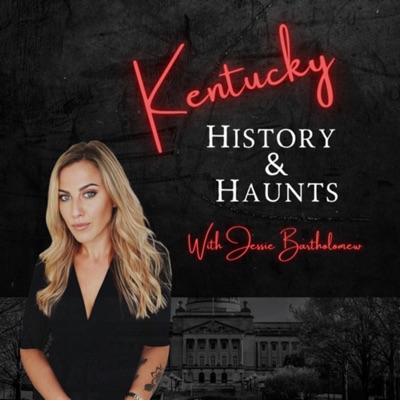
DiscoverKentucky History & Haunts
Kentucky History & Haunts

Kentucky History & Haunts

Author: Jessie Bartholomew

Subscribed: 74Played: 3,292
Share

Description

History, true crime & bizarre happenings in the bluegrass state. Kentucky is a treasure trove of unique people, events, and places dating as far back as the mastodon! You don't have to be from Kentucky to appreciate these stories. Subscribe today and share with a friend. Please email topic suggestions to kyhistoryhaunts@gmail.com. Visit the website to browse our merch at kyhistoryhaunts.com. And please leave a review or rating wherever you're enjoying the show. Thanks for listening.
164 Episodes
Reverse
First we’re paging through the Courier Journal for stories of romance gone sideways, dramatic gestures, and a few fiery plot twists.Starting with a Louisville divorce case where Mrs. Bessie Offutt tried to end her 17 year marriage, claiming her much older husband preferred sitting by the fire all day while she earned the living. The judge ruled that the law does not dissolve every unhappy marriage. Still, when her husband died years later, her name was nowhere in his obituary. Draw your own conclusions.Then we head to Mercer County, where Cecil Connor left a suicide note and his coat on a bridge over Dix Dam Lake, prompting a full scale search. Days later, he reappeared alive, admitting he staged the whole thing to frighten his estranged wife into reconciling. Spoiler alert: it did not work.Next, a jailhouse romance that feels stranger than fiction. Kentucky native Ray H. Foor, convicted of killing a Kansas policeman in 1923, was released just three years later and married Avereil Gay, a woman who fell in love with him while he was behind bars. She once declared he did not love her yet, but he was the man she intended to marry. They later settled in Brandenburg and lived quietly.In Accidents & Close Calls, we revisit the dramatic burning of a twenty seven room mansion in Cherokee Park, once owned by Judge Robert Worth Bingham. Thousands of rounds of ammunition exploded in the blaze. The owner, Giles VanCleave, narrowly escaped. The house was never rebuilt. Years later, VanCleave was found dead by suicide in the garage on the same property.We also remember Letitia Vance DePauw, a decorated Red Cross worker who served near the Argonne Forest in World War I and later became a state parole officer in Kentucky.And finally, a palate cleanser: a wanted fraud suspect in St. Louis was tracked down partly because of his legendary appetite. Seven pork chops for breakfast tends to leave a paper trail.Love, pride, scandal, heroism, and a few questionable life choices. Just another week in Kentucky history.Send feedback to kyhistoryhaunts@gmail.com*Transcripts are auto-generated and may contain errors
Kentucky in March of 1926 stands at a threshold. Winter is loosening its grip, modern life is creeping in, and beneath the surface of everyday routines, tensions simmer. Automobiles share muddy roads with horses, radios crackle with distant voices, and Prohibition is officially enforced while quietly ignored.In this episode of Kentucky History & Haunts, we explore a month where gossip turns deadly, crime crosses state lines, and justice proves slippery at best.The “Bob-Haired Bandit” of Bell County Eighteen-year-old Helen Simpson disguises herself in men’s clothing and robs a rural post office near Pineville. A torn dollar bill leads to her capture, and newspapers obsess over her appearance as much as the crime itself. Her sentence sends her far from home, to a women’s institution in North Carolina.$100,000 in Diamonds Vanish on Louisville Streets A New York jewelry salesman is attacked in broad daylight near Fourth and Market Streets. The diamonds are never recovered. Nearly a year later, a nearly identical robbery happens again. What follows is a tangled web of suspects, deadlocked juries, alleged inside jobs, kidnappings, and one criminal who just won’t stay out of the headlines.A Duel on Greasy Creek A respected schoolteacher, Virginia Skeens Coleman, kills her brother-in-law in a pistol duel after years of escalating accusations, courtroom battles, and family feuds. The case forces a community to confront gossip, reputation, and what self-defense looks like in rural Kentucky. The aftermath reshapes her life in unexpected ways.Moonshine by MoonlightA sheriff’s child wakes with a cold in the middle of the night, setting off a chain of events that leads to the capture of a moonshiner, the destruction of sixteen half-gallons of liquor, and the confiscation of a mule. A small, almost humorous story that unfolds against the backdrop of serious political turmoil in Harlan County.Kentucky in March of 1926 is caught between seasons, between old rules and new ambitions, and between what is spoken openly and what unfolds in the shadows. And as always, when history pauses at a crossroads, the stories waiting there are anything but quiet.🎧 Listen now wherever you get your podcasts.Part two available the day after this one is released.*Please note the transcripts for this show are auto-generated and may contain errors.Send Jessie mail:9115 Leesgate Rd Suite ALouisville, KY 40222Instagram: @kyhistoryhauntshttps://www.facebook.com/kyhistoryhauntsSend Jessie coffee money:Venmo: @kyhistoryhauntsSend feedback to kyhistoryhaunts@gmail.com. Please leave a rating or review wherever you listen.
In this episode of Kentucky History & Haunts, we trace the remarkable life of Dr. St. Elmo Brady, a Louisville-born chemist, educator, and civil rights pioneer whose influence reached far beyond the laboratory. Born in 1884 amid flooding, segregation, and racial inequality, Brady rose to become the first Black American to earn a Ph.D. in chemistry and one of the most important scientific educators of the 20th century.From Central Colored High School in Louisville to Fisk University, Tuskegee Institute, Howard University, and beyond, Brady’s life was defined by curiosity, service, and an unshakable belief in education as a tool for progress. Along the way, he forged relationships with Booker T. Washington and George Washington Carver, built chemistry departments from the ground up, delivered lectures that blended science, faith, and social responsibility, and mentored generations of students.This episode also explores the deeply personal moments of Brady’s life, including devastating loss, tireless travel, and his lifelong commitment to teaching and research, even into his final years. Though his name is often overlooked in popular histories, his legacy quietly shapes American science and education to this day.If you enjoyed this episode, consider leaving a rating or review on your podcast app. It helps more people find the show and supports independent history storytelling.Venmo: https://account.venmo.com/u/kyhistoryhauntsInstagram: https://www.instagram.com/kyhistoryhauntsFacebook: https://www.facebook.com/kyhistoryhauntsSend Jessie mail:Jessie Bartholomew9115 Leesgate RdSuite ALouisville KY 40222Have a Kentucky story you’d like to hear explored? Or an historic figure you think deserves more attention?Reach out anytime.Email @kyhistoryhaunts@gmail.com*Transcripts are auto-generated and may contain errors.LEARN MORE ABOUT ST. ELMO BRADY-https://chemistry.illinois.edu/spotlight/alumni/brady-st-elmo-1884-1966 https://www.acs.org/education/whatischemistry/landmarks/st-elmo-brady.htmlhttps://www.acs.org/education/whatischemistry/landmarks/st-elmo-brady.html
Yep, this episode from the 'century ago in Kentucky' series should technically have been about February 1926. I didn't realize I had been researching 101 years ago until I was about to hit publish! But I bet Kentucky was just as interesting in '25 as it was in '26! February 1925In this episode of Kentucky History & Haunts, I explore the headlines of February 1925, uncovering a mix of crime, romance, tragedy, and the supernatural.You’ll hear about:Teen “boy pirates” hiding stolen goods on an Ohio River islandA shady arrest linked to the Horse Thief Detective AssociationThe murder of Dr. Marvin Kingins during a baby rescue missionA doomed romance born during the Floyd Collins cave rescueDeadly mining accidents and heartbreaking healthcare storiesHaunted houses, flying rocks, and skepticalghost huntersA woman who discovered she was 103, not 93And a very good dog cleared in court by Kentucky’s first female judgeFebruary 1925 was a cold, dangerous, and unforgettable moment in Kentucky history, and I'm here to bring its strange and human stories back to life.*I misspoke in the West Virginia haunting story: YWCA stands for Young Women’s Christian Association (not WYCA).*The stylish gentleman in the episode art for this episode is Mr. Davis, mentioned in the story about the haunted house in Mitchellsburg. https://indianamemory.contentdm.oclc.org/digital/collection/p16066coll19/searchhttps://historicindianapolis.com/friday-favorites-the-national-horse-thief-detective-association/Email: kyhistoryhaunts@gmail.comLeave a rating, review, or comment on your podcast app to support the show!Send me mail:9115 Leesgate Rd, Suite ALouisville, KY 40222
In this episode, we follow the winding, unsettling path of a cold case that stretches from Lexington, Kentucky to Austin, Texas, and across nearly a decade of violence.In November 1998, 43-year-old Linda Rutledge was murdered inside her family’s hearing aid business in Lexington. Her body was found after the building was set on fire, and despite early investigation, the case quickly went cold. For years, Linda’s murder remained one of Lexington’s quiet unsolved crimes, rarely revisited and seldom mentioned in the media.But decades later, advances in forensic science and genetic genealogy would breathe new life into Linda’s case and unexpectedly link it to one of the most infamous unsolved cases in American history: the 1991 Yogurt Shop murders in Austin, Texas.This episode traces the life and crimes of Robert Eugene Brashers, a transient and violent offender whose movements across the country allowed him to evade justice for years. Using newly analyzed ballistic evidence and DNA technology, investigators have connected Brashers to multiple murders and sexual assaults spanning several states and nearly a decade. Linda Rutledge may have been his final victim before he died by suicide in 1999.⚠️ Content Warning: This episode contains discussion of violence against women, sexual assault, and murder. Listener discretion is strongly advised.Topics CoveredThe 1998 murder of Linda Rutledge in Lexington, KentuckyThe Yogurt Shop murders of four teenage girls in Austin, TexasHow fires were used to conceal violent crimesThe life, movements, and criminal history of Robert Eugene BrashersAdvances in DNA testing and genetic genealogyThe role of ballistic evidence in cold case investigationsResources & ReferencesRecent documentary on the Yogurt Shop murders (HBO Max)Reporting on genetic genealogy by CeCe MooreContemporary news coverage from Kentucky, Missouri, Texas, and South CarolinaPhotos and archival clippings referenced in this episode will be shared on KY History & Haunts social media.Connect With the Show📧 Email: kyhistoryhaunts@gmail.com📱 Instagram & Facebook: @kyhistoryhauntsIf you enjoy the show, please consider leaving a rating or review on Spotify or Apple Podcasts. It helps more people find the podcast and keeps these stories from fading into silence.
In this episode, I dive into the life of Mildred “Milly” Lucas, a woman often credited as the first female jailer in Kentucky—though her journey to that role was anything but straightforward. What begins as an exploration of early female jailers in the state becomes a gripping true story of violence and political upheaval.After the brutal murder of her husband, Daviess County Jailer William Lucas, during a racially motivated lynching in 1884, Mildred stepped in to run the jail. Her fight to hold the office—despite widespread gender bias, legal battles, personal tragedy, and even a jailbreak—reveals both the extraordinary challenges she faced and the rigid societal barriers of the time.Content Warning:This episode includes descriptions of a lynching and racially motivated violence. Graphic details are minimized but the events remain disturbing. Listener discretion is advised.Learn how William Lucas, a Confederate veteran turned jailer, moved his family to Owensboro and became widely respected for maintaining the courthouse square—despite constant dangers inside the jail walls.Hear the newspaper-reported account of Richard May, a young Black farmhand accused of assaulting a white woman—a claim that rapidly escalated into fear, rumor, and mob justice.In the aftermath of her husband’s murder, Mildred—described by some as “delicate,” yet brave and unyielding—was appointed interim jailer. Despite winning the next election “by a large margin,” Mildred’s eligibility was fiercely contested.Following her forced removal, Mildred’s life was marked by sickness and profound loss. She died of consumption in 1898, after losing three of her children the same year. Newspapers remembered her as a “good woman” and the widow of a “martyred jailer.”This episode exposes:The racial terror that shaped Kentucky’s pastThe challenges women faced in pursuing public officeThe human cost of mob violence and community silenceThe resilience of a woman who stepped into danger and leadership during crisisSelected newspaper accounts from the Owensboro Messenger and other 19th-century Kentucky publications.If you enjoyed this episode or want to share your thoughts:📧 kyhistoryhaunts@gmail.com⭐ Leave a review on Apple Podcasts or Spotify📲 Share the show on social media—your support makes a huge difference!
What happens when a newly elected Governor of Kentucky finds his political career consumed by corruption scandals, a burning state capitol…and his son’s sensational murder trials? In this episode, we dive into the dramatic rise and infamous downfall of Governor Joseph Desha — and his son Isaac, who may have been one of Kentucky's first serial killers.We begin with Joseph’s early life as a frontier soldier turned influential political powerhouse. He championed national expansion and state infrastructure — while waging a bitter political battle to reshape Kentucky’s judiciary.Just months into his term as governor, flames destroyed the state capitol, public trust collapsed, and an even darker scandal erupted. Joseph’s son Isaac was accused of brutally murdering a traveling attorney named Francis Baker — a case filled with shocking evidence, political interference, and multiple controversial retrials. And the story didn’t end there…When Isaac fled Kentucky under an alias, another man wound up dead thousands of miles away — leading newspapers to brand him a monster and fueling rumors that stretched all the way to Hawaii.This episode includes discussion of violence and attempted suicide. Listener discretion advised.What You’ll LearnHow Joseph Desha rose from frontier militia to Governor of KentuckyThe political chaos of the “Old Court – New Court” controversyThe mysterious 1824 fire that destroyed Kentucky’s state capitolThe sensational murder trial(s) of Isaac Desha — and a governor’s abuse of powerHow a second suspicious death sealed Isaac’s reputationThe truth behind the long-standing “Desha in Hawaii” conspiracyWhat became of the Desha family after the scandalResources & ReferencesPrimary newspaper accounts referenced include:Lexington Weekly PressFrankfort ArgusThe Olive Branch and Danville AdvertiserAdditional research includes state historical records and modern historical analysis.Connect With the ShowHave thoughts on this story? Email: kyhistoryhaunts@gmail.comFollow KYHH on social media — If you enjoyed this episode, please rate, review, and share. It truly helps the show grow.Send Jessie mail:9115 Leesgate Rd, Suite ALouisville, KY 40222
This episode explores the rich history and significance of the Brown Theater in Louisville, detailing its evolution from a premier theater to a movie house, its role in civil rights protests, and its modern-day significance as a community resource. The discussion also touches on ghost stories associated with the theater and the importance of the arts in society.Special thanks to Christian Adelberg and William Richards with Kentucky Performing Arts for taking the time to speak with me.Visit www.kentuckyperformingarts.org to check out upcoming shows at all three venues. Follow KYHH on social media for episode-related content:https://www.instagram.com/kyhistoryhaunts/https://www.facebook.com/kyhistoryhauntsEmail kyhistoryhaunts@gmail.com for corrections & suggestionsSome additional resources related to this episode: ⁠https://www.filsonhistorical.org/archive/news_v6n4_theater.html⁠⁠https://core.ac.uk/download/pdf/232566705.pdf⁠⁠https://ket.org/program/living-the-story-the-rest-of-the-story/raoul-cunningham-892/⁠⁠https://youtu.be/Q9IZcywXtJg⁠
Content Warning: This episode includes discussion of a murder scene and a suicide. Please use care deciding when or whether to listen.We pick up moments after Mayor Dr. George P. Archer is found shot beside his car outside his clinic in Prestonsburg, KY (July 12, 1973). A witness reports a beige-on-green Buick LeSabre fleeing the scene—similar to the car driven by Judith Archer, the city clerk and executive director of the Housing Authority, married to Archer’s cousin William “Bill Tom” Archer. As rumors snowball (including an alleged affair), timelines shift, pressure mounts, and within eight days Judith dies by suicide—before any arrest is made. A grand jury later calls dozens of witnesses but issues no indictments, and the case cools. Fifty-plus years on, questions about conflicts of interest, missing records, and political entanglements still shadow Prestonsburg.Connect & ContributeHave information, corrections, or family stories about this case?Email: kyhistoryhaunts@gmail.comInstagram: @kyhistoryhauntsFacebook: Kentucky History & HauntsIf you or someone you know is struggling, please consider contacting the 988 Suicide & Crisis Lifeline (U.S.).Send Jessie a note:9115 Leesgate Rd Suite ALouisville, KY 40222
Content Warning: This episode discusses a murder scene in detail as well as a suicide. Please use care deciding when or whether to listen.In this episode of Kentucky History & Haunts, we travel back to 1970s Floyd County to uncover the high-profile—but surprisingly underreported—murder of Prestonsburg Mayor Dr. George P. Archer.Born into a prominent Eastern Kentucky family of doctors and civic leaders, Archer carried on a legacy of medicine, public service, and political influence. From expanding healthcare access in rural communities to transforming Prestonsburg’s infrastructure and serving as mayor, Archer’s career was full of ambition and impact.But his story came to a shocking and violent end on the night of July 12, 1973, when he was gunned down outside his medical clinic. The crime, committed in a well-lit, public space across from a drive-in theatre, stunned the small community. Despite early leads—including a suspiciously similar revolver attack on Archer’s home earlier that year, eyewitness accounts of a fleeing Buick LeSabre, and questions directed toward those close to him—the case was never solved.Along the way, we’ll also trace Archer’s deep ties to Prestonsburg’s most powerful families, his clashes with the United Mine Workers Association, his role in reshaping healthcare access in Eastern Kentucky, and the political pressures of leading a coal town during a time of economic and social change.This is the story of a man who seemed untouchable—until he wasn’t.Southern Bell Data Phone Video: https://www.youtube.com/watch?v=QsqHBzW6gS0&t=1sTo reach Jessie, email kyhistoryhaunts@gmail.comSend a postcard to:Jessie Bartholomew9115 Leesgate Rd, Suite ALouisville, KY 40222
In this episode of Kentucky History & Haunts, we head back to August 1925—a month of sensational scandals and small-town crime sprees that made big headlines.First, you’ll hear the wild tale of Lucy Wagner McMills, a young woman accused of kidnapping her husband and tricking him into marriage after a whirlwind romance. Newspapers from Kentucky to New York branded her a “Modern Cavewoman,” while her groom swore he’d been too drunk to know he was saying “I do.”Then, we dive into the chaotic, decades-long saga of the Alford family of Winchester, known as “the Bootleg Syndicate” during Prohibition. From barn raids to shootouts, jailbreaks to safe-cracking, the Alfords’ rap sheets stretched across generations. George Alford was dubbed the Bootleg King of the Bluegrass, while his children—including Virgil, Tommy, and Woodrow—made headlines for everything from moonshining to armed robbery.This episode has it all: star-crossed lovers, outlaw families, jailbreaks, scandals, and tragedy.📬 Got a spooky Kentucky story suggestion for the upcoming Halloween season? Email kyhistoryhaunts@gmail.com or send a message on social media.🔎 Want me to research the history of your property? I’d love to dig into it! Reach out anytime.👉 Don’t forget to follow the show on Instagram and Facebook, leave a rating or review on your podcast app, or send a postcard/book to my mailing address:9115 Leesgate Rd Suite ALouisville, KY 40222
In this offbeat episode, we take a break from heavy historical biographies and dive into something a little lighter. What started as a routine property history search for a Louisville listing led me down a rabbit hole of vintage newspaper clippings, culminating in an unexpected and fascinating journey through the early nudist (or naturist) movement in Kentucky and Indiana.You’ll hear the bizarre headline that sparked it all—“Bee Intrudes as 2 Louisvillians Enter Ranks of Nudist Royalty”—and meet the surprisingly compelling couple at the heart of it. We cover the founding of Zoro Nature Camp in Indiana in the 1930s, its battles against public scandal and legal scrutiny, and how it became a hub for naturist conventions and moral high ground.We follow the story of Bernard and Dorothy Harding, a deaf couple from Louisville who lived fascinating lives full of hardship, resilience, and—briefly—nudist royalty. Plus, we explore how lawmakers in Kentucky reacted to the idea of nudist colonies with 20-foot wall requirements, licensing fees, and statewide panic.This episode has it all:🔍 Historical deep dives📜 Archival weirdness👑 A nude coronation⚖️ Oddball legal history🧡 And a love story that’s almost too strange to be true.Quotes to Remember:🗞️ “We are unashamed of our bodies. It will take more than court orders and cold weather to stop us from leading our lives as we wish.”👑 “A bee intruded itself upon the coronation scene… the ceremony was quickly finished.”📜 “If a man wants to get off in the woods and gambol about in the nude, he ought to have that right.” – Rep. Henry WardFurther Reading / Links:Kentucky Nudism Laws: https://naturistaction.org/laws/kentucky-laws/Support the Show:🧡 Leave a review wherever you listen📲 Follow on social media📬 Send mail to 9115 Leesgate Rd, Suite A, Louisville KY 40222✉️ Corrections/feedback/topic suggestions: kyhistoryhaunts@gmail.comThanks for tuning in—and until next time, keep your curiosity uncovered.
In this episode, we explore the extraordinary life of Brigadier General Charles Young — a man born into slavery in Mays Lick, Kentucky, during the Civil War who went on to break barriers across the U.S. military and beyond. Despite facing relentless racism, repeated demotions, and exclusion due to his race, Young became a pioneer and trailblazer, achieving numerous historic firsts as a Black officer in the U.S. Army.You'll learn about Young's journey from his family’s escape to freedom in Ripley, Ohio, through his tough years at West Point, his service with the Buffalo Soldiers, and his role as the first Black superintendent of a National Park (Sequoia & General Grant). We also learn about his friendships with figures like W.E.B. Du Bois, and his diplomatic posts in Haiti and Liberia.This episode touches on Young’s incredible resilience, the legacy he left through public service, education, and advocacy, and his long-overdue posthumous promotion to Brigadier General in 2021. *The transcript for this show is auto generated using AI. Robots make mistakes too y'all!Connect with the show on social media-Facebook: Kentucky History & HauntsFacebook Group: Kentucky History & Haunts & MoreInstagram @kyhistoryhauntsEmails with comments, corrections, etc. can be sent to kyhistoryhaunts@gmail.comMail can be sent to Jessie Bartholomew9115 Leesgate Rd Suite ALouisville, KY 40222This episode is written, recorded, edited and marketed by Jessie. To buy her a coffee for her work on the show, Venmo @kyhistoryhauntshttps://www.nps.gov/media/video/view.htm?id=219094BE-2C76-4E63-85B3-8D8B46EFFFB5https://brigadiergeneralcharlesyoungfoundation.org/timeline/
Episode 150 (hooray) explores the historical significance of the Passenger Pigeon, the life of Junius Booth, and the cultural impact of extinction. It delves into the tragic story of the Passenger Pigeon, once abundant in North America, and the role of hunting and habitat loss in its extinction. The discussion also highlights the life of Junius Booth, father of John Wilkes Booth, and his connection to the passenger pigeon, revealing the intertwining of history, theater, and wildlife conservation.Get a copy of My Thoughts Be Bloody: https://www.simonandschuster.com/books/My-Thoughts-Be-Bloody/Nora-Titone/9781416586067To leave Jessie a tip for her work on this episode, Venmo: @kyhistoryhauntsSend a postcard or chotchke to Jessie:Jessie Bartholomew9115 Leesgate Rd Suite ALouisville, KY 40222Send comments or conerns to kyhistoryhaunts@gmail.comFollow the show on Instagram @kyhistoryhaunts or find the page on Facebook or the group Facebook History & Haunts & More for additional episode information and photos!Leave a review on Apple Podcasts or rating on Spotify. Also be sure to leave a comment with feedback if you're listening on Spotify. I love to hear from you all! *KYHH episode transcripts are auto-generated using AI and may contain errors
Mary Byron was waiting for her car to warm up in the parking lot of the mall where she worked on the night of her 21st birthday. She was about to head home to decorate the Christmas tree with her family. Instead she was shot to death by Donavan Harris, her former boyfriend. Just a few weeks earlier, Harris was arrested for holding Mary hostage at gunpoint and assaulting her in the basement of her own home. He was released on bond, and less than a week later, Mary was dead.This left the Mary's family, and the community, wondering if things could have been different if they had been notified of his release from jail. This case ultimately led to the creation of the victim notification service known today as VINE.*Listener discretion advised*Thanks to Christopher B. for recommending this case.Thanks to Ms. Lillie for becoming a Patreon member!Thanks to Neal for your donation and for hyping the show up while visiting local landmarks!The 24-Hour Domestic Violence Hotline can be reached at 1-844-BESAFE1 (237-2331)Follow the show on Instagram @kyhistory haunts or look it up on Facebook by typing the show name in the search bar. Send emails to kyhistoryhaunts@gmail.comSend mail to:Kentucky History & Haunts9115 Leesgate Rd, Suite ALouisville, KY 40222
Dr. Britton was the first black woman in Kentucky to practice medicine... but there is so much more to her story! Born in Lexington in 1855, she grew up a free black citizen and went to private schools in Lexington, then Berea college. She studied medicine in Battle Creek, Michigan under Dr. Kellogg. Dr. Britton helped open the Colored Orphans home in Lexington. She caused a stir at the 1893 Chicago World's Fair. She protested the Separate Coach bill in the 1890s- her speech later published in the Lexington Herald-Leader.She was a teacher, writer, doctor and activist. *This episode briefly mentions suicide. Listener discretion is advised.Let me know what you think of the episode by leaving a comment on Spotify or sending an email to kyhistoryhaunts@gmail.com.My mailing address is: Jessie Bartholomew9115 Leesgate Rd, Suite ALouisville, KY 40222I research, write, record and edit every episode. If you'd like to leave me a tip you can Venmo me, @kyhistoryhauntsLinks:https://bereaky.gov/for-visitors/community-profile/history/https://networks.h-net.org/node/2289/blog/ky-woman-suffrage/2574422/1887-speech-mary-e-britton-danville-woman-suffragehttps://www.jstor.org/stable/23384055?read-now=1&seq=11#page_scan_tab_contents
In the late 1830s, the owner of Mammoth Cave hoped to attract more tourists to the area. One of the key figures in making that happen was a slave named Stephen Bishop. Stephen became one of the most popular guides in the caves history, as well as a brave and savvy explorer, responsible for the expansion of the cave system with his discovery of several 'new' areas like the Bottomless Pit and Ruins of Karnak.It was stipulated in his owners will that Stephen was to be emancipated seven years after the owners death, and he was finally free in 1856, but unfortunately his story does not have a happy ending.There is so much more to be said about the role of slaves related to the early exploration and management of Mammoth Cave than what's covered in this episode. For further research, I recommend starting with the following-*Legendary tour Guides who were Enslaved AmericansA National Council for the Social Studies Publication Number58 • January/February 2017*Mammoth Cave, Slavery, and Kentucky: Overcoming the Chains that Bind Susan Farmer Western Kentucky University, *https://www.nytimes.com/2014/03/02/travel/in-kentucky-a-family-at-the-center-of-the-earth.html*https://www.nps.gov/maca/learn/historyculture/african-american-history.htmIf you'd like to be pen pals, you'd like to send me holiday cards or some homemade jam, my mailing address is:Jessie Bartholomew9115 Leesgate Rd, Suite ALouisville, KY 40222Email kyhistoryhaunts@gmail.com topic suggestions, feedback or corrections. Connect with the show on Instagram @kyhistoryhaunts and search Kentucky History & Haunts on Facebook. Leave a comment on this episode if you're listening on Spotify and let me know what you think!Please leave a review or rating on Apple, Spotify, or wherever you listen!
Welcome to another installment of 'A Century Ago in Kentucky', where I share some of my favorite newspaper clippings from Kentucky newspapers in 1924. This episode includes stories of prisoners celebrating behind bars, while others are set free in time for the holidays, hundreds of gallons of wine are poured into the sewer by the Feds, plus fires and other accidents, burglars, crossword puzzles, and a special appearance by my great-grandfather! This episode includes clippings from the Louisville Courier-Journal and The Lexington Herald-Leader. This podcast is researched, written, recorded and produced by me, Jessie Bartholomew. To leave me a tip for a cup of coffee, use the following link: https://account.venmo.com/u/kyhistoryhaunts For more on crossword puzzles: https://www.alieward.com/ologies/enigmatology https://time.com/5811396/crossword-history/
In the 1840s, a doctor from Louisville purchased Mammoth Cave. One of his motives for purchasing the land was to conduct an experiment by inviting tuberculosis patients to live underground during the winter months to cure them. It did not go well. For more on this topic, check out THE PURSUIT OF HEALTH IN THE MAMMOTH CAVE, published in the Bulletin of the History of Medicine, 1971, by Stanley Sides & Harold Malloy. Follow the show on Instagram @kyhistoryhaunts and find it on Facebook by searching Kentucky History & Haunts. For feedback, corrections and topic suggestions, email kyhistoryhaunts@gmail.com To buy Jessie a coffee for her work on this episode, you can Venmo @kyhistoryhaunts. Thanks for listening!
On a cold January evening in 1925, after a long day of widening an entrance to a newly discovered cave, Floyd Collins lost his footing, knocked over his light, caused a shift in the tunnel and was pinned under a rock. Floyd was hopelessly stuck. Over the next two weeks, miners, geologists, engineers, family members and the Kentucky National Guard worked tirelessly to rescue Floyd. Floyd had passed by the time they reached him, but that wasn't the end of his story. For more information on Floyd Collins, start here: https://www.nps.gov/articles/000/tragedy-at-sand-cave.htmAnd for photos of his second funeral service, go here:https://westernkentuckyuniversity.pastperfectonline.com/byperson?keyword=Collins%2C%20Floyd%2C%201887-1925
loading
Comments (1)

Art 34

My family is from KY, I live just across the river, and I really enjoy the "local" history/true crime stories!

Dec 4th
Reply
