


 Claim Ownership
Artificial Intelligence Podcast: ChatGPT, Claude, Midjourney and all other AI Tools
Subscribed: 227Played: 3,869
Subscribe

© 2026 Jonathan Green : Artificial Intelligence Expert and Author of ChatGPT Profits
Description
Navigating the narrow waters of AI can be challenging for new users. Interviews with AI company founder, artificial intelligence authors, and machine learning experts. Focusing on the practical use of artificial intelligence in your personal and business life. We dive deep into which AI tools can make your life easier and which AI software isn't worth the free trial. The premier Artificial Intelligence podcast hosted by the bestselling author of ChatGPT Profits, Jonathan Green.
412 Episodes
Reverse

For twenty years the rule was simple: get more people into the top of the funnel. AI broke that rule. Jonathan Green talks with Tanner Sherman (Principal & Managing Broker, Top Tier Investment Firm, Omaha) about what happens when inquiring costs nothing — 150 "is this still available?" messages a day, 1,500 inquiries per rental, and a signed-lease rate that fell from one in 80 to one in fifteen hundred. The fix is not a better funnel. It is a deliberately worse one.Key Takeaways:AI did not create more demand, it created more noise. Tanner's team went from roughly one signed lease per 80 inquiries to one per 1,500 once "I'm interested" became a single tap.Deliberate friction is the filter. An auto-reply that asks people to text the office cuts 1,500 inquiries down to 100–150 actual humans, then to 10–12 showings, then to one lease.Stop optimizing for engagement and start optimizing for proof of commitment. Reach, clicks and inquiries are exactly the numbers AI inflates fastest — the number that matters is who took a costly step.Referrals repriced overnight. When résumés, portfolios and proof can all be generated, a person somebody actually knows beats a better-qualified stranger.Delegate to AI the way you delegate to people, using the four levels: investigation, informed progress, informed results, ownership. Most people never leave level one and then blame the tool.Notable Quotes:"It's become too easy to inquire. We get spammed with probably 150 'is this still available's a day." — Tanner Sherman"Whether you're hiring a VA, a US-based employee, or delegating to AI, the intention of the employer needs to be clear as to what level you're utilizing that skill." — Tanner ShermanConnect with Tanner Sherman:LinkedIn: https://www.linkedin.com/in/tanner-sherman-707529222Website: Top Tier Investment Firm — https://toptierinvestmentfirm.comPodcast: Freedom Fighter Podcast — https://podcasts.apple.com/us/podcast/freedom-fighter-podcast/id1765821493Enjoyed this? Follow The Artificial Intelligence Podcast and send it to whoever still brags about how many leads came in last month.

Your team is already afraid of AI — and "we're using ChatGPT" is usually the cover story. Jonathan Green talks with Paco Farias (Co-Founder at Glinx; formerly GE, Amazon, and Snap) about where AI resistance actually lives, why so many splashy rollouts are dead in six months, why token bills are about to rival payroll, and what "AI native" actually requires: a reboot of the human operating system, not a new logo.
Key Takeaways:
• Culture starts and ends with founders and CEOs. If leadership does not practice AI, pamphlets and all-hands decks will not produce adoption.
• The earliest sign of quiet resistance is "I use ChatGPT every day" — prompting is step zero, not adoption. Fear (conscious or not) keeps teams there.
• Boards rush the hype to signal to markets, then quietly kill the program six months later because they treated AI like a resource-allocation problem instead of a change-management one.
• Token spend is the next people-budget. AWS leaked $500 million in tokens in a month. Unlike salaries, token costs are a black box that can double mid-project.
• "AI native" is not a branding decision. It is teaching people that AI is an enabler, not the enemy — plus the technical layers. Skip the culture and the team reverts to the old operating system.
Notable Quotes:
"I would say in the founders — that's where it starts and where it ends." — Paco Farias
"AI is the enabler. It's gonna make you a thousand times more productive if you take the time to understand how to enable it." — Paco Farias
Connect with Paco Farias:
LinkedIn: https://www.linkedin.com/in/paco-farias
Company: Glinx — https://glinks.ai
Enjoyed this? Follow The Artificial Intelligence Podcast and share it with a leader whose team is quietly stalling the AI rollout.Connect with Jonathan GreenThe Bestseller: ChatGPT ProfitsFree Gift: The Master Prompt for ChatGPTFree Book on Amazon: Fire Your BossPodcast Website: https://artificialintelligencepod.com/ Subscribe, Rate, and Review: https://artificialintelligencepod.com/itunesVideo Episodes: https://www.youtube.com/@ArtificialIntelligencePodcast

Everyone now has the same AI. That should make markets smarter — Gary Brode says it does the opposite. Jonathan Green talks with Gary Brode (Managing Partner at Deep Knowledge Investing) about why AI is a terrible stock picker: it summarizes the herd, it cannot say "I don't know," it cannot disagree with the dominant narrative, and the places you actually make money are the moments when everybody else is wrong.
Key Takeaways:
• Access to information is not an edge — AI lets everyone read every 10-K in seconds, so that advantage is already priced in. The scarce skill is a different interpretation of the same facts.
• AI cannot say "I don't know." It answers with total confidence, including when it is guessing. Gary hires interns for the opposite: the candidate who hits the edge of their knowledge and says they will come back with an answer.
• AI is not objective. It is weighted toward mainstream media, Reddit, Substack, and a fairly monolithic view of politics and economics. Knowing those biases is the advantage.
• The hyperscaler treadmill is the risk story: trillions in capex, token prices down 75–90%, models obsolete in months, and no clean way to stop spending without writing the last few years to zero.
• Where you make real money is when the dominant narrative is incorrect. AI is built to repeat that narrative, not to challenge it.
Notable Quotes:
"Having better information is typically not a good way to make money in the stock market. I rarely have an information advantage, but I analyze it differently." — Gary Brode
"I don't know is a really good answer. AI doesn't do that. AI will give you the wrong answer or a made-up answer confidently." — Gary Brode
Connect with Gary Brode:
LinkedIn: https://www.linkedin.com/in/gary-brode-deep-knowledge-investing
Company: Deep Knowledge Investing — https://deepknowledgeinvesting.com
X: https://x.com/Gary_Brode
Subscriber coupon: Jonathan40 (40% off the first year)
Enjoyed this? Follow The Artificial Intelligence Podcast and share it with someone who thinks ChatGPT is about to replace their fund manager.Connect with Jonathan GreenThe Bestseller: ChatGPT ProfitsFree Gift: The Master Prompt for ChatGPTFree Book on Amazon: Fire Your BossPodcast Website: https://artificialintelligencepod.com/ Subscribe, Rate, and Review: https://artificialintelligencepod.com/itunesVideo Episodes: https://www.youtube.com/@ArtificialIntelligencePodcast
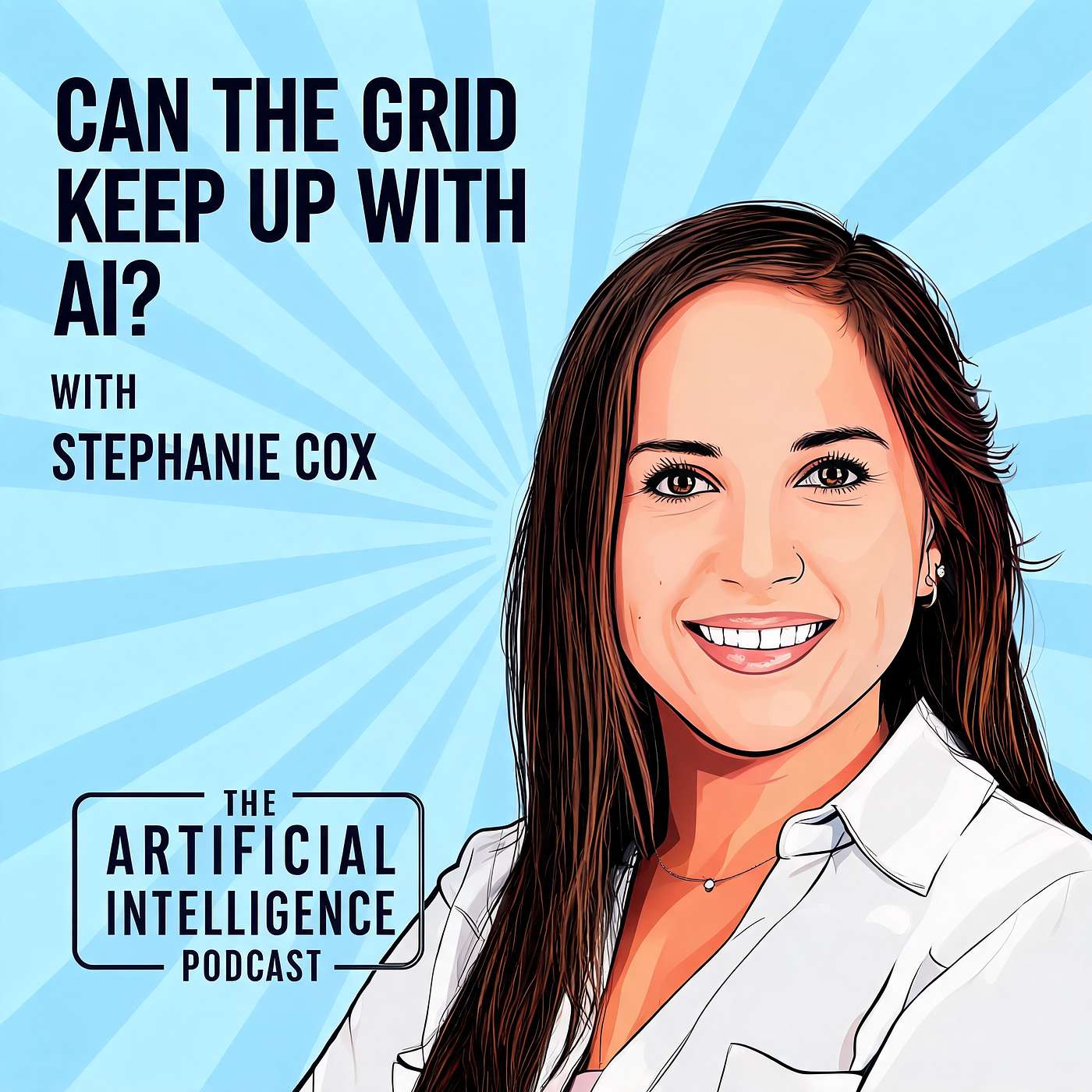
The cloud isn't actually in the sky — it runs on electricity, and AI is straining the grid like nothing before it. Jonathan Green talks with Stephanie Cox (CEO of GridEQ) about the energy reality behind the AI boom: why hyperscale data centers are a brand-new kind of load, why the real bottleneck is planning and permitting rather than power, how energy storage bridges fast-moving AI and slow infrastructure, why communities are pushing back, and where a smarter, more distributed grid goes from here.
Key Takeaways:
• AI data centers are a new kind of load — continuous, massive draw the grid was never designed for (it was built for peak and weather events, not 24/7 hyperscale demand).
• The real bottleneck isn't power, it's planning — transmission lines, interconnection queues, permitting, water, land, and community support. Securing power now takes far more than a purchase agreement.
• Energy storage is the bridge — it fills the gap while slow infrastructure (substations take years) catches up to fast-moving AI and software.
• Communities are pushing back — a stat she cites: ~90% of Americans don't want hyperscalers nearby (higher costs, water and power strain, few local jobs). The tension is power to the data center vs. power to the community.
• Bet on efficiency and a diversified grid — smart investors already model the decline (chips obsolete in 12–18 months, software getting leaner). The future is distributed centers, mixed generation + storage, and secondary markets for stranded equipment (GridEQ's new line).
Notable Quotes:
"90% of folks in the US don't necessarily want the data centers coming into play." — Stephanie Cox
"My hope is for a more diversified and resilient ecosystem — relying on more than just one technology." — Stephanie Cox
Connect with Stephanie Cox:
LinkedIn: https://www.linkedin.com/in/stephcox-co
Company: GridEQ
Enjoyed this? Follow The Artificial Intelligence Podcast and share it with someone thinking about AI, energy, or infrastructure.Connect with Jonathan GreenThe Bestseller: ChatGPT ProfitsFree Gift: The Master Prompt for ChatGPTFree Book on Amazon: Fire Your BossPodcast Website: https://artificialintelligencepod.com/ Subscribe, Rate, and Review: https://artificialintelligencepod.com/itunesVideo Episodes: https://www.youtube.com/@ArtificialIntelligencePodcast

Joshua Wilson has done roughly 2,500 interviews and runs Oneiron Network, a podcast network built for dealmakers, capital markets and investment banking. He remembers when an hour of recording meant ten hours of work — and when that work quietly killed the only part that mattered, which was building relationships with people. So he handed the tedious half to AI early, and then drew a hard line around the rest. Jonathan Green talks with him about why he now deliberately wants the chickens in the background, how a library of transcripts becomes a deal-signal machine that quietly brokers relationships between guests who have never met, how to break a media-trained guest out of their script, and the part of this no machine gets to touch.
Key Takeaways:
• Over-production now costs you trust. Joshua actively wants the ums, the kids in the background, the moment a guest says "that was probably dumb." When a show looks like a movie, the audience starts wondering whether any of it is real — so he tells his own network to edit less, not more.
• Your transcript archive is the asset, not the SEO. Where else do you get an hour of a billionaire's undivided attention on the record? Do a hundred of those a year, make them searchable, and then mine them for deal signals — who wants to buy, who wants to sell, who is raising — and broker introductions between two guests who have never met.
• Split the calibration by format rather than by taste. Audio can run long and unedited; the video cut gets trimmed for platform rules that can cost you monetization. That way the raw human moments survive where they are allowed to, instead of being sanded off everywhere.
• Break the frame on a media-trained guest. When someone keeps slipping their company name into every answer, a curveball question scratches the record they are playing — and once they suspect another one is coming, they stop reciting and start talking.
• Everything technical gets outsourced eventually; the human condition does not. AI will not tell you it knew an idea was wrong and did it anyway out of love for something. So use AI for all the work before and after the conversation — and never for choosing the guest, planning the questions, or the interview itself.
Notable Quotes:
"It lowers the trust factor when your show looks like a movie and people are like — are you even real?" — Joshua Wilson
"The challenging question we must ask ourselves is: who do I serve?" — Joshua Wilson
Connect with Joshua Wilson:
LinkedIn: https://www.linkedin.com/in/joshuabrucewilson
Network: Oneiron Network — https://oneironnetwork.com
Enjoyed this? Follow The Artificial Intelligence Podcast and send it to whoever keeps polishing their show into something nobody trusts.Connect with Jonathan GreenThe Bestseller: ChatGPT ProfitsFree Gift: The Master Prompt for ChatGPTFree Book on Amazon: Fire Your BossPodcast Website: https://artificialintelligencepod.com/ Subscribe, Rate, and Review: https://artificialintelligencepod.com/itunesVideo Episodes: https://www.youtube.com/@ArtificialIntelligencePodcast

Comments

Download from Google Play

Download from App Store
 United States