DiscoverUrban Limitrophe
Urban Limitrophe
Claim Ownership

Urban Limitrophe

Author: Alexandra Lambropoulos

Subscribed: 8Played: 24
Share

Description

Urban Limitrophe is a podcast exploring the various initiatives happening in cities across the African continent (and diaspora) to creatively solve problems, support their communities, create vibrant urban spaces, and build better cities overall. Ideas from the continent are often overlooked. This podcast seeks to bring to light the intersecting ideas and practices from urban planning, architecture, economics, arts and culture, geography, and politics that define our urban living, and uncover how to build resilient communities, economies, and ecologies. Tune in to catch interviews with urban planners, designers, researchers, community-builders, creatives and more, doing great work to change the future of their cities and find out how you support them to make a difference in their communities and get inspired to take action in yours. 

31 Episodes
Reverse
What if water infrastructure could do more than deliver clean drinking water — what if it could transform economies, support food security, reduce climate migration, and unite communities across borders? In this 3-part series, Urban Limitrophe explores the story of the TransAfrica Pipeline (TAP) — a visionary project to bring clean, desalinated water across the Sahel through a 7,000-kilometre pipeline powered by renewable energy. Through conversations with co-founders Dr. Rod Tennyson and Dr. Romila Verma, we unpack how water connects to everything: agriculture, innovation, migration, environmental justice, and community resilience. TAP is more than a pipeline — it’s a call to imagine water systems built with care, innovation, and the future in mind. Guest: Dr. Rod Tennyson & Dr. Romila Verma Episode 1: The Pipeline That Could Transform a Continent How do you build a continent-sized water system? In this episode, we explore what it takes to design a 7,000-kilometre pipeline to bring clean water across one of the driest regions in the world. Co-founders Dr. Rod Tennyson and Dr. Romila Verma share the origin story of the TransAfrica Pipeline (TAP) — a visionary infrastructure project that combines solar-powered desalination, salt recovery, and lightweight materials to deliver sustainable water access across the Sahel. From technical design to big-picture ambition, we dive into how TAP was engineered — and how it could change lives on a continental scale. Acknowledgements: This episode is co-supported by the Nurubian, the University of Toronto School of Cities and the Department of Geography and Planning. About Urban Limitrophe: Please visit www.urbanlimitrophe.com for all episode show notes, references and guest details. To access social media, newsletter, and additional projects visit: https://linktr.ee/urbanlimitrophe Please address any related communication to hello[at]urbanlimitrophe.com Credits: Music by Imany Lambropoulos Podcast concept, development, and design by Alexandra Lambropoulos
What does it mean to rebuild with dignity after disaster strikes? In this episode of Urban Limitrophe, we speak with architect Omar Degan, founder of DO Architecture and the Fragility Lab. Together, they explore how architecture can be a tool for healing, not just shelter — and how co-designing with communities leads to more just, resilient spaces in the aftermath of crisis. Omar shares his journey designing in fragile contexts — from post-conflict housing in Somalia to consulting for the UN — and how his work challenges traditional top-down models of humanitarian aid. Instead of quick fixes, his approach centers culture, collaboration, and care. You’ll learn how DO Architecture uses emergency design to center communities in fragile contexts, and why beauty, dignity, and belonging should never be seen as luxuries — even in disaster recovery. Whether you're a planner, designer, changemaker, or curious listener, this conversation invites you to rethink how we rebuild, who we build for, and what’s possible when communities lead the way. Guest: Omar Degan Acknowledgements: This episode is co-supported by the Nurubian, the University of Toronto School of Cities and the Department of Geography and Planning. About Urban Limitrophe: Please visit www.urbanlimitrophe.com for all episode show notes, references and guest details. To access our newsletter visit: https://tinyurl.com/ULNewsletter Please address any related communication to hello[at]urbanlimitrophe.com Credits: Music by Imany Lambropoulos Podcast concept, development, and design by Alexandra Lambropoulos
What do you build when the systems around you fall short? In Season 2 of Urban Limitrophe, we travel across continents, through cities, and into communities — from the innovation hubs of Botswana to the rural coastlines of Nova Scotia, the medinas of Tunisia to the farmlands of Togo, from Athens to Abidjan. This season is about community, imagination, innovation, and the power of everyday people to shape the places they call home — in housing, culture, cycling, climate, and beyond. We’ll hear from architects, artists, activists, and storytellers who are transforming how cities are designed, governed, remembered, and lived in — one idea, one connection, one act of care at a time. Subscribe now. New episodes coming soon.
The built environment is a reflection of political decisions. The officials you elect shape the environment around you. So, what happens if people don’t participate in the voting process? In this episode, we delve into the critical intersection of civic action and urban development with our insightful guest, Dafe Oputu. We’ll explore the urban landscapes of Accra, Ghana; Cotonou, Benin; and Lagos, Nigeria, examining how trust and accountability in municipal governance shape these cities. We’ll discuss different cities' strategies to encourage public participation and civic action, and why voting is crucial for building better cities. Together we also unpack Africa's obsession with megacities, like Akon City and Eko Atlantic (and how to avoid creating ghost cities). Guest: Dafe Oputu Acknowledgements: This episode is co-sponsored by the University of Toronto School of Cities and the Department of Geography and Planning. About Urban Limitrophe: Please visit www.urbanlimitrophe.com for all episode show notes, references and guest details. To access social media, newsletter, and additional projects visit: https://linktr.ee/urbanlimitrophe Please address any related communication to hello[at]urbanlimitrophe.com Credits: Music by Imany Lambropoulos Podcast concept, development, and design by Alexandra Lambropoulos
What makes a city truly smart? Or just? The answer lies with the people. In this episode, we explore the human-centric side of Smart Cities with our guest Titus Kaloki from the Friedrich Ebert Stiftung Kenya office. Through their Just Cities Project, Titus is on a mission to make cities both smart and just, leveraging technology to put people at the center of urban planning. Titus and his team have been leveraging an innovative software called Urban Collective Design Environment (U_CODE) to achieve an 85% participation rate in their Just Cities Project in Nakuru City, Kenya. This process brings together local government, urban planners, and citizens to co-design the future of the city using 3D modelling software. Join us as we delve into how this approach results in community-informed plans that conform to urban guidelines and zoning while saving time, money, and reducing frustration for all parties involved. Guest: Titus Kaloki Acknowledgements: This episode is co-sponsored by the University of Toronto School of Cities and the Department of Geography and Planning. About Urban Limitrophe: - Please visit www.urbanlimitrophe.com for all episode show notes, references, and guest details. - To access social media, newsletter, and additional projects visit: https://linktr.ee/urbanlimitrophe - Please address any related communication to hello[at]urbanlimitrophe.com Credits: - Music by Imany Lambropoulos - Podcast concept, development, and design by Alexandra Lambropoulos
What if the true architects of our cities are not the government officials or urban planners, but the communities who live in them? In this episode, we dive deep into a provocative question: When governments fail to provide essential services like water and electricity, and communities step up to fill the gaps, who define the future of urban development? We journey to Brazil to unravel the story of the 2001 City Statute, a groundbreaking piece of legislation aimed at making cities more equitable. This innovative law, born from decades of activism and aimed at redistributing urban resources, has struggled with implementation challenges. My special guest, Mayara Almeida de Paula, a PhD candidate at the University of Toronto and an expert in urban planning, will share her insights on how race, gender, and urban policies impact the lives of Black women in Brazil and how these factors either support or restrict their right to the city. Guest: Mayara Almeida de Paula Acknowledgements: This episode is co-sponsored by the University of Toronto School of Cities and the Department of Geography and Planning. About Urban Limitrophe: Please visit www.urbanlimitrophe.com for all episode show notes and references and guest details. Instagram & Twitter: @urbanlimitrophe Subscribe to the newsletter: https://shorturl.at/dKQV9 Please address any related communication to hello[at]urbanlimitrophe.com Credits: Music and editing by Imany Lambropoulos Podcast concept, development, and design by Alexandra Lambropoulos
In this episode, we're headed to Tangier, Morocco. My co-host Naziha Nasrin and I speak with Amine Houari of Think Tanger, a non-profit cultural agency shaping Tangier's development through art, research, and collaboration. Together, we discuss crucial topics such as creative insurgency, planning in suburban contexts in Toronto (Scarborough) and Tangier (Bir Chifa), multicultural approaches to community development, and insights for other cultural planning organizations. Additionally, we offer advice for Western cities planning for diverse cultural contexts. Key insights from the episode include: - Planning in multicultural cities and suburbs - The importance of people-centred practices to urban/suburban development - Think Tanger's StudioCity program and how it promotes dialogue, arts, city-building, and neighbourhood pride in Tangier - The foundational elements of Think Tanger's approach to fostering a more inclusive and engaged community - Exploring the colonial history of Tangier and its impact on the city's culture and built environment - How Think Tanger uses publications like their magazine MAKAN and their store KIOSK alongside residency programs to support the decolonization of arts and culture in the city - Crafting inclusive approaches that resonate with the unique cultural and historical context of a city - Strengthening cultural programming and development through strategic collaborations and financial support - Inclusive approaches to cultural planning Guest: Amine Houari of Think Tanger Co-Host: Naziha Nasrin of plazaPOPS Acknowledgements: This episode is co-sponsored by the University of Toronto School of Cities and the Department of Geography and Planning. About Urban Limitrophe: Please visit www.urbanlimitrophe.com for all episode show notes and references and guest details. Instagram & Twitter: @urbanlimitrophe Subscribe to the newsletter: https://shorturl.at/dKQV9 Please address any related communication to hello[at]urbanlimitrophe.com Credits: Music and editing by Imany Lambropoulos Podcast concept, development, and design by Alexandra Lambropoulos
Join me, along with my co-hosts Joycelyn and Erin, as we dive into an insightful conversation with Lanrick Bennett Jr., Toronto's Bicycle Mayor, and the Executive Director of Charlie's FreeWheels. We explore his tenure as a bike mayor and the expansive network of BYCS-appointed mayors, stretching from India to Uganda and beyond. In this episode, we discuss crucial topics such as Vision Zero and efforts to reduce vehicular-related fatalities in Toronto. We delve into designing inclusive cycling infrastructure and offer advice for those looking to cycle in the city and who want to get involved in making their streets safer for all.  Guest: Lanrick Bennett Jr., Bicycle Mayor of Toronto & Executive Director of Charlie’s FreeWheels Co-Hosts: Joycelyn Guan and Erin Acknowledgements: This episode is co-sponsored by the University of Toronto School of Cities and the Department of Geography and Planning. About Urban Limitrophe: Please visit www.urbanlimitrophe.com for all episode show notes and references and guest details. Please address any related communication to hello[at]urbanlimitrophe.com Credits: Music by Imany Lambropoulos Podcast concept, development, and design by Alexandra Lambropoulos
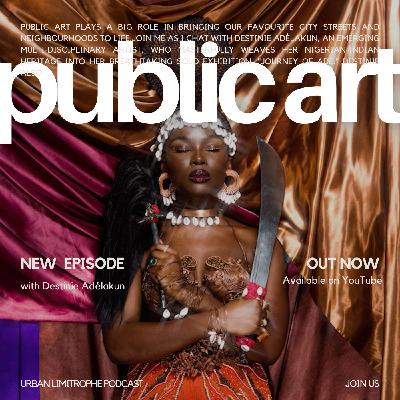
This episode marks the first video episode of the podcast! Here's a sneak peek of my conversation with Destinie Adélakun, an emerging multi-disciplinary artist, who masterfully weaves her Nigerian-Indian heritage into her breathtaking solo exhibition, "Journey of Adé." Destinie also shares the excitement of exhibiting at Toronto's renowned Nuit Blanche, her work bridging mental wellness and public art as part of the Scarborough-based Behind the Art Collective, and the crucial role that public art plays in shaping the identity of our cities. This is just a snippet of our conversation. To watch our full discussion head on over to the new Urban Limitrophe YouTube channel to see all of the art pieces that Destinie refers to in the episode: https://www.youtube.com/watch?v=srnqt0NuzNg Guest: Destinie Adélakun, Behind the Art Collective Acknowledgements: This episode is co-sponsored by the University of Toronto School of Cities, the Department of Geography and Planning, and GlowReel About Urban Limitrophe: Please visit www.urbanlimitrophe.com for all episode show notes and references and guest details. Subscribe to the newsletter: https://shorturl.at/dKQV9 Please address any related communication to hello[at]urbanlimitrophe.com
Join me in this captivating episode of the podcast as I have an insightful conversation with Heba Elhanafy, an urban researcher from the Charter Cities Institute (CCI) Zambia. Together, we explore the fascinating world of charter city development and dive deep into the Planning Guidelines Report titled "Guided Organic Growth: An urban planning framework for charter cities." In this episode, you'll learn about: - What are charter cities and why promoting good governance is at the heart of making them work - The benefits of taking an incremental approach to infrastructure development for more affordability and efficiency - The importance of adapting urban policies and plans to the evolving needs of citizens - And much more! Guest: Heba Elhanafy, Charter Cities Institute (CCI) Zambia - Website: www.chartercitiesinstitute.org - Twitter: @hebaelhanafi - Instagram: @hebaelhanafy - LinkedIn: https://www.linkedin.com/in/heba-elhanafy-918691a0 Acknowledgements: This episode is co-sponsored by the University of Toronto School of Cities and the Department of Geography and Planning. About Urban Limitrophe: Please visit www.urbanlimitrophe.com for all episode show notes and references and guest details. Instagram & Twitter: @urbanlimitrophe Please address any related communication to hello[at]urbanlimitrophe.com Credits: - Music and editing by Imany Lambropoulos - Podcast concept, development, and design by Alexandra Lambropoulos
In this episode, I chat with Angela Oduor Lungati, the CEO of Ushahidi. Ushahdi is a mobile platform dubbed “Africa’s Gift to Silicon Valley” by the New York Times. Born out of a crisis, the open-source software enables virtually anyone with a cellphone or internet connection to efficiently crowd-source information, map it and share it with those the most in need and guide those who can provide aid. Ushahidi is a powerful planning and decision-making tool for communities and cities in the midst of an emergency and has been used by groups worldwide to track everything from COVID-19 recovery to police brutality and everything in between. In this episode, you'll learn about: - how Ushahidi has been leveraged by communities and governments worldwide, - how to keep communities at the center of innovation, - and much more! Guest: Angela Oduor Lungati, CEO of Ushahidi - Website: www.ushahidi.com - Twitter: @AngieNicoleOD | @Ushahidi - Instagram: @Ushahidi - Donate: give.ushahidi.com Acknowledgements: This episode is co-sponsored by the University of Toronto School of Cities and the Department of Geography and Planning. About Urban Limitrophe: Please visit www.urbanlimitrophe.com for all episode show notes and references and guest details. Instagram & Twitter: @urbanlimitrophe Please address any related communication to hello[at]urbanlimitrophe.com Credits: Music and editing by Imany Lambropoulos Podcast concept, development, and design by Alexandra Lambropoulos
En novembre 2021, j'ai eu le plaisir de parler avec M. Patrick Mudekereza le Directeur Exécutif du Centre d'Art Waza. Le Centre d'art Waza, situé à Lubumbashi, en République démocratique du Congo une ville désignée en 2015 par l'UNESCO, comme étant la Ville créative d'artisanat et des arts populaires. Ainsi, pendant notre discussion nous parlons par rapport de la créativité des Lushois, du rôle de l'art public dans la ville, les projets divers dirigés par le Centre et ce qui fait de Lubumbashi une Ville Créative. Dans cet épisode, vous découvrirez: - pourquoi l’art public est si important pour les villes et les communautés qui les accueillent, - l'histoire de la ville de Lubumbashi d'un perspective artistique, - qu’est-ce qui fait de Lubumbashi une ville aussi créative, - et bien plus encore! Invité: Patrick Mudekereza - Website: www.centredartwaza.org - Twitter: @centredartwaza - Instagram: @centredartwaza Remerciements: Cet épisode est co-parrainé par l'Université de Toronto School of Cities et le Département de Geographie et de l'Aménagement Urban Limitrophe: Veuillez visitez www.urbanlimitrophe.com pour toutes les notes et références de l’émission et les détails sur les invités. - Instagram: @urbanlimitrophepodcast - Twitter: @urbanlimitrophe - Contact: hello[at]urbanlimitrophe.com Assistance: - Monteur et producteur de musique: Imany Lambropoulos - Animatrice de podcast et graphiste: Alexandra Lambropoulos
In this episode, my co-host Sami Ferwati and I chat with Salma Elbasty from CLUSTER (Cairo Lab for Urban Studies, Training and Environmental Research). CLUSTER undertakes a number of research, architecture, and arts-based urban initiatives with a special focus on analyzing urban informality and highlighting its role in our cities. During our discussion, we explore the impact of two of CLUSTER's major projects—the CAUL (Critical Arab Urban Lexicon) and their Creativity in Action toolkit—and how through their diverse programming they work with artists, artisans, academics, businesses, communities, and everyone else in between to bring their projects to life. In this episode, you'll learn about: - urban informality and its role in creative cities, - the process CLUSTER follows to undertake their various creative, community-based activities, - the Critical Arab Urban Lexicon (CAUL) and the importance of translating urban terms into different languages, - ALFABRIKA, CLUSTER's maker space and community hub, - and much more! Guest: Salma Elbasty, CLUSTER - Website: www.clustercairo.org - Twitter: @clustercairo - Instagram: @clustercairo Co-Host: Sami Ferwati Acknowledgements: This episode is co-sponsored by the University of Toronto School of Cities and the Department of Geography and Planning. About Urban Limitrophe: - Please visit www.urbanlimitrophe.com for all episode show notes and references and guest details. - Instagram & Twitter: @urbanlimitrophe - Please address any related communication to hello[at]urbanlimitrophe.com Credits: - Music by Imany Lambropoulos - Podcast concept, development, and design by Alexandra Lambropoulos
In this episode, my co-host Jane O'Brien Davis and I chat with Marion Anvango at Book Bunk. The Book Bunk is "working to restore some of Nairobi's most iconic public libraries into sites of heritage, public art, collective memory, knowledge production, shared experiences, cultural leadership and information exchange." During our discussion, we explore their diverse series of programming that they offer in their public library branches. We also chat about Book Bunk's approach to restoring libraries to make them more inclusive and accessible and cultivate a sense of belonging for the local community. In this episode, you'll learn about: - how they involve the community in the restoration of public libraries, - their experiential, digital, architectural, and social approach to restoring public libraries, - their efforts to make library services more accessible for those living with disabilities, - why public libraries are so important for cities to have, - and much more! Guest: Marion Anvango, Book Bunk - Website: https://www.bookbunk.org/ - Twitter: @thebookbunk - Instagram: @thebookbunk Co-Host: Jane O’Brien Davis - Twitter/Instagram: @janeobd - Linkedin: linkedin.com/in/jane-o-brien-davis-772211197/ Acknowledgements: This episode is co-sponsored by the University of Toronto School of Cities and the Department of Geography and Planning. About Urban Limitrophe: Please visit www.urbanlimitrophe.com for all episode show notes and references and guest details. Instagram & Twitter: @urbanlimitrophe Please address any related communication to hello[at]urbanlimitrophe.com Credits: - Music by Imany Lambropoulos - Podcast concept, development, and design by Alexandra Lambropoulos
In this episode, I chat with Adwoa Afful, the founder of Black Futures Now Toronto (BFN TO). BFN TO is collective that uses a mixture of storytelling, radical mapping, and a whole lot of creative talent, to develop a number of interactive ways of archiving, experiencing, and celebrating overlooked Black histories and geographies. During our talk, we explore their innovative Mapping Black Futures (MBF) story mapping project, and how in collaboration with Black nonbinary youth and women from across the Greater Toronto Area, they built a virtual community centre that highlights Black histories and placemaking. In this episode, you'll learn about: - why it's important to map Black histories and Black geographies, - what is counter/radical mapping and how it can be used as a tool for community building, - how Black Futures Now Toronto developed their virtual community centre, - the youth responsible for creating the content for the Mapping Black Futures project, - and much more! Guest: Adwoa Afful, Black Futures Now Toronto - Website: www.blackfuturesnow.to/ - Twitter: @BlackFuturesNow - Instagram: @bfntoronto - bfntoronto[at]gmail.com Acknowledgements: This episode is co-sponsored by the University of Toronto School of Cities and the Department of Geography and Planning. About Urban Limitrophe: Please visit www.urbanlimitrophe.com for all episode show notes and references and guest details. Instagram & Twitter: @urbanlimitrophe Please address any related communication to hello[at]urbanlimitrophe.com Credits: - Music by Imany Lambropoulos - Editing by Hannah Ahamedi - Podcast concept, development, and design by Alexandra Lambropoulos
In this episode, I speak with Tatu Gatere, the co-founder and CEO of Buildher. Buildher is a non-profit based in Nairobi Kenya that is on a mission to promote gender equality within the construction industry through the provision of accredited construction, artisanry, and manufacturing skills to women that participate in their training program. Through their holistic approach to skills training and workforce development, Buildher is working hard to knock down biases and close the gender gap in the construction industry in Kenya and beyond. In this episode, you'll learn about: - Buildher's holistic approach to training women in the construction and artisanry, - why it's important for women to be involved in the construction/urban infrastructure sector, recommendations for integrating more women into the construction sector, - the exciting projects (i.e. their new product line) that Buildher has in store, - their upcoming podcast's and programming's focus on youth employability in Kenya, - and much more! Guest: Tatu Gatere, CEO and Co-Founder of Buildher Website: https://www.buildher.org/ Acknowledgements: This episode is co-sponsored by the University of Toronto School of Cities and the Department of Geography and Planning. About Urban Limitrophe: Please visit www.urbanlimitrophe.com for all episode show notes and references and guest details. Instagram: @urbanlimitrophepodcast Twitter: @urbanlimitrophe Please address any related communication to hello[at]urbanlimitrophe.com Credits: Music by Imany Lambropoulos Editing by Hannah Ahamedi Podcast concept, development, and design by Alexandra Lambropoulos
In this episode, my co-host Hannah and I chatted with Milly Kakungulu, the Education Department Lead at Justice Defenders Uganda. Through our discussion, we learned more about how the Justice Defenders (formerly known as the African Prisons Project) are defending the defenceless by educating prisoners on how to provide legal services for themselves and others. In this episode, you'll learn about: - the importance of a people-centred approach to justice, the different challenges that prisoners face with getting access to justice in the current legal system, - the Justice Defenders model (education, training, practice) and the various opportunities that Justice Defenders provides participants, - how prisoners have leveraged the education Justice Defenders' has provided them to transform their own lives and influence policies that improve justice within their communities at various government levels, - and much more! Guest: Milly Kakungulu - Website: https://www.justice-defenders.org/ Co-Host: Hannah Ahamedi Acknowledgements: This episode is co-sponsored by the University of Toronto School of Cities and the Department of Geography and Planning. About Urban Limitrophe: Please visit www.urbanlimitrophe.com for all episode show notes and references and guest details. Instagram & Twitter: @urbanlimitrophe Please address any related communication to hello[at]urbanlimitrophe.com Credits: - Music by Imany Lambropoulos - Editing by Hannah Ahamedi - Podcast concept, development, and design by Alexandra Lambropoulos.
In this episode, I chat again with Roxana Escobar Ñañez. Roxana is pursuing her Ph.D. in Human Geography at the University of Toronto and she was recently one of five special guests on the 12th episode of the podcast. Given her unique research interests, after our last conversation, I decided to invite her to the show again to dive deeper into her work examining 'the places Afro-Peruvian women hold in Lima’s sonic landscapes' and Black womanhood in Latin America and to get a better understanding about how these themes of music, Blackness, and cities emerge in the diaspora. What started off as a discussion of her research turned into a vivid exploration of Lima's history through the lens of Afro-Peruvian music, food, culture, and most importantly Black joy and resilience. In this episode, you'll learn about: - the project of mestizaje and the origins of criollo music and culture in Peru, - what are sonic landscapes and how Afro-Peruvian women, in particular, are essential to shaping Lima's vibrant soundscape and unique cultural identity, - the key characteristics of Afro-Peruvian music, additional resources and artists to help you learn more about Afro-Peruvian culture and its impact in Peru, - the importance of highlighting Black joy when researching Black histories and geographies, - and much more! Guest: Roxana Escobar Ñañez - Twitter: @RoxanaEscobarN - Instagram: @Roxanaescobar14 - Email: roxana.escobar[at]mail.utoronto.ca Acknowledgements: This episode is co-sponsored by the University of Toronto School of Cities and the Department of Geography and Planning. About Urban Limitrophe: Please visit www.urbanlimitrophe.com for all episode show notes and references and guest details. Instagram & Twitter: @urbanlimitrophe Podcast concept, development, and design by Alexandra Lambropoulos. Music by Imany Lambropoulos Please address any related communication to hello[at]urbanlimitrophe.com
This special episode of Urban Limitrophe is brought to you in collaboration with the Graduate Geography & Planning Student Society (GGAPSS) in celebration of Black History/Black Futures Month! In this episode, I speak with Roxana Escobar Ñañez (PhD Human Geography), Brianna Lane (MA Physical Geography), Priscilla Ankomah-Hackman (MSc Planning), Jane O'Brien Davis (MSc Planning), and Bola Oshinusi (PhD Planning) to explore why they got interested in geography and planning, and their advice for other aspiring geographers and planners looking to study in this field. In this episode, you'll learn about each guests': - research interests and upcoming projects, - reasons for studying at the University of Toronto, - hopes for having more diversity in their respective field, - advice for other emerging geographers and planners, - and much more! Collaborator: Graduate Geography & Planning Student Society (GGAPSS) - Twitter: @GGAPSS_UT - Instagram: @ggapss - Website: ggapss.wordpress.com/ - LinkedIn: linkedin.com/company/ggapss/about/ Guests (visit the podcast website for contact details): - Roxana Escobar Ñañez (PhD Human Geography) - Brianna Lane (MA Physical Geography) - Priscilla Ankomah-Hackman (MSc Planning) - Jane O'Brien Davis (MSc Planning) - Bola Oshinusi (PhD Planning) Acknowledgements: This episode is co-sponsored by the University of Toronto School of Cities and the Department of Geography and Planning. About Urban Limitrophe: Please visit www.urbanlimitrophe.com for all episode show notes and references and guest details. Instagram & Twitter: @urbanlimitrophe Podcast concept, development, and design by Alexandra Lambropoulos. Music by Imany Lambropoulos Please address any related communication to hello[at]urbanlimitrophe.com
In this episode, I speak with Abigail Moriah, a registered urban planner and founder of the Black Planning Project. Through this initiative, Abigail and her team, collect and share the stories of Black urban planning professionals and students to highlight their important work and encourage more diverse voices to enter the profession. Most importantly, through its various mentorship opportunities and research endeavours, the Black Planning Project builds the relationships and the community ties necessary to make sure that urban planning and hopefully the city building sector overall makes room for new perspectives and ideas. In this episode, you'll learn: - why it is essential to encourage spaces where urban planners can discuss racial injustices in planning, - about some of the experiences and injustices that Black planners face in their profession, - about resources and advice for emerging urban planners of colour to help them navigate the field, - the importance of including diverse voices in the urban planning profession, - and much more! Guest: Abigail Moriah - Facebook: facebook.com/BlackPlanningProject - Twitter: @planning_black - Instagram: @blackplanningproject - Website: www.blackplanningproject.com/ Acknowledgements: This episode is co-sponsored by the University of Toronto School of Cities and the Department of Geography and Planning. About Urban Limitrophe: Please visit www.urbanlimitrophe.com for all episode show notes and references and guest details. Instagram & Twitter: @urbanlimitrophe Podcast concept, development, and design by Alexandra Lambropoulos. Editing by Hannah Ahamedi Music by Imany Lambropoulos Please address any related communication to hello[at]urbanlimitrophe.com
loading
Comments