


 Claim Ownership
Main Bhi Muslim
Subscribed: 11Played: 72
Subscribe

© Main Bhi Muslim
Description
'Main Bhi Muslim' the podcast is a conversational space for individuality and diversity within the context of being an Indian, a Muslim and everything in between.
www.mainbhimuslim.com
www.mainbhimuslim.com
40 Episodes
Reverse
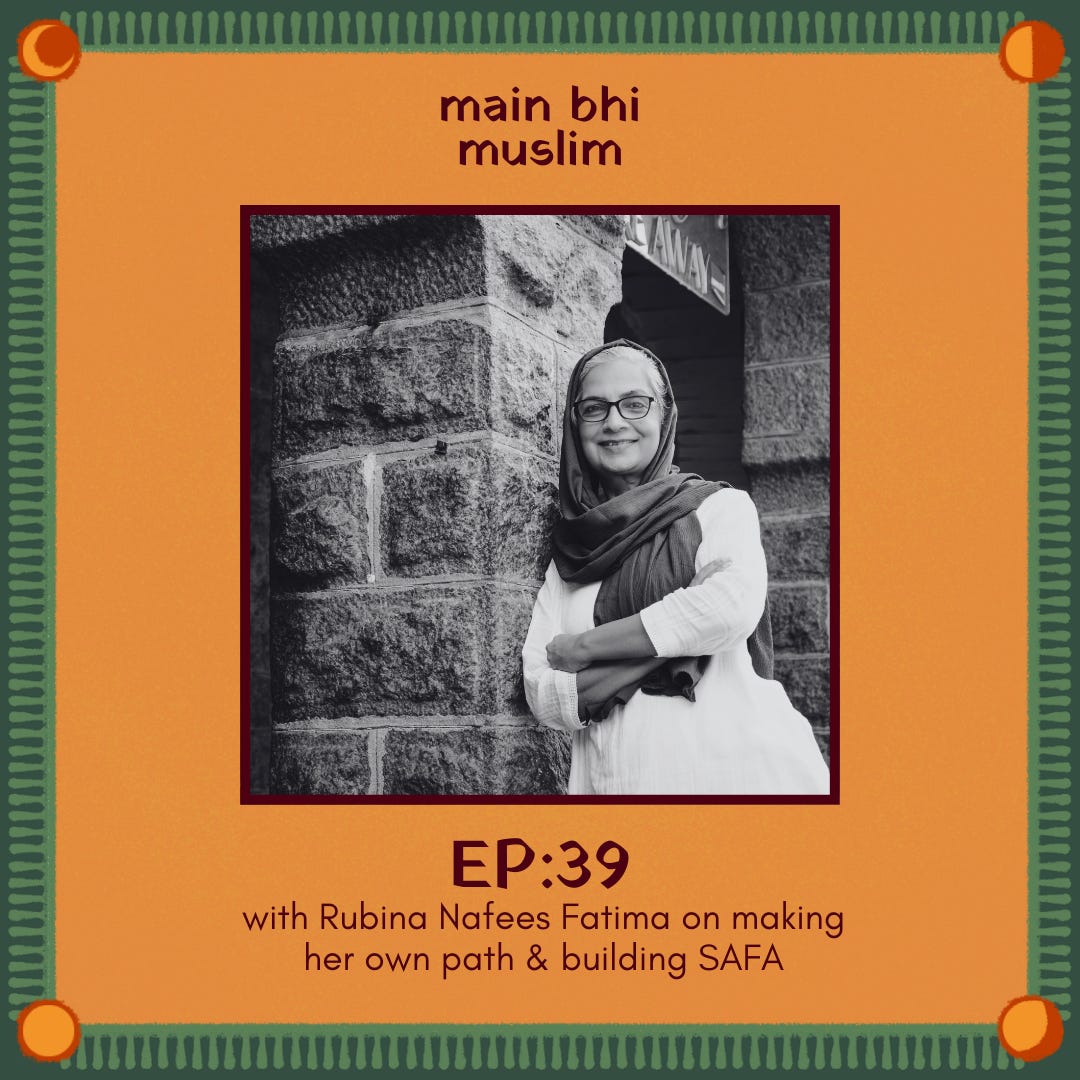
This MBM conversation is with social entrepreneur Rubina Nafees Fatima who is the Founder & Director of Hyderabad-based non-profit SAFA. For nearly 20 years, SAFA has been instrumental in supporting economically and socially marginalised communities in Hyderabad, through education, skill training, livelihoods, placements, and community wellbeing initiatives.How Rubina decided to start SAFA and her journey up until then is what we discuss in this episode. From her early beginnings growing across different parts of the country, being raised by a progressive father, recognising the dissonance between her family’s values and societal norms, and sticking to her north star at every stage of her life. Now in her sixties, Rubina continues to dream towards expanding SAFA’s work and impact, and in her own words is ‘raring to go.’ This Women’s Day, do give this episode a listen.About SAFA:* Website: https://www.safaindia.org/* Instagram: https://www.instagram.com/safaindia* Linktree: https://linktr.ee/safangoEpisode notes:* To learn more about the Islamic story of Safa and Marwa - Following Haajar’s Footsteps to a Feminist Reading of Islam (Aneesa Bodiat, JSTOR Daily, October 2019)* Crossing the River Musi: The Identity and Agency of Women | Rubina Nafees Fatima (TEDxHyderabad, April 2025)* Hyderabad: ‘Only 5% Muslims in Old City slums pursue higher edu’, says survey (The Siasat Daily, March 2023)* 37 percent of women are single bread earners for families of which 43 percent are widows, 22 percent are divorced and 37 percent are single women abandoned by spouses.* Hijab ban: Karnataka high court upholds government order on headscarves (BBC, March 2022)MBM visual identity design by Shazia Salam || Music by Jupneet Singh This is a public episode. If you would like to discuss this with other subscribers or get access to bonus episodes, visit www.mainbhimuslim.com
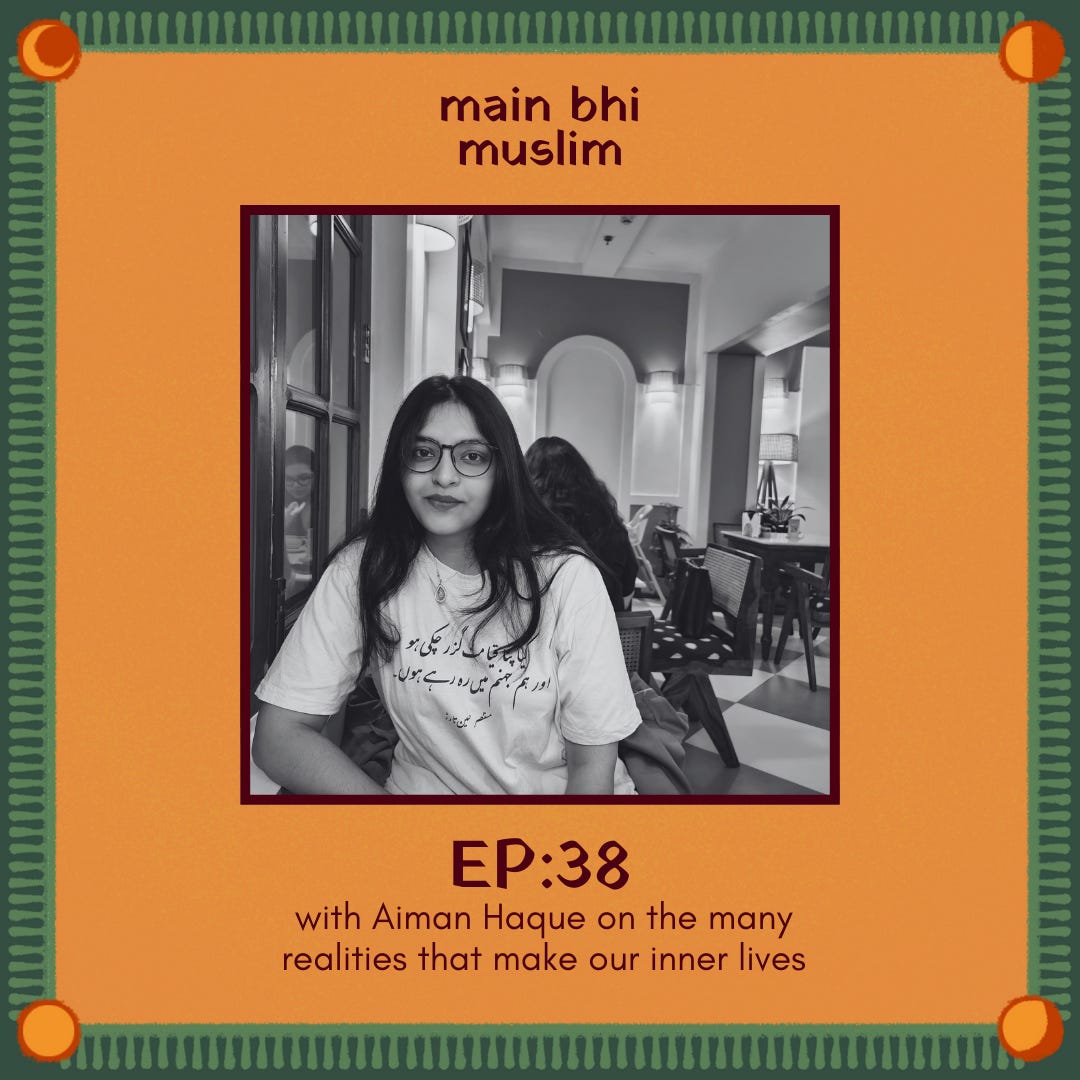
This MBM conversation is with Aiman Haque, a Delhi based researcher and writer. Through her years of growing up, working and having family across different parts of the country, Aiman shares how language, caste, history and local cultures have shaped her sense of identity and belonging. We discuss how caste manifests within Muslim communities, especially during arranged marriage discussions or in the choice of words used to address certain sections of the community.We also discuss the value of understanding the inner lives of Muslim women, in order to truly address the needs of the community as a whole. Aiman also shares what it takes to have spaces that are caste-conscious and compassionate towards every person, and find ways to expand opportunities and sense of belonging in more ways than one.Episode notes:* Panel 5: Counter-Narratives to Majoritarianism | Counter-Narratives: The MHI Conference 2025 (YouTube, Mariwala Health Initiative, April 2025)* The forgotten riots of Bhagalpur, In Pictures (Javed Iqbal, Al Jazeera, December 2014)* Caste and social stratification among Muslims in India (edited by Imtiaz Ahmad, Aakar Books, April 2018)* The political life of Muslim caste: articulations and frictions within a Pasmanda identity (Shireen Azam, Contemporary South Asia, July 2023)* Kerala hijab row: How a dispute between a teen and her school became a state-wide debate (Haritha Manav, The News Minute, October 2025)* The Indian development sector has got diversity hiring all wrong (Aiman Haque, The Caravan, January 2024)* Mental Health Is Political: Institutional Violence, Marginalisation And Mental Health Policies At Work (Aiman Haque, Feminism In India, May 2022)MBM visual identity design by Shazia Salam || Music by Jupneet Singh This is a public episode. If you would like to discuss this with other subscribers or get access to bonus episodes, visit www.mainbhimuslim.com
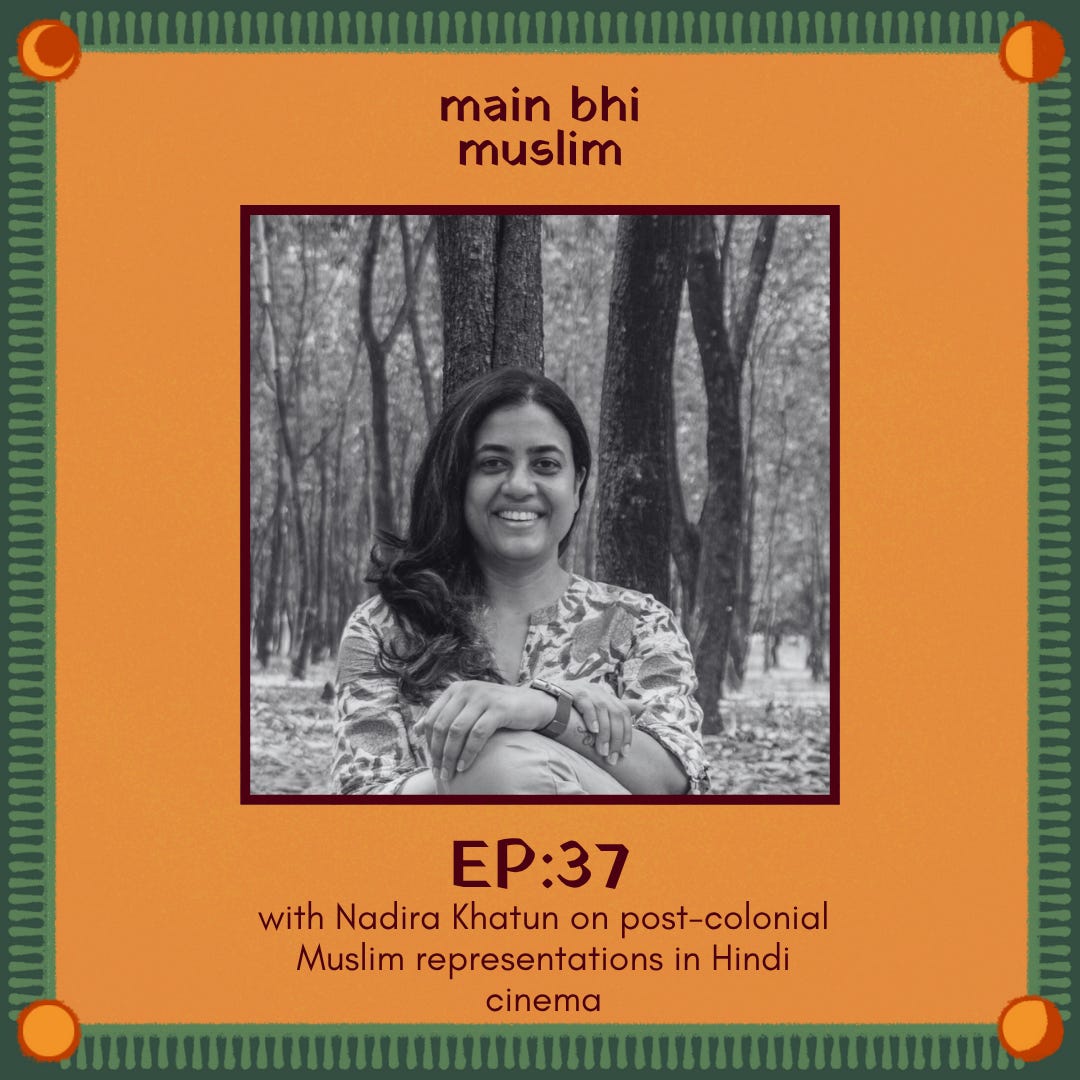
This MBM conversation is with Nadira Khatun, author of the book ‘Postcolonial Bollywood and Muslim Identity: Production, Representation, and Reception’. Through this book, Nadira traces the representation of Muslim characters within Hindi cinema in post-partition India, and how the socio-political and economic factors have contributed to varied representations across decades.We discuss the influence of Bollywood on our own personal upbringings, how cinematic representations contributed to the majoritarian perceptions of the Muslim identity and its interactions with us. From films like Mughal-e-Azam and Mammo to Gully Boy and Superboys of Malegaon, we talk about the evolution of Muslim characters and what would it take to make a movie with a truly effortless Muslim representation that does not fulfil any expectation or stereotype.We also discuss the many failings of Hindi film-makers in representing Muslim women - who were either exoticised or oppressed, leaving us with the hope that there is a whole world to cover when it comes to exciting possibilities in the space of truly bebaak representations.About Nadira KhatunNadira Khatun is associate professor at School of Communications, XIM University, Bhubaneswar, Odisha. She was visiting assistant professor at McMaster University, Hamilton from January 2021 to January 2022. She has contributed to academic journals and edited volumes on social media, Bollywood and Muslim identity. Her book tilted, Postcolonial Bollywood and Muslim Identity: Production, Representation, and Reception was released in August 2024 with Oxford University Press, UK. Email address of corresponding author: nadira.khatun@gmail.comEpisode notes:* ‘Exoticised, alienised, villainised’: A book looks at how Muslims have been portrayed in Hindi films (Nandini Ramnath, Scroll, June 2025)* Ghettoisation, Crime and Punishment in Mumbai (Abdul Shaban, Economic and Political Weekly, 2008)* Jain, Ranu, and Shaban, Abdul (1999). Socio Economic and Educational Status of Muslims in Mumbai. A Research Report, Submitted to the Maharashtra State Minorities Commission. Mumbai: Government of Maharashtra.* Bombay Cinema’s Islamicate Histories (Edited by Ira Bhaskar and Richard Allen, The University of Chicago Press, 2021)* To Be Seen Whole: Blackness, Muslimness, and the Politics of Art (Topibechwa’s Substack, May 2025)* Links to certain films discussed in the conversation:* Mammo (1994)* Garm Hava (1974)* Mughal-e-Azam (1960)* Umrao Jaan (1981)* Pakeezah (1972)* Bebaak (2018)* Dhadak 2 (2025)* Salim Langde Pe Mat Ro (1989)* Gully Boy (2019)* Darlings (2022)* Superboys of Malegaon (2024)* Supermen of Malegaon (2008)* Jawan (2023)* Zindagi Na Milegi Dobara (2011)* Coolie (1983)MBM visual identity design by Shazia Salam || Music by Jupneet Singh This is a public episode. If you would like to discuss this with other subscribers or get access to bonus episodes, visit www.mainbhimuslim.com
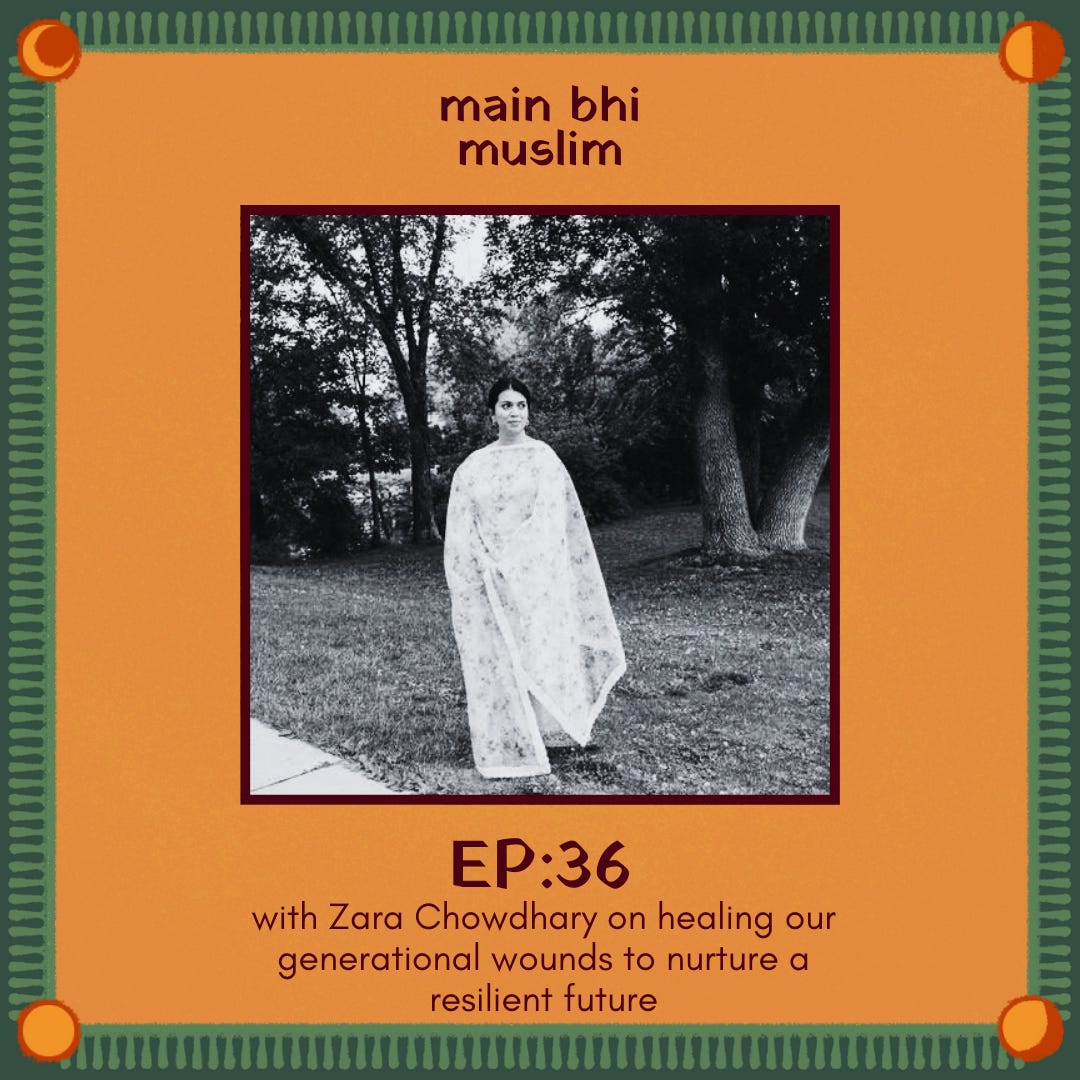
This MBM conversation with Zara Chowdhary, author of the memoir The Lucky Ones - a survivor’s account of the 2002 Gujarat Pogrom. The book is a deeply personal story of Zara and her family whose roots and history are entwined within the soil and soul of the Indian subcontinent, but also the trauma that speaks through the family, especially the women across generations.Zara’s writing is intimate, visceral and soul-stirring, with each page offering truth and dignity to every relationship she writes about, evoking a deep sense of humanity that we most often refuse to acknowledge even within ourselves. We talk about that and many other things including the ways faith informs her interactions with the people and communities she chooses to be part of.About Zara ChowdharyZara Chowdhary is a writer and educator in the US. She has an MA in writing for performance from the University of Leeds, and an MFA in creative writing and Environment from Iowa State University. She has previously worked behind the camera for studios like Red Chillies Entertainment, Vinod Chopra Films, Eros Entertainment and others. Her debut, The Lucky Ones, a first by any survivor of the 2002 Gujarat Pogrom, released in the US last year to critical acclaim.It was a PEN America finalist, and a Time Magazine Top Ten Best Nonfiction Books of the Year, as well as a Best Book by NPR, Kirkus Reviews, Publishers Weekly, People Magazine, Esquire, Electric Literature and others. In India, The Lucky Ones released in September 2024, and has become a nonfiction bestseller, winning the prestigious Shakti Bhatt Prize 2024, and currently long-listed for the Ramnath Goenka Sahitya Samman. Zara teaches creative writing and South Asian studies at the University of Iowa.MBM visual identity design by Shazia Salam || Music by Jupneet Singh This is a public episode. If you would like to discuss this with other subscribers or get access to bonus episodes, visit www.mainbhimuslim.com
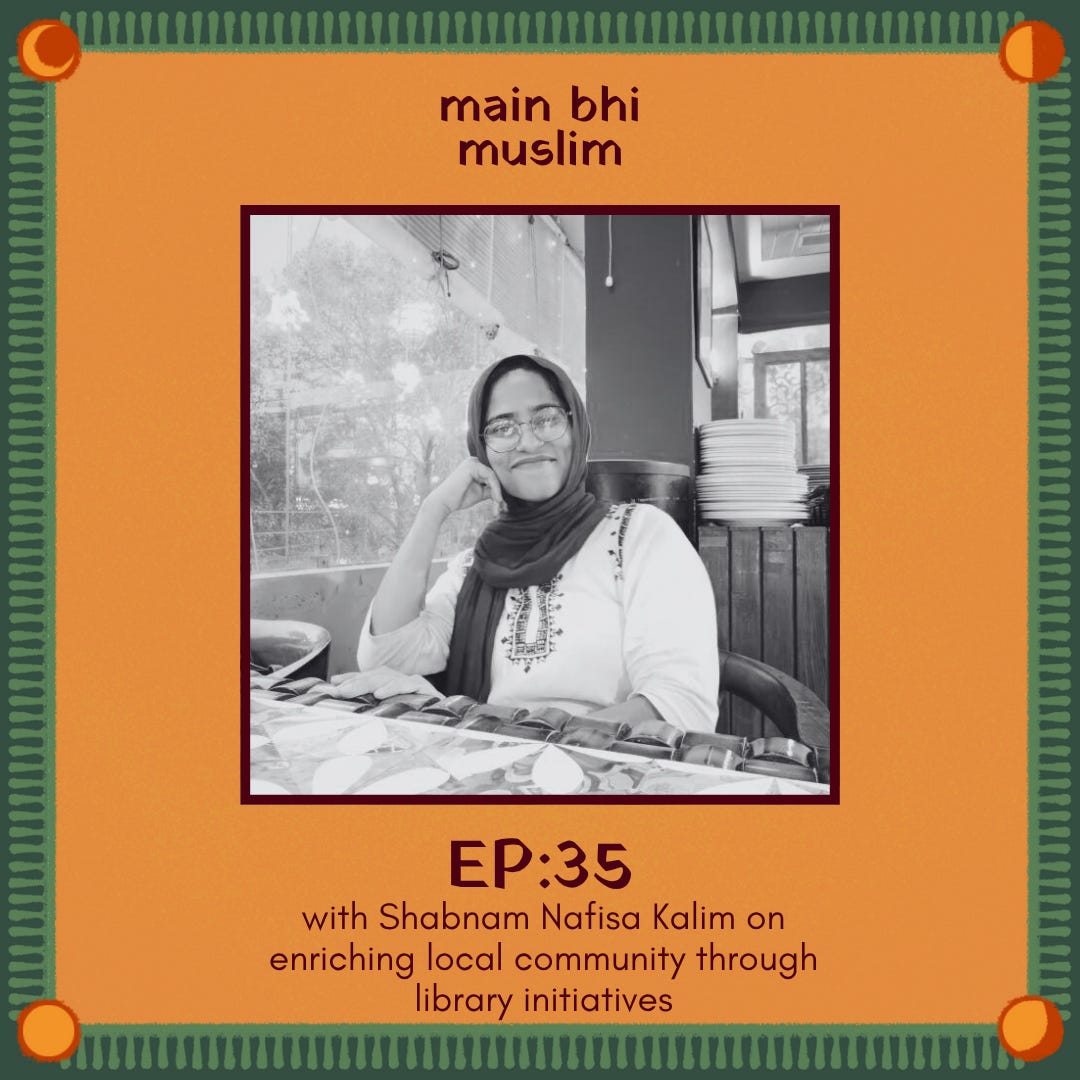
This MBM conversation is with Shabnam Nafisa Kalim, a resident of Mustafabad - a predominantly Muslim suburban area in North-east Delhi, where she and her team of volunteers run two libraries to create a learning and educational space for their community. Mashaal Library and Amma’s Library have over the years become spaces of educational resources to prepare Mustafabad’s youngsters for competitive examinations, and support the local community through adult literacy, career counselling and mental well-being sessions. In this interaction, Shabnam also sheds light on managing internal community challenges, ensuring that libraries are acknowledged as fundamental needs for younger generation, where girls and women can spend time without being questioned by their families, and women recognise the value of their time away from family responsibilities. This kind of effort has resulted in more women coming to these libraries and encouraging others to join too. Links of the libraries: * Mashaal Library * Amma’s LibraryEpisode notes: * Why libraries are a must in India’s public schools (Sneha Priya Yanappa and Avinash Reddy, Scroll, March 2023) * With Poor Infrastructure, Lack of Facilities Govt Schools Perform Worst Across India: Report (Ditsa Bhattacharya, NewsClick, July 2021)* Ghettoes, Religious Communities and the State - A Muslim Enclave in New Delhi (Debanjana Das, ARF India, 2022) * Delhi Riots Fact-Finding 2020 by Delhi Minorities Commission (July 2020) * The Pursuit of Dignity & Beauty in a Broken World ft. Bhumika Saraswati (Anurag Minus Verma Podcast, January 2025)* Kranti Collective MBM visual identity design by Shazia Salam || Music by Jupneet Singh This is a public episode. If you would like to discuss this with other subscribers or get access to bonus episodes, visit www.mainbhimuslim.com
This MBM conversation is with Nausheen Khan, an independent film-maker based in India, whose documentary Land of My Dreams is a retracing of her journey as an Indian Muslim woman as she covered the Shaheen Bagh protests in 2019-2020.In this conversation, Nausheen shares her introspection around her identity growing up, the effect of stereotypes on her, and reclaiming her Muslimness in more ways than one. We discuss the myriad forms in which being a woman in the present times challenges us to show up with more clarity and confidence in every space we choose to be in.We also discuss the impact of friendships and the need for bonds that allow one to express the vulnerabilities one lives with, as a woman, an artist, a Muslim, among others. For Nausheen, living with joy is the biggest act of resilience and this conversation is a snippet of that.About Nausheen Khan Nausheen Khan is an independent filmmaker based in India, working on gender perspectives amid conflict and political unrest in contemporary times. Land of My Dreams is her first self-financed feature-length documentary film. It won Best Long Documentary at the International Documentary and Short Film Festival of Kerala, in 2023, and the Citizens' Prize at the Yamagata International Documentary Film Festival, in 2023.Episode notes:* [Trailer] Land of My Dreams | Nausheen Khan | Documentary | Monthly Film Screening | April 2024 (Peoples Film Collective, YouTube, April 2024)* Nausheen Khan’s Land of My Dreams wins Best Long Documentary Award at IDSFFK (The Hindu, August 2023)* India: Tennis player Yadav killed by her father — reports | Tanika Godbole with DW sources (DW, July 2025)* Systems are crumbling – but daily life continues. The dissonance is real (Adrienne Matei, The Guardian, May 2025) MBM visual identity design by Shazia Salam || Music by Jupneet Singh This is a public episode. If you would like to discuss this with other subscribers or get access to bonus episodes, visit www.mainbhimuslim.com
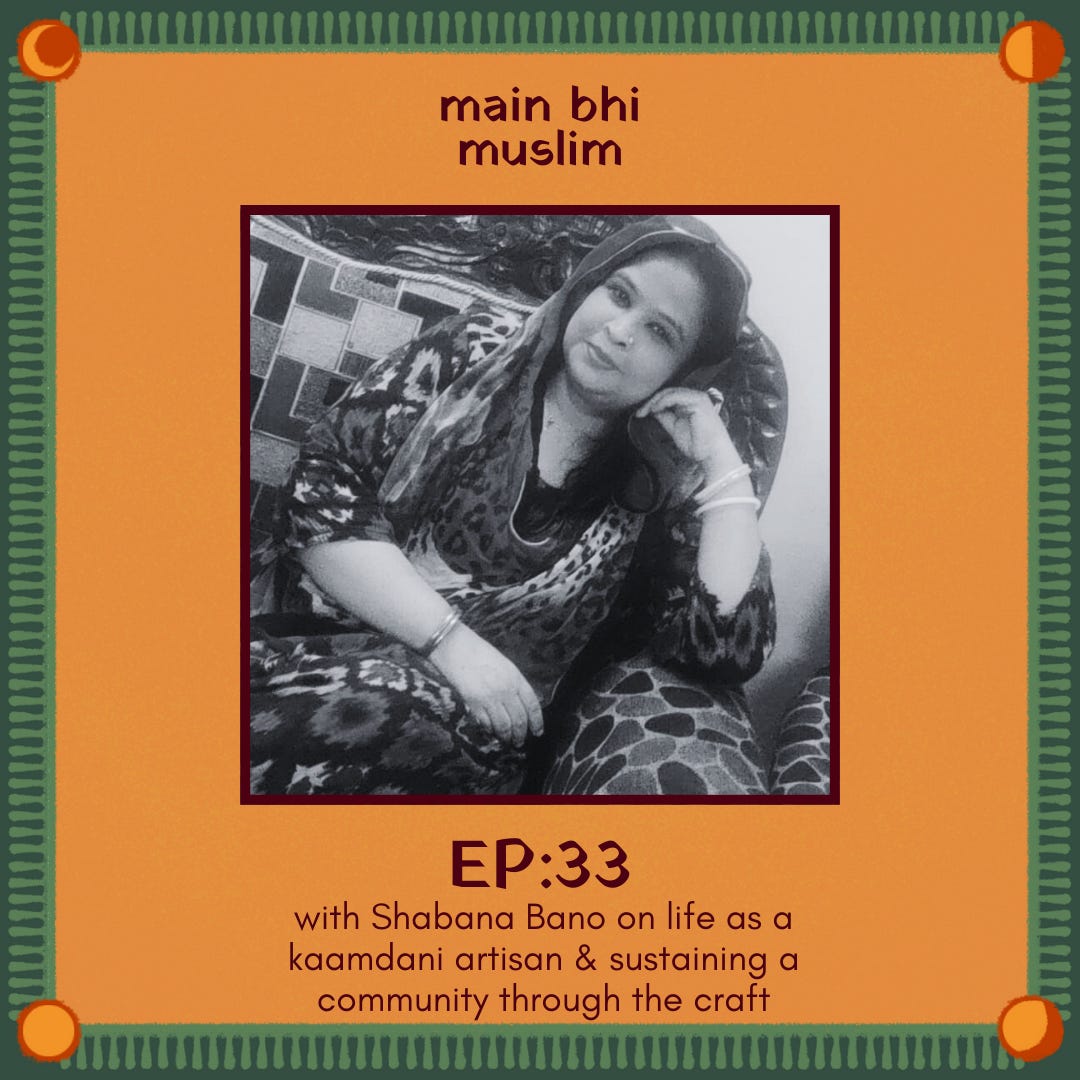
This MBM conversation is with Shabana Bano, a Lucknow-based kaamdani artisan. Kaamdani or Mukaish as its popularly known, is intricate metal-work embroidery which requires skill, talent, time and patience to stitch patterns and designs onto fabric. For more than 15 years, Shabana ji has been making her living through this craft, has trained and supported countless women and currently has a team of 50 women artisans who work with her.In this episode, Shabana ji shares her experience learning and expanding her craft to make a living and help other working-class women pick it up too. She highlights the challenges that women participating in this kind of informal sector face, not just domestically but also socially, and how this craft has enabled an intimate self-help group, in the absence of any institutional support, dignified working rates and employee benefits. She speaks of the glaring income inequalities that exist between such artisans who earn as little as INR 150 per day (less than USD2) and certain apparel store owners and designers who price such products in thousands if not more.Shabana ji has also managed to encourage and support more women to not only take up this work but also recruit other women to learn and earn just like her. She hopes that this craft and its people receive their rightful wages and dignity to lead their lives with more resources and support. This conversation was mostly recorded in Urdu and the English transcript of it is available on MBM’s website.Link to Shabana Bano’s Instagram account which showcases her and her team’s work: https://www.instagram.com/mirza_chiken/Shabana Bano’s phone number for any work-related queries: +91 887390 95976Episode notes:* Short video essay on Mrs. Shabana’s work (Maroof Umar, Instagram, February 2025)* Mukaish/Badla/Metallic Embroidery of Lucknow, Uttar Pradesh (Asia InCH, Encyclopedia of Living Heritage)* Indian Sequins: A Jeweled Textile of India (Tooba Fatma, International Journal for Multidisciplinary Research, October 2024)* Amazon launched a program for Indian handicrafts. Local artisans say it’s not working (Nipun Prabhakar, Rest of World, October 2024)MBM visual identity design by Shazia Salam || Music by Jupneet Singh This is a public episode. If you would like to discuss this with other subscribers or get access to bonus episodes, visit www.mainbhimuslim.com
Can a Muslim university be an Indian university? These are the first words in Dr Laurence Gautier’s book Between Nation and ‘Community’ - Muslim Universities & Indian Politics after Partition, in which she explores the history, nature and contribution of India’s leading Muslim universities - Aligarh Muslim University (AMU) and Jamia Milia Islamia (JMI), two institutions which in her words acted, “as crucibles for competing conceptions of ‘Indian Muslimness’ in post-independence India.” This MBM conversation is with researcher and author, Laurence Gautier where we discuss how these universities, their members and students played key roles in recognising the needs of a new India in terms of education, nation-building and social reform. We dive deeper into debates and contestation of ideas around the Indian Muslim identity that continues to evolve and the ways in which many figures, men and women, both worked towards making it more encompassing and holistic, despite the internal and external challenges. The conversation also sheds some light on caste-based politics, women’s participation in universities, and the possible future roles of both these universities in the making of modern India. In this episode we use abbreviations - ‘AMU’ for Aligarh Muslim University and ‘JMI’ for Jamia Millia Islamia.About Dr Laurence Gautier:Laurence Gautier is a researcher at the Centre de Sciences Humaines (CSH), New Delhi. She completed her PhD in History at the University of Cambridge and taught at O.P. Jindal Global University, Sonipat before joining CSH. She writes on Muslim politics, secularism, nation-building and university politics in post-independence India. Between Nation and Community is her first monograph. She also co-edited Historicizing Sayyid-ness: Social Status and Muslim Identity in South Asia with Julien Levesque (JRAS, 2020).Episode notes:* Islamic Revival in British India: Deoband, 1860-1900 (Barbara D. Metcalfe, Princeton University Press, 1982)* Emotions and Modernity in Colonial India: From Balance to Fervor (Margrit Pernau, Oxford University Press, 2019)* Books by Mushirul Hasan* Imagined Communities - Reflections on the Origin and Spread of Nationalism (Benedict Anderson, Verso Books)* Rekhta* Sajida Zaidi,celebrated Urdu writer,passes away at 84 (The Indian Express, March 2011)* Zahida Zaidi writings (Rekhta)* Social Exclusion of Muslims in India and Britain (Sabah Khan, Journal of Social Inclusion Studies Volume 6, Issue 1, June 2020)* Mandal Commission Report (National Commission for Backward ClassesA Constitutional Body under Article 338B of the Constitution of India)* Why caste among Muslims must be studied (Shireen Azam and Srinivas Goli, The Indian Express, May 2022)* Gerda Philipsborn, the Lesser Known Maker of Jamia Millia Islamia (Mahtab Alam, The Wire, October 2021)MBM visual identity design by Shazia Salam || Music by Jupneet Singh This is a public episode. If you would like to discuss this with other subscribers or get access to bonus episodes, visit www.mainbhimuslim.com

This MBM conversation is with Nusrat Jafri, author of the memoir ‘This Land We Call Home’. In this book, Nusrat traces her maternal history going back to her great grand-father, who was originally part of the Bhantu tribe, and later adopted Christianity as a way to overcome the ostracisation imposed upon him and his family for belonging to what the British deemed as ‘criminal tribes’. Nusrat’s book offers a window into the lives and choices of her grand aunts, who with the help of Christian missionaries’ efforts got access to education and opportunities to become the first women to study in boarding schools, have varied career choices, travel abroad, marry or not by their own choices, and in effect become role models for her. She writes about her mother Meera, born in the year of India’s independence, who also carved a path of her own, fell in love with a Muslim man, decided to convert to Islam, and effectively raised Nusrat and her siblings in a Muslim household. This conversation takes a deeper dive into Nusrat’s years growing up in a cultural milieu where the term conversion was not a loaded one and where being a Muslim came with a space to ask questions to arrive at one's own answers. We talk about many layers of this Muslim identity, including gender, caste, class and how one carries their Muslimness in the world and country we find ourselves today. Do give this episode a listen and share it with your friends, family and loved ones.About Nusrat JafriNusrat Jafri, is a Mumbai based award-winning cinematographer. She has over fifteen years of experience in filmmaking. Born and brought up in Lucknow, she moved to New Delhi for graduation and post-graduation in Mass Communication. Her professional journey includes stints as a journalist with The Pioneer and CNBC Awaaz. Nusrat is a mentee of the first cohort (2021) of South Asia Speaks. She was featured in the second edition of Rising Beyond The Ceiling: 100 stereotype-shattering stories of Muslim women of Uttar Pradesh, India. She lives in Mumbai with her husband, son and a cat named Jamia.You can learn about her book and find links to purchase here.Episode Notes:* From the memoir: How Bhantus, a ‘criminal tribe’, found acceptance from Christian missionaries (Excerpt from the book, This Land We Call Home by Nusrat Jafri, Scroll, June 2024) * Ants Among Elephants: An Untouchable Family and the Making of Modern India by Sujatha Gidla (Farrar, Straus and Giroux, 2018) * Understanding Ganga-Jamuni Tehzeeb: How diverse is the "Indian multiculturalism"(Rana Safvi, DNA, June 2014)* “Many see Indian Muslims as suspect foreigners, despite the fact that most are descendants of Hindus who converted to Islam.” India’s Muslims: An Increasingly Marginalized Population (Lindsay Maizland, Council on Foreign Relations, March 2024)* Chhattisgarh: Hindutva group attacks Christian families, forces to sign pact to ‘convert within ten days’ (Sidra Fatima, Maktoob Media, June 2024)* Issue Update: India’s State Level Anti-Conversion Laws (United States Commission on International Religious Freedom, March 2023) * Religious Composition of India - All religious groups in India show major declines in fertility rates, limiting change in the country’s religious composition over time (Pew Research Center, September 2021)* 25 years later, long shadow of the Staines murders (Debabrata Mohanty, Hindustan Times, January 2024)* Why caste among Muslims must be studied (by Shireen Azam and Srinivas Goli, The Indian Express, May 2022)* Caste Among Indian Muslims Is a Real Issue. So Why Deny Them Reservation? (Pratik Patnaik, The Wire, December 2020)MBM visual identity design by Shazia Salam || Music by Jupneet Singh This is a public episode. If you would like to discuss this with other subscribers or get access to bonus episodes, visit www.mainbhimuslim.com
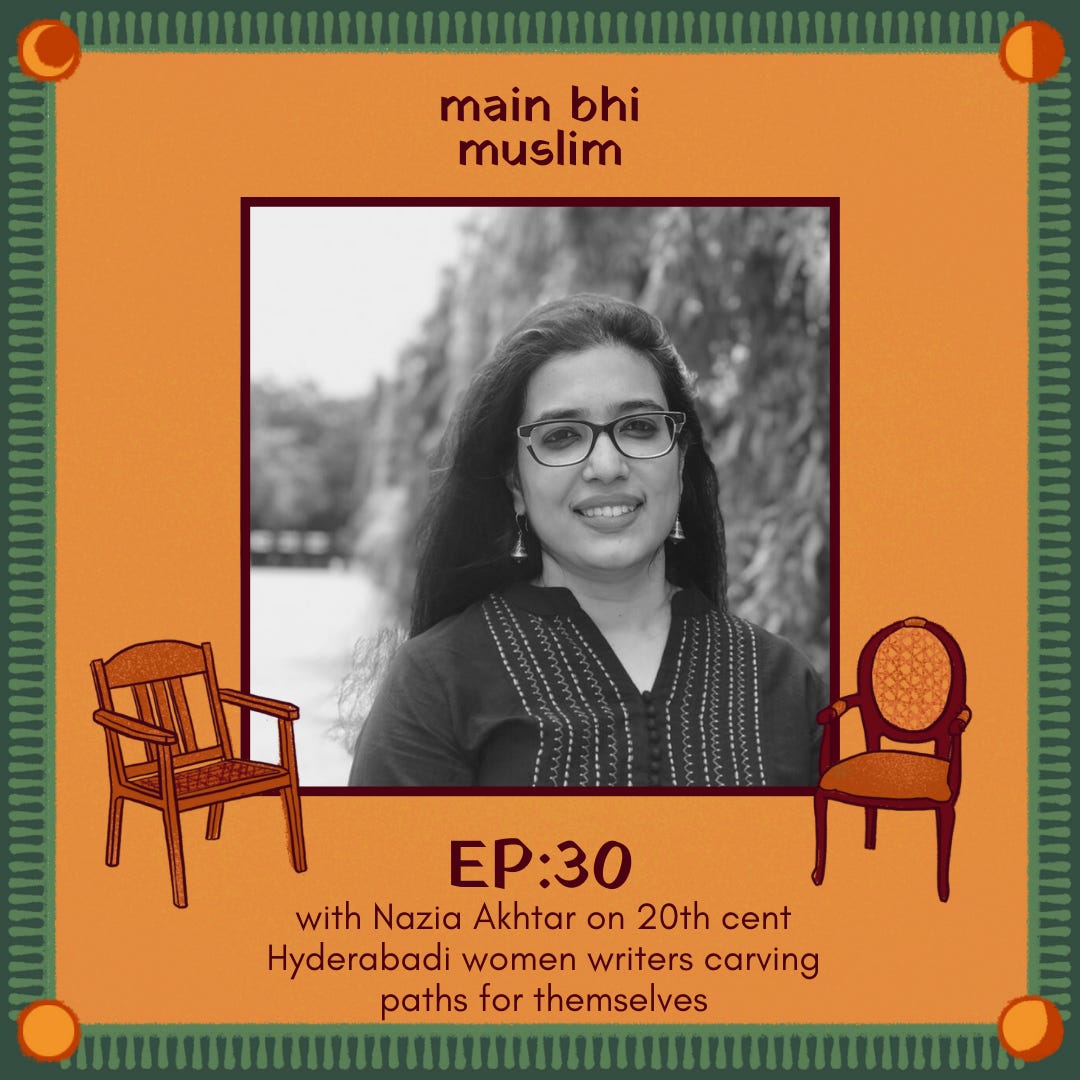
This conversation is with Nazia Akhtar, Assistant Professor at the Human Sciences Research Centre, International Institute of Information Technology, Hyderabad and the author of Bibi’s Room: Hyderabadi Women and Twentieth-Century Urdu Prose, in which she has profiled three prolific Hyderabadi Urdu writers, namely Zeenath Sajida, Najma Nikhat and Jeelani Bano. We discuss some of the most influential and invigorating writings by these women, notably stories like Sajida’s ‘If Allah Miyan Were A Woman’, which offers a critical and compassionate outlook of womanhood in negotiation with one’s Muslim beliefs, Nikhat’s writings that starkly brought out the behaviours and attitudes of feudal class, and Bano’s body of work spanning almost fifty years. We also discuss Dakhani as a language of the Deccan soil and ‘Begumati Zubaan’ that opens a world of its own through communications between women interacting with one another. Through this conversation, Nazia offers a nuanced understanding of the lives of these women in post-Independence decades in Hyderabad, who as Nazia puts were “thrice marginalised”. Bibi’s Room is an invaluable source of Indian Muslim women’s writings challenging patriarchal structures and norms within and outside their circles, and expands the canon of feminist Urdu writings in the country. Do give this episode a listen, and pick up the book, wherever you can.About Nazia Akhtar (bio republished with permission by the author)Nazia Akhtar is an Assistant Professor at the Human Sciences Research Centre, International Institute of Information Technology (IIIT), Hyderabad (India), where she teaches courses in Indian and Russian literatures. In 2017, she was awarded a New India Foundation fellowship to write a book on Urdu prose by Hyderabadi women. Bibi’s Room: Hyderabadi Women and Twentieth-Century Urdu Prose went into print in July 2022. She received a commendation from the jury of the Jawad Memorial Prize (2021) for her translation of Zeenath Sajida’s Urdu short story “Chhotam Jaan.” Her second book, The Deccan Sun: Essays and Stories by Zeenath Sajida (1924-2009), will be published by Penguin Random House in 2025. This is a public episode. If you would like to discuss this with other subscribers or get access to bonus episodes, visit www.mainbhimuslim.com
![[Election Special] Baatein beyond the ballot](https://s3.castbox.fm/e3/ed/4f/d17c5cd3c42b825d7a86e7ca381d530554_scaled_v1_400.jpg "[Election Special] Baatein beyond the ballot")
What does it mean to be a Muslim woman from Bundelkhand living through its socio-economic and political realities? What are their aspirations and expectations from the upcoming elections? How do they imagine their futures as citizens of this country?These are some questions that Main Bhi Muslim and Khabar Lahariya follow in this episode, speaking to Muslim women voters across Uttar Pradesh and Madhya Pradesh - mainly in Jhansi, Banda, Chitrakoot, Panna, and Ayodhya to listen to their aspirations, their hopes, and bear witness to their fears and anxieties.These women across all age groups are homemakers, recent graduates, working women, community builders and social activists, who offer a deeper understanding of the on-ground realities of their society.These interviews and recordings are mostly conducted by Khabar Lahariya’s Senior Reporter, Nazni Rizvi, with additional recordings by KL reporters Kumkum Yadav and Alima. In the episode, Nazni later shares her own views on interacting with these women some of whom chose to remain anonymous, whose voices are often less heard in the gamut of electoral politics but are ever important, especially now. She also shares instances of her own experiences as a journalist and a Muslim woman observing the change in norms and sentiments within the society she lives and works in. Recent reports on issues and topics raised by women in the podcast:* Unemployment: बेरोज़गारी की मार झेलता छतैनी गाँव पलायन करने को हुआ मजबूर | UP Elections 2022 (Khabar Lahariya, February 2022)* Anti-Muslim violence and fear within community: “हिन्दू राष्ट्र” बनता भारत, लक्ष्य एक “मुस्लिमों को….”, सुरक्षा-आज़ादी सिर्फ एक धर्म के नाम (Sandhya, Khabar Lahariya, August 2023)* Price hike of gas cylinders: वाराणसी: महंगे सिलिंडर ने लौटाए चूल्हे के दिन (Khabar Lahariya, November 2021)* Vegetables price hike: हाय रे… महंगाई ने कमर तोड़ डाली (Khabar Lahariya, July 2023)* House tax prices: चुनाव जीतने पर ख़त्म करूँगा हाउस टैक्स -प्रमोद सोनी उम्मीदवार | नगर निकाय चुनाव 2022 (Khabar Lahariya, November 2022)* Absence of state support for people with disabilities: चित्रकूट : दिव्यांग परिवार को नहीं मिली आवास, शौचालय व पेंशन जैसी सुविधाएं (Khabar Lahariya, October 2022)* Intertwined Hindu-Muslim religious sites at Jhansi: झांसी के दरगाह शरीफ में बना मंदिर-मज़ार है हिन्दू-मुस्लिम के प्रेम व एकता का प्रतीक (Sandhya, Khabar Lahariya, February 2024)* Uttar Pradesh removes loudspeakers from religious sites (The Hindu, April 2022)* Delhi Police suspend official caught on camera kicking Muslim men offering prayers (Independent, March 2024)Do subscribe to MBM to receive more episodes and rate/review it wherever you listen to podcasts. This episode is in collaboration with Khabar Lahariya - India’s only digital news network run by women from marginalised backgrounds reporting from the country’s hinterlands. Subscribe to KL Hatke to receive on-ground reportage by women journalists in rural India. This is a public episode. If you would like to discuss this with other subscribers or get access to bonus episodes, visit www.mainbhimuslim.com
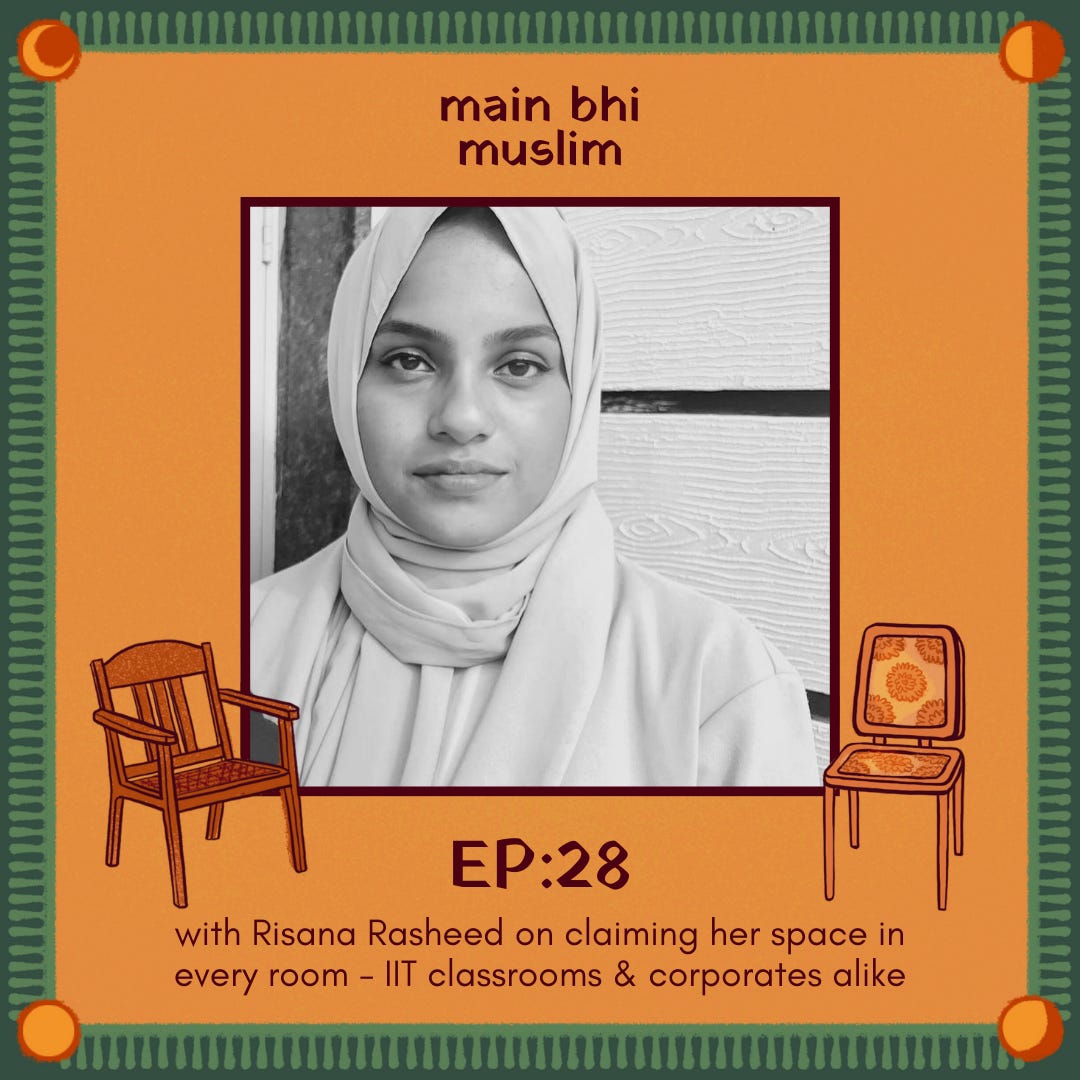
In this episode, MBM’s host Mariyam Haider is in conversation with Risana Rasheed from Kasargod, Kerala, who along with her twin sister, Ramseena, became the first women in their community to clear the JEE advanced, considered one of the toughest entrance exams, to enter the Indian Institute of Technology (IIT). Do check out EP27 with Ramseena Rasheed, to learn more about their early educational years and journeys. This episode contains personal views of the guest regarding the said academic institution.In this episode, Risana shares her coming of age story as a young woman, navigating priorities, lifestyle and identity choices, simply keeping one goal in mind - to build a life through academic achievement. After clearing IIT, Risana found herself in a new place, unlearning and learning aspects of herself, experiencing realities being perceived as a visible Muslim woman, especially coming from a non-Hindi speaking background into a predominantly North Indian setting. Risana also offers a window into her experience at the campus, how her OBC background was brought into spotlight through caste-oriented questions by other students and the impact it had on her and those coming from other reserved categories. While Risana shares her personal experience and coping mechanisms to wade through her higher education and early career years, if you are a listener going through something similar, please do consider seeking professional counselling and community support. About Risana Rasheed* Risana Rasheed is a software engineer based in Bangalore, currently working at Harness.io. She pursued her Bachelor's degree in Electrical Engineering from IIT Roorkee (2017-21 batch) and has previously held roles as an SDE at Amazon and Enphase Energy.Her professional passion lies in crafting scalable, robust, and user-friendly software solutions. Outside of work, she immerses herself in various creative pursuits and enjoys exploring different parts of India, capturing experiences through travel content on Instagram. She also finds solace in creating paintings and finding fulfilment in assisting students with career guidance and counselling.*Bio and image published with guest’s permission.Episode notes:* Child marriage awareness lacking in Kerala’s remote places: Justice Mustaque (The New Indian Express, February 2024) * Risana Rasheed’s Instagram* Mappila Muslim Culture - How a Historic Muslim Community in India Has Blended Tradition and Modernity by Roland E. Miller* 1 Out Of 3 SC/ST Students Asked About Their Caste: IIT-Bombay 2022 Survey (Aakriti Handa, The Quint, April 2023)* 33 IIT students died by suicide in last 5 years: Govt (The Indian Express, April 2023)MBM visual identity design by Shazia Salam || Music by Jupneet Singh This is a public episode. If you would like to discuss this with other subscribers or get access to bonus episodes, visit www.mainbhimuslim.com
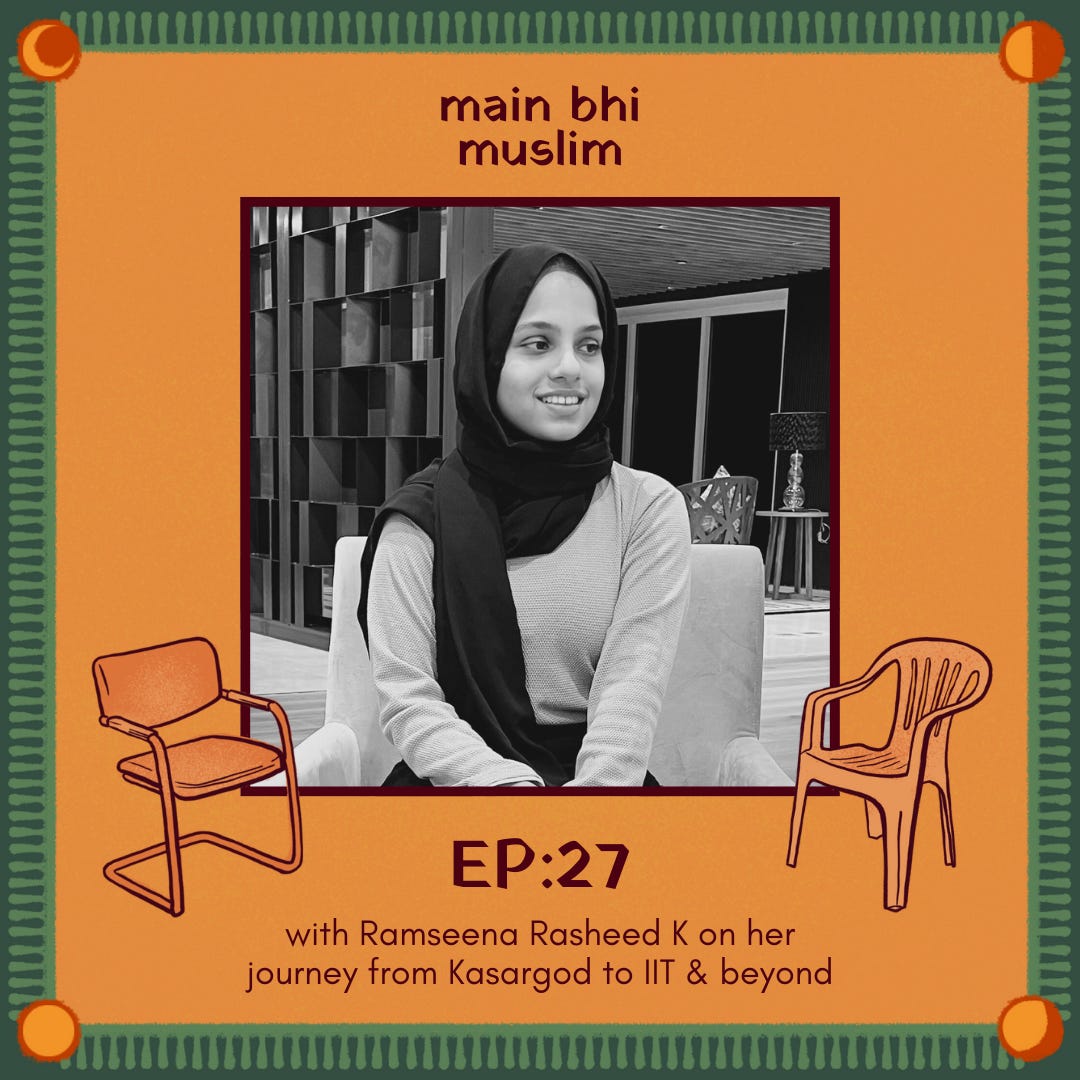
In this episode, MBM’s host Mariyam Haider is in conversation with Ramseena Rasheed from Kasargod, Kerala, who along with her twin sister, Risana, became the first women in their community to clear Joint Entrance Examination (JEE)-advanced, considered one of the toughest entrance exams, to enter the Indian Institute of Technology (IIT).Ramseena offers a window into her upbringing in a working-class family, the unconditional support from her parents, and wading through patriarchal attitudes of relatives and sexist or Islamophobic notions of teachers over the course of her schooling and engineering coaching. For Ramseena, her five years at IIT were filled with cultural exposure, tireless competition and a drive to find a job to financially support her family. Currently working in the corporate sector in Bengaluru, she shares many instances of her professional life through social media, and despite experiencing online trolling over her visible Muslim identity or views, Ramseena continues to offer advice and learnings to young career aspirants from her hometown and across the country. We discuss this and many more things that make Ramseena’s journey truly an inspiration for many young women in the country. About Ramseena RasheedRamseena Rasheed holds a BTech and MTech degree in Aerospace Engineering from IIT Kharagpur (2017-2022 batch). Currently, she is working as a backend developer for Aerospace software at AIRBUS, Bangalore, and is passionate about AI, ML related topics and their applications in the aerospace industry.*Bio and image published with guest’s permission.Episode notes:* Inspiring Journey Of Twin Muslim IITian Sisters From Kasargod Draws Unwarranted Criticism On Social Media (Shahzeen Khan, The Observer Post, January ‘24)* Ramseena Rasheed’s Instagram This is a public episode. If you would like to discuss this with other subscribers or get access to bonus episodes, visit www.mainbhimuslim.com
In this conversation, MBM’s producer and host, Mariyam Haider speaks with Sulfath Laila and Gargi Harithakam, who are the co-founders of Vanaja Collective - that supports and helps couples from Kerala’s queer community, overcome their families’ resistance and find systemic avenues to bring them together. One of the successful cases that Vanaja Collective worked on was of Adhila Nasarin and Fathima Noora - who fought familial and legal challenges - to reunite and live together as a couple.As a queer Muslim woman, Sulfath shares their journey growing up in a household that was largely driven by men and followed patriarchal norms and expectations. Over the years, Sulfath notes how they have derived support and strength from the women in her family, fought patriarchal mindsets and come together to tackle Muslim stereotypes and unjust rhetoric in other spaces. Sulfath also shares how queer voices from within Kerala’s Muslim community are emerging and voicing themselves in price marches and other public dialogues and initiatives.Gargi discusses how ill-practices such as ‘conversion therapy’ continue to exist that harm the LGBTQI+ community and despite it being outlawed, is often used by families against their own kin. Gargi and Sulfath underline their commitment through Vanaja Collective towards expanding spaces of conversations and support for people from other marginalised backgrounds. We discuss how Malayalam cinema has a long way to go in showcasing stories with feminist characters and queer couples whose love stories do not end in misery or tragic circumstances. Finally, we engage in ways that listeners can support Vanaja Collective’s fundraising efforts and stay connected with them. All details are mentioned on MBM’s website.You can support Vanaja Collective’s ongoing fundraiser by donating through the link here: https://milaap.org/fundraisers/support-the-organisation-4Episode notes:* Kerala student dies in Goa, death puts focus on inhuman 'conversion therapy' on queer people (Cris, The News Minute, May 2020)* ‘Conversion therapy’ still continues in India, despite a ban (Sukanya Shaji, The News Minute, August 2023)* Kerala study reveals 45% prevalence of conversion therapy among LGBTQIA+ persons (Cris, The News Minute, February 2023)* Kerala's lesbian couples share heart-warming photos from a memorable get-together (Onmanorama, July 2023)* Queer Representation In Malayalam Cinema: The Past, The Present, And The Possible Future (Rhea F, Feminism In India, July 2023)* The youth of Kerala want to make gay marriage legal (Mathrubhumi, March 2021)* Malayalam films that tried to explore LGBTQ+ representation (Pooja Pillai, Pink Lungi, September 2023)* Movies discussed in the episode:* Desatanakkili Karayarilla (1986)* Sancharram (2004)* Moothon (2019)* The Great Indian Kitchen (2021)* Badhaai Do (2022)* Queerphobia in Kerala: A Student Fights For Gender Identity on College Campus (Smitha TK, The Quint, December 2022)* Kerala: Lesbian Couple’s Harrowing Journey Shines Light on Continuing Dangers of ‘Conversion Therapy’ (Mrudula Bhavani, The Wire, July 2023)* Kerala lesbian couple separated by parents, united by High Court, drops a viral bridal photoshoot (Shaurya Thapa, DailyO, November 2022)MBM visual identity design by Sunakshi Nigam || Music by Jupneet Singh This is a public episode. If you would like to discuss this with other subscribers or get access to bonus episodes, visit www.mainbhimuslim.com
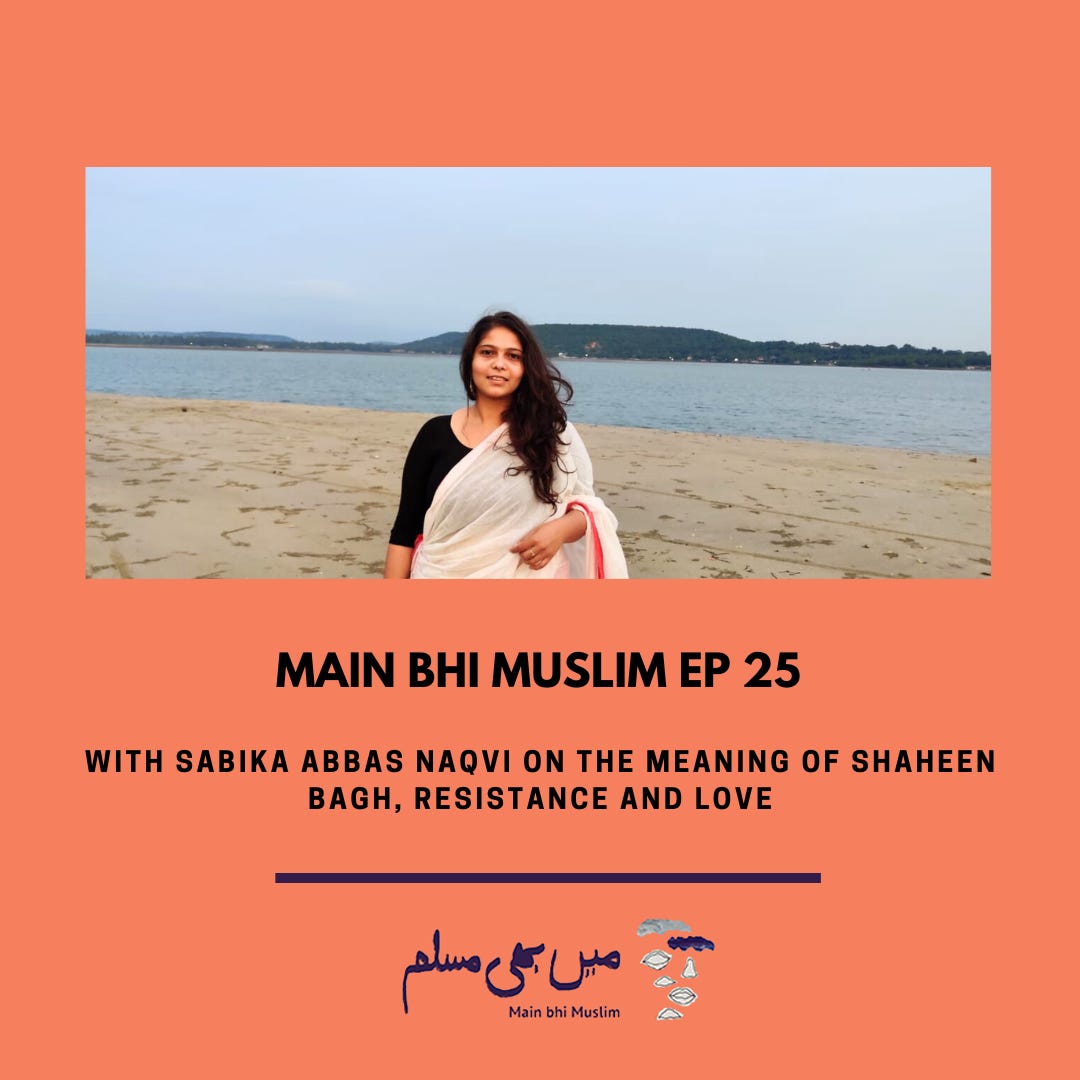
Main Bhi Muslim’s last episode of the year is with the spirited and incredible human being, Sabika Abbas, aka @boltiaurat on Instagram.Sabika is a poet, organiser, SEL educator and story-teller. Her work revolves around issues of gender, minority rights and justice. She performs in public spaces, edits anthologies, translates and is constantly working on at least five dreamy or nonsensical side projects. If not for her work, she would be a full time stand-up comic or leading a cult of ‘doing nothing’. After working with change.org and Fearless Collective, Sabika, is currently the Organising and Campaigns Lead at Noor.* In this episode, Sabika takes us down her memory lane growing up in a mosque complex in Lucknow, how her Muslim upbringing has shaped her view of life and helped in using her voice against injustice and oppression. We discuss her journey being a poet performing on the streets and how her poems belong to the people and streets she shares them with. Sabika also talks about the current realities for Indian Muslims and the constant reconciliations one does when the country one is born in and belongs to, denies it acceptance and protection. Finally, we talk about love of all kinds, how kindred friendships keep our hearts and souls warm, and ending with a beautiful poem by Sabika talking about what being a lover means to her in current times. This episode is recorded to commemorate and celebrate the anniversary** of the 2019 Shaheen Bagh protests led by Indian Muslim women. Do give this episode a listen, share it within your circles and recognise your part in standing up for justice and liberation for all.*Bio republished with permission by the guest.**The episode host mistakenly says third anniversary of the Shaheen Bagh protests in the conversation. This year marks the fourth anniversary. The error is regretted.Episode notes:* How Pro-BJP WhatsApp, Facebook Groups Are Using the Israel-Hamas War to Stoke Islamophobia (Kunal Purohit, The Wire, October, 2023)* India terror law haunts Muslims jailed since 2020 for Delhi riots (Hanan Zaffar and Danish Pandit, Al Jazeera, February, 2023) * US Commission on International Religious Freedom (names of political prisoners mentioned in the episode)* Gulfisha Fatima* Umar Khalid * Khalid Saifi * Natasha Narwal * Devangana Kalita * Siddique Kappan: India journalist walks out of jail after 2 years (Al Jazeera, February, 2023)* Why Shaheen Bagh protests are an important moment in India’s history (Elizabeth Puranam, Al Jazeera, February, 2020)* Building allyship & solidarity through shared tiffins - a childhood memory, present-day friendships and action-filled hope to tide over hate and othering (Mariyam Haider, Substack, August, 2023)* Sabika Abbas Naqvi: Reclaiming public spaces through poetry (INKtalks, February, 2020)* ‘Bulli Bai’, 'Sulli Deals': On Being Put Up for ‘Auction’ as an Indian Muslim Woman (Mariya Salim, The Wire, January, 2022)* ‘Auction’ of India’s Muslim women shows tech weaponised for abuse (Al Jazeera, January, 2022) This is a public episode. If you would like to discuss this with other subscribers or get access to bonus episodes, visit www.mainbhimuslim.com
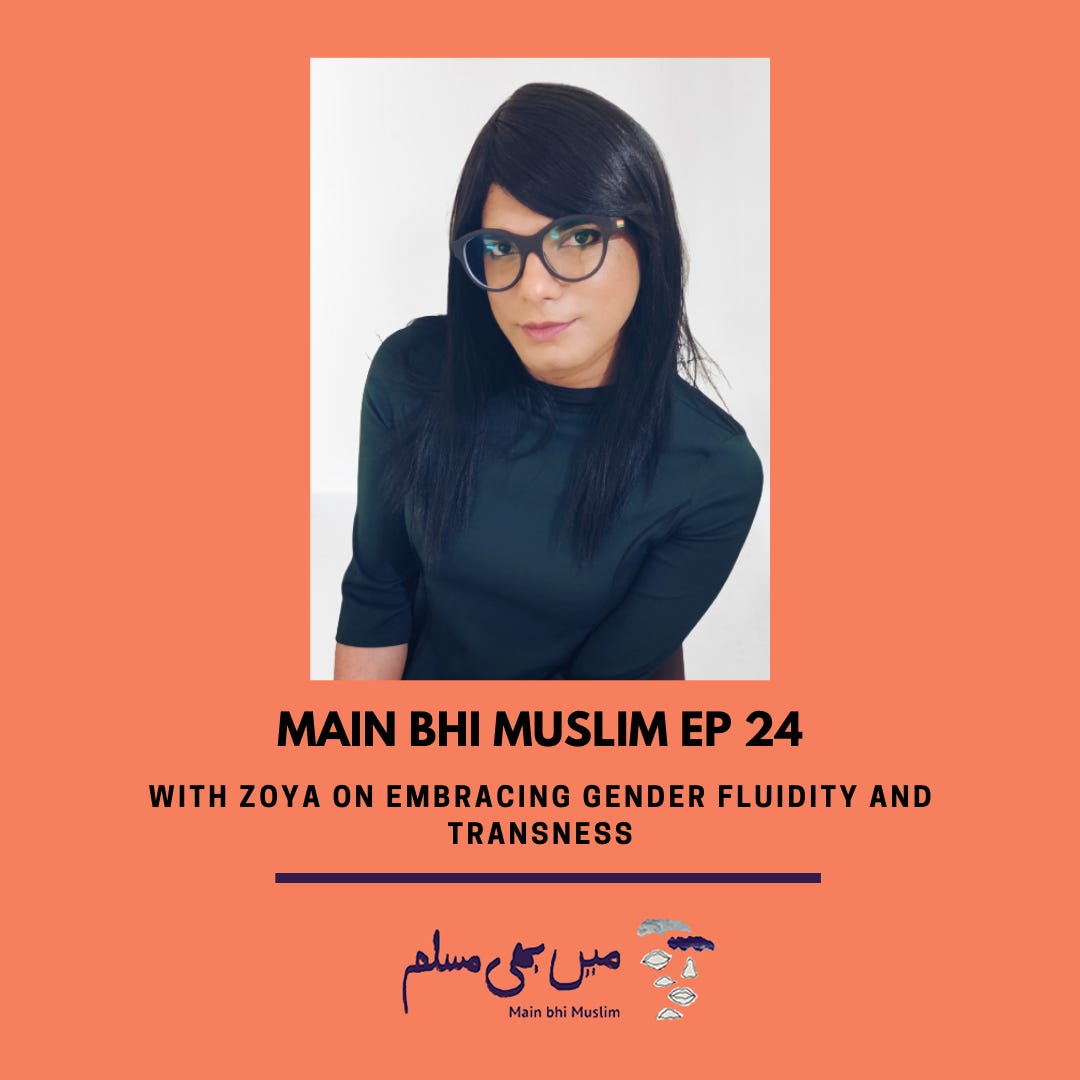
In this MBM conversation, Mariyam Haider speaks to Zoya who identify as a “They/Them with a She/Her vibe” and defines themselves as a “queer soul with the vibrant hues of a Transwoman, embracing the diverse rhythms of life.” In this episode, Zoya shares their journey exploring gender fluidity, and discusses how this exploration has enabled them to have more meaningful relationships. They also share their relationship with their Indian Muslim identity and the ways it shows up in their life.A DEI professional, Zoya sheds light on the challenges and opportunities present within the corporate spaces, the Supreme Court ruling that failed to grant same-sex couples marriage rights in India, and the responsibilities of allies across the board.Finally, we talk about finding love and discuss the role of queer and minority representation in certain Hindi movies and the recent Amazon series, Made In Heaven, Season 2. This month in which we observe Trans Awareness Week and Transgender Day of Remembrance, do give this episode a listen and share it with your loved ones.Episode notes* Faith & Queerness: Finding The Intersection Between Religion And Homosexuality ((Gaysi), 2 August, 2022)* SC Refuses to Legalise Marriage Equality, 2 of 5 Judges Say Queer Couples Must Be Given Legal Rights (The Wire, 17 October, 2023)* NATIONAL LEGAL SERVICES AUTHORITY (NALSA) VS. UNION OF INDIA (South Asian Trans Law Database, Centre for Law and Policy Research)* Full NALSA Judgement 2014* Breaking news: India falls short to granting marriage rights to same-sex couples but the Chief Justice articulated unprecedented assertion of queerness and trans rights in verdict (Fabrice Houdart, Substack, 17 October, 2023)* Nepal Courts Refuse to Register Same-Sex Marriages - Lower Courts Defy Supreme Court Order (Human Rights Watch, October 10, 2023)* How Made in Heaven Tests Limits of Secular, Liberal Imagination of Muslim Women (Zehra Mehdi, The Quint, 2 September 2023) This is a public episode. If you would like to discuss this with other subscribers or get access to bonus episodes, visit www.mainbhimuslim.com
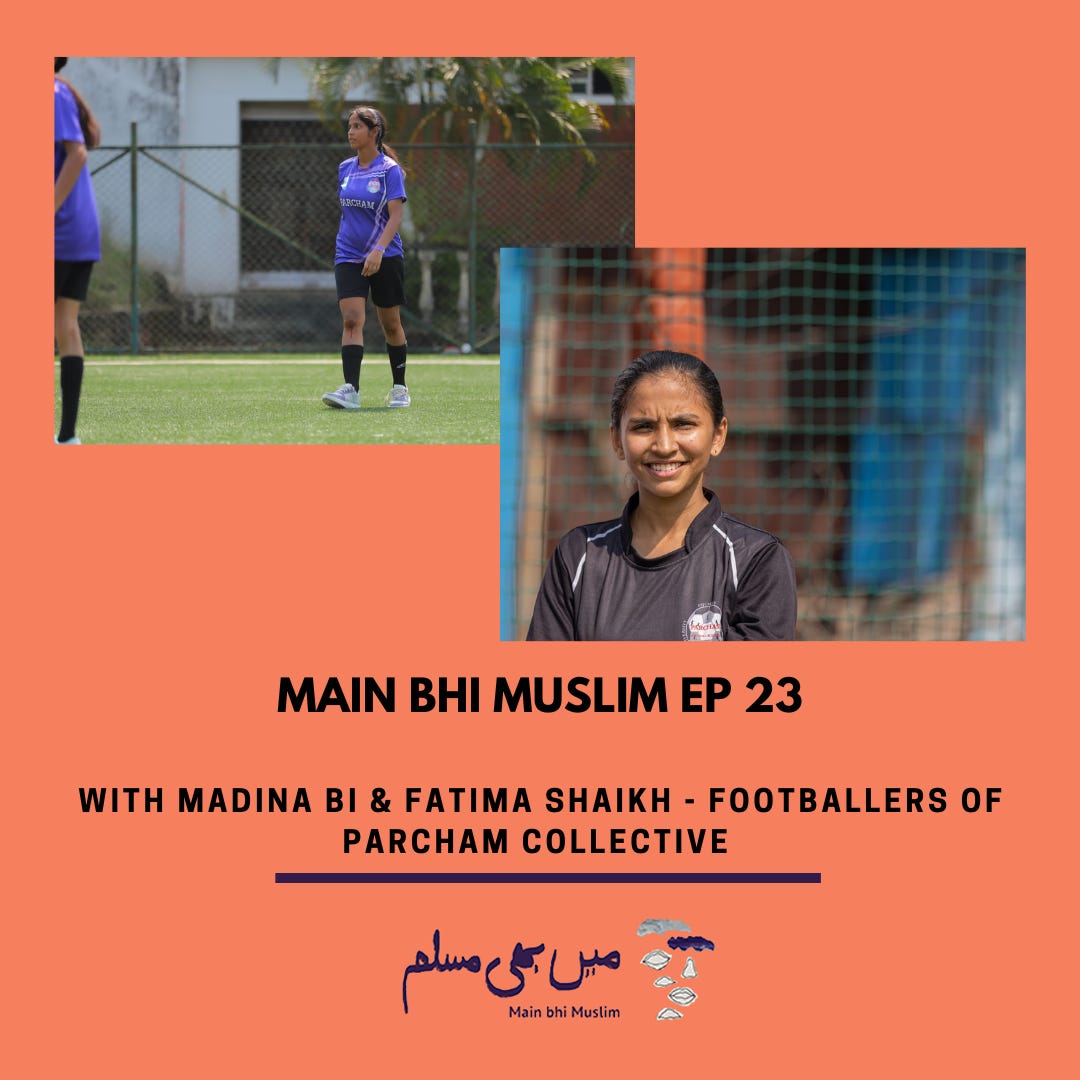
In this conversation, Mariyam Haider is joined by two of Parcham’s footballers and licensed coaches, 21-year old Madina Bi and 19-year old Fatima Shaikh. Mumbra-based, Madina and Fatima share their journeys with football and negotiating with family members to make it part of their lives. While Madina’s parents are understanding and supportive, Fatema had and continues to have a difficult relationship with her family when it comes to her aspirations. Listeners discretion is advised as this episode mentions instances of physical violence, and the notes of this interview have time-codes, in case listeners want to be aware of them before listening (9.46 and 21.59 min)*. We discuss the challenges that the girls and other female footballers face in Mumbra to practise football, the need for more administrative and corporate support in maintaining the Fatima Bi Savitri Bai Ground for girls, and what more can be done for Mumbra’s aspiring sports women. They both offer a breadth of understanding around Muslim women’s dreams, their stand against sometimes violent patriarchal systems, and the tireless negotiation for spaces they occupy as young women.Madina dreams and aspires to join the Gokulam Kerala Football Club and Fatema wants to keep learning and playing, as she continues to also support her family financially. This Independence Day, give this episode a listen, hear the voices of two inspiring and talented Indian Muslim women, who are fighting the fight against all odds that stand in front of them to live their football dreams. *At these time-codes, there are mentions of physical violence.Episode notes and associated references:* Why the Parcham Collective is fighting for a football ground for Mumbra’s girls (Mint Lounge, October, 2021)* The remarkable story of Jammu and Kashmir footballer Afshan Ashiq (Hindustan Times, 2017) * For the love of the game: Indian women defy sexism, abuse to chase football dream (South China Morning Post, December, 2022) * Sports for Peace, Sports for Empowerment (Parcham Collective)Visual identity design by Sunakshi Nigam || Music by Jupneet Singh This is a public episode. If you would like to discuss this with other subscribers or get access to bonus episodes, visit www.mainbhimuslim.com
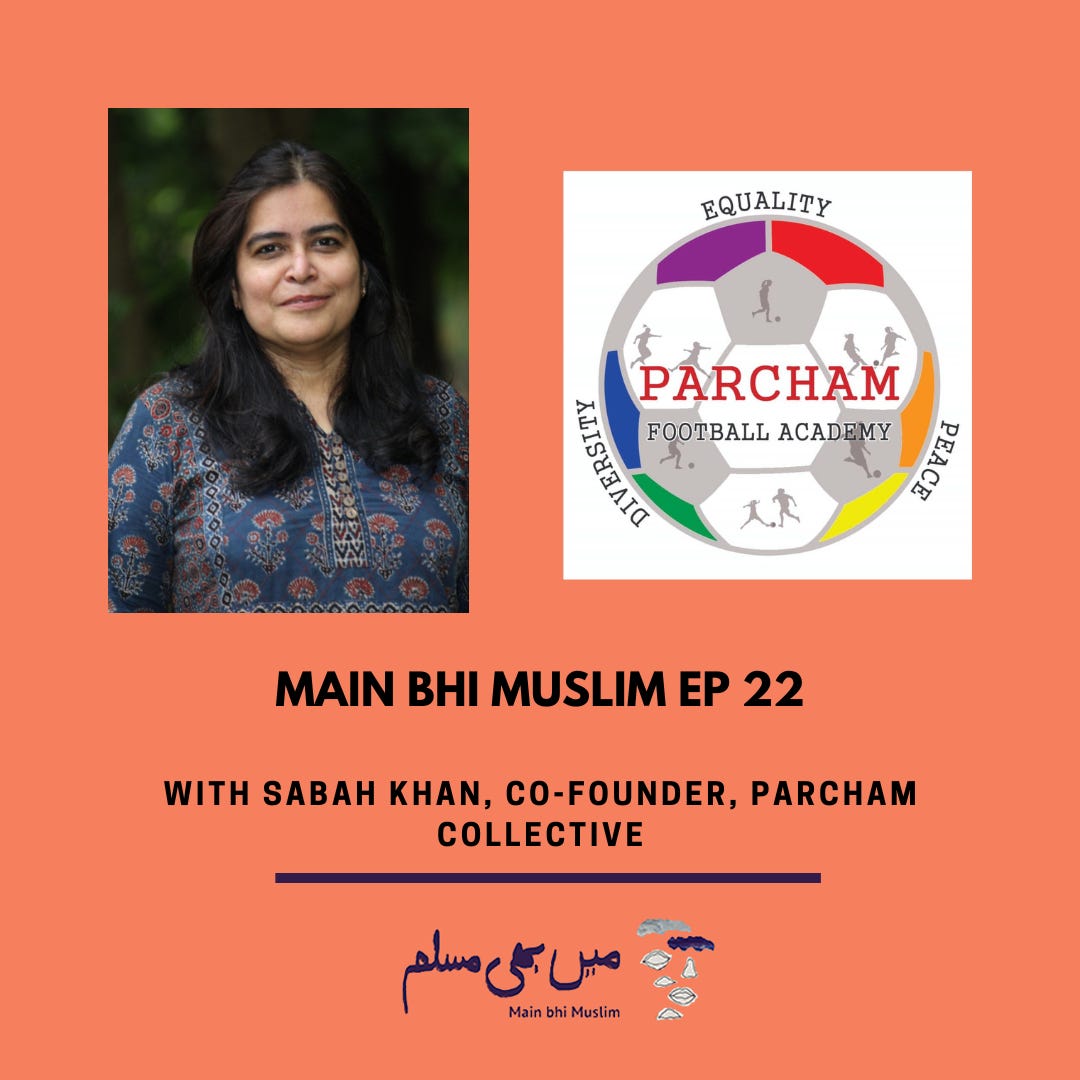
In this conversation, MBM’s Mariyam Haider is joined by Sabah Khan, Co-Founder of Parcham - a Mumbai-based feminist organisation that champions inclusion, diversity and equality within the society. For more than a decade, Parcham has been running a football program that trains girls from marginalised communities and different religious backgrounds to become footballers and coaches. Their football program began in Mumbra (a predominantly Muslim ghetto on the outskirts of Mumbai) and over the years has expanded across different suburban areas of the metropolis. Through this football initiative, Parcham has helped girls tackle conservatism and orthodoxy within their families and communities, and at the same time, enabled them to reclaim public spaces for themselves. In this episode, Sabah shares her own journey growing up in a ghetto, the impact of the 1992-93 anti-Muslim violence in Mumbai on her, reasons for starting Parcham and the journey of young Muslim female footballers over the years. This conversation focuses on how these girls often had to fight for their interest in sports with their families, tackle sexism at home and on ground, how mothers and fathers have come around and supported many on their football journeys, and what more needs to be done to support them build their lives around a sport they have come to love.Episode notes* In Mumbra, Girls From Ghettoised Minorities Are Kicking Their Way To Independence (Outlook, February 2023)* Documentary: Under the Open Sky (School of Media and Cultural Studies, Tata Institute of Social Sciences, Mumbai, April 2018)* Sabah Khan, Reimagining Play In: Sports Studies in India. Edited by: Meena Gopal and Padma Prakash (Oxford University Press, 2021)* IWL 2023: Gokulam Kerala fittingly winners again, but India’s top female footballers deserve better (Scroll, May 2023)* Meet the Indian wrestlers taking on Modi’s establishment (Financial Times Magazine, June 2023) This is a public episode. If you would like to discuss this with other subscribers or get access to bonus episodes, visit www.mainbhimuslim.com
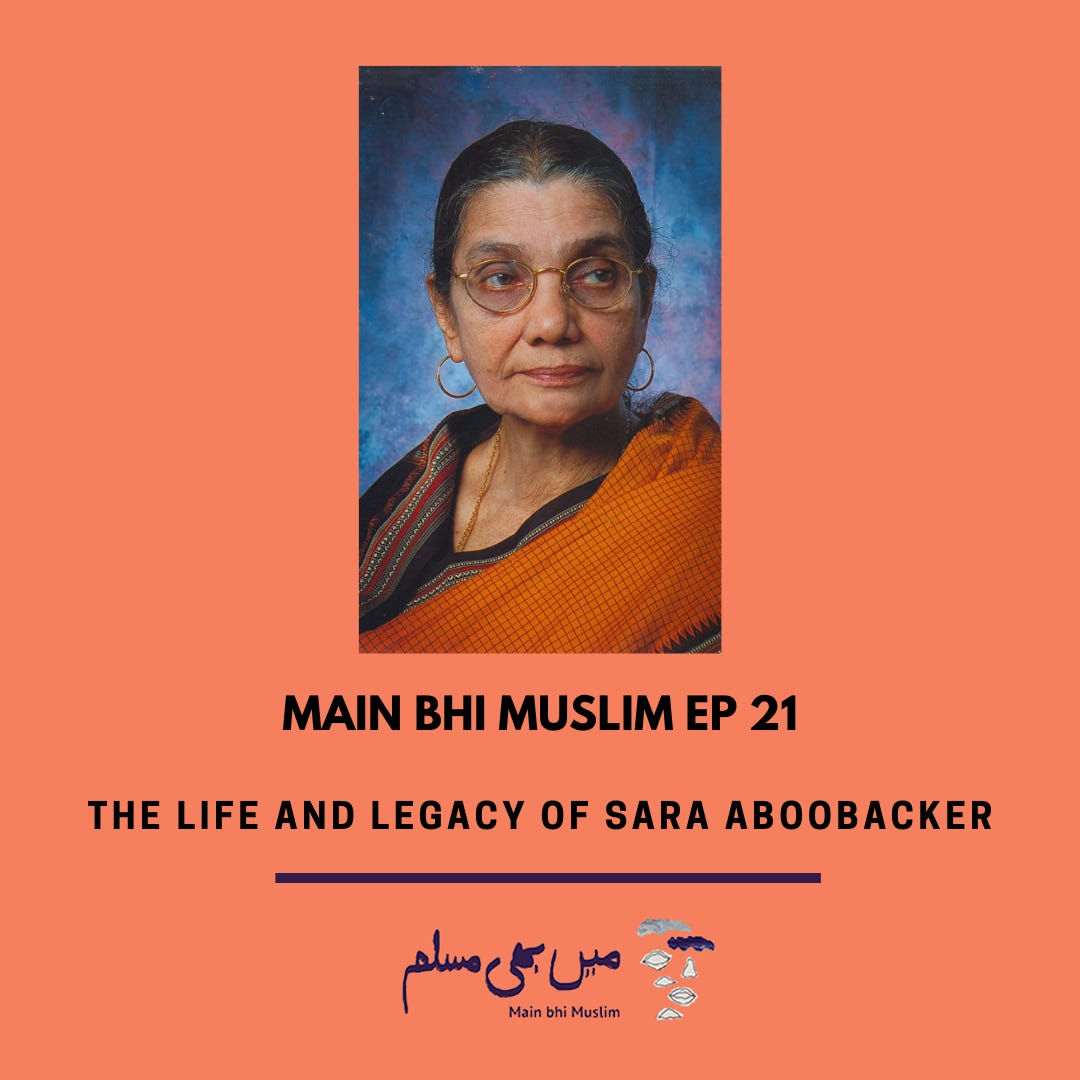
This conversation is between Dr Sabiha Bhoomigowda, retired Vice Chancellor of Karnataka State Women’s Akkamahadevi University, Vijayapura, and scholar Dr Sukanya Kanarally who has kindly interviewed Dr Sabiha on behalf of MBM. Dr Sabiha is a literary critic and was a friend of the late Kannada author, Sara Aboobacker.This episode is dedicated to discussing Sara Aboobacker’s journey as a writer who was deeply influenced by her background as a Muslim woman from the Beary community - predominantly based in the South-Western coast of India. Sara wrote about the issues and prejudices concerning Muslim women within the community often at the hands of the clergy class. Her breakthrough novel, Chandragiriya Teeradalli, translated into English as Breaking Ties or Nadira, established her as the leading Muslim woman writer in Kannada literature. A progressive writer, she used her voice and writing as mediums not just to express support for Muslim women’s rights, but also gender equality, women’s education, communal harmony and stand against caste or religious-based discrimination, violence and injustice. She was awarded the Karnataka Sahitya Akademi Award in 1984; followed by other recognitions for her contribution to Kannada literature. Sara Aboobacker passed away in January 2023 at the age of 86, but has left behind a legacy of progressive writings and thinking that continues to influence writers and scholars beyond Kannada literature. At the beginning of this episode, you will hear me in conversation with scholar Dr Sukanya Kanarally, who has kindly translated Dr Sabiha’s responses to my questions. Post the English introduction, the conversation is between Dr Sabiha Bhoomigowda and Dr Sukanya in Kannada. The full English transcript of this conversation is available on MBM’s website, that is mainbhimuslim.com.This interview was conducted in Kannada, and the English transcript can be found on MBM's website.About Dr Sabiha BhoomigowdaDr. Sabiha Bhoomigowda, retired Vice Chancellor of Karnataka State Women’s Akkamahadevi University, Vijayapura, began her career as an Assistant Professor in Kannada at SVP College, Mangalore and continued to serve as a Professor and Head of the Department of Kannada. She served as the Director-in-charge at the Centre for Post-graduate Studies, Mangalore University, at Chikka Aluvara. She has successfully completed seven research projects alongside supervising many students in their doctoral research. Dr. Sabiha Bhoomigowda is a writer too. She has published twenty books that span across genres like poetry, short story, essay, life story, literary criticism, column writing, and women’s studies. She has known Sara Aboobacker from close quarters as a friend and a critic. She has been one of the editors of Sara Aboobacker’s felicitation volume. She has also co-edited twenty seven research and literary works. Several of her poems, short stories and essays have been anthologised in the university textbooks. Dr. Sabiha Bhoomigowda strongly believes that there should be no chasm between academics and social activism and that the society truly benefits only from such integrity. She has served as the President of Karavali Women Writers and Readers for two terms. She has also been serving Karnataka State Federation for Atrocity Against Women since its very inception.Selected episode notes* Sara Aboobacker’s biography (Sahitya Akademi, 2011)* Sara Aboobacker, a Critical Insider Who Challenged Gender Hegemony and Oppression (The Wire, 2023)* The Brahmanisation of Textbooks in Karnataka (Round Table India, 2022)* Selected Writings by Sara Aboobacker (The Library of Congress) This is a public episode. If you would like to discuss this with other subscribers or get access to bonus episodes, visit www.mainbhimuslim.com
![[IWD Special] Muslim women participation in India's workforce](https://substackcdn.com/feed/podcast/270087/post/110716727/26bcd246348d393d6f3ebf623e23cadd.jpg "[IWD Special] Muslim women participation in India's workforce")
In this International Women’s Day special episode, MBM’s Mariyam Haider is in conversation with the team at LedBy Foundation - India's first leadership incubator that focuses on the professional development of Muslim women. Deepanjali Lahiri is the Chief Operating Officer and Fatema Chiba is the Program Manager at LedBy, which has been running training, mentoring programmes and fellowships to support young Muslim women in India enter entrepreneurial and corporate workspaces. In this episode, Deepanjali and Fatema talk about their personal and professional experiences that have shaped their understanding of the challenges that Muslim women face. Fatema highlights what growing up as the only Muslim student felt like and how working with an educational non-profit enabled a closer understanding of the way gender, caste and class barriers impact students’ aspirations and professional outlooks. Deepanjali shares how she had not hired a single Muslim woman candidate in her years of working across IT, retail, and FMCG sectors and the differences between multinationals and Indian companies when it comes to diversity, equity and inclusion. We also discuss the current state of Muslim women participation within India’s formal and informal sectors, the challenges that structural inequities impose on women and how diverse are the career needs and visions for Muslim women in urban versus rural parts. This MBM episode also offers a glimpse of the long journey that Indian workplaces have to make towards religious diversity, inclusion and representation across all levels of management and leadership. Finally, we talk about Seattle becoming the first American city to add caste to its anti-discrimination laws and if there is hope for similar changes within Indian workspaces in the coming times. Notes related to the conversationThe Hiring Bias Study conducted by LedBy Foundation assessed Muslim women employment in entry-level positions. Main findings as reported in the study:* ‘The net discrimination rate was 47.1%, as the Hindu woman profile (Priyanka Sharma) received 208 positive responses, while the Muslim woman profile (Habiba Ali) received half of that (103). This was evident across industries.* Recruiters were more cordial to the Hindu candidate; 41.3% of the recruiters had connected with Priyanka over phone calls, while only 12.6% spoke with Habiba over a call.* North India had a lower discrimination rate (40%) compared to jobs located in West (59%) and South India (60%).’If you find this or any past episode interesting, please do share it with your friends, family and social groups, and rate or review it wherever you listen to podcasts. This really helps in keeping MBM conversations alive. Thank you always for your time and attention.Visual identity design by Sunakshi Nigam || Music by Jupneet SinghThanks for listening to Main Bhi Muslim. Subscribe for free to receive new episodes and support MBM’s work. This is a public episode. If you would like to discuss this with other subscribers or get access to bonus episodes, visit www.mainbhimuslim.com

Comments

Download from Google Play

Download from App Store
 United States