


 Claim Ownership
Teaming With Ideas
Subscribed: 3Played: 14
Subscribe

© Copyright 2020 All rights reserved
Description
The podcast that explores how people at work, work together. Carlos Valdes-Dapena, the host, has spent decades working with teams as well as researching, writing and speaking about collaboration. Here he speaks with some of the brilliant people he’s met over the years - academics, business leaders, managers and consultants who share his passion for collaboration, and discusses their thoughts, theories, experiences and practices so that you can put them to work to make your work life richer and more rewarding. Enjoy.
31 Episodes
Reverse

Angela Mangiapane, President of Mars, Inc's Global Services organization, applied her financial background to her HR position in a surprisingly creative way. She encouraged her team to dream, visualizing new would-be scenarios for success. Then the team worked together to realize that outcome. Hear her stories of creative problem-solving while her IT department maintains fluid productivity during a pandemic.

Darryl Stickel has studied the data, and concluded that trust is created in the one who trusts, not in someone else's trustworthiness. Learn how to build trust in your team by beginning with yourself.

The World Health Organization, ISO, even the UN agree: psychological safety begins with you, not your manager. Learn how to self actualize your own psychological safety and how self-compassion, mindfulness and acceptance of what you can and can't control are the tools to achieve it.

Quincy Troupe learned early on that staying curious and trusting others will bring their best to work resolves conflicts and contrasting political agendas resiliently. Listen or read his interview here.

Andrew Fox has a lot to say about his style of leadership, having courage at work to lead and collaborate, and how to deal with jerks - both as teammates and bosses.

Mutuality with Gary ClarkeWith over 30 years of business experience Gary is an authentic value driven business leader with global and domestic CPG experience. He was fortunate enough to build a 20-year career with MARS right through from entry sales level to General management. He is well known for his ability to coach mentor and lead teams that deliver sustainable long-term outcomes. With this experience and passion, Gary has now founded 360Resolve a company that is driven by the belief that business and leaders have a huge role to play as we look to build more sustainable businesses through better human social and environmental practices.Gary, did you get a degree in business at some point?No, I actually didn’t; that’s what makes it quite unique. I left school at fifteen and started a trade. So I joined the FMCG industry at the age of thirty. So I’ve done a lot of different things before actually joining Mars, which makes it quite unique.What trade were you trained in?I climbed power poles, electrical poles. And I started about the age of fifteen. That’s dangerous stuff, that’s risky!It can be, yes, and that’s why I decided that I’d be better off selling things rather than climbing power poles. From climbing poles to leading teamsOne of the things that’s interesting about you and your bio is that you chose to go from being a productive member of society to being a consultant. I’m just curious to know - how did you land on that?It goes back just a little bit. In the last role that I had at Mars, I was fortunate enough to join an executive education program at Oxford called the Economics of Mutuality, and it explores the idea of businesses’ role in society and environmental practice and how you can build sustainable businesses moving forward. And that fascinated me and really hooked me in. I spent a lot of time working with the team, I went through the program, I went back as a guest presenter, and I’ve continued to stay in touch with them. At the end of my time at Mars, I was sort of - as we all do - wondering what I was going to do with my time, and I’m quite altruistic so I wanted to give back. I felt that I could play a role in helping business leaders prepare for the future, because I think the future is a lot different than the past that I grew up in.My business has three areas. It’s a coaching business, it does some business consulting, but it also does thought leadership, and the thought leadership area is where I bring the Economics of Mutuality program forward through a partnership with them and other business units. It’s sort of uncharted waters. We’re all looking at the condition of the planet and we’re looking at how things are operating; we know we need to change, and I think business can play a significant role in that, so I’m here to help.If you Google Economics of Mutuality you’ll find a compelling area of social science and economics that was pioneered by our former employer, Mars Inc. Early Teams leadership lessonsYou’ve been a member of teams from your days climbing power poles, right on through your years with Mars. When did you lead your first team?I’ve always led teams. I was lucky to be good enough at sport to be the captain, if you like. I always had a really strong appreciation for the value of players on a field, and I think when you’re young you don’t really understand the concept of teamwork other than to lead by example - what I was always taught. If you did your best, you would hope that everybody else would follow along. That concept was probably my first ever go at line management when I got into leading a business team. I thought, “I need to get involved and show everybody how it’s done, and then I’m sure they’ll follow.” It didn’t quite work that way. What kind of team was it? What function? I was working for Mars in the Petcare business. We had a team of territory managers. My idea of being a great line manager was to get in the trenches and do the work alongside the teams, which is one element. Boy, was I about to learn that there is a lot more to managing a business team than just showing them how to do things. What I would do was replicate the behaviors that I wanted them to carry out, but what I was missing was that they actually wanted to know that I knew they could do the job themselves. So I was, very early, taught the lesson of, “it’s not your job to come out here and do my job for me, your job is to come out and help me do my job really well.” It sort of changed my mind quite quickly. I got the concept of being able to coach and mentor and support, and get off the field, if you like - if you want to use that analogy - get off the field, be outside and watch people and help them when they need the support. That was a really good experience for me and I’m glad I got that experience fairly young in my career at Mars.“DRIVING” A TEAM VS LEADING ONEWithin that experience, Gary, was there one of those tough “aha” moments, when either someone sat you down and had some straight talk with you, or you just had a sudden realization that you’d put your foot in it?I think I started to understand quite quickly that I was getting a reputation as being a driver, and that didn’t sit that well with me. “Here he comes again, he’s gonna come out and drive me.” I didn’t really enjoy that, and I heard it through the team. The team was starting to give me feedback - “This isn’t how we want to be managed, this isn’t how we want to be led.” I was lucky enough to be able to (a.) have a team that was giving me feedback, which I think is a really important thing, and then (b.) having the maturity to be able to respond to it.Memorable leader and their lessonsIt was fairly collegial, it sounds like. Do you recall a leader you worked with early on who was either a positive or a negative role model for you?Absolutely. It was my first field manager that I worked for in Western Australia, and she very quickly invested heavily into my development. I couldn’t believe it, actually. I mean, I’d been in the business world for fifteen years, and done it all pretty much by myself; I’d worked for small businesses, or worked for myself. And then to have somebody who’s (a.) interested in you, and (b.) prepared to put resources behind you and help you grow - I was shocked, to be honest, and couldn’t believe it was actually happening. And I’m ever thankful and grateful, because what she did was set me on a path which really did tie well into my whole career because development is important. It does make a difference, and it can really transform you - the person - and your business environment. She was an amazing line manager for giving me the confidence to grow, just by clearly taking an interest in me and investing in me. I couldn’t believe it was happening. She was a very firm believer in - there’s classrooms, and then there’s learning from others, and then there’s learning on the job. So she would constantly stretch me. I can recall I used to get quite angry because she’d just give me more tasks, more tasks, more tasks. But that was her way of finding out where my capacity was. At the time it didn’t feel like that. The lesson you learned was about “don’t be a driver,” but it sounds like she was driving you pretty hard, Gary. Towards your development, but she was driving you. I think she was, but not in the way that I probably was doing it to the team that I was experiencing, because I was probably going down this perfectionist trait as well. I wanted things to be done exactly right, all the time, in time, on full, no room for error. So it was a different type of driving, whereas she was driving me to find my potential. It’s a different feeling. Leading By ExampleI want to talk about that “leading by example” thing you talked about earlier, because that’s a very common phrase. Where is it right to lead by example, or is it ever?I prefer to call it “setting the tone” rather than “leading by example.” I think when you’re talking behaviors - the way you want the business to run or the teams to run - then I think it is the role of the leader to set the tone of the business. But what I was confusing it with was that hands-on, right down into the detail, showing them everything, leading by example. But rather, setting the tone of the organization, and the values and the behaviors.Whether you intended to do it or not, you were setting a tone of, “it’s got to be perfect, no room for error.” Was there any room to learn?It’s quite stifling, the “my way or the highway” type approach. Whilst it might give you some short-term wins, it’s not going to give you long-term sustainable business growth. Teamwork vs CollaborationTeamwork is a generic term that describes a general tone of helpfulness and a sense of mutual support, whereas collaboration is actually working together to produce specific outcomes. What have you learned about getting people to work productively together?I’d probably go back to a line manager again that taught me this. It was, again, my first time working for somebody who, instead of working individually on each of the people in the team, he was very engaged in the team dynamic. And what he was brilliant at was having these environments where you talked about how you bring personal commitment to each other. What you’re at stake for - your team member and the greater team. And then getting the expectations really clear about each person’s role in that team, and then the ramifications if you don’t do it, the impact it has on the other person once you’ve made that commitment. So, for me, that was a real step change. Instead of that line manager theory of “get the best players,

Mark Ippolito and Carlos Valdes-Dapena, friends since 1986, together explore the importance, and benefit of being what AI cannot: vulnerable, humble and emotionally intelligent.

Kerry Wekelo believes in practicing gratitude, and lives by it. Using gratitude when giving feedback, when collaboration, and even when talking to yourself is enormously powerful, as outlined in her book, "Gratitude Infusion". Listen to or read this podcast blog for more.
Have a hard time receiving a compliment? Be sure to listen to the end of this podcast!
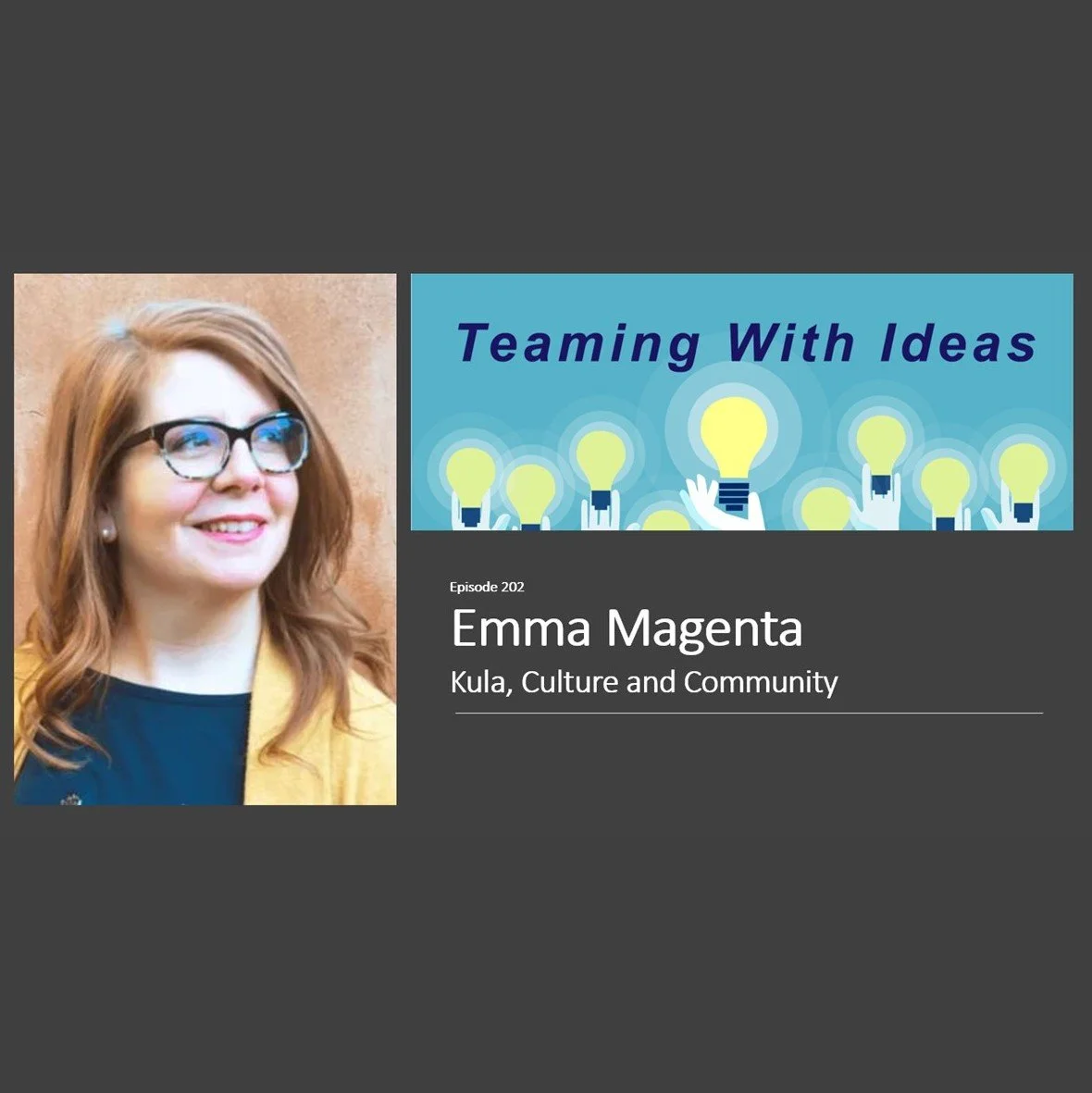
Emma Magenta,, life coach and former owner of South Mountain Yoga, discusses leading a kula or community with individual attention.

Sylvia Burberry, President, Emerging and Seed Markets for Royal Canin, shares 1 very important lesson to team leaders: the importance of bringing everyone's whole selves to teams and team meetings. Listen to or read this podcast post to learn why, and how skipping in the individual check-ins at every meeting can help the entire team foster trust, context, collaboration and relationships that add value to any team and organization. Sound too easy? This simple step is masterful. Here's why.

Hamish Thomson, author or IT'S NOT ALWAYS RIGHT TO BE RIGHT and start-up advisor, reveals lessons learned leading teams all over the world.

The part of the diversity really interested me was the knowledge. I was really inspired at the macro level; putting people together and figuring out how to make it work. It's not just putting people together and hoping something will happen, it's not that garbage can model. It's, “No, I'm actually going to manage the process.” Leaders have goals, they want to create value. So, you can't just throw people together and expect it to work. You’ve got to have processes that work toward a particular value-driven goal.

Nevada Lane, MSOD ACC, facilitates meetings using much more than talking points. Listen and learn how graphic facilitating your team or group meetings builds retention and clarity.

The delicate balance of both empathy and accountability are Clint Kofford's heartstones to leading a successful team

Juliana Saretta, an international team leader now at Keurig Dr Pepper, explains how leading a team with dignity and respect for individual team members produces the best collaboration

Tom Russell, CEO of InkyThinking, not only helps teams draw out their vision, but trains people in graphic facilitation. The results are magnificent. Getting people on their feet, drawing their ideas, collaborating in a way that overrides obstacles, a team’s ideas are heard AND seen.

We have guiding principles in organizations that say fact-based decision making certainly makes sense. And certainly in scientific organizations, that makes a lot of sense. But I also noticed that there's a lot of people holding back their ideas, their perspectives, their gut sense, because they've not been able to say, I am basing this idea on a fact. It's just a hunch. What I understand is, the higher up you go in an organization, the more important intuition becomes because it makes you a better listener, a better strategic planner, a better problem solver.

This unusual interview features Carlos Valdes-Dapena and Devan Bailey discussing emotional freedom at work. Practices include meditation instead of suppression.

Lindy Greer has compared the power dynamic of being a team leader to being a hippo. Sometimes your strong and ferocious, rising up out of the water, and sometimes a leader goes under water with only their eyes on the pond. Science and research driven, listen to University of Michigan's Lindy Greer explore the power flexibility needed to run a great team.

A few focused strategies, adult-to-adult communication build team trust, Ulf candidly shares stories of his lessons learned leading teams. Don't miss this entertaining interview of how he brings out the best in his teams to find solutions and answers in difficult situations

Comments

Download from Google Play

Download from App Store
 United States