


 Claim Ownership
Global Take with Black Professionals in International Affairs
Subscribed: 24Played: 41
Subscribe

© Black Professionals in International Affairs
Description
Welcome to Global Take, presented by Black Professionals in International Affairs. In each episode, we engage with a diverse range of ambassadors, diplomats, business executives, creatives, and academics.
Our guests share their unique perspectives on the most pressing global issues, examining how these challenges affect communities both at home and abroad. Tune in for insightful conversations that connect global affairs to local impact.
Our guests share their unique perspectives on the most pressing global issues, examining how these challenges affect communities both at home and abroad. Tune in for insightful conversations that connect global affairs to local impact.
26 Episodes
Reverse
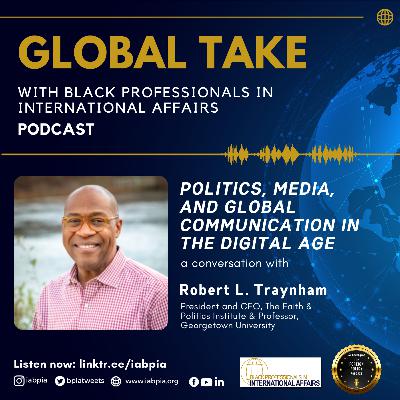
In this episode, host Oona Nelson sits down with Robert L. Traynham — President & CEO of The Faith & Politics Institute and Professor at Georgetown University — for a wide-ranging conversation on the future of public-policy communications. Together, they explore how media trends and emerging technologies are reshaping the public square; the intersection of global communications, politics, and culture; how organizations across sectors can think more strategically about media, reputation, and global audiences; and what the next decade may demand from leaders navigating an increasingly interconnected world.Host: Oona NelsonExecutive Producer: Ethel MwedziwendiraSound Engineer: Karen Kyabega
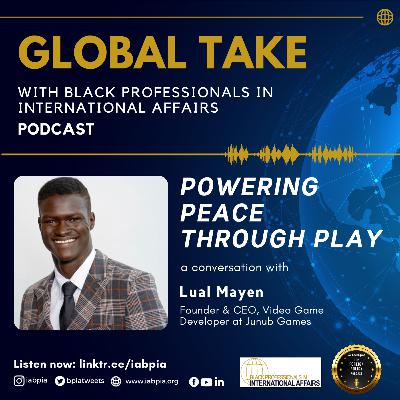
In this episode of Global Take, we sit down with Lual Mayer, CEO and Founder of Junub Games , to explore how gaming can serve as a powerful tool for storytelling, empathy, and peacebuilding across global conflict zones.Host: Oona NelsonExecutive Producer: Ethel MwedziwendiraSound Engineer: Karen Kyabega
When the morning news broke to the world that WNBA Star Brittney Griner was arrested in Russia, it brought the invasion against Ukraine up close and personal to the Black community. The WNBA Star, age 32 at the time, was detained in Russia on February 17, 2022, for allegedly possessing cannabis oil in her luggage after arriving in Moscow from New York City. Griner's wife, Cherelle Griner, along with a host of celebrity friends like Lebron James, pressured the Biden Administration to bring Griner back home, adding an international spotlight to her case. On August 4, 2022, she was sentenced to nine years in prison following weeks of a long trial. Black America poured out their frustrations on social media criticizing President Biden's slow efforts to negotiate her release with Russian President, Vladimir Putin as there were concerns of her personal safety given that she was both black and lesbian. Griner's case was even more complicated given that her negotiation was during the Russian invasion of Ukraine. More importantly, how would Griner's prisoner swap affect U.S. national security? In this episode, Alexanderia Haidara talks with Dr. Nola Haynes to discuss the implications of Griner's case, the Russian invasion of Ukraine, and the geopolitical shifts with China.
Dr. Nola Haynes
Dr. Nola Haynes is an adjunct professor at Georgetown University. She is an academic, policy writer, and advocate. Her interests center on emerging threats, WMD in space, strategic competition, and intersectionality. Recently, Dr. Nola was named one of the top 50 leaders in national security and foreign affairs by the Center for Strategic and International Studies (CSIS) and Diversity in National Security (DINSN). She is the former Director of the West Coast chapter of Women of Color Advancing Peace and Security (WCAPS) and sits on several boards, including the Women's Caucus for the International Studies Association communications team (WCIS), Foreign Policy board for the American Political Science Association (APSA), and ISA West. She is a Black Professionals in International Affairs (BPIA) member and an alumnus of the WestExec Advisors mentoring program. As a Pacific Council on International Policy member, Dr. Nola works as an Ops Coordinator to help resettle Afghan allies with Evacuate Our Allies (EOA) and is a policy advocate for the Afghan Adjustment Act. Dr. Nola has over ten years of experience working in Diversity, Equity, and Inclusion and is a proud New Orleans native.
Donate and follow Black Professionals in International Affairs at www.iabpia.org, Facebook, Linkedin, Twitter, and Instagram.
In this Hollywood edition of Global Take Podcast, we discuss the challenges of promoting black films overseas and how racism and social media in America impact Black American movie sales and films overseas, especially in Asia. Juanita Ingram discusses the ups and downs of producing the second season of The Expats International Ingrams, sharing stories of black women dating overseas, and promoting black beauty through winning Mrs. Universe 2023.
Global Take Podcast Host, Alexanderia Haidara, and Juanita reflect on the obstacles that Black Hollywood Producers face promoting their content in global markets. They dive deep into the fallout over Netflix's Queen Charlotte's true heritage and whether she had African ancestry, why Disney's Little Mermaid tanked in China's movie box office, and why Egyptians could not accept that Queen Cleopatra could be black. Join the conversation at Global Take Podcast!
About Juanita Ingram
Juanita Ingram, Esq. is breaking down barriers and empowering others as an award-winning attorney, filmmaker, author, fashion philanthropist, and actress. Currently living in Singapore and formerly residing in London and Taiwan, she is also a wife, mother of two, and the newly crowned Mrs. Universe 2022/2023. She is the Founder and CEO of Purpose Productions Inc., a 501(c)3 women-led production company with a mission of creating content that celebrates authentic BIPOC narratives while empowering women and youth through film. Purpose Productions utilizes the visual arts as a vehicle for challenging negative stereotypes and providing cross-cultural experiences for audiences throughout the world. Purpose Productions is also a conduit for sharing a balanced depiction of diverse cultures and powerful under-represented narratives while serving to foster educational and cross-cultural exposure for global audiences.
On Juneteenth 2021, she launched Purpose Streaming, a streaming platform dedicated to content that inspires, informs, and empowers through BIPOC-centric content.
She received her Bachelor’s Degree in Accounting from Tennessee State University and her MBA and Jurist Doctorate degree from the University of Memphis. She is a US-licensed attorney and a former adjunct professor of Business Law. She is also the founder and Board Chairwoman of Dress for Success Greater London and Dress for Success Chattanooga.
The 2021 Haitian migration crisis on the U.S.-Mexico border stirred many emotions and became a reminder of the unequal treatment of Black migrants by the United States government. In addition, the United States has not had a positive track record in Haiti and has often supported leaders that are the target of antigovernmental protests or not supporting those embraced by the population. In this episode, Alexanderia Haidara sits down with Senior Reporter for the Miami Herald, Jacqueline Charles, to discuss how the history of U.S.-Haitian relations has impacted the current political and security crisis plaguing the country. We discuss the outcome of the investigation of U.S. Border Patrol agents riding on horseback whipping Haitian back across the Rio Grande River.
Given the focus of President Biden on immigration, how are his policies being received by those advocates promoting fair treatment of migrants from Haiti and African nations? How will President Biden and Canadian Prime Minister Justin Trudeau work together to address political insecurity, the rise of gang violence, and kidnappings? What is the role of the Haitian Diaspora in America to influence U.S. policy and local politics? We also reflected on the impact of the January 6 insurrection on the U.S. Capitol on other democracies in Latin America. Please write a review!
About Jacqueline Charles,
Jacqueline Charles is a Pulitzer Prize finalist and Emmy Award-winning Caribbean correspondent at the Miami Herald. She began her journalism career at the Herald as a 14-year-old high school intern before graduating from the University of North Carolina at Chapel Hill's School of Journalism and Mass Communication, where she was later honored for her contributions to the field of journalism as a 2022 inductee into the NC Media & Journalism Hall of Fame.
Charles' assignments have taken her throughout the Caribbean as well as Liberia, Kenya, Italy, and in recent years, Mexico, Canada, and Chile to report on the plight of Haitian migrants.
She is a founding member of the Carolina Association of Black Journalists, a college-affiliated chapter of the National Association of Black Journalists (NABJ). She is also a past president and scholarship chairwoman of the South Florida Black Journalists Association and a longtime assistant director of the University of Miami/Dow Jones High School Journalism Workshop.
The first to tell the world that then-Haitian President René Préval had survived the devastating January 12, 2010, earthquake, she spent 18 months living in Haiti as part of the Miami Herald's commitment to have a journalist stationed full time after the tragedy.
Charles served as co-producer on the Emmy-winning documentary on Haiti, Nou Bouke (We are Fed Up), which was broadcast in more than 50 PBS markets in the United States.
Her numerous other awards include NABJ Journalist of the Year for her Haiti earthquake coverage, and she was a 2011 Pulitzer Prize finalist for that same coverage. She was also recognized for her contributions to the Miami Herald's Panama Papers investigation, which was awarded a 2017 Pulitzer Prize. In 2018, she won the Maria Moors Cabot Award, the oldest prize in journalism and the most prestigious for coverage of Latin America and the Caribbean.
Her 2018 Pulitzer Center-supported reporting series, Cancer in Haiti, was the recipient of numerous awards, including the The AACR June L. Biedler Prize for Cancer Journalism.
Charles is a longtime member of NABJ and currently serves as a member of UNC's Hussman School of Journalism and Media's Board of Advisers. In 2015 she was recognized by UNC as a Distinguished Alumni.
Credits:
Host, Producer and Editor: Alexanderia Haidara
In this episode, we discuss the impact of climate change on African food production with Enock Chikava, the Interim Director for the Agricultural Development Department at the Bill and Melinda Gates Foundation. Global Take Podcast Host, Alexanderia Haidara, spoke with Mr. Chikava on the heels of the 2022 Goalkeepers Summit that took place in New York City on September 20-21, 2022. In 2015, world leaders agreed to 17 Global Goals for Sustainable Development to achieve a better world by 2030. Started by the Bill & Melinda Gates Foundation, Goalkeepers is a catalyst for action toward these goals—bringing together leaders from around the world to make progress toward ending poverty and fighting inequality. Goalkeepers is dedicated to accelerating progress toward the Global Goals: using powerful stories, data, and partnerships to highlight progress achieved, and bring together a diverse range of leaders to address the world’s major challenges. Chikava highlighted the importance of building a robust agricultural economy in Africa, the demand for climate resistance seeds for food production, investing in women's agriculture businesses, and intra-Africa trade as the solution for Africa to become a breadbasket for the world.
About Enock Chikava
Enock Chikava leads the foundation’s work to reduce poverty for millions of farming families in Sub-Saharan Africa and South Asia by promoting inclusive agricultural innovations that drive productivity and income growth for smallholder farmers in a sustainable way. He joined the foundation in April 2015 as a senior program officer focusing on crop innovations. Enock trained in Agricultural Economics and Business Strategy, with 30-years’ experience in agriculture. His career spans from farmer organizations, private sector seed industry, agribusiness, food processing, and now philanthropy. Enock Chikava is a board member of the African Enterprise Challenge Fund (AECF) and former president of the African Seed Trade Association (AFSTA). He was raised on a smallholder farm in Zimbabwe in a family of eleven and has dedicated his life to working towards smallholder farmers' success as they use technology to raise productivity, incomes, nutrition, and economically empower themselves.
Love the episode? Write a review.
Podcast Team
Alexanderia Haidara, Host and Podcast Producer
Cheryle Galloway-Podcast Op-Ed Writer
Sidney Walters-Podcast Social Media Coordinator
Oona Nelson-Podcast Editor
Follow Black Professionals in International Affairs at www.iabpia.org, Facebook, Linkedin, Twitter, and Instagram.
Africa will shape the future — not just the future of the African people, but of the world. These were the exact words quoted from President Joe Biden when he delivered his speech at the U.S.-Africa Leaders Summit on Dec. 13-15, 2022. President Biden invited 49 African Heads of State to Washington D.C. along with leaders from civil society, business leaders, women, and youth to discuss U.S.-Africa relations. The agenda included discussions on efforts to strengthen business and trade relations, war and political instability, COVID-19, and poverty. Africa is a major geopolitical player, especially with other countries like China and Russia courting the continent too.
In this episode, Alexanderia Haidara spoke with Florizelle Liser, CEO and President of the Corporate Council on Africa, to discuss American companies doing business in Africa. Corporate Council on Africa (CCA) is the leading U.S. business association focused solely on connecting business interests in Africa and co-hosted the U.S.-Africa Business Forum and several special side events at the conference. Alexanderia also talked to Mark Tatum, COO and Deputy Commissioner of the National Basketball Association (NBA) to discuss its expansion on the continent. The Basketball Africa League is Africa's premier men's basketball league. The league consists of twelve teams, each qualified through their domestic competition. NBA Africa is in its 3rd season with teams in Senegal Egypt, and Rwanda to name a few. Given both the criticism of the conference, Alexanderia spoke with the State Department's Principal Deputy Spokesperson, Vedant Patel to discuss the deliverables, diaspora engagement, and the future of U.S.-Africa policy.
Podcast Team
Alexanderia Haidara, Host and Podcast Producer
Cheryle Galloway-Podcast Op-Ed Writer
Sidney Walters-Podcast Social Media Coordinator
Oona Nelson-Podcast Editor
Follow Black Professionals in International Affairs at www.iabpia.org, Facebook, Linkedin, Twitter, and Instagram

Climate change is real and politicians can no longer dismiss it as a myth or fake news. Droughts are becoming the norm in Sub-Saharan Africa. Hurricanes and storms are slowly eroding the world's best beaches. Black communities worldwide are the most vulnerable to poor water and sanitation, and pollution, living in the most deplorable living conditions. In this episode of Global Take, Alexanderia Haidara talks with Dr. April Baptiste about the effects of climate change, and how global policies affect Black Caribbean communities. We discuss the effects of environmental racism on black communities in Latin America and the Caribbean. Her research centers on the effects of climate change in Caribbean fishers communities, particularly among black Jamaicans. Recently many countries signed the Paris Agreement, which seeks to guide the treatment of climate change by limiting the rise of the global temperature below 2 ̊ Celsius. Do these international treaties target marginalized black communities in the Caribbean and Latin America? How effective are these treaties when it comes to combating climate change? What about China and its growing influence in the Caribbean? Tune in to Global Take.
Bio:
Dr. April Baptiste is a professor of environmental studies and Africana and Latin American studies at Colgate University. She loved climbing guava trees with her five siblings as a child, collecting fruits in her backyard, and playing with her mother’s animals as if they were pets. Born in Trinidad and Tobago, Baptiste grew up embraced by greenery, faith, and a mother who prioritized hard work and education for her children. She earned her B.S and M.Sc from the University of West Indies in St. Augustine, Trinidad in 2002 and 2004 respectively. She earned her Ph.D. from State University of New York, College of Environmental Science and Forestry in 2008. Her research focuses on the intersection of environmental psychological variables and environmental justice issues within the Caribbean region. Dr. Baptiste’s research projects have examined the relationship between environmental attitudes and concerns toward oil and gas drilling in Trinidad and the relationship between environmental justice and the siting of aluminum smelters. She has been featured on NPR and other international media outlets.
Podcast Team
Alexanderia Haidara, Host and Podcast Producer
Cheryle Galloway-Podcast Op-Ed Writer
Sidney Walters-Podcast Social Media Coordinator
Follow Black Professionals in International Affairs at www.iabpia.org, Facebook, Linkedin, Twitter, and Instagram.

In this episode, Alexanderia Haidara, host of Global Take has a thoughtful discussion with Juanita Ingram. She is an award-winning attorney, television producer, filmmaker, and actress. Mrs. Ingram is the hit producer of her new reality TV show, The Expat International Ingrams, featured on Amazon Prime. The show is a reality documentary series that sheds light on Mrs. Ingram’s journey from corporate attorney to stay-at-home wife while living and traveling with her children in another country. The show follows her life abroad and how her family adapts to living in a new culture while dealing with everyday challenges. Juanita discusses how Black American films affect how black people throughout the African diaspora are treated abroad. We explore how the black film industry plays a role in influencing US foreign policy and promoting American democracy abroad. Do the images of Black Americans on television shows and movies affect how Asians view and treat black people in their own countries? Join our discussion online with Global Take!
Bio:
Juanita, the President, Founder, and Executive Producer of PURPOSE Productions, is originally from Chattanooga, Tennessee, where she received her Bachelor’s Degree in Accounting from Tennessee State University. Juanita received her MBA and Juris Doctorate degrees from the University of Memphis.
She is a member of Delta Sigma Theta Sorority, Inc., The Links Incorporated Circle City Chapter, and the American Bar Association. Not to forget she is a loving wife and mother of two, currently residing in the United States of America.

On September 19, 2021, the world watched in shock as images flew across the airwaves showing the inhuman treatment of Haitian migrants at the U.S.-Mexico Border. Headlines across the globe were brutal: “Grim echoes of history in images of Haitians at U.S.-Mexico Border” from London’s BBC to “Biden faces harsh criticism for expelling Haitian asylum seeker” by Al-Jazeera in Qatar. The horrifying images of the US Border Patrol galloping on their horses while whipping black Haitian immigrants into submission revive emotions of slavery. Some argue that the Biden administration is only continuing a long history of exclusionary policy against Haitian asylum seekers.
In this episode, Alexanderia Haidara interviews Patrice Lawrence, Executive Director of Undocublack, an organization leading the fight to help address the Haitian migrant crisis and provide justice for black immigrants in America. Given the aftermath of the George Floyd cases, should Black America, descendants of American slaves, care about the Haitian crisis? How do we bridge the gap between mainstream Black America and the black immigrant community? Find out more on Global Take.
Bio: Patrice Lawrence is Executive Director of UndocuBlack Network (UBN). She leads the work of those who are Black, currently or formerly undocumented across the diaspora and are steadily leading the charge on what they need by making their demands clear on a local and national level. UndocuBlack™️ has ushered in victories for TPS and Liberian DED communities, fought for DACA and now involving the legalization fight for all 11 million undocumented people, public health, mental wellness, and spearheaded powerful media narratives centering Black undocumented people while fighting the criminalization of our lives through unjust deportation and detention.
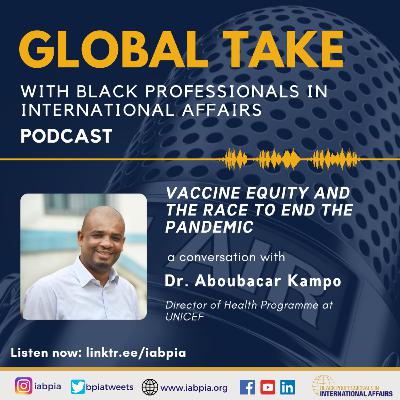
As we approach the end of 2021, the world is still grappling with the COVID-19 pandemic. Everyone is tired of wearing masks, quarantining, and social distancing. However, the sad reality is just 55% of the world population have received their first dose of vaccine. This is mostly concentrated in richer nations including most of the United States, Europe, and parts of Asia. In many parts of Africa, barely 15% of the population is vaccinated as they battle with their 3rd and 4th wave of infections. Vaccine equity is crucial towards winning the war to end the pandemic. If one country is fully vaccinated while the rest of the world struggles to get one dose, we are exposing ourselves to more variants to develop. In this episode, we will talk with Dr. Aboubacar Kampo, Director of Health Programs at UNICEF Headquarters. Dr. Kampo stresses the need for greater vaccine equity, ending the pandemic, and strengthening public health systems in Africa and Asia.

On August 30, 2021, the U.S. military completed their withdrawal from Afghanistan after nearly 20 years of fighting against terrorism. President Biden defended his decision to end the war by stating that the U.S. must learn from its mistakes and not become involved in nation-building in a post-9/11 world. While Washington debates whether or not President Biden should have pulled the plug, a humanitarian crisis is brewing on the ground. The Taliban, who the U.S. ousted from power shortly after 9/11, now control nearly all of Afghanistan. Girls struggle to continue their education, while authorities discourage women from working outside the home. The Afghan people are fleeing their country by the thousands, causing a refugee crisis at the border. In this episode, we talk with Christopher Nyamandi, Country Director for Save the Children in Afghanistan, to understand the humanitarian impact on the ground and the future of women and children’s rights under the new Taliban government.
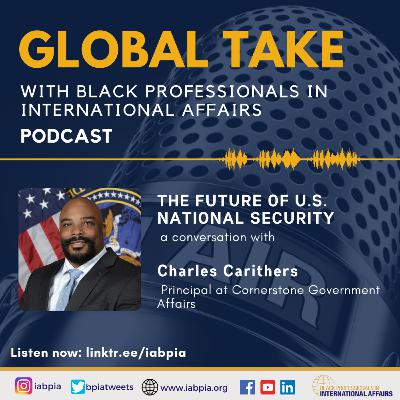
In this episode we talk to Mr. Charles Carithers about the future of U.S. national security in the aftermath of George Floydd racial protests. Mr. Carithers discusses how his role at the Department of Defense, U.S. House Committee on Homeland Security, and now, a Principal at Cornerstone Government Affairs has shaped U.S. national security policy. He reflected that his career on the Hill was intellectually stimulating and inspiring. As a Morehouse College graduate at the nation’s most prestigious Historically Black College and University, Mr. Carithers discussed the confidence he gained at his college and how his mentors asked him how he was going to change and impact the world. Throughout his career, Mr Carithers has seen many gaps in the recruitment of Black Americans in this sector and he aims to change it. He further discusses how the lack of cultural diversity in the national security policy arena is a detriment to our democracy and political stability. He argues we need diversity of thought and culture in order to keep our world safe and secure. If we continue to have our national security policy led by the same group of individuals who come from the same culture and thought, then we will continue to see global problems escalate, such as immigration, climate change, and now the global pandemic.
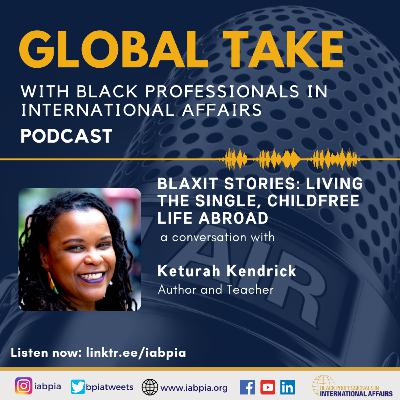
In this episode, we talk to author, educator, and entrepreneur, Keturah Kendrick, as she discusses her new book: No Thanks: Black, Single and Living in The Martyr Free Zone. Keturah takes us on an international journey as she discusses the challenges and joys of traveling and living abroad as a single, black, and childless woman. We dive deep as we discuss how her lifestyle choice was perceived around the world.
Her book, No Thanks, chronicles the challenges and reflections of a single Black woman, with no children, and considering the world as her home. The essays, sharp and witty, have brought the issue of singlehood to the forefront in the Black community. The essays also reveal the bewildering ways in which Keturah got tagged by others: in Africa she was a "crazy American woman," in Asia, she was "too much altogether," and in the US, not considered the ideal and "good Black woman."
In No Thanks, Keturah emerged as a free woman, living unapologetically, challenging the readers’ conceptions of what it means to be enough for oneself and others. She also reveals the rich experiences of women who are single by choice.
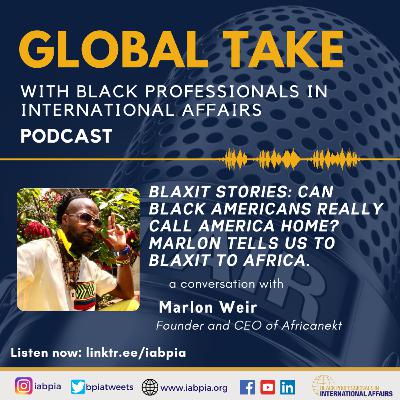
George Floyd’s brutal murder became a catalyst for the global Black Lives Matter movement. Despite all the social unrest, many Black immigrants from Africa and the Caribbean still view Americans as the beacon of hope for economic prosperity. Meanwhile, Black Americans are exiting and moving abroad. Today we talk with Marlon Weir aka “The Dandy Afrikan to discuss his motivation to live and stay abroad. Marlon discusses the freedoms he enjoys as a black man living in Africa and why more Black Americans need to escape from the American "plantation" and Blaxit.
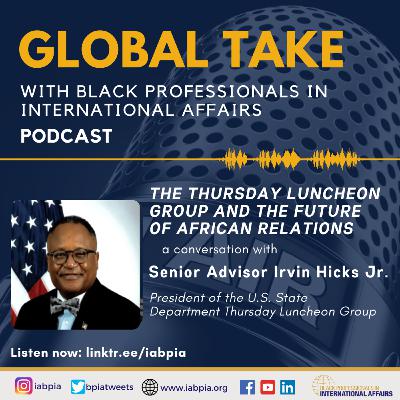
Join us as we speak to Irvin Hicks Junior, a Senior Advisor in the Bureau of International Narcotics and Law Enforcement Affairs. Advisor Hicks Jr. has had State Department assignments in Nigeria, Brazil, Djibouti, Burundi, New Guinea, and many other locations. Today, we talk about his work as the president of the Thursday Luncheon Group as well as the future of Africa.
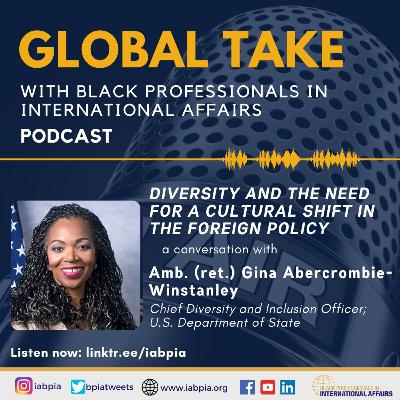
Join us as we speak with Gina Abercrombie-Winstanley, a retired ambassador and newly appointed Chief Diversity and Inclusion Officer in the U.S. State Department. Chief Officer Abercrombie-Winstanley has had an expansive career in the foreign service, spanning from her assignments in the Middle East monitoring democratic elections, to her service as the longest-serving U.S. ambassador to the Republic of Malta. In this episode, we talk about her career journey through the U.S. Department of State, Congress, and the Department of Justice. We also discuss what it means to be the token diversity pick in a field that leaves little room for minorities, and what true inclusion means in the government space.
In our society, the disparity between black and white teachers has reached new heights. Teachers protesting for higher wages, more resources, and better treatment have become commonplace in our country's media. Let's hear from educators Holly Dancy, Shinea Wright, and Arlissa Pinkleton about their journey as professionals who left the United States educational system to pursue a career abroad. In this podcast, we learn about these educator's reasoning for becoming international teachers, the benefits and unique experiences that come with their careers, and the struggles of being black women abroad.
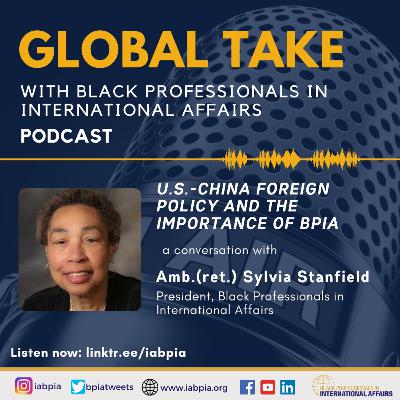
President Biden declared at the Munich Security Conference on February 19, 2021 that “America is Back” and that he was concerned by China’s human rights record and unfair trade practices. However, will the success of U.S. foreign policy in China depend on the Biden Administration’s ability to quickly resolve racial injustice and inequality at home? How urgent is it for the Biden Administration to uproot systematic racism and white supremacy in order to retake its role as leader of the free world? What role will Black American diplomats play in advancing America’s democratic ideals abroad? Join Alexanderia Haidara, Co-Host of Global Take, as we discuss these pressing global issues with Ambassador Sylvia Gaye Stanfield, President of Black Professionals in International Affairs.
About Ambassador Sylvia Gaye Stanfield
Ambassador Sylvia Gaye Stanfield was the U.S. Ambassador to Brunei Darussalam from 1999-2002 and a career member of the U.S. Senior Foreign Service. Asia was the focus of much of her 30 plus years with the Foreign Service. Her first overseas assignment was with the then American Embassy in Taipei, Taiwan. As a political track Chinese language officer, she had postings with the U.S. Consulate General in Hong Kong, the U.S. Embassy in Beijing, and the American Institute in Taiwan in Taipei. She served on the State Department’s “China desk” at the time of the normalization of U.S. relations with the People’s Republic of China and later headed the Office of Taiwan Coordination Affairs. She was Director of Australian and New Zealand Affairs prior to serving as Charge d’Affaires and Deputy Chief of Mission of the U.S. Embassy in Wellington, New Zealand. She was Diplomat-in-Residence at Florida A&M University and at Spelman College before serving as Senior Advisor for Mentoring Coordination at the Department of State.
Along with continuing involvement in mentoring activities, she is the President of Black Professionals in International Affairs (BPIA) – an organization founded in 1989 to increase African-Americans’ interest and involvement in international affairs, and a member of the Association of Black American Ambassadors executive committee. A native Texan, she earned a B.A. degree in intercultural studies from Western College for Women in Oxford, Ohio. While an East West Center grantee, she received a M.A. degree in Asian Studies from the University of Hawaii and continued her studies at the University of Hong Kong School of Oriental Studies and Linguistics.
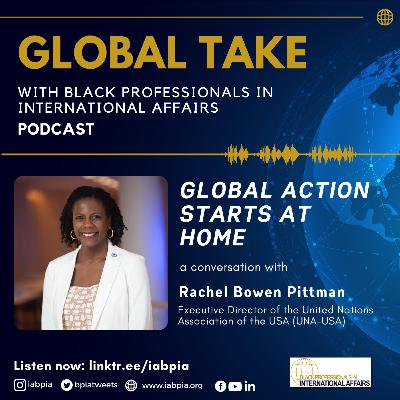
In this episode of Global Take, we sit down with Rachel Bowen Pittman, Executive Director of the United Nations Association of the USA (UNA-USA), to explore the power of grassroots advocacy in shaping global diplomacy. Rachel shares her journey, the vital role of UNA-USA in strengthening U.S.-UN relations, and how everyday Americans can make an impact on international issues. From mobilizing communities to influencing policy, this conversation is a must-listen for anyone passionate about global engagement and leadership. Host: Oona NelsonExecutive Producer: Ethel MwedziwendiraSound Engineer: Karen Kyabega

Comments

Download from Google Play

Download from App Store
 United States