


 Claim Ownership
4-Quarter Lives
Subscribed: 11Played: 362
Subscribe

© Avivah Wittenberg-Cox
Description
You are likely to live longer than you think. Are you ready? Science has gifted us ever longer, 100-year lives. This impacts… everything! From couples and careers - to companies and countries. We’ll interview the experts who are exploring the consequences – and the individuals applying it to their own lives and choices. Generational and gender expert Avivah Wittenberg-Cox talks with people designing new ways of living, working and loving at all ages – across life’s 4 quarters.
elderberries.substack.com
elderberries.substack.com
104 Episodes
Reverse
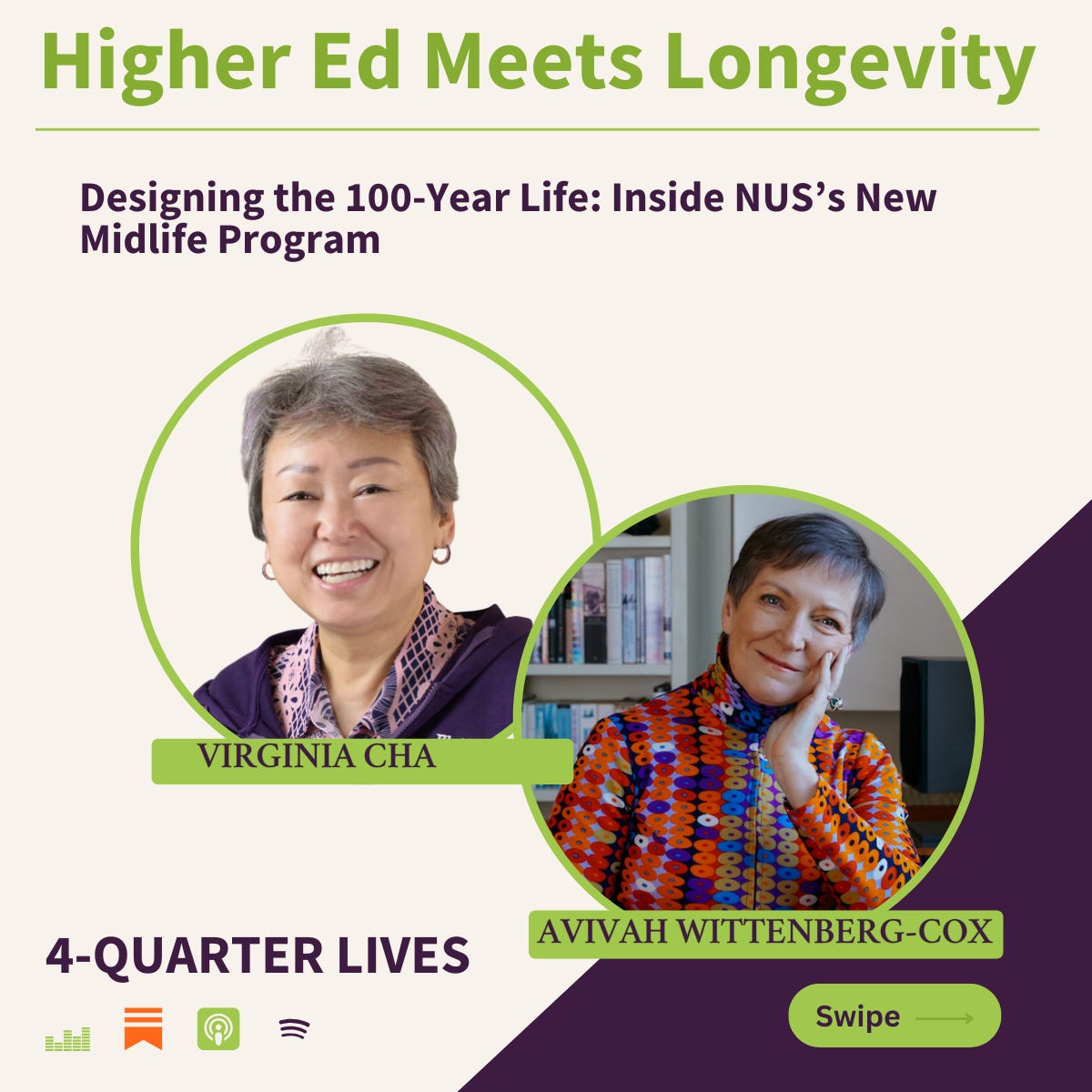
In Series 10 of 4-Quarter Lives Avivah Wittenberg-Cox talks with the leaders of a growing number of university faculties running programmes for individuals looking to change direction as they enter their 3rd Quarter of life. She discusses the origins and motivations for these programmes and how they fit into the evolving role of higher education. This week she speaks with Professor Virginia Cha, Academic Director of the new Distinguished Senior Fellows Program at the National University of Singapore (NUS)—Asia’s first university-based midlife transition program.They explore why Singapore, one of the world’s fastest-ageing societies, is pioneering this new model; how the program blends longevity science, purpose projects, fieldwork, and an ASEAN immersion trip; and the remarkable friendships and impact emerging from this inaugural cohort.Virginia shares why she launched this 13-week, executive-level program—rooted in longevity literacy, purpose, and impact—designed specifically for adults navigating their 3rd Quarter of life. She describes Singapore’s demographic pressures, the untapped “third demographic dividend,” and why midlife talent represents one of Asia’s most powerful yet overlooked assets. She and Avivah discuss the program’s unique structure: curated seminars across philosophy, religion, culture, arts, and science; a signature module, Thriving in the 100-Year Life; and team-based impact projects.Virginia also reflects on her own turning-65 moment, rediscovering early passions in anthropology and religion, and designing the program she wished existed. Unexpectedly, the deepest impact has been friendship—“like kindergarten again,” she says—revealing the joy, stimulation, and motivation that come from learning in community in later life.Professor Virginia Cha is the Academic Director of the Distinguished Senior Fellows Program at the National University of Singapore (NUS). An award-winning educator, entrepreneur, and longtime adjunct faculty member at NUS, she brings decades of experience spanning technology leadership, innovation, and executive development. After a global career in tech and business—including multiple CEO roles—Virginia turned her attention to longevity, purpose, and the future of ageing in Asia.Useful Links* Distinguished Senior Fellows Program (NUS)* SmiLing Gecko Cambodia — social enterprise & education project Get full access to Elderberries at elderberries.substack.com/subscribe
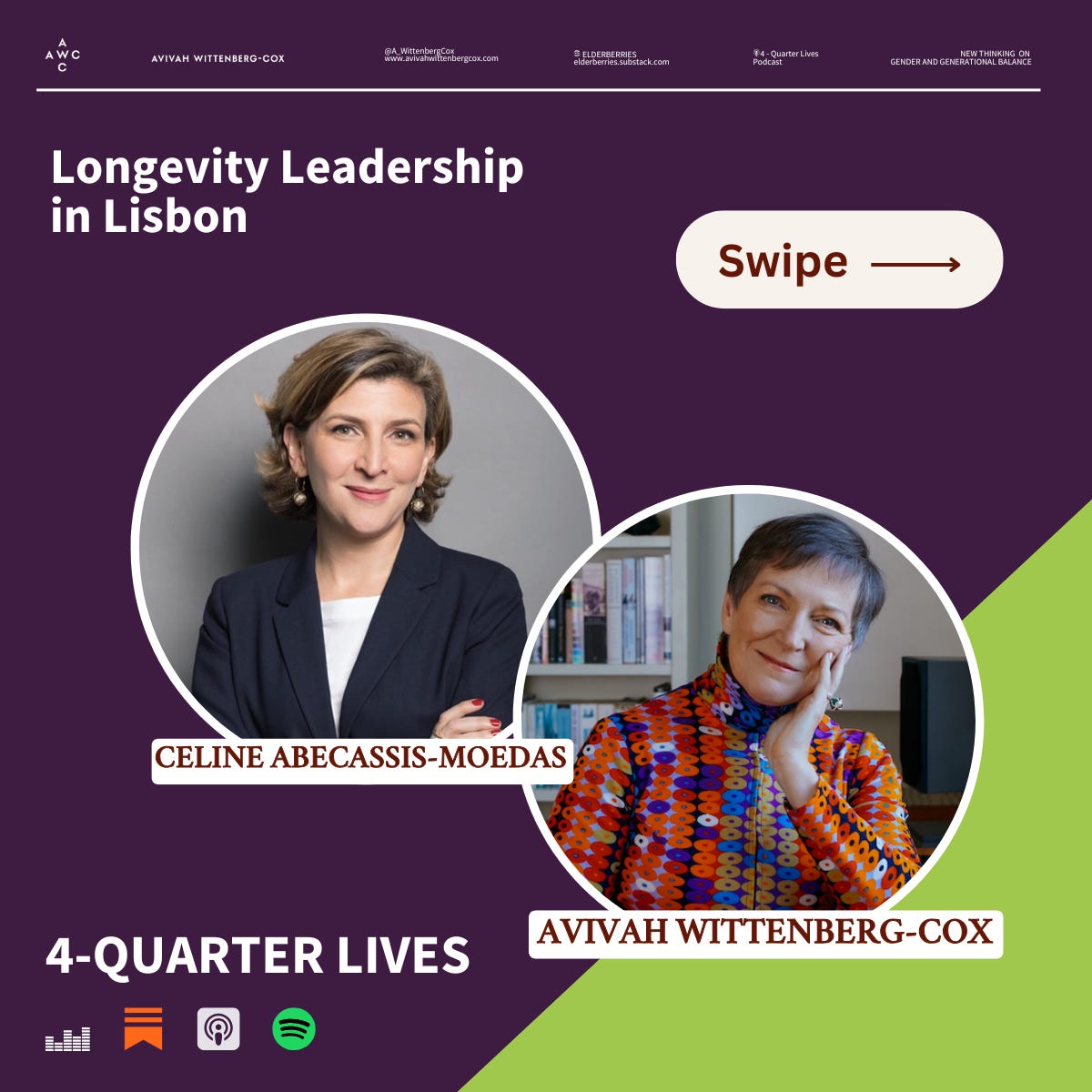
In Season 10 of 4-Quarter Lives, Avivah Wittenberg-Cox talks with the leaders of a growing number of university faculties developing programmes for individuals looking to change direction in their 3rd Quarter of life. We explore the origins and motivations behind these programmes—and how they fit the evolving role of higher education in ageing societies.This week we are republishing Avivah’s conversation with Céline Abecassis-Moedas, Pro-Rector for Innovation and Entrepreneurship at Universidade Católica Portuguesa in Lisbon, Portugal, and Co-Director of the Longevity Leadership Program at Catolica. As becomes clear during their conversation, her fellow director on this program is Avivah Wittenberg-Cox!Not surprisingly their conversation focuses on the need for and value of a Longevity Leadership programme of this kind. Launched in June 2024, the week-long program addresses the growing impact of lengthening lives for individuals, businesses and society. Céline explains how it offers a unique, holistic approach that combines three elements – personal development, business strategy and societal perspectives on longevity. Lisbon is itself emerging as a longevity hub in various ways, making it a valuable location for the program. Céline describes how her personal experience sparked her interest in longevity and her recognition of a gap in executive education in part (though not specifically) for the 55+ demographic, and examining the growing significance of longer careers. Working with Avivah, they developed this into the larger concept of a course also exploring the organisational and societal implications of changing demographics, and structured a program that covers macro-economic trends, business opportunities, career transitions, personal health and finance, and even urban planning, bringing in a range of experts on each of these topics. Participants, ranging in age from late 20s to early 60s, gender balanced and from a range of corporate and non-corporate backgrounds, reported exceptionally high satisfaction ratings.Céline Abecassis-Moedas is a Professor and Pro-Rector for Innovation and Entrepreneurship at Universidade Católica Portuguesa and an Ambassador at the Stanford Center on Longevity. She holds a PhD in Management from École Polytechnique, Paris and an MA in Management from the Université Paris Dauphine. She is a graduate from École Normale Supérieure de Cachan and La Sorbonne in Economics and Management. Celine was Dean for Executive Education at Catolica Lisbon from 2019 to 2024 and previously Assistant Professor at the Centre for Business Management at Queen Mary, University of London. She worked in Business Development at Lectra in New York and as a Consultant at AT Kearney in London. Céline’s research interests are on the role of design in innovation, design management, innovation management and entrepreneurship mostly in creative industries, and her work as been widely published. In addition to her academic experience, Celine is non-executive director at CUF, Vista Alegre Atlantis and Lectra.Some Useful Links:* Catolica Lisbon Longevity Leadership Program Overview* Catolica Lisbon Longevity Leadership Program Structure* Catolica Lisbon Longevity Leadership Program Application Form* Stanford Center on Longevity Ambassador Get full access to Elderberries at elderberries.substack.com/subscribe
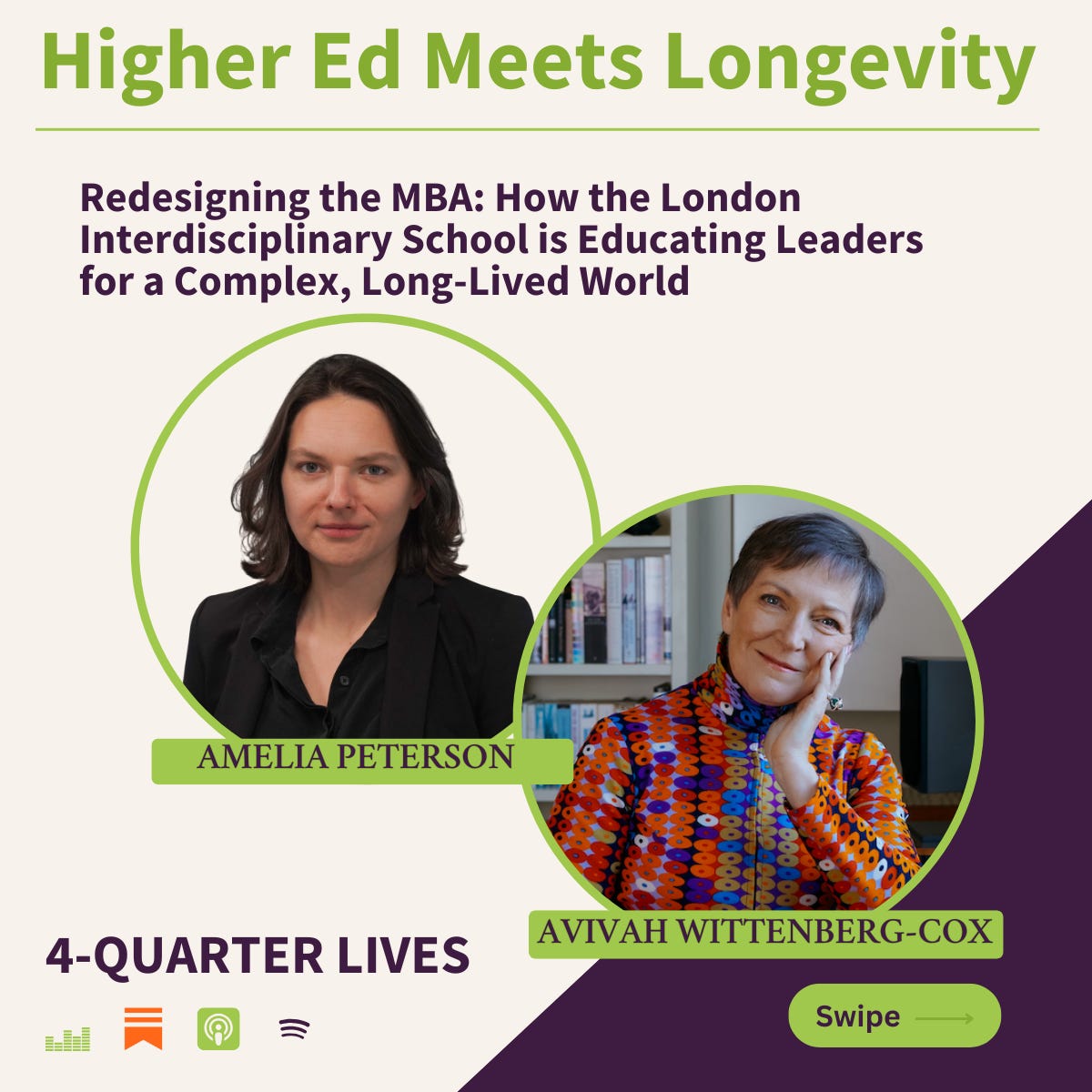
In this week’s 4-Quarter Lives, Avivah Wittenberg-Cox is joined by Dr Amelia Peterson — founding faculty member of the London Interdisciplinary School (LIS) — to explore how higher education can reinvent itself for an age of complexity, longevity, and accelerating change.Amelia shares the story behind LIS’s bold rethink of the traditional MBA — an interdisciplinary programme designed not around internal business functions, but around six defining global “shifts”: complexity, intelligence, energy, ecosystems, trust, and longevity. These six forces, she explains, are reshaping work, leadership, and the skills needed to navigate an era of systemic uncertainty.Unlike conventional MBAs focused on finance and management silos, LIS’s approach begins with the world outside organisations — the social, environmental, and technological transformations that leaders must now understand to act responsibly and effectively. Each “shift” is both a slide (a slow-moving global trend) and a shock (an accelerating disruption), demanding that leaders develop adaptive, long-term perspectives.Amelia discusses how longevity became a cornerstone of the curriculum — linking demographic change and longer working lives to corporate time horizons and intergenerational collaboration. Drawing on her background in education policy and systems innovation, she outlines how LIS is creating programmes that combine academic depth with real-world application.The new MBA-alternative is designed for mid-career professionals — typically in their late 30s to 50s — who want to keep working while studying. The 18-month, part-time format blends immersive residential weeks with hybrid learning, offering time for what LIS calls the “inner shift”: personal and interpersonal development alongside intellectual exploration. Amelia also highlights how LIS is tackling accessibility in higher education — offering a world-class programme at roughly half the price of elite US equivalents..As higher education faces its own “midlife crisis” — demographic shifts, AI disruption, and declining enrolments — LIS is testing how universities can stay relevant. Amelia sees its role as “innovating on behalf of the system,” developing new models of learning, assessment, and leadership that larger institutions may one day adopt.Dr Amelia Peterson is a social scientist and founding faculty member at the London Interdisciplinary School (LIS), where she leads curriculum innovation and programme design. Her research bridges education policy, systems change, and the future of work, focusing on how learning environments can prepare people to tackle complex, real-world problems. Before joining LIS, she worked with the Innovation Unit, advising governments and public-sector leaders on education reform, and held academic positions at the Harvard Graduate School of Education and the London School of Economics. She holds degrees from Harvard and LSE and is a leading voice on rethinking higher education for a changing world.Useful Links:* London Interdisciplinary School (LIS) – MBA Programme* Amelia Peterson on LinkedIn* LIS Website Get full access to Elderberries at elderberries.substack.com/subscribe
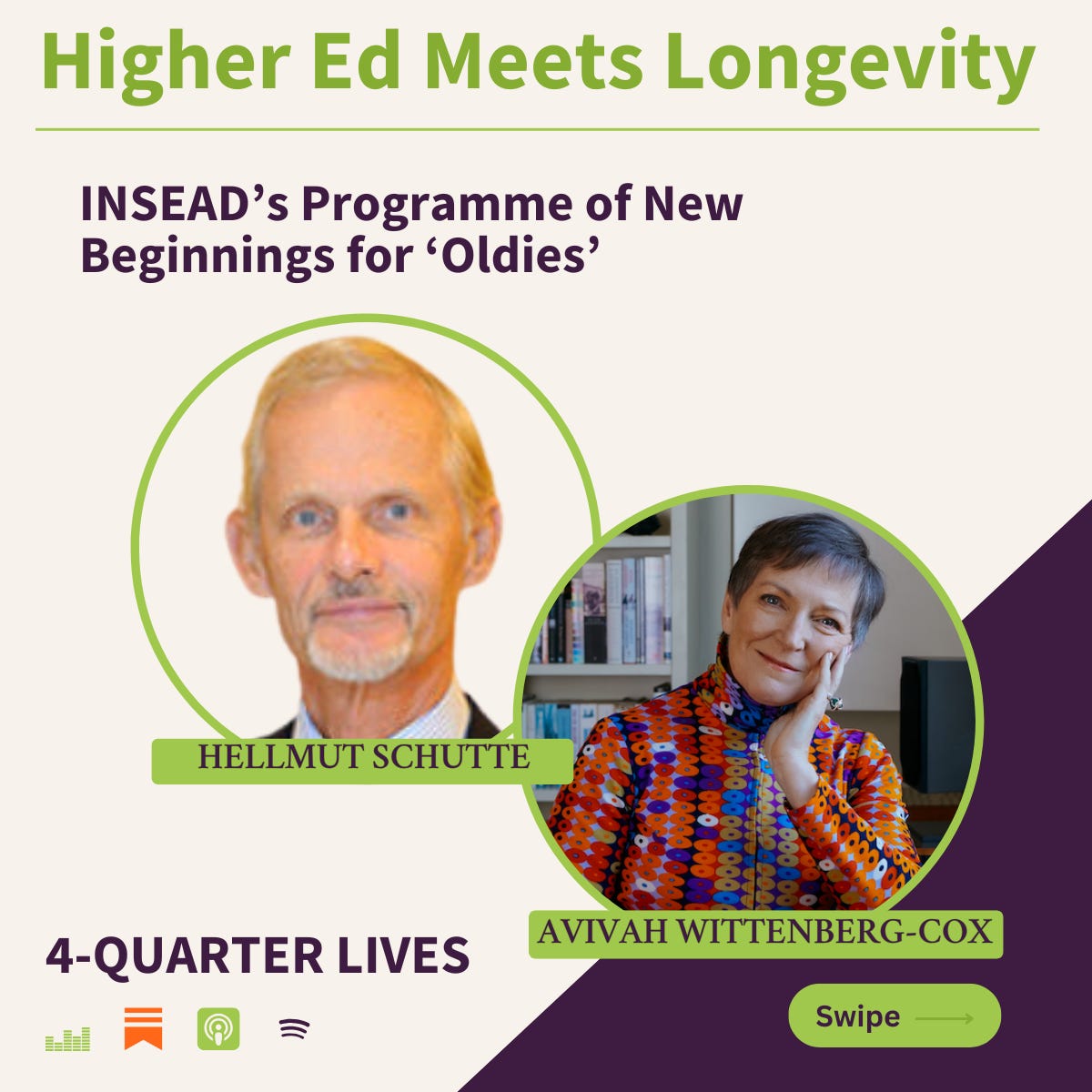
In Series 10 of 4-Quarter Lives, Avivah Wittenberg-Cox explores how higher education is reinventing itself for ageing societies—helping experienced leaders and professionals navigate longer lives, extended careers, and purposeful transitions beyond their peak corporate years.In this episode, Avivah speaks with Hellmut Schütte, Emeritus Professor of International Management at INSEAD, about INSEAD’s groundbreaking new programme, AI Ventures - Empowering Your Life Transition. Launched in early 2024, the course quickly became the school’s most popular lifelong-learning offer, designed for senior professionals seeking renewal after formal careers. Hellmut explains how the initiative blends longevity, AI and entrepreneurship to help alumni rediscover meaning, develop “dream projects”, and master emerging technologies. He shares what the programme reveals about purpose, pride, and the untapped potential of later-life learners—and why business schools must rethink their role in this new demographic era.Hellmut Schütte is Emeritus Professor of International Management at INSEAD and former Dean of INSEAD Singapore and CEIBS in China. With a career spanning Europe and Asia, he is widely recognised for his expertise in global strategy, emerging markets and cross-cultural leadership. Since joining INSEAD in France, he held various other academic roles in the US, Japan, Switzerland and Central Europe. In recent years, Hellmut has turned his focus to longevity and lifelong learning, spearheading INSEAD’s innovative AI Ventures - Empowering Your Life Transition programme. Get full access to Elderberries at elderberries.substack.com/subscribe
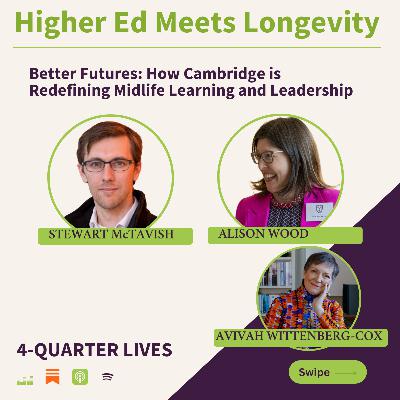
In Series 10 of the 4-Quarter Lives Podcast, Avivah Wittenberg-Cox continues her exploration of how universities around the world are redesigning themselves for longer lives and careers. In this episode, she talks with Stewart McTavish and Alison Wood from the University of Cambridge about the launch of Better Futures, a new programme supporting leaders in midlife transition.Together they reflect on why now is the moment for Cambridge to join this global movement and how the university’s distinctive collegiate structure and interdisciplinary depth are shaping its approach. Stewart and Alison describe how Cambridge is reimagining its role in an ageing society — from offering “structured spaciousness” for reflection to building a community of leaders committed to creating “better futures.” They share the programme’s three pillars — Foundations, Frontiers and Wayfinding — and how these help participants navigate transition while remaining deeply connected to impact and meaning. It’s a thoughtful look at how an 800-year-old institution is quietly reinventing itself for the longevity era.About Stewart McTavishStewart McTavish is the Academic Director and co-founder of the Better Futures Programme. A long-time innovator at the intersection of technology entrepreneurship and social impact, he has spent over two decades helping build Cambridge’s innovation ecosystem, as a founder and entrepreneur himself and also as a supporter including as the founding Director of University of Cambridge’s ideaSpace and as a founder of Deeptech Labs, an accelerator and venture fund. His background is computer science and engineering informs his systems-based approach to change, and his current focus is on connecting leaders across business, society, politics and academia to co-create opportunities to cultivate better futures.About Alison WoodDr Alison Wood is Deputy Director of the Better Futures programme and a Fellow at Homerton College, University of Cambridge. A scholar of the humanities and education, she has spent her career exploring how universities can respond to societal change through innovation and interdisciplinary learning. Her work spans literature, music, and leadership education, and she has been a driving force behind Cambridge’s experiments in lifelong learning and midlife transformation. Passionate about rethinking what universities are for, she brings a deep interest in systems, culture, and the evolution of knowledge communities.Useful links* University of Cambridge – Better Futures Programme Get full access to Elderberries at elderberries.substack.com/subscribe
Get full access to Elderberries at elderberries.substack.com/subscribe
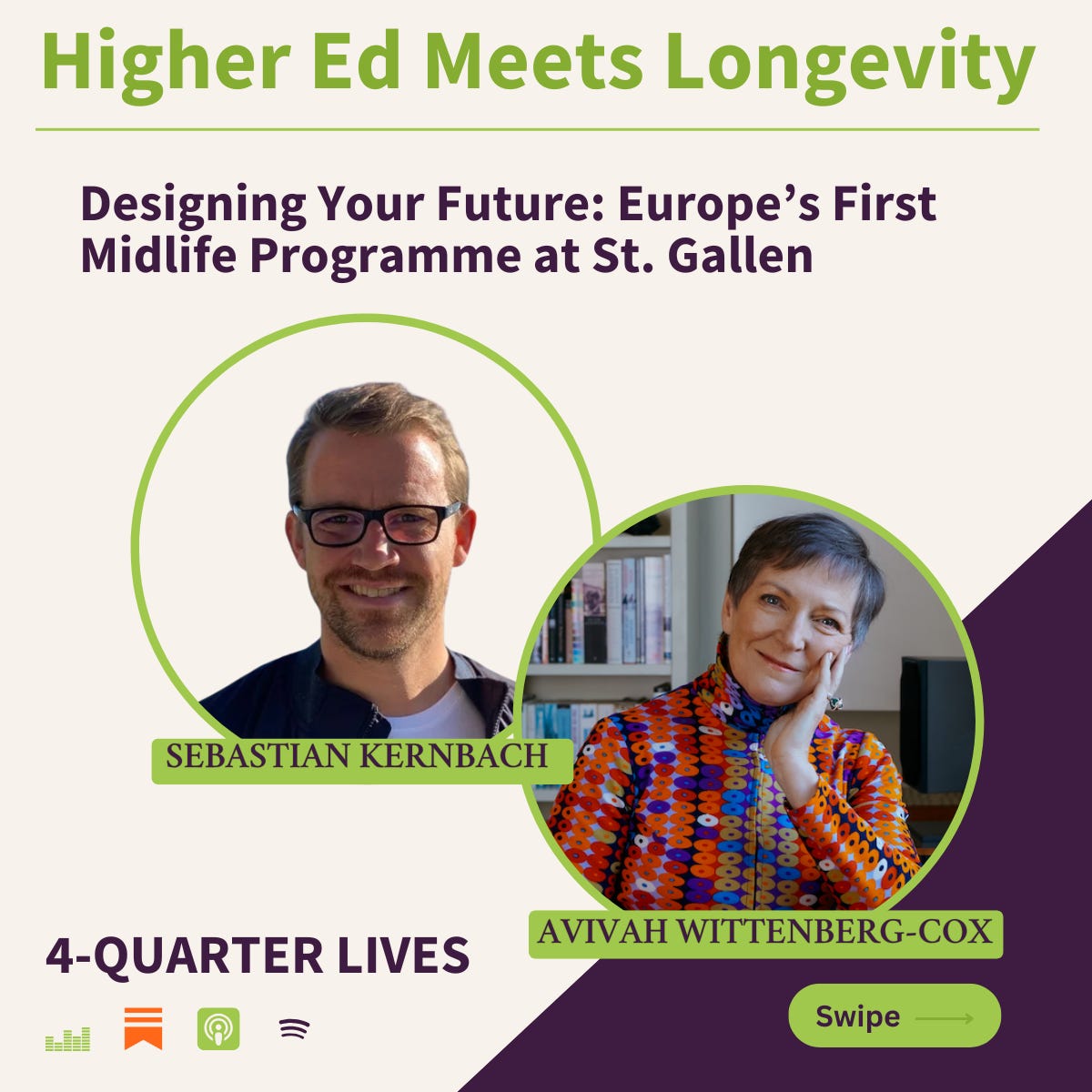
In Series 10 of 4 Quarter Lives, Avivah Wittenberg-Cox continues her exploration of the world’s leading midlife transition programmes. This week she speaks with Sebastian Kernbach, founder of the University of St. Gallen’s Next – Design Your Future initiative — the first university-based midlife programme in continental Europe.They discuss how St. Gallen’s approach blends design thinking, positive psychology and behavioural economics to help accomplished professionals rethink their purpose, portfolio, and personal transitions, in what Kernbach calls the multi-stage life. He describes how the three-day “sabbatical” has evolved into a five-day immersive experience, designed to give participants a structured yet creative space to pause, prototype, and rediscover what drives them.Together, Avivah and Sebastian compare models emerging from Harvard, Stanford and Chicago with Europe’s more academically grounded, culturally diverse programmes. They explore Kernbach’s key ideas — from infinite procrastination and the magic circle to the stairway to heaven — practical methods for turning reflection into action. The conversation widens to include the role of universities and employers in supporting lifelong learning, intergenerational connection and longer, healthier, more flexible careers.Kernbach shares his vision of “transition competence” — the lifelong skill of navigating change with agency, creativity and patience — and why Europe’s blend of rigour, reflection and community may offer a new model for longevity education worldwide.Sebastian Kernbach is Professor at the University of St. Gallen, where he teaches creativity, life design and visual thinking. Her is Visiting Scholar at Columbia University and Stanford University, and Guest Professor at the African Doctoral Academy and the Central University of Beijing.Previously he worked for Xerox and Interbrand. He advises and consults organizations like Nike, The United Nations, IBM and others. He founded the Visual Collaboration Lab and the Life Design Lab at the University of St. Gallen and co-authored the award-winning book “Meet up!” as well as the best-selling books “Life Design” and “Life Design Action Book”, and is author of the forthcoming book Design Your Future.Useful links:University of St. Gallen – Next Programme web page Get full access to Elderberries at elderberries.substack.com/subscribe
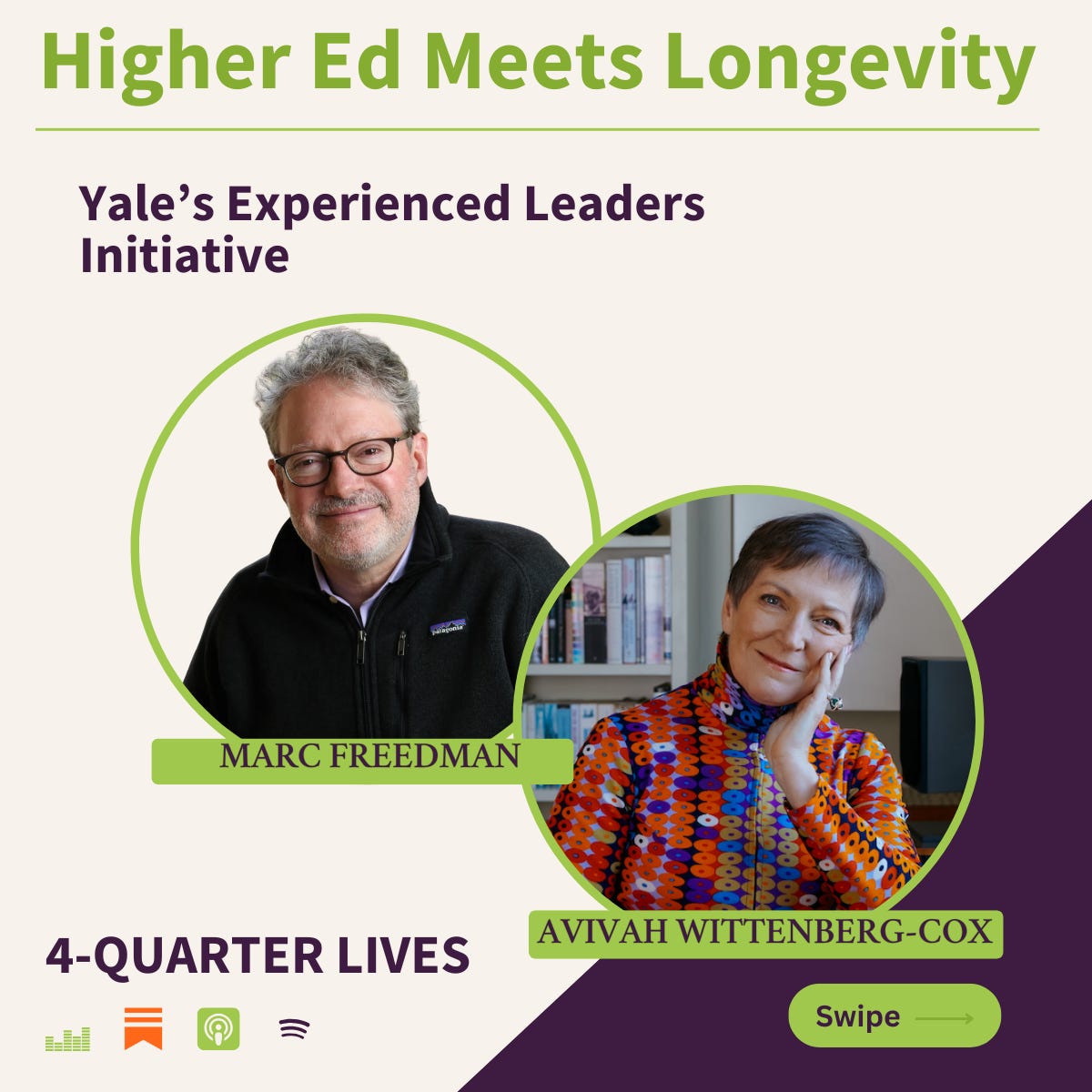
In Series 10 of 4-Quarter Lives, Avivah Wittenberg-Cox talks with the leaders of a growing number of university faculties developing programmes for individuals looking to change direction in their 3rd Quarter of life. We explore the origins and motivations behind these programmes—and how they fit the evolving role of higher education in ageing societies.In this episode she speaks with Marc Freedman — one of the world’s most influential thinkers on ageing, purpose, and intergenerational connection. As co-founder and co-CEO of CoGenerate, and founding faculty director of Yale’s Experienced Leaders Initiative, Marc has spent four decades at the forefront of reimagining how society supports connection, contribution and education across generations.Marc reflects on his journey from creating Experience Corps — a pioneering national program linking older volunteers with schoolchildren — to leading Encore.org (which popularized the concept of the “encore career” — a second act for the greater good) and now CoGenerate, a leading organization bridging the generational divide through programs and partnerships that connect older and younger people to solve society’s biggest challenges.. Across these initiatives, his mission has remained consistent: to bridge generational divides and build a more cohesive, age-integrated society.Avivah and Marc explore how higher education is beginning to adapt to longevity and the new life course. They discuss the evolution of midlife learning programs from Harvard’s ALI to Yale’s hybrid ELI model, and what universities must do to become truly multi-generational. Together, they consider the big questions: How do we scale these programs beyond elite institutions? How do we make midlife learning affordable, inclusive, and globally accessible?Marc shares why transitions in midlife take longer than expected, why reflection is as vital as reinvention, and how the future of education will depend on bringing young and old together to co-create what comes next.Marc Freedman is the Co-Founder and Co-CEO of CoGenerate, as well as the Founding Faculty Director of Yale’s Experienced Leaders Initiative (ELI). He was previously the Founder and CEO of Encore.org. He also co-founded Experience Corps, one of the U.S.’s largest service programs for older adults, now part of AARP. Marc is the author of several books, including The Big Shift and How to Live Forever, and was named one of the world’s leading social entrepreneurs by the Schwab Foundation.Useful Links:* Yale Experienced Leaders Initiative website* Learn more about CoGenerate* Experience Corps web-page Get full access to Elderberries at elderberries.substack.com/subscribe
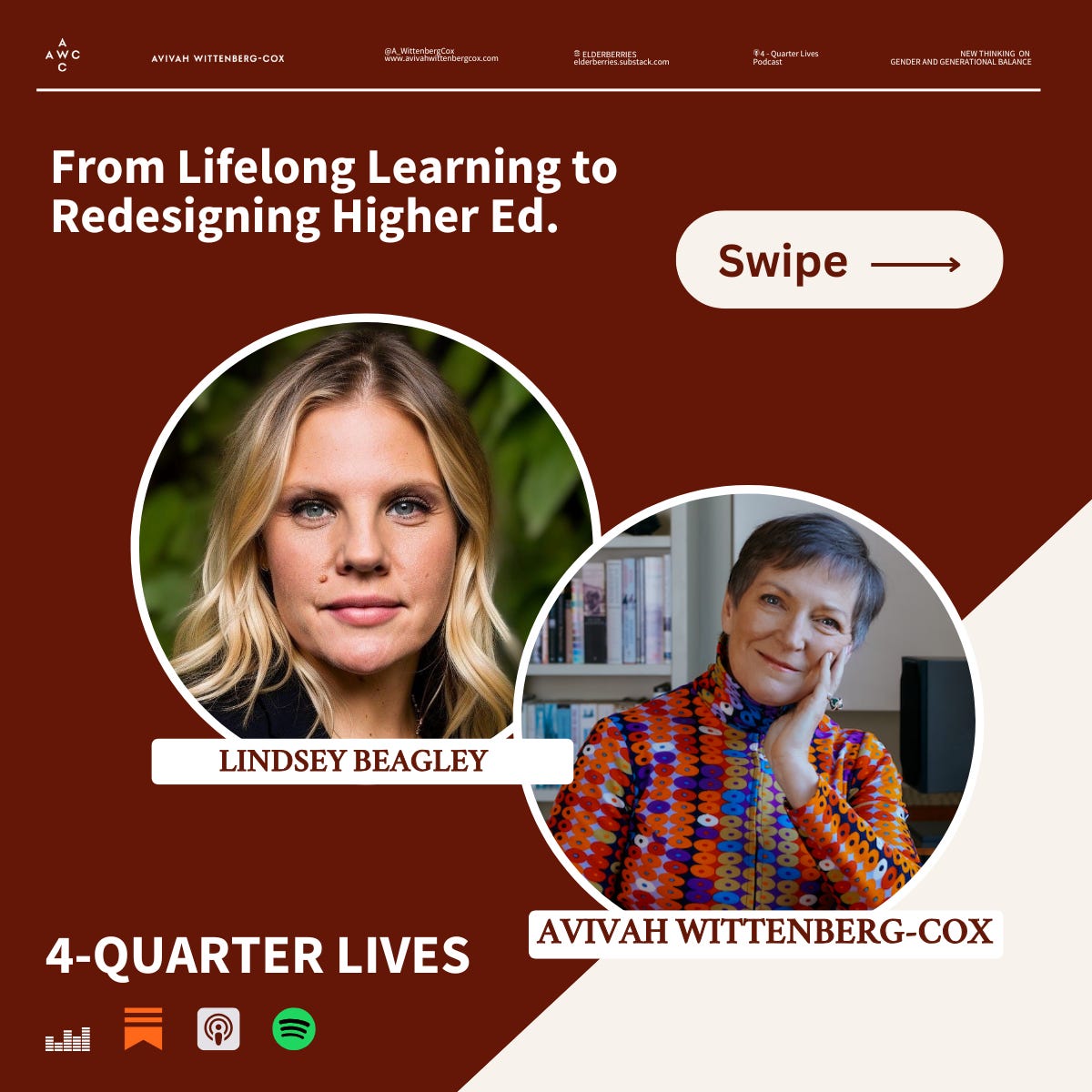
In Series 10 of 4-Quarter Lives, Avivah Wittenberg-Cox talks with the leaders of a growing number of university faculties developing programmes for individuals looking to change direction in their 3rd Quarter of life. We explore the origins and motivations behind these programmes—and how they fit the evolving role of higher education in ageing societies.This week we republish a conversation Avivah had with Lindsey Beagley, Senior Director of Lifelong University Engagement at Arizona State University. They discuss the growing interest of universities to re-design themselves for the new age of longevity, engaging with people throughout their lives rather than just as the outset. Lindsey describes how Arizona State University is doing so in its various programmes, and in particular their ground-breaking Mirabella University Retirement Community on the ASU Tempe campus – integrating a continuing care retirement community into a university campus. She talks about how older adults involved in the Mirabella program are eager to help young people as well as to continue their own learning, and how this desire to mentor and support younger generations has influenced the program’s design and success.Lindsey Beagley currently serves as Senior Director of Lifelong University Engagement at Arizona State University. In this role, she launched Mirabella at ASU, a University Retirement Community on the ASU Tempe campus. She serves on the global council of the Age-Friendly University Global Network and on the board of directors for Heirloom Communities, intergenerational residential housing for low-income older adults and youth aging out of the foster care system. Beagley holds a master’s degree in public administration and is currently pursuing her Doctor of Education degree in Higher Education Leadership and Innovation with a focus on intergenerational learning in college classrooms.Some Useful Links:* https://www.insidehighered.com/opinion/views/2024/08/08/longevity-boom-boost-higher-ed-opinion* https://www.mirabellaasu.org/* https://learning.asu.edu/* https://www.universityretirementcommunities.com/* The Nexel Collaborative: https://thenexel.org/* Age Friendly University Global Network: www.afugn.org* Heirloom Communities: https://www.heirloomcommunities.com/ Get full access to Elderberries at elderberries.substack.com/subscribe
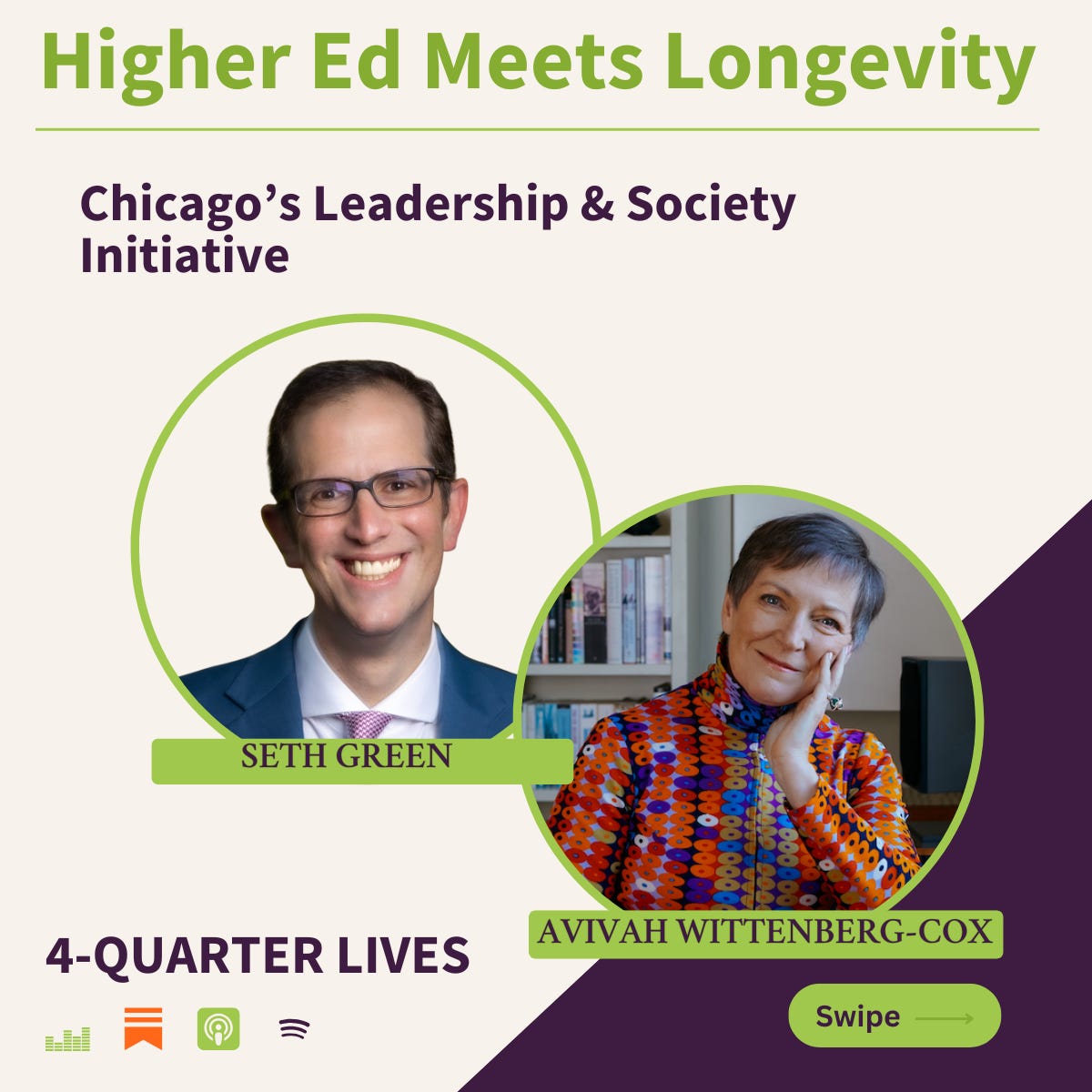
In Series 10 of 4-Quarter Lives, Avivah Wittenberg-Cox talks with the leaders of a growing number of university faculties developing programmes for individuals looking to change direction in their 3rd Quarter of life. We explore the origins and motivations behind these programmes—and how they fit the evolving role of higher education in ageing societies.This week she welcomes Seth Green, Dean of the University of Chicago’s Graham School, which is the home to the university’s Leadership & Society Initiative (LSI). Seth discusses how a Chicago-style commitment to humanistic inquiry and free expression is reshaping midlife transitions—and the lives of the people who join them.Seth also explains why LSI exists now: longer lives, extended careers, and leaders who want to “rewire and refire” rather than retire. Chicago’s DNA—great books and rigorous debate—anchors a three-part journey: know oneself, understand the world, and envision the future. Humanistic inquiry sits at the core, from Aristotle to Viktor Frankl, complemented by executive tools and one-to-one coaching that turn reflection into direction.Free expression is treated as a feature, not a bug. Faculty deliberately present competing lenses—economics, sociology, policy—so fellows stress-test assumptions and sharpen their own views. The result is intellectual freedom many executives haven’t enjoyed while holding institutional titles. LSI then translates insight into action through practical routes to impact: board service, strategic philanthropy, and venture creation.The programme now runs along two pathways. Design, a fully embedded year on campus, immerses fellows in 15 courses (nine cohort-based plus six audits across the university), mentoring relationships, and a culminating purpose plan. Imagine, a low-residency option of four four-day gatherings with hybrid touchpoints, offers a compass for leaders who remain in demanding roles yet want structured progress toward a portfolio life.LSI is “stage-not-age.” Candidates are at meaningful inflection points—often C-suite or equivalent—eager to redeploy serious skills toward contribution. What participants rate most highly isn’t only the Nobel-calibre faculty; it’s the peers. Values-based dialogue forges friendships that outlast titles and help executives escape what Seth calls the “underside of achievement,” the prestige trap that can slow reinvention.Midlife transitions take longer than most expect. LSI supports the arc beyond year one through its Alliance community, accompanying fellows as they iterate purpose into practice. Demand is strong—over 700 candidacies in the programme’s first years—while the university’s leadership champions LSI as part of a broader vision of an “engaged university,” integrating experience-rich leaders with research and teaching to co-create societal value.Seth Green is Dean of the University of Chicago’s Graham School. Before joining Graham, he served as Founding Director of the Baumhart Center for Social Enterprise and Responsibility at Loyola University Chicago. Previously he led Youth & Opportunity United (Y.O.U.), a nonprofit organization that prepares low-income youth for post-secondary and life success. Earlier in his career, Green worked as a consultant at McKinsey & Company. A recipient of McKinsey’s Community Fellowship, he spent one year of his time at the firm supporting nonprofit clients, including the Gates Foundation and United Way.USEFUL LINKS* Chicago’s Leadership and Society Initiative Website Get full access to Elderberries at elderberries.substack.com/subscribe
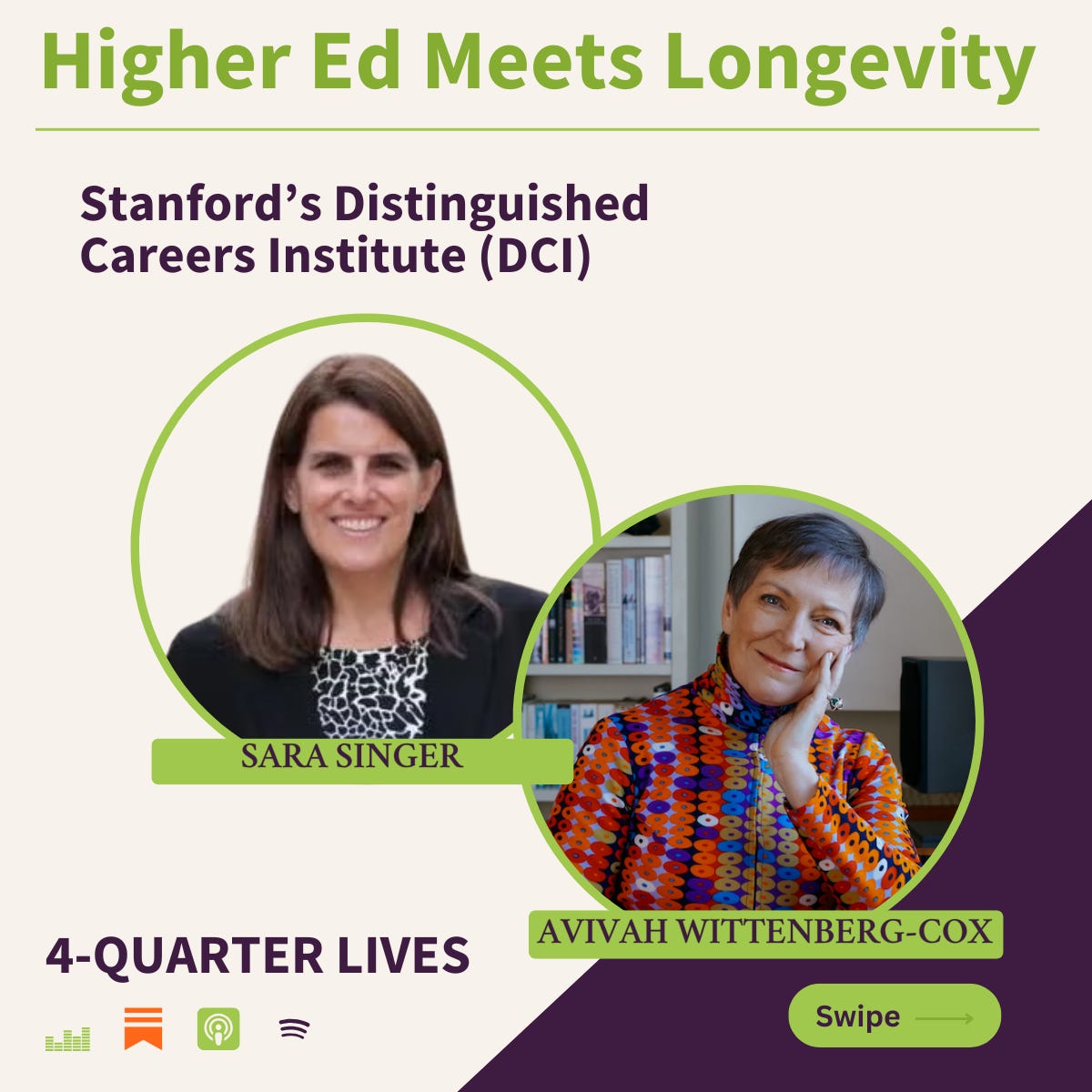
In Series 10 of 4-Quarter Lives Avivah Wittenberg-Cox talks with the leaders of a growing number of university faculties running programmes for individuals looking to change direction in their 3rd Quarter of life. She discusses the origins and motivations for these programmes and how they fit into the evolving role of higher education.This week she welcomes Sara Singer, Faculty Director of the Stanford Distinguished Careers Institute (DCI), to discuss how midlife transition programmes are reshaping universities — and the lives of the people who join them. A leading voice on health policy, organisational behaviour, and system design, Sara has brought a research lens to DCI, measuring its impact on purpose, community, and wellness.In this conversation, Sara shares how she moved from Harvard to Stanford, and then took on first Research Director and then Faculty Director of DCI. She explains why the programme treats each fellow’s journey as an experiment, how intergenerational learning on campus reinvigorates both students and midlife professionals, and why she sees DCI as a “jewel on campus.”They explore DCI’s three evidence-based pillars — renewing purpose, building community, and recalibrating wellness — and what the data reveals about their effectiveness. Sara also reflects on unique aspects of the programme, including its openness to couples, memoir writing, and Life Transformation Reflections. She explains why “readiness” is the key ingredient for successful fellows, and how transitions at midlife take more time than most expect. This conversation offers an inside look at how institutions can prepare people — and societies — for our new, multi-stage, 60-year careers.Sara Singer is Professor of Health Policy and Medicine at Stanford University School of Medicine and Professor of Organizational Behavior at the Stanford Graduate School of Business. She is Faculty Director of the Stanford Distinguished Careers Institute and also serves as its Research Director. Her scholarship spans health policy, leadership, and system design, with a focus on how organisations can improve population health outside of traditional medical care. At DCI, she integrates rigorous research with faculty leadership to help fellows — and the university — benefit from midlife transformation and intergenerational learning.USEFUL LINKS* Learn more about the Stanford Distinguished Careers Institute* Explore the Excel Collaborative — a network of midlife transition programmes Get full access to Elderberries at elderberries.substack.com/subscribe
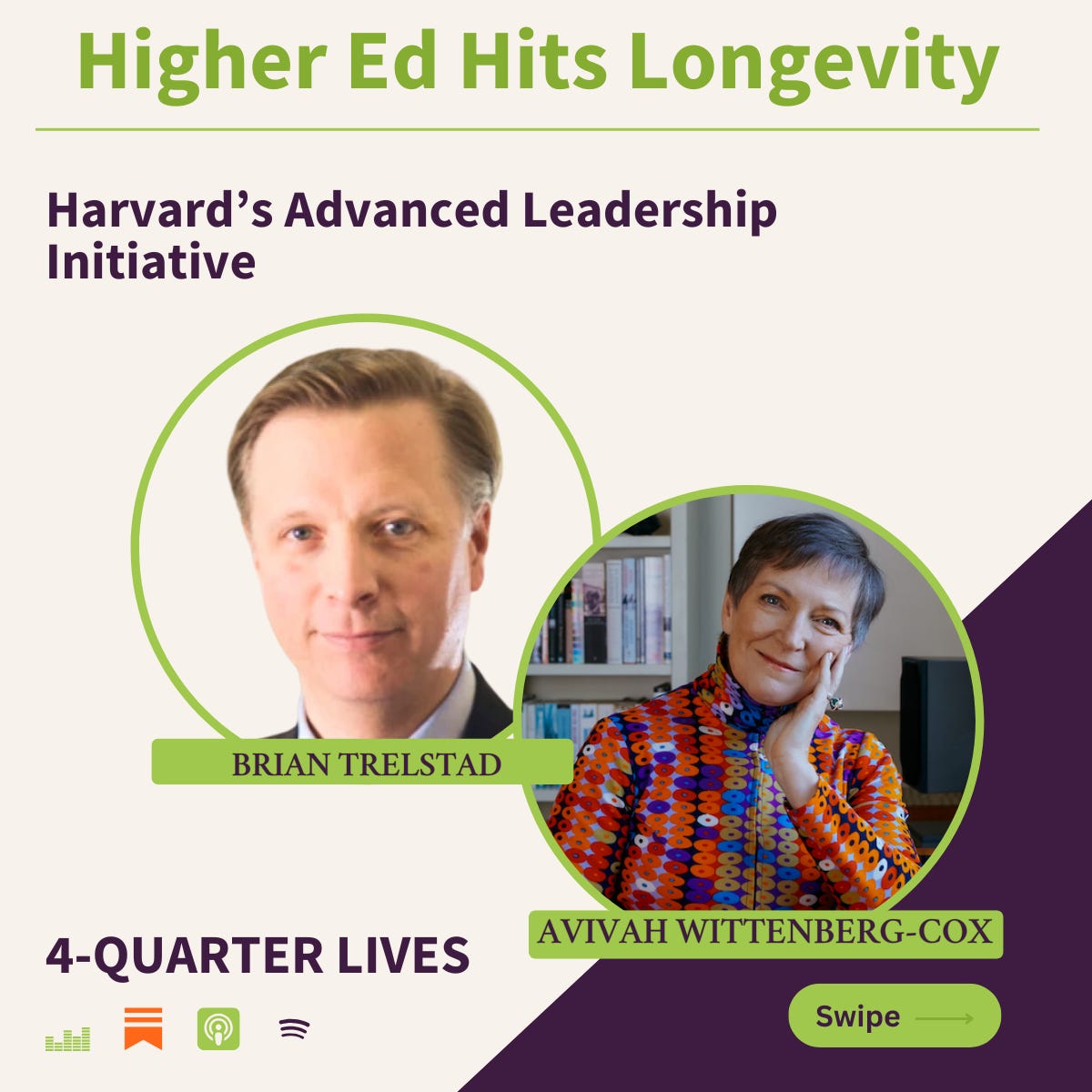
In Series 10 of 4-Quarter Lives Avivah Wittenberg-Cox talks with the leaders of a growing number of university faculties developing programmes for individuals looking to change direction in their 3rd Quarter of life. She discusses the origins and motivations for these programmes and how they fit into the evolving role of higher education. In this episode, she talks with Brian Trelstad, faculty chair of Harvard’s Advanced Leadership Initiative. Amongst other topics they discuss* The origins of ALI and the three trends it was designed to address: longer lifespans, the complexity of global problems, and higher education’s role in public problem-solving.* ALI’s focus on impact — equipping fellows to address problems they care deeply about, whether through launching initiatives, joining existing platforms, or building a portfolio of meaningful activities.* The “person-problem-pathway” framework for aligning leadership skills with social change goals.* Who thrives in ALI: accomplished professionals with curiosity, humility, and a readiness to learn and unlearn.* How the program is expanding its before-and-after support — from recruitment to alumni engagement and project acceleration.* Why humility, curiosity, and experiential learning are essential for shifting from private sector leadership to social impact work.* The evidence linking purpose, pro-sociality, and longevity — and why ALI is, in a way, a health program.Whether you’re considering your own third chapter or just curious about how universities are reimagining leadership education for a 100-year life, this conversation offers a rich insider’s view of the field’s pioneer.Brian Trelstad is the William Henry Bloomberg Senior Lecturer of Business Administration and the Joseph L. Rice III, Faculty Fellow at Harvard Business School and the Faculty Chair for the Advanced Leadership Initiative for Harvard University. He teaches social entrepreneurship and systems change, impact investing, and business ethics. Outside of Harvard, Brian is a Partner and Board Member of Bridges Fund Management, a pioneering impact investment fund.Useful Links:* Learn more about ALI: advancedleadership.harvard.edu* Brian’s Harvard profile Get full access to Elderberries at elderberries.substack.com/subscribe
Welcome to 4-Quarter Lives, a podcast exploring the profound impact of longer, healthier and more engaged lives, not only for ourselves and our couples, but also for companies and countries. I’m Avivah Wittenberg-Cox, and today, I’m doing a summary of our 9th season of this podcast.Each season of 4-Quarter Lives feels like a tapestry—woven from voices, visions, and lived experiments in the age of longevity. Season 9 may be the most practical yet: full of builders, architects, and reimagineers of how we live, age, and contribute across life’s 4 Quarters.Instead of summarising episode by episode, I’ve stepped back to distil the bigger picture. Across ten cool conversations, three conclusions emerged that I believe are shaping the future we need—urgently, optimistically, and globally.Longevity is Inspiring a New Generation of Products & ServicesOne of the clearest patterns to emerge this season was the burst of creativity in the longevity economy—services that meet both the challenges and possibilities of longer lives.There’s a beautiful throughline here: that midlife and later life are not just about winding down, but winding differently. These new services are creating options for housing, purpose, income, and legacy—often in deeply intergenerational ways.* Lisa Goldsobel’s work at Two Generations was a standout. Matching older homeowners with younger renters is more than a housing fix—it’s a loneliness solution, a purpose-provider, and an empathy engine.* Laurie Kilby reminded us that fostering isn’t just for the young. An innovative new platform, Now Foster, inspired by Now Teach founder Katie Waldegrave, taps into the experience and spaciousness of midlife to invite people to support children in care—through flexible roles that are redefining what caregiving can look like - one weekend a month.* Farah Baxter and Ignacio Moreno reframe legacy as something emotional and accessible. Their platform, Soalma, helps people record and share their stories, values, and advice (as well as admin details and paperwork)—a kind of “emotional will” that may turn out to be more lasting than any financial or legal one.* Julianne Miles runs Career Returners, and her new book Return Journey shares the lessons of thousands of people who’ve gone back to work after an extended break. As lives and careers lengthen, we’ll need more breaks, more returns and a better understanding of how to manage it all. For both individuals and companies. Here, she shares her summary view.* Neeraj Sagar’s WisdomCircle is a professional headhunter’s mature passion project. It connects retirees with companies and causes that value their insights. It’s a quiet revolution in how we value age, experience, and time. A placement platform that values wisdom and experience, not screens it out with AI. And supported by some of the top people in the business.These aren’t fringe ideas—they’re scalable, smart, and deeply human. And they share a philosophy I deeply believe in: that connection is the gift - and essential survival skill - of longevity.Conclusion: Intergenerational design isn’t just nice—it’s necessary. Longevity done well serves - and benefits - all ages.It’s Not Just Lifespan. It’s Also Healthspan—and Fullspan.This season deepened my conviction that living longer isn’t the point, despite billions being invested to do just that. The goal is simpler and a lot cheaper. Live better, longer. And to do that, we need new definitions, new metrics, and new mindsets.Three guests stood out in shaping this thinking:* Richard Leider, a global pioneer in ‘purpose’ coaching, reminded us that meaning is a biological imperative. Purpose doesn’t just extend our years—it enriches them. And it’s most powerful when it’s practical, everyday, and shared. And it doesn’t have to have a capital ‘P.’* Melinda Blau, with her signature blend of warmth and research, reframed ageing as a relational journey. It’s not about the family you’re born into, but the “wisdom friends” you cultivate. She shares her latest book, The Wisdom Whisperers, showcasing her deep friendships with nine ‘old ladies’ who taught her how to age.* Mileham Hayes brought the physician’s lens—one sharpened by decades in cardiac care. His message was sobering but hopeful: most of the major killers in older age are preventable. But only if we start testing and treating risk early and personally. So he shares what is most likely to kill you in every decade and what tests you should run to prevent that happening to you.Together, they drew a new kind of longevity triangle: Purpose. Prevention. People. The three “Ps” of fullspan health.Conclusion: We must stop treating ageing as a condition to be endured and start designing for energy, connection, and meaning at every stage.To Matter, Longevity Must Be Local—and GlobalThe final message of the season took us beyond the West—and into the rich, diverse realities of aging in the Global South. We often talk about longevity as if it’s only happening in wealthy countries. But the data says otherwise—and so do our guests.* Saher Mehdi, a molecular biologist turned health entrepreneur in India, is creating AI-guided diagnostics specifically for women. Her work on biological age is brilliant—but her motivation is even more striking. She’s filling a gap that most Western systems barely acknowledge: affordable, gender-informed longevity care in low-resource settings.* Maria Clara Pinheiro, who leads Ashoka’s longevity work in India, showed how older adults are being empowered not through government policy, but social innovation. She highlighted grassroots leaders—from grandmother-led mental health programmes in Zimbabwe to intergenerational educators in Brazil—who are reframing age as an asset.Their work reminded me that ageing may be universal, but the solutions must be rooted in culture, context, and equity. Longevity is not just a science—it’s a social contract.Conclusion: The future of aging is not one-size-fits-all. It’s local, lived, and deeply varied. Listening is the first act of innovation.Where Do We Go From Here?Looking back on Season 9, what struck me most was how tangible it all felt. These weren’t just ideas. They were already becoming reality. Quietly, bravely, and beautifully.If Season 8 explored the demographic disruption, Season 9 revealed the builders. People crafting new scaffolding for longer lives: services, tools, mindsets, and movements that meet the realities of Q3 and Q4 with grace and ambition.So what are we left with?* A reframing of ageing as something profoundly creative.* A call to think beyond “lifespan” toward “fullspan.”* And a reminder that if we design this right, longevity could be not just an extension—but an expansion.What are you building for your next quarter?We’ll be back in the fall with Season 10. I’ll be featuring the Directors of many of the world’s leading midlife transition programmes in top universities - from Harvard’s ALI, Stanford’s DCI to Oxford and Cambridge’s more recent additions. If ever you’re tempted by some later life educational breaks, this one will be for you.Until then—stay curious, stay connected, and keep designing a life, and a Quarter, that fits who you are becoming.You can find Season 9 on a phone near you, on any podcast platform, or right here on Substack. Get full access to Elderberries at elderberries.substack.com/subscribe
This week on 4-Quarter Lives, Avivah Wittenberg-Cox welcomes Julianne Miles, career psychologist and co-founder of Career Returners, to discuss her forthcoming book Return Journey: How to get back to work and thrive after a career break. A leading voice in the returner space, Julianne has spent over a decade supporting thousands of professionals - many in midlife - relaunch their careers after extended breaks.In this conversation, Julianne reveals her own return-to-work story and why writing Return Journey was both personal and timely. She outlines the book’s three-stage structure - from initial mindset shifts, to finding ‘work that works’, to thriving once back at work - and explains why internal blockers like guilt and perfectionism can be just as limiting as external biases and ageism in the workplace.We explore what makes Q3 returners unique in this ‘return journey’, the myths around age and ability, and why employers should view returners not as charity hires but as motivated, experienced talent. Julianne also offers practical exercises, the value of ‘realistic optimism,’ and why intuition may be your most overlooked superpower.Whether you’re returning, hiring, or simply curious about the future of work trends, this episode - and Julianne’s book - offers a roadmap to getting ready for navigating the ins and outs of our new, 60-year careers.Return Journey is out in September 2025.Julianne Miles MBE is a chartered occupational psychologist, INSEAD MBA graduate, and, since 2014, cofounder, CEO and now Executive Chair of Career Returners (formerly Women Returners). After an early career in strategy consulting, and marketing at Diageo in the UK and Australia, she took a fouryear break to raise her children before obtaining an MSc in Organisational Psychology. Identifying the “career break penalty,” she launched Career Returners to build returntowork programs (“returnships”) and a peer network community, partnering with over 200 organisations and supporting over 3,500 professionals. With 10,000 network members, this social impact business reshapes hiring norms. In 2019 Julianne was awarded an MBE for services to business and equality.USEFUL LINKS* Buy Return Journey: How to get back to work and thrive after a career break, (To be published on 4 Sept 2025)* Visit Career Returners website* Join the Career Returners Community* Listen to the Career Returners Podcast Get full access to Elderberries at elderberries.substack.com/subscribe
In this week’s 4-Quarter Lives, Avivah Wittenberg-Cox talks with Maria Clara Pinheiro, Co-lead of Ashoka’s New Longevity Initiative. Ashoka, the world’s largest network of social entrepreneurs, has identified longevity as a key emerging trend through a bottom-up approach, observing a growing number of its fellows tackling issues related to ageing populations. This led to a global mapping of 100 fellows’ work and the launch of Ashoka’s “New Longevity” initiative. Five key themes emerged: changing the narrative around ageing, lifelong learning and work, health and care, intergenerational relationships, and economic security and inclusion.Maria Clara emphasizes the unifying concept of “lifelong contribution,” where every individual, regardless of age, is seen as a potential changemaker. She shares powerful examples, including Dixon Chibanda’s Friendship Bench project in Zimbabwe, where grandmothers are trained to provide mental health support.The conversation also explores cultural and regional differences, noting how countries like Brazil, India, and Indonesia are aging rapidly without the same infrastructure as the West. To respond, Ashoka is launching localized “Longevity Labs” to drive systems change and foster collaboration among entrepreneurs, universities, companies, and governments. India, despite its youthful reputation, is revealed to have over 150 million older adults—a powerful yet underrecognized force in shaping the country’s future. Maria Clara paints a compelling picture of how countries like India, Brazil and Zimbabwe are incubating the next wave of ageing innovation – community-driven, tech-enabled, and radically inclusive.Ashoka is a nonprofit organization that promotes social entrepreneurship by connecting and supporting individual social entrepreneurs. It invests in over 4,000 social entrepreneurs in over 90 countries worldwide. The aim is that these individuals in turn become the people that others will try to follow by example.Maria Clara Pinheiro co-leads Ashoka’s Global New Longevity initiative. She joined Ashoka in 2003 and has held leadership roles in Brazil, The United States and India. Over that time she has supported social innovators, built entrepreneurial teams and led a range of global programmes and partnerships for Ashoka. Useful Links:* Ashoka’s New Longevity Initiative website* Ashoka website* Friendship Bench website Get full access to Elderberries at elderberries.substack.com/subscribe
This week, on 4-Quarter Lives, Avivah Wittenberg-Cox talks with Dr Mileham Hayes, author of ‘Live Longer: Revealing Today’s Secrets of Longevity and Wellbeing’ and a specialist in preventative medicine. As he says, "preventive medicine has never realized its promise or potential...until now". Mileham, who launched the world’s first longevity clinic and has spent nearly six decades in coronary care, shares how much of heart disease—still the world’s top killer - is preventable, yet persistently neglected. He discusses key diagnostic tests such as ApoB, Lp(a), and coronary artery calcium scans, many of which he began using in the 1990s but still remain underused. He advocates a targeted 20-test health screening battery for anyone over 40, customized by age and gender, which is downloadable with the episode.He critiques the broader health ecosystem where profit-driven industries—from pharma to fast food—drown out preventive efforts, leaving doctors and patients with minimal influence. He shares sobering statistics on the top causes of death by decade and gender across the US, UK, and Australia—highlighting suicide as a leading killer of younger men. Rather than obsessing over radical life-extension strategies, Hayes urges a back-to-basics focus on preventing known, measurable threats. Witty, forthright, and deeply experienced, Hayes is a passionate advocate for practical, accessible healthcare that prioritizes staying alive—and healthy—as the first rule of longevity.Dr Mileham Hayes is a Specialist Physician and a Fellow of both the Royal College of Physicians of London and Edinburgh. He was appointed to the world's first Coronary Care Unit and researched prevention of heart attacks – still the greatest cause of premature death. He has now spent some 50 years in clinical practice and is the author of two medical textbooks and a series of books on living longer through prevention, nutrition and exercise. His most recent book is ‘Live Longer: Revealing Today’s Secrets of Longevity and Wellbeing’. Mileham studied medicine at the University of Queensland. He has five children, played most sports at a high level, farmed, gardens, writes doggerel and cooks. He also had an ABC radio weekly program and two national TV shows presenting and playing jazz. He has the Order of Australia Medal for his services to Jazz.Useful Links:* Download a pdf by Mileham of a list of actions to Live Longer* Buy Mileham’s book ‘Live Longer’* On Amazon.com* On Amazon.co.uk Get full access to Elderberries at elderberries.substack.com/subscribe
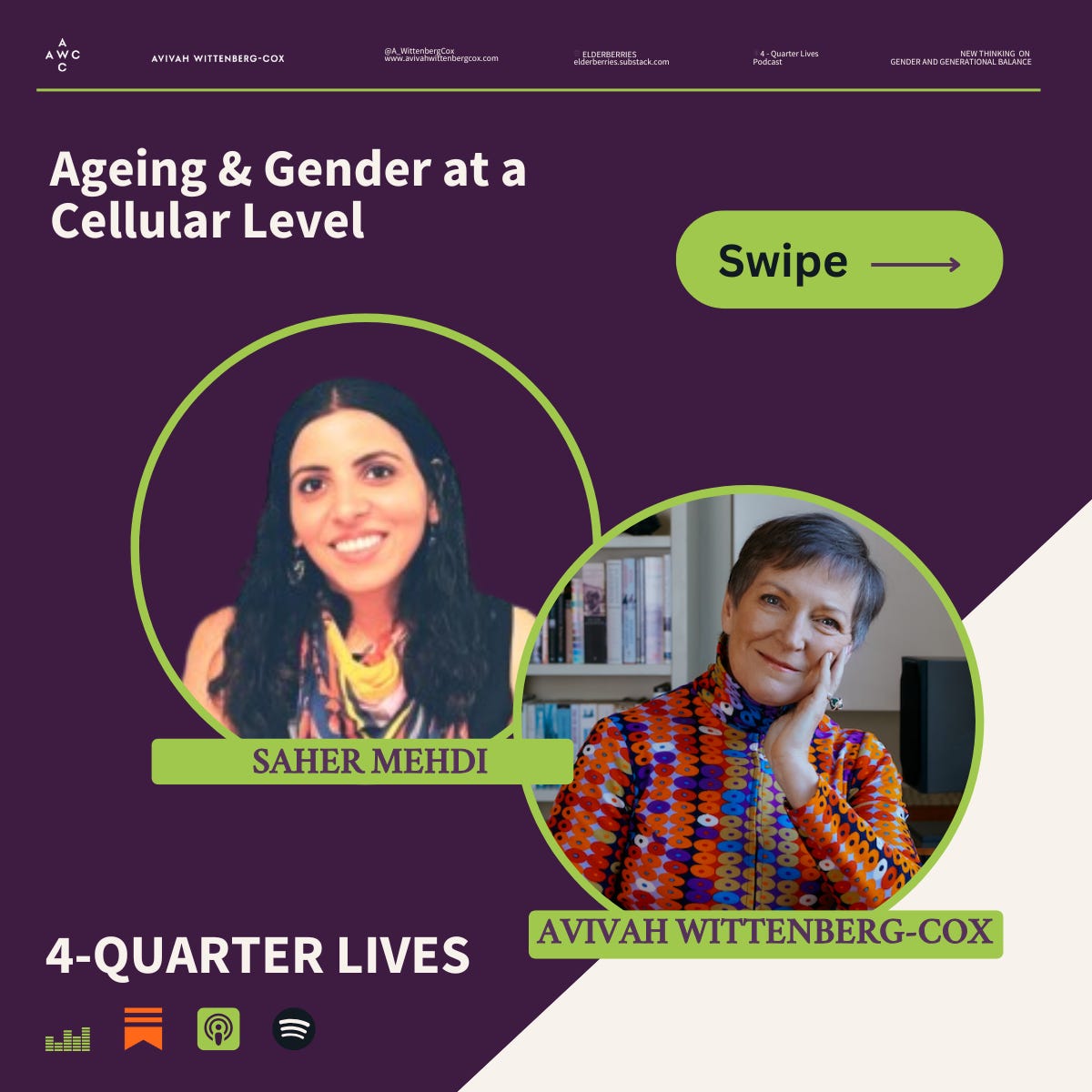
In this week’s 4-Quarter Lives, Avivah Wittenberg-Cox is joined by Dr. Saher Mehdi- molecular biologist, longevity researcher, and healthcare entrepreneur, to explore what it truly means to age well.Saher traces her journey “from molecules to meaning,” beginning with a childhood curiosity sparked by her grandmother’s ageing hands. That moment led to a lifelong inquiry into the biology of ageing, one that took her across continents and disciplines. With a PhD from Durham University and postdoctoral research at Oxford, Uppsala, and KU Leuven, her research has spanned cell fate, cardiac regeneration, epigenetics, and the stress responses that shape how, and how fast, we age.But her understanding of ageing evolved beyond the lab. Living and working in the UK, Sweden, and Belgium deepened her appreciation for how biology is shaped by culture, climate, and inequality. Returning to India, she saw the urgent need to translate cutting-edge science into accessible, personalised tools, especially in a country where 1 in 6 people will be over 60 by 2050, and where rising rates of diabetes and heart disease reveal a unique intersection of genetic vulnerability and environmental risk.Through her company ReWise Health, Saher is building a new approach to ageing — using AI and biomarker data to assess biological age, personalise interventions, and prevent disease before it strikes.She makes the case that ageing itself, not just chronic diseases, is the leading driver of mortality, and that slowing cellular ageing could add more healthy years to life than curing cancer or heart disease. In a striking metaphor, she compares female mitochondria to fuel-efficient hybrid engines, while male mitochondria resemble high-performance machines that burn through energy faster, illustrating the cellular gender gap in ageing.Saher continues to unpack the science of gendered ageing through telomeres, the protective caps at the ends of chromosomes that erode with time and stress. Women, she notes, tend to have longer telomeres and slower attrition, thanks to estrogen and the second X chromosome. But she also critiques the deep male bias in medical research: for decades, women, particularly post-50, have been excluded from clinical trials, creating massive knowledge gaps in care.She calls for a shift in longevity science, away from elite biohacking and toward public health equity, especially for ageing women in low-resource settings. Through ReWise, she’s designing a culturally relevant, scalable model for biological age testing and intervention, one rooted in empathy, science, and real-world impact.Dr. Saher Mehdi is a molecular biologist, epigenetics expert, and two-time founder in the field of preventive health and longevity. She founded Wellowise and now leads ReWise Health, a cutting-edge biotech building tools to personalise ageing and extend healthspan. With a PhD from Durham and postdoctoral research at Oxford, Uppsala, and Leuven, her work spans cell fate, cardiac regeneration, cellular stress, and the biology of ageing. A global voice in the science of longevity, Dr. Mehdi is redefining how we understand, measure, and optimise the experience of growing older with data, compassion, and vision.Useful Links:* ReWise Health website* Saher Mehdi’s Substack blog* Saher’s X account* Saher Linkedin Get full access to Elderberries at elderberries.substack.com/subscribe
VIDEO No.1 was WAKE UP to the New #DemographicsVIDEO No.2 is WE GOTTA GET GOOD AT #TRANSITIONS WHY?Because longer lives and #careers, and the new #Q3 chapter of our #4QuarterLivesmeans we need to understand, anticipate and transition gracefully and skilfully from quarter to quarter.Are you ready? Get full access to Elderberries at elderberries.substack.com/subscribe

This week, on 4-Quarter Lives, Avivah Wittenberg-Cox talks with Richard Leider, founder of Inventure – The Purpose Company, and one of America’s pre-eminent executive-life coaches. Ranked by Forbes as one of the “Top 5” most respected executive coaches, and by the Conference Board as a “legend in coaching”, he and Avivah explore a life devoted to helping others uncover meaning across the lifespan. Richard traces his journey back to his early days as a listener, when questions of “why” ignited his lifelong focus on purpose. A pivotal encounter with Viktor Frankl shaped his core philosophy: purpose is not something to seek, but something to contribute.Influences from both Frankl and Maslow emphasised that true fulfilment comes from serving others—whether in big or small ways. Richard distinguishes between “Big P” and “little p” purpose, suggesting that even everyday contributions can profoundly shape one’s life. He speaks candidly about how purpose supports health, longevity, and emotional well-being, now backed by science, including the telomere effect. Cross-cultural wisdom—from African hunter-gatherers to boardrooms—affirms a universal desire for relevance and connection.Richard also addresses gendered paths to purpose, noting that women more readily explore meaning in later life, while many men confront unfulfillment after success. At 80, he continues writing and speaking in flow, advocating for relevance over retirement. His message is clear: purpose is not a luxury—it’s essential.Richard Leider is an internationally recognised coach, author and speaker. He has written twelve books, including three best sellers, which have sold over one million copies and been translated into 20 languages. The Power of Purpose is considered a classic in the personal growth field. His PBS Special – The Power of Purpose – was viewed by millions across the U.S. Richard is the founder of Inventure – The Purpose Company, a firm created to guide individuals to live, work, and lead on purpose. He has worked with leaders from organizations such as AARP, Ameriprise, Blue Zones, Blue Spirit, Ericsson, General Mills, Habitat for Humanity, Lifespark, Mayo Clinic, Modern Elder Academy, National Football League, Outward Bound, Optum, Pfizer, United Health Group, and the U.S. Dept of State.Richard holds a master’s degree in Counseling and has been recognized with many awards including a Bush Fellowship, and the Outstanding Scholar for Creative Longevity and Wisdom award from the Fielding Institute. He is a Senior Fellow at the University of Minnesota’s Earl E. Bakken Center for Spirituality and Healing, and an Education Fellow with the Retirement Income Institute. He also serves as a Purpose Ambassador for Blue Zones and Blue Spirit Costa Rica. For over 30 years, he has led Inventure Expedition walking safaris in East Africa where he is a founder and a board member of the Dorobo Fund for Tanzania.Useful Links:* Richard’s website* Richard’s blog* Book: Who Do You Want to Be When You Grow Old?: The Path of Purposeful Aging by Richard Leider and David Shapiro (2021)* Amazon.com* Amazon UK* Book: The Power of Purpose, by Richard Leider and David Shapiro (4th Edition, 2025)* Amazon.com* Amazon UK Get full access to Elderberries at elderberries.substack.com/subscribe

In this week’s episode of 4-Quarter Lives, Avivah Wittenberg-Cox talks with journalist and author Melinda Blau, about her latest book, The Wisdom Whisperers. Now in her own Q4, Melinda has written a very personal narrative about the nine much older friends who emboldened her to embrace ageing, instead of dreading it.Melinda Blau, is an award-winning journalist, a New York Times bestselling author, and a host/producer for the Crow’s Feet: Life As We Age podcast. She has spent a lifetime researching and writing about the importance of relationships: Consequential Strangers is an exploration of vital social connections beyond family and close friends, the New York Times bestseller, Secrets of the Baby Whisperer, its two sequels, and Family Whispering cover our more intimate bonds. The Wisdom Whisperers looks at the value of relationships between generations. Links: * The Wisdom Whisperers on Amazon or wherever you buy books: The Wisdom Whisperers: Golden Guides to a Long Life of Grit, Grace, and Laughter. * Website: https://melindablau.com/* Substack: * Medium: https://medium.com/@melindablau Get full access to Elderberries at elderberries.substack.com/subscribe

Comments

Download from Google Play

Download from App Store
 United States