


 Claim Ownership
Wines and Vines!
Subscribed: 3Played: 34
Subscribe

© Vintality Tech Inc.
Description
Wines and Vines is a podcast for and about the wine industry. Talking farming, winemaking, and business with winemakers, farmers, and businesspeople. Whether you're in the wine industry or just passionate about wine, learn with us about the entire life cycle of the wine industry.
This podcast is sponsored by Vintality is a supportive hub to help you realise all your vineyard aspirations using quantitative data gathering and analysis, precision viticulture tools, community connection with a love for terroir in its truest form.
The future of farming is technological, and for us that means EC surveys and soil pits, bioavailability soil sampling, or mapping chlorophyll efficiency with drones. Pushing the edges of science and terroir to help you create better fruit more profitably.
We also have a weekly newsletter with BC wine news, useful resources and interesting articles whether you’re on the business side, in the vineyard, or just passionate about wine. You can sign up at our website vintality.com.
winesandvines.substack.com
This podcast is sponsored by Vintality is a supportive hub to help you realise all your vineyard aspirations using quantitative data gathering and analysis, precision viticulture tools, community connection with a love for terroir in its truest form.
The future of farming is technological, and for us that means EC surveys and soil pits, bioavailability soil sampling, or mapping chlorophyll efficiency with drones. Pushing the edges of science and terroir to help you create better fruit more profitably.
We also have a weekly newsletter with BC wine news, useful resources and interesting articles whether you’re on the business side, in the vineyard, or just passionate about wine. You can sign up at our website vintality.com.
winesandvines.substack.com
8 Episodes
Reverse
Thanks to everyone who came out to the webinar, and the many emails asking for a video to follow up on. Here it is!You will find some context below, then a summary of highlights, and below that the transcript. Thibaut Scholasch & Fruition SciencesThibaut Scholasch is the co-founder of Fruition Sciences, a plant physiology consultancy that uses high-level data and research to drive irrigation decisions in vineyards worldwide. Trained as a winemaker, Scholasch built Fruition’s methodology out of a conviction that wine quality is determined more by what happens in the vineyard than in the cellar. Their client list includes Château Lafleur in Pomerol, operations across Israel, South America, and California, and — closer to home — vineyards in the South Okanagan. Their peer-reviewed work on vine water status assessment (ex. Scholasch & Laurent 2023, IVES Technical Reviews) is among the most practically applicable research in the field. I used to reference it before ever meeting Thibaut. The DiscussionWe sat down with Thibaut to talk through the realities of irrigation management in the Osoyoos climate — a region he flagged as having evaporative demand comparable to Portugal and Israel, with less than 200–300 mm of rainfall over the growing season. The conversation covered Fruition’s framework for slicing the season into five physiological periods, each with distinct rules: where to push water deficit to drive tannin concentration (Period 3, berry set to véraison), and where to protect the vine from drought damage during ripening (Period 4). Michael Kullmann of Osoyoos LaRose joined to share their on-the-ground experience working with the system — including how they dropped potential alcohol from 16.5% to 14.5% in one vintage by tracking sugar loading and managing irrigation timing around heat waves. We also got into the mechanics of white vs. red irrigation strategy, canopy management as a lever for water demand, and why vine age fundamentally changes how fast you need to respond with irrigation.Full webinar here. A follow-up session is planned for the coming months. Webinar HighlightsKey topics and timestamps from the “Better Wine, Less Water” webinar with Thibaut Scholasch (Fruition Sciences) and Chris (Vintality), featuring grower commentary from Michael Kullmann (Su Rose Winery, Osoyoos).00:00:00 Introduction — Chris (Vintality) opensChris introduces Thibaut Scholasch as co-founder of Fruition Sciences and the most influential researcher on vine irrigation he has encountered. He credits Thibaut’s accessible academic writing on irrigation and sensing technology as foundational to Vintality’s approach, and notes Fruition’s global client base spanning Israel, South America, California, and France.00:01:45 Thibaut’s background — winemaker turned scientistThibaut explains that Fruition Sciences’ methodology grew out of his training as a winemaker and a desire to improve wine quality beyond what is achievable in the cellar. The core ambition: establish direct causation between how a fruit ripens in the vineyard and what ends up in the bottle.00:02:38 Global client context and Château Lafleur case studyFruition Sciences works primarily in arid regions (Douro Valley, Australia, Israel, Chile, California, Pomerol) but demonstrates that vine water-use monitoring applies even in non-irrigated areas, as it reveals vineyard fertility and quality-priming capacity. Château Lafleur (Pomerol) — which borders Pétrus — is highlighted as a client that stepped outside the Appellation d’Origine Contrôlée (AOC) regulatory framework to adopt data-driven irrigation in response to climate change, a collaboration Fruition has maintained for several years.00:06:03 The four-step Fruition Sciences methodologyThe operating framework is structured in four steps:• Measure with purpose — collect data that directly informs a field action• Analyse — contextualise plant data to understand why the same soil moisture produces different outcomes across sites or vintages• Decide — account for current phenological stage and the memory of what the plant has experienced to date• Capitalise — assess whether the impact of each practice landed where expected, building institutional knowledge vintage over vintageThe distinguishing principle: the plant is placed at the centre of all decisions rather than modelling environmental inputs. Because the vine is capable of self-training and physiological evolution, models built on weather, soil, rootstock, and variety will always lag behind what the plant is actually doing.00:09:14 The five-period seasonal frameworkThe growing season is divided into five physiological periods, each governed by different ecophysiological priorities and requiring different management rules. The framework applies to both red and white varieties; the difference is in the intensity and timing of interventions within it.• P1 — Winter rest to bud break: plant is highly sensitive to water and nitrogen deficiency• P2 — Shoot and flower development: monitor leaf area growth rate as an early proxy for nitrogen or water deficit• P3 — Fruit set to veraison (herbaceous growth): primary management window; sap flow is the key index; moderate water deficit trains plant drought resilience, determines total tannin and polyphenol content, and sets maximum berry size• P4 — Maturation (veraison to hydraulic disconnection): shift to protection; sugar mass loading tracked to detect hydraulic disconnection and manage harvest timing risk• P5 — Post hydraulic disconnection: irrigation via roots no longer reaches the berry; berry volume responds only to vapour pressure deficit (VPD) in the cluster microclimate00:10:48 P3 as the critical quality windowPeriod 3 (fruit set to veraison) is identified as the single most important window for wine quality intervention. Three specific objectives are active simultaneously:• Train the plant for drought and heat-wave resilience• Activate secondary metabolism — the total polyphenol and tannin potential is fixed by the end of P3 and cannot be increased later• Set the ceiling for maximum berry size (which determines the concentration potential heading into P4)Water deficit during P3 also synchronises berry-to-berry ripening under a common “clock,” producing more uniform harvest decisions and easier tank management.00:14:57 Sugar loading and hydraulic disconnection — three transitionsThibaut describes three sequential hydraulic transitions as the berry matures:• Transition 1 (end of herbaceous growth / lag phase): water flow to the berry shifts from root-driven to phloem-driven (leaf-sourced sugary water)• Transition 2 (~21–22 Brix): phloem connection to the berry breaks; berry volume is now governed by atmospheric VPD only• Transition 3 (full hydraulic disconnection): irrigation has no further effect on fruit; the risk of rapid yield loss (20–40% overnight) from dehydration becomes acuteFruition Sciences uses sap flow sensors and sugar mass tracking (not sugar concentration/Brix alone) to detect the precise timing of these transitions. Knowing which transition the vineyard is in determines whether irrigation, misting, or canopy management is the appropriate response to an incoming heat wave.00:16:18 Leaf area growth rate and canopy monitoring (P2)Leaf area growth rate is expressed in degree-days rather than calendar days, removing heat-accumulation variability. The result reveals two distinct growth phases after bud break: a rapid early phase where interventions (nitrogen, water) have maximum leverage, and a slow late phase (mid-June onward) where the same intervention produces negligible return. Intervening early — while canopy growth velocity is high — is the principle underpinning the “super early” action requirement in fast-accumulating climates like Osoyoos.00:21:04 Sap flow measurement — how it worksThe sap flow sensor treats the vine’s vascular system as a series of articulated pipes. A small, precisely calibrated heat pulse is applied; the rate at which that heat transfers from point A to point B is converted into an actual volume measurement (litres per plant per day). This allows direct characterisation of vine water need satisfaction — and identification of the gap between atmospheric demand and what the plant is actually able to deliver — on a continuous basis throughout the season.00:21:45 Pomerol drought case study — vine water need collapseA Pomerol site (not Château Lafleur) illustrates extreme water stress: starting in June at 100% vine water need satisfaction, the plant declined progressively through July due to the mismatch between atmospheric demand and rainfall supply. By late August, even after rain, the plant could only recover to ~40% of its original satisfaction level — a 60% permanent loss of functionality triggered by hydraulic cavitation. The consequence: not only is that season’s yield and fruit quality compromised, but carbohydrate reserves for the following year are depleted, bud fertility declines, and vineyard productivity spirals downward. Château Lafleur’s data, shown alongside, demonstrates how 1–3 targeted irrigations maintain minimum satisfaction without over-watering — preserving plant function and next-season productivity.00:24:59 Chile case study — water savings and harvest timingA Chilean block was split into two management zones: conventional irrigation vs. the Fruition Sciences demand-driven protocol. Key findings:• The plant-signal-guided zone used ~10–15 litres less per plant per measurement period, despite receiving far less total water• The excess water applied in the conventional zone was largely vaporised immediately into the atmosphere — providing no net benefit to the plant• The conventional zone was harvested 20 days later due to excess vegetative vigour delaying veraison and hydraulic disconnection• The demand-driven zone achieved earlier veraison, earlier disconnection, and earlier harvest — reducing dehydration risk and, counterintuitively, producing higher yield beca
Just a quick note: If you’ve previously subscribed to our podcast, you will need to do so again (after our move to Substack). You can find it anywhere good podcasts are made. * Apple* Spotify* RSS FeedThanks for reading Wines & Vines! This post is public so feel free to share it.Well, it’s been a busy last couple of months!Addison and I return for our second edition of “The Terroir Report” where we share some of what we’ve been up to, what we’re seeing with clients and colleagues at this time, and interesting research we’ve come across. (By the way, how do you like the name Terroir Report?)We talk vineyard establishment, bulldozer’s disease, falling wine demand, rootstocks, and share our perspectives on wine and health. You know, as our role as doctors. And a lot more. Let us know if you’re enjoying this, or perhaps which speaker you find so dreadfully boring? "It's a dangerous business, Frodo, going out of your door," he used to say. "You step into the Road, and if you don't keep your feet, there's no knowing where you might be swept off to." This is a public episode. If you would like to discuss this with other subscribers or get access to bonus episodes, visit winesandvines.substack.com
I’m excited we’re finally getting back to our podcasting with a more regular plan. In this monthly series, we’ll be looking back at what work we’ve been doing as a precision viticulture company, sharing what we’re seeing in vineyards, and (where allowed) work we’ve been doing with clients. As well, we’ll each share one interesting piece of research or knowledge we’ve learned that will be of interest to the audience. Very interested in feedback here, both positive and constructive, so hit us up! Let us know what you liked, didn’t like, and what you would like to here about. This is a public episode. If you would like to discuss this with other subscribers or get access to bonus episodes, visit winesandvines.substack.com
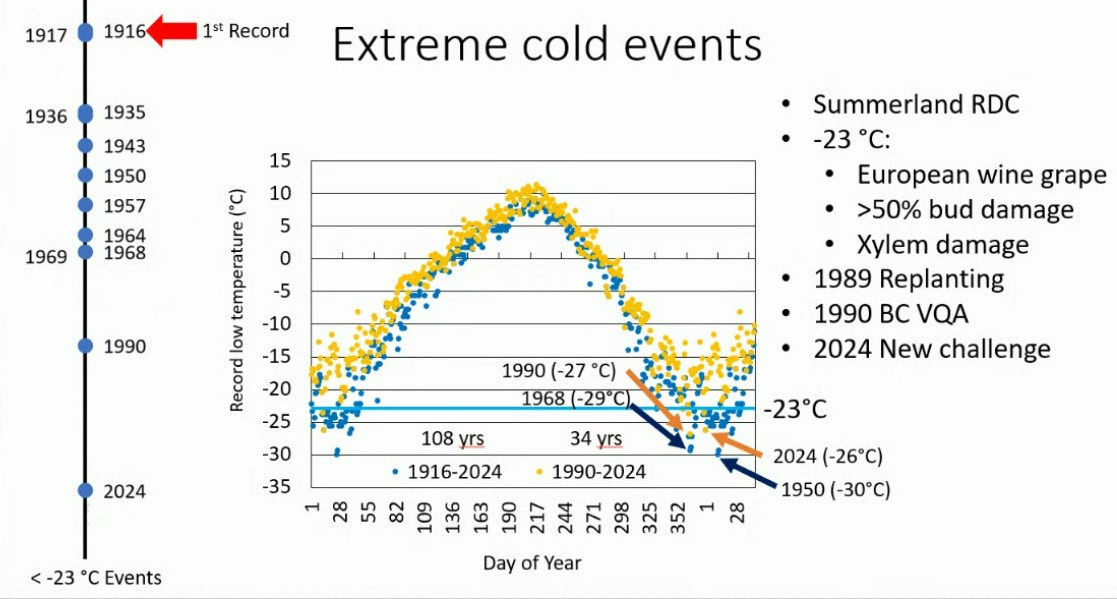
Ben-Min Chang, research scientist at the Summerland Research Center, and Andy Nadler, agricultural meteorologist from Peak Hydromet, discuss and share data from the January 2024 winter freeze. We talk bud hardiness, climate projections, bud dissections, and what cold numbers we really hit. And a lot more. This is a public episode. If you would like to discuss this with other subscribers or get access to bonus episodes, visit winesandvines.substack.com

John Skinner of Painted Rock Winery joins us to talk building the international rep of Canadian and BC wine, why it all starts in the vineyard (and the price they pay to keep it that way), the benefits of working with Alain Sutre, and the pursuit of elegant wine. This is a public episode. If you would like to discuss this with other subscribers or get access to bonus episodes, visit winesandvines.substack.com

This episode we’re joined by Karnail Sidhu, owner and operator of Kalala Organic Estate Winery in Kelowna BC. Karnail’s original background is an electrical engineer and his role as an outsider to the wine industry - as an engineer, immigrant, and Sikh - is one of both frustration and triumph. Karnail is dedicated to organic practices and draws on his Punjabi farming heritage to spend time listening to the land first. He also strongly empowers his staff and shares the successes and defeats of doing so - and why he won't stop. This is a public episode. If you would like to discuss this with other subscribers or get access to bonus episodes, visit winesandvines.substack.com

In this episode Severine Pinte, a managing partner at Enotecca Winery and Resorts where she oversees Le Vieux Pin and LaStella wineries, shares her early wine education in France, why she moved to BC, and the critical role education plays in becoming a better winemaker and viticulturalist. Sev's dedication to bringing up the next generation, both educationally and environmentally, is an absolute highlight. This is a public episode. If you would like to discuss this with other subscribers or get access to bonus episodes, visit winesandvines.substack.com

Today’s guest is John Clerides. He is the owner of the incredibly successful Marquis Wine store, the premier wine shop in BC, as well as a number of other ventures and businesses. You’ll hear from John how he modeled his store after Kermit Lynch’s Adventures on the Wine Route, why John thinks biodynamic practices lead to better wines, why generational wine making matters, what BC and Canadian wine need to start doing, and a helluva lot more. This is a public episode. If you would like to discuss this with other subscribers or get access to bonus episodes, visit winesandvines.substack.com
Comments


Download from Google Play

Download from App Store
 United States