


 Claim Ownership
Joy Venture Podcast
Subscribed: 10Played: 116
Subscribe

© Copyright Joy Venture Podcast
Description
Joy Venture is our impassioned yet fully imperfect attempt to inspire, nudge and, when appropriate, help others experience lasting joy in their life’s work.
30 Episodes
Reverse
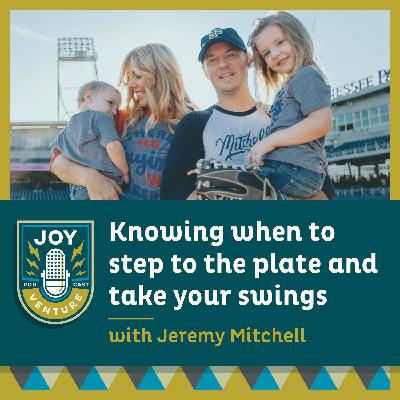
We all have those dreams of performing on the big stage — and chances are those dreams continue to evolve over time. For some it may start out as hitting a game-winning home run or seeing a song you wrote/performed go to the top of the charts. For the here and now it may be about giving a great TED-like talk or raising the necessary capital for a big idea. But how do we know when its time to step up to the plate, to take our swings? And when we do, what do we do when we connect, when our performance exceeds even our own lofty expectations? What’s next?Jeremy Mitchell’s story is one spent entrenched in the game of baseball — first as a starry-eyed boy collecting baseball cards and autographs, then as a youthful player, and always as a lifelong fan of the game. As an adult, he had an idea that would blend his love for baseball and its rich and colorful history into a side project that would exceed his boyhood dreams. While watching the World Series in 2013 (Game 6, Boston Red Sox vs. St. Louis Cardinals), Jeremy knew it was time and he launched Mitchell Bat Company, a creative endeavor that would specialize in hand-painted baseball bats. In less time than it took to play three innings, Jeremy took his early sketches and mock-ups on his laptop and converted them into a live, online order-taking business. But as fast as it all came together, Jeremy acknowledges that his one swing on an October night in 2013 was 36 years in the making. Jeremy’s story is one where patience meets timing, history meets creativity, and a big dream meets a down-to-earth reality.

Nick Fancher is a photographer, author, and educator who specializes in dramatic lighting, often employing the use of bold colors and experimental camera techniques. His work ranges from portrait and commercial photography to fine art. He is particularly known for his efficient method of working, which is with the use of minimal gear, often in unconventional locations. — from nickfancher.comWe know Nick. We’re familiar with his work. And as captivating as it is, we were drawn like a moth to light regarding a very different story unfolding with him. Earlier this year, he made the decision to do what some might see as unthinkable — especially from a “grow your business” standpoint. He quit social media. Why does an entrepreneur with more than 60,000 followers delete his social media accounts? How can an entrepreneur, whose work is tailor-made for platforms such as Instagram, decide to quit feeding the beast?Even if it’s a necessary evil, the key word is still “necessary” — right?As we pose these questions to Nick he reveals both the practical and personal reasons for walking away from social media at the height of his online visibility. Whether you think it’s a deft move or one that will prove detrimental can be debated. But for Nick that’s not really the point. Instead he reached a breaking point. Now he is literally taking control of his work and his life the only way he knows how.

Missing out? Who wants to miss out?Perhaps the better questions to ask are:What are you missing out on by being fully distracted, seduced by the ding and siren song bell of an incoming text, tweet, IM or post? What does it mean to live in the present, the here and now without incessantly scrolling through the carefully curated lives of your infinite followers — many of whom you must admit we have no personal relationship with? We grapple with this addictive digital discourse that we all face, contemplate the example we’re providing for those around us, the need for guardrails, and how the concept of boredom and white space is virtually nonexistent — just look around at everyone with their heads buried in their devices. FOMO is a byproduct of the digital times we live in. But if we’re intentional, we can get back the precious time we hand over to social apps and push notifications that keep us from true social engagement and/or downtime to fuel our curiosity and creativity.If FOMO is a real thing for you (we can attest that we’re guilty of succumbing to it from time to time), then it’s time to change this narrative and embrace JOMO — and spread that kind of joy instead of auto-feeding the fear.
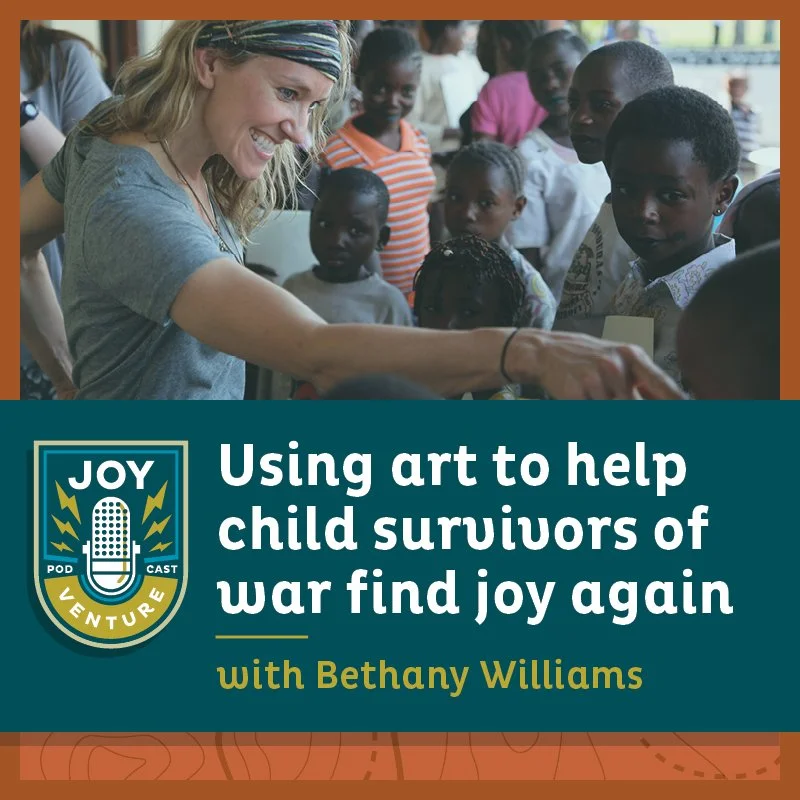
Orphans. War. Child soldiers. Displacement. Abuse of nearly every form. Topics like these often feel so astronomically huge that we don’t know what to do or where to begin — let alone feel as if our tiny effort could actually make a difference. Thankfully there are people like Bethany Williams in the world who not only refuse to buy into that narrative, but decide to do something about changing it. Bethany is world leader at helping restore children — emotionally, psychologically and spiritually — who have been affected by war and who can’t yet imagine a life worth celebrating again. Bethany pulls from her own hurt and brokenness (documented in her book The Color of Grace) as well as her training as a psychologist and counselor to help these children. And it all starts with art therapy that includes a white handkerchief and some markers. It is on a simple yet symbolic handkerchief that children can express in pictures what they don’t even have words for. It is where the pain within can safely be expressed to initiate the process of healing. Led by Bethany and her husband Matthew, Exile International is going into the darkest places to do this difficult and often emotionally devastating work. But thanks to that willingness, there is a generation of former child soldiers, abused daughters and sons, and war-torn kids who now get to dream again. They get to experience renewed joy. And they can imagine a life of great expectations — just like any other child.

This is a recurring theme in the pursuit of any joy venture. It’s also a stumbling block for those who find that the journey becomes difficult.But the joy/happiness dilemma isn’t a zero sum game. In fact, it’s not an either/or proposition. It can be a both/and reality.We have some pretty strong opinions, convictions and examples that begin to outline the difference between joy and happiness as it relates to the joy venture. We won’t spoil it here, instead have a listen and let us know what you think.

What does a teenage farm kid growing up in Pataskala, Ohio know about launching a career in hip-hop music and becoming a rapper — in the no-internet era of the mid-1990s? Arguably very little, but that didn’t stop a young “John Reuben” Zappin from pursuing his joy anyway.Always using humor as his safety shield, John embraced the uncomfortable moments of dropping his rhymes in front of audiences at summer camp, the church hall, and open mic nights to build his confidence and find his voice. That voice would eventually ink a deal with Gotee Records where he would go on to record six albums. In a pre-file sharing, pre-American Idol world, John put in the work to carve out his niche in an unlikely genre of rap. John shares his story and drops some wisdom for anyone pursuing their dream. But now on the cusp of 40 and having already achieved a level of success that any recording artists would envy, John is like that teenage kid all over again: back in Ohio and asking “what if” and wondering “what’s next.”

Have you ever felt like you were the weird one who just didn’t fit in with the crowd? If so CJ has an important message for you: weird wins.CJ is a writer and author, creator, filmmaker, mover and shaker, and all around disrupter — and he’s doing all this with one goal in mind — and that’s to help misfits like you and me embrace our weirdness. Because in a sea of same, those of us who think a bit differently are needed more than ever before. CJ recounts the long journey he’s been on, why he’s written a book to help others get weird, and where all this weirdness is leading. For CJ, it’s back to the classroom where the idea of fitting in has misguided generations of people. By building a media-based curriculum for schools that is rooted creativity, empathy and kindness — the soft skills that leading companies say will be needed in the automated workforce of the future — he wants to redefine what it means to be sweetly, uniquely and powerfully weird.
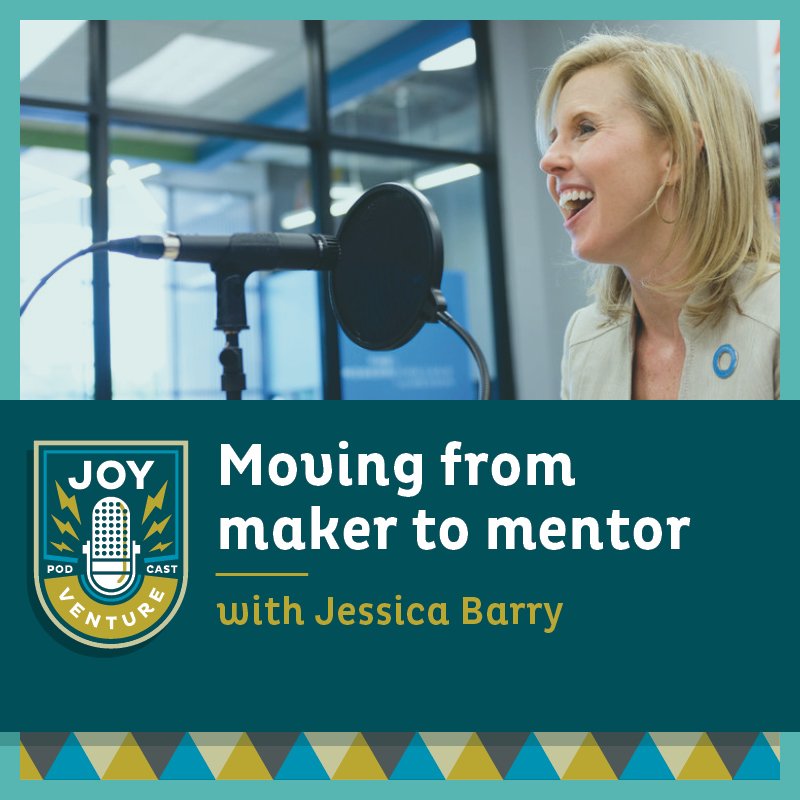
Jessica wanted to be a designer — a really good designer. And, like anyone with the talent and tenacity to fulfill that kind of dream, she went to art school, learned from great mentors, honed her craft, and eventually became that really good designer.But what if there's more than that... more than just being a good designer? What if the dream was merely a stepping stone to something else despite the design skills she worked so hard to cultivate? Jessica recounts her journey from attending the small upstart School of Advertising Art in Kettering, Ohio, to the unheard of act of buying — fully purchasing — the same school she once attended. The move from maker to mentor wasn't easy and it certainly wasn't her expected career path. Jessica talks about weighing her new opportunities and rethinking what a career can look like if you take it one step at a time.At the time of this recording, Jessica and her staff were preparing to officially open their doors to the new Modern College of Design — expanded and rebranded in time for the 2018-19 class. She talks about the risk and reward of these ambitious changes and the big, hairy, audacious goals she has for the school in the not-so-distant future.

So you think you're ready to embark on a joy venture, but there’s still something nagging at you. You’re not sure if you’ve truly discovered your joy. And before you dive in, you want to be certain that THIS. IS. IT. Spoiler alert: it doesn't work that way. In this episode, we get practical about discovering joy — and how you might figure out what your joy venture looks like through the process of discovery. If you're looking for five foolproof steps to discovering your joy or three hacks to launching the perfect Joy Venture — this isn't it. There isn’t a right way or a wrong way. But there is one definitive way — and it requires that you take action.

Like most kids growing up in middle America, Jeff loved to ride his bike. But unlike some, it’s a love affair that's never waned. When he was old enough to drive a car, he chose to keep riding bicycles instead. Jeff is a bike guy and gearhead through and through, and you could say that his lifelong passion borders on the obsessive — although that would be selling his story short. Jeff isn’t an entrepreneur the way they’re often idolized. Rather, he’s the once-plucky kid from the warehouse with an idea and an email, who was given a green light to go build something. That something was his dream job, and it would evolve into All-City — a bicycle brand under the QBP banner and named after the All-City Championship bike race Jeff founded in his bike-friendly city of Minneapolis. Jeff takes us on an unvarnished ride that holds nothing back about the steep valleys (getting laid off from his bike shop job, living in van and being flat broke) that sometimes need to be traveled before reaching the peak. His story is a street-smart testament to grit and determination, building community and fostering culture, and believing that dreams are meant to be fulfilled if you have the tenacity to power through the trials head-on.

In order to brave the woods successfully, you’d better walk into them with a plan, some goals and the right tools. It’s not an analogy on how to work with Brad and Krystal Woodard, owners of Brave the Woods, but rather a mindset of how they look to build a family-run business that’s going to fulfill and stretch them in all the right ways. Brad is the face and accomplished designer behind their action-oriented moniker while Krystal keeps all things non-design running and mapping out the journey, quick to push Brad out of his comfort zone for the sake of growing. This Boise, Idaho duo stopped in Columbus as part of a cross-country workshop tour and talked with us about what motivates them and how they are motivating others. From Kickstarting a children’s book to support victims of Typhoon Haiyan in The Philippines, to crowdsourcing Artists for Education with educational design for teachers to use in the classroom — doing good and building community are part and parcel of their craft. It’s those brave and unselfish acts that are key to their success and opening up opportunities that fuel their business, which also reveal new ways to do meaningful work and have a positive impact on others.

Kevin Ely knows beer. And now he knows how to build a brewery — quite literally by hand.Kevin's story is a pivot of a different nature. Previously the brewmaster at Uinta Brewing, a nationally recognized craft brewery in Salt Lake City, Kevin and his wife Jael Malenke decided to move back to her hometown in Fresno and purchase a farm.Fresno, Ohio that is. Armed with a degree in brewing science from UC Davis (yes, there is such a degree), Kevin is no hobbyist. Beer is indeed his career and he's a recurring judge at the annual Great American Beer Festival. Kevin shares with us his decision to start his own brewery in Ohio, the importance that family and community played in that decision, and why starting a farm brewery in a rural patch of rolling hills just made sense. Curly haired mangalitsa pigs ("wooly" pigs) that inspired the name actually roam his farmland and are visible from his taproom patio with cold beer in hand. It's both idyllic and intentional; it's also indicative of everything about this brewery. From the quirky name to the German-Bavarian style of beers he chooses to brew, down to his hand-made and hand-planed taproom — all of it is crafted with purpose and a story behind it.

Talk to anyone who frequents The Roosevelt Coffeeshop in Columbus, Ohio and they'll tell you what a great guy Kenny Sipes is and how they love the mission of his shop. His nonprofit coffeehouse has become a magnetic hub for people looking for community, good coffee and to do a little good in the process. The Roosevelt is fueled to give back by supporting three human-centered, justice-driven issues: providing clean water, fighting hunger and abolishing human trafficking. Kenny's story continues to gain coffee clout and the Roosevelt has become a community darling in the social enterprise space. That reality is a far cry from the 40-day stint he spent in rehab as a teenager, the years growing an urban record store, and his beloved service as a youth pastor to middle school kids. Even as he employed the hard work and discipline he first saw his father model, he also recognized his gift of being a connector of people. For Kenny, an ideal way to be faithful to what he was being called to do was open a communal space centered around coffee so he could pour into people and purpose in life-changing ways.

Emrich Office is perhaps best summarized as the artistic vision of Josh and Katie Emrich that is made full with their four kids and one rather spectacular basement studio in Indianapolis. It's also a long way from Colorado and the design mountains Josh was trying to scale just a handful of years ago. But as Josh explains, summits can look awfully good from the ground, but from the summit, base camp has a genuine appeal, too.Josh and Katie share their journey of slogging through a recession-era climate in attempt to go big, and keep the gears cranking. What they ultimately found was a greater reward in embracing the appeal of small — both with regard to their business size and those of family-owned businesses that comprise their client list. We learn that behind a great designer is... another great designer. And that's what makes this duo work so well in running a successful design business and designing a deliberate way of life for their not-so-small family.Insight, wisdom and lessons learned abound in this third installment of our "Indy or Bust" series featuring Indiana-based creatives.

When two longtime friends and artists decide to finally collaborate, naturally they land on... one-inch buttons?As quirky as it sounds, Drew Hill and Bob Ewing gravitated to this tiny canvas with much a bigger purpose in mind. What if they could get other artists to submit designs? What if by buying a series of rad buttons from Inch x Inch, patrons would also be supporting arts education (which is continuously in danger) and fuel a future generation of artists? What if their own idea about collaboration turned into an organization that was fully reliant on collaboration and committed partners?Drew and Bob talk about the importance of side projects, how theirs came about and ensuring it wasn't all about them, and how something as ridiculously inconsequential as one-inch buttons is actually making a tangible difference.

A move. A pivot. A layoff. And a whole lot of pursuit into the unknown.For many of us, this kind of change, disruption and lack of clarity can be unnerving. For Ben and Beth, they are choosing to see an alternative plan for how best to approach work and the art of living a purposeful life. Becoming familiar with their story, one could easily be reminded of the lyrics to Divine Intervention, the opening track to Matthew Sweet's classic 1991 album, Girlfriend.I don't know whereI'm gonna liveDon't know if I'll find a placeI'd have to think about it someAnd that I do not wish to faceI guess that I'm counting on hisDivine intervention.Hopeful, heartbreaking, funny, honest and real— these are perhaps the best ways in which to illustrate a conversation with two big-hearted creatives that are pursuing a path less traveled with no regrets.

Ian remembers being a typical, jovial college student having fun on vacation at the beach with his friends. He also recalls the moment when he dove into the ocean waves off of the Carolina coast and hit a sandbar — that very moment when everything changed.Ian learned shortly thereafter that he had suffered a devastating spinal cord injury. His diagnosis: paralyzed for life. At age 19, Ian’s life was forever altered. Ian shares his story that is equal parts heartbreaking, heartwarming and, truth be told, literally mind altering. Ian is the first person ever to undergo an elective brain surgery to implant a device that can read his brain waves in effort to help him regain movement. It is here — where life and science intersect, and joy and pain coexist — that Ian speaks with a steady cadence of hope and reason borne of a tragic accident. We return to the site of his first internship, Brainstorm Media, which was the type of place he could envision a career after college. Ian gives us the encouragement to be optimistic and inspired, especially when a new set of aspirations are ready to replace those best laid plans.

Anyone who knows Mark would likely agree that he’s one of the more upbeat and positive people you’ll ever meet — and as the founder and creative force behind sparkspace, he’s running one of the coolest places on the planet for creative inspiration, personal development and team building. And that’s all Mark wanted to do. Run a business just like that.Until he didn’t. Mark opens up about what happens when you lose that spark for the thing you love, how depression can still get its grips on the optimist, and how figuring out what you’re good at — and not simply passionate about — is the key to unleashing your ordinary super powers. This is a story of rediscovery and finding that spark again to do your best work — that stuff you were meant to do.We also discover some interesting back history on Mark as he reveals tidbits about his life as as Top 40 radio disc jockey in middle America, with a not-so-middle-America on-air persona.

Pulling up to Chris’s airplane hangar turned “workshop” — where he roasts beans for Backroom Coffee Roasters today — is a much different setting for his business compared to when he was fueling his coffee fix out of the back room of a bike shop, hence the company name.Chris is far from being stuck in the same gear. He’s the kind of guy who has multiple interests and a willingness to pursue them as far as they will go. He’s also a guy who avoids getting too comfortable with any venture, knowing that comfort has a way of stunting growth and breeding complacency. Chris charts his entrepreneurial path and insatiable desire for discovery, from motor sports to bicycles and from coffee to beer. And he believes in doing the kind of work you’re passionate about and can pour yourself into. It’s how he has turned his passions into paychecks and immensely enjoyable work.Chris’s story will encourage you to go for it — whatever your “it” might be.

Most people who think about purchasing an RV and traveling around the country plan to do so in retirement. For Nick Couts, taking that leap as a millennial was a calculated move to enjoy the world now and not wait for another 35 years. After taking a sabbatical from the acclaimed Spacejunk studio, getting encouragement from his wife, and honing a motion graphics skill set that doesn’t confine him to a cubicle farm, Nick is now two years deep into being a nomadic artist without a permanent address. He’s a man happily living out his plan in a van. Traveling the wide open west with his wife and a massive Saint Bernard, Nick talks about the challenges and rewards of working remotely, a radically different shift in lifestyle and the inspiration a creative gets when the landscape is constantly changing. Nick supplies us with his story of mapping his own road, as well as a handful of photographs he’s taken during his travels, with links to his Facebook and Instagram account to show more of his adventures.

Comments

Download from Google Play

Download from App Store
 United States